
【古殿唱片音樂故事】法國音樂界的鋼琴「上帝」:伊夫 奈特(Yves Nat,1890-1956),與他一個人完成的使命
古殿殿主
那個聲音,讓人忘記了他的存在
殿主第一次放下唱針,聽他的貝多芬。
那個聲音,非常隨性。非常自然。像是音樂自己在流——不像是一個人在演奏,而像是音符自己知道該去哪裡,然後就去了。有慢的地方,有快的地方,有輕的地方,有重的地方。每一個轉換,都像呼吸一樣自然發生,沒有被推動的感覺,沒有刻意,沒有表演。
聽著聽著,忘記了他的存在。
先停在這裡,說一件事。
一首貝多芬奏鳴曲的樂譜,密密麻麻地寫滿了音符、力度記號、速度指示、表情術語。但樂譜,只是一張地圖。
地圖標注了山的位置、河的走向——但地圖本身不是那座山,不是那條河,不是走在路上腳底的感受。作曲家在樂譜上寫下的,是他心中音樂的地圖,不是音樂本身。音樂本身,是那個活的、流動的、在時間裡展開的東西——它存在於演奏的當下,存在於聲音在空間裡消散的那一刻,然後就消失了。
把樂譜上每一個音符都正確演奏出來,不等於完成了音樂。那只是完成了地圖的閱讀。
真正的音樂,在音符與音符之間。在強與弱的比例關係裡。在一個句子結束、下一個句子開始之前那一口氣的長度裡。在那個你說不清楚但感受得到的東西裡——那個讓你覺得「對,就是這樣」的瞬間。
所以,一個演奏者真正要做的,遠比「把音符彈對」深得多。
第一步,是讀懂樂譜背後的作曲家。不只是音符,而是那個寫下音符的人——他為什麼在這裡寫了一個突強,為什麼讓聲音在那裡突然消失,為什麼這個句子要用這個節奏而不是另一個。每一個記號背後都有一個人,那個人有他的思維,有他的情感邏輯,有他想說的話。讀懂樂譜,是讀懂那個人。
第二步,是把那個人的意圖,轉化成音樂。不是轉化成「對的音符」,而是讓那個人想說的話,真正在空間裡活起來、被聽見。
第三步,才是最難的:把這一切,從大腦送進身體,然後讓身體忘記它知道這件事。
理解,是大腦的工作。但演奏,是身體的工作——從神經到肌肉,從手臂的重量到手指觸鍵的角度,從呼吸的節奏到整個身體在椅子上的重心。這些,不能在演奏的當下靠大腦指揮。大腦太慢了,音樂不等人。
所以那些理解,必須從大腦沿著神經一路往下,進入骨頭和肌肉,變成身體的直覺,變成不需要思考就會發生的反應。這不是幾個月能完成的事。它只能從日常生活裡,日復一日,年復一年地累積——讓身體的每一個部分都浸泡在那個理解裡,直到音樂成為身體的一部分。
還有最後一關,是情緒。
音樂裡有情緒。演奏者是有血有肉的人,聽到那些情緒,會被帶動。某個悲傷的旋律讓他多停留了一秒;某個激昂的段落讓他不自覺地加重了力度;某個脆弱的樂句讓速度慢過了界線。每一個偏差都是微小的,但微小的偏差會累積。音樂的形狀開始改變,作曲家精心設計的比例關係在演奏者的情緒裡慢慢失真。到了某個時刻,演奏者已經回不去了。
他以為自己在詮釋音樂,但他其實在用音樂詮釋自己的情緒。那已經不是作曲家的音樂了。
這個陷阱,幾乎所有的演奏者都掉進去過。掉得深的,演奏聽起來很「感人」——情緒是真實的,聽眾會被打動。但那種打動,是演奏者的情緒在感染聽眾,不是音樂本身在說話。音樂,在這個過程裡,其實消失了。
真正難的,是做完所有這些準備之後,走上舞台,然後讓自己消失。
不是消滅情緒,而是讓情緒也成為身體已經內化的東西——把那些起伏的尺度、那些情感的邊界,連同音符一起,在無數次的積累裡,一併送進了骨頭和肌肉裡。然後在演奏的當下,不需要決定任何事,不需要思考任何事——因為身體已經知道了。
手指落下去,音樂就出來了。
不是因為他在演奏,而是因為那個音樂,已經住在他身體裡了。
這個過程,沒有捷徑。它只能從日常生活裡一點一點地長出來——在每一天與音樂的相處裡,在每一次閱讀樂譜、每一次思考作曲家的意圖、每一次讓身體去感受那些聲音的積累裡,讓音樂慢慢地成為自己的一部分。
而這一切,不是為了討好觀眾,不是為了掌聲,不是為了評論家,不是為了任何外部的目的。
只有一個目標:
為了音樂。
奈特把這件事做到了。
真正熟悉樂譜的人,拿著譜坐下來聽他的演奏,會有一種幾乎是驚愕的感受——貝多芬寫下的每一個細節,每一個音符背後的意圖,他都在對的地方、以對的份量完成了。快的地方快,慢的地方慢,強的地方強,輕的地方輕。每一個轉折,每一個過場,每一個看似微不足道的銜接,都恰如其分。
但聽的時候,你感受不到任何努力的痕跡。
音符消失了,音樂出現了。演奏者消失了,作曲家說話了。
而那個作曲家,已經死了兩百年。
這才是「一切為了音樂」真正的意思——不是謙虛,而是一種需要窮盡一生才能抵達的境界。
法國音樂界用一個詞來形容他所達到的高度:「上帝」。
這個詞不是一個獎項,不是一個頭銜,而是一種感受——在聽完他的演奏之後,找不到其他詞可以用的感受。殿主聽完之後,完全理解了為什麼是這個詞。
那麼,這個人是誰?他是怎麼活出這種音樂的?
一個不情願的鋼琴家
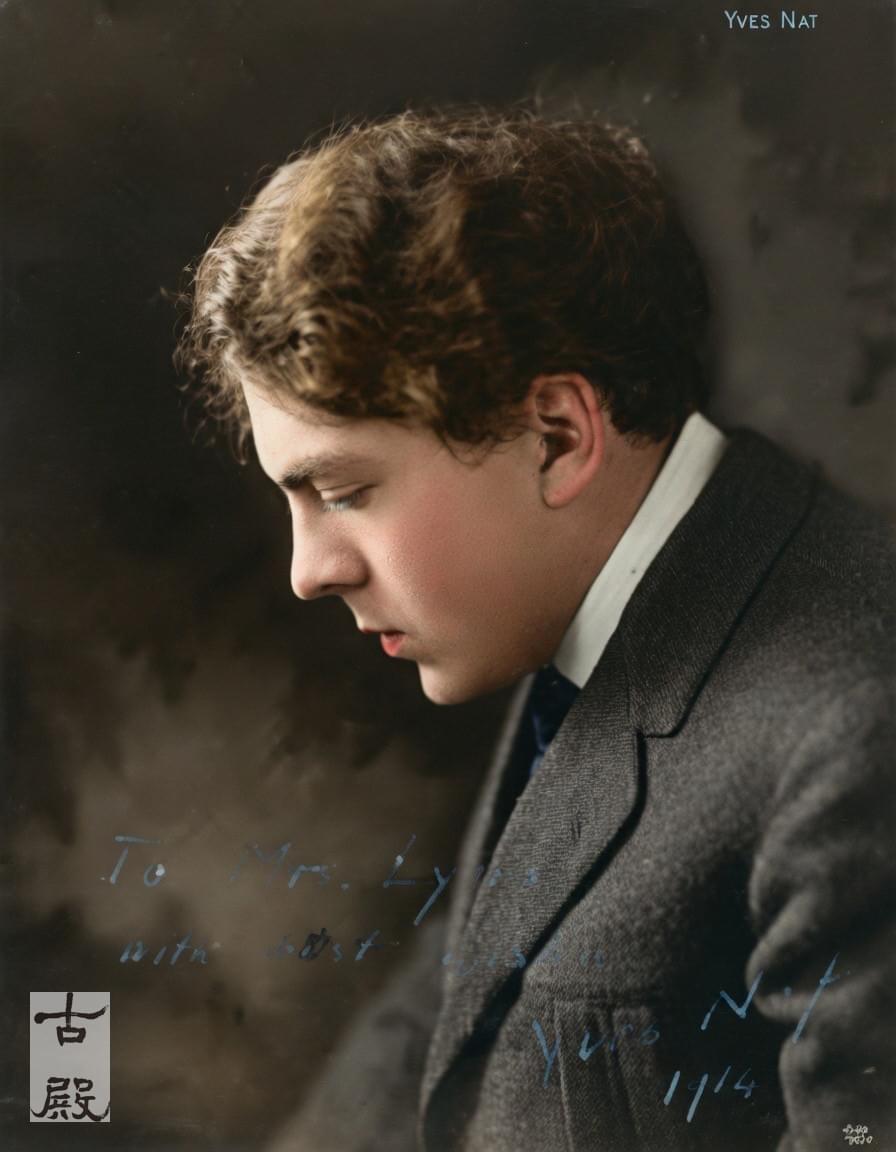
伊夫 奈特(Yves Nat,1890-1956),法國鋼琴家、作曲家、教育家。
但這些頭銜,都不是理解他最重要的入口。
奈特七歲開始每週日在貝濟耶(Béziers)大教堂的管風琴上即興演奏,十一歲已將巴哈《平均律》四十八首前奏曲與賦格全部背熟,十歲時指揮自己創作的管絃樂幻想曲。佛瑞(Gabriel Fauré,1845-1924)和聖桑(Camille Saint-Saëns,1835-1921)聽見了他,親自把他送進巴黎音樂院,進入路易・迪埃默(Louis Diémer,1843-1919)的班級——那個稍早也培養出柯爾托(Alfred Cortot,1877-1962)的班級。1907年,十七歲的奈特拿下第一獎。
從外部看,他的未來是清晰的:一個法國鋼琴天才,偉大的演奏生涯正在前方等著他。
但奈特自己,從來不想成為一個鋼琴家。
他真正的渴望,是作曲。鋼琴對他而言,是一個他被迫接受的媒介,而不是一個他想在舞台上展示的工具。法國 Universalis 百科對他有一個精準的描述:他是一個「不情願的鋼琴家」(pianiste malgré lui)——有著鋼琴家的天賦,卻有著作曲家的靈魂,一生在兩個身份之間拉扯。
這個拉扯,後來成了他最深的藝術資產。因為他從不把鋼琴當作目的,他始終把音樂當作目的。鋼琴只是通往音樂的路,不是終點。這個態度,決定了他的整個演奏哲學——也決定了為什麼他能做到那件大多數人做不到的事:讓自己消失,讓音樂說話。
逆流而行:一個法國人對德奧音樂的執著
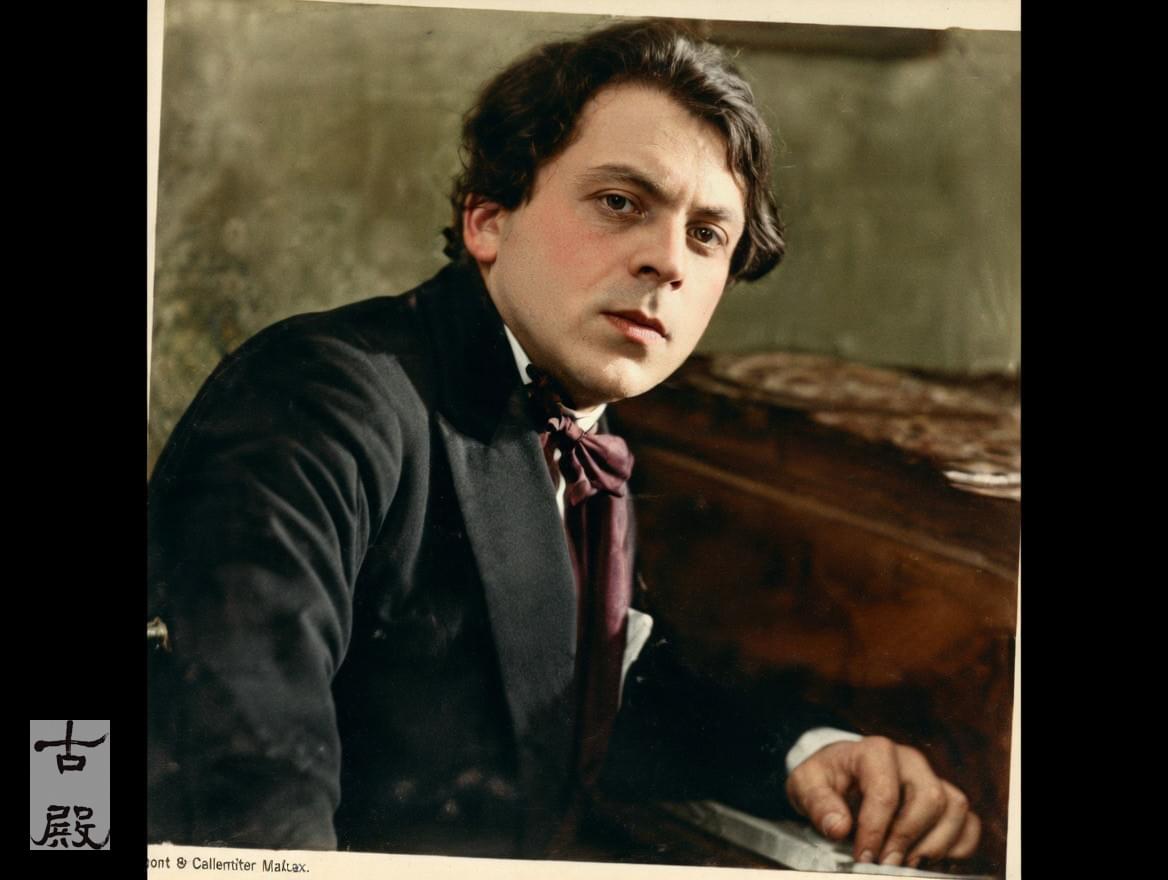
1907年之後,奈特開始了演奏生涯。與提博(Jacques Thibaud,1880-1953)、安奈斯可(George Enescu,1881-1955)同台巡演,與意沙易(Eugène Ysaÿe,1858-1931)搭檔演出,1911年首次赴美巡迴。
但在這些年裡,他的節目單裡始終固執地出現一個名字:貝多芬。
在那個年代的法國,這個固執有著特殊的重量。兩次大戰之間,法國音樂圈籠罩在民族主義的氛圍裡。德奧音樂帶著政治色彩,法國的音樂家幾乎集體轉向德布西、拉威爾——那是法國的驕傲,法國的現代性。
同出自迪埃默門下的柯爾托,走的就是這條路——成為法國鋼琴的象徵,蕭邦與德布西的守護者。
奈特走了另一條路。他愛的是貝多芬、舒曼、布拉姆斯、舒伯特。他把這些名字一遍又一遍排進節目單,面對整個時代的文化壓力,從不妥協。
這不是政治立場,而是一個最簡單的誠實:他愛什麼音樂,他就演奏什麼音樂。
那個誠實的代價,是孤獨。奈特從不在乎。他只說過一句話,關於他自己對音樂的理解:
「Tout pour la musique; rien pour le piano。一切為了音樂,鋼琴什麼都不是。」
在教學上,他同樣堅持這個信念,換了一種說法:「我不是在教鋼琴,而是在教音樂。」他對學生說:「把自己完全遺忘,讓作品重新記起自己。」
法國大文豪普魯斯特(Marcel Proust,1871-1922)聽過他演奏之後說:「他從視線中消失,成為一扇直視傑作本身的窗。」這句話,是對他整個演奏哲學最精準的外部描述。而那個描述,也正是殿主放下唱針之後,在空間裡感受到的那件事。
十六年的沉默,是更深的準備
1934年,奈特接受了巴黎音樂院的鋼琴教授職位。此後逐漸退出演奏舞台,1937年近乎完全隱退。
這個退隱,不是因為失敗,而是因為選擇。
他選擇把時間給兩件更重要的事:把他對音樂的理解透過學生傳遞下去,以及為他真正想完成的作曲計畫爭取空間。
在這十六年裡,他的學生包括了約格・德慕斯(Jörg Demus,1928-2019)、讓-貝爾納・波米耶(Jean-Bernard Pommier,1944-)、皮耶・桑坎(Pierre Sancan,1916-2008)、瑪麗-克萊兒・阿蘭(Marie-Claire Alain,1926-2013),以及雷蒙・圖阿(Raymond Trouard,1916-2008)——幾乎每一個名字,後來都成為歐洲音樂史上重要的人物。奈特傳給他們的,不是技術,而是那句話的活法:一切為了音樂。圖阿後來在蕭邦與貝多芬的詮釋裡,那種不張揚、不強加於人的透明感,正是奈特美學最直接的聲音延續。
同時,他傾盡心力完成了他最重要的管絃樂作品《地獄》(L'Enfer,1942年)——一部大型合唱與管絃樂作品,是他音樂生命裡最深的投入。它從未被錄製,沒有留下任何聲音。
一個把音樂當作生命的人,最深的作品,永遠消失了。
這個遺憾,讓後來的貝多芬錄音,有了一種更沉的份量——那不只是一個錄音計畫,而是一個人在知道時間有限的情況下,決定把自己所知道的關於音樂的一切,留下來。
六十一歲,一個人,三十二首
1951年,奈特悄悄回來了。
不是在舞台上,而是在錄音室裡。
Les Discophiles Français(法國愛樂唱片協會)——那個年代法國最重要的獨立古典音樂廠牌,專為缺乏國際光環但藝術深度無庸置疑的音樂家留下文獻——邀請他錄製貝多芬鋼琴奏鳴曲全集。奈特說,可以。但他要求:用兩週時間重新整理技巧,然後正式開始。
兩年後,1953年,他才站回舞台上。香榭麗舍劇院的音樂會座無虛席。那些在1920年代聽過他的老聽眾,已經老了,但他們來了。六十三歲的奈特演奏了貝多芬、舒曼,以及蕭邦的《葬禮》奏鳴曲。聽過的人說:他比從前更深了。
這個順序,本身就很奈特——先回到錄音室,先回到音樂,再回到觀眾面前。
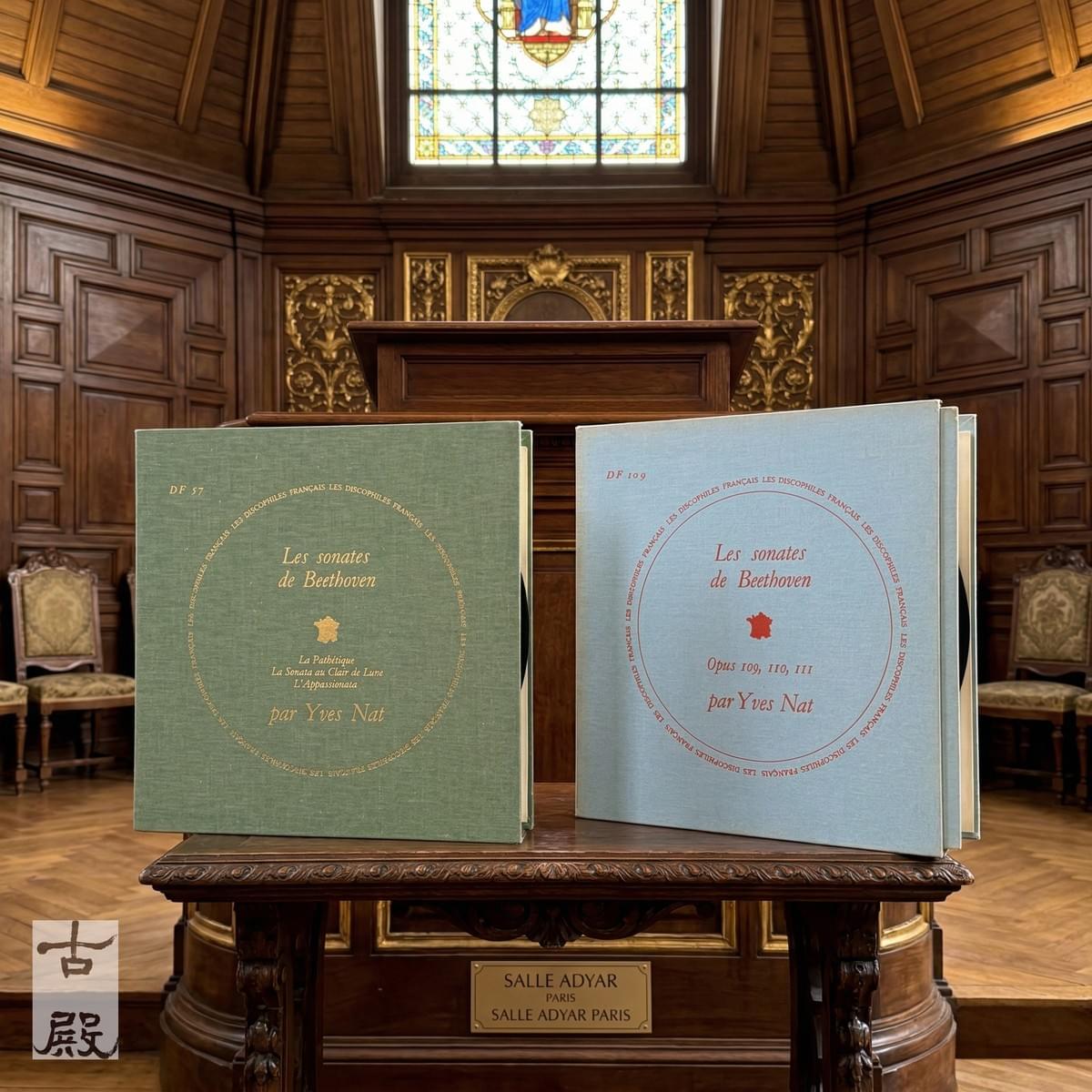
從1951年到1955年,他在巴黎愛迪爾廳(Salle Adyar)一首一首錄製。錄音師是夏蘭(André Charlin,1903-1983)——法國錄音史上最重要的聲音技術先驅,生涯獲得118項法國唱片大獎(Grand Prix du Disque)。鋼琴是一台由莉莉克勞絲(Lili Kraus,1903-1986) 親自為 Discophiles Français 挑選的 Hamburg Steinway。
三十二首,一首一首。全部完成。
奈特,就此成為法國歷史上第一位完整錄製貝多芬三十二首鋼琴奏鳴曲的人。
在他之前,從未有任何法國鋼琴家做過這件事。不是因為技術不夠,而是因為沒有人覺得,這是一個法國鋼琴家「應該」完成的事。
奈特不在乎「應該」。他只在乎:這件事是不是應該被做,以及他有沒有能力做。
那個高度,為何後來沒有人再到達?
1956年8月31日,奈特在巴黎去世,六十五歲。
他沒有看見這套錄音被後世重新發現。沒有看見評論家把他的貝多芬與許納貝爾(Arthur Schnabel,1882-1951)並列討論。沒有看見後來的收藏家為了一張 Les Discophiles Français 的原版黑膠所願意付出的代價。
在德國音樂界,流傳著一個場景:某次奈特演奏之後,肯普夫(Wilhelm Kempff,1895-1991)附耳對季雪金(Walter Gieseking,1895-1956)說——這兩位,是20世紀德奧鋼琴傳統最重要的代表——「他給了我們一堂課。」
一個法國人,給了兩個德國鋼琴大師一堂課。課的內容,不是技術,而是那種透明度。
那種透明度,不是練出來的,而是活出來的。是一個人把音樂當作生活方式,用整個生命去浸泡、去積累、去消化,然後在最後幾年,把那個生命的全部重量,凝縮進三十二首奏鳴曲的溝槽裡。
今天的演奏文化需要個人品牌,需要辨識度,需要被看見的表演性格。整個生態,與奈特的哲學,是根本對立的。更重要的是——那種透明度,需要的不是時間,而是一種完全不同的生命態度:不是為了任何外部的目的而演奏,只是為了音樂本身。
這種態度,在今天幾乎不可能被選擇。不是因為有人禁止,而是因為整個世界的運作方式,讓這個選擇變得極度困難。
這就是為什麼,那個高度,後來沒有人再到達。
黑膠上,還留著那個生命的印記
殿主手上有這套 Les Discophiles Français 的原版奈特貝多芬——DF 57(悲愴・月光・熱情)與 DF 109(最後三首,op.109 / 110 / 111)。白底藍環標籤,André Charlin 錄音,法國原版壓片。
每次放下唱針,那種透明度就在空間裡重新出現。
不是因為音質特別好,而是因為那道溝槽裡保存的,是一個把音樂當作生命的人,在生命最後幾年所凝縮下來的聲音印記。那個「人消失了、只剩下音樂」的感受,在黑膠上還活著。
在那個法國與德奧音樂長達一個世紀的相遇史裡——從拉穆盧的「貝多芬協會」、卡培弦樂四重奏,到舒李希特在巴黎、克路易坦在柏林——那些都是集體的故事:樂團、四重奏、指揮與樂手之間的相遇。
奈特是一個人坐在鋼琴前。沒有集體,沒有對話,只有他,和貝多芬。
他在那個孤獨裡,把一個法國人對音樂的理解,推到了一個沒有人再去過的地方。
聽完他的貝多芬,殿主一直在想一件事。
奈特說:「一切為了音樂,鋼琴什麼都不是。」
如果把「鋼琴」換成任何一個詞——名聲、地位、被看見、被認可——這句話依然成立嗎?
一切為了那件真正重要的事,其他什麼都不是。
******
[Old Palace Music Stories] The "God" of the French Piano World: Yves Nat (1890-1956) and His One-Man Mission
That Sound… It Makes You Forget He Exists
The first time I lowered the needle to hear his Beethoven, something strange happened.
The sound was incredibly spontaneous. Natural. It felt as if the music was flowing of its own accord—less like a human was "performing" and more like the notes simply knew where they needed to go, and so they went. There were slow parts, fast parts, light moments, and heavy ones. But every transition felt as natural as breathing. There was no sense of being pushed, no artifice, no "performance."
As I listened, I forgot he was even there.
Let’s pause for a moment to talk about something. A score for a Beethoven sonata is a dense thicket of notes, dynamic markings, tempo indications, and expression terms. But a score is merely a map.
A map marks the location of the mountain and the path of the river—but the map itself is not the mountain, it is not the river, and it is certainly not the sensation of the earth beneath your feet as you walk. What a composer writes on the score is the map of the music in his heart, not the music itself. True music is that living, breathing thing that unfolds in time—it exists in the moment of performance, in the split second before the sound dissipates into the space, and then it’s gone.
Playing every note on the page correctly doesn't mean you’ve "completed" the music. It just means you’ve finished reading the map.
Real music lives in the space between the notes. It lives in the proportional relationship between loud and soft. It lives in the length of the breath taken after one sentence ends and before the next begins. It lives in that intangible thing you can’t quite name but can certainly feel—that "Yes, that’s it" moment.
Therefore, what a performer truly needs to do is far deeper than just "hitting the right notes."
The first step is to understand the composer behind the score. Not just the notes, but the human who wrote them—why did he write a sforzando here? Why did he let the sound vanish there? Every mark represents a person with their own logic, emotions, and message. To read the score is to read the soul.
The second step is to transform that intent into music. Not into "correct notes," but into a living message that breathes in the room.
The third step is the hardest: Sending all of this from the brain into the body, and then letting the body forget that it knows.
Understanding is the brain's job. But playing is the body’s business—from nerves to muscles, from the weight of the arm to the angle of the fingertip, from the rhythm of breath to the center of gravity on the bench. You cannot "command" these things with your brain in the heat of a performance. The brain is too slow; music waits for no one.
So, that understanding must travel from the brain, down the nerves, into the bones and muscles, until it becomes a physical intuition—a reaction that happens without thought. This isn't something that happens in a few months. It accumulates through daily life, year after year, until the music becomes a part of the body.
The Final Barrier: The Trap of Emotion
Music is emotional. Performers are flesh and blood, and when they hear those emotions, they get carried away. A sad melody might make them linger a second too long; a passionate passage might make them strike too hard; a fragile phrase might slow the tempo past the limit.
Each deviation is tiny, but they add up. The shape of the music begins to warp. The proportions carefully designed by the composer begin to distort through the performer’s own feelings. Eventually, the performer can’t find their way back.
They think they are interpreting the music, but they are actually using the music to interpret their own emotions. That is no longer the composer’s music.
Almost every performer has fallen into this trap. Those who fall deep sound very "moving"—their emotions are real, and the audience is touched. But that "touch" is just the performer’s emotion infecting the listener. The music itself has actually disappeared.
The truly difficult thing is to do all that preparation, walk onto the stage, and then make yourself disappear.
It’s not about killing emotion. It’s about letting emotion become something the body has already internalized—letting those peaks and valleys, those emotional boundaries, sink into your bones alongside the notes. Then, in the moment of performance, you don’t have to decide anything or think about anything.
Because the body already knows. The fingers drop, and the music emerges. Not because he is playing it, but because the music is already living inside him.
There are no shortcuts here. It can only grow, bit by bit, out of a life lived with music—every day spent reading scores, thinking about the composer’s intent, and letting the body absorb those sounds. And none of this is for the audience, the applause, or the critics.
There is only one goal: For the music.
Yves Nat achieved this.
For those who truly know the scores, listening to him is an almost startling experience. Every detail Beethoven wrote, every intention behind every note, is there—in the right place, with the right weight. The fast is fast, the slow is slow, the loud is loud, and the soft is soft. Every transition, every bridge, every seemingly insignificant connection is exactly as it should be.
Yet, as you listen, you feel no trace of effort.
The notes disappear; the music appears. The performer disappears; the composer speaks. Even though that composer has been dead for two hundred years.
This is the true meaning of "Everything for the music"—not a hollow humility, but a state of being that takes a lifetime to reach. The French music world used one word to describe the height he reached: "God."
It wasn't an award or a title. It was a feeling—the only feeling left after hearing him play. After listening, I completely understood why they chose that word.
So, who was this man? How did he live out this kind of music?
The Reluctant Pianist
Yves Nat (189
0-1956) was a French pianist, composer, and educator. But none of these titles are the most important doorway to understanding him.
Nat began improvising on the organ at Béziers Cathedral every Sunday at the age of seven. By eleven, he had memorized all forty-eight Preludes and Fugues of Bach’s The Well-Tempered Clavier. At ten, he conducted an orchestral fantasy he had composed himself. Gabriel Fauré and Camille Saint-Saëns heard him and personally sent him to the Paris Conservatoire, into the class of Louis Diémer—the same class that had recently produced Alfred Cortot. In 1907, at seventeen, Nat won the First Prize.
From the outside, his future was clear: a French piano prodigy with a legendary career ahead of him.
But Nat himself never wanted to be a pianist.
His true longing was to compose. To him, the piano was a medium he was forced to accept, not a tool he wanted to flaunt on stage. The Encyclopædia Universalis describes him perfectly: he was a "pianiste malgré lui" (a pianist in spite of himself)—possessing the talent of a pianist but the soul of a composer, torn between two identities his entire life.
This internal struggle became his greatest artistic asset. Because he never saw the piano as the goal, he always saw the music as the goal. The piano was just the road to the music, not the destination. This attitude defined his entire philosophy of performance—and why he could do what most cannot: disappear and let the music speak.
Moving Against the Tide: A Frenchman’s Obsession with Austro-German Music
After 1907, Nat began his performing career, touring with Jacques Thibaud and George Enescu, partnering with Eugène Ysaÿe, and making his US debut in 1911.
But during these years, one name stubbornly remained on his programs: Beethoven.
In the France of that era, this stubbornness carried a heavy weight. Between the two World Wars, the French music scene was shrouded in nationalism. Austro-German music was politically charged. Most French musicians turned almost collectively toward Debussy and Ravel—they were the pride of France, the symbols of modernity.
Alfred Cortot, who came from the same teacher, took that path—becoming the symbol of the French piano, the guardian of Chopin and Debussy.
Nat took the other path. He loved Beethoven, Schumann, Brahms, and Schubert. He put these names on his programs over and over again, never compromising in the face of cultural pressure. It wasn't a political stance; it was simple honesty. He played the music he loved.
The price of that honesty was solitude. Nat didn't care. He said only one thing regarding his understanding of music:
"Tout pour la musique; rien pour le piano." (Everything for the music; nothing for the piano.)
In his teaching, he maintained this conviction. He told his students, "I am not teaching piano; I am teaching music." He would say: "Forget yourself entirely, so that the work may remember itself."
The great writer Marcel Proust, after hearing him play, said: "He disappears from sight and becomes a window looking directly into the masterpiece itself." This is the most accurate external description of his philosophy—and exactly what I felt when I lowered the needle.
Sixteen Years of Silence: A Deeper Preparation
In 1934, Nat accepted a professorship at the Paris Conservatoire. He gradually withdrew from the stage, and by 1937, he was almost completely retired.
This retreat wasn't due to failure; it was a choice.
He chose to give his time to two more important things: passing his understanding of music to his students and making space for the compositions he truly wanted to finish.
During these sixteen years, his students included Jörg Demus, Jean-Bernard Pommier, Pierre Sancan, Marie-Claire Alain, and Raymond Trouard—nearly every name became a pillar of European music history. What Nat passed to them wasn't technique, but a way of living: "Everything for the music." When you hear Trouard play Chopin or Beethoven today, that transparent quality—unpretentious and never forced—is the direct sonic legacy of Nat’s aesthetics.
Meanwhile, he poured his heart into his most important orchestral work, L'Enfer (The Inferno, 1942)—a massive work for chorus and orchestra. It was his deepest investment. Yet, it was never recorded. It left no sound behind.
For a man who treated music as life itself, his most profound work has vanished.
This regret gives his later Beethoven recordings a heavier weight. It wasn't just a recording project; it was a man who knew his time was limited, deciding to leave behind everything he knew about music.
61 Years Old, One Man, 32 Sonatas
In 1951, Nat quietly returned. Not to the stage, but to the recording studio.
Les Discophiles Français—the most important independent French classical label of that era, dedicated to documenting artists with undeniable depth but perhaps less international "glamour"—invited him to record the complete Beethoven Piano Sonatas. Nat agreed, but with one condition: he needed two weeks to reorganize his technique before starting.
He didn't return to the stage until 1953. The Théâtre des Champs-Élysées was packed. The listeners from the 1920s had grown old, but they came. A 63-year-old Nat played Beethoven, Schumann, and Chopin’s "Funeral March" Sonata. Those who were there said he was deeper than ever before.
This sequence is very "Nat"—returning to the studio first, to the music first, and then to the audience.
From 1951 to 1955, he recorded them one by one at Salle Adyar in Paris. The engineer was André Charlin, the pioneer of French recording technology who won 118 Grand Prix du Disque. The piano was a Hamburg Steinway personally selected for the label by Lili Kraus.
Thirty-two sonatas. All completed.
With this, Yves Nat became the first person in French history to record the complete cycle of Beethoven’s 32 Piano Sonatas. Before him, no French pianist had ever done it. Not because they lacked the technique, but because no one felt it was something a French pianist "should" do.
Nat didn't care about "should." He only cared if it was a task worth doing, and if he had the strength to do it.
Why has no one reached that height since?
On August 31, 1956, Nat died in Paris at sixty-five.
He never lived to see these recordings rediscovered by later generations. He didn't see critics place his Beethoven alongside that of Arthur Schnabel. He didn't see the prices collectors would eventually pay for an original Les Discophiles Français vinyl.
In the German music world, a story is told: After hearing Nat play, Wilhelm Kempff leaned over to Walter Gieseking—the two most important representatives of the 20th-century Austro-German tradition—and whispered: "He has given us a lesson."
A Frenchman gave two German masters a lesson. And the subject of that lesson wasn't technique—it was transparency.
That transparency isn't something you practice; it’s something you live. It comes from a person who treats music as a way of life, using their entire existence to soak in it, accumulate it, and digest it, until finally, in their last years, they condense the full weight of that life into the grooves of thirty-two sonatas.
Today’s performance culture demands personal branding, "recognition," and a performative personality that can be seen. The entire ecosystem is fundamentally opposed to Nat’s philosophy. More importantly, that kind of transparency requires not just time, but a completely different attitude toward life: playing not for any external purpose, but only for the music itself.
This choice is almost impossible to make today. Not because anyone forbids it, but because the way the world operates makes this path incredibly difficult to choose.
This is why no one has reached that height since.
The Imprint of a Life on Vinyl
I have the original Les Discophiles Français set of Nat’s Beethoven—DF 57 (Pathétique, Moonlight, Appassionata) and DF 109 (the last three, Op. 109/110/111). White labels with blue rings, André Charlin engineering, original French pressings.
Every time I lower the needle, that transparency reappears in the room.
It’s not just because the audio quality is "good"; it’s because what is preserved in those grooves is the sonic imprint of a man who treated music as life. That feeling—that the person has disappeared and only the music remains—is still alive on the vinyl.
In the century-long history of French and Austro-German musical encounters—from the "Beethoven Society," to the Capet Quartet, to Schuricht in Paris or Cluytens in Berlin—those were collective stories: orchestras, quartets, the meeting of conductors and players.
Nat sat at the piano alone. No collective, no dialogue. Just him and Beethoven. In that solitude, he pushed a Frenchman’s understanding of music to a place where no one else has gone again.
After listening to his Beethoven, I often think about one thing. Nat said: "Everything for the music; the piano is nothing."
If we replaced the word "piano" with anything else—fame, status, being seen, being recognized—would that sentence still hold true?
Everything for the one thing that truly matters; everything else is nothing.