
【古殿唱片音樂故事】她的「奮不顧身」,比你的「完美」更有力量——卡拉絲1953–1955,世紀美聲的巔峰時刻
古殿殿主
一個問題,一個令人不安的答案
如果有人告訴你:一位歌手聲音已在衰退,評論家卻說她「比以往更令人興奮」——你會怎麼理解這件事?
這不是誇張修辭。這是1964年《留聲機》雜誌評論瑪麗亞·卡拉絲(Maria Callas,1923-1977)的實際文字。
那一年,卡拉絲四十一歲。她的歌劇生涯在實質上已接近終點。她的聲音出現了所有人都聽得出來的問題——高音不穩,音域的接縫處偶爾會出現裂縫。
但評論家說:比以往更令人興奮。
這個弔詭,就是卡拉絲現象的核心。也是為什麼,在她去世近五十年後,她的錄音依然讓人頭皮發麻的原因。
什麼叫做「完全不計代價」?
卡拉絲曾說過一句話,幾乎是宣言:「為了傳達戲劇效果,我必須發出那些並不美麗的聲音。我不介意它們是醜的,只要它們是真實的。」
注意這句話裡的邏輯。她不是說「我的高音技術有時候會出問題,我只能接受」。她是說:「為了角色的真實,我選擇讓聲音承擔風險。」
這個選擇,在整個歌劇世界裡,幾乎找不到第二個人做過同樣的事。
一般的歌劇競爭是在同一個座標系裡比較:誰的花腔更清晰,誰的高音更穩,誰的音色更純。這些比較是有標準的,可以測量的,可以通過訓練不斷精進的。
卡拉絲的投入方式,把這個座標系打破了。
當她完全消失在角色裡,觀眾就不再在聽「一個女高音演唱這個角色」,而是在「目睹這個人物存在」。導演維斯康蒂描述那個狀態:她穿著最普通的毛衣和裙子,「但只要她一開口,我就看見傳說中的猩紅鬃毛和魔女的長裙在我眼前成形」。
她的搭檔說:「你應該只是描繪情感,而不是真的陷入其中。但瑪麗亞永遠都成為了那個角色。」
這就是問題所在——也是卡拉絲現象最難解釋的地方。她在台上不是在演一個人哭,她就是那個在哭的人。這不是技術問題,這是一種存在方式。
「燃料」只有這一生這一份
樂評家阿拉斯泰爾·麥考利(Alastair Macaulay)說過一句精準的話:卡拉絲「犧牲了舒適感、美麗,以及她聲音本身的根本資本,以服務音樂之神壇。」
「聲音的根本資本」。這個詞值得停下來想一想。
一個人的聲音,是他這輩子最不可再生的東西。每一次全力以赴,都是在消耗一份只有這一生這一份的資本。卡拉絲知道這一點。她的聲音構造本身就充滿風險——三個音域之間的接縫,是隨時可能崩潰的地方。她每次上台,都在走鋼索。
而她的選擇,是明知如此,仍然走。
結果,她的歌劇生涯在四十歲就實質結束了。那些守護聲音的女高音——蘇珊蘭、荷恩——可以唱到六十歲以後。卡拉絲把一生的燃料,在二十年內燒完了。
這就是那個奇特評論的答案:1964年,聲音已在衰退的卡拉絲,讓評論家說「比以往更令人興奮」——因為她投入的深度,超過了聲音損耗帶來的代價,甚至反而超越了她聲音最完好的時期。燃料雖然少了,燃燒卻更徹底了。
1953–1955:巔峰時代的物理印記
在「古殿」有四張唱片,都來自卡拉絲巔峰的核心年份。
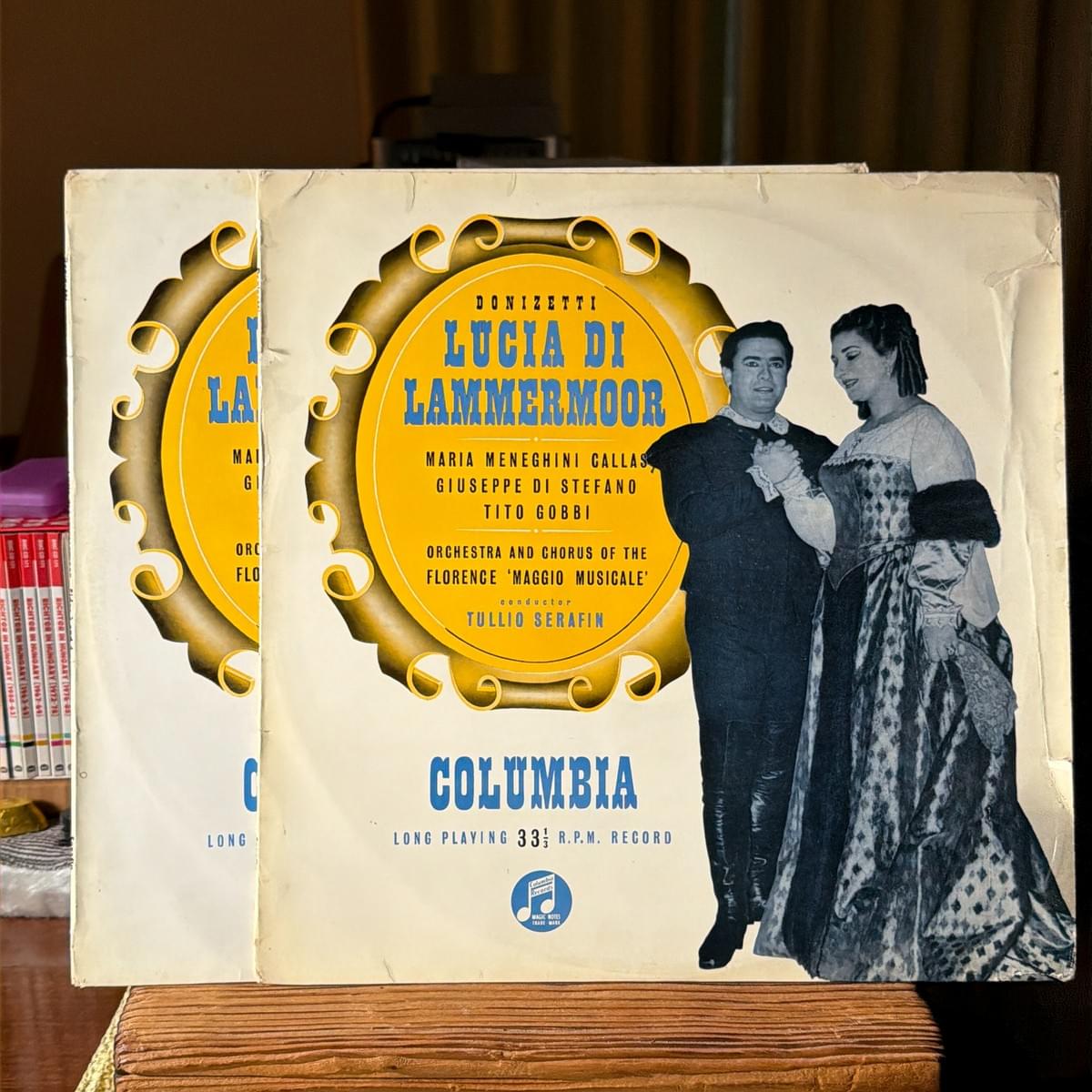
第一張是 Columbia 33CX 1131/1132,《拉美摩爾的露琪亞》,1953年1月錄製,藍金標英國原版。這是卡拉絲為 EMI 錄製的第一部完整歌劇,與迪·史蒂法諾(Di Stéfano,1926-2014)、戈比(Tito Gobbi,1913-1984)、賽拉芬(TuIlio Serafin,1878-1968)的第一次共同錄音。
在這張唱片之前,《露琪亞》是一部活躍的歌劇。從19世紀到20世紀前半葉,嘉麗古奇(Galli-Curci,1882-1963)、莉莉彭絲(Lily Pons,1898-1976)、柏麗(Lucrezia Bori,1887-1960)都在舞台上演唱這個角色。歌劇院從來沒有遺忘它。
但它活在一個特定框架裡:那是花腔女高音的展示台。瘋狂場景是舞台上的技術煙火,觀眾等待的是高音的穩定、花腔音階的靈巧、那個漂亮的降 E。露琪亞這個人物本身——她的恐懼、她的崩潰邏輯、她為什麼會走到那個終點——不是重點。沒有人問這個問題。
卡拉絲從第一個音符起,就在問這個問題。
她呈現出一個高度緊張、神經質的人物,但以無可挑剔的連貫唱法演唱,所有花腔裝飾都融入聲樂線條,而非浮在上面炫耀。瘋狂場景不再只是技術展示,而是一個心理崩潰的全過程——你能聽見那個人是怎麼一步一步走到那裡的。《留聲機》的評論家在聽完之後寫道,那個終結的高音之後,他「不得不到花園裡散步降溫」。
卡拉絲改變的不是這部歌劇的地位。她改變的是人們理解這部歌劇能夠承載什麼的方式。在她之後,露琪亞不再只是一個「高音漂亮就夠了」的角色——她是一個必須被理解的人。
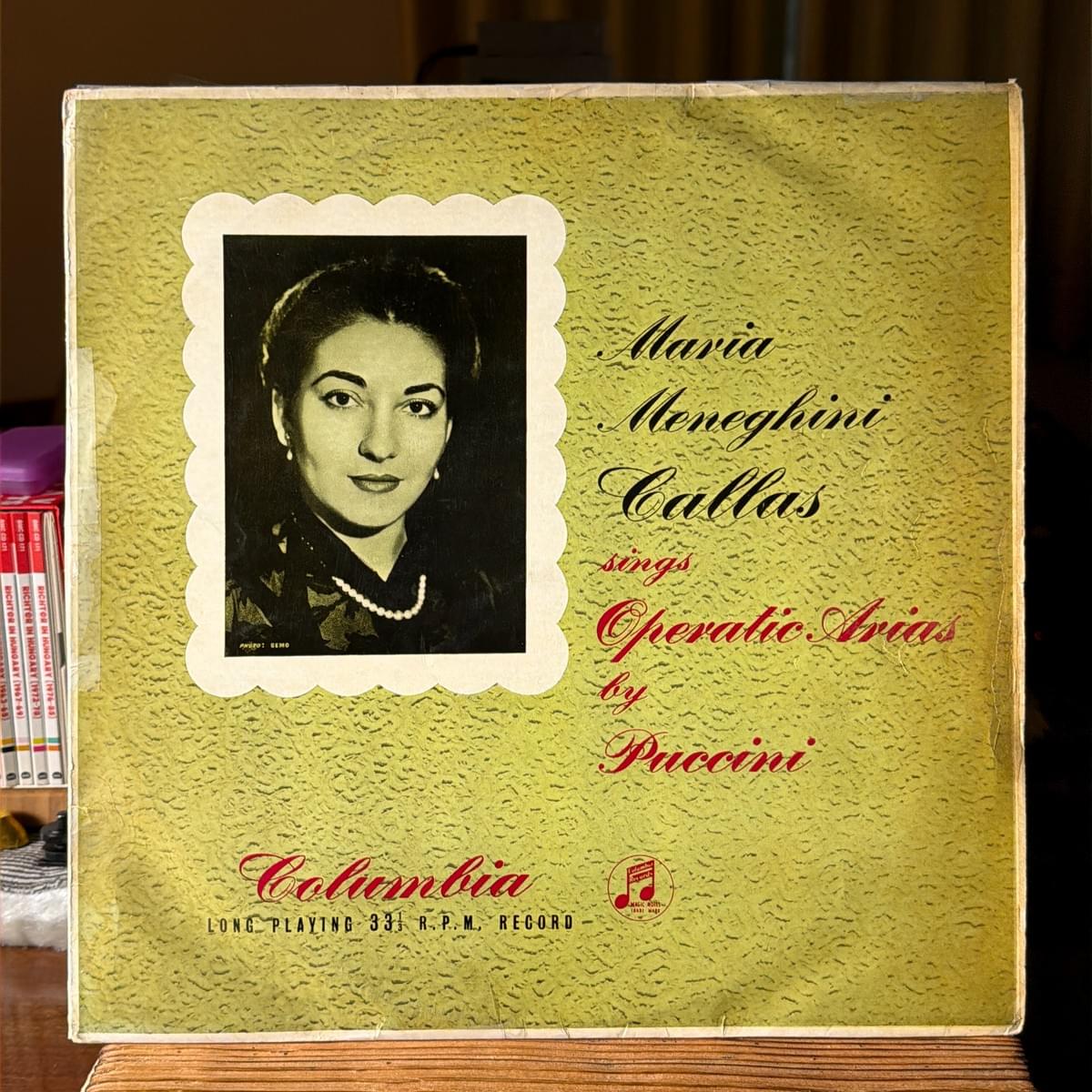
第二張是 Columbia 33CX 1204,《普契尼歌劇詠嘆調》,1954年9月錄製,藍金標英國原版,歷史首版。
這張唱片有一個幾乎不可思議的事實:卡拉絲在錄製這些詠嘆調時,大多數角色她從未在舞台上演出過。沒有蝴蝶夫人,沒有米米,沒有圖蘭朵的舞台記憶。
但她做到了什麼?《留聲機》首次評論時說:「她為每一首詠嘆調帶來了個人藝術的印記、某種人物刻畫的質感,以及對詠嘆調戲劇性與音樂塑造的關注,這與我們今日通常聽到的普契尼演唱截然不同。」
這張唱片後來成為卡拉絲有史以來最暢銷的個人獨唱唱片。1954年是她嗓音最特殊的一個時間點——剛完成體重減輕後的第一批重要錄音,聲音既保有戲劇性女高音的厚度,又同時擁有輕盈的花腔靈活性。這個窗口只存在很短的時間。這張唱片,正好站在窗口的正中央。
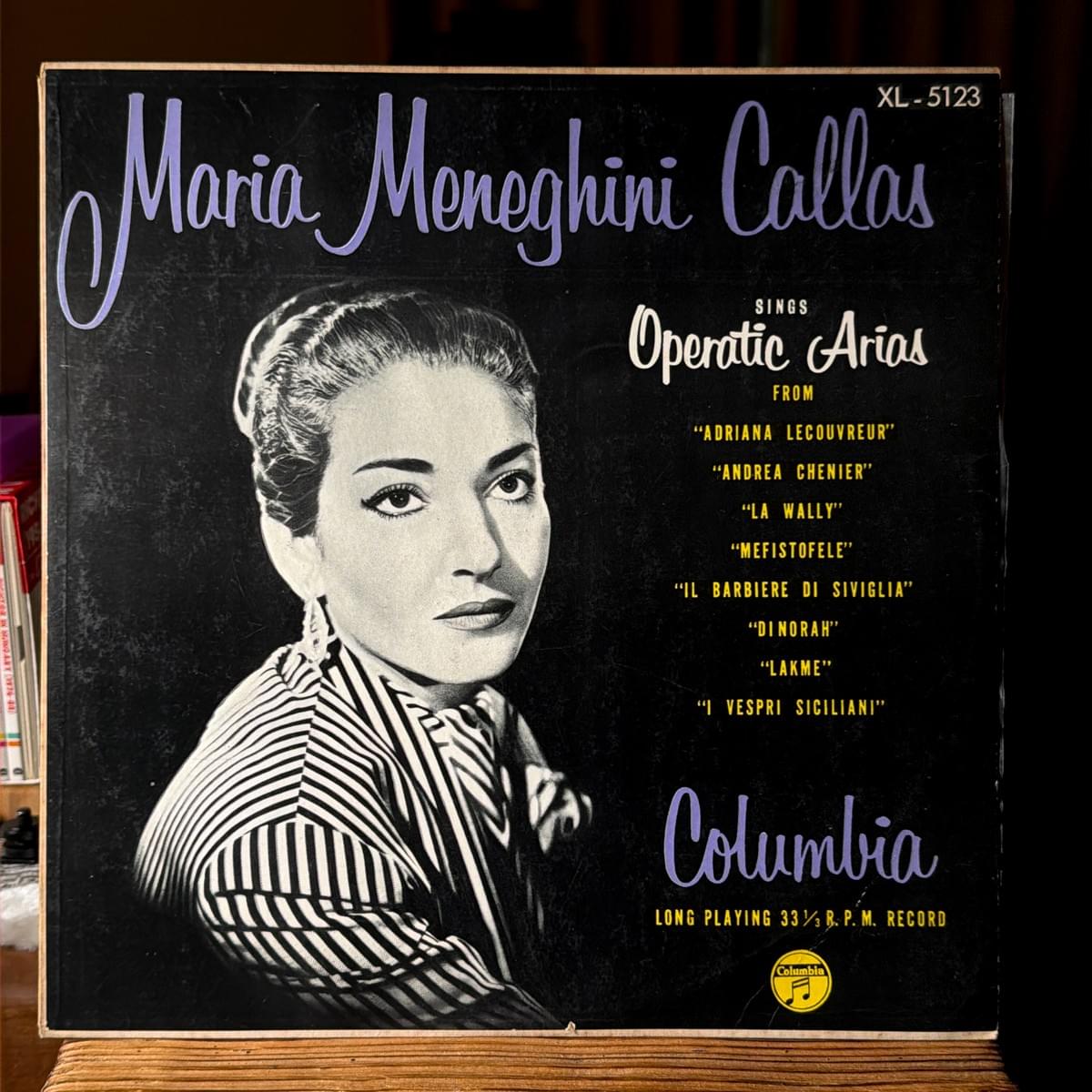
第三張是 Columbia XL-5123,《抒情與花腔詠嘆調》,同樣錄製於1954年9月。
這張唱片的設計,在當時是一個挑戰書。A面是真實主義詠嘆調——接近提芭蒂(Renata Tebaldi,1922-2004)的領域。B面是花腔詠嘆調——接近嘉麗古奇(Galli-Curci)的領域。同一個人,同一張唱片,兩種通常被認為根本不可能共存的聲音能力。
提芭蒂根本不可能嘗試 B 面的任何一首。這張唱片發行的那一天,某種意義上就已宣告了比賽的結果。
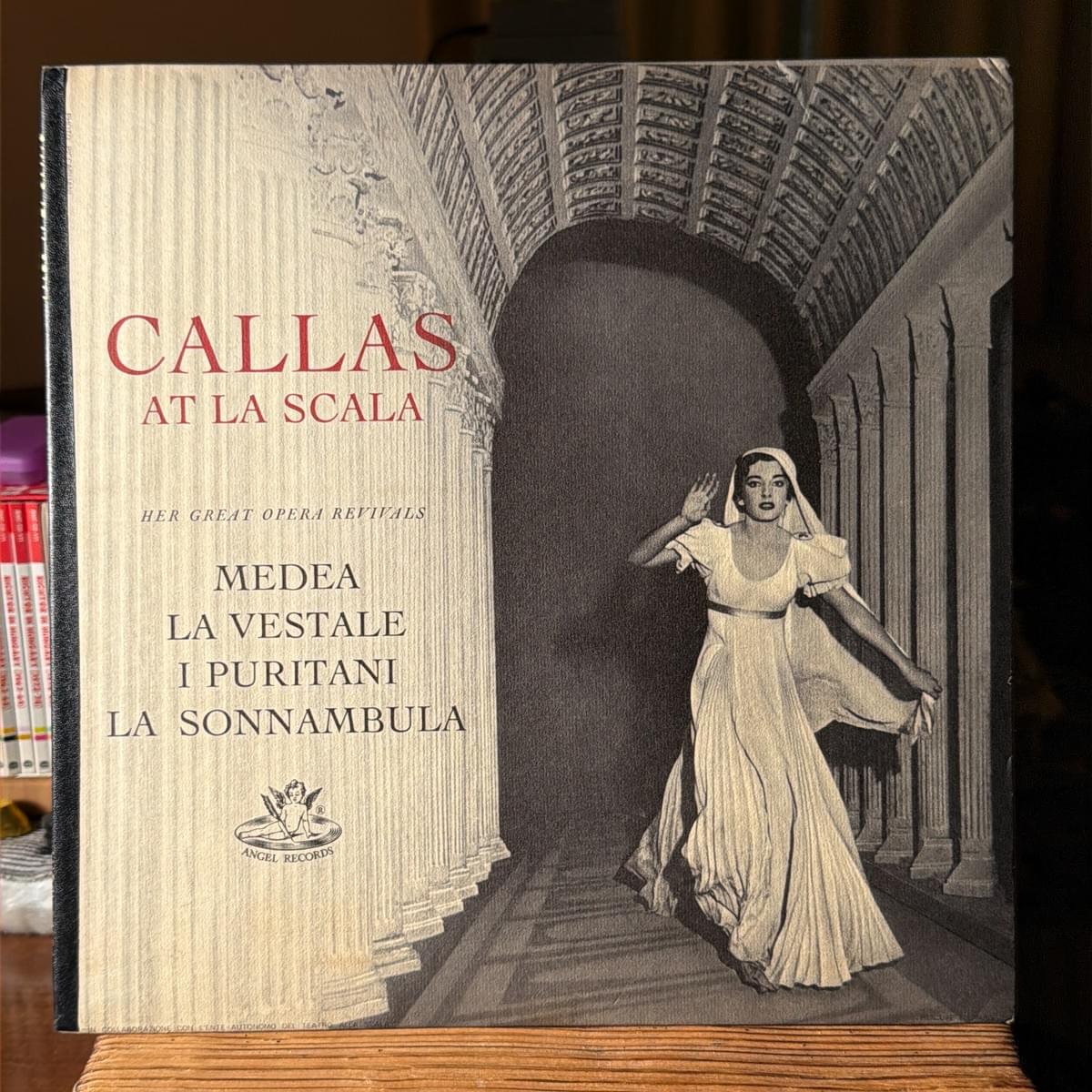
第四張是 Angel ANG. 35304,《卡拉絲在史卡拉歌劇院》,1955年錄製,紅標英國壓製,歷史首版。
這張唱片的意義,不只是「一張精選集」。它是一份計畫性歷史行動的聲音文件。
卡拉絲與賽拉芬在1950年代的米蘭史卡拉,做的是一件今天根本不可能再發生的事:他們系統性地把整個19世紀被忽視的歌劇曲目重新帶上舞台,一部一部復排,讓它們重新活著。
《夢遊女》這個角色,在朱迪塔 帕斯塔(Giuditta Pasta,1797-1865)和瑪麗亞 馬利夫蘭 (Maria Malibran,1808-1936)之後,幾乎從主流舞台消失——直到1955年3月,它為卡拉絲重新誕生。《祭火女》的史卡拉製作,是維斯康蒂(Visconti,1906-1976)第一次執導歌劇,製作預算打破了當時所有紀錄。《凱魯比尼的美狄亞》,在大多數劇院院長眼裡,是一部根本沒有理由復排的作品——直到卡拉絲讓它成為歌劇史上最令人震撼的演出之一。
造就卡拉絲的那個人
把這四張唱片連在一起的,是同一根指揮棒——塔里歐·賽拉芬。
關於賽拉芬這個人,古殿另有一篇文章。這裡只說最關鍵的一件事。
1949年1月,威尼斯鳳凰歌劇院。距離貝里尼《清教徒》演出只剩幾天,飾演女主角的花腔女高音突然病倒。《清教徒》是花腔女高音的曲目,和卡拉絲當時正在演出的華格納《女武神》幾乎是光譜的兩端。賽拉芬把卡拉絲叫來,說:妳來替代那個角色。
卡拉絲拒絕了:她從未學過這部歌劇,時間根本不夠。
賽拉芬說:我相信你能做到。
幾天後,卡拉絲站上了《清教徒》的舞台。那場演出讓全場屏息,也讓樂界開始意識到:這個女人的聲音,能做到幾乎不可能做到的事。
卡拉絲後來說:「若沒有賽拉芬,我絕不可能成為絕對首席女主角。」
這不是客套。是事實。
賽拉芬給了卡拉絲的,不是技術,而是一種哲學:每一個音符,都必須知道自己為什麼在這裡。 音樂必須有表情,必須有理由存在。
卡拉絲接受了這個信念,然後用她自己的方式實踐它:為了讓那個理由完全傳達,她願意讓聲音承擔任何代價。
這四張唱片,是那個信念,在1953年至1955年間,被刻進黑膠溝槽的物理記憶。
她打破了什麼定義
卡芭葉(Montserrat Caballé,1933-2018)說過:「她為我們打開了一扇門,那扇門本來是緊閉的。門後沉睡的,不只是偉大的音樂,而是偉大的詮釋理念。」
但卡芭葉說的是「打開」——這聽起來像是一件好事,一份禮物。換一個角度看:在門被打開之前,所有歌手都在門外,還不知道自己在門外。卡拉絲把門打開了,讓所有人看見裡面有什麼,然後所有人都必須面對同一個問題:我有沒有能力進去?
提芭蒂是唯一一個誠實回答這個問題的人。她說:「我不知道為什麼要把我們放在一起比較,因為聲音的類型根本就不同。她是真的非常不尋常的存在。」
「類型不同」——這不只是說聲音類型。這是在說:我們在做不同的事。泰芭蒂選擇走美聲之路,卡拉絲選擇走生命燃燒之路。兩條路不是高下之分,但它們通往完全不同的地方,帶來完全不同的代價,也留下完全不同的東西。
針頭走進溝槽的那一刻
女次女高音凱薩琳·馬爾菲塔諾(Catherine Malfitano,1948-)說過一句話:「卡拉絲是所有跟隨她的人的靈感,但她也是一種警示故事,讓藝術家們理解,當你那樣飢渴時,你冒著極大的風險。」
「那樣飢渴」——這三個字是所有解釋的終點。
卡拉絲不是「投入」,她是「飢渴」。那是一種不計後果的需要,不是策略,不是技術,而是一種存在狀態。而這種存在狀態,是無法被訓練出來的。
我們可以分析她的音域換接問題,可以計算她的音準偏差,可以生成關於她技術缺陷的完整報告。
但無法回答的是:當針頭走進這四張唱片的任何一條物理溝槽時,那發出的歌聲,為什麼仍是讓我們頭皮發麻。
那個發麻,是1953年佛羅倫斯的錄音室、1954年沃特福德市政廳、1955年米蘭史卡拉的物理現實,仍然活著的證明。那不是技術問題,那是生命深度的問題——而卡拉絲是歷史上少數幾個,把生命歌唱的深度直接刻進溝槽的人。
這樣的燃燒方式,你身邊有沒有見過?一個人為了某件事,完全不計代價地投入,直到把自己燒完——你覺得,那是悲劇,還是某種意義上的完整?
******
Her "Abandon" is More Powerful than Your "Perfection" — Callas 1953–1955, the Peak of the Voice of the Century
A Question, and a Troubling Answer
If someone told you that a singer’s voice was already in decline, yet critics claimed she was "more exciting than ever"—how would you make sense of that?
This isn't hyperbole. These are the actual words from a 1964 review in Gramophone magazine regarding Maria Callas.
That year, Callas (1923–1977) was forty-one. Her operatic career was, for all intents and purposes, nearing its end. Her voice showed cracks that anyone could hear—unsteady high notes and occasional breaks in the seams between her vocal registers.
Yet, the critics said: more exciting than ever.
This paradox is the very heart of the Callas phenomenon. It is why, nearly fifty years after her passing, her recordings still give us goosebumps.
What Does "At Any Cost" Truly Mean?
Callas onc
e uttered a sentence that was practically a manifesto: "To convey the drama, I must produce sounds that are not beautiful. I don't mind if they are ugly, as long as they are true."
Look closely at the logic here. She wasn't saying, "My high notes are failing, so I just have to deal with it." She was saying, "For the sake of the character's truth, I choose to let my voice take the risk."
In the entire world of opera, you can hardly find a second person who made the same choice.
Usually, operatic competition happens within a specific set of coordinates: whose coloratura is clearer, whose high notes are steadier, whose tone is purer. These are measurable standards that can be perfected through training.
Callas’s way of "all-in" commitment shattered those coordinates.
When she completely vanished into a character, the audience was no longer listening to "a soprano singing a role," but "witnessing a human being exist." The director Luchino Visconti described this state: she could be wearing a plain sweater and skirt, "but the moment she opened her mouth, I saw the legendary scarlet mane and the sorceress’s long robes take shape before my eyes."
Her colleagues said: "You are supposed to depict emotion, not actually fall into it. But Maria always became the character."
This is the hardest part to explain about the Callas phenomenon. On stage, she wasn't acting like someone crying; she wasthe person crying. This isn't a technical issue—it’s a way of being.
"Fuel" Only Comes in One Lifetime Supply
Music criti
c Alastair Macaulay once wrote with precision: Callas "sacrificed comfort, beauty, and the fundamental capital of her voice itself to serve at the altar of music."
"The fundamental capital of the voice." Let’s pause and think about that.
A person’s voice is the most non-renewable resource they have. Every time you go "all out," you are spending a portion of capital that only exists once in a lifetime. Callas knew this. Her vocal construction was inherently risky—the seams between her three registers were places that could collapse at any moment. Every time she stepped on stage, she was walking a tightrope.
And her choice, knowing this, was to walk it anyway.
The result? Her operatic career effectively ended by forty. Those sopranos who guarded their voices—like Joan Sutherland or Marilyn Horne—could sing well into their sixties. Callas burned a lifetime's worth of fuel in twenty years.
And that is the answer to that strange 1964 review. The Callas whose voice was fading was "more exciting than ever" because the depth of her commitment outweighed the cost of her vocal loss. In fact, it surpassed her "perfect" years. The fuel was less, but the combustion was more complete.
1953–1955: The Physical Imprint of the Peak Era
At "Palaeo-H
all," I have four records that come from the very core of Callas’s peak years.
The first is Columbia 33CX 1131/1132, Lucia di Lammermoor, recorded in January 1953, Blue/Gold label UK original. This was Callas’s first complete opera recording for EMI, and her first collaboration with Di Stéfano, Tito Gobbi, and Tullio Serafin.
Before this recording, Lucia was a popular opera. From the 19th century to the first half of the 20th, singers like Galli-Curci, Lily Pons, and Lucrezia Bori all performed the role. The opera houses never forgot it.
But it lived within a specific frame: it was a showcase for the "coloratura soprano." The "Mad Scene" was a display of technical fireworks; the audience waited for steady high notes, agile scales, and that beautiful E-flat. Lucia the person—her fear, the logic of her breakdown, why she ended up there—was not the point. No one even asked the question.
Callas, from the very first note, started asking that question.
She presented a highly tense, neurotic character, but sang with impeccable legato. All the coloratura ornaments were woven into the vocal line rather than floating on top for show. The Mad Scene was no longer just a technical display; it was the entire process of a psychological collapse—you can hear exactly how she got there, step by step. A critic from Gramophone wrote that after hearing that final high note, he "had to go for a walk in the garden to cool down."
Callas didn't just change the status of this opera. She changed the way people understood what this opera could carry. After her, Lucia was no longer a role where "pretty high notes are enough"—she was a human being who had to be understood.
The second is Columbia 33CX 1204, Puccini Operatic Arias, recorded in September 1954, Blue/Gold label UK original, first pressing.
There is an almost unbelievable fact about this record: when Callas recorded these arias, she had never performed most of these roles on stage. No stage memories of Madama Butterfly, Mimi, or Turandot.
Yet, what did she achieve? When Gramophone first reviewed it, they said: "She brings to each aria the stamp of her individual art, a certain texture of characterization, and a concern for the dramatic and musical shaping of the aria that is quite different from the Puccini singing we generally hear today."
This record later became the best-selling solo recital album Callas ever made. 1954 was a unique moment for her voice—she had just finished her first major recordings after losing weight. Her voice retained the richness of a dramatic soprano while possessing light coloratura agility. That window of time existed only briefly. This record stands right in the center of that window.
The third is Columbia XL-5123, Lyric and Coloratura Arias, also recorded in September 1954.
The design of this record was a challenge to the world at the time. Side A featured "Verismo" arias—approaching the territory of Renata Tebaldi. Side B featured "Coloratura" arias—approaching the territory of Galli-Curci. The same person, the same record, two vocal abilities usually considered impossible to coexist.
Tebaldi wouldn't have even dreamed of attempting anything on Side B. The day this record was released, in a sense, the competition was already decided.
The fourth is Angel ANG. 35304, Callas at La Scala, recorded in 1955, Red label UK pressing, first edition.
The significance of this record is more than just a "best-of" collection. It is a sonic document of a planned historical movement.
In the 1950s, Callas and Serafin were doing something at La Scala in Milan that simply couldn't happen today: they were systematically bringing neglected 19th-century repertoire back to the stage, revival after revival, bringing them back to life.
The role of La sonnambula, after Giuditta Pasta and Maria Malibran, had almost disappeared from mainstream stages—until it was reborn for Callas in March 1955. The production of La Vestale was the first time Visconti directed an opera, with a budget that broke all records at the time. Cherubini’s Medea was, in the eyes of most theater managers, a work with no reason to be revived—until Callas made it one of the most shocking performances in operatic history.
The Man Who Made Callas
What connects
these four records is the same baton: Tullio Serafin.
I have another article about Serafin himself, but I’ll tell you the most crucial bit here.
January 1949, Teatro La Fenice in Venice. Only a few days before the performance of Bellini’s I Puritani, the coloratura soprano playing the lead fell ill. I Puritani is a coloratura role, almost at the opposite end of the spectrum from Wagner’s Die Walküre, which Callas was performing at the time. Serafin called Callas over and said: "You are going to replace her."
Callas refused: she had never studied the opera, and there wasn't enough time.
Serafin said: "I believe you can do it."
A few days later, Callas stood on the stage for I Puritani. That performance took the audience’s breath away and made the music world realize: this woman’s voice could do the impossible.
Callas later said: "Without Serafin, I could never have become the Prima Donna Assoluta."
This wasn't just politeness. It was a fact.
Serafin didn't just give Callas technique; he gave her a philosophy: Every single note must know why it is there. Music must have expression; it must have a reason to exist.
Callas accepted this belief and practiced it in her own way: to ensure that reason was fully conveyed, she was willing to let her voice pay any price.
These four records are the physical memory of that belief, etched into the grooves of vinyl between 1953 and 1955.
The Definition She Shattered
Montserrat Cab
allé once said: "She opened a door for us that had been tightly shut. Behind that door was sleeping not just great music, but great concepts of interpretation."
But Caballé said "opened"—which sounds like a good thing, a gift. Look at it from another angle: before that door was opened, all singers were outside, not even knowing they were outside. Callas threw the door open, let everyone see what was inside, and then everyone had to face the same question: Do I have the strength to go in?
Renata Tebaldi was the only one who answered that question honestly. She said: "I don't know why they compare us, because our types of voices are completely different. She is truly an extraordinary presence."
"Different types"—she didn't just mean vocal types. She meant: We are doing different things. Tebaldi chose the path of Bel Canto beauty; Callas chose the path of burning her life. These two paths aren't about which is "better," but they lead to completely different places, carry different costs, and leave behind different things.
The Moment the Needle Enters the Groove
Mezzo-soprano C
atherine Malfitano once said: "Callas is an inspiration for all who followed her, but she is also a cautionary tale, helping artists understand that when you are that hungry, you take enormous risks."
"That hungry"—these two words are the end of all explanations.
Callas wasn't just "involved"; she was "hungry." It was a need that disregarded consequences. It wasn't a strategy or a technique; it was a state of being. And that state of being cannot be taught.
We can analyze her register-shift issues, calculate her pitch deviations, and generate complete reports on her technical flaws.
But what we cannot answer is: why, when the needle enters the physical groove of any of these four records, does that voice still make our skin crawl?
That shiver is the proof that the physical reality of the 1953 Florence studio, the 1954 Watford Town Hall, and the 1955 Milan La Scala is still alive. It's not a matter of technique; it's a matter of the depth of a life—and Callas is one of the few in history who etched the depth of a life lived through song directly into the grooves.
Have you ever seen this kind of "burning" around you? A person who throws themselves into something with total abandon, until they have burned themselves out—do you think that is a tragedy, or, in a certain sense, a form of completeness?