
【古殿唱片音樂故事】拉威爾為她寫安眠曲,愛因斯坦親筆致謝——但大部分人可能從沒聽過她的名字?
她是那個時代最偉大的鋼琴家之一:畢生只留下四張正式發行的唱片,卻活得比任何人都完整:尤拉 菊勒的傳奇人生。
古殿殿主
幾天前,殿主寫了一個故事:1909年巴黎音樂學院的校際競賽,一個11歲的美國女孩,創下了兩百年來從未被打破的最年輕一等獎紀錄。
但同一個舞台,同一場競賽,還有另一個人也拿到了一等獎。
評審對那個11歲女孩的評語是:「與生俱來的天份無與倫比。」
對這個人的評語,是完全不同的語氣:
「鋼鐵般的演奏技藝,音樂非常生動,有豐富的色彩變化,極具個性;混合了優雅與生命力,這不是憑運氣,而是有真正的自我風格。」
對一個是:發現了一個奇蹟。
對另一個是:承認了一個藝術家。
這兩種眼光的差距,在今天讀來仍然讓人心跳一下。
這個人叫尤拉 菊勒(Youra Guller,1895–1980)。
她後來的故事,你無論如何想不到。

那個時代最頂尖的人,都認識她
畢業後的菊勒,很快躍上歐洲舞台。
一戰結束後,英國聞名的威格摩爾音樂廳(Wigmore Hall)舉行了一系列世紀名家「鋼琴獨奏會」,邀請那個時代公認最偉大的鋼琴家各自舉行獨奏會。那份名單上有六個當時全世界最頂尖的鋼琴家,以及——尤拉·菊勒。
名單如下:
莫里茨·羅森塔爾(Moritz Rosenthal,1862-1946)
埃米爾·紹爾(Emil Sauer,1862-1942)
阿圖爾·魯賓斯坦(Artur Rubinstein,1887-1982)
約瑟夫·霍夫曼(Josef Hoffman,1870–1952)
阿爾弗雷德·柯爾托(Alfred Cortot,1877-1962)
所羅門(Soloman, 1902-1988)
尤拉·菊勒(Youra Guller, 1895-1980)
她是這份名單上唯一的女性,卻被視為理所當然地名列其中。 那個時代,對她說過話的人,是這些:
● 「她從少女時代起,就以其深邃、甚至可稱為崇高的音色,以及光輝燦爛的演奏風格脫穎而出。」——達律斯·米堯(作曲家)
● 「尤拉·菊勒是音樂女神。」——雅克·提博(小提琴家)
● 「就我所知,她是具備最完美天賦的鋼琴家之一。」——費魯喬·布梭尼(鋼琴家、作曲家)
● 「我從小就認識的尤拉·菊勒,如今在音樂藝術界已是偉大的存在。」——帕布羅·卡薩爾斯(大提琴家,1942年親筆)
● 「在現代種種偏見中,浪漫派大師的傳統正逐漸失去其偉大的光芒,而她強烈地向我們展示了這一傳統,也正因如此,它顯得愈發珍貴。」——曼紐因(小提琴家)
● 「自從我們在1920年代於日內瓦合作演出貝多芬的10首奏鳴曲以來,尤拉·菊勒一直是我的良伴之一。最近聽了她的演奏,發現即使過了幾十年,她的藝術依然毫不褪色。」——約瑟夫·西格提(小提琴家)
● 「To Youra Guller, the wonderful artist, in gratitude.」(獻給尤拉·菊勒,這位美妙的藝術家,致上感謝。)——阿爾伯特·愛因斯坦(1928年親筆)
● 「請代我向菊勒女士致以敬意,並表達我希望能再次聽到她演奏貝多芬晚期奏鳴曲的心情——她至今仍是我心目中我們這個時代唯一的詮釋者。」——羅曼·羅蘭(作家、貝多芬傳記作者,親筆手寫)
● 「每當聆聽尤拉·菊勒的演奏,我都會因她獨特的個性與音樂魔力而感受到深刻且難以忘懷的感動。」——瑪爾塔·阿格麗希(鋼琴家,1971年親筆)
這些不是印刷的宣傳文字。它們是真實存在的親筆手跡——愛因斯坦1928年的德文親筆、卡薩爾斯1942年的題詞、作曲家米堯的兩段讚辭、阿格麗希1971年的親筆信。
還有一份更私密的文件:
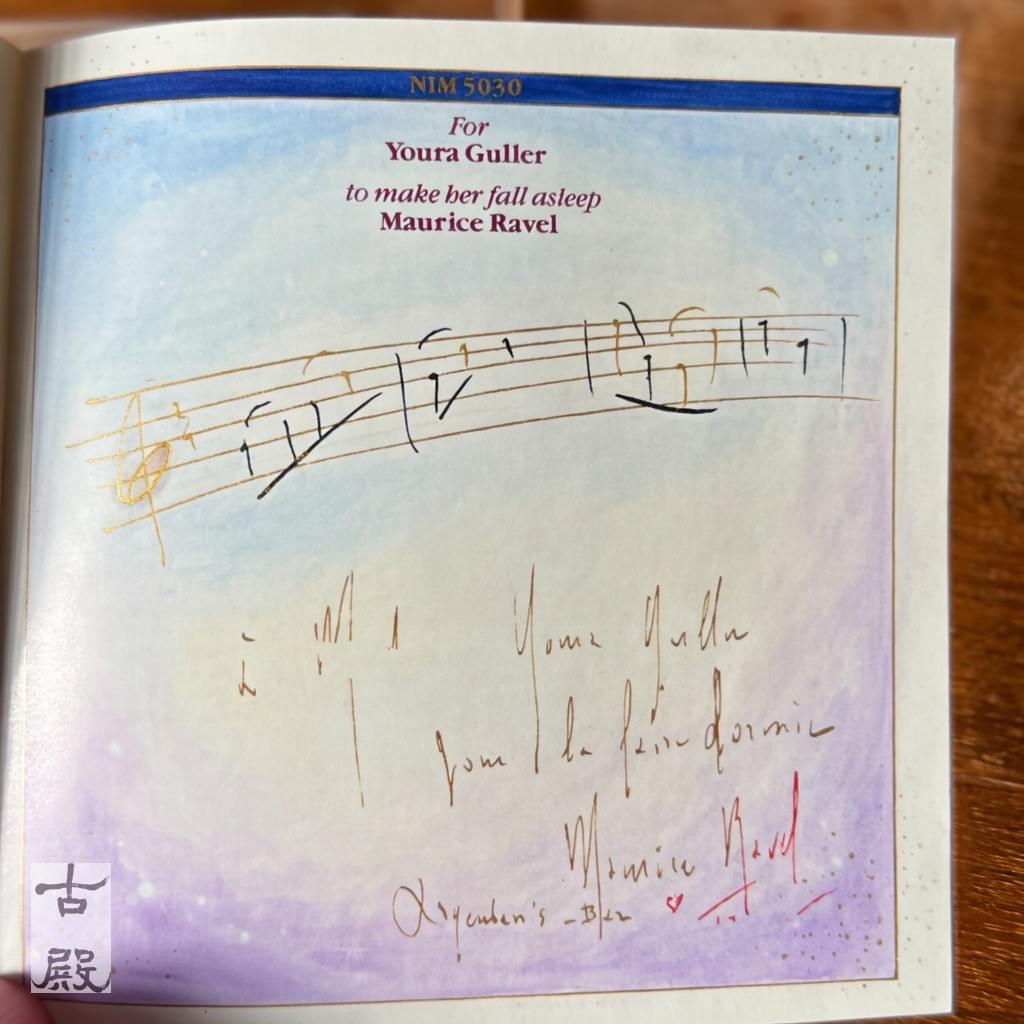
作曲家拉威爾(Maurice Ravel,1875-1937)為菊勒親手寫下了一段樂譜,題獻語是法文:
「à Youra Guller, pour la faire dormir」
——「獻給尤拉 菊勒,為了讓她入睡」。
拉威爾不是為陌生人寫安眠曲的人。這份手稿說明的,是兩個人之間遠超音樂圈交誼的深厚情誼。
還有一張照片:菊勒與法國大文豪1947年諾貝爾文學獎得主安德烈·紀德(André Gide,1869-1951)靠近交談,兩人之間的氣氛,是只有長年知己才有的那種從容。據說菊勒曾私下教紀德彈琴。
這些,都是真實發生過的事。她確實是那個時代歐洲最頂尖的鋼琴家之一。
但是——她當時幾乎沒有留下任何錄音。
她最輝煌的歲月,對後世來說是一段完全無聲的存在。不是因為她不在,而是因為那個時代,她沒有進入商業錄音的系統。
戰爭兩度摧毀了她的身體
然後,戰爭來了。不只一次,是兩次。
一戰期間,她經歷了長途跋涉與長期嚴重的營養不良,身體受到了根本性的損傷。演奏生涯被迫長期中斷。
二戰更為殘酷。納粹佔領法國,她以猶太人身份被迫躲藏。那段歲月裡,她再次承受了長途跋涉與長期嚴重營養不良——幾乎沒有飯吃的日子。據記載,她曾短暫移居中國上海,以偶爾教琴維生,確切停留了幾年,今天已難以考證。
她一生的軌跡,像流星一樣反覆出現又消失——多次讓人以為她已經不在人世,她卻又悄悄出現在某個城市的舞台上,然後再度無聲消失。
兩次大戰,兩次對同一個身體的摧殘。
戰後,1955年,她重新走回舞台。隔年錄製了兩張蕭邦唱片——這是她歷劫歸來後,自己決定走回音樂面前的姿態。法國樂壇給了她高度的評價。
但身體終究撐不住了。職業演奏家的生活——大量音樂會、長途旅行、持續的體力消耗——是她在兩次戰爭的損傷之後,再也無法承受的事。
她再度退下來。不是放棄音樂,是真的撐不住了。
音樂從未離開她的生命。她只是停止把自己的身體當作職業工具來使用。
她回到瑞士,在鄉下安靜地生活,偶爾教幾個孩子彈琴。
瑞士鄉下,教小朋友彈琴的那個人
這裡有一個讓人說不出話來的畫面。
曾經被整個歐洲樂壇奉為女神的人——拉威爾為她寫安眠曲、愛因斯坦親筆致謝、羅曼·羅蘭說她是「唯一的詮釋者」——晚年在瑞士鄉下,靠偶爾教幾個孩子彈琴維生。
樂壇不知道她在哪裡。或者說,樂壇已經把她當作一個遙遠過去的傳說,甚至以為她早已不在人世。
然後,消息不知透過什麼樣的機緣,傳到了當時世界上最偉大的鋼琴家之一——瑪爾塔·阿格麗希那裡。
當她得知那個傳說中的尤拉·菊勒,原來一直活著,就住在瑞士,以教琴度日——她立刻採取了行動。
消息在樂壇傳開。那個時代最頂尖的音樂家們聚在一起,為菊勒組織了一筆養老金。這不是憐憫,這是一種集體的承認:我們都知道你是誰,我們不能讓你就這樣消失。
阿格麗希更進一步,鼓勵菊勒重新為世界演奏,留下錄音。
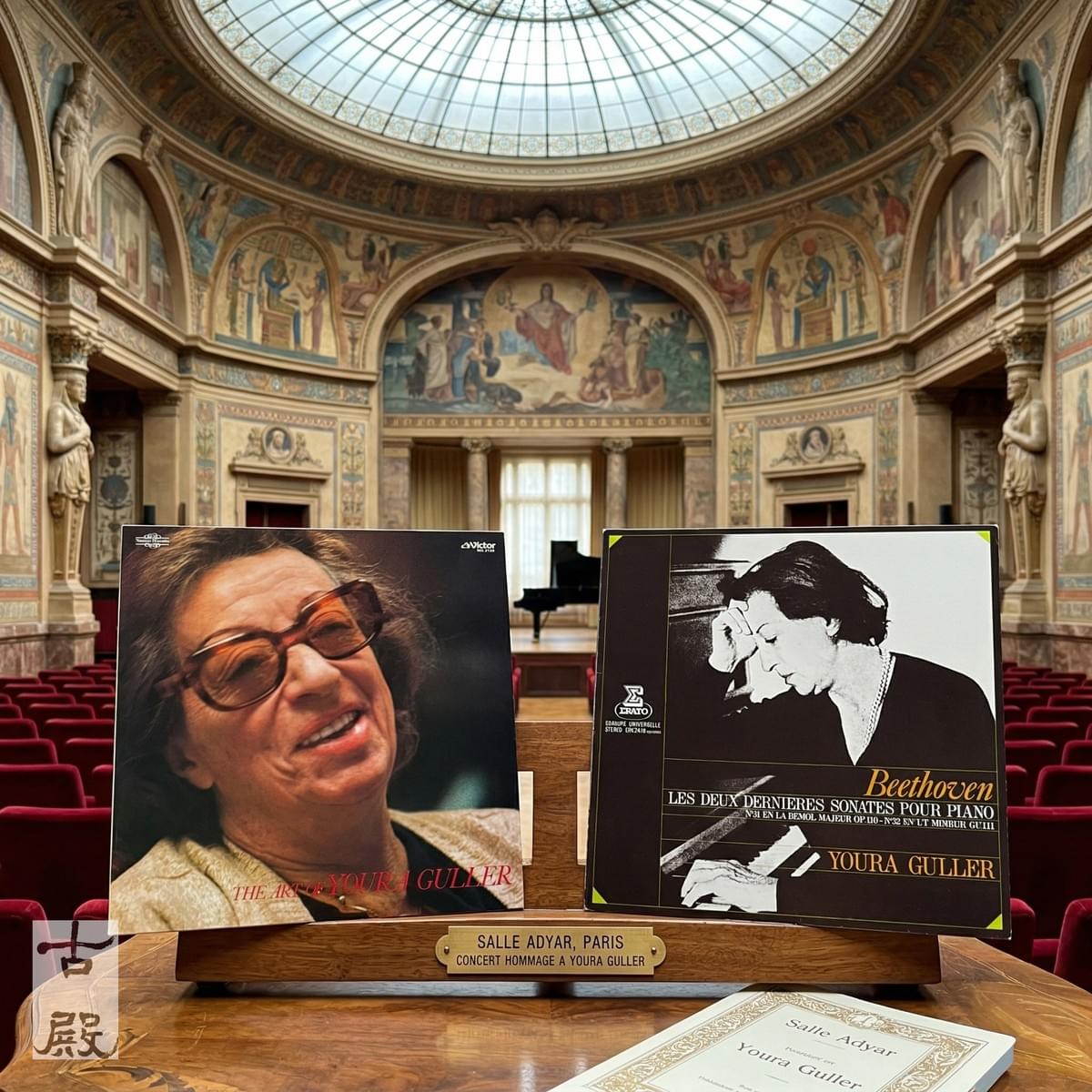
於是有了她生命最後的兩張唱片:
1973年,七十八歲,在巴黎一座教堂裡錄製的貝多芬晚期鋼琴奏鳴曲。
1975年,八十歲,在英國伯明罕錄製的一張跨越巴哈、蕭邦、法國古樂的演奏集。
加上她1956年自己決定復出時留下的兩張蕭邦,她一生正式出版的錄音,總共只有四張。
七十八歲,在教堂裡彈下貝多芬的最後告別
那個1973年的貝多芬錄音,後來被樂評家稱為「有史以來最偉大的貝多芬詮釋之一」。
七十八歲。走過兩次世界大戰、走過長途跋涉與長期營養不良對身體的兩度摧殘、走過以猶太人身份在法國的躲藏歲月、走過在上海以教琴維生的異鄉歲月、走過戰後一次又一次嘗試復出又消失的歲月、走過在瑞士鄉下安靜度過的那些年——然後在巴黎一座教堂裡,一個人對著麥克風,彈下貝多芬對死亡、超越與告別的最後沉思。
她選擇在教堂而非錄音室錄製,本身已是一種聲明——教堂的自然殘響,讓聲音保有它應有的空間感與整體生命,而不是被切割成可以精密調整的片段。
兩年後,1975年的那張Nimbus錄音,背後是同一個哲學:Nimbus採用單點麥克風的空間收音方式,追求最接近現場聆聽的整體感,而非主流錄音工業追求的技術零瑕疵。錄音中偶爾出現的失誤,應放在一位八十歲鋼琴家全力投入、充滿生命力的整體演出脈絡下來理解。
一張在教堂收音,一張用單點麥克風捕捉整體空間——這兩張唱片,是同一個信念的兩種實現:音樂是一個整體的生命,不是可以被切割和修補的技術成品。
羅曼·羅蘭當年說的那句話——「希望能再次聽到她演奏貝多芬晚期奏鳴曲,她至今仍是我們時代唯一的詮釋者」——那不是抽象的讚美,那是一個親身聽過她演奏的人,在聽完之後寫下的話。
1973年的那個錄音,是對那句話最後的回應。
任何年輕的鋼琴家,無論天份多高,都無法複製那個演奏。因為那個演奏需要的不是天份,而是時間——以及那個時間裡所發生的一切。
即便身體和精神都曾破碎,藝術能讓痛苦轉向。菊勒彈奏的音樂,真正達到了「身、口、意」合一——作為一個人,最自然、最純真的境界。那不是修煉出來的,那是一個人用整個生命活出來的。
音樂的價值,永遠都不是數量的多寡,而是見及本心。身口意合一,哪怕只有一次,都是具有永恆價值的至高境界。
這才是為什麼羅曼·羅蘭聽過她一次,終生念念不忘。這才是為什麼阿格麗希說,她的演奏讓自己進入「一個充滿喜悅與難以忘懷情感的世界」。那不只是讚美,那是一個人描述自己身體裡發生過的真實震動。
那個震動,不需要被錄音,也不會因為沒有被記錄而消失。
「歷史」是什麼?
今天,你去任何一個音樂平台,哈絲姬兒的錄音多到翻不完。
但你還記得嗎?1909年的競賽,哈絲姬兒拿的是二等獎。
(哈絲姬兒的演奏與錄音也是殿主的最愛,在此並不是有貶哈絲姬兒的意思)
菊勒的消失,不是因為她不夠好,而是因為她最輝煌的歲月,沒有被那個時代的記錄機制捕捉到。商業錄音的機會、戰爭的中斷、身體的極限——一連串真實發生的事情,讓她從可以被傳遞的歷史裡消失了。
這讓我們不得不重新思考一個問題:
「歷史」到底是什麼?
我們以為歷史是被記錄下來的那些事。但其實,歷史的本質是生命狀態——每一個人活著的每一天,都是真實的歷史,不管有沒有被記錄。
菊勒在那個倫敦音樂廳演奏的夜晚,是歷史。她在上海一個陌生的房間裡教琴的那個下午,是歷史。她在瑞士鄉下教一個孩子彈琴的那個清晨,是歷史。她在巴黎教堂裡彈下貝多芬的那個瞬間,是歷史。
這些,不因為沒有被錄音而消失。它們都真實發生過。
好好過好每一天,然後一切隨緣
菊勒一生命運坎坷,多次像流星般出現,又瞬間消失於人世,幾乎消失得無影無蹤,以至於人們總以為她已經逝世了。
然而,她最終活了八十五歲。
一生只「正式」出版了四張唱片。
1956年,在法國Ducretet-Thomson唱片公司的邀請下,由傳奇錄音師夏蘭(André Charlin,1903-1983)在賽爾 阿迪雅廳(Salle Adyar, Paris)錄製了兩張蕭邦——瑪祖卡選曲與夜曲選曲。
1973年,七十八歲,在巴黎黎巴嫩聖母教堂(Église Notre-Dame du Liban)為法國Erato廠牌錄製的貝多芬晚期鋼琴奏鳴曲第31號(Op.110)與第32號(Op.111)。
1975年,八十歲,在英國伯明罕Nimbus Studio錄製的《尤拉 菊勒的藝術》——巴哈、蕭邦、史卡拉第、庫普蘭、拉摩等作品。
第一眼看,這像是老天開的一個殘忍玩笑。
但仔細想,其實不是。
菊勒從來不是在等待被記錄,也不是在忍受被遺忘。她就是好好活著——音樂在生命裡,生活在音樂裡,其他的一切隨緣。戰爭來了,承受。身體垮了,退下來。有人找到她,就再彈一次。沒有人找,就在瑞士鄉下教幾個孩子彈琴,把音樂傳下去。
那四張唱片,不是搶救,不是遺產。就是一個好好活著的人,在那個當下,把她有的全部給出來了。
這才是菊勒真正留給我們的東西——
好好過好每一天的生活,見及本心,然後一切隨緣。
遺忘又算得了什麼?
她的音樂存在過。她的生命存在過。那些聽過她演奏的人,身體裡發生過真實的震動。那個震動是真實的歷史,不需要被記錄,也不會因為沒有被記錄而消失。
菊勒的故事,不是一個被遺忘的悲劇。
她是一個好好活著的人。
******
[Musical Stories from the Vault] Ravel wrote her a lullaby, Einstein sent his gratitude—so why have most people never heard her name?
She was one of the greatest pianists of her era: leaving behind only four official albums in a lifetime, yet living more "completely" than anyone else. This is the legendary life of Youra Guller.
A few days ago, I shared a story about the 1909 inter-school competition at the Paris Conservatoire. An 11-year-old American girl (Clara Haskil) set a record that hasn’t been broken in two hundred years: the youngest person ever to win the Premier Prix (First Prize).
But on that same stage, in that same competition, there was another person who also won the First Prize.
The judges’ comment for that 11-year-old girl was: "An incomparable, innate talent."
But for this other winner, the tone was entirely different:
"A technique of steel, music that is incredibly vivid with rich tonal shifts and a strong personality; a blend of elegance and vitality. This isn't luck—it is a true, individual style."
For one, they had discovered a miracle. For the other, they had recognized an artist.
Even reading these words today, the distinction makes my heart skip a beat. That artist was Youra Guller (1895–1980). You would never guess what happened to her next.
The giants of the era all knew her
After g
raduation, Guller quickly rose to the top of the European stage. After WWI, London’s famous Wigmore Hall held a series of "Master Recitals," inviting the greatest pianists of the century to perform. The list featured six of the most legendary names in the world, and—Youra Guller.
The roster was as follows:
Moritz Rosenthal (1862-1946)
Emil Sauer (1862-1942)
Artur Rubinstein (1887-1982)
Josef Hofmann (1870–1952)
Alfred Cortot (1877-1962)
Solomon (1902-1988)
Youra Guller (1895-1980)
She was the only woman on that list, and it was considered perfectly natural that she was there. Back then, the people who spoke of her were the titans of history:
Darius Milhaud (Composer): "Since her youth, she stood out with a deep, even sublime tone and a brilliant style."
Jacques Thibaud (Violinist): "Youra Guller is the Goddess of Music."
Ferruccio Busoni (Pianist/Composer): "As far as I know, she is one of the most perfectly gifted pianists."
Pablo Casals (Cellist): "The Youra Guller I have known since childhood is now a great presence in the world of musical art." (Handwritten, 1942)
Yehudi Menuhin (Violinist): "Among modern prejudices, the great light of the Romantic master tradition is gradually fading; she shows us this tradition so strongly that it becomes all the more precious."
Joseph Szigeti (Violinist): "Ever since we performed Beethoven’s 10 sonatas together in Geneva in the 1920s, Youra Guller has been one of my great companions. Hearing her recently, I found that even after decades, her art remains unfaded."
Albert Einstein: "To Youra Guller, the wonderful artist, in gratitude." (Handwritten, 1928)
Romain Rolland (Author/Beethoven Biographer): "Please pay my respects to Madame Guller and express my wish to hear her play Beethoven’s late sonatas again—she remains, in my mind, the only interpreter of our time." (Handwritten)
Martha Argerich (Pianist): "Whenever I listen to Youra Guller, I am moved by a profound and unforgettable emotion born of her unique personality and musical magic." (Handwritten, 1971)
These weren't just promotional blurbs. These are real, handwritten letters—Einstein’s German script from 1928, Casals’ inscription from 1942, Milhaud’s praise, and Argerich’s personal letter from 1971.
There is also a more intimate document: The composer Maurice Ravel (1875-1937) hand-wrote a fragment of a score for Guller with a French dedication:
“à Youra Guller, pour la faire dormir” — "For Youra Guller, to help her sleep."
Ravel wasn’t the type to write lullabies for strangers. This manuscript speaks of a bond that went far beyond professional networking. There is even a photograph of Guller in close conversation with the Nobel laureate André Gide; the atmosphere between them is the effortless ease of lifelong confidants. It is said Guller even taught Gide how to play.
She was, without a doubt, at the very pinnacle of European music. But—at that time, she left behind almost no recordings.
Her most glorious years are, to us, a period of total silence. Not because she wasn't there, but because she simply didn't enter the commercial recording system of that era.
Two wars broke her body
Then ca
me the wars. Not once, but twice.
During WWI, long-distance travel and severe, chronic malnutrition caused fundamental damage to her health. Her career was forced into a long hiatus.
WWII was even more cruel. When the Nazis occupied France, she was forced into hiding because of her Jewish heritage. Once again, she endured the physical toll of fleeing and hunger—days without food. Records suggest she briefly moved to Shanghai, China, surviving by occasionally teaching piano, though the exact years are hard to trace today.
Her life followed the trajectory of a comet—appearing and vanishing. People repeatedly thought she had passed away, only for her to quietly reappear on a stage in some city, before vanishing again into the shadows.
The teacher in the Swiss countryside
By 1955
, after the wars, she attempted a comeback. In 1956, she recorded two Chopin albums—a gesture of returning to music after surviving the abyss. The French critics were floored.
But her body finally gave out. The life of a professional performer—the concerts, the travel, the constant physical exhaustion—was something her war-torn body could no longer sustain. She stepped back again. Not because she gave up on music, but because she simply couldn't physically hold on.
She moved to the Swiss countryside, living a quiet life and teaching a few local children.
It’s a haunting image, isn't it? The "Goddess of Music," the woman Ravel wrote lullabies for and Einstein thanked, was living in obscurity. The music world had forgotten where she was, assuming she was long gone.
Then, word reached Martha Argerich.
When Argerich discovered that the legendary Youra Guller was alive and teaching in Switzerland, she immediately took action. The top musicians of the era gathered to organize a pension for her. This wasn't charity; it was a collective recognition: “We know who you are, and we cannot let you vanish.”
Argerich encouraged Guller to play for the world once more. This led to the final two albums of her life:
1973 (Age 78): Beethoven’s late piano sonatas, recorded in a Paris church.
1975 (Age 80): A collection of Bach, Chopin, and French Baroque music recorded in Birmingham, UK.
Including her 1956 Chopin records, her entire lifetime of official recordings totals just four albums.
A final farewell in a church
That 19
73 Beethoven recording is now considered one of the greatest interpretations in history.
Think about it. Seventy-eight years old. Having survived two world wars, chronic hunger, years in hiding, exile in Shanghai, and decades of silence in Switzerland—she sat alone in a Paris church and played Beethoven’s final meditations on death, transcendence, and farewell.
She chose a church over a studio for a reason. The natural resonance of a church allows the sound to retain its spatial integrity and life, rather than being sliced into perfect, adjustable fragments.
The 1975 Nimbus recording followed the same philosophy: using a "single-point microphone" to capture the atmosphere of the room. It wasn't about technical perfection; it was about the whole human being. The occasional slip of a finger from an 80-year-old pianist is irrelevant when compared to the vibrant, living soul of the performance.
One in a church, one with a single-point mic—these two records are two expressions of the same belief: Music is a living whole, not a technical product to be cut and mended.
When Romain Rolland said she was "the only interpreter of our time," he wasn't being abstract. He was describing the physical truth of her playing. That 1973 recording was her final answer to his wish.
Any young prodigy can play the notes, but no one can replicate that performance. Because that music doesn't require talent—it requires time, and everything that happened within that time.
Even when the body and spirit are broken, art can transform that pain. Guller’s music achieved a total alignment of "Body, Speech, and Mind"—the most natural, purest state of a human being. That isn't something you "practice"; it’s something you live.
What is history, anyway?
Today,
if you go to any streaming platform, you'll find endless recordings of Clara Haskil. (And I love Haskil’s work; this isn't to diminish her.) But do you remember? In that 1909 competition, Haskil took second prize to Guller.
Guller "disappeared" not because she wasn't good enough, but because the recording mechanisms of her time didn't catch her at her peak. Commercial timing, wars, and physical limits erased her from the "traceable" history.
This makes me wonder: What is "History" really?
We think history is what gets recorded. But the essence of history is a state of being. Every day a person lives is real history, whether a microphone is there or not.
The night she played in London was history. The afternoon she taught in a room in Shanghai was history. The morning she taught a child in Switzerland was history. And the moment she struck the keys in that Paris church was history. These things don't cease to exist just because they weren't taped.
Live well, and let the rest be
Guller’
s life was full of hardship. She vanished so many times that she became a ghost while still breathing. Yet, she lived to be 85.
She left only four "official" albums:
1956: At the invitation of the French label Ducretet-Thomson, recorded by the legendary André Charlin (1903-1983) at Salle Adyar, Paris. Two albums of Chopin (Mazurkas and Nocturnes).
1973 (Age 78): Beethoven’s Late Sonatas No. 31 (Op. 110) and No. 32 (Op. 111), recorded for Erato at the Église Notre-Dame du Liban, Paris.
1975 (Age 80): The Art of Youra Guller—Bach, Chopin, Scarlatti, Couperin, Rameau, recorded at Nimbus Studio, Birmingham.
At first glance, it seems like a cruel joke from the universe. But if you look closer, it isn't.
Guller wasn't waiting to be recorded, nor was she "enduring" being forgotten. She was simply living. Music was in her life, and life was in her music. When the war came, she bore it. When her body failed, she stepped back. When someone found her, she played again. When no one called, she passed the music on to a child in the countryside.
Those four records aren't "relics" or "salvaged scraps." They are the gift of a person who lived fully and gave everything she had in that exact moment.
This is what Youra Guller truly leaves us: Live your days well, stay true to your heart, and let the rest be.
What does "being forgotten" even matter? Her music existed. Her life happened. The vibrations she created in the bodies of those who heard her were real. That vibration is the true history—it doesn't need a record, and it will never disappear.
Youra Guller’s story isn't a tragedy of being forgotten. She was simply a human being who lived beautifully.