
【古殿唱片音樂故事】布列茲的老師,最出名的唱片卻被拿來展示發燒音響:勒內·萊布尼茲(René Leibowitz,1913-1972)與《管弦樂的威力》
古殿殿主
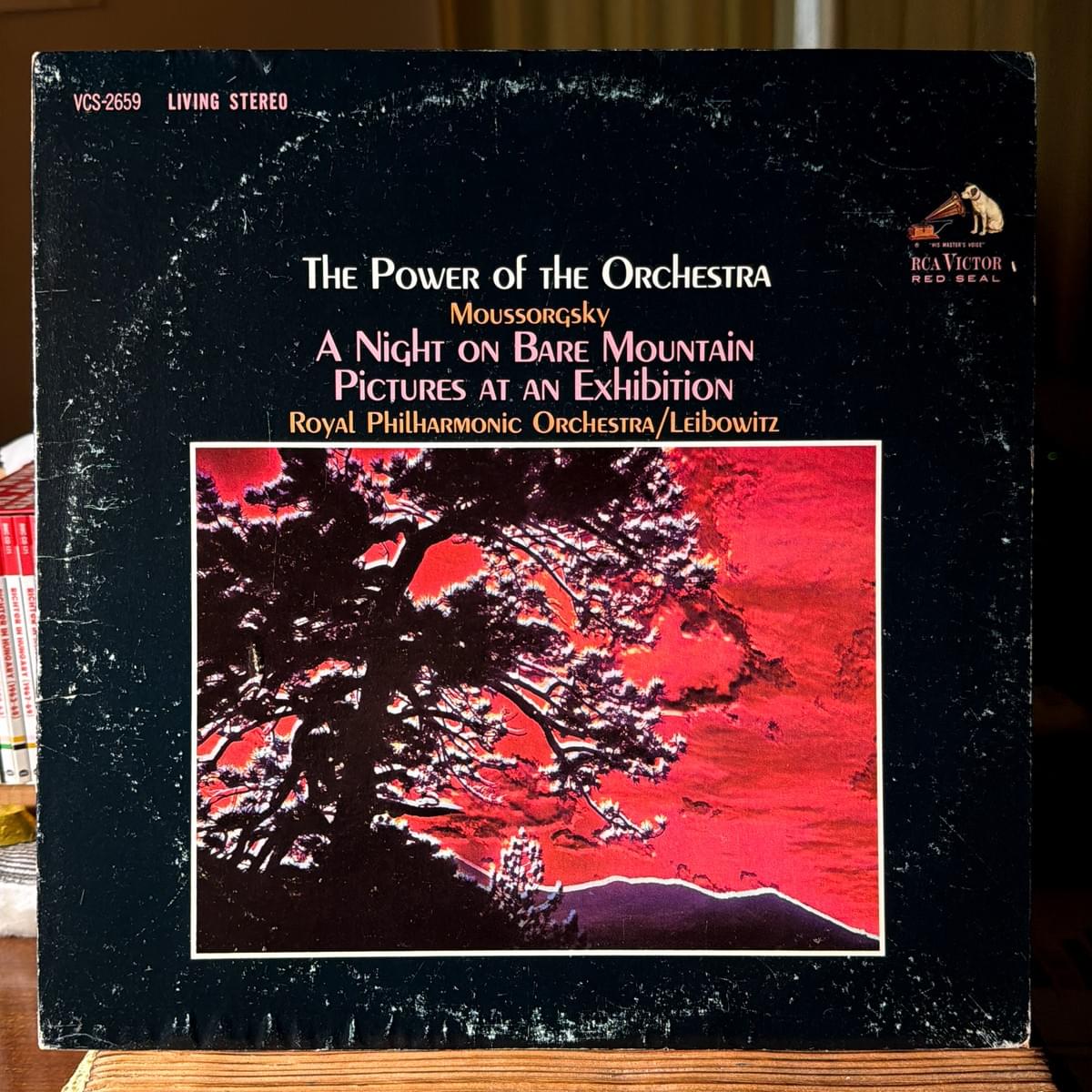
RCA Victor Red Seal VCS-2659|1963 年美國 Living Stereo 紅色影子狗深溝歷史首版
一張讓人困惑的唱片
我手上這張唱片,封面是一整片深黑,正中央嵌著一幅被染成火紅的松林與山稜。抽出唱片,紅色的標籤依然鮮豔,影子狗正側著頭,對著留聲機的喇叭聆聽。
標題只有幾個字:《管弦樂的威力》(The Power of the Orchestra)。
在美國發燒音響圈,這張唱片幾十年來被當作試金石。有人用它測試大鼓的低頻夠不夠沉,有人用它測試銅管會不會刺耳,它登上了美國《TAS(絕對之聲)》雜誌創辦人哈利·皮爾森(Harry Pearson,1937-2014) 那份傳奇的「超級唱片榜」。
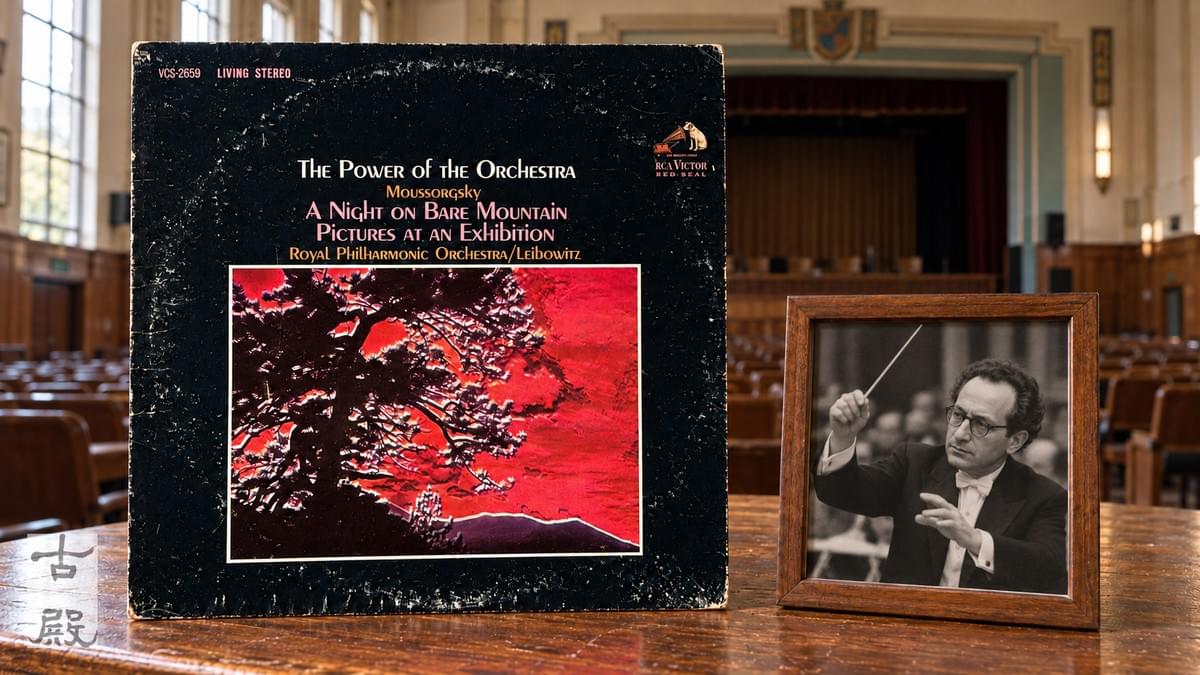
而指揮這張唱片的人,是勒內·萊布尼茲(René Leibowitz,1913-1972)。
如果你去問一位研究二十世紀音樂的學者,他會告訴你一個完全不同的萊布尼茲:戰後把荀柏格(Arnold Schoenberg,1874-1951) 的十二音音樂帶進法國的頭號推手,他是布列茲(Pierre Boulez,1925-2016) 的老師,寫過一本又一本艱深的理論專書,在德軍占領下的巴黎秘密授課的前衛作曲家。
一位以艱深前衛聞名的理論家,讓他名字流傳最廣的,卻是一張原本為《讀者文摘》郵購訂戶錄製的通俗名曲唱片,被發燒友拿來測喇叭。
這是怎麼回事?
答案藏在 1962 年倫敦東北郊的一座市政大廳(倫敦華森斯托大會堂(Walthamstow Assembly Hall))裡——那裡同時站著一位前衛作曲家、一支剛失去創辦人的樂團、一位美國唱片製作人,以及一位英國王牌錄音師。
一個不斷改寫自己履歷的人
萊布尼茲 1913 年生於波蘭華沙,父母是俄裔猶太人。一次大戰期間舉家遷往柏林,他十歲就以小提琴演奏者的身份登台;三年後全家移居巴黎,從此在法國落地生根。
二次大戰,德軍占領法國。他一度以外籍人士身份遭到拘留,沒能逃出去。之後的日子,他部分時間躲在巴黎,靠思想家喬治·巴代伊(Georges Bataille,1897-1962) 掩護;其餘時間與家人藏身在非占領區。就在那段隨時可能被搜捕的歲月裡,他做了一件事:秘密地教巴黎音樂院的學生。
戰爭一結束,那些在地下累積的手稿一口氣爆發。1947 年他出版《荀柏格與他的樂派》,兩年後又寫了十二音技法的入門專書。他兩度遠赴洛杉磯拜訪荀柏格,還替這位大師謄寫了《華沙倖存者》的總譜——一個在華沙出生的猶太人,親手抄寫一部紀念華沙猶太人的作品。戰後巴黎的年輕作曲家,布列茲、亨策(Hans Werner Henze,1926-2012),都曾在他門下。
故事到這裡,像是一部完美的前衛英雄傳記。但它還有一個轉折。
許多舊唱片解說與辭典都寫著:萊布尼茲師事荀柏格與魏本(Anton Webern,1883-1945),隨拉威爾(Maurice Ravel,1875-1937) 學配器,隨蒙都(Pierre Monteux,1875-1964) 學指揮。這些說法,今天大多已被學界推翻。
2001 年版《葛羅夫音樂辭典》指出,他自稱見過荀柏格、師事魏本,都沒有獲得證實;拉威爾與蒙都的權威傳記裡,也找不到他的名字。有音樂學者甚至說,關於他的可靠生平資料,幾乎不可能找到。
他真正可以查證的老師,是一位不太出名的作曲家艾利希·伊托·康(Erich Itor Kahn,1905-1956),1930 年代初在巴黎把荀柏格的技法介紹給他;另一位深刻影響他的人,是荀柏格的小舅子、小提琴家魯道夫·科利希(Rudolf Kolisch,1896-1978)。
一個替自己編造顯赫師承的人,聽起來像個騙子。但萊布尼茲對音樂的立場,卻剛好相反:他一輩子主張,演奏者必須回到作曲家寫下的文本。 他晚年的論文集,書名就叫《作曲家與他的分身》——演奏者,只是作曲家的分身。
這不是空談。1961 年,他與皇家愛樂管弦樂團為《讀者文摘》錄製貝多芬交響曲全集,是史上最早嘗試完全遵照貝多芬親筆節拍器速度的全集之一。當年英國樂評嫌它草率;三十多年後,美國音樂學者理查·塔魯斯金(Richard Taruskin,1945-2022) 卻認為,它在音樂上和學理上都勝過後來那些標榜「古樂考證」的錄音。
一個對自己的過去如此隨意的人,對作曲家的樂譜卻如此較真。記住這個矛盾,因為它正是這張唱片 A 面那首《荒山之夜》的鑰匙。
1867 年的一封信,和一個只存在於這道溝槽裡的版本
1867 年 7 月 12 日,穆索斯基(Modest Mussorgsky,1839-1881) 在一封信裡,興奮地描述他剛寫完的一部作品。這段話被完整印在這張唱片的封底:
「如果我沒記錯的話,女巫們會在荒山上集會,在撒旦降臨前喧鬧嬉戲。當撒旦現身時,她們便環繞在其寶座四周向他歌功頌德……嗯,我就是照這個脈絡譜寫的!」
他接著列出四個段落:集結與喧嘩、撒旦的行伍、淫穢邪惡的讚美、安息日狂歡。
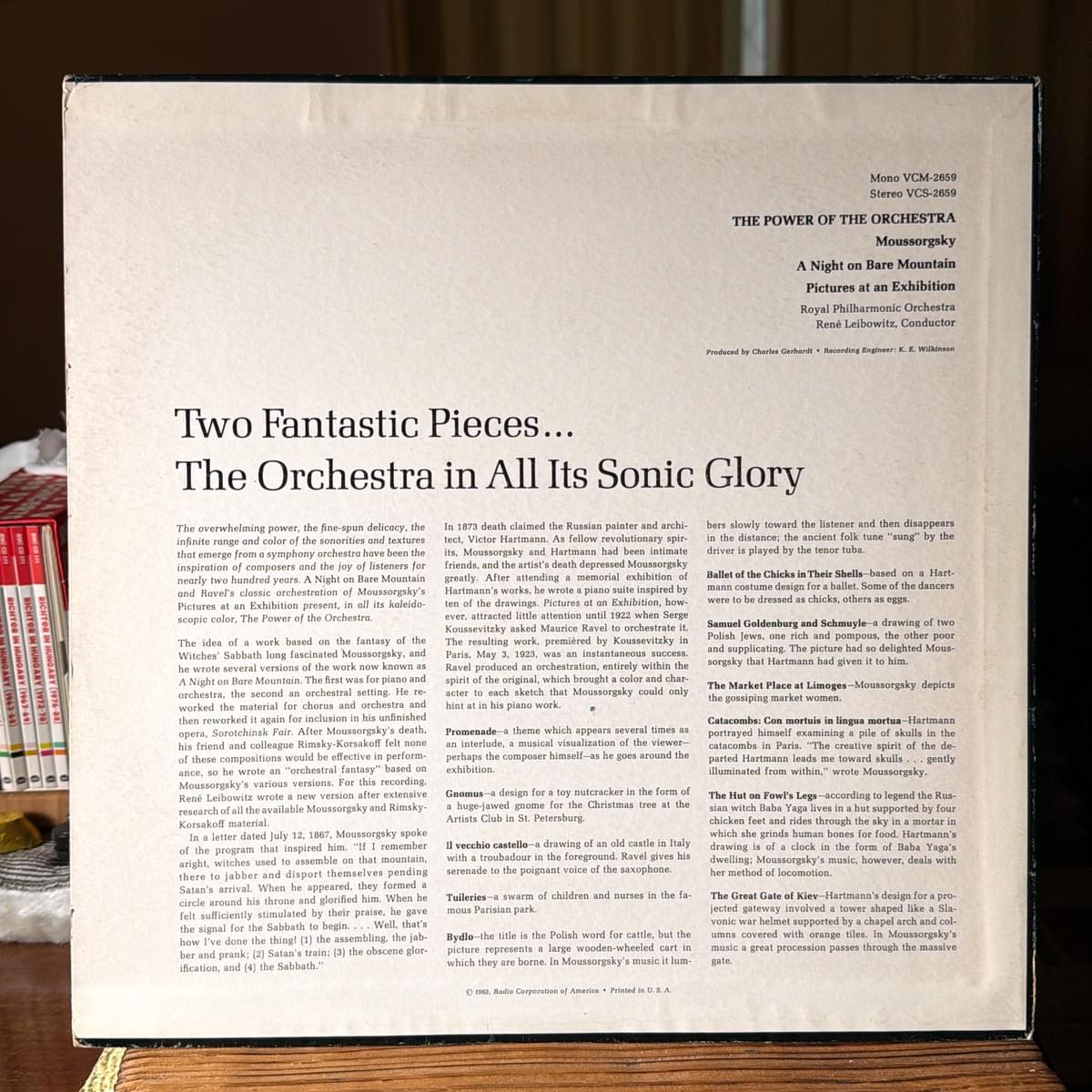
但我們今天在音樂廳裡聽到的《荒山之夜》,其實不是這個版本。封底解說寫得很清楚:穆索斯基一生把這個題材寫了好幾遍——鋼琴與管弦樂版、純管弦樂版、合唱與管弦樂版,最後還想塞進未完成的歌劇《索羅欽齊市集》。他死後,摯友林姆斯基-高沙可夫(Nikolai Rimsky-Korsakov,1844-1908) 認為這些版本都不適合演出,於是綜合各份草稿,寫成一部「管弦樂幻想曲」。
那段晨鐘響起、單簧管引出寧靜黎明的結尾,那個我們最熟悉的《荒山之夜》——其實是林姆斯基的《荒山之夜》。1940 年迪士尼動畫《幻想曲》裡的版本,也是從林姆斯基版改出來的。
然後,封底寫下了這張唱片解說最重要的一句話:
「在本次錄音中,指揮家勒內·萊布尼茲在對穆索斯基與林姆斯基-高沙可夫現存的所有文獻手稿進行廣泛深入的研究後,親自編寫了一個嶄新的詮釋版本。」
回到第二節那個矛盾。一個主張「作曲家文本至上」的人,面對一份被別人整理過的樂譜,他會怎麼做?萊布尼茲的答案是:繞過林姆斯基,回到穆索斯基自己留下的材料,重新拆解,重新組裝。
綜合各方聽評,這個版本開頭還算常規,越往後越狂放,比史托科夫斯基(Leopold Stokowski,1882-1977) 為迪士尼改編的版本更狂野。他加入了風聲器與雷聲板,結尾則完全重寫,不再是林姆斯基那段安詳的黎明。
評價兩極。有人覺得它比林姆斯基版更有道理,也有發燒樂評嫌它雜亂。但有一件事沒有爭議:萊布尼茲的《荒山之夜》,據目前所知,沒有其他指揮採用過,這張唱片幾乎就是它唯一的演奏錄音。
還有一個巧合值得一提。五年前的 1957 年,這張唱片的錄音師肯尼斯·威金斯(Kenneth E. Wilkinson,1912-2004),才剛為 RCA 錄下另一張發燒名盤《女巫的釀酒》,裡面收的正是林姆斯基版的《荒山之夜》。同一雙耳朵,錄下了兩個版本的女巫安息日。把兩張唱片放在一起聽,就是一堂最生動的配器課。
一場沒有公司高層盯著的錄音
要理解這張唱片為什麼會誕生,得先說一段唱片業的「分手」。
1957 年,美國 RCA 結束了與英國 EMI 長達 55 年的合作,轉而與英國 Decca 結盟。從此,RCA 在歐洲的許多錄音,都委託 Decca 錄製;而 Decca 往往派出它的王牌——錄音師威金斯。1959 年 RCA 那套著名的《皇家芭蕾》,就是 Decca 製作人與威金斯的作品。
這張唱片的身世更特別。封底寫著:製作人查爾斯·格哈特(Charles Gerhardt,1927-1999),錄音師 K. E. 威金斯。格哈特是 RCA 的人,1960 年被 Red Seal 部門派到英國,任務是替《讀者文摘》製作郵購古典唱片套裝——那些要寄進百萬個美國家庭客廳的唱片。現場的錄音工程,則由 Decca 借出的威金斯團隊負責。
美國人的製作判斷,英國人的錄音耳朵,在同一座大廳裡共事。 這是 RCA 與 Decca 結盟最深的一種形態。
《讀者文摘》的錄音有一個不尋常的條件:它請來的指揮,多半不受主要唱片公司的長約綁定。1962 年秋天,同一個團隊在倫敦華森斯托大會堂連續錄音,克利普斯(Josef Krips,1902-1974)、霍倫斯坦(Jascha Horenstein,1898-1973)、巴畢羅里(John Barbirolli,1899-1970)、萊納(Fritz Reiner,1888-1963) 輪番上陣。一位樂評人形容,這批錄音聽起來是「沒有公司高層干預」的 Decca 聲音。
萊布尼茲的《管弦樂的威力》,就在同一年、同一座大廳完成。唱片上只寫「Recorded in England」;後來的發燒再版商常說是金斯威廳,但較可靠的證據指向華森斯托——這座廳的聲音比較直接、結實,低頻特別有重量。
至於樂團,皇家愛樂當時正處於創團以來最危險的時刻。創辦人湯瑪斯·畢勤爵士(Sir Thomas Beecham,1879-1961) 1961 年 3 月去世,樂團頓失靠山;兩年後,它被迫改組為自治團體,失去了格林德堡歌劇節的駐節權,連「皇家」的名號都岌岌可危,直到 1966 年才由女王正式授予。
1962 年的皇家愛樂,是畢勤時代聲音的最後一抹餘暉。 那批由比徹姆親手挑選、各有鮮明個性的首席們,大多還在團裡;一年後,他們就陸續離開了。
一幅畫,一種聲音
唱片中演奏的另一首作品,背後是一場喪禮。
1873 年,俄羅斯畫家兼建築師維克托·哈特曼(Viktor Hartmann,1834-1873) 猝逝。封底解說說,他與穆索斯基是「志同道合的革命性藝術靈魂」,是無話不談的摯友;朋友的早逝讓穆索斯基深陷悲痛。在參觀了哈特曼的紀念畫展之後,他挑了其中十幅畫,寫成一套鋼琴組曲。
這部《展覽會之畫》在作曲家生前幾乎沒人注意。半個世紀後的 1922 年,指揮家庫塞維茲基(Serge Koussevitzky,1874-1951) 委託拉威爾把它改編成管弦樂;1923 年 5 月 3 日在巴黎首演,一舉轟動。解說寫得很精準:拉威爾為每一幅素描,賦予了穆索斯基當年在鋼琴上只能「隱約暗示」的色彩與性格。
拉威爾的方法,是一幅畫,換一種聲音。 這張唱片的解說,就像一份逐幅導覽:
- 〈古堡〉,義大利古城前的吟遊詩人——拉威爾把這首憂傷的小夜曲,交給了交響樂團裡極少登場的薩克斯風。
- 〈牛車〉,一輛巨大木輪的牛車從遠方轆轆駛來,又消失在遠方——車夫哼唱的古老民謠,由次中音低音號吹出。
- 〈富人與窮人〉,兩位波蘭猶太人,一個傲慢,一個卑微。解說裡藏著一個動人的小細節:這幅畫讓穆索斯基愛不釋手,哈特曼便親手把畫送給了他。
- 〈墓穴〉,哈特曼提著燈,凝視巴黎地下墓穴裡堆積的頭骨。穆索斯基在樂譜上寫下一句話:亡友的創造性靈魂,正引領著他走向那些頭骨,頭骨由內散發出柔和的微光。
- 〈基輔大門〉,一座從未建成的城門。哈特曼畫了,城門卻沒有蓋;穆索斯基用音樂,替亡友把它蓋了起來。
這部作品,正是為「獨奏者」寫的協奏曲。每一位首席都要在自己的那幅畫裡站出來。而 1962 年的皇家愛樂,那批比徹姆留下來的首席,正適合這種一幅畫換一種音色的作品。
萊布尼茲的處理,延續他「文本至上」的立場:不拖沓、不浪漫地延宕,全曲兩面合計約 31 分 40 秒,屬於緊湊的一派。美國洛杉磯發燒唱片行 Better Records 的老闆湯姆·波特(Tom Port)——一位以逐張試聽比較同一張唱片不同壓片聞名的唱片商——說得直接:萊布尼茲「照譜直演」,而這正是他喜歡的方式。
還有一個只有拿著黑膠才會注意到的設計:A 面在〈牛車〉結束。 那輛牛車從遠方駛近、再消失於遠方的時刻,唱針正好走到唱片最內圈,聲音隨之淡出;翻到 B 面,第四次〈漫步〉重新響起,觀畫者走向下一個展間。
這張黑膠會自己說故事
把唱片拿在手上,它自己會說出很多事。
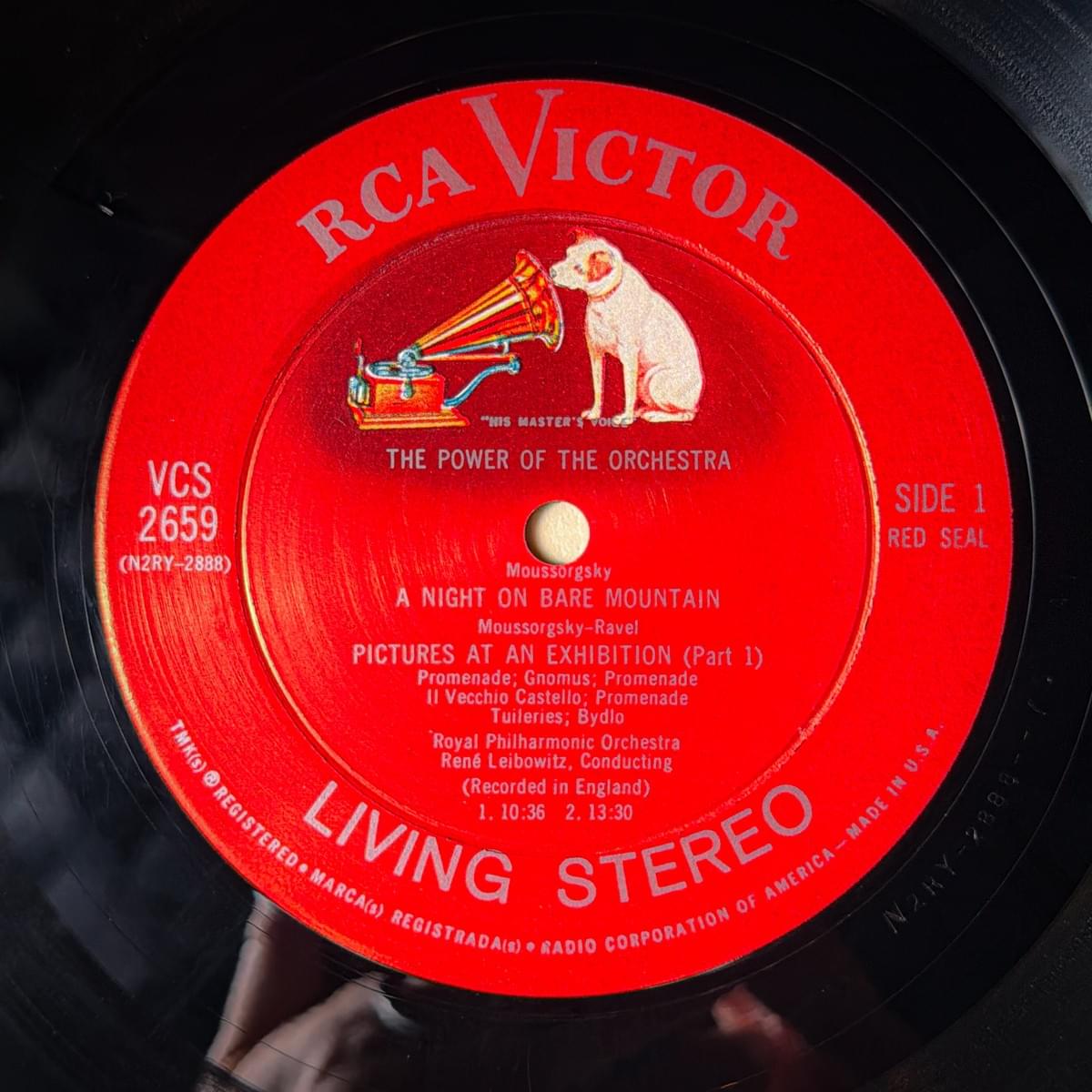
編號:VCS-2659。 RCA 那個時期的立體聲古典唱片,幾乎都用 LSC 字頭;這張卻是整個號段裡唯一用 VCS 的單張唱片。原因至今沒有官方說明。美國收藏家推測,它原本是為《讀者文摘》套裝錄製,後來才轉由 RCA 單獨推出,V 字或許代表某種販售方案——但這只是推測。封底同時印著單聲道版的編號 VCM-2659。
標籤:紅色影子狗標。 紅底銀字,尼普狗背後有一圈較深的紅色漸層,底部印著 LIVING STEREO。這是 RCA 第一代立體聲標籤,收藏界稱為「影子狗」(Shaded Dog)。
影子狗本身,就是一個證據。 RCA 與 EMI 分手後,影子狗商標在美國以外大多屬於 EMI 旗下的 HMV;RCA 唱片在英國經 Decca 發行時,不能用影子狗。所以標籤上這隻側耳傾聽的狗,說明這是一張為美國市場壓製的唱片——錄在英國,刻片壓片在美國。
刻版號:N2RY-2888 與 N2RY-2889。 開頭的 N,在 RCA 的編碼裡代表 1963 年;封底版權年也是 1963。標籤、刻版、封套三方互相印證,這是首版世代的壓片。
在拍賣資料上,這張唱片的美國首版有四百多筆成交紀錄。片況若是保存比較好的,最近幾年價格,大約在 186 到 292 美元之間。
一張發燒名盤的六十年
這張唱片的名聲,是一層一層疊上去的。
1963 年,RCA 自己就把它當音響示範片來賣,所以名為:《管弦樂的威力》。封底大標題寫著:「兩首奇幻名作……聲響極致輝煌的管弦樂世界」。從出生那天起,它的賣點就不是「又一個詮釋」,而是「錄音本身」。
1980 年代末,美國發燒廠牌 Chesky 取得 RCA 的母帶授權重新刻片,這個再版本登上了皮爾森的《TAS(絕對之聲)》超級唱片榜。之後是一連串的復刻:日本的 24bit CD、Analogue Productions 的 SACD、45 轉雙張、200g 的 33 轉、15ips 開盤帶,甚至還有單面 45 轉的製作——同一份 1962 年的磁帶,被一代又一代的刻片師重新回答。
發燒圈的共識,集中在三件事上。前面提到的 Better Records 老闆湯姆·波特,在評論中描述得最具體:明亮的銅管能穿透整個樂團,卻一點也不刺耳;動態聽起來幾乎沒有壓縮,該大聲時真的大聲;全曲大量的大鼓重擊沒有被削頂——他指出,那個年代的真空管刻片放大器常在大鼓處力不從心,這張卻是少數例外。這三點,正好就是華森斯托大會堂的聲音性格。
但這張唱片的故事裡,有一個很少人注意的細節:登上超級唱片榜的,是 Chesky 的再版,不是 RCA 的原版。 拍賣網站上,原版的標題常常寫著「TAS」,借用的其實是再版的榮譽。
更耐人尋味的是,評價從來不是一面倒。《TAS(絕對之聲)》2010 年評 45 轉版,音效給滿分,音樂只給 3.5 分;有買家給一星,說演奏平庸,不如回去聽萊納;波特自己則前後翻案好幾次,先是喜歡,後來說自己看走眼,近年又對某張立體聲版不滿意。他還發現,被冷落的單聲道版 VCM-2659,樂器的實體感反而比他聽過的任何立體聲錄音都強。
波特說過一句話:所謂原版,從來不只一張,而是成千上萬張,每一張聽起來都不一樣。他說的是聲音——不同的母版序號、不同的壓片批次、六十年來不同主人的使用方式,讓每一張原版的聲音各有差異。
但聲音的差異,改變不了一件事:無論後世再版多少次、刻得多乾淨,真正的 1963 年歷史首版,就只有一種。 再版是後人對那份磁帶的重新回答;首版卻是錄音同時代的耳朵、同時代的刻片機與壓片,在 1963 年直接留下的物理結果,是這條傳承鏈唯一的起點。後世可以複製聲音,卻無法複製那個年代。每一份版本的聲音或許各不相同,但它們同屬那唯一的一次誕生。
******
【Gudian Music Stories】Pierre Boulez’s Mentor, Celebrated Most for a Speaker Test Disc: René Leibowitz (1913–1972) and The Power of the Orchestra
RCA Victor Red Seal VCS-2659 | 1963 US Living Stereo "Shaded Dog" Deep-Groove Original First Pressing
A Perplexing Artifact
The album before me features a jet-black jacket framing a central painting of pines and mountain ridges bathed in fiery crimson. Slipping the vinyl from its sleeve reveals a vivid red label: Nipper the dog tilts his head attentively toward the gramophone horn against a shaded backdrop.
The title is bold and unadorned: The Power of the Orchestra.
In American audiophile circles, this LP has reigned as a definitive reference disc for decades. Listeners spin it to test whether the subterranean weight of the concert bass drum holds firm, or whether massed brass tuttis glare and shatter under pressure. It earned a spot on the late Harry Pearson’s (1937–2014) legendary The Absolute Sound (TAS) Super LP List.
Yet the man on the podium was René Leibowitz (1913–1972).
Mention his name to a scholar of twentieth-century music, and you will hear of a completely different figure: the foremost postwar advocate who introduced Arnold Schoenberg’s (1874–1951) twelve-tone method to France; the exacting teacher of Pierre Boulez (1925–2016); the author of rigorous theoretical treatises; and the avant-garde composer who held clandestine seminars under the Nazi occupation of Paris.
How did an uncompromising modernist theoretician become famous for a set of orchestral warhorses originally cut for a mail-order Reader's Digest box set, treasured above all by audiophiles testing their stereo rigs?
The answer lies in Walthamstow Assembly Hall in the northeast suburbs of London in the autumn of 1962—where an avant-garde composer, an orchestra mourning the recent loss of its founder, an American producer, and a peerless British balance engineer converged on a single stage.
A Man Continually Rewriting His Own Biography
Leibowitz was born in Warsaw in 1913 to Russian-Jewish parents. During the First World War, the family relocated to Berlin, where he debuted on the concert stage as a violin prodigy at age ten. Three years later, they moved to Paris, putting down permanent roots in French soil.
When German forces occupied France during World War II, Leibowitz was briefly interned as a foreign national. Failing to escape the country, he lived precariously: part of the time in Paris under the shelter of philosopher Georges Bataille (1897–1962), and the remainder hidden with family in the unoccupied zone. Under the constant shadow of arrest, he continued to teach students from the Conservatoire de Paris in secret.
With the Liberation, his accumulated underground manuscripts erupted into print. In 1947, he published Schoenberg and His School, followed two years later by an introductory manual on twelve-tone technique. He made two pilgrimages to Los Angeles to visit Schoenberg, serving as an amanuensis who copied the master’s full score of A Survivor from Warsaw—a Warsaw-born Jew transcribing a monumental musical memorial to the Warsaw Ghetto. In postwar Paris, the vanguard of young composers—including Pierre Boulez and Hans Werner Henze (1926–2012)—passed through his studio.
The story reads like a heroic modernist narrative, but it carries an intriguing fold.
Numerous early liner notes and biographical dictionaries claim that Leibowitz studied with Schoenberg and Anton Webern (1883–1945), learned orchestration from Maurice Ravel (1875–1937), and studied conducting under Pierre Monteux (1875–1964). Modern scholarship has largely debunked these claims.
The 2001 edition of The New Grove Dictionary of Music and Musicians points out that his claims of studying with Webern or meeting Schoenberg in the interwar years lack corroborating evidence; authoritative biographies of Ravel and Monteux contain no record of his name. One musicologist went so far as to remark that reliable biographical facts about Leibowitz are nearly impossible to pin down.
His only verified early mentor was Erich Itor Kahn (1905–1956), an overlooked composer who introduced him to Schoenbergian serialism in Paris in the early 1930s. Another major influence was Schoenberg’s brother-in-law, violinist Rudolf Kolisch (1896–1978).
A figure who embellished his pedigree might easily be mistaken for a charlatan. Yet Leibowitz’s artistic convictions were the exact reverse: throughout his life, he insisted that a performer’s sole duty was unswerving fidelity to the composer’s written text. His late collection of essays was titled The Composer and His Double—the performer, in his eyes, was merely the composer’s mirror.
This was no armchair philosophy. In 1961, he recorded a complete Beethoven symphony cycle with the Royal Philharmonic Orchestra for Reader's Digest, standing as one of the earliest recorded traversals to adhere strictly to Beethoven’s original metronome markings. British critics at the time dismissed the tempos as rushed; more than thirty years later, musicologist Richard Taruskin (1945–2022) argued that Leibowitz’s cycle surpassed later historically informed period-instrument sets in musical and scholarly validity.
A man so casual about his personal history proved fiercely uncompromising before the notes on the page. Keep that tension in mind: it is the master key to the idiosyncratic reading of Night on Bald Mountain on Side One.
An 1867 Letter and a Score Etched Solely into These Grooves
On July 12, 1867, Modest Mussorgsky (1839–1881) wrote an enthusiastic letter describing a piece he had just finished. The excerpt is printed in full on the rear sleeve of this LP:
"If my memory does not deceive me, the witches used to gather on this mountain... gossiping, and making fun, in anticipation of Satan's arrival. When he appeared they formed a circle around his throne, and sang his praises... Well, that is the way I did it!"
He outlined four distinct episodes: the assembly and chatter, the procession of Satan, the unholy praise, and the Sabbath revelry.
Yet the Night on Bald Mountain performed in modern concert halls is not that score. The jacket notes trace its winding history: Mussorgsky reworked the material repeatedly—for piano and orchestra, pure orchestra, vocal chorus with orchestra, and finally as an interpolated episode in his unfinished opera The Fair at Sorochyntsi. Following his death, his close friend Nikolai Rimsky-Korsakov (1844–1908) deemed the surviving fragments unplayable in their raw form, collating them into an orchestral tone poem.
That familiar version—where church bells sound, and a tranquil clarinet ushers in a serene dawn—is essentially Rimsky-Korsakov’s conception. The version heard in Walt Disney’s 1940 animated feature Fantasia was adapted from Rimsky's score.
The liner notes then offer the crucial key to this release:
"For this recording, the conductor René Leibowitz, after making a study of the available manuscripts of both Mussorgsky and Rimsky-Korsakov, has made a completely new version."
Here, the paradox returns. When a musician who advocates literal fidelity to the composer’s intent encounters a score smoothed over by an editor, what does he do? Leibowitz chose to bypass Rimsky-Korsakov, returning directly to Mussorgsky’s surviving primary sketches to deconstruct and reassemble them afresh.
Critical reactions describe an interpretation that begins conventionally, only to veer into wild, unchecked frenzy—surpassing even Leopold Stokowski’s (1882–1977) cinematic adaptation for Disney. Leibowitz added wind machines and thunder sheets, completely rewriting the ending to omit Rimsky’s pastoral dawn in favor of an unsettled close.
Reactions have been divided: some find it far truer to Mussorgsky’s spirit than Rimsky’s polished tone poem, while certain audiophile critics found it chaotic. One fact remains undisputed: Leibowitz’s distinctive edition has never been taken up by any other conductor. This recording stands as its sole commercial document.
A historical coincidence links this disc to another classic. Five years earlier, in 1957, balance engineer Kenneth E. Wilkinson (1912–2004) engineered the celebrated audiophile benchmark Witches' Brew for RCA, which featured Rimsky-Korsakov’s standard edition of Night on Bald Mountain. The same set of ears captured two radically different incarnations of the Witches' Sabbath. Listening to them back-to-back offers an instructive masterclass in orchestration.
A Session Free of Corporate Interference
To understand the origin of this album, one must revisit a pivotal corporate divorce in the recording industry.
In 1957, RCA Victor severed its 55-year partnership with British EMI, forming an alliance with British Decca. From that point on, RCA’s European sessions were contracted to Decca, which dispatched its premier production teams—led by balance engineer Kenneth Wilkinson. RCA’s 1959 recording of The Royal Ballet was the product of a Decca production team and Wilkinson’s engineering.
This release had a distinctive pedigree. The sleeve credits Charles Gerhardt (1927–1999) as producer and K. E. Wilkinson as engineer. Gerhardt was an RCA executive dispatched to London in 1960 by the Red Seal division to supervise classical subscription box sets for Reader's Digest—albums bound for millions of American homes. On the floor, the engineering was handled by Wilkinson’s Decca team.
American production judgment paired with British balance engineering inside the same hall represented the peak of the RCA-Decca partnership.
The Reader's Digest sessions enjoyed an unusual artistic advantage: the roster featured conductors who were not tied to long-term exclusive contracts with major labels. In the autumn of 1962, this team held sustained sessions at Walthamstow Assembly Hall, rotating through Josef Krips (1902–1974), Jascha Horenstein (1898–1973), Sir John Barbirolli (1899–1970), and Fritz Reiner (1888–1963). One critic described these recordings as "the Decca sound free from corporate meddling."
Leibowitz’s The Power of the Orchestra was completed that same autumn in the same hall. The jacket notes tersely state: "Recorded in England." While later reissue notes frequently point to Kingsway Hall, reliable evidence indicates Walthamstow Assembly Hall—a venue noted for its direct, visceral presentation and exceptional bass extension.
The Royal Philharmonic Orchestra was navigating the most precarious crisis in its history. Its founder, Sir Thomas Beecham (1879–1961), had died in March 1961, depriving the ensemble of its artistic and financial protector. Two years later, the orchestra was forced to reorganize as a self-governing body, losing its residency at the Glyndebourne Festival and seeing its royal title called into question until Queen Elizabeth II formally confirmed it in 1966.
The 1962 Royal Philharmonic captured on this disc represents the twilight of the Beecham era. The principal desks handpicked by Beecham were still largely intact; within a year, they would disperse.
One Canvas, One Timbre
The companion piece on the program grew out of mourning.
In 1873, Russian painter and architect Viktor Hartmann (1834–1873) died suddenly at thirty-nine. The sleeve notes describe him and Mussorgsky as kindred revolutionary spirits; Hartmann’s death plunged Mussorgsky into grief. Following a memorial exhibition of Hartmann’s sketches and watercolours, Mussorgsky chose ten subjects to weave into a piano suite.
Pictures at an Exhibition attracted little notice during the composer’s lifetime. Half a century later, in 1922, conductor Serge Koussevitzky (1874–1951) commissioned Maurice Ravel to orchestrate the work, unveiling it in Paris on May 3, 1923, to immediate acclaim. As the liner notes observe, Ravel realized the colors and dramatic character that Mussorgsky had sketched at the keyboard.
Ravel’s method was to match each canvas to a distinct orchestral timbre. The liner notes serve as a gallery guide:
- "The Old Castle": A troubadour sings before an Italian fortress—Ravel assigns the melancholic serenade to the alto saxophone, an instrument rarely featured in a classical symphony orchestra.
- "Bydło": A massive wooden-wheeled oxcart trundles from the horizon and fades into the distance—the peasant's chant voiced by the solo euphonium/tuba.
- "Two Polish Jews, One Rich, the Other Poor": Hartmann gave this original sketch to Mussorgsky as a personal gift after the composer admired it at the exhibition.
- "Catacombs": Hartmann depicts himself holding a lantern among Parisian catacombs. Mussorgsky wrote in the margin that the spirit of his departed friend was leading him toward the skulls, which glow faintly from within.
- "The Great Gate of Kiev": A monument designed on paper that was never built. Mussorgsky used sound to erect the gate his friend could not finish in stone.
The score functions as a concerto for orchestral principals, demanding that each desk step forward in turn. The 1962 Royal Philharmonic, retaining Beecham’s principal players, was well suited to this showcase of contrasting colors.
Leibowitz’s interpretation reflects his objective stance: free of romantic indulgence, pacing the entire score in roughly 31 minutes and 40 seconds. Tom Port, proprietor of the Los Angeles audiophile clearinghouse Better Records—noted for evaluating original pressings through comparative shootouts—summarized it directly: Leibowitz plays the score straight, with rhythmic precision.
A mechanical detail appears on the vinyl surface: Side A concludes with "Bydło." As the oxcart disappears into the distance, the stylus nears the inner groove as the music fades away. Turning to Side B, the Promenade sounds anew as the listener enters the next gallery.
An Artifact That Speaks for Itself
Examining the physical LP reveals several historical markers:
- Catalog Number (VCS-2659): RCA’s stereo classical releases of this era used the "LSC" prefix; this disc is the only single release across the block to carry the "VCS" designation. While no official documentation explains the prefix, collectors deduce that because it was tracked for Reader's Digest before being issued under RCA Red Seal, the "V" designated a special release status. The rear sleeve also lists the monaural catalog number, VCM-2659.
- Label (The "Shaded Dog"): Red paper with silver type, featuring Nipper set against a shaded crimson gradient, anchored by the words LIVING STEREO along the lower rim. This represents RCA’s first-generation stereo label.
- Trademark Significance: Following RCA’s separation from EMI, the dog trademark outside the United States belonged largely to EMI’s HMV imprint; British pressings manufactured by Decca could not display the Nipper emblem. The Shaded Dog confirms that this vinyl was mastered and pressed in the United States for the domestic market, from tapes tracked in Great Britain.
- Matrix Numbers (N2RY-2888 and N2RY-2889): The prefix letter "N" denotes the year 1963 in RCA Victor's internal dating system, matching the copyright date on the rear jacket. Label, matrix, and sleeve corroborate this copy as an authentic first-generation pressing.
Auction registries document over four hundred verified sales of the original US first edition. Clean copies have changed hands between $186 and $292 USD in recent years.
Sixty Years of an Audiophile Icon
The album's critical reputation grew in layers.
In 1963, RCA marketed the LP as an acoustic showpiece under the title The Power of the Orchestra, with the rear jacket proclaiming: "Two fantastic masterpieces... A dazzling panorama of orchestral sound." From its inception, its commercial identity was rooted in engineering rather than interpretive nuance.
In the late 1980s, the American audiophile label Chesky Records licensed the original analog tapes to recut the title, earning a place on Pearson’s TAS Super LP List. A succession of high-end reissues followed: Japanese 24-bit compact discs, Analogue Productions SACDs, dual 45 RPM sets, 200g 33⅓ RPM recuts, 15 ips reel-to-reel tapes, and single-sided 45 RPM pressings.
Audiophile consensus centers on three attributes: brass brilliance that cuts through the ensemble without glare; dynamic range free of audible compression; and unrestrained bass drum impacts that avoid tape or cutterhead saturation. As Tom Port observed, mid-century vacuum-tube cutting amplifiers often softened under heavy bass drum transients; this cut remains an exception. These traits reflect the acoustic signature of Walthamstow Assembly Hall.
Yet a key detail is often overlooked: the edition inducted into the TAS Super LP List was the Chesky reissue, not the 1963 RCA original. Secondary market dealers routinely apply the "TAS" label to original pressings, borrowing the honor won by the remaster.
Critical opinion has fluctuated. Reviewing the 45 RPM reissue in 2010, The Absolute Sound awarded full marks for audio fidelity while giving the performance 3.5 stars. Certain collectors dismiss the reading as workmanlike compared to Fritz Reiner’s Chicago Symphony account. Port revised his assessment multiple times over the years, while noting that the mono issue (VCM-2659) offers an instrumental weight that rivals its stereo counterparts.
Port noted that an original pressing is never a single uniform entity; variations in stampers, plating runs, and decades of play wear yield distinct sound profiles across surviving copies.
Yet despite these differences, the 1963 first pressing remains a unique historical document. Modern reissues represent later reassessments of that master tape; the original pressing embodies the ears, cutterheads, and vinyl formulations of 1963. While later generations can remaster the audio, the material circumstances of its birth cannot be repeated.