
【古殿唱片音樂故事】為了錄《彌賽亞》找了五年場地:寶碟 Proprius 與它的瑞典錄音哲學
古殿殿主
找了五年,才找到對的教堂
曾經,瑞典有一家唱片公司,為了錄韓德爾(George Frideric Handel,1685-1759)的《彌賽亞》,花了整整五年尋找合適的場地。這五年裡,沒有任何一個空間符合他們的耳朵。
於是他們做了一個今天幾乎不可能的決定:不將就。
沒有「先在錄音室湊合」,沒有「換個差不多的教堂」,就是繼續找。
最後,他們找到了一座適合的教堂。那是斯德哥爾摩的阿道夫·弗雷德里克教堂(Adolf Fredriks kyrka)。1982 年 2 月 13、14 日,他們趁著現場演出,把韓德爾的《彌賽亞》錄了下來,做成三張一套的黑膠盒裝(PROP 7871-73)。指揮是安德斯·厄爾瓦爾(Anders Öhrwall,1932-2012),演出者是斯德哥爾摩巴赫合唱團與瑞典廣播交響樂團的成員;獨唱是伊馮·肯尼(Yvonne Kenny,1950-)、保羅·埃斯伍德(Paul Esswood,1942-)、馬丁·希爾(Martyn Hill,1944-)與馬格努斯·林登(Magnus Lindén)。五年的等待,換來的是一個對的空間。
這家公司叫 Proprius,香港當年的譯名是「寶碟」,拉丁文的意思是「特有的」。
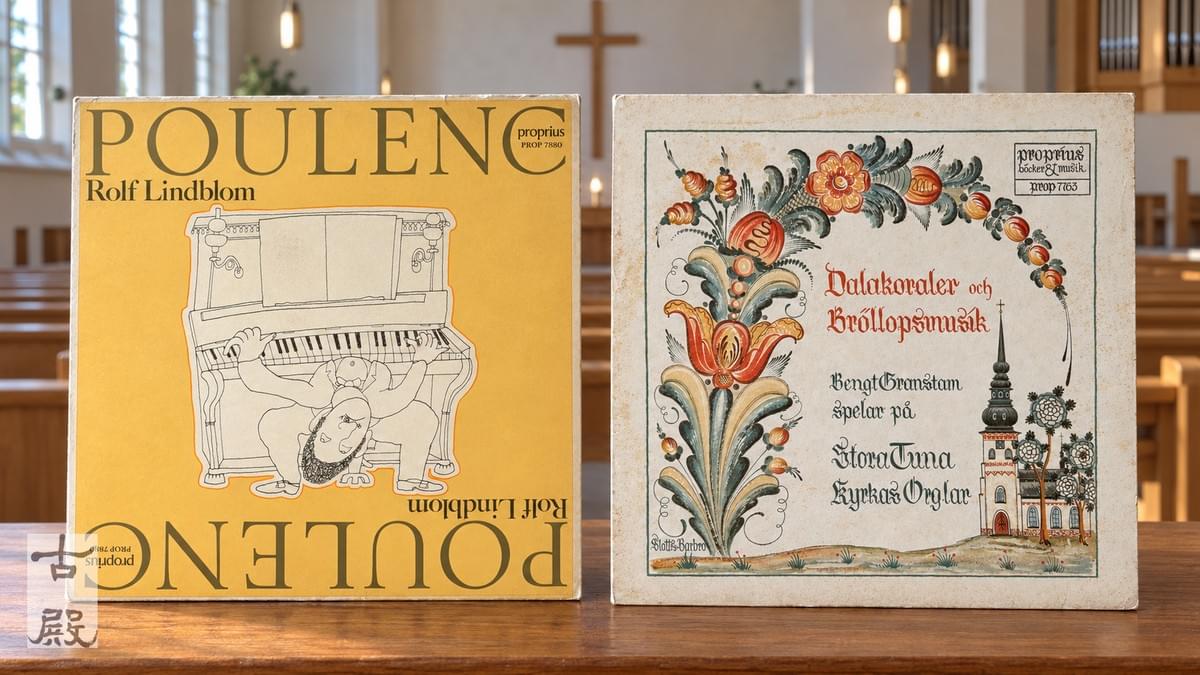
「古殿」手邊有兩張它們出版的黑膠。一張是 1976 年的管風琴唱片《達拉那眾聖歌與婚禮音樂》(PROP 7763),封面是一幅達拉那民俗彩繪;另一張是 1982 年的鋼琴唱片《普朗克》(PROP 7880),封面是尚·考克多(Jean Cocteau,1889-1963)筆下一個倒懸在鋼琴上的漫畫人物。一張錄在瑞典中部鄉間的大教堂,一張錄在斯德哥爾摩的教堂,相隔六年,但負責錄音的是同一個人。
這篇文章想說的是:Proprius 不只是「教堂之聲」、「當鋪爵士」、「麥田之歌」。它的理念與實作,成就了一家非凡的廠牌,也留下了許多同樣精彩、卻少有人提起的作品。
我們先從兩個問題開始:什麼樣的人,會為了一個對的空間,等上五年?以及,為什麼半世紀後,世人只記得這家廠牌的寥寥幾張唱片?
一家出版社長出來的唱片廠
Proprius 不是一開始就想當唱片公司。
它的母體 Proprius förlag 是出版社,1963 年由雅各布·博埃修斯(Jacob Boëthius,1925-2005)創立,原本出版的是歷史與宗教文獻。1969 年,出版社才分出唱片部門,一開始錄的是合唱與管風琴;後來逐步擴大,走向以外銷為主的發燒唱片路線。
這條血緣,在兩張唱片上都看得到。
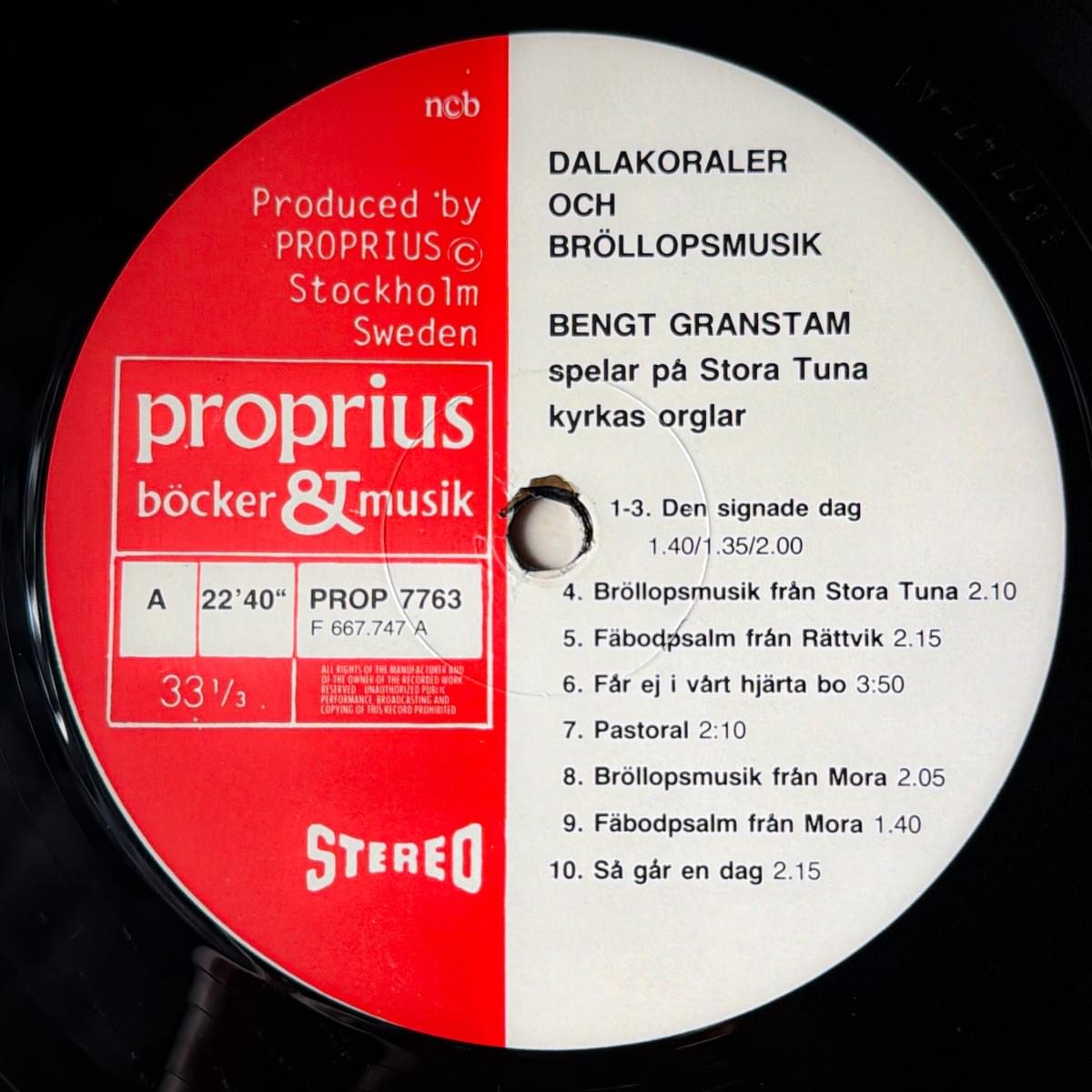
1976 年的 PROP 7763,封面與標籤上印的是「Proprius böcker & musik」——書與音樂;版權頁寫的是「Proprius förlag AB」,也就是「出版社」。六年後的 1982 年,PROP 7880 的版權頁已經改成「Proprius Musik AB」,書不見了,只剩音樂。同一家公司,在這六年之間,從出版社變成了純粹的唱片公司。
也因此,Proprius 的錄音目錄裡,管風琴、合唱、宗教音樂與艱深的中古音樂佔了很高的比例。它的出發點更接近一種文化出版——把值得留下來的東西,用最誠實的方式留下來——而不是音樂工業。
1990 年前後,Proprius 進行組織重整,旗下的爵士副廠牌 Prophone 獨立成公司,這家廠牌在 1990 年代初期走入歷史。時間點並不是巧合:那正是「全球化」席捲唱片工業的年代。
全球化帶來的,是一種以商業為唯一對價的全球商業模式:一切都要考慮市場,賺錢才是王道。
在那之前,世界各地有許多區域性的小廠,可以不計成本,只為了某個地區、某一種理念,讓一小批認同的人支持。Proprius 就是這樣的廠牌。當唱片工業被整併進同一套邏輯,「只為一小批人而存在」的空間,就消失了。
Proprius 還有一條不成文的理念:曲目可以不是瑞典的,人必須是瑞典的。
古典之外,爵士、世界民族音樂都在它的錄音範圍裡;但演奏與演唱的人員,錄音與製作的人員,幾乎都是瑞典在地的人。
兩張唱片正是如此。PROP 7880 錄的是法國作曲家的作品,彈的卻是瑞典鋼琴家林德布洛姆(Rolf Lindblom,1944-),錄音在斯德哥爾摩的教堂,封套上列出的其他工作人員,也幾乎都是瑞典人名。PROP 7763 則整張都是達拉那自己的歌:由大圖納自己的管風琴師,在大圖納自己的教堂裡演奏,連封面都出自當地畫家之手。
連那份《彌賽亞》也是這個思路:主要的音樂演奏團隊,指揮、合唱團與樂團,都是瑞典的。
世界的音樂,由本地的人與耳朵來完成。
這條理念還有一個很實際的結果:它讓瑞典本地的音樂家,多了更多演奏與演唱的機會,也多了增加收入的方式。
這是區域小廠才做得到的事。它不是靠市場,而是用一張一張的錄音,把在地的音樂人留在在地。
麥克風越少越好,空間才是樂器
Proprius 的錄音器材,其實沒有任何特別之處。用的就是當時業界的標準設備。
真正特別的是理念,說白了就是四個字:不加味精。
七〇年代,大廠牌流行在宣傳裡誇耀自己用了二十四支、甚至三十六支麥克風,錄完再慢慢調音、修飾、加殘響。Proprius 的做法剛好相反:麥克風越少越好,能用兩支就不用三支,如果可以,寧願只用一支。
但比麥克風數量更重要的,是:場地。
他們幾乎不在錄音室錄音,而是去找真實存在的空間:古老的教堂,或是一般的生活空間。空間本身,就是樂器的一部分。找不到對的空間,寧可再等——《彌賽亞》的五年,就是這麼來的。最後,他們找到一座適合的教堂,以現場演奏的方式錄下了它。
兩張唱片裡,這個選擇看得很清楚:
- PROP 7763:1976 年 5 月 31 日與 6 月 1 日,直接在達拉那的大圖納教堂(Stora Tuna kyrka)現場錄製。這座教堂 1469 年啟用,可容納七百人,是瑞典最大的鄉村教堂之一。
- PROP 7880:1982 年 9 月 5 日至 7 日,在斯德哥爾摩的阿伯拉罕斯貝格教堂(Abrahamsbergskyrkan)錄製。鋼琴用的是演奏者自己收藏的一台 1919 年出廠的史坦威 C 型。
同一個思路,兩種做法:一個把整座教堂的管風琴與石造空間一起錄下來;另一個沒有追求最新的琴,而是用演奏者自己的老琴,一台比 1936 年完成的這首作品還早誕生十幾年的 1919 年史坦威。
連唱片本身,都帶著這種「對聲音負責」的態度。PROP 7763 的封底印著一行小字,大意是:請使用唱頭所允許的最高針壓播放,以避免失真。他們在意的,不只是把聲音錄下來,還有聲音被播放出來的那一刻。
這件事今天幾乎不可能再發生了。一家公司願意為了一個空間等五年、用一台老琴去錄一首老作品、為了不失真而在封底叮嚀你調整針壓——這需要的不是預算,而是一種不把音樂當商品的固執。
一老一少,和兩段自白
Proprius 的錄音現場,流傳著「一老一少」的搭檔:一位經驗豐富的資深者,一位拼勁十足的年輕人,兩人都對音樂與錄音懷抱同樣的熱情。
那位資深者,就是創辦人博埃修斯(Jacob Boëthius)本人。他不只是坐在辦公室的出版商,據說也親自下場參與錄音現場的判斷。
年輕的那一位,是貝蒂爾·阿爾文(Bertil Alving,1952-)。兩張唱片的封底,錄音工程師都掛著他的名字,PROP 7763 的「製作」一欄則是博埃修斯。阿爾文的起點是管風琴製造師與管風琴師,後來才轉進錄音;對教堂的聲學,他不是外行人,他是從管風琴的內部聽過來的。
1976 年,他才二十四歲左右,同一年做了兩件事:在斯德哥爾摩的奧斯卡教堂,用一台 Revox A77 盤帶機和兩支 Pearl TC4 麥克風,錄下後來的發燒傳奇《Cantate Domino》;也在達拉那的大圖納教堂,錄下這張鮮為人知的 PROP 7763。
同一雙耳朵,同一年,兩種命運。
這家廠牌留下過兩段話,值得並排放在一起讀。
一段出自廠牌老闆:「我們是一家小唱片公司,負擔不起錄音品質差的唱片發行。身為愛樂者,你們必須相信所選擇的 Proprius 是業界最好的。」
另一段出自參與製作的音樂家們:「我們是音樂家,不想把音樂作為商品。我們會錄一些美好的音樂,但不一定是流行的,只要好,能感動人,我們並不計較銷售量。」
第一段話的口氣其實相當大膽:「你們必須相信」——要聽眾在聽到之前,先把信任交出來。這不是推銷,這是一場押注。
第二段話則是另一個方向的聲明:對內,也是對自己。不計較銷售量,意味著他們選曲的標準從來不是「賣不賣」,而是「值不值得留下」。這個標準,決定了後面所有的事。
唱片一|把達拉那的民俗彩繪,變成管風琴的聲音
PROP 7763 的封面,是一圈手繪的花卉拱門,環抱著一座白色教堂與它的尖塔。這是達拉那地區的傳統民俗彩繪(dalmålning)。畫家署名「Slotts-Barbro」——斯洛茨·巴布羅(Slotts-Barbro,1944-),她就是在大圖納長大的孩子,1976 年錄這張唱片時,三十出頭,還在學藝階段。
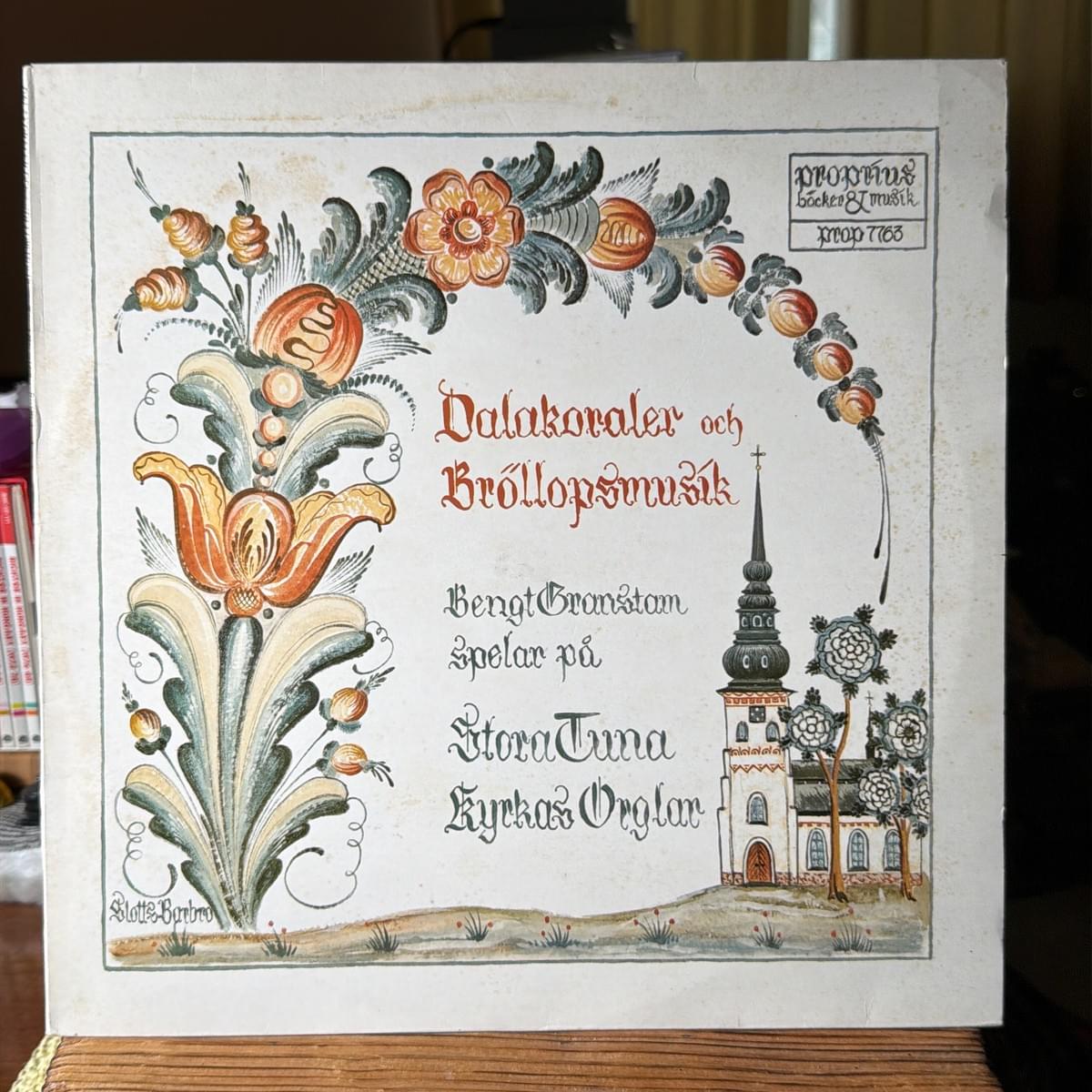
封底第一句話,點出了整張唱片的概念:古老的達拉那彩繪,用圖像描繪民間的聖經故事;而在歌謠與聖詠裡,我們同樣遇見這種民間藝術。所以,這些管風琴改編曲,是「音符中的達拉那彩繪」。每一首,用前奏與後奏環抱旋律,旋律本身則由單一聲部清楚唱出。
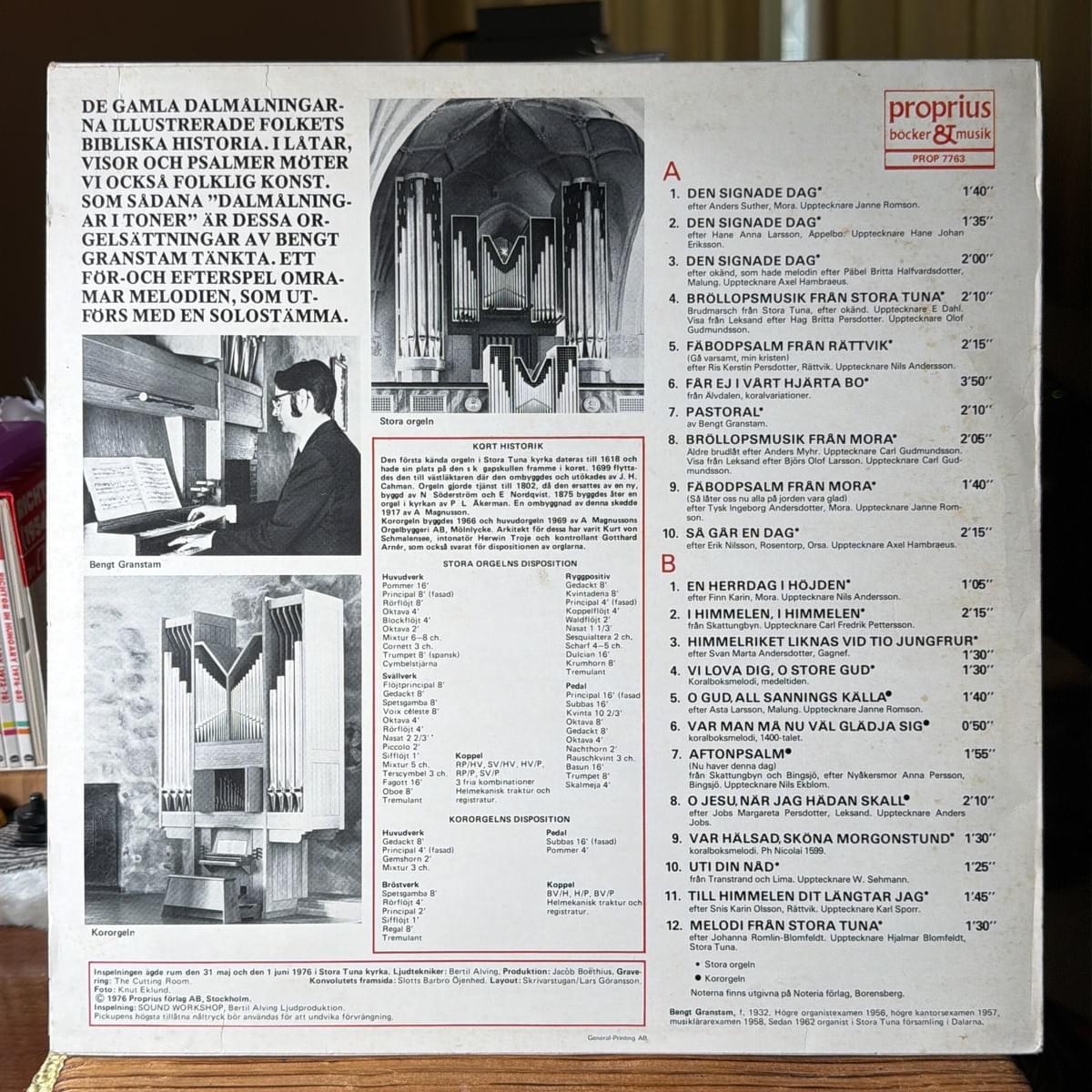
演奏者是本特·格蘭斯塔姆(Bengt Granstam,1932-)。1956 年取得高級管風琴師資格,1957 年取得高級領唱員資格,1958 年取得音樂教師資格。從 1962 年起,他就是大圖納堂區的管風琴師。錄音那年,他已經在同一座教堂、同一組琴鍵前,度過了十四個年頭。他不是巡迴演出的獨奏家,他是這座教堂的人。
他彈的曲子,不是他自己採來的。
曲目裡的二十多首聖詠與婚禮音樂,都附著採集者的名字——揚內·隆松、尼爾斯·安德松、阿克塞爾·漢布雷烏斯⋯⋯他們是走進達拉那山村、把口傳旋律一首一首記成樂譜的人。A 面開頭的〈蒙福之日〉(Den signade dag)一連收了三個版本,分別採自莫拉、埃佩爾博、馬隆三個教區:同一首聖詠,在不同村子裡被唱成了不同的樣子。B 面的〈晚禱聖詩〉採自斯卡通比恩與賓舍——這兩個地方,至今仍被視為達拉那民俗音樂保存最完整的村落。
據當地資料,這張唱片錄製的前一年,達拉那博物館剛出版了《達拉那民間聖歌集》,推手是大圖納教區當時的副牧師約爾恩·迪坎德(Jörgen Dicander),他自己出於熱情,清查了歷來散佚的聖歌採集檔案。1976 年的這次錄音,緊接在這波搶救之後。
於是,一條很長的鏈子,在這張唱片上接了起來:
無名的老人口唱 → 採集者的手寫樂譜 → 管風琴師的改編 → 阿爾文的麥克風 → 黑膠的聲音溝槽。
管風琴本身,也有它的年輪。大圖納教堂已知最早的管風琴,可以追溯到 1618 年,之後在 1699、1802、1875、1917 年多次改建、重造。錄音時用的這兩台,唱詩班管風琴造於 1966 年,大管風琴造於 1969 年,皆出自默恩呂克的 A. Magnussons 管風琴廠,全機械式鍵盤傳動;封底把兩台琴的音栓配置完整印了出來,連 16 呎的 Pommer、西班牙式水平小號、星鈴(Cymbelstjärna)都一一列明。曲目旁標示著每一首用的是大管風琴還是唱詩班小管風琴。
這座教堂還有一位著名的長眠者:瑞典國寶男高音尤西·畢約林(Jussi Björling,1911-1960)。
唱片二|一位爵士鋼琴手,用 1919 年的老琴彈普朗克
PROP 7880 的封面很有趣:「POULENC」這個名字,上面印一次,下面又倒過來印一次,中間是考克多畫的那個人——一個倒掛在直立式鋼琴前、雙手誇張伸展的人。這幅畫的題目叫《表現主義者》,是向巴黎的畫廊取得授權才印上的。連唱片標籤上的 proprius logo,也是上下顛倒印了兩次。
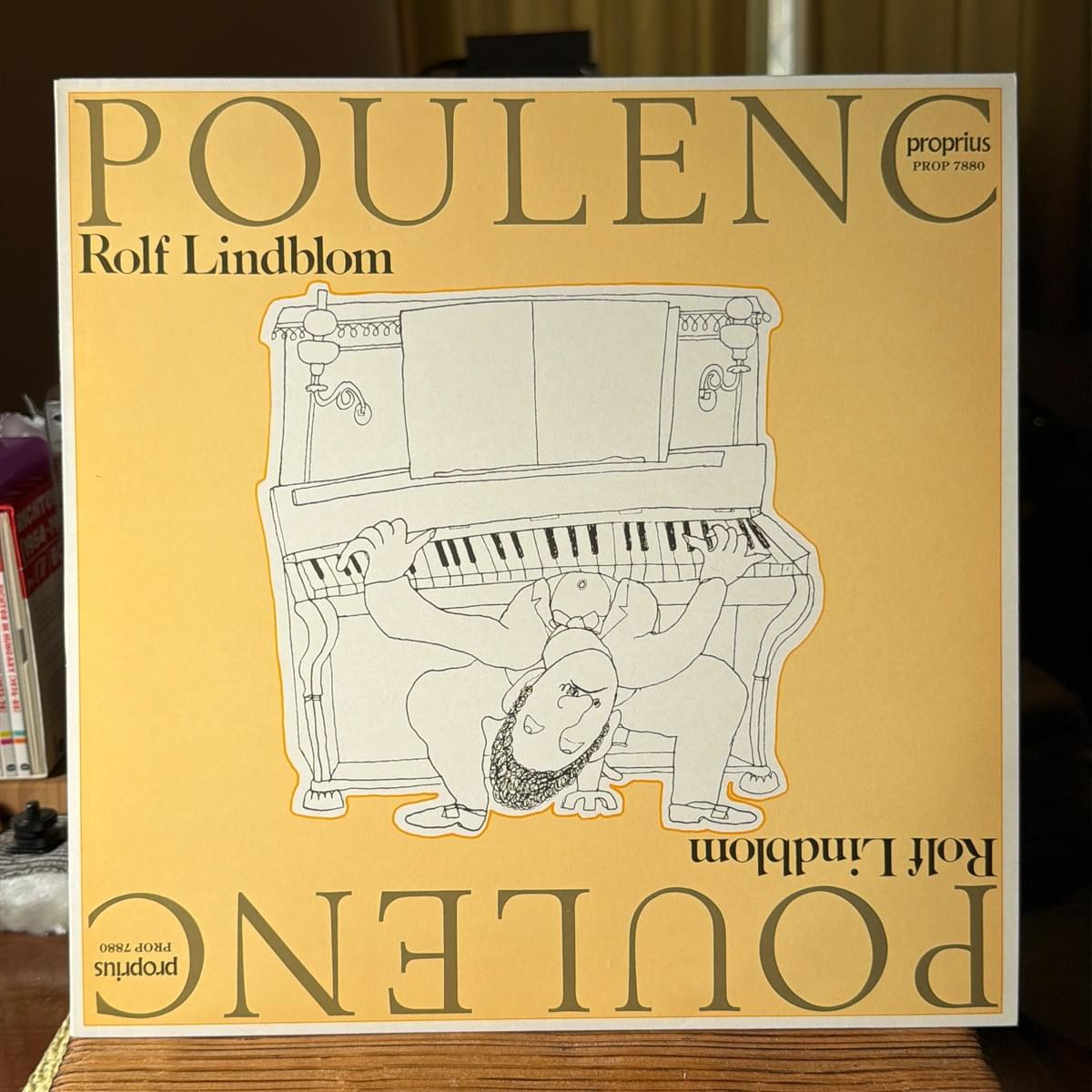
這張唱片的 A 面,是一首作曲家本人說過要「毫不留情徹底否定」的曲子。
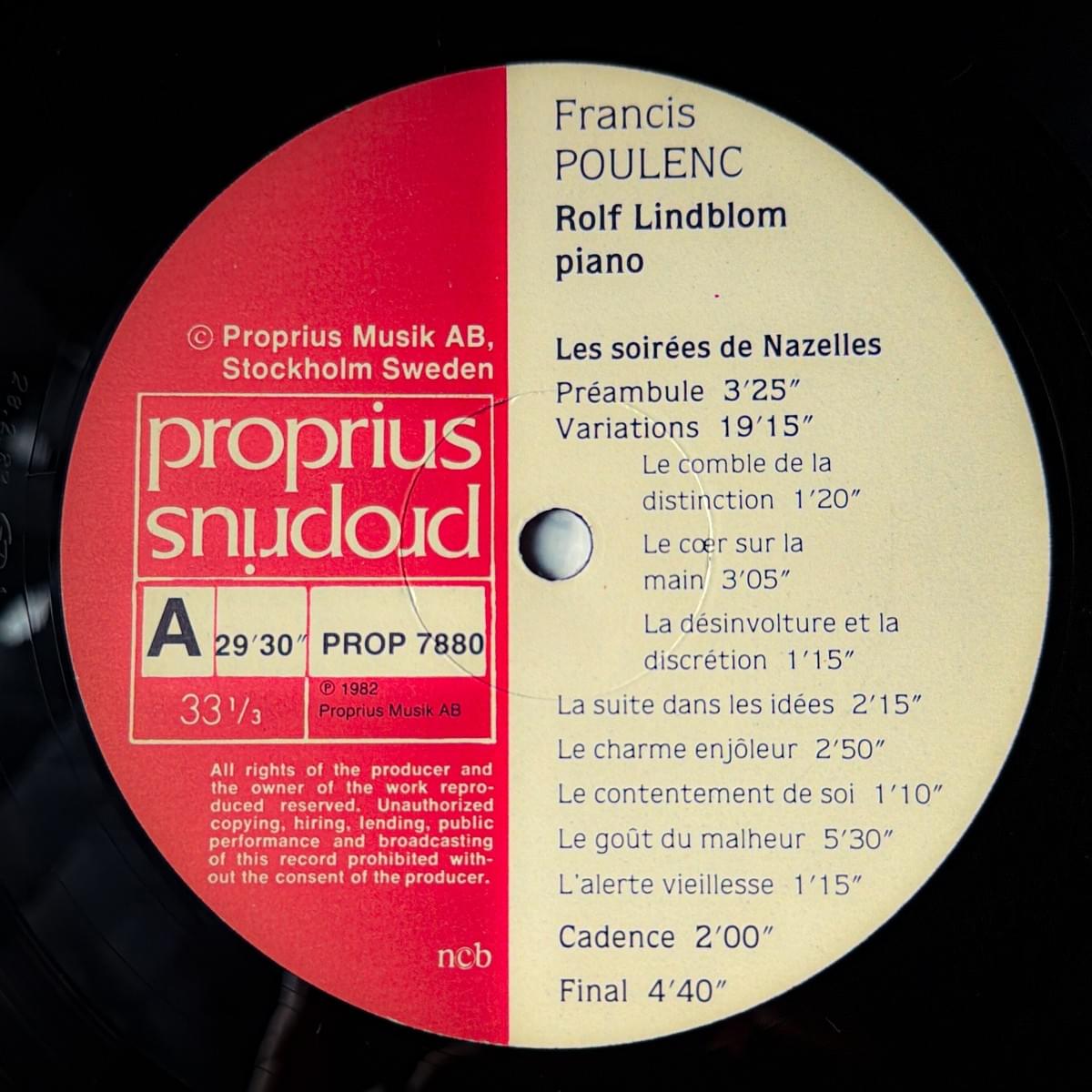
法蘭西斯·普朗克(Francis Poulenc,1899-1963)晚年回顧自己的鋼琴作品時,語氣苛刻。封套內頁引了他的話:他對《拿坡里》與《納澤爾之夜》,是「毫不留情地譴責」。然而 Proprius 偏偏把《納澤爾之夜》整整錄滿 A 面,29 分 30 秒。而同一本解說冊的作者也寫道,許多人視它為普朗克最好的鋼琴作品之一。
這首曲子從 1930 年開始構思,1936 年 10 月 1 日完稿,題獻給他一位並非親戚、卻情同家人的姑媽。曲中的八段變奏,每一段都有一個詼諧的標題——「極致的高貴」、「坦率慷慨」、「不幸的品味」、「敏捷的老年」——那是普朗克當年在法國都蘭鄉下的夜晚,圍著鋼琴,即興彈奏給朋友們聽的「音樂肖像」。
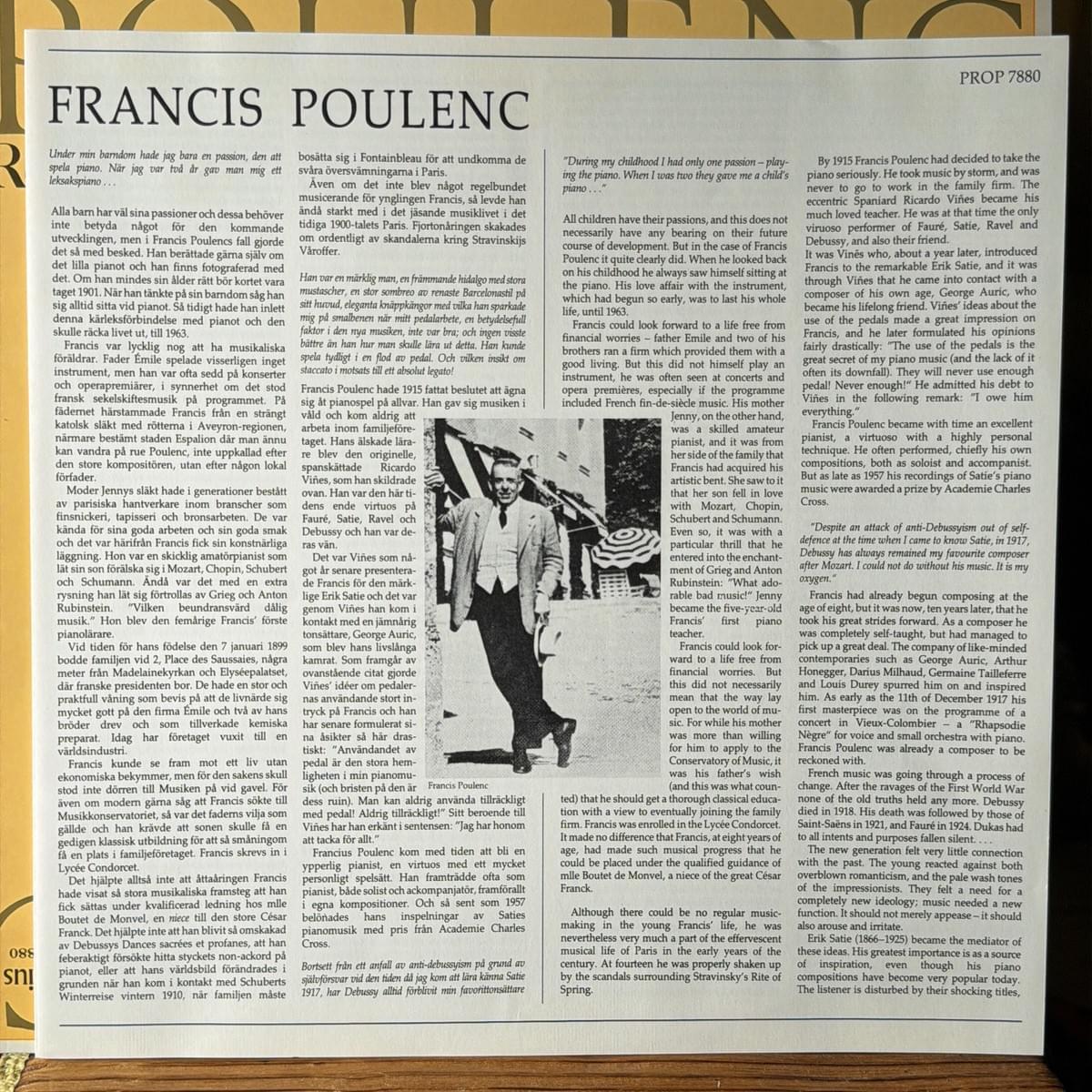
B 面是《三首小品》與 1921 年的《散步》:十段以交通方式為題的小品,徒步、汽車、騎馬、乘船、飛機、公車、馬車、火車、自行車、驛馬車。其中汽車那一段,普朗克在樂譜上寫了「蕭邦」兩個字,還畫了一個方框圈起來。
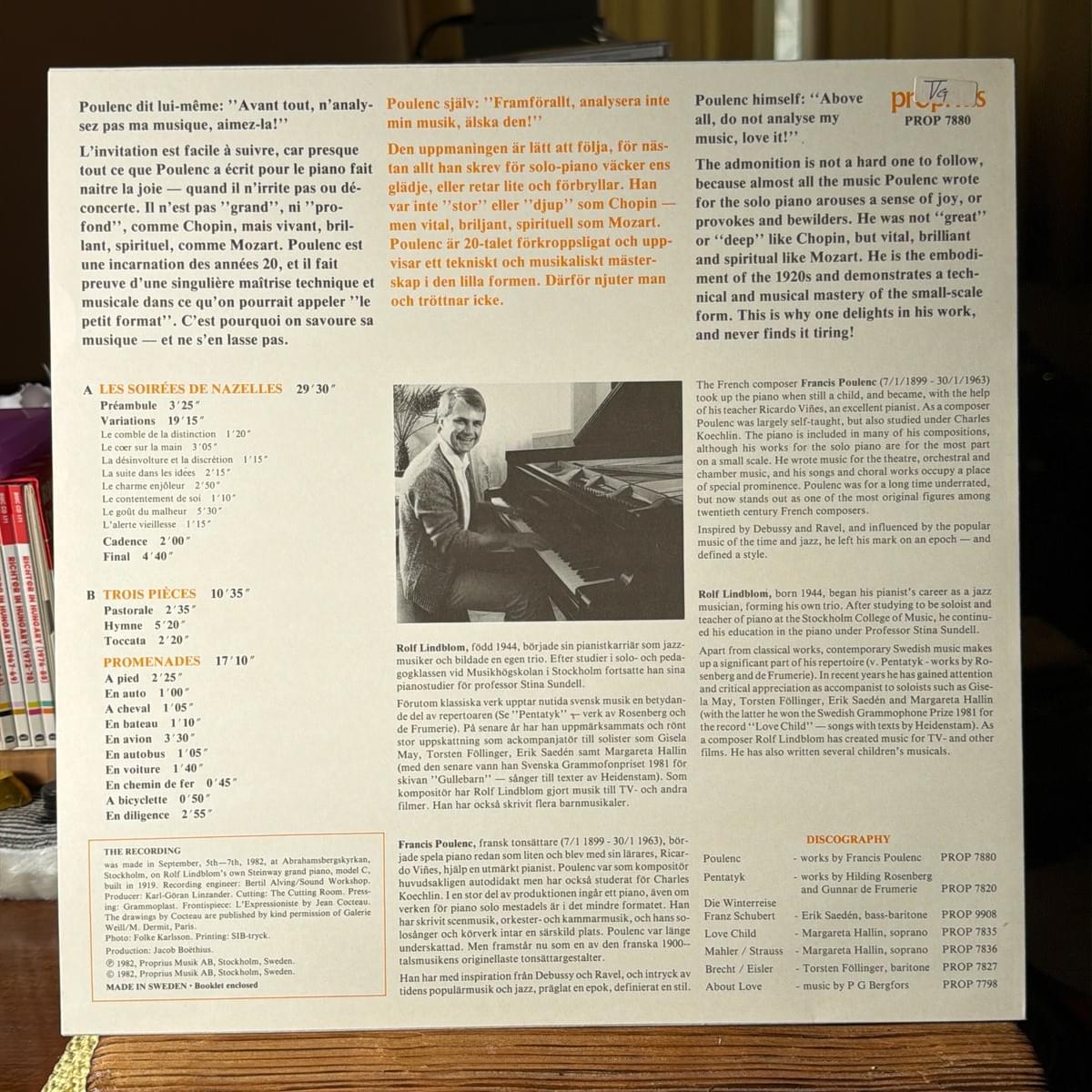
彈這些曲子的人,是羅爾夫·林德布洛姆(Rolf Lindblom,1944-)。
他最早是爵士鋼琴手,自己組過三重奏,後來才進斯德哥爾摩音樂高等學院,隨斯蒂娜·桑德爾教授學琴。據他個人網站的介紹,桑德爾年輕時曾在維也納隨埃米爾·馮·紹爾(Emil von Sauer,1862-1942)學琴,而紹爾是李斯特(Franz Liszt,1811-1886)的親傳弟子。一條線,從李斯特,到紹爾,到桑德爾,到林德布洛姆。
但他並沒有因此變成一個嚴肅的學院派。他長期是瑞典歌唱家們的伴奏者;1981 年,他與女高音瑪格麗塔·哈林合錄的海登斯坦詩作歌曲集《受寵的孩子》(Love Child),還拿下了瑞典留聲機大獎。他也為電視、電影寫配樂,寫過好幾部兒童音樂劇。
他官網的首頁最醒目處,放著一句來自台灣的評語:「The recording and performance are perfect.」
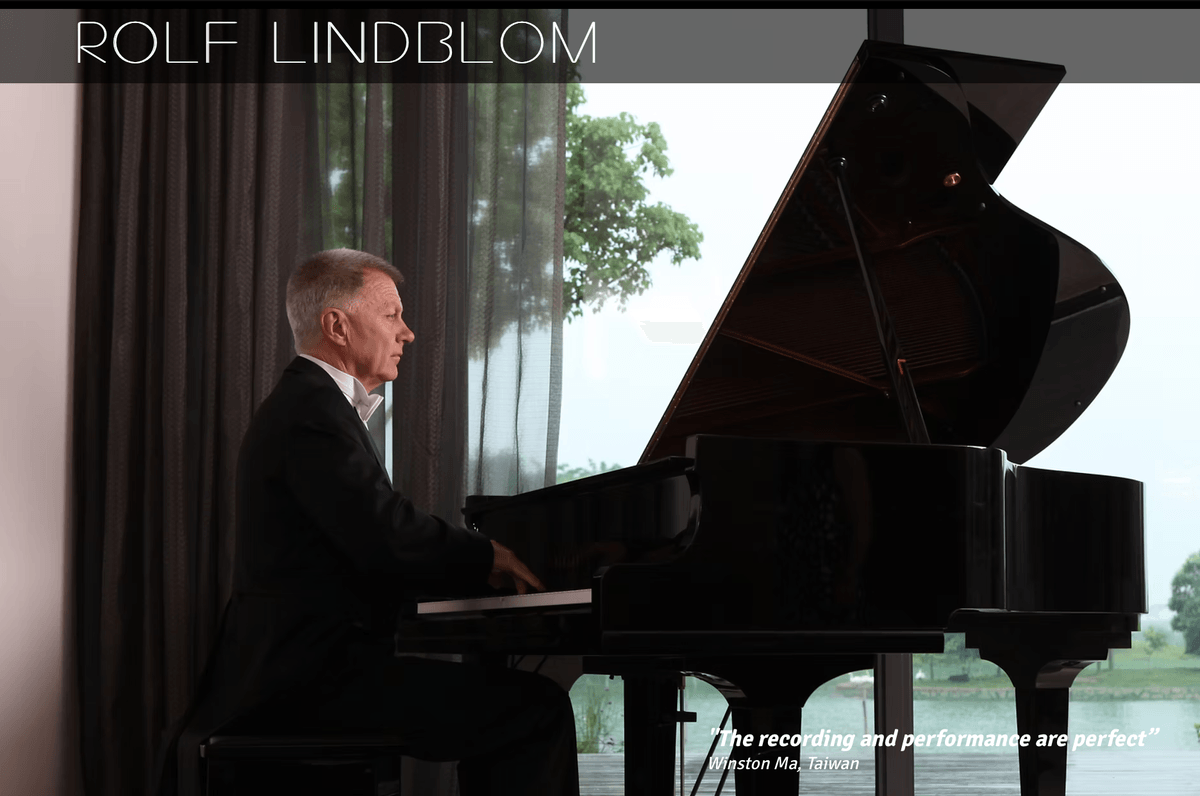
錄音在 1982 年 9 月 5 日至 7 日,一連三天,地點是斯德哥爾摩的阿伯拉罕斯貝格教堂。鋼琴是林德布洛姆自己的 1919 年史坦威 C 型,錄音師還是阿爾文,製作人是卡爾-約蘭·林贊德(Karl-Göran Linzander),母帶由 The Cutting Room 切刻,Grammoplast 壓製。
普朗克的《納澤爾之夜》完成於 1936 年,這台琴出廠時,這首曲子還要等十一年才會動筆。
一個從爵士俱樂部走出來的鋼琴手、一台比作品更老的鋼琴、一座教堂、三天——這就是這張唱片的全部。至於結果是不是真的如那句評語所說,古殿不替你下結論。普朗克自己早就說過了,他最想對聽眾說的只有一句話:別分析我的音樂,去愛它。
不只是三張:理念結出的整片森林
如果你在發燒圈裡提到 Proprius,聽到的名字大概就那幾個:「教堂之聲」、「當鋪爵士」、「麥田之歌」。它們成了日後發燒錄音的代名詞,每年都有各種新的版本不斷出版。
先說「教堂之聲」,也就是《Cantate Domino》(PROP 7762),1976 年,斯德哥爾摩奧斯卡教堂,阿爾文用一台 Revox A77 和兩支 Pearl TC4 麥克風錄成。它被公認為世界上最好的古典錄音之一,半世紀來,被一次又一次重新製作:XRCD、SACD、K2HD、高解析母帶、15ips 盤帶⋯⋯幾乎每一種發燒格式,都為它重出過一次。
再來是「當鋪爵士」,《Jazz at the Pawnshop》(PROP 7778/7779)。1976 年 12 月 6、7 日兩晚,在斯德哥爾摩老城一家名叫 Stampen 的爵士俱樂部現場錄製,製作人是博埃修斯,錄音師是蓋特·帕爾姆克蘭茲(Gert Palmcrantz),樂手包括阿恩·多姆內魯斯(Arne Domnérus,1924-2008)。據傳,俱樂部空間太窄,錄音機甚至得放在工程師的膝蓋上。這張唱片同樣被重新母帶了無數次,連 45 轉、200 克重的極致版本都有人做。
最後是「麥田之歌」,原名《Now the Green Blade Riseth》,直譯是「如今,綠色的嫩芽升起」,取自一首復活節聖詠。據復刻版的說明,這張唱片是阿爾文 1981 年 3 月在斯德哥爾摩近郊的奧斯特哈寧厄教堂錄成,由斯德哥爾摩大教堂合唱團與兒童合唱團演唱新舊聖詠,伴奏是管風琴、吉他、長笛與低音提琴。
有不少發燒友認為,它至少不輸、甚至勝過名氣大得多的《Cantate Domino》。2020 年,AudioNautes 復刻的黑膠版,還被美國發燒網站 Positive Feedback 選為當年的年度錄音。
看出來了嗎?「教堂之聲」與「麥田之歌」,都出自阿爾文之手,都是瑞典在地的合唱團、在瑞典的教堂裡錄成的。
這不是在貶低它們,它們配得上這些名聲。
但請注意一個細節:《Cantate Domino》的目錄編號是 PROP 7762,而本文的主角之一,達拉那那張,是 PROP 7763。
編號只差一號,同一位錄音師,同一年,同樣在教堂裡。一張被奉為神作,另一張幾乎無人知曉。
差別在哪裡?不是錄音理念,不是場地,不是工程師。大教堂裡的合唱與管風琴,和爵士俱樂部的現場,剛好都是「適合拿來測試喇叭」的音樂。它們有聽得出來的空間感、動態、臨場感,能讓人在器材店裡一放就驚呼。後世的記憶,是被這種需求篩選過的。
那 Proprius 真正的品味在哪裡?看一眼 PROP 7880 的封底,那裡印著林德布洛姆在這家廠牌的唱片目錄:
- 《五音集》(Pentatyk),瑞典作曲家羅森伯格與德·弗魯梅里作品(PROP 7820)
- 舒伯特《冬之旅》,男低音埃里克·賽登(PROP 9908)
- 《受寵的孩子》,女高音瑪格麗塔·哈林(PROP 7835)
- 馬勒與理查·史特勞斯歌曲集,哈林(PROP 7836)
- 布萊希特與艾斯勒作品,男中音托斯滕·弗林格(PROP 7827)
- 《關於愛》,伯格福斯作品(PROP 7798)
解說冊裡還特別指出,Proprius 的目錄裡,另有普朗克的《管風琴、弦樂與定音鼓協奏曲》(PROP 7785)與《人類的面容》(PROP 7839)。
藝術歌曲、瑞典當代音樂、嚴肅的合唱作品、民間聖歌的採集與改編。這些都不是容易被拿來當喇叭測試片的類型。這才是這家廠牌花了二十多年真正在做的事,也是它「不把音樂當商品」那句話的實際內容。
這些作品並不因為少人提起而遜色。林德布洛姆與哈林合錄的《受寵的孩子》,在 1981 年拿下了瑞典留聲機大獎——這是瑞典本國樂壇的肯定,比任何發燒榜單都更早。
爵士也不只有《當鋪爵士》。多姆內魯斯 1974 年的《Antiphone Blues》,同樣是這家廠牌的重要作品;2018 年,AudioNautes 把它重新發行成黑膠,成為該廠牌復刻 Proprius 的第一張。
現場錄製的韓德爾《彌賽亞》、管風琴與合唱、爵士、藝術歌曲、民俗聖歌的採集、瑞典當代音樂、普朗克的鋼琴與管風琴協奏曲⋯⋯類型橫跨得很遠。把它們串在一起的,不是類型,而是同一套做法:真實的空間、最少的麥克風、瑞典在地的人。
理念不是口號,它一張一張地變成了唱片。
據發燒圈的回顧文章,Proprius 的目錄後來版權落到 Naxos 手上,直到最近幾年,才有小眾復刻廠牌開始選擇性地重新發行其中少數幾張。
換句話說,我們今天所說的「Proprius 的評價」,其實是一份被潮流篩選過的評價。它誠實,但不完整。
這正是歷史評價最危險的地方:後來的人往往以為,被記得的就是最好的;其實,被記得的只是剛好被需要的。
如果是你,會等嗎?
回到那個五年的故事。
一家公司為了一個空間,等了五年,才肯開始錄。這個堅持,等於說了一件事:聲音不是可以從世界上切下來的東西。它屬於一座 1469 年啟用的教堂,屬於三個世紀裡一代代管風琴工匠留下的機械,屬於一台 1919 年出廠的鋼琴,屬於一位服務同一座教堂十四年的管風琴師,屬於那些從未被錄下、卻被採集者一首一首抄成譜的無名歌者。
「古殿」的建議很簡單:Proprius 的原版黑膠,幾乎張張都可以收。
就算你還沒聽過它的音樂,也沒有關係。可以慢慢聽,慢慢理解。它的作品,不會讓你失望。
Proprius 的原版黑膠,也非常適合收藏家一張一張收集。封面設計都很出色:光是本文這兩張,一張是考克多的漫畫線條,一張是達拉那的手繪彩繪,風格完全不同,卻同樣耐看。
把它們收成一個系列,一張一張擺起來,收藏感十足,也會很有成就感。
*******
【Gudian Music Stories】Waiting Five Years for the Right Venue to Record Messiah: Proprius and Its Swedish Acoustic Philosophy
Five Years Just to Find the Right Church
Once upon a time in Sweden, an independent record label spent five full years searching for the right space to record George Frideric Handel’s (1685–1759) Messiah. Throughout that half-decade, not a single venue satisfied their ears.
So they made a decision that sounds almost impossible today: they refused to compromise.
There was no "let’s just make do in a studio," no "settling for an ordinary chapel nearby." They simply kept searching.
Finally, they found the sanctuary they were listening for: the Adolf Fredrik Church (Adolf Fredriks kyrka) in Stockholm. On February 13 and 14, 1982, during live concert performances, they committed Handel’s Messiah to master tape, resulting in a three-LP boxed set (PROP 7871–73). Conducted by Anders Öhrwall (1932–2012), the performance featured the Stockholm Bach Choir, members of the Swedish Radio Symphony Orchestra, and a solo vocal quartet comprising Yvonne Kenny (b. 1950), Paul Esswood (b. 1942), Martyn Hill (b. 1944), and Magnus Lindén. Five patient years, all for a space that breathed true.
That label was Proprius—known in Hong Kong audiophile circles as "Baodie" (寶碟), derived from the Latin for "one's own" or "proper."
Resting in the Ancient Palace collection are two of its original LPs. One is a 1976 organ recording, Hymns and Wedding Music from Dalarna (PROP 7763), its sleeve adorned with traditional Dalecarlian folk painting (dalmålning). The other is a 1982 piano recital, Poulenc (PROP 7880), bearing an ink caricature by Jean Cocteau (1889–1963) of a figure draped upside down over an upright piano. One was captured inside an expansive country church in central Sweden, the other inside a parish sanctuary in suburban Stockholm. Six years apart, yet balanced and tracked by the very same set of ears.
Proprius is far more than Cantate Domino, Jazz at the Pawnshop, and Now the Green Blade Riseth. Its underlying philosophy and quiet craftsmanship built an extraordinary catalog, preserving recordings that are just as compelling, even if seldom mentioned today.
Let us begin with two questions: What kind of minds wait five years just for the right acoustic room? And why, half a century later, does the world remember only a tiny handful of their releases?
An Imprint Grown Out of a Publishing House
Proprius did not set out to be an audio label.
Its parent enterprise was Proprius förlag, a publishing firm founded in 1963 by Jacob Boëthius (1925–2005) dedicated to historical, literary, and theological literature. In 1969, the house established a recorded music division, initially capturing sacred choral anthems and local pipe organs. Over time, it broadened its scope, eventually becoming celebrated internationally as an export-driven audiophile label.
That lineage is legible on the physical artifacts themselves.
On the 1976 issue (PROP 7763), the jacket and label proudly read "Proprius böcker & musik"—Books & Music—with the copyright attributed to "Proprius förlag AB" (the publishing house). Six years later, on the 1982 issue (PROP 7880), the legal imprint had evolved into "Proprius Musik AB": the word "books" had vanished, leaving only the music. Across those six years, a literary publisher had transformed into a dedicated record company.
Consequently, pipe organs, liturgical choirs, and sacred works accounted for a major share of the Proprius catalog. Its creative impulse was closer to cultural preservation—entrusting heritage to posterity in the most unvarnished, honest manner possible—than to industrial entertainment.
Around 1990, Proprius underwent corporate restructuring; its jazz subsidiary, Prophone, was spun off as an independent company, and the original label drew to a close in the early 1990s. The timing was no coincidence: that was the exact moment globalization swept through the recorded music industry.
Globalization brought a commercial model that prioritized mass marketability and financial scale above all else.
Before that consolidation, regional independent labels could operate without obsessive corporate overhead. They existed for a specific locale, a shared ethos, sustained by a devoted circle of listeners who shared their values. Proprius was that kind of label. Once the industry merged into a single commercial logic, the space for labels that existed "only for the few" evaporated.
Proprius also adhered to an unwritten creative rule: the repertoire may be international, but the hands that play it must be Swedish.
Beyond classical compositions, its catalog welcomed jazz and indigenous folk traditions. Yet the performing soloists, vocalists, balance engineers, and producers were drawn almost exclusively from Sweden’s domestic musical community.
The two LPs in hand reflect this creed. PROP 7880 features works by a French composer, but the pianist at the keyboard is Swedish musician Rolf Lindblom (b. 1944), tracked in a Stockholm church by a local crew. PROP 7763 gathers local melodies of Dalarna, played by the parish organist of Stora Tuna on his own church organ, with cover art contributed by a local painter.
Even their Messiah observed this discipline: the conductor, choir, and instrumentalists were all Swedish.
The world’s music, realized through local hands and local ears.
This philosophy yielded an immediate practical benefit: it gave local Swedish musicians paid performance opportunities and a sustainable livelihood.
Only a regionally rooted, independent label could work this way. Unbeholden to commercial trends, it used vinyl to anchor local artists to their own soil.
The Fewer the Microphones, the Better: The Room Is the Instrument
There was nothing exotic about Proprius’s recording equipment. They used standard studio hardware of the era.
What was extraordinary was their working method, which can be summed up in a simple phrase: no artificial flavor enhancers.
In the 1970s, major labels boasted of sessions running twenty-four or thirty-six separate microphone stems, relying on faders, compressors, and studio plate reverbs to manufacture a soundstage. Proprius did the opposite: use as few microphones as possible. If two microphones did the job, never set up a third; if one sufficed, use only one.
Yet far more decisive than microphone counts was the physical venue.
They rarely recorded in dead studio rooms. Instead, they scouted authentic architectural volumes: ancient stone churches or living everyday spaces. The room was treated as an active acoustic instrument of the ensemble. If the right room could not be found, they waited—which is how that five-year quest for Messiah came to be. In the end, they found their chapel and captured the performance live in the room.
Across these two LPs, that discipline is evident:
- PROP 7763: Recorded live on May 31 and June 1, 1976, within Stora Tuna Church (Stora Tuna kyrka) in Dalarna. Inaugurated in 1469, this sanctuary seats seven hundred and stands as one of the largest medieval country churches in Sweden.
- PROP 7880: Tracked from September 5 to 7, 1982, inside Abrahamsberg Church (Abrahamsbergskyrkan) in Stockholm. The instrument was not a rented concert grand, but the pianist's personal 1919 Steinway & Sons Model C.
One philosophy, two expressions: one captures a historic stone nave and its pipe organ as an indivisible whole; the other foregoes modern showroom pianos in favor of a vintage 1919 Steinway, an instrument built seventeen years before the French score was even completed.
That sense of responsibility carried through to the listening instructions. On the rear sleeve of PROP 7763, a line advises the listener: Please play this record at the highest tracking force permitted by your phono cartridge to avoid groove mistracking. They cared not only about how sound entered the tape head, but about how it emerged from the stylus.
Such patience is almost unthinkable today. Waiting five years for a room, choosing a vintage piano for a 1930s score, printing cartridge setup advice on the back cover—this reflects a refusal to treat recorded sound merely as a commercial commodity.
The Mentor, the Apprentice, and Two Declarations
In the production lore of Proprius, sessions were anchored by an elder-and-apprentice partnership: an experienced founder and a driven younger engineer, united by a shared passion for music and honest acoustic capture.
The elder was founder Jacob Boëthius himself. Far from staying behind a publisher’s desk, he took an active role in session logistics and aesthetic decisions.
The apprentice was Bertil Alving (b. 1952). His name appears as recording engineer on both releases, while Boëthius is credited as producer on PROP 7763. Alving began his career as an organ builder and organist before transitioning into audio engineering; he understood church acoustics not as an outsider, but from having climbed inside organ pipe chests.
In 1976, around age twenty-four, Alving completed two sessions: inside Oscarskyrkan in Stockholm, using a Revox A77 tape deck and a single pair of Pearl TC4 microphones, he recorded the audiophile landmark Cantate Domino; and out in Dalarna at Stora Tuna Church, he captured the lesser-known PROP 7763.
The same ears, the same year, two very different commercial fates.
Two manifestos preserved by the label are worth reading side by side.
The first comes from the founder:
"We are a small recording company which cannot afford to publish records of poor technical quality. As a music lover, you must be able to trust that your choice of a Proprius record is the best on the market."
The second comes from the participating musicians:
"We are musicians and do not want to make a commodity out of music. We want to record beautiful music, not necessarily popular music. As long as it is fine and touches people's hearts, we do not care about sales figures."
The founder's words are remarkably bold: "You must be able to trust." He asks listeners to place their confidence in the label before hearing a single note. It was not sales copy; it was a commitment.
The musicians' declaration turns that conviction inward: disregarding sales figures meant that repertoire was chosen not for commercial potential, but because it deserved to be preserved. That principle guided every decision that followed.
Record One: Turning Dalecarlian Folk Painting into Organ Sound
The cover of PROP 7763 features a hand-painted floral arch framing a white church and its belfry spire: an authentic example of Dalecarlian folk painting (dalmålning). The artwork is signed "Slotts-Barbro"—Barbro Göransson (b. 1944)—who grew up in Stora Tuna and was a young artist in her early thirties when this record was cut in 1976.
The opening line of the rear sleeve sets the conceptual framework: just as ancient Dalecarlian frescoes illustrated biblical stories through vernacular folk art, so too do traditional hymns and spiritual songs embody that folk heritage. These organ settings are "Dalecarlian frescoes translated into musical notes." Each hymn surrounds its melody with introductory preludes and closing postludes, while the core tune sings out clearly in an unadorned single voice.
The organist is Bengt Granstam (1932–2022). Having qualified as an organist in 1956, a precentor in 1957, and a certified music educator in 1958, he was appointed parish organist of Stora Tuna in 1962. By the time of this session, he had served at the same console for fourteen years. He was not a touring virtuoso; he was the resident voice of that church.
The melodies he performed were gathered by devoted field collectors.
The two dozen hymns and wedding marches credit their original transcribers: Janne Romson, Nils Andersson, Axel Hambreus—men who walked the valleys of Dalarna transcribing oral tunes into staff notation. The opening hymn on Side A, Den signade dag ("O Blessed Day"), is presented in three regional variants from the parishes of Mora, Äppelbo, and Malung: the same sacred text, sung with different regional accents across neighboring valleys. Side B features evening hymns gathered in Skattungbyn and Bingsjö—villages celebrated as pristine repositories of Dalecarlian folk fiddle traditions.
Regional archives indicate that a year prior to this session, the Dalarna Museum published a comprehensive anthology of Dalecarlian folk hymns, spearheaded by Jörgen Dicander, then assistant vicar of Stora Tuna, who undertook an exhaustive inventory of scattered hymn manuscripts. The 1976 recording arrived in the slipstream of that preservation effort.
Thus, an unbroken line formed on this piece of vinyl:
Oral singing by elders⟶Transcriptions by folklorists⟶Organ settings⟶Alving’s microphones⟶Mastered grooves
The instrument carries its own lineage. Stora Tuna's earliest recorded pipe organ dates to 1618, undergoing restorations in 1699, 1802, 1875, and 1917. The two mechanical-action instruments played on this disc—the choir organ built in 1966 and the grand organ completed in 1969—came from A. Magnussons Orgelbyggeri in Mölnlycke. The rear sleeve lists their complete stop dispositions, from the 16-foot Pommer to the Spanish horizontal Trumpet and the Cymbelstjärna (revolving star bells), noting which instrument serves each track.
The churchyard also serves as the final resting place of a national treasure: tenor Jussi Björling (1911–1960).
Record Two: A Jazz Pianist Playing Poulenc on a 1919 Steinway
The cover of PROP 7880 is eye-catching: the name "POULENC" is printed right-side up at the top and inverted upside down along the bottom. Between them sits Cocteau’s caricature, The Expressionist—a figure suspended over an upright piano with arms outstretched—licensed from a Paris gallery. The Proprius logo on the record label is similarly mirrored upside down.
Side A contains a score the composer himself once sought to disown.
In his later years, Francis Poulenc (1899–1963) looked back on his piano oeuvre with self-deprecation. The inner gatefold quotes his sharp assessment: he reserved "unsparing condemnation" for Napoli and Les Soirées de Nazelles. Yet Proprius chose to give over the entire first side—twenty-nine minutes and thirty seconds—to Les Soirées de Nazelles. As the annotator notes, many consider it among Poulenc's finest solo piano achievements.
Conceived in 1930 and completed on October 1, 1936, the work was dedicated to a maternal aunt who was treated as family. Its eight variations bear witty, characterful titles—"Extreme Nobility," "Heartfelt Generosity," "Unfortunate Taste," "Sprightly Old Age"—musical portraits sketched during evenings in rural Touraine as Poulenc improvised at the keyboard among friends.
Side B features the Trois Pièces alongside the 1921 suite Promenades: ten travel miniatures sketching modes of transit—foot, automobile, horse, boat, airplane, bus, carriage, railway, bicycle, and stagecoach. In the movement titled "In an Automobile," Poulenc wrote the name "Chopin" into the manuscript score, neatly framing it inside a box.
The pianist is Rolf Lindblom.
He began as a jazz pianist, leading his own trio before entering the Royal College of Music in Stockholm to study with Professor Stina Sundell. As his biography notes, Sundell studied in Vienna with Emil von Sauer (1862–1942), who was a direct disciple of Franz Liszt (1811–1886). A line runs from Liszt to Sauer, to Sundell, and down to Lindblom.
Yet he never retreated into academic conservatism. He served as an accompanist for Swedish vocalists; in 1981, his collaboration with soprano Margareta Hallin on songs set to Verner von Heidenstam’s poetry, Love Child, received the Swedish Grammis Award. He also scored film and television projects and composed children’s musical theater.
On the front page of his personal website sits an endorsement from a listener in Taiwan: "The recording and performance are perfect."
The sessions took place across three days from September 5 to 7, 1982, in Abrahamsberg Church, Stockholm. Lindblom played his own 1919 Steinway Model C. Bertil Alving engineered, Karl-Göran Linzander produced, lacquers were cut at The Cutting Room, and discs were pressed by Grammoplast.
When that Steinway left the factory in 1919, Poulenc's Les Soirées de Nazelles was still seventeen years away from completion.
A pianist rooted in jazz clubs, a piano older than the music it served, a quiet church, and three days of work. As to whether the result merits that review, I leave the verdict to your own ears. Poulenc offered his own counsel on the matter, noting that he had only one request of his listeners: Do not analyze my music—love it.
Beyond Three Landmarks: The Broader Forest
Mention Proprius in audiophile circles, and conversation usually turns to three titles: Cantate Domino, Jazz at the Pawnshop, and Now the Green Blade Riseth. They became audiophile touchstones, reissued in various formats year after year.
First came Cantate Domino (PROP 7762), captured in 1976 inside Oscarskyrkan by Alving using a Revox A77 and a pair of Pearl TC4 microphones. Revered as a reference for classical recording, it has been remastered across nearly every high-end format: XRCD, SACD, K2HD, high-resolution DSD, and 15 ips master tape transfers.
Next came Jazz at the Pawnshop (PROP 7778/7779), recorded live on December 6 and 7, 1976, at Stampen, a jazz pub in Stockholm’s Gamla Stan. Produced by Boëthius and engineered by Gert Palmcrantz, it featured saxophonist Arne Domnérus (1924–2008). In the cramped venue, the reel-to-reel deck had to be balanced on the engineer's knees. It too has seen continuous remasters, up to 45 RPM, 200-gram vinyl pressings.
Then came Now the Green Blade Riseth (Kornet har sin vila), taking its name from the traditional Easter hymn. Tracked by Alving in March 1981 inside Österhaninge Church near Stockholm, the Stockholm Cathedral Choir and Children's Choir performed traditional hymns accompanied by organ, guitar, flute, and double bass.
Many audio connoisseurs regard it as equal, if not superior, to Cantate Domino. In 2020, an analog reissue by AudioNautes was named a Recording of the Year by the American journal Positive Feedback.
Both Cantate Domino and Now the Green Blade Riseth were recorded by Alving, featuring Swedish choirs in Swedish sanctuaries.
They deserve their reputation.
Yet consider a small discographical detail: Cantate Domino bears catalog number PROP 7762. The Dalarna organ release discussed here is PROP 7763.
Consecutive numbers, the same balance engineer, the same year, in stone churches. One was canonized worldwide; the other remains virtually forgotten.
The difference lies not in engineering or acoustics. Choral hymns with deep organ pedals and smoky jazz club ambiance serve as effective demonstration material for hi-fi equipment: they present immediate soundstaging, transient dynamics, and room cues that impress in audio showrooms. Historical memory was filtered through that commercial demand.
Where did Proprius’s broader musical curiosity reside? Examine the rear sleeve of PROP 7880, where Lindblom’s discography on the label is listed:
- Pentatyk: Works by Swedish composers Hilding Rosenberg and Gunnar de Frumerie (PROP 7820)
- Schubert’s Winterreise: Erik Saedén, bass (PROP 9908)
- Love Child: Margareta Hallin, soprano (PROP 7835)
- Songs of Mahler and Richard Strauss: Margareta Hallin (PROP 7836)
- Works of Brecht and Dessau: Torsten Föllinger, baritone (PROP 7827)
- About Love: Compositions by Lars-Erik Bergfors (PROP 7798)
The booklet notes that the Proprius catalog also featured Poulenc’s Concerto for Organ, Strings and Timpani (PROP 7785) and his secular choral masterwork Figure Humaine (PROP 7839).
Lieder recitals, contemporary Scandinavian scores, serious choral cycles, and field collections of rural hymnody: none of these serve as conventional loudspeaker demonstration tracks. Yet this was what the label spent two decades documenting, giving substance to their claim of "not making a commodity out of music."
These recordings are in no way secondary. Lindblom and Hallin’s Love Child took home the Swedish Grammis in 1981—an honor awarded by their domestic musical peers long before foreign audio lists took notice.
Their jazz catalog extended well beyond Pawnshop. Arne Domnérus’s 1974 Antiphone Blues remains an essential recording for the label, chosen by AudioNautes in 2018 as their debut Proprius vinyl reissue.
A live Messiah, organs and choirs, chamber jazz, art songs, collected folk hymns, modern Swedish works, and Poulenc’s keyboard literature: the genres span a wide horizon. What binds them together is not musical category, but a shared approach: real spaces, minimal microphones, and local musicians.
Their philosophy became tangible, record by record.
After the original firm wound down, distribution rights passed to Naxos, and only in recent years have boutique reissue houses begun licensing select titles back onto vinyl.
Our modern consensus of Proprius is an appraisal filtered by audiophile trends: accurate, but incomplete.
That is the paradox of historical reputation: posterity assumes what is remembered must be best, when what is remembered is often simply what served a commercial purpose.
Would You Have Waited?
Consider again that five-year search.
A label that waited five years for a room declared that sound cannot be detached from its physical environment. It belongs to a church built in 1469, to the pipework restored across three centuries of craftsmanship, to a piano crafted in 1919, to an organist who served the same parish for fourteen years, and to the voices of unheralded singers whose melodies were transcribed note by note.
My perspective is simple: original Proprius vinyl pressings are well worth exploring.
Even if you have not encountered these titles before, take time to listen without haste. The craftsmanship will reward your patience.
They are also rewarding objects to collect. The jacket designs stand on their own: Cocteau’s expressive pen strokes on one, a folk painting from Dalarna on the other—radically different in visual vocabulary, yet unified in care.
Bringing them together on a shelf as a sequence offers an engaging look into a distinctive chapter of Scandinavian audio history.