
【古殿唱片音樂故事】他沒能彈完最後一首圓舞曲:李帕第(Dinu Lipatti,1917-1950)與蕭邦十四首圓舞曲
古殿殿主
最後一首圓舞曲,他沒有彈完
1950 年 9 月 16 日,法國東部歷史古城貝桑松(Besançon)。
下午三點,醫生打電話給音樂節主辦單位:今晚的獨奏會必須取消。鋼琴家高燒不退,劇痛反覆發作,連站都站不穩。
後來鋼琴家聽說,音樂會開始前兩個小時,廳裡就已經坐滿了人。座位不夠,觀眾坐到舞台邊的台階上,連門外的接待區都擠滿了。
他仍決定上台。
妻子和醫生一左一右扶著他,走上通往音樂廳的樓梯。上半場是巴哈(Johann Sebastian Bach,1685-1750)、莫札特(Wolfgang Amadeus Mozart,1756-1791)、舒伯特(Franz Schubert,1797-1828)。下半場,是蕭邦(Frédéric Chopin,1810-1849)的十四首圓舞曲。
他彈完了第十三首。降 E 大調〈華麗大圓舞曲〉的最後一個和弦落下,全場爆出掌聲。
然後他開始彈最後一首,第 2 號降 A 大調。
只彈了開頭,琴聲就停了。
他站起來,走回後台。全場一片沉默,安靜得像過了很久很久。最後他回到台上,沒有再碰那首圓舞曲,而是彈了一首巴哈〈耶穌,吾民仰望之喜悅〉,作為整場音樂會、也是他一生舞台生涯的終點。
十一週後,他在日內瓦去世,年僅 33 歲。
他是迪努·李帕第(Dinu Lipatti,1917-1950)。
這篇文章想說的,是一個奇怪的事實:那首他在台上沒能彈完的圓舞曲,其實早已完整地存在了。就在兩個月前,它已被完整地錄了下來。
而那十四首圓舞曲的順序,藏著李帕第最後一個、也是最完整的音樂構想。
這件事在英語樂評圈被反覆記下,在中文世界卻幾乎沒有人談。就我所知,還沒有一篇中文文章把它從頭到尾說清楚:李帕第為什麼要重排這十四首?他怎麼排?這個曲序隱藏著什麼樣的結構?它在錄音室、音樂會、原始78 轉蟲膠與 LP 之間經歷了什麼?後來又有誰接下了它?
這篇文章,想第一次用中文,把這些關係完整地談一遍。
一個連老師都說「沒什麼可教」的學生
李帕第 1917 年生於羅馬尼亞布加勒斯特。他的音樂教父,是父親的好友、羅馬尼亞最偉大的音樂家喬治・安奈斯可(George Enescu,1881-1955)。
十六歲那年,他參加維也納國際音樂大賽,只拿到並列第二名。評審之一的法國鋼琴家阿爾弗雷德·柯爾托(Alfred Cortot,1877-1962)當場表態抗議,拒絕在證書上簽名。他認為這個孩子應該是第一名。
一年後,李帕第到巴黎跟柯爾托學琴。柯爾托後來說,他沒有什麼可以教這個學生的。
但要理解李帕第,有一件事必須先說清楚:他是一位完整的音樂家,只是選擇以鋼琴發聲。
他生在一個音樂家庭:父親是小提琴家,曾隨帕布羅·德·薩拉沙泰(Pablo de Sarasate,1844-1908)與卡爾·弗萊什(Carl Flesch,1873-1944)學琴;母親是鋼琴家。對李帕第來說,音樂不是後來「學」來的技能,而是像母語一樣,在家裡自然而然學會的語言。父親的小提琴、母親的鋼琴,就是他最早聽見、也最早開口說的聲音。據說他還沒學會笑,就已經會彈鋼琴了;他受洗時,還親自彈了一首莫札特的小步舞曲。一張攝於 1921 年 6 月 12 日的照片裡,四歲的李帕第手持一把小小的小提琴,仰頭望著同樣手持小提琴的教父安奈斯可(照片出自貝桑松獨奏會的 Angel 首版《Dinu Lipatti: Last Recital》,編號 Angel B 3556。這套由英國製造、輸往美國發行販售,裝在豪華盒中,附一本圖片豐富、內容詳盡的解說書,書中還有製作人李格的專文。同年的法國首版附的是另一本解說書;英國首版 33CX 1499、1500 則是兩張單張發行,沒有解說書。這張照片只見於 Angel 首版。)他生命最初的畫面,就收在他最後一場音樂會的唱片裡。少年時期,他在布加勒斯特隨米哈伊爾·喬拉(Mihail Jora,1891-1971)學鋼琴與作曲,並連續三年在安奈斯可作曲大賽中得獎:1932 年的鋼琴奏鳴曲、1933 年的小提琴與鋼琴小奏鳴曲,以及 1934 年拿下首獎的管弦樂組曲〈吉普賽人〉。
到了巴黎,他進入柯爾托創辦的巴黎高等師範音樂學院(École Normale de Musique de Paris)。鋼琴隨柯爾托與柯爾托的助教伊馮·蕾菲布(Yvonne Lefébure,1898-1986);作曲先隨保羅·杜卡(Paul Dukas,1865-1935),杜卡去世後再隨娜迪亞·布蘭潔(Nadia Boulanger,1887-1979),他稱布蘭潔是自己的「精神母親」;他還隨迪蘭·阿雷克薩尼安(Diran Alexanian,1881-1954)與夏爾·孟許(Charles Munch,1891-1968)學指揮。後來他發現無法同時兼顧鋼琴、作曲與指揮三個領域,才放下了指揮。
鋼琴、作曲、指揮。這些名字,幾乎就是二十世紀上半葉法國音樂教育的全部精華。而李帕第在這三個領域都下過真功夫。
但真正讓李帕第成為李帕第的,不是師承,而是他的性格。
他是一個近乎偏執的藝術完美主義者。 一首重要的曲目,他可以準備好幾年才搬上舞台。他也坦白
說過自己喜歡錄音,因為錄音可以把不好的地方去掉。
1943 年,他離開戰火中的羅馬尼亞,定居日內瓦,在日內瓦音樂院任教。也是在那裡,怪病開始出現。醫生一開始束手無策,後來才確診為何杰金氏症,一種淋巴系統的惡性疾病。
1949 年初,他在荷蘭準備展開巡演,卻被緊急送回瑞士,接下來十個月無法再上台。原本排在那年十月的蕭邦圓舞曲錄音,也跟著取消。
一個把完美看得比什麼都重的人,身體卻一天天背叛他。
他會怎麼做?
唱片公司把錄音室開到病人身邊
1950 年夏天,轉機出現了。
一種當時仍屬實驗性質的藥物,可體松,讓李帕第的體力暫時回到身上。這些注射的費用,是由幾位富有的支持者出資負擔的。
HMV的唱片製作人華爾特·李格(Walter Legge,1906-1979)知道,這個窗口不會開太久。
李帕第的身體不允許他去倫敦,那就換個方式。李格讓人把整套錄音設備開車運到日內瓦,借用日內瓦廣播電台的第二錄音室。從 7 月 3 日到 12 日,在李帕第狀況較好的日子,一段一段地錄。
十天裡,他錄下了巴哈、莫札特,以及這十四首蕭邦圓舞曲。
但在 1950 年,錄音是一件沉重的物理工程:設備要用車載運,錄音師要親自到場,每一面唱片只能容納四到五分鐘的聲音。
而對李帕第來說,這十天的每一首曲子,都可能是他最後一次彈。
你在這份錄音裡聽到的,不是一位健康的鋼琴家在最佳狀態下的「標準版本」。而是一個與時間賽跑的人,在每一個音都沒有重來機會的條件下,給出的最後答案。
奇怪的是,這份錄音聽起來一點也不悲傷。
他把十四首小品,寫成了一首大作品
要理解這份錄音為什麼不悲傷,得先回答一個問題:
蕭邦的十四首圓舞曲,應該怎麼排?
大多數人的直覺答案是:照編號排,第 1 號彈到第 14 號。幾乎所有的樂譜、絕大多數的唱片,都是這樣做的。
李帕第不這樣做。
前面說過,中文世界很少談這件事。大家說起這份錄音,多半說它是「圓舞曲的最佳版本」,說它清澈、優雅、節制,說它是一位垂死天才的絕唱。這些都對。但它們談的,都是「怎麼彈」。
那李帕第彈的,到底是什麼?
我的答案是:他彈的不是十四首圓舞曲。他彈的是一首由十四個段落組成的「大作品」。而這首作品的作者,某種意義上,是李帕第自己。
一個「作曲家」的決定
他的理由很簡單:這些圓舞曲是蕭邦在不同時期寫的,從來就不是為了成套演奏而寫。既然如此,照編號排並沒有音樂上的道理。真正該做的,是重新安排它們的順序,讓它們在音樂上成為一個「整體」。
這正是前面說過的:李帕第不只是鋼琴家,而是一位完整的音樂家。他寫過小提琴與鋼琴小奏鳴曲、管弦樂組曲〈吉普賽人〉、古典風格的鋼琴小協奏曲;他也學過指揮,懂得如何掌握一部大型作品從頭到尾的架構。一個鋼琴家想的是「這首怎麼彈」;一個作曲家、一個指揮家想的,是「這些材料怎麼組成一個結構」。李帕第面對蕭邦的十四首圓舞曲,用的是後者的眼光。
這個構想,誕生在他最虛弱的時候。
1949 年病中休養時,為了在體力不穩的情況下仍能開音樂會,李帕第設計了一套「比較不累」的節目:巴哈的降 B 大調組曲、莫札特的 a 小調奏鳴曲、舒伯特的兩首即興曲,最後是蕭邦十四首圓舞曲。同年 12 月,他在伯恩第一次演出這套節目。
拆解這首「大作品」
要看清這個結構,最好的依據是貝桑松現場的曲序,因為那是李帕第親手在舞台上給出的版本。把十四首依序攤開,再看看每一首的調性:
開場
- 第 5 號 Op. 42:降 A 大調
- 第 6 號 Op. 64-1〈小狗〉:降 D 大調
- 第 9 號 Op. 69-1〈離別〉:降 A 大調
走入暗處
- 第 7 號 Op. 64-2:升 c 小調
- 第 11 號 Op. 70-1:降 G 大調
- 第 10 號 Op. 69-2:b 小調
- 第 14 號 遺作:e 小調
- 第 3 號 Op. 34-2:a 小調
轉折
- 第 4 號 Op. 34-3:F 大調
- 第 12 號 Op. 70-2:f 小調
回到光裡
- 第 13 號 Op. 70-3:降 D 大調
- 第 8 號 Op. 64-3:降 A 大調
終曲
- 第 1 號 Op. 18〈華麗大圓舞曲〉:降 E 大調
- 第 2 號 Op. 34-1:降 A 大調
(以上的段落劃分,是我依調性與情緒走向所做的解讀,不是李帕第留下的標示。)
攤開來看,有幾件事會跳出來。
第一,它以降 A 大調開始,也以降 A 大調結束。 第一首 Op. 42 和最後一首 Op. 34-1 都是降 A 大調,中間還有兩首降 A 大調反覆出現。降 A 大調在這裡,就像一部大型作品的「主調」,是整個旅程出發與回歸的家。
第二,倒數第二首的降 E 大調,正是降 A 大調的屬調。 在古典和聲裡,屬調最強烈的作用,就是把音樂推回主調、完成終止。李帕第把 Op. 18 放在倒數第二,等於在整套作品的尺度上,做出一個「屬調→主調」的大終止。那一夜在貝桑松,觀眾正是在 Op. 18 結束時忍不住爆出掌聲,因為音樂已經把他們帶到了終點的門口。
第三,中段是一整片小調的陰影。 第 4 到第 8 首,升 c 小調、b 小調、e 小調、a 小調接連出現,中間只夾著一首柔和的降 G 大調。這是整首作品最深、最暗的地方。
第四,F 大調是那道裂縫裡透進來的光。 走過一連串小調之後,Op. 34-3 的 F 大調像突然打開一扇窗。這首正好接在同屬 Op. 34 的 a 小調之後,把蕭邦原本出版時的這一對作品,重新放回彼此身邊。接著 f 小調短暫地回頭,然後音樂一路轉亮:降 D 大調、降 A 大調、降 E 大調,最後回到降 A 大調的家。
從明亮出發,走進黑暗,在轉折中找到光,最後輝煌地回家。
這不是十四首曲子的集合,而是一首有開場、有發展、有終曲的大型作品。 就像一首多樂章的奏鳴曲,從頭到尾,一氣呵成。
兩個版本,一個構想
上面這張表依據的是貝桑松現場。1950 年 7 月的錄音室版,曲序與它只有兩處位置不同(詳見下一節),其餘完全一致。
有意思的是,貝桑松的版本,正好讓「以降 A 大調開始、以降 A 大調結束」的框架完整成形;F 大調也因此從開場移到黑暗之後,成為轉折點。我們無法確知李帕第為什麼在 7 月到 9 月之間做了這個調整。但從結構上看,貝桑松的版本更嚴謹,更像一個作曲家的最終定稿。
為什麼這份錄音不悲傷
現在回頭看第一節那個畫面,就會明白那一夜的分量:在貝桑松,李帕第彈到這首「大作品」的倒數第二個段落,觀眾才終於忍不住鼓掌。然後,他沒能完成最後一個段落,那個回到降 A 大調的「家」。
而這份錄音之所以不悲傷,是因為李帕第在裡面要傳達的,從來不是自己的病痛。是蕭邦。是一個從光出發、穿過黑暗、又回到光裡的完整世界。
一個知道自己時間不多的人,最後花心力去做的,不是證明自己還能彈得多好,而是替十四首零散的小品,找到一個完整的形狀。
同一場演奏,三種不同的命運
這份構想,後來以三種完全不同的物理形態留了下來。這三種形態,殿主都曾親手經手、逐一比對研究過。
第一種:78 轉蟲膠,被拆散的十四首
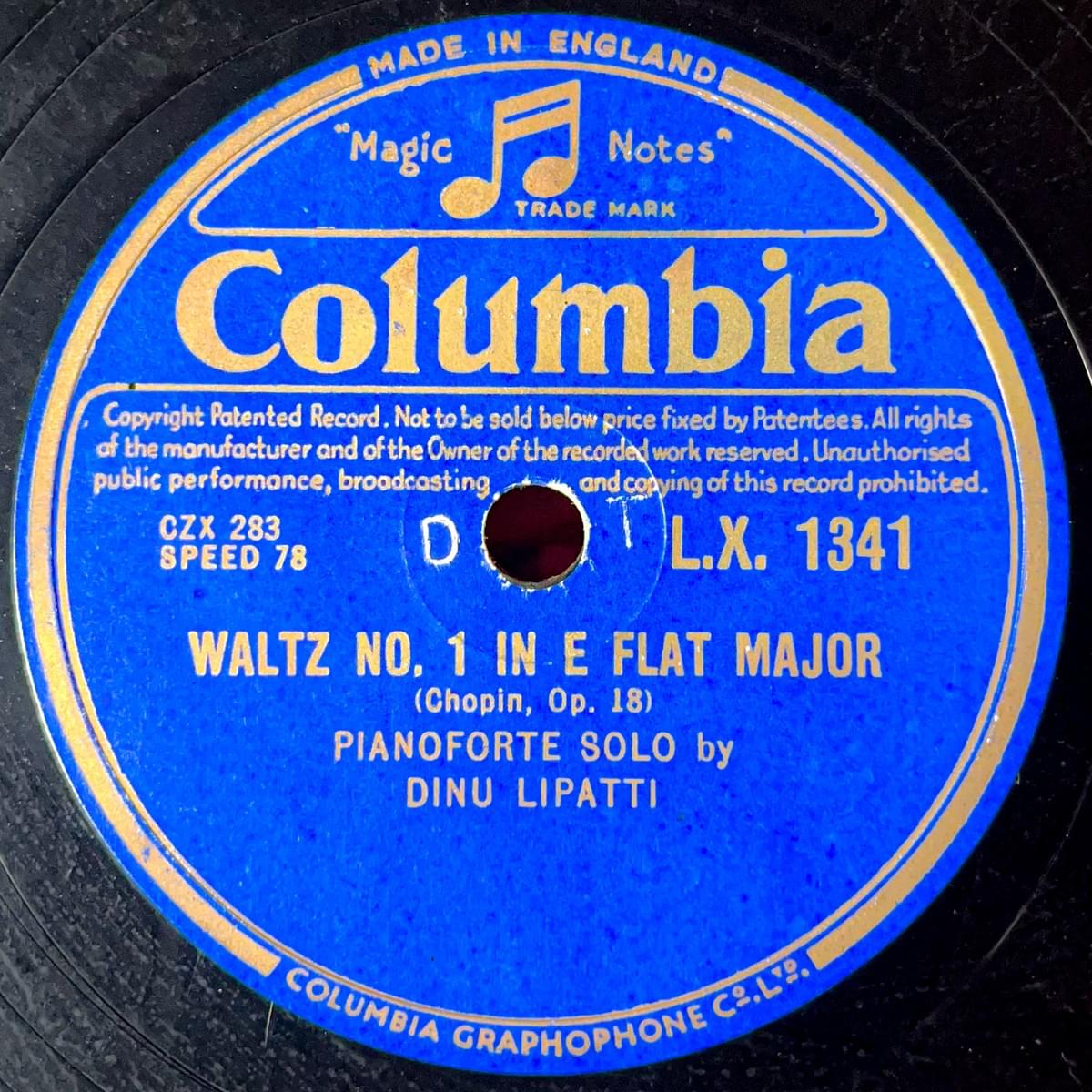
古殿收藏一整套英國 Columbia 的 78 轉唱片,編號 LX 1341 到 LX 1346,一共六張。深藍底的標籤,金色的「Magic Notes」雙音符商標,拿在手上沉甸甸的。
這是這份錄音最早的實體原始載體。但翻開一看,你會發現一件事:它們是照第 1 號到第 14 號的編號排列的。 較短的曲子,兩首合併在同一面;最後一張的背面,還補上了一首馬祖卡。
李帕第的曲序,在這裡完全不見了。78 轉時代的聽者,每四五分鐘就得起身換面,拿到的是十四首各自獨立的圓舞曲,而不是李帕第心中的那一首大作品。
第二種:貝桑松現場,唯一的證據
那一夜的演出,法國廣播電台原本打算現場直播。因為李帕第的身體狀況太不穩定,最後改為錄音,事後再播出。
這份錄音在檔案庫裡沉睡了好幾年,直到一位在 Pathé Marconi 工作的職員雅克·萊澤(Jacques Leiser,生卒年不詳),在翻找資料時發現了它的目錄卡。他一再力爭,唱片公司才在 1957 年由法國Columbia正式出版。
這是目前已知唯一一份李帕第現場彈奏圓舞曲全套的錄音,也是唯一能證明他在音樂會上真的照自己的曲序、從頭到尾連續演奏的紀錄。 雖然最後一首沒有彈完,他實際完成的是 13 首。今天市面上的貝桑松復刻版,會用 7 月 8 日錄音室錄下的第 2 號,把那個空缺補上。
仔細比對會發現,貝桑松現場的曲序和錄音室版黑膠有兩處不同:
- F 大調 Op. 34-3:錄音室版放在開場第 1 首;貝桑松移到第 9 首,接在同屬 Op. 34 的 a 小調之後。
- 降 A 大調 Op. 64-3:錄音室版放在第 10 首;貝桑松移到第 12 首,排在 Op. 70 兩首之後、Op. 18 之前。
除了這兩處,其餘十二首的相對位置完全相同:同樣在中段走入一整片小調,同樣以 Op. 18 與 Op. 34-1 作為終曲。兩個版本的差異是細部的調整,骨架則是同一個構思。 它們都是李帕第那首「大作品」的不同樣貌。
如果要問「李帕第的曲序」最終是什麼,答案應該以貝桑松為準。那是他親手在舞台上給出的版本,也是兩個月後他對同一個構思所做的最後修訂。
第三種:LP,讓「大作品」第一次在唱片上成立
1950 年 7 月錄音時,英國 EMI 還沒有推出 LP,當時唯一的發行形式就是 78 轉。所以李帕第生前,從來沒有機會為一張 LP 編排曲序。
1953 年,英國 Columbia 以 33CX 1032 發行了這套圓舞曲的 LP。它的曲序,是出版方在他去世後,依照他生前的演出資料整理出來的,和他的音樂會順序幾乎一致。
直到這一刻,李帕第「一整首作品」的構想,才第一次能在唱片上兩面連續流動。
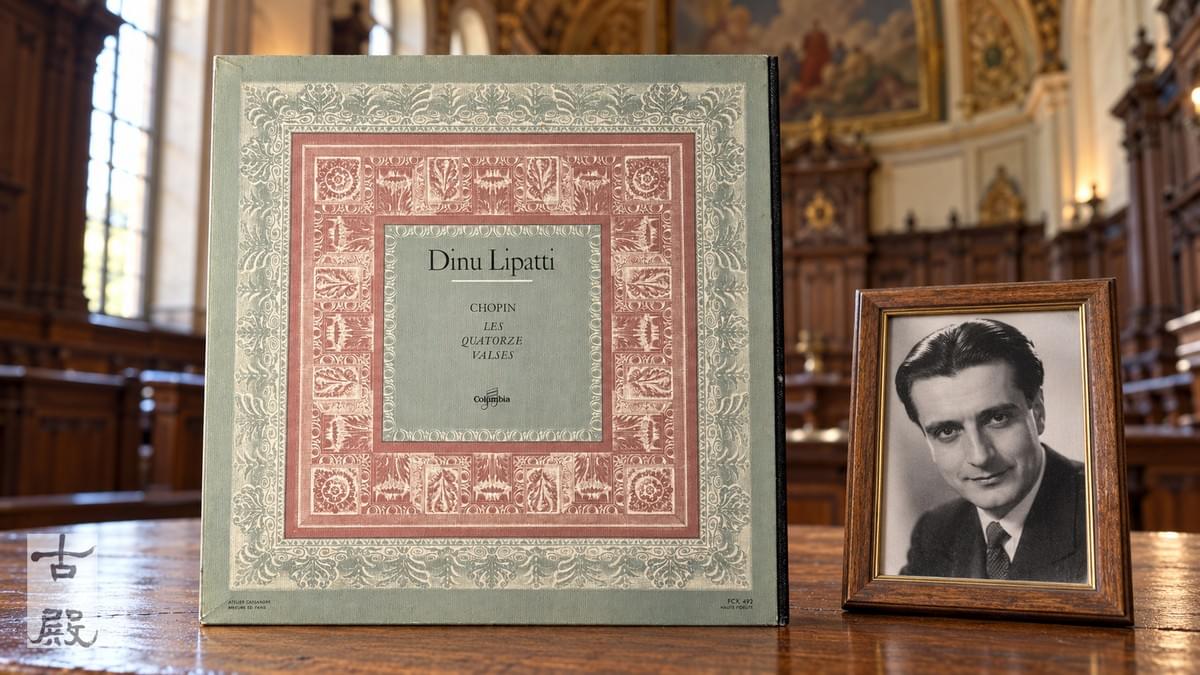
殿主經手研究過的另一張實體唱片,是法國 Columbia 的 33 FCX 492。灰綠與磚紅的古典紋飾封面,出自法國傳奇設計師卡桑德爾(A. M. Cassandre,1901-1968)的工作室;硬殼精裝,黑色布面書脊,捧在手上像一本書。
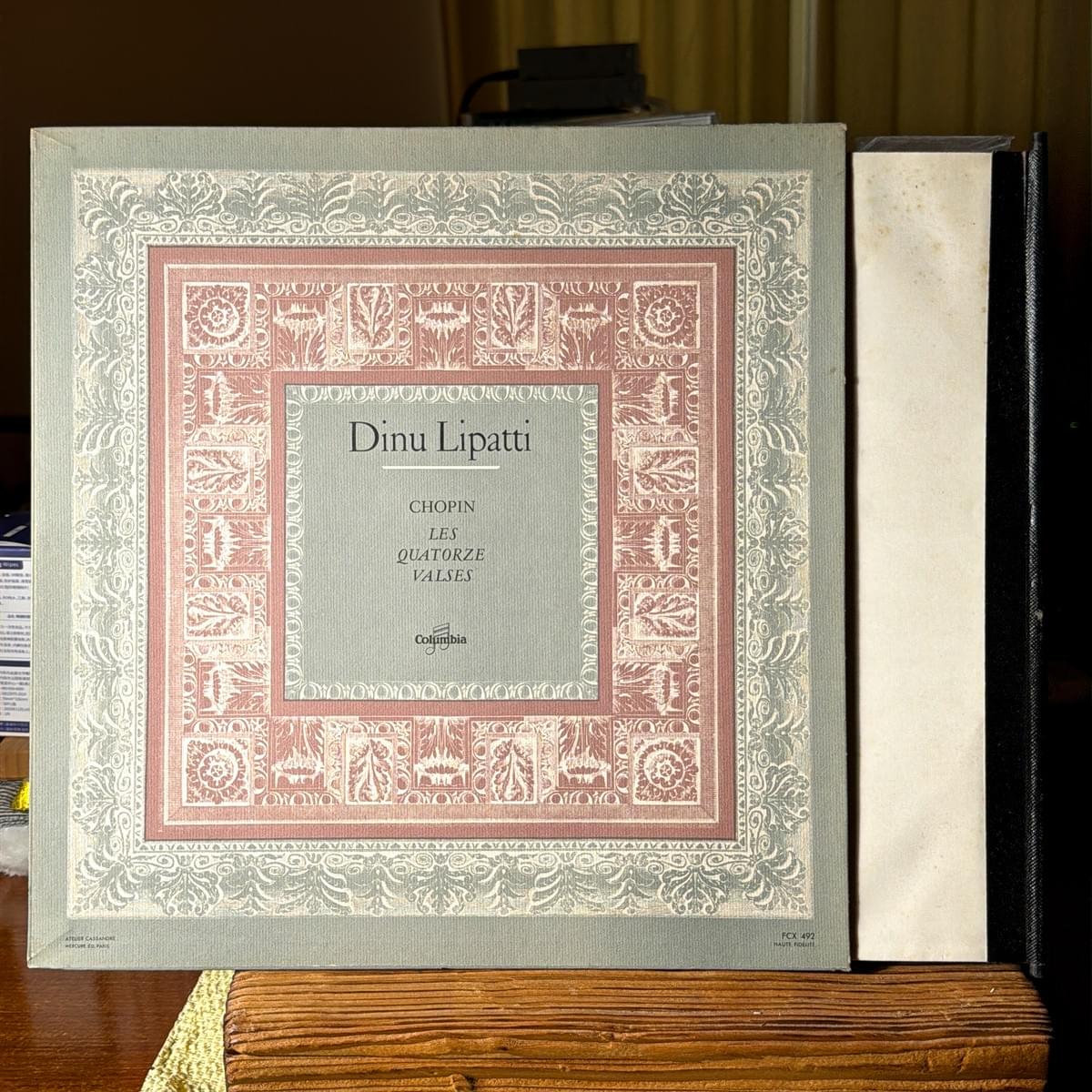
同一份 1950 年的演奏,在 78 轉上是十四首圓舞曲,在 LP 上才成為一首大作品。媒介本身,決定了你聽到的是什麼。
一個曲序,被一位鋼琴家帶著走了三十多年
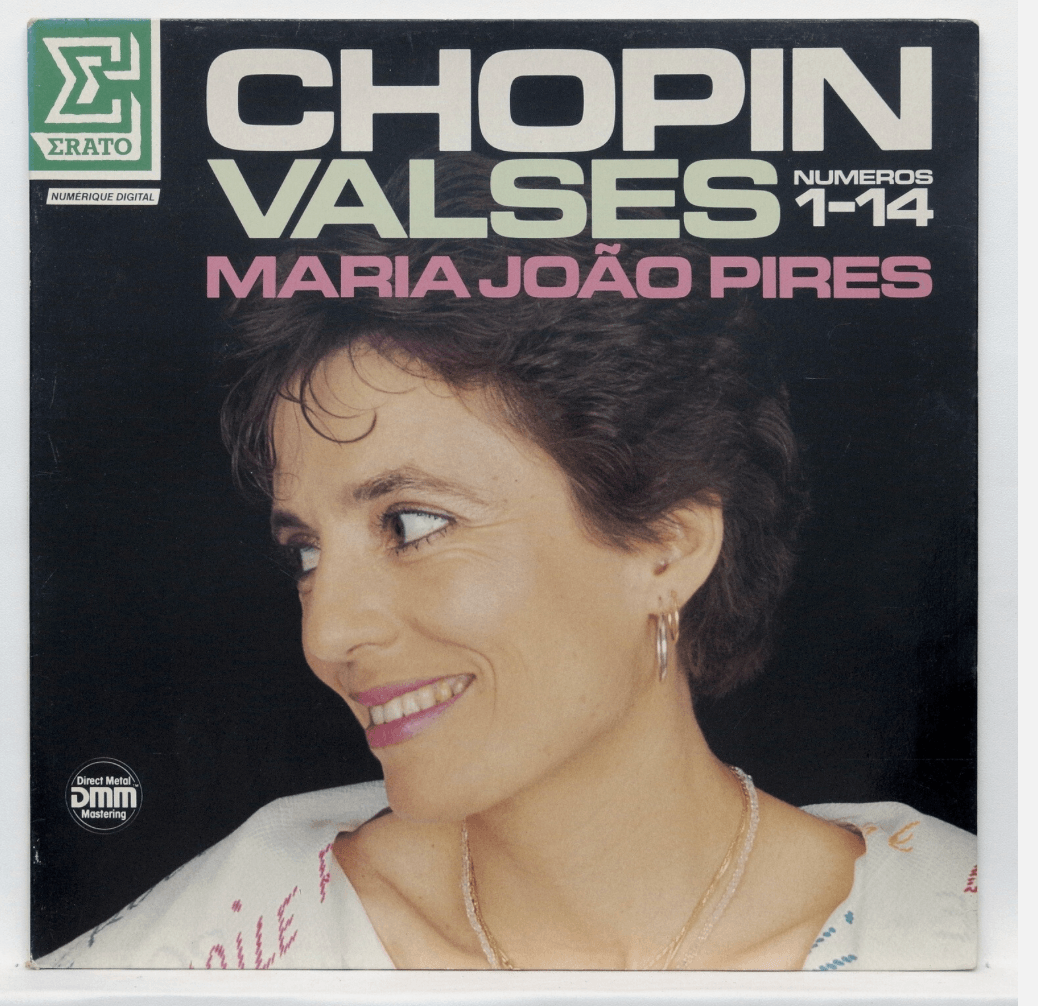
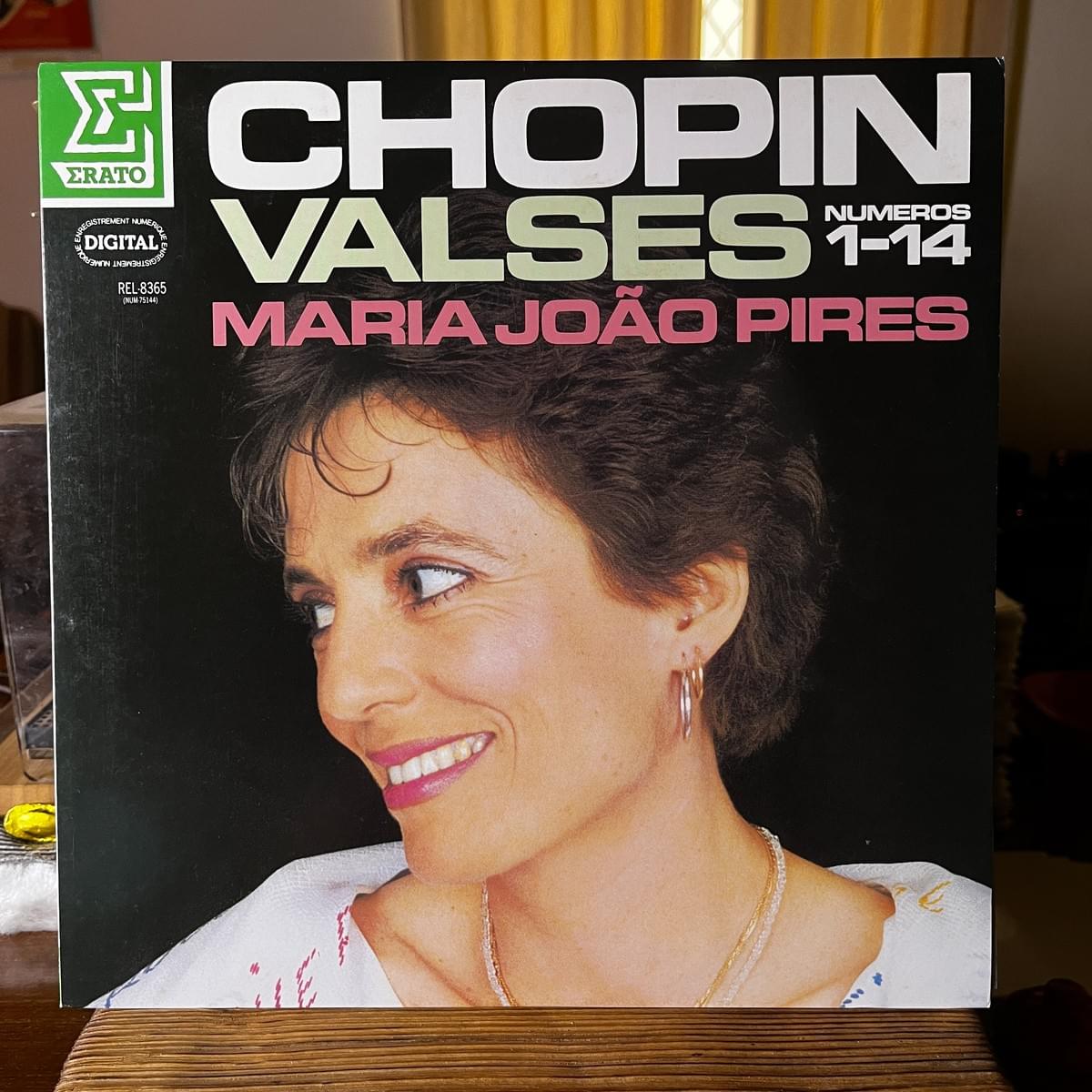
李帕第去世三十多年後,1984 年,葡萄牙鋼琴家瑪麗亞·若昂·皮耶絲(Maria João Pires,1944-)為法國 Erato 錄製蕭邦十四首圓舞曲。
這份錄音 1984 年 2 月錄於巴黎的阿迪亞爾廳(Salle Adyar),1985 年由 Erato 發行(法國原版 NUM 75144)。法國原版的封底,在曲目表下方用法、英、德三種語言印著同一句話,法文是「A l'instar de Dinu Lipatti, Maria João Pires a choisi cette mise en face」,意思是:「仿效迪努·李帕第,瑪麗亞·若昂·皮耶絲選擇了這樣的曲序」。這是唱片上留下的白紙黑字證據。
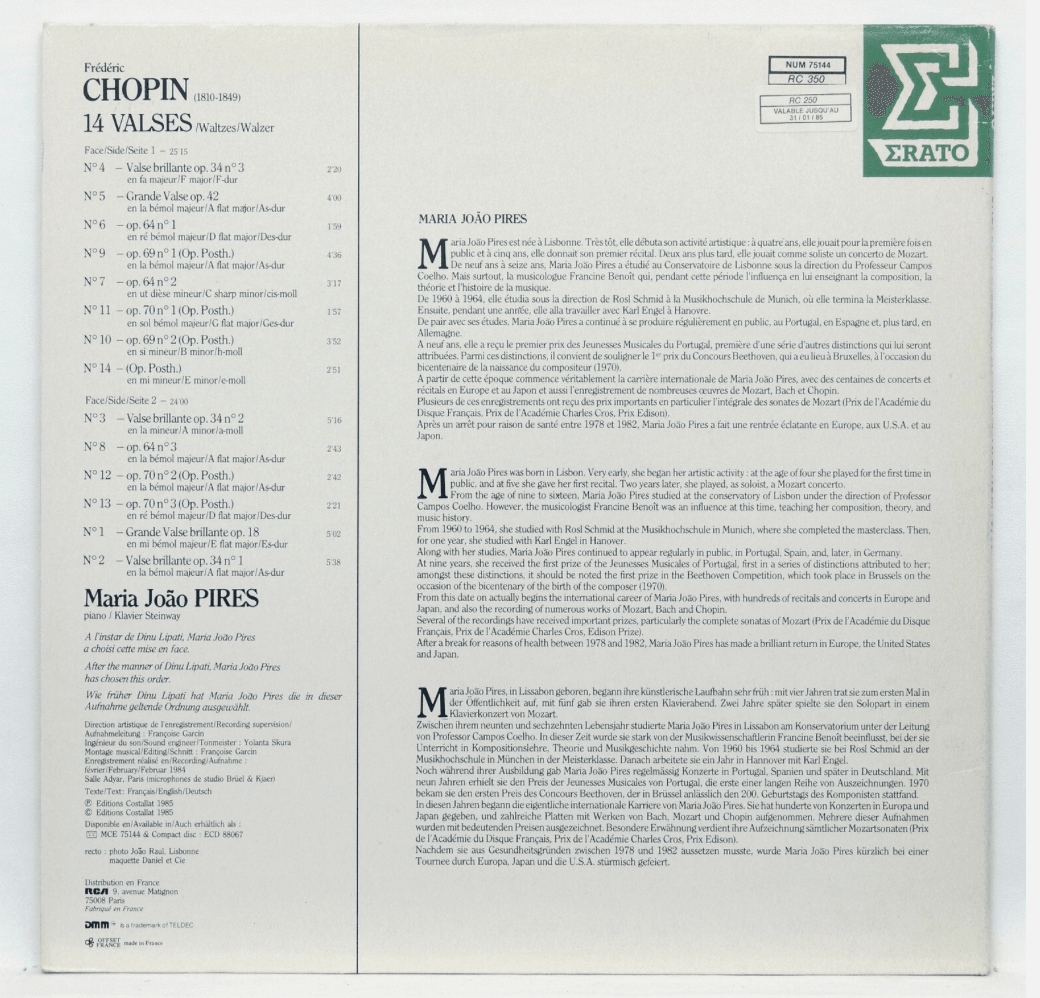
封底也記下了這份錄音的製作資料:錄音藝術總監是法蘭索瓦絲·加爾桑(Françoise Garcin,生卒年不詳),錄音師是約蘭塔·斯庫拉(Yolanta Skura,生卒年不詳)。斯庫拉是 Erato 當年的重要錄音師,1977 年那套法國巴黎音樂院博物館典藏歷史名琴的錄音,也出自她手,被日本音響評論家長岡鐵男列入「外盤 A 級榜」;她後來在 1990 年創立了傳奇的 Opus 111 唱片公司,自任製作人與錄音師。這張唱片裡,皮耶絲彈的是 Steinway 鋼琴,錄音使用 Brüel & Kjaer 的錄音室麥克風。A 面總長 25 分 15 秒,B 面總長 24 分鐘。
英國《留聲機》(Gramophone)雜誌在 1985 年 1 月號評論這張唱片時,第一句話就點明了這件事:「皮耶絲依照李帕第採用的曲序來演奏十四首圓舞曲。評論者特別指出,這個順序既不是依創作年代,也不是依出版順序,卻構成一個令人滿意、變化豐富的序列,把早期與成熟期的作品交錯得恰到好處」。
一位英國樂評人在四十多年前就聽出來了:這個曲序不是隨意的排列,而是一個經過設計的整體。不過那篇評論對皮耶絲的演奏本身褒貶參半,認為有幾首處理得極好,也有幾首未能深入。他甚至順帶提到,Op. 18 彈得太快,而李帕第的版本也一樣快。
《留聲機》後來在幾篇專題中,也一再提到這件事:在〈十位最偉大的蕭邦鋼琴家〉與〈五十張最偉大的蕭邦錄音〉裡,編輯都特別註明,李帕第的十四首圓舞曲是依他自己選擇、而非依年代的順序演奏的。在英語樂評圈,這個曲序是一件被反覆記下的事;但在中文世界,卻幾乎沒有人提及這件事。
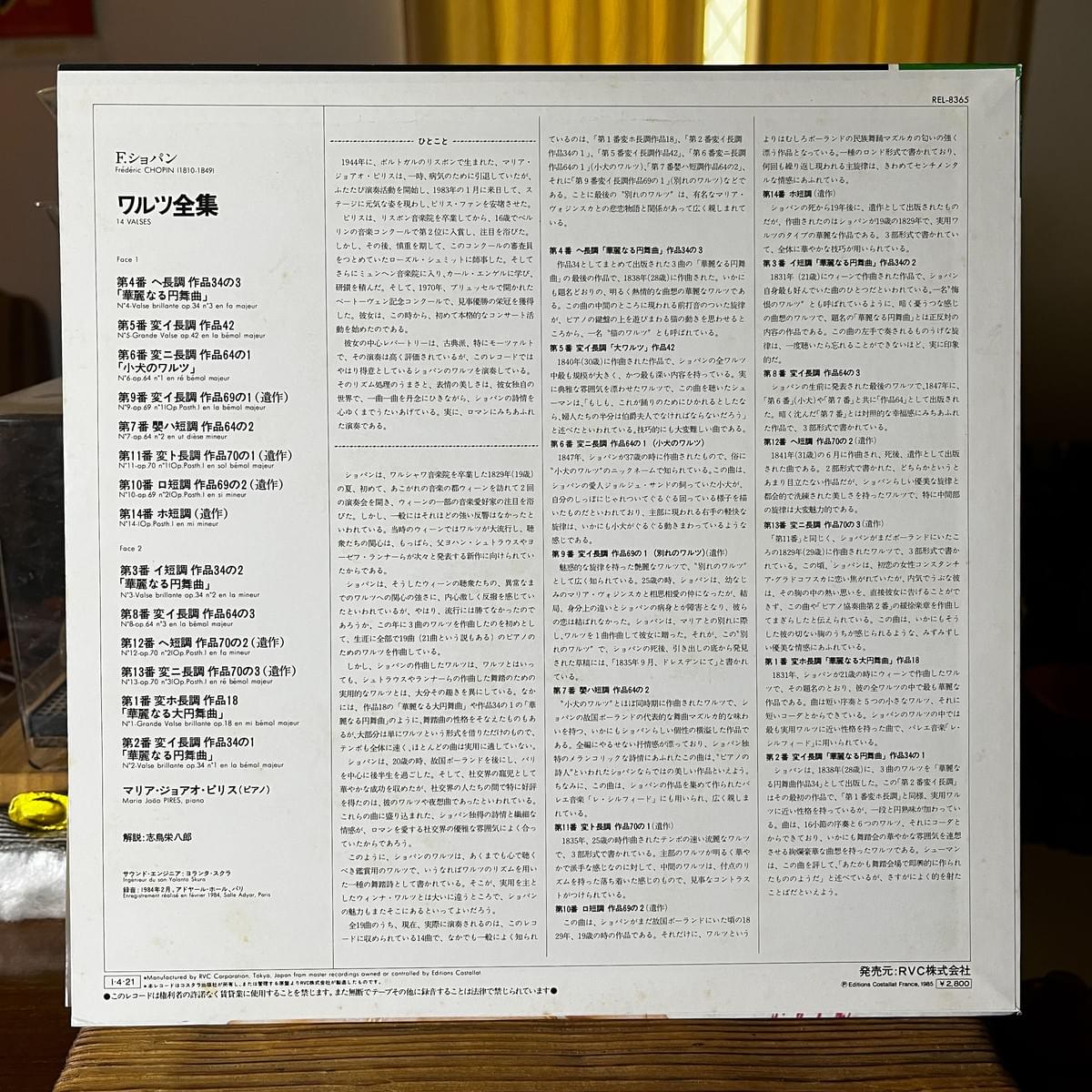
殿主也經手過這張唱片的日本 RVC 版(REL-8365,對應法國原版 NUM-75144)。拿標籤逐首比對:A 面是第 4、5、6、9、7、11、10、14 號,B 面是第 3、8、12、13、1、2 號,和李帕第版的曲序一字不差。
有意思的是,日本版封底由樂評家志鳥栄八郎撰寫的解說,介紹了皮耶絲的生平與每一首圓舞曲,卻沒有提到這個曲序和李帕第的關係。曲序明明白白印在標籤上,它背後的來歷,卻在東亞的唱片解說裡悄悄消失了。
皮耶絲對李帕第的景仰由來已久。她回憶自己 4 歲時在里斯本,聽過小提琴家吉奈特·努娃(Ginette Neveu,1919-1949)的音樂會,那是她記憶中深刻的經驗;幾天後,努娃死於空難。一年後,李帕第也走了。兩位早逝的天才,在一個小女孩的童年裡留下了深刻印記。
後來,比利時鋼琴家朱利安·李貝爾(Julien Libeer,1987-)年輕時瘋狂收集一切和李帕第有關的東西,最後又拜入皮耶絲門下。
李帕第、皮耶絲、李貝爾。一個曲序,一種對音樂的態度,就這樣跨越了三代人。
但說到底,這仍是一條很窄的路。
李帕第的圓舞曲唱片七十多年從未絕版,幾乎是每位愛樂者都聽過的名盤。可是他的曲序,那個把十四首小品變成一首「大作品」的構想,卻始終沒有真正流傳開來。皮耶絲用一整張唱片向他致敬,《留聲機》的樂評人也白紙黑字寫了下來,此後絕大多數的錄音與音樂會,仍舊照著編號或創作年代來排。
更諷刺的是,就連皮耶絲的唱片出版到了日本,曲序雖然原封不動地印在標籤上,那句在原始法國首版上「仿效迪努·李帕第」卻被刪除了。
人們記住了李帕第怎麼彈,卻很少有人追問他彈的是什麼?
李帕第曲序的全貌:一份時間表(年譜)
把散落在唱片、樂評與文獻裡的線索依時間排開,這個曲序從誕生到流傳的完整脈絡如下:
- 1935 年:作曲老師杜卡去世,葬禮與李帕第在巴黎的一場獨奏會撞期。他以巴哈〈耶穌,吾民仰望之喜悅〉開場致敬。十五年後,這首曲子成了他一生最後一場音樂會的終曲。
- 1949 年初:病情惡化,被迫停止演出近十個月;原定當年 10 月的圓舞曲錄音取消。
- 1949 年:病中設計一套「比較不累」的音樂會節目,十四首圓舞曲的曲序在此時成形。
- 1949 年 12 月:在伯恩首次演出這套節目。
- 1950 年 7 月 3–12 日:在日內瓦廣播電台第二錄音室錄下十四首圓舞曲,製作人李格。
- 1950 年代初:英國 Columbia 以 78 轉 LX 1341–1346 發行,依作品號碼排列,曲序不見了。
- 1950 年 9 月 16 日:貝桑松最後一場獨奏會,依自己的曲序演奏,彈完 13 首,第 2 號未能完成。這是他最後修訂的曲序。
- 1950 年 12 月 2 日:在日內瓦去世。
- 1953 年:英國 Columbia 33CX 1032 首度以 LP 發行,曲序由出版方依他生前的演出資料整理,「一首大作品」第一次在唱片上連續流動。
- 1955 年:逝世五週年,法國 Columbia 推出 FCX 491–495 紀念系列,圓舞曲為 FCX 492,封面出自卡桑德爾工作室。
- 1957 年:貝桑松現場錄音首度出版:法國首版,後來再有英國首版兩張單張與輸往美國的 Angel B 3556 豪華盒裝版。
- 1984 年 2 月:皮耶絲在巴黎錄下十四首圓舞曲,採用李帕第的曲序。
- 1985 年:Erato 法國原版 NUM 75144 以法、英、德三語標明「仿效迪努·李帕第」;《留聲機》1 月號的評論第一句就點出這件事。同年的日本 RVC 版 REL-8365 保留了曲序,卻沒有保留這句說明。
- 2000 年代以後:比利時鋼琴家李貝爾因李帕第而決定成為鋼琴家,後來拜入皮耶絲門下。
從 1949 年病中的一個構想,到七十多年後殿主親手比對過的 78 轉、LP 與皮耶絲的唱片,這條線從未真正斷過。只是它太細,細到大多數人都沒有注意到。
殿主認為這個曲序是研究李帕第的重要課題。它不需要去猜他心裡想什麼:有他本人說過的理由,有錄音室與現場兩份錄音,還有他在兩個月之間親手修訂的兩處位置。這樣具體、可比對的證據,在演奏史上並不多見。
若日後能在他的書信或節目單中找到更多記載,這個構想的全貌,還能再往前推進一步。
******
【Gudian Music Stories】The Final Waltz Left Unfinished: Dinu Lipatti (1917–1950) and Chopin's Fourteen Waltzes
The Final Waltz Left Unfinished
September 16, 1950. The historic city of Besançon in eastern France.
At three in the afternoon, the doctor telephoned the festival directors: tonight’s recital had to be canceled. The pianist was racked by an intractable high fever and agonizing physical pain, barely able to remain upright.
Word soon reached him that two hours before curtain, the hall was already packed. With every seat taken, attendees sat along the steps bordering the stage apron, spilling out into the foyer.
He resolved to play anyway.
Supported on either side by his wife and physician, he ascended the stairs to the stage. The first half comprised Johann Sebastian Bach (1685–1750), Wolfgang Amadeus Mozart (1756–1791), and Franz Schubert (1797–1828). The second half was dedicated entirely to Frédéric Chopin’s (1810–1849) fourteen waltzes.
He finished the thirteenth. As the final chord of the Grande Valse brillante in E-flat major died away, the hall erupted in applause.
Then he began the final selection: Waltz No. 2 in A-flat major, Op. 34, No. 1.
He sounded only the opening bars before his hands came to a stop.
He stood and walked backstage. The auditorium fell into dead silence—a stillness that felt suspended in time. At last, he returned to the keyboard. Leaving the waltz untouched, he played Bach's chorale Jesu, Joy of Man's Desiring, bringing the recital—and his life on the concert stage—to its final close.
Eleven weeks later, he passed away in Geneva at just thirty-three years old.
His name was Dinu Lipatti (1917–1950).
This article explores a remarkable fact: the waltz left incomplete on that stage had already been realized. Just two months prior, it had been captured in its entirety in a recording studio.
Moreover, the order in which Lipatti performed those fourteen waltzes concealed his final, most comprehensive musical architecture.
While documented across Western critical literature, this design has received scant attention in the Chinese-speaking world. To my knowledge, no comprehensive Chinese-language account has unraveled the narrative: Why did Lipatti reorder the fourteen waltzes? How did he organize them? What structural logic lies beneath this sequence? What path did it take across the studio, the stage, original 78 RPM shellacs, and microgroove LPs? And who carried the torch forward?
This essay offers a thorough account of that artistic lineage.
A Student Whose Teacher Proclaimed: "There Is Nothing Left to Teach"
Dinu Lipatti was born in Bucharest, Romania, in 1917. His godfather was his father's close friend and Romania’s preeminent musical titan, George Enescu (1881–1955).
At sixteen, he entered the Vienna International Music Competition, placing joint second. Alfred Cortot (1877–1962), a member of the jury, resigned in protest and refused to sign the diploma, maintaining that the young prodigy deserved undisputed first prize.
A year later, Lipatti arrived in Paris to study under Cortot. Cortot remarked soon afterward that he had nothing left to teach him.
To understand Lipatti, one must first recognize that he was a complete musician whose chosen medium happened to be the piano.
He was born into a musical household: his father was a violinist who had studied with Pablo de Sarasate (1844–1908) and Carl Flesch (1873–1944); his mother was a pianist. For Lipatti, music was not an acquired skill, but a native mother tongue spoken effortlessly at home. The father's violin and the mother's piano were the earliest sounds he absorbed. It was said he played piano before he learned to laugh, and at his baptism, he performed a Mozart minuet. A photograph taken on June 12, 1921, captures the four-year-old Lipatti holding a miniature violin, looking up at his godfather Enescu, who cradles his own instrument. (This portrait appears in the first American Angel pressing, Dinu Lipatti: His Last Recital, catalog number Angel B 3556—a deluxe boxed set manufactured in the UK for US distribution, complete with an illustrated booklet and an essay by producer Walter Legge. The contemporary French issue featured a different booklet, while the UK first pressing on Columbia 33CX 1499–1500 comprised two single LPs without a booklet; this image appeared solely in the Angel box.) The opening image of his childhood was preserved alongside the recording of his farewell concert.
In Bucharest, he studied piano and composition under Mihail Jora (1891–1971), taking honors in the Enescu Composition Prize for three consecutive years: a Sonatina for Violin and Piano in 1933, a Piano Sonatina in 1932, and the first prize in 1934 for his symphonic suite Les Tsiganes.
In Paris, he enrolled at the École Normale de Musique de Paris, studying piano with Cortot and Cortot's assistant Yvonne Lefébure (1898–1986). He read composition with Paul Dukas (1865–1935), and following Dukas’s death, with Nadia Boulanger (1887–1979), whom he revered as his "spiritual mother." He also pursued conducting under Diran Alexanian (1881–1954) and Charles Munch (1891–1968), abandoning the podium only when he realized he could not divide his energies between three demanding disciplines simultaneously.
Piano, composition, conducting: these names formed the intellectual peak of French musical pedagogy in the first half of the twentieth century. Lipatti engaged with all three.
Yet what defined his artistry was his temperament: an uncompromising pursuit of perfection. He would labor over an important work for years before bringing it to the concert platform. He acknowledged an affinity for the recording studio because it offered the opportunity to eliminate technical flaws.
In 1943, fleeing war-torn Romania, he settled in Geneva, teaching at the Geneva Conservatory. It was there that unexplained symptoms began to manifest, eventually diagnosed as Hodgkin's disease.
In early 1949, about to embark on a tour of the Netherlands, he fell ill and was rushed back to Switzerland, remaining sidelined for the next ten months. A scheduled recording of the Chopin waltzes that October had to be canceled.
For an artist devoted to perfection, his physical body was giving way.
How would he respond?
Bringing the Studio to the Patient
In the summer of 1950, an unexpected reprieve arrived.
An experimental medication, cortisone, temporarily restored Lipatti's physical stamina, funded through the generosity of private patrons.
Walter Legge (1906–1979), the legendary producer for Columbia/HMV, recognized that this window would not remain open for long.
Since Lipatti could not travel to London, Legge arranged for full mobile recording equipment to be transported across the continent to Geneva, setting up shop inside Studio 2 of Radio Genève. Between July 3 and July 12, taking advantage of Lipatti’s strongest days, they tracked the repertoire movement by movement.
Over those ten days, he recorded Bach, Mozart, and the fourteen Chopin waltzes.
In 1950, mobile recording was a demanding physical endeavor: heavy equipment had to be hauled by road, engineers worked on site, and each wax or lacquer side held barely four to five minutes of music.
For Lipatti, every piece set down across those ten days might well be his final performance.
What emerges from these grooves is not a comfortable reading by a healthy pianist in peak condition, but the distillation of an artist racing against time, offering definitive interpretations with no second chances.
Curiously, the resulting performance carries no trace of despair.
Transforming Fourteen Miniatures into an Organic Monument
To understand why this recording remains free of despair, one must address a fundamental question:
How should Chopin's fourteen waltzes be ordered?
The conventional approach is to follow the standard chronological or opus numbering: Waltz No. 1 through Waltz No. 14. Virtually every printed edition and commercial recording follows this practice.
Lipatti broke from that custom.
Commentators routinely praise this recording as the benchmark interpretation of the waltzes, noting its clarity, aristocratic poise, and emotional economy—the swan song of a dying master. All of this is true, but it addresses only how he played.
What was Lipatti actually playing?
He was not merely presenting fourteen separate waltzes. He was articulating an expansive, coherent cyclic work in fourteen movements. And the architect of that large-scale design was, in a creative sense, Lipatti himself.
A Composer's Conception
His rationale was straightforward: Chopin composed these waltzes at different times and locations, never intending them as an indivisible concert suite. Playing them by numerical sequence offered no musical cohesion. The proper approach was to reorder them so they functioned as an integrated whole.
This reflects Lipatti’s background as a composer and conductor. A pianist asks, "How do I play this piece?" A composer or conductor asks, "How do these materials assemble into a coherent structure?" Lipatti approached Chopin's waltzes through the latter lens.
This formal conception took shape during his periods of deepest physical exhaustion.
Resting during his 1949 illness, searching for an economical program that would preserve his stamina, Lipatti constructed a balanced recital: Bach’s Partita in B-flat major, Mozart’s Sonata in A minor, two Schubert Impromptus, concluding with the fourteen Chopin waltzes. He unveiled this sequence in Bern in December 1949.
Anatomy of the Cyclic Structure
The clearer framework is documented in the Besançon recital order, representing the sequence Lipatti presented on the concert stage. Setting out the fourteen waltzes alongside their tonal centers reveals an unmistakable narrative:
Opening: Brightness and Momentum
- No. 5 in A-flat major, Op. 42
- No. 6 in D-flat major, Op. 64, No. 1 (Minute)
- No. 9 in A-flat major, Op. 69, No. 1 (Farewell)
Descent into Shadow
- No. 7 in C-sharp minor, Op. 64, No. 2
- No. 11 in G-flat major, Op. 70, No. 1
- No. 10 in B minor, Op. 69, No. 2
- No. 14 in E minor, Op. posth.
- No. 3 in A minor, Op. 34, No. 2
The Turning Point: A Ray of Light
- No. 4 in F major, Op. 34, No. 3
- No. 12 in F minor, Op. 70, No. 2
Return to Light
- No. 13 in D-flat major, Op. 70, No. 3
- No. 8 in A-flat major, Op. 64, No. 3
Coda: The Grand Affirmation
- No. 1 in E-flat major, Op. 18 (Grande Valse brillante)
- No. 2 in A-flat major, Op. 34, No. 1
(Note: The sectional groupings above represent my analytical interpretation based on tonal and dramatic shifts, rather than explicit markings left by Lipatti.)
Analyzing this layout brings several structural choices to the fore:
First, it opens in A-flat major and closes in A-flat major. The first piece (Op. 42) and the final work (Op. 34, No. 1) share the tonic of A-flat major, reinforced by two additional appearances of that key along the way. A-flat major acts as the home key of this cyclic architecture—the point of departure and the destination of return.
Second, the penultimate piece in E-flat major serves as the dominant of A-flat major. In classical tonal harmony, the dominant creates the harmonic tension that drives the music home to the tonic. By placing Op. 18 second from last, Lipatti engineered a monumental dominant-to-tonic cadence across the entire sequence. That evening in Besançon, the audience broke into applause after Op. 18 because the music had brought them to the threshold of that homecoming.
Third, the central section moves through sustained minor keys. From pieces four through eight, C-sharp minor, B minor, E minor, and A minor follow in close succession, relieved only by the brief respite of G-flat major. This forms the emotional core of the cycle.
Fourth, F major acts as light breaking through the darkness. Emerging from this run of minor keys, the F major of Op. 34, No. 3 opens like a window. It follows the A minor of Op. 34, No. 2, reuniting two companion pieces from Chopin’s original publication. After a brief turn into F minor, the music brightens steadily: D-flat major, A-flat major, E-flat major, and finally home to A-flat major.
Beginning in light, descending into shadow, finding renewal at the pivot, and concluding in a triumphant return home.
This was not a compilation of fourteen isolated miniatures, but an integrated work with an exposition, development, and resolution, conceived like a multi-movement sonata.
Two Versions, One Blueprint
The chart above reflects the live Besançon recital. The studio version set down in July 1950 differs in only two positions, while remaining identical in every other detail:
- F major, Op. 34, No. 3: Placed first in the studio LP sequence; shifted to the ninth position at Besançon, following the A minor of Op. 34.
- A-flat major, Op. 64, No. 3: Placed tenth in the studio LP sequence; shifted to twelfth at Besançon, directly following the two Op. 70 waltzes and preceding Op. 18.
The Besançon sequence solidifies the architectural frame: beginning in A-flat major, concluding in A-flat major, and allowing the F major to function as a dramatic turning point following the minor-key depths. While Lipatti left no written explanation for this adjustment between July and September, the Besançon order presents a tighter, more cohesive formal design.
Why the Recording Transcends Despair
Looking back at that scene in Besançon reveals the weight of that evening: Lipatti played through to the penultimate movement of this cycle before the audience broke into spontaneous ovation. He was then unable to deliver the final movement—the ultimate return home to A-flat major.
Yet this recording remains free of despair because Lipatti was not expressing his physical suffering. He was serving Chopin: presenting a complete expressive world that journeys from light, through darkness, and back to renewal.
An artist aware that his days were numbered spent his final energies organizing fourteen disparate miniatures into an enduring whole.
One Interpretation Across Three Formats
Lipatti's conception was preserved across three distinct physical media, each of which I have examined and compared directly in the Ancient Palace archives:
1. The 78 RPM Shellacs: The Disassembled Suite
The Ancient Palace preserves the complete UK Columbia 78 RPM set, catalog numbers LX 1341 through LX 1346—six heavy shellac discs with dark blue labels and gold "Magic Notes" lettering.
This was the earliest commercial format for the recording. Examining the labels reveals that the pieces were pressed strictly by opus number from No. 1 to No. 14, pairing shorter waltzes on single sides and concluding with a Mazurka on the final disc face.
Lipatti’s structural sequence was absent here. Listeners in the 78 RPM era, turning the records every four to five minutes, encountered fourteen discrete waltzes rather than the unified work Lipatti had designed.
2. The Besançon Live Tape: The Solitary Stage Document
French Radio had initially intended to broadcast the Besançon recital live. Due to Lipatti's precarious condition, the event was captured on tape for delayed transmission instead.
The master tapes remained in the archives until Jacques Leiser, an official at Pathé Marconi, uncovered the index card during an archival search. Through his advocacy, the recording was issued commercially by French Columbia in 1957.
This document stands as the only surviving recording of Lipatti performing the waltzes live in concert, proving that he executed this reordered cycle continuously on stage. While he was unable to finish the final waltz—leaving thirteen complete performances—modern reissues bridge the gap by splicing in the studio take of Waltz No. 2 recorded on July 8.
Aside from the repositioning of Op. 34, No. 3 and Op. 64, No. 3, the architecture of the two accounts remains identical: both traverse the central minor-key terrain and culminate in Op. 18 and Op. 34, No. 1. They represent two manifestations of the same structural vision, with the Besançon concert capturing Lipatti's final thoughts on the cycle.
3. The LP: Giving Physical Form to the Suite
When the sessions took place in July 1950, British EMI had not yet adopted the microgroove LP format; the recording was captured exclusively for shellac release. During his lifetime, Lipatti never had the opportunity to program an LP side.
In 1953, UK Columbia issued the waltzes on LP (33CX 1032). The production team reconstructed the tracklist based on Lipatti’s surviving recital programs, mirroring his concert sequence.
For the first time, Lipatti’s conception flowed uninterrupted across two vinyl sides.
Another historical pressing in the Ancient Palace archive is French Columbia’s 33 FCX 492: a deluxe clothbound edition with a patterned cover by the designer A. M. Cassandre (1901–1968), bound like a book.
The same 1950 performance represents fourteen disconnected dances on 78 RPM, yet coalesces into a coherent whole on LP. The playback format directly shaped the listener's perception of the music.
A Tracklist Carried Forward for Three Decades
More than three decades after Lipatti's death, in February 1984, Portuguese pianist Maria João Pires (b. 1944) recorded Chopin’s fourteen waltzes for the French label Erato.
Captured at the Salle Adyar in Paris and released in 1985 (French original NUM 75144), the rear sleeve prints an explicit credit beneath the program in French, English, and German: "À l'instar de Dinu Lipatti, Maria João Pires a choisi cette mise en page" ("Following the example of Dinu Lipatti, Maria João Pires chose this arrangement of sides").
The production notes document the team behind the sessions: artistic direction by Françoise Garcin and engineering by Yolanta Skura. Skura was an important engineer for Erato—responsible for the 1977 recordings of historical instruments at the Paris Conservatory Museum, selected by Japanese critic Tetsuo Nagaoka for his Import Disc Class-A List—who later founded the Opus 111 label in 1990. Pires performed on a Steinway instrument captured via Brüel & Kjær laboratory microphones, with Side A clocking in at 25'15" and Side B at 24'00".
Reviewing the release in January 1985, Gramophone noted the connection in its opening sentence: "Pires plays the fourteen waltzes in the order adopted by Dinu Lipatti... not chronological in composition or publication, yet forming a satisfying and varied sequence that interleaves early and mature works with admirable balance."
A British critic recognized four decades ago that this sequence was a coherent whole. While the review was mixed regarding Pires’s performance—praising certain selections while finding others less persuasive, and noting that her brisk tempo in Op. 18 matched Lipatti’s own—the structural choice was acknowledged.
Gramophone revisited the point in retrospectives on "Ten Greatest Chopin Pianists" and "Fifty Greatest Chopin Recordings," noting that Lipatti performed the waltzes in his own chosen sequence rather than by chronological date. Yet while documented in English-language commentary, this design remained largely unremarked in Chinese-language scholarship.
The Japanese RVC pressing of this title (REL-8365, corresponding to French NUM-75144) matches Lipatti’s studio sequence across both sides: Nos. 4, 5, 6, 9, 7, 11, 10, and 14 on Side A; Nos. 3, 8, 12, 13, 1, and 2 on Side B.
Curiously, while Eiichiro Shitori’s Japanese liner notes detail Pires’s career and analyze each waltz, they make no mention of Lipatti’s influence on the sequence. The order was printed on the label, but its provenance was omitted from the Japanese commentary.
Pires’s devotion to Lipatti ran deep. She recalled that as a four-year-old child in Lisbon, she attended a recital by violinist Ginette Neveu (1919–1949)—a performance that left a profound impression shortly before Neveu perished in an air crash. A year later, Lipatti was gone. The passing of these two prodigies shaped her childhood imagination.
Decades later, Belgian pianist Julien Libeer (b. 1987), who spent his youth studying Lipatti's recorded legacy, went on to study under Pires.
Lipatti, Pires, Libeer: a sequence and an artistic ethos carried across three generations of musicians.
Yet this interpretive lineage remained rare.
While Lipatti’s recording of the waltzes has remained continuously in print for over seventy years, his concept of unifying the fourteen miniatures into a cyclic work was rarely adopted. Pires paid tribute to him across an entire LP, and Gramophone documented the lineage, yet most subsequent recitals and recordings defaulted to numerical or chronological order.
Even on the Japanese issue of Pires’s recording, the acknowledgment reading "Following the example of Dinu Lipatti" was removed from the jacket.
Listeners remembered how Lipatti played, but rarely asked what he was playing.
Chronology of Lipatti's Reordered Sequence
Tracing the evidence across recordings, critical reviews, and archival documents outlines the history of this sequence:
- 1935: Following the passing of his composition teacher Paul Dukas, which coincided with a recital in Paris, Lipatti opened his performance with Bach’s Jesu, Joy of Man's Desiring in tribute. Fifteen years later, that chorale became the final piece he performed on stage.
- Early 1949: Deteriorating health forced Lipatti to withdraw from performance for nearly ten months; scheduled recording sessions for the Chopin waltzes were canceled.
- 1949: During his convalescence, he assembled a balanced program designed to conserve his physical stamina; the reordered cycle of fourteen waltzes took form.
- December 1949: Lipatti premiered this sequence in Bern.
- July 3–12, 1950: The fourteen waltzes were recorded in Studio 2 of Radio Genève, produced by Walter Legge.
- Early 1950s: Issued on UK Columbia 78 RPM (LX 1341–1346), ordered strictly by opus number; the structural sequence was disassembled across six discs.
- September 16, 1950: The farewell recital at Besançon. Lipatti performed according to his revised sequence, completing thirteen waltzes before leaving No. 2 unfinished.
- December 2, 1950: Lipatti passed away in Geneva.
- 1953: UK Columbia 33CX 1032 was issued on LP, reconstructing the sequence from his concert notes, allowing the cycle to flow across two sides.
- 1955: On the fifth anniversary of his death, French Columbia issued the commemorative series FCX 491–495; the waltzes (FCX 492) featured cover artwork from the studio of A. M. Cassandre.
- 1957: The live Besançon recital was published for the first time: initially in France, followed by UK single LPs and the deluxe US Angel B 3556 box set.
- February 1984: Maria João Pires recorded the fourteen waltzes in Paris, adopting Lipatti’s sequence.
- 1985: Erato's original French release (NUM 75144) noted "Following the example of Dinu Lipatti" in three languages; Gramophone highlighted the lineage in its January review. The Japanese RVC release (REL-8365) preserved the sequence but omitted the note.
- 2000s onward: Belgian pianist Julien Libeer was inspired by Lipatti's recordings to pursue a concert career, later studying under Pires.
From a convalescent concept in 1949 to the historical 78s, LPs, and Pires releases preserved in the Ancient Palace archives, this interpretive thread remained unbroken, even as it went largely unnoticed.
This structural sequence represents an essential subject in Lipatti scholarship. It requires no speculation regarding his intentions: we have his stated rationale, the studio and concert recordings, and his adjustments to the sequence across those final two months. Such documentary evidence is rare in the history of performance practice.
Should additional correspondence or concert programs come to light, the origins of this formal architecture will become clearer still.