
【古殿唱片音樂故事】巴絲塔博之二:她在佔領下的阿姆斯特丹拉的貝多芬協奏曲,黑膠時代只有這一張——吉拉·巴絲塔博(Guila Bustabo,1916-2002)與孟根堡(Willem Mengelberg,1871-1951)
古殿殿主
一個對不上的日期
上一篇寫吉拉·巴絲塔博(Guila Bustabo,1916-2002),是從西貝流士那句「需要好幾個世代,才能再造這樣的一雙巧手」寫起,寫到她晚年在伯明翰街頭推著的那輛雜貨手推車。那張唱片,是加拿大 Rococo 廠牌留下的1940年柏林廣播檔案。
這一篇,要從一張白色封套的唱片寫起。
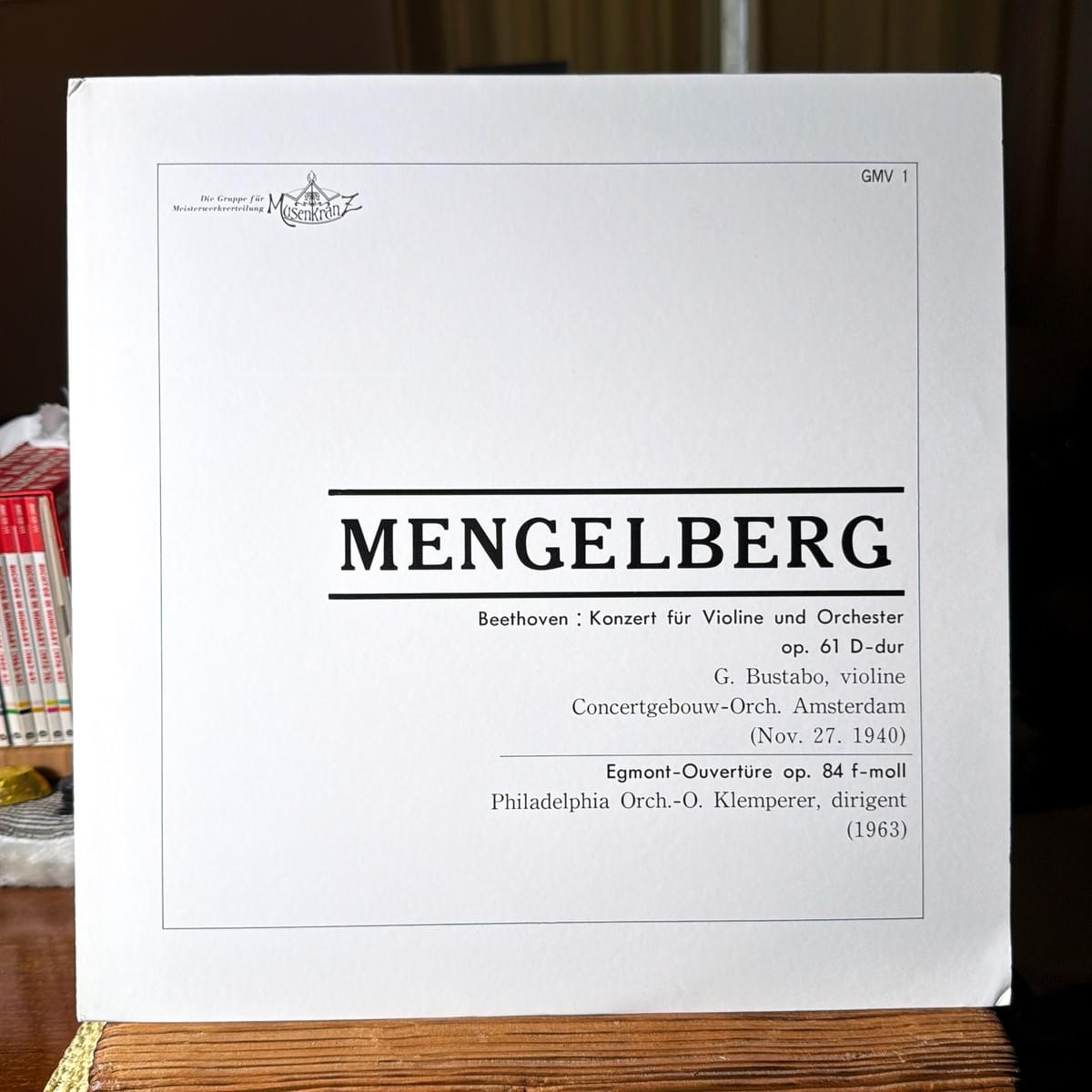
封套上大字印著「MENGELBERG」,下面是貝多芬《D大調小提琴協奏曲》,獨奏「G. Bustabo」,阿姆斯特丹結合音樂廳管弦樂團,括弧裡寫著錄音日期:「Nov. 27. 1940」。
但查遍後來所有的 CD——英國 Archive Documents、法國 Tahra、日本 Seven Seas、歐洲 Memories——巴絲塔博與孟根堡(Willem Mengelberg,1871-1951)合作的貝多芬協奏曲,只有一份,日期都標著:1943年5月6日。
那「1940年11月27日」是哪裡來的?兩人確實在1940年合作過一場——布魯赫的第一號小提琴協奏曲,1940年10月27日。「27日」、「1940年」,都屬於布魯赫那一晚。這張唱片上的日期,恐怕是把兩場演出混在了一起。
而這個錯誤偶然地揭開了一件事:如果這份錄音真的是1943年,那它錄下的,就不只是一場音樂會。
上一篇沒有說完的阿姆斯特丹
上一篇提到,戰爭結束後,盟軍在巴黎逮捕巴絲塔博母女,起因主要是她曾在孟根堡指揮下,於德軍佔領期間的阿姆斯特丹登台。
這張唱片,就是那樣的一場演出。
1943年5月,荷蘭已經在德軍佔領下三年。巴絲塔博二十七歲,站在結合音樂廳的舞台上,身旁是執掌這個樂團已經半個世紀的孟根堡。她不知道,兩年多以後,那份寫著「曾在納粹宣傳部特許下,於德國及德占地區演出」的美軍調查紀錄,會把她的名字列進黑名單;她也不知道,這一晚拉出的每一個音,都會成為她日後無法回到祖國舞台的理由之一。
如果說上一張說的西貝流士,錄下的是母親那個選擇剛剛發生的一年;那麼這張貝多芬,錄下的就是那個選擇最深的處——她在佔領區的舞台上,演奏德國音樂的核心曲目。
但也要說一句公道話:這個決定不是她做的。她曾兩度試圖掙脫母親,都被尋回。站在舞台上的,是一個依然沒有自己人生的二十七歲女子。
孟根堡:另一個付出代價的人
站在她身旁的那個人,命運也好不到哪裡去。
孟根堡生於荷蘭烏得勒支,父母是德國裔。他自小被送到德國科隆音樂學院學習鋼琴與作曲,師事法蘭茲·維爾納(Franz Wüllner,1832-1902)——而維爾納是貝多芬的「孫弟子」。二十歲,他英雄出少年,被選為瑞士琉森市的音樂總監;1895年二十四歲返國,接掌阿姆斯特丹音樂大會堂管弦樂團,一做就是五十年。
他是十九世紀末崛起的年輕世代代表。他和理查·史特勞斯(Richard Strauss,1864-1949)、馬勒(Gustav Mahler,1860-1911)結盟,後來又支持巴爾托克(Béla Bartók,1881-1945)與高大宜(Zoltán Kodály,1882-1967),在音樂大會堂演出、推廣他們的新作。1898年,史特勞斯把交響詩《英雄的生涯》題獻給二十七歲的孟根堡與他的樂團;馬勒自1903年起,多次應他之邀到阿姆斯特丹指揮自己的交響曲;1920年,馬勒逝世將屆十年,孟根堡舉辦了史上第一個「馬勒音樂節」,九場音樂會全演馬勒。他從1899年開始的復活節前演出巴哈《馬太受難曲》的傳統,至今仍在延續。
他的指揮以自由的速度、大幅的搖擺與濃烈的表情著稱。二十世紀中期以前,他是全世界最頂尖的指揮大師之一,也因此在這段時間留下了不少珍貴的歷史錄音。
佔領期間,他繼續指揮。戰後,他在荷蘭被禁止指揮,最後在瑞士去世,再也沒有回到他一手打造的樂團。
這張唱片上的兩個人,一個失去了祖國的舞台,一個失去了自己的樂團。他們的命運,都在這一晚之後轉向。
那一晚的貝多芬
然而,當唱針落下,所有這些都還沒有發生。
這一篇的貝多芬,意義和上一篇的西貝流士不一樣。
西貝流士的協奏曲在當時是新曲子。作曲家還在世,工作就在芬蘭的家中;它是一位現代作曲家的新創作,把炫技和音樂結合在一起。巴絲塔博身上那種大氣魄、大音量的技巧,在西貝流士裡很自然地發光,直接得到作曲家本人的肯定。
貝多芬的協奏曲則是另一回事。自從姚阿幸(Joseph Joachim,1831-1907)十二歲在孟德爾頌指揮下把它拉活,它就是德奧傳統的試金石,沒有作曲家可以點頭,只有一個世紀的演奏系譜在旁邊看著。炫技在這首曲子裡幫不上忙,它問的是另一個問題:你能不能進入這個萬神殿。
所以巴絲塔博的這份貝多芬,從某個意義上,比西貝流士更重要。而站在她身旁的,恰好是師事貝多芬「孫弟子」的孟根堡。
美國樂評形容這份貝多芬「處在一個崇高的層次」,從頭到尾是阿波羅式的均衡與光明;孟根堡一如往常地鬆弛、自由,卻與巴絲塔博形成了一種自然的默契。另一位美國樂評則說,如果你一定要聽孟根堡指揮的貝多芬小提琴協奏曲,就去找巴絲塔博的那一版——她的演奏比其他版本有品味得多,技巧也精湛得多。
這份錄音裡還有一個小小的聲音。日本 Tower Records 介紹2019年的 CD 復刻時提到,在樂章之間,可以聽到一聲像嘆息般的「布拉沃」——懷疑是孟根堡本人發出的。
如果你手上有這份錄音,可以試試這樣聽:第一樂章結束後,先別急著往下,仔細聽那一陣空白。一位七十二歲的老指揮,在佔領下的音樂廳裡,對一位二十七歲的美國女子,忍不住發出了一聲讚嘆。那一聲不在樂譜上,也不在任何文獻裡,只在黑膠唱片裡。
一張天字第一號的唱片
上一篇的西貝流士,是加拿大一群愛樂者開的小廠牌 Rococo 幫她保住的。這張貝多芬,則是在地球另一端的日本。
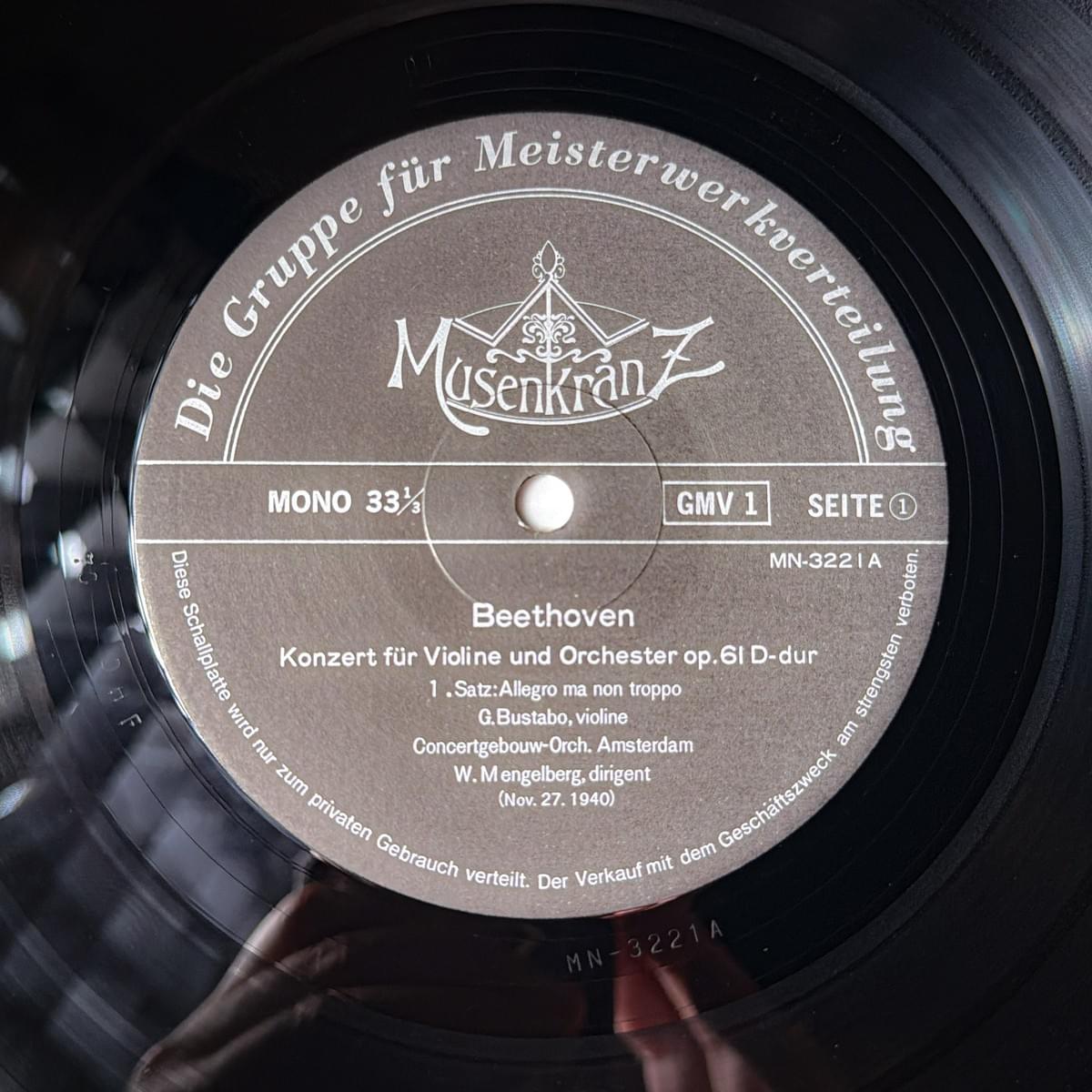
封套左上角是一個皇冠商標,寫著「Musenkranz」,旁邊一行德文「Die Gruppe für Meisterwerkverteilung」——「名作頒布團」。圈標外緣印著另一行德文:「本唱片僅供私人使用頒布,嚴禁以營利為目的販售。」
它看起來像一張德國唱片,其實是日本愛樂者群體自主製作、只發給會員的頒布盤,從沒在唱片行賣過。Musenkranz 後來成為日本歷史錄音廠牌 Epitagraph 的前身;1989年,它用同樣的白色封套與灰褐色圈標,第一次發行了克萊門斯·克勞斯(Clemens Krauss,1893-1954)最後一場維也納新年音樂會的現場全本。
而這張 GMV 1,是整個系列的第一張——天字第一號。
一個專門挖掘歷史實況的日本廠牌,把「第一號」留給了一位在祖國幾乎被遺忘的美國女小提琴家。這個選擇本身,就是一種評價。
黑膠時代唯一的一張
巴絲塔博的黑膠,一張都不是大廠牌發行的。美國曾有兩套小量私人壓製的雙 LP:「The Bustabo Legacy」收錄她與柏林、阿姆斯特丹樂團的演出及無伴奏曲;另一套則是沃爾夫-費拉里與努西奧的協奏曲——沃爾夫-費拉里,正是她少年時的老師,也把這首協奏曲獻給了她。這兩套在美國拍賣會上都曾以數百美元成交,可見其珍貴的程度。
但兩套都沒有貝多芬。
巴絲塔博與孟根堡的貝多芬協奏曲,在黑膠時代,只有 Musenkranz GMV 1 這一版。要到 CD 時代,英國 Archive Documents、日本 Seven Seas、法國 Tahra、歐洲 Memories 才陸續發行多種;它們應該都來自同一個音源,只是各自用不同的方式轉錄、調整。其中 Archive Documents 那版後來廢盤,在日本曾讓樂迷遍尋不著。
至於 GMV 1 本身,由於當年是非賣品,穿過了幾十年,市面上幾乎未曾見到它流通。
另一面:克倫培勒的《艾格蒙》
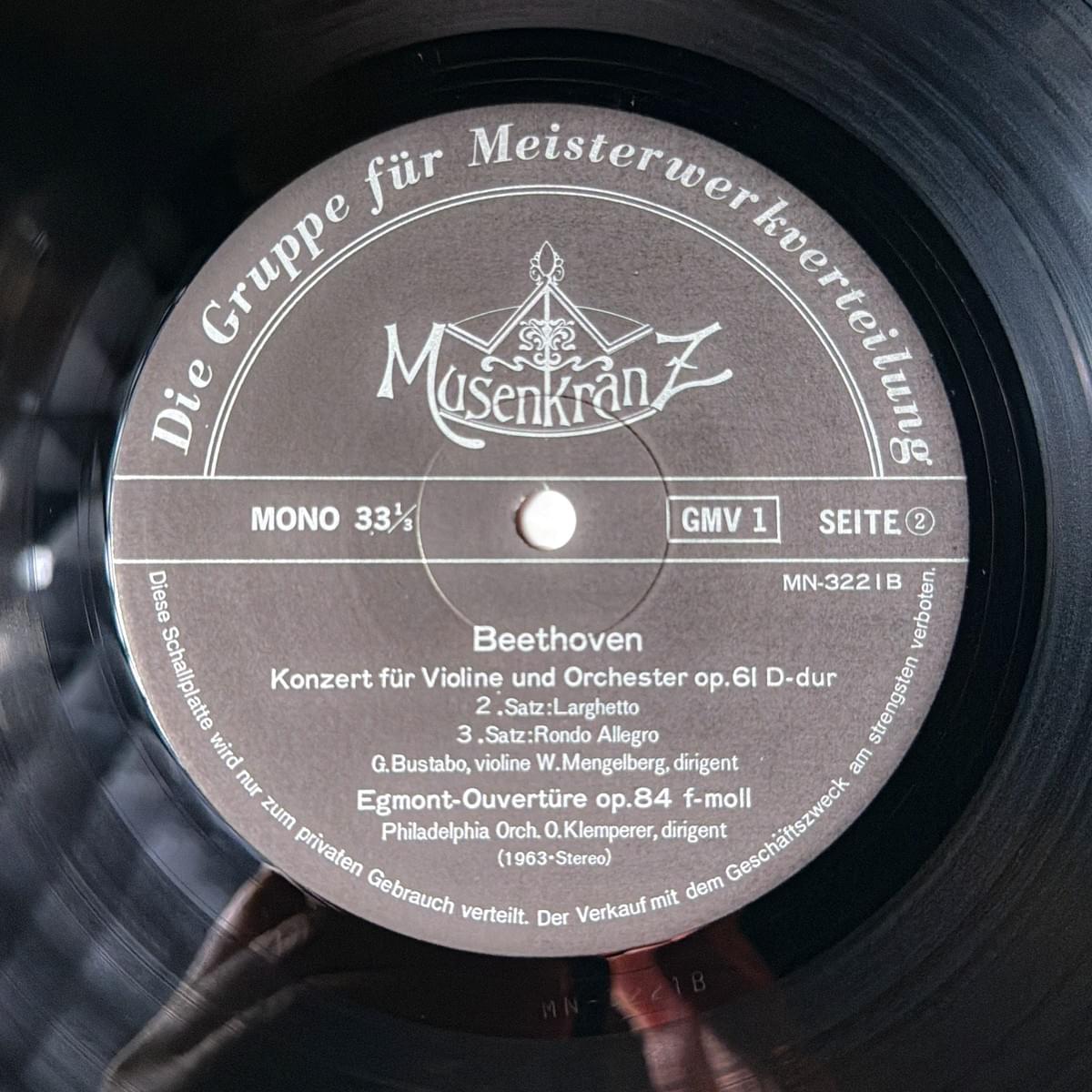
唱片的第二面,在貝多芬協奏曲的第二、三樂章之後,接上了另一位指揮家的貝多芬:克倫培勒(Otto Klemperer,1885-1973)指揮費城管弦樂團的《艾格蒙序曲》。
圈標寫著「1963」。但克倫培勒與費城的合作,只有 1962年秋天那一輪——又一個對不上的日期。那一年,他經過二十七年重返費城,身上帶著腦瘤、中風、嚴重躁鬱症與三度燒傷的痕跡;原本規劃的唱片錄音落空,留下來的只有廣播。有樂評說,這首序曲:「彷彿就是為克倫培勒而寫」。
一個濃烈自由感的孟根堡,一個嚴峻巨大的克倫培勒。他們一個在二戰後失去了舞台,一個在二戰前就被迫流亡,都是被同一個時代改寫了命運的人。
兩個不相識的人
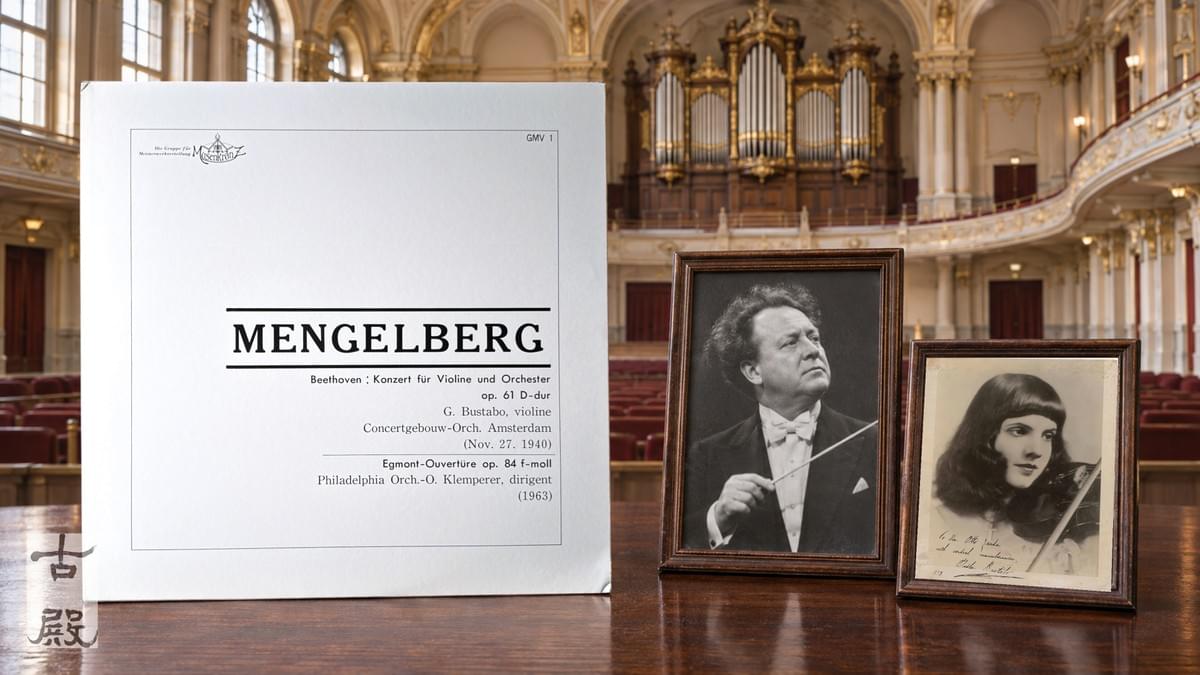
上一篇,一位在多倫多大學圖書館裡研究小提琴錄音史的加拿大研究者,為她寫下了介紹文字;這一篇,一群不知名的日本愛樂者,把她放在了他們的愛樂會員俱樂部的自主製作唱片第一號。
他們互不相識,分居地球兩端,卻在巴絲塔博被主流唱片業遺忘的年代,各自把她的聲音刻進了溝槽。一位晚年在街頭推著手推車的女子,她大概不知道,在多倫多和日本,有人一直記得她。
唱片上的日期錯了,但黑膠唱片裡的聲音,有沒有因此少了一分真實?
*******
巴絲塔博之一
【古殿唱片音樂故事】西貝流士說:「再造這雙手,要等好幾個世代」——這位女子晚年,卻推著雜貨手推車在街頭撿東西度日~吉拉·巴絲塔博(Guila Bustabo,1919-2002):
*****
[Gudian Record Stories]Bustabo, Part II: Her Beethoven Concerto in Occupied Amsterdam, and Its Sole Pressing of the Vinyl Era—Guila Bustabo (1916–2002) and Willem Mengelberg (1871–1951)
A Date That Refused to Match
My previous essay on Guila Bustabo (1916–2002) opened with Jean Sibelius’s remark that "it takes several generations to produce another pair of hands like hers," and followed her all the way to the grocery pushcart she wheeled through the streets of Birmingham in her twilight years. That recording was a 1940 Berlin radio aircheck preserved by Canada’s Rococo label.
This chapter begins with a record housed in a stark white jacket.
Across the sleeve, bold block letters proclaim MENGELBERG, followed below by Beethoven’s Violin Concerto in D major, soloist G. Bustabo, the Concertgebouw Orchestra of Amsterdam, and a recording date printed in parentheses: "Nov. 27. 1940."
Yet check every subsequent compact disc reissue—Britain’s Archive Documents, France’s Tahra, Japan’s Seven Seas, Europe’s Memories—and you will find that Bustabo and Willem Mengelberg (1871–1951) left only one recording of the Beethoven concerto, every single one bearing the exact same date: May 6, 1943.
Where, then, did "November 27, 1940" come from? The two artists did indeed collaborate in the autumn of 1940—performing Max Bruch’s Violin Concerto No. 1 on October 27, 1940. Both the "27th" and the year "1940" belonged to that Bruch evening. Whoever compiled this vinyl jacket had conflated two separate concerts.
Yet that clerical slip inadvertently uncovers a profound historical truth: if this performance actually took place in May 1943, then what was etched into these grooves was far more than an ordinary concert.
The Unfinished Chapter of Amsterdam
As noted in the first essay, when Allied forces arrested Bustabo and her mother in Paris after the liberation, the primary charge stemmed from her appearances on the Concertgebouw stage under Mengelberg’s baton during the German occupation of the Netherlands.
This record is an acoustic document of one of those exact evenings.
By May 1943, the Netherlands had endured three full years under German occupation. Bustabo was twenty-seven years old, standing on the Concertgebouw platform beside Mengelberg, who had presided over that orchestra for nearly half a century. She had no way of knowing that just over two years later, a US Army intelligence file noting that she had "performed in Germany and German-occupied territories under special license from the Nazi Propaganda Ministry" would place her name on a blacklist; nor did she know that every note she drew from her strings that night would become part of the indictment barring her from returning to American concert stages.
If the Sibelius recording discussed previously captured the year her mother’s fateful decision was first made, this Beethoven concerto captures the deepest consequences of that choice: an American virtuosa standing in an occupied European capital, performing the sacred cornerstone of the Austro-German canon.
Fairness demands one vital clarification: the choice was never hers. Twice in her youth she attempted to break free from her mother’s iron control, and twice she was tracked down and brought back. Standing on that stage was a twenty-seven-year-old woman who still had no ownership over her own life.
Mengelberg: Another Artist Who Paid the Price
The man standing on the podium beside her faced an equally grim reckoning.
Born in Utrecht in the Netherlands to parents of German descent, Mengelberg was sent as a youth to the Cologne Conservatory to study piano and composition under Franz Wüllner (1832–1902)—a direct pupil of Beethoven's friend and pupil Ferdinand Ries, placing Mengelberg in a direct lineage from Beethoven himself. At twenty, he was appointed music director of the city of Lucerne in Switzerland; returning home at twenty-four in 1895, he assumed leadership of the Amsterdam Concertgebouw Orchestra, holding the post for fifty years.
He stood at the vanguard of the generation rising at the close of the nineteenth century. Allied closely with Richard Strauss (1864–1949) and Gustav Mahler (1860–1911), he later championed Béla Bartók (1881–1945) and Zoltán Kodály (1882–1967), premiering and promoting their new works in Amsterdam. In 1898, Strauss dedicated his tone poem Ein Heldenleben to the twenty-seven-year-old Mengelberg and his orchestra; beginning in 1903, Mahler traveled repeatedly to Amsterdam at Mengelberg’s invitation to conduct his own symphonies; and in 1920, approaching the tenth anniversary of Mahler’s death, Mengelberg mounted history’s first "Mahler Festival," presenting nine concerts devoted entirely to his friend's works. The annual Palm Sunday tradition of performing Bach’s St. Matthew Passion, which Mengelberg inaugurated in 1899, continues in Amsterdam to this day.
His conducting was celebrated for its elastic tempos, sweeping rubato, and incandescent emotional intensity. Prior to the mid-twentieth century, he ranked among the supreme conductors in the world, leaving behind an invaluable legacy of historical recordings.
During the German occupation, he continued to conduct. Following the war, Dutch authorities banned him from the podium; he died in exile in Switzerland in 1951, never setting foot again before the orchestra he had built into a world-class instrument.
The two musicians preserved on this disc—one stripped of her homeland's stages, the other banished from his own orchestra—both saw their fates sealed after that night.
Beethoven on That May Evening
Yet in the moment the stylus settles into the groove, none of those postwar reckonings had occurred.
The Beethoven preserved here carries a wholly different artistic weight from the 1940 Sibelius recording.
In 1940, the Sibelius concerto was still relatively modern repertoire. The composer was alive and working at his home in Finland; it was a contemporary vehicle uniting bravura display with Nordic lyricism. Bustabo’s expansive tone and fearless technical command shone naturally in Sibelius, earning the direct endorsement of the composer himself.
Beethoven’s Violin Concerto is an entirely different proposition. Ever since twelve-year-old Joseph Joachim (1831–1907) resurrected the neglected work under Felix Mendelssohn’s baton, it has stood as the supreme touchstone of the Austro-German tradition—no living composer sits in the hall to nod approval, only a century of interpretive lineage watching from the shadows. Virtuosic fireworks offer no shelter here; the score asks a single, unsparing question: Do you belong inside this pantheon?
In that sense, Bustabo’s Beethoven holds even greater artistic significance than her Sibelius. And standing beside her on the podium was Mengelberg, trained in the direct lineage of Beethoven’s disciples.
American critics have described this reading as inhabiting "an exalted plane," radiating an Apollonian poise and luminosity from first bar to last; Mengelberg, characteristically supple and expansive in his phrasing, locks into an intuitive rapport with his soloist. Another American reviewer noted pointedly that if one insists on hearing Mengelberg conduct the Beethoven concerto, one should seek out the Bustabo performance—her playing displays infinitely finer taste and far more commanding technique than his studio account.
There is also an intimate sonic detail tucked inside these grooves. When Tower Records Japan introduced its 2019 CD reissue, the notes pointed out that between movements, one can hear a quiet, sigh-like "Bravo"—suspected to have escaped from Mengelberg himself.
If you own a copy of this recording, try listening for it: as the first movement concludes, resist the urge to look away and listen closely to the quiet between movements. A seventy-two-year-old maestro, standing inside an occupied concert hall, unable to restrain an involuntary murmur of admiration for a twenty-seven-year-old American violinist. That whispered syllable appears on no printed score and in no official chronicle—it survives solely in the analog groove.
A "Number One" Pressing
Where her Sibelius was rescued by Rococo, a small circle of Canadian enthusiasts, her Beethoven was preserved on the opposite side of the globe in Japan.
Printed in the upper-left corner of the sleeve is a crown emblem bearing the name Musenkranz, accompanied by the German subtitle "Die Gruppe für Meisterwerkverteilung" ("The Society for the Distribution of Masterworks"). Along the outer perimeter of the label runs a German legal notice: "This record is distributed for private use only; commercial sale is strictly prohibited."
Though styled from cover to dead wax to resemble an authentic German archival issue, it was in fact a private subscription edition produced by a Japanese circle of historical record collectors strictly for its members, never sold in retail record shops. Musenkranz later evolved into the renowned Japanese historical imprint Epitagraph; in 1989, using the exact same stark white jacket and taupe label design, it issued the world-premiere complete live recording of Clemens Krauss’s (1893–1954) final 1954 Vienna New Year’s Concert.
And this Bustabo-Mengelberg disc, cataloged GMV 1, was the inaugural release of the entire series—Number One.
A specialist Japanese label dedicated to unearthing historic live broadcasts chose to reserve its very first catalog number for an American violinist virtually forgotten in her own country. That choice alone is a critical verdict.
The Sole Pressing of the Vinyl Era
Not a single LP featuring Guila Bustabo was ever issued by a major commercial label. In the United States, two privately pressed, small-batch double-LP sets appeared: The Bustabo Legacy, gathering broadcast performances with the Berlin and Amsterdam orchestras alongside unaccompanied works, and a second set pairing concertos by Ermanno Wolf-Ferrari and Riccardo Nuccio—Wolf-Ferrari having been her childhood composition mentor, who dedicated his violin concerto to her. Both sets routinely fetch hundreds of dollars at American auctions, attesting to their scarcity.
Yet neither set contained her Beethoven.
Throughout the entire vinyl era, Bustabo and Mengelberg’s Beethoven Violin Concerto existed on a single LP pressing: Musenkranz GMV 1. Only with the arrival of the compact disc did Britain’s Archive Documents, Japan’s Seven Seas, France’s Tahra, and Europe’s Memories issue digital transfers—all drawn from the same broadcast source, each reflecting different mastering philosophies. The Archive Documents CD eventually went out of print, becoming a sought-after rarity among Japanese collectors.
As for GMV 1 itself, because it was never sold commercially, copies have scarcely surfaced on the open market across the ensuing decades.
On the Flip Side: Klemperer’s
Egmont
On Side Two of the LP, following the second and third movements of the Beethoven concerto, the disc closes with another conductor’s Beethoven: Otto Klemperer (1885–1973) leading the Philadelphia Orchestra in the Egmont Overture.
The label prints the date "1963." Yet Klemperer’s guest appearances in Philadelphia took place exclusively during a single residency in the autumn of 1962—yet another mismatched date. Returning to Philadelphia that autumn after a twenty-seven-year absence, Klemperer carried the physical scars of a brain tumor, a stroke, severe bipolar illness, and third-degree burns; planned commercial studio sessions fell through, leaving only radio airchecks behind. One critic remarked of this performance that the overture sounded "as though it had been composed specifically for Klemperer."
A volatile, rhapsodic Mengelberg paired with an austere, monumental Klemperer. One stripped of his podium after the Second World War, the other driven into exile before it began—two titans whose destinies were rewritten by the upheavals of the same century.
Two Strangers Across the Globe
In the first chapter of this story, a Canadian scholar working inside the University of Toronto’s music library wrote the liner notes to preserve her memory; in this second chapter, an anonymous circle of Japanese collectors placed her at the very front of their private archival vinyl series.
Strangers to one another, separated by an ocean, they each etched her voice into vinyl grooves during the decades when the mainstream record industry had erased her name. Pushing her grocery cart down the streets of Birmingham in her old age, Guila Bustabo likely never knew that in Toronto and in Tokyo, devoted listeners had never forgotten her.
The date printed on the jacket was wrong—but did that slip take away a single ounce of truth from the sound preserved inside the groove?