
【古殿唱片音樂故事】克萊門斯·克勞斯(Clemens Krauss,1893-1954)1954年新年音樂會:唯一完整現場實況錄音的故事
古殿殿主
今天,維也納愛樂的新年音樂會在九十多個國家轉播,是全世界最多人同時收看的古典音樂會。但創立它的那個人親自指揮的那些年,它只在收音機裡播出。他最後一場新年音樂會的完整現場錄音,要等整整三十五年,才第一次被刻成唱片——而且不是在維也納,是在日本,而且是在一套「私人團體自主製作」的唱片上。
這篇要說的,就是這場音樂會、這位指揮,以及這一卷帶子後來走過的路。
你聽過的「克勞斯新年音樂會」,其實不是在元旦錄的
許多樂迷聽過克勞斯指揮的「新年音樂會」,那多半是英國 Decca 在1952、1953、1954年推出的三張 LP。但這三張唱片都不是現場錄音。為了讓唱片在元旦前就擺上唱片行,Decca 每年提前幾個月在金色大廳以錄音室條件錄好,曲目由唱片公司挑選,再編入當天更長的音樂會裡。1954年那張(LXT 2913)只有七首,其中〈天體之音〉錄於1953年12月18至19日——比真正的音樂會早了快兩個星期。
還有一個有趣的痕跡:1953年那張唱片的〈無窮動〉,克勞斯在結尾用英語說了一句「And so on」,而不是德語的「Und so weiter」,因為他是替英國Decca公司錄製唱片。
所以,真正屬於某一個元旦早晨、有觀眾、有掌聲、有加演習俗的克勞斯新年音樂會,一直是空白的。直到這份1954年的現場錄音出現。
一個在帝國維也納長大的孩子
克萊門斯·克勞斯生於奧地利維也納,一生都在這座「音樂之都」裡長大。他的母親克萊門汀·克勞斯生下他時才十五歲,是維也納宮廷歌劇院芭蕾舞團的舞者,後來成為知名的演員與輕歌劇歌手;生父赫克托·巴爾塔齊(Hector Baltazzi,1851-1916)出身與哈布斯堡宮廷往來密切的銀行家族。透過這層血緣,他和梅耶林事件中與魯道夫皇儲殉情的少女瑪麗·維采拉(Mary Vetsera,1871-1889)是表親。少年時,他是宮廷禮拜堂少年合唱團的團員,也就是今日維也納少年合唱團的前身。
來自舞者母親的血脈,加上自幼浸潤的宮廷與貴族生活,讓他指揮的維也納圓舞曲,確實帶有在地舞蹈生活的身體感,有一種翩翩起舞的感覺——這是他與其他指揮家感受差別最大的地方。對他來說,史特勞斯家族的音樂不是「輕音樂曲目」,而是他童年所呼吸的那個帝國維也納的聲音。
1929年,他英雄式地回到維也納,出任維也納國立歌劇院總監;1930年接替福特萬格勒(Wilhelm Furtwängler,1886-1954),執掌維也納愛樂的定期音樂會。同一時期,從1929到1933年,他每年在薩爾茲堡音樂節指揮一場史特勞斯作品音樂會——維也納愛樂官方網站把這看作日後新年音樂會格式的雛形。他同時也是理查·史特勞斯(Richard Strauss,1864-1949)晚年最信任的指揮家,首演了《阿拉貝拉》與《隨想曲》等作品。克勞斯是維也納的驕傲,也是最後一位真正體現「音樂即生活、音樂從土地與生活而來」的維也納指揮。
一個從黑暗年代誕生的傳統
新年音樂會的起點並不光明。維也納愛樂官方網站坦白寫道,第一場音樂會誕生在奧地利與樂團歷史最黑暗的篇章裡:1939年12月31日,克勞斯在金色大廳指揮了一場史特勞斯家族作品的特別音樂會,收入全數捐給納粹的「戰時冬季救濟」募款。1941年元旦,樂團改在新年第一天舉行「約翰·史特勞斯音樂會」,從此年年不輟。
二戰結束後,克勞斯因第三帝國時期的職位遭盟軍調查、禁止公開演出兩年;1946、1947年的新年音樂會,由約瑟夫·克利普斯(Josef Krips,1902-1974)代為指揮。1948年禁令期滿,克勞斯重回指揮台,一口氣又指揮了七屆,直到1954年。
他起初還擔心,元旦早上大家剛熬完除夕夜,恐怕沒什麼人來聽。結果證明他多慮了。
1954年1月1日上午
那天是星期五。前一天,克勞斯才在同一個大廳指揮了一場同樣曲目框架的「除夕音樂會」。元旦上午,他再次走上指揮台。
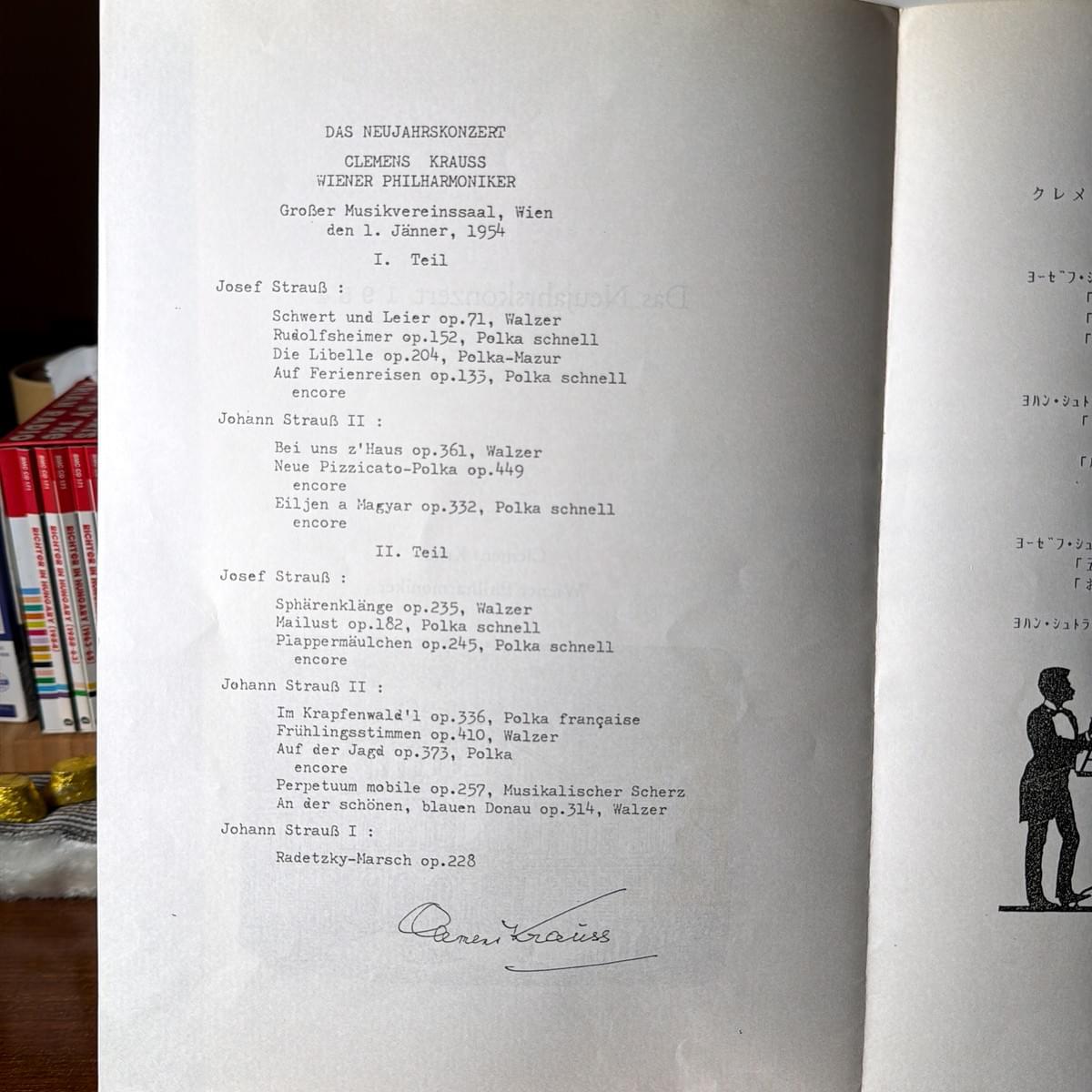
節目分成兩部。第一部以約瑟夫·史特勞斯(Josef Strauss,1827-1870)的〈劍與琴〉圓舞曲開場,接著是〈魯道夫斯海姆人〉、〈蜻蜓〉、〈度假旅行〉,再到小約翰·史特勞斯(Johann Strauss II,1825-1899)的〈在我們家〉、〈新撥奏波卡〉、〈匈牙利萬歲〉。第二部仍由約瑟夫領頭:〈天體之音〉、〈五月之樂〉、〈饒舌〉;然後是小約翰的〈在克拉普芬森林〉、〈春之聲〉、〈狩獵〉、〈無窮動〉、〈藍色多瑙河〉,最後以老約翰·史特勞斯(Johann Strauss I,1804-1849)的〈拉德茨基進行曲〉收尾。
這份錄音保存了幾個今天已經看不到的現場習慣。
第一,當年的加演,是把同一首曲子再奏一次。日文唱片冊子在每一處加演旁都寫著,加演:同上曲。〈度假旅行〉、〈新撥奏波卡〉、〈匈牙利萬歲〉、〈饒舌〉、〈狩獵〉,五首快速波卡都在觀眾掌聲不止之下,立刻從頭再奏一遍。同一首曲子,第二次演奏時,樂團與觀眾的能量已經完全不同。
第二,〈拉德茨基進行曲〉還沒有觀眾跟著拍手。今天全世界觀眾最熟悉的那個拍手儀式,在這張唱片裡還聽不到。日本樂評家鈴木淳史2021年在《日經新聞》評介這份錄音時,也特別點出這兩個「當時演奏會的慣習」。
第三,日文冊子特別標出了四首曲子:〈劍與琴〉、〈魯道夫斯海姆人〉、〈新撥奏波卡〉、〈五月之樂〉,說明這是克勞斯第一次留下這幾首的錄音。它們都不在 Decca 的任何一張錄音室唱片裡。換句話說,若沒有這份現場錄音,克勞斯詮釋這四首作品的聲音將完全不存在。
鈴木淳史比較了 Decca 錄音室版,認為現場實況或許因為是節慶場合,維也納的味道更濃;他也提到〈天體之音〉兼具交響詩般的戲劇性與優雅。他對音質的評語很老實:應是電台廣播用的錄音,音質尚可,但現場的熱力傳達得很好。
台上台下沒有人知道,這是克勞斯的最後一次。四個多月後,1954年5月16日,他隨維也納愛樂在墨西哥巡演,指揮完一場音樂會的幾個小時後,因心臟病發辭世。新年音樂會由樂團首席波斯科夫斯基(Willi Boskovsky,1909-1991)接手,一直主持到1979年。
一卷帶子的三十五年:這份錄音的出版史
1954年的新年音樂會只在收音機裡播出。克勞斯過世後,這場演出留存在一卷電台轉播的錄音帶上,三十五年間沒有人把它做成唱片。
1989年:世界首版黑膠,一張「私人團體自主製作」的唱片
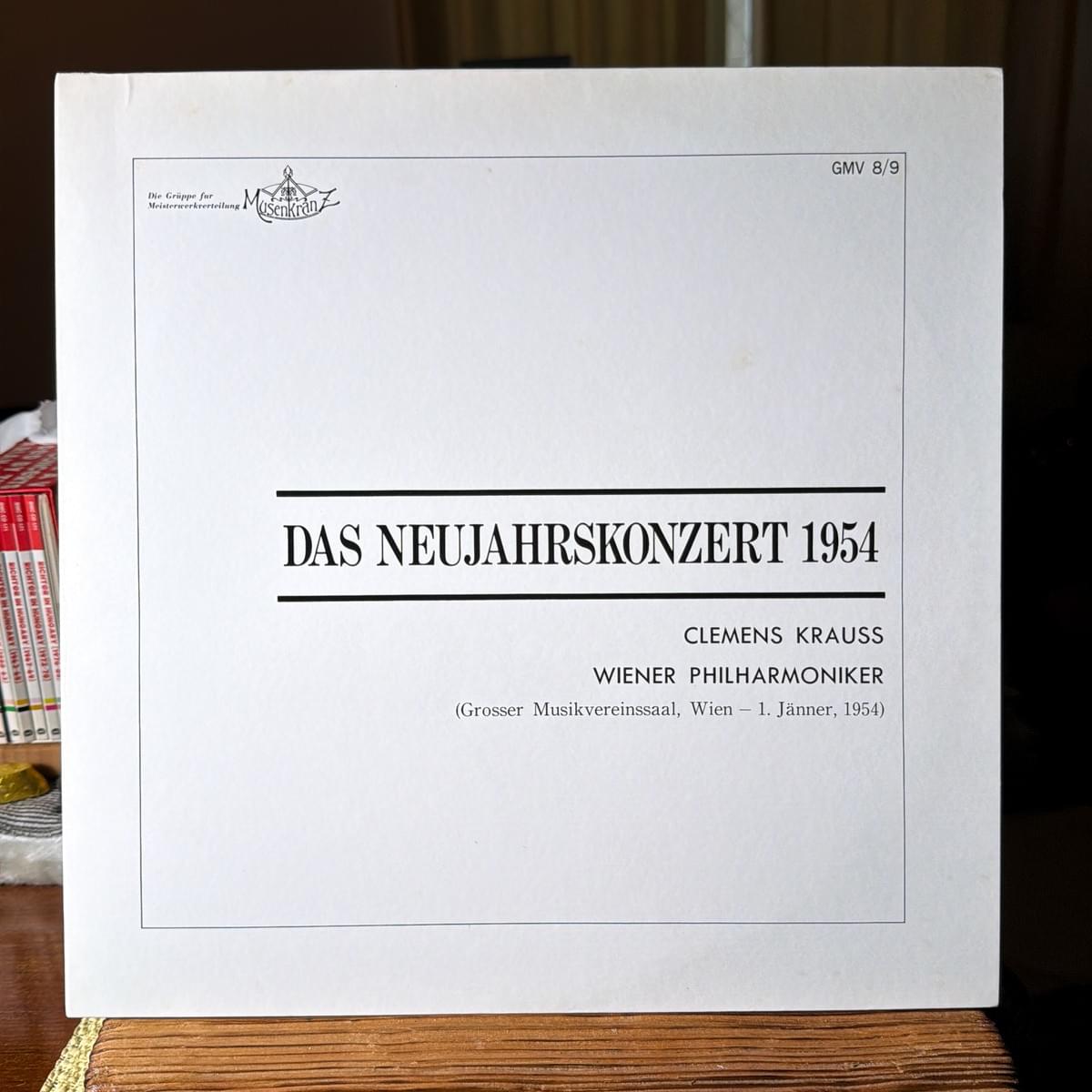
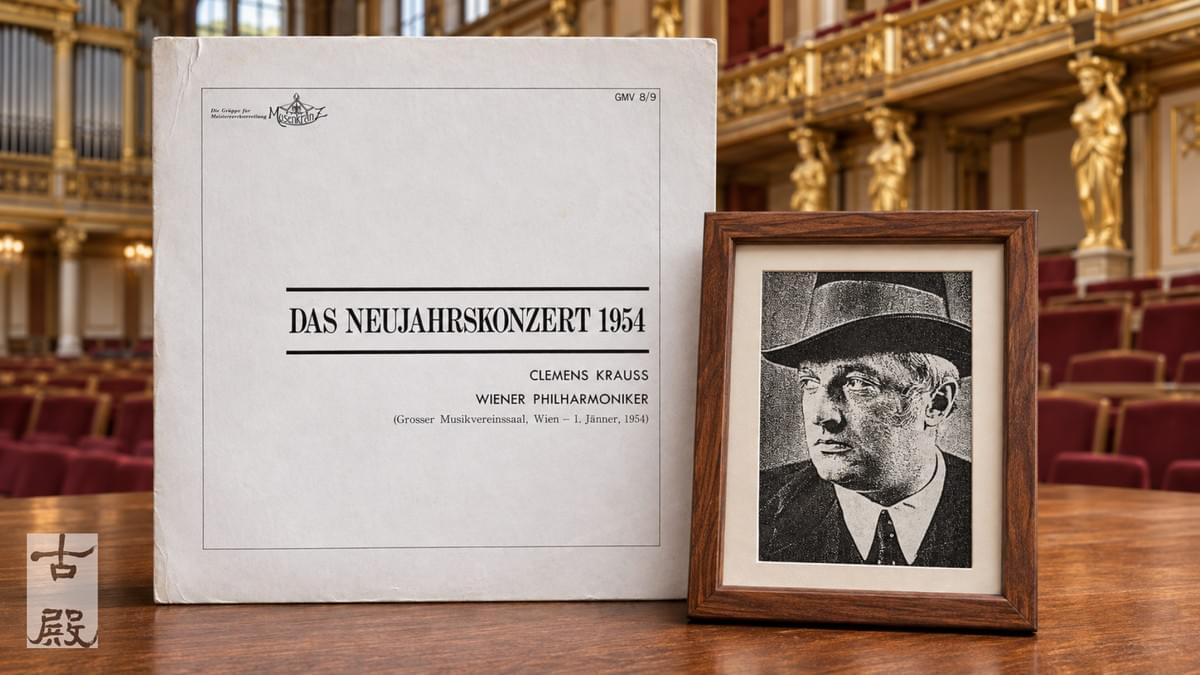
1989年,日本的 Musenkranz 以雙 LP「GMV 8/9」第一次發行了這份現場錄音,這是它在全世界第一次以唱片問世。
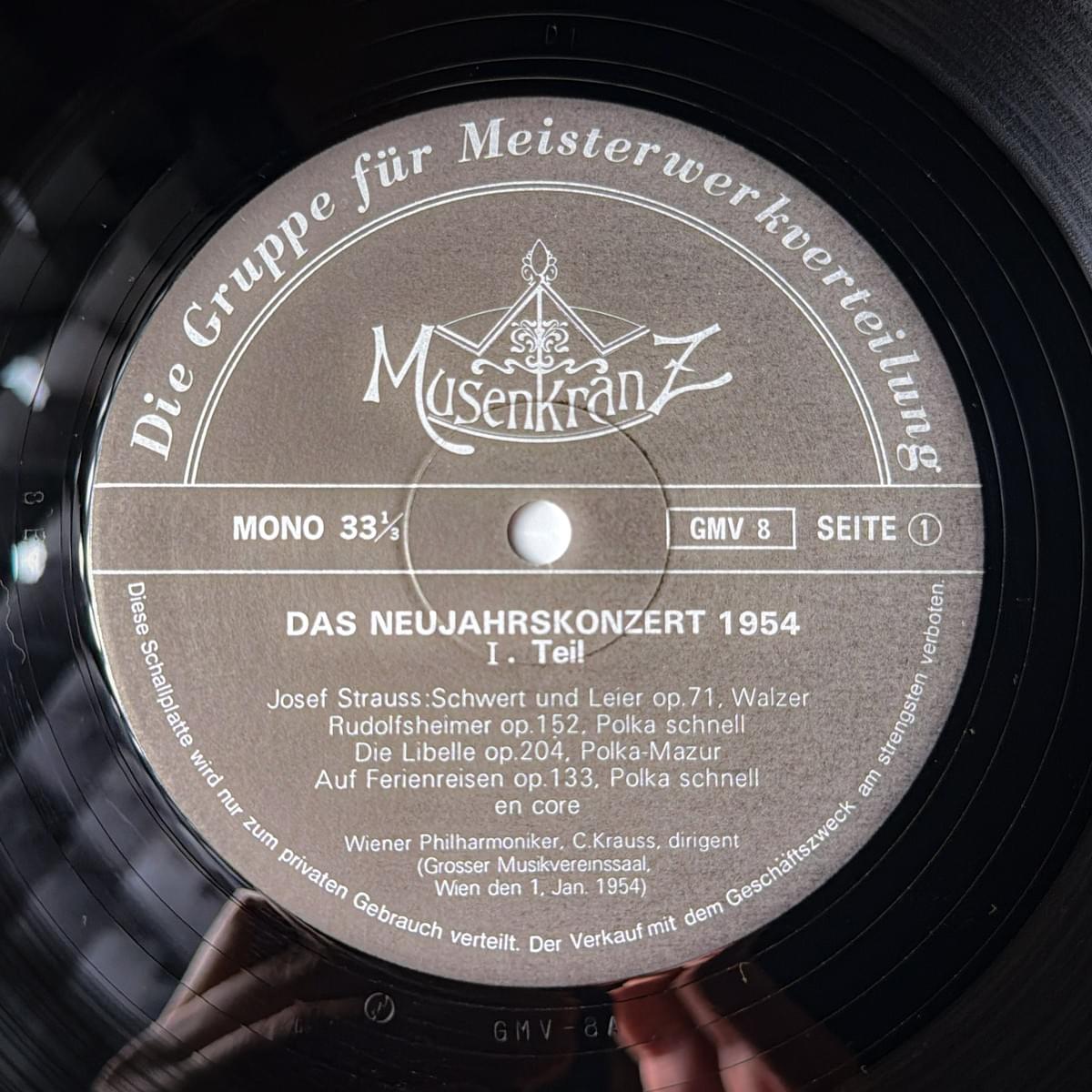
這張唱片從裡到外都做成德國的樣子。封套與圈標印著德文「Die Gruppe für Meisterwerkverteilung」,意思大約是「名作頒布團」;封套上寫的是奧地利特有的日期寫法「1. Jänner, 1954」;內頁冊子有一頁用打字機打出的德文節目單,連「ß」都保留了,末尾附上克勞斯的簽名摹本。但翻過一頁,就是日文的分面曲目,還有一行老實的提醒:「第I部開頭部分有聽感不佳之處,敬請見諒。」圈標外緣則印著一行德文:「本唱片僅供私人使用,嚴禁以營利為目的販售。」
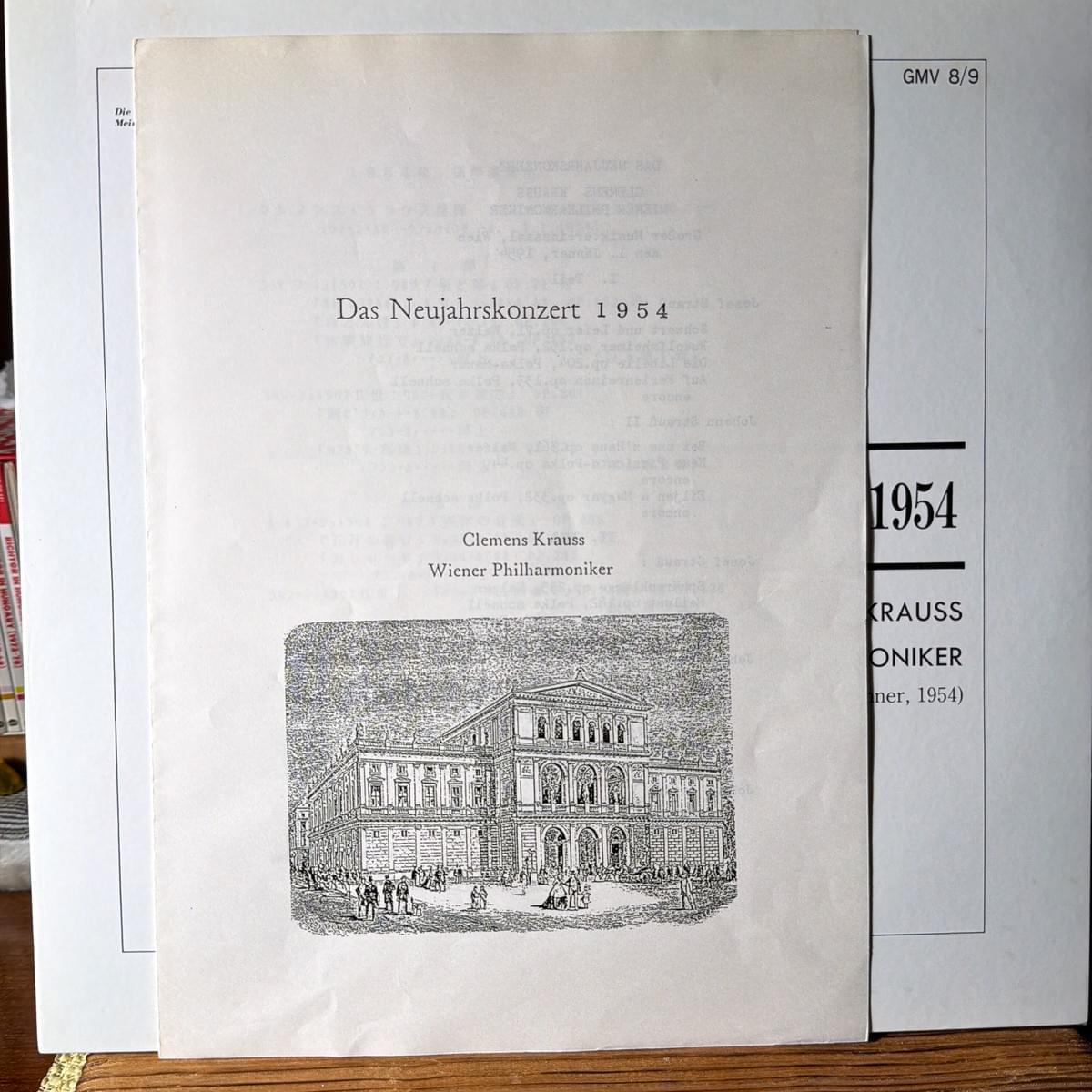
也就是說,它不是在唱片行賣的商品,而是日本愛樂者組成的「歷史名盤頒布會」發給會員的唱片。日本古書店形容這個系列「做成德國風格,其實是歷史名盤頒布會製作的」。同系列還有 GMV 1(巴絲塔博與孟格堡的貝多芬小提琴協奏曲)、GMV 6(瑪爾姬與莫里妮的協奏曲)等,都是當年難得一見的歷史實況,在後世的二手唱片市場價值不菲。
後來才知道,Musenkranz 正是今日日本歷史錄音廠牌 Epitagraph 過去使用的自主製作黑膠品牌。這份音源當初曾被宣傳為出自「克萊門斯·克勞斯檔案館」,後來證實其實是當年電台現場轉播的側錄。
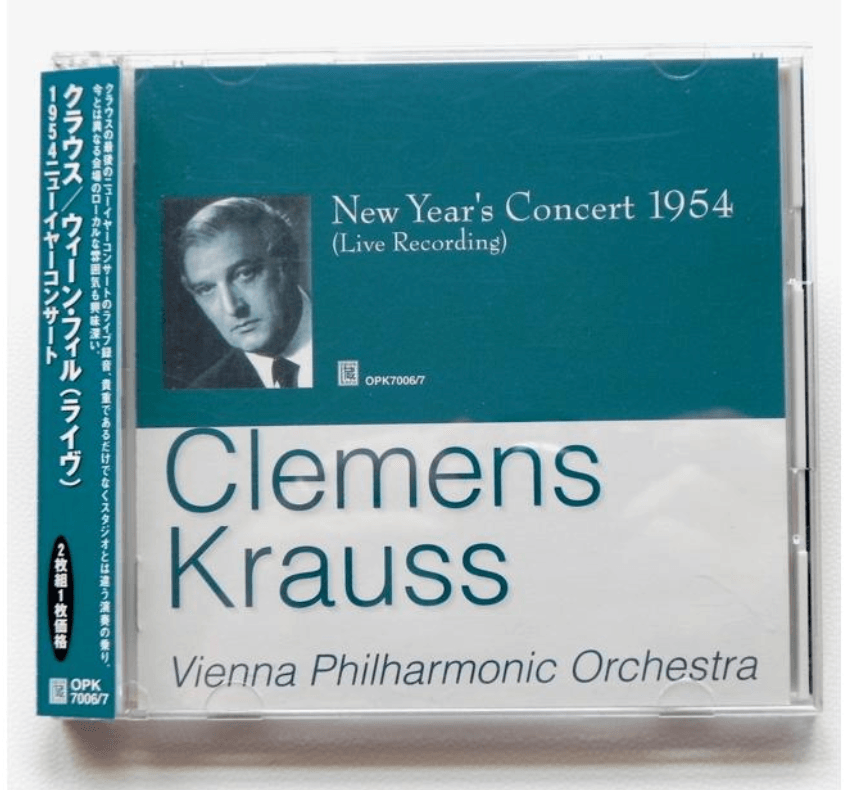
2004年:「Opus 蔵」 的 CD
2004年,以歷史錄音復刻著稱的日本獨立廠牌 「Opus 蔵」(Opus Kura)推出雙 CD「OPK 7006/7」,讓這份錄音第一次以 CD 形式流通,美國市場在2005年上市。據 Epitagraph 的說明,這套 CD 的音源是從 Musenkranz 的 LP 轉錄而來。Opus 蔵 同系列的克勞斯史特勞斯家族專輯,曾獲法國《音叉》雜誌金音叉獎。
另一個來源:Archiphon 的「12月31日」
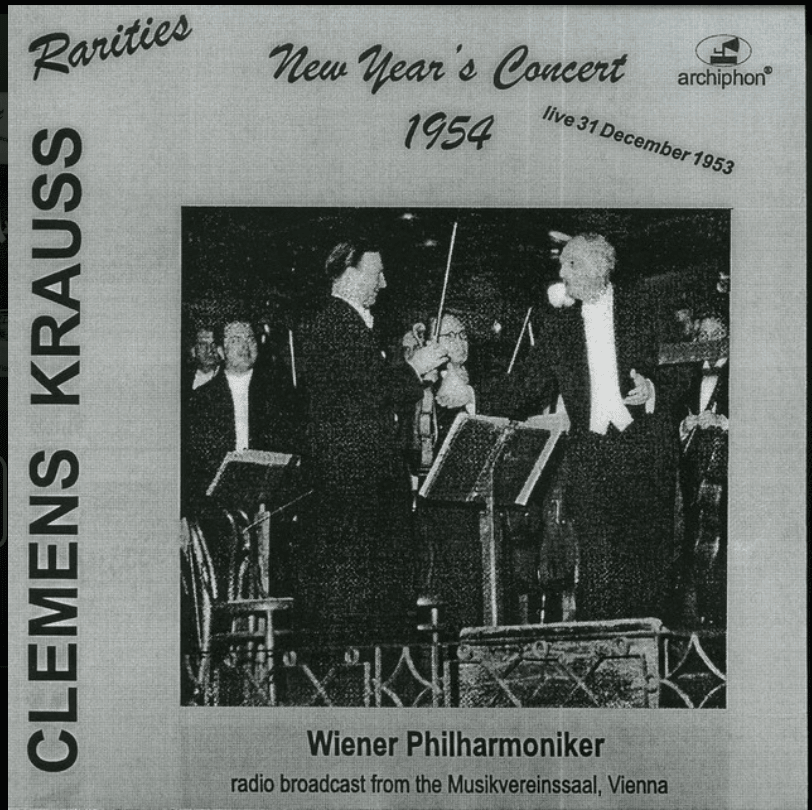
德國廠牌 Archiphon 也發行過一套雙 CD「ARC-WU 116/17」,同樣標明是克勞斯最後一場新年音樂會的廣播錄音,但封面寫的錄音日期是「1953年12月31日」,也就是前一天的除夕音樂會。Archiphon 和 Musenkranz、Epitagraph 這條線沒有延續關係,是另一個獨立的來源;而它的音質並不理想,1989年的 Musenkranz 黑膠聽起來還比較好。
2021年:母帶終於變成 CD
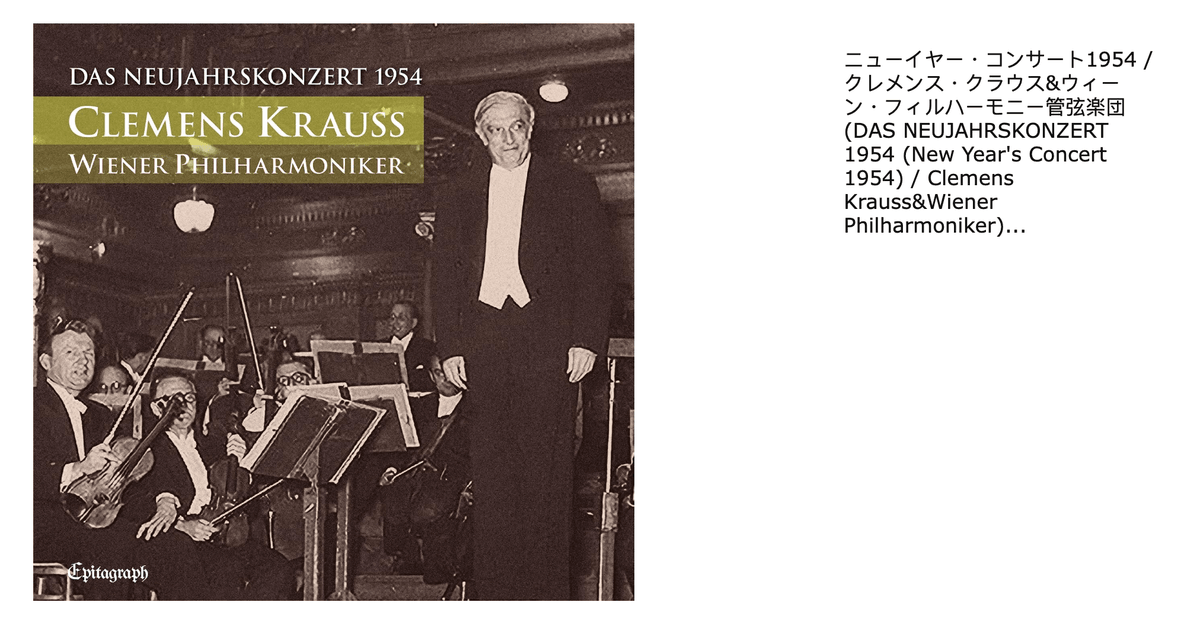
2021年6月,Epitagraph 以雙 UHQCD「EPITA-017/8」(King International 發行,限量)復刻這場音樂會。這一次不再從唱片轉錄,而是直接用當年製作 Musenkranz LP 的那卷母帶,並保留了轉播節目中的德語播報(依製作方說明)。不過,那卷磁帶從1989年到這時,又存放了三十多年。磁帶會隨時間老化,1989年刻成的 Musenkranz 黑膠,把這卷母帶更早時的狀態固定在類比溝槽裡。同年8月,鈴木淳史在《日經新聞》週日版的「名作コンシェルジュ(名作嚮導)」專欄評介了這張 CD。
容易混淆的「不是現場」
市面上還有幾套標題相近、但內容是 Decca 錄音室版的唱片,例如 Archipel 2004年的雙 CD「The Complete New Year Concerts 1952–1954」(ARPCD0225)與 Decca Eloquence 2017年的「The New Year Concerts 1951–54」。這裡的「Complete」,指的是三張 Decca 唱片全收,不是音樂會全本。
- 1954年|奧地利電台轉播:現場轉播,當時只有收音機聽得到。
- 1989年|Musenkranz GMV 8/9(雙 LP):世界首版,會員制頒布,私人團體自主製作。
- 2004年|Opus 蔵 OPK 7006/7(雙 CD):據 Epitagraph 說明,轉錄自 Musenkranz LP。
- 年份待查|Archiphon ARC-WU 116/17(雙 CD):獨立的廣播錄音來源,誤標為1953年12月31日(經殿主對聽,確認為同一場1月1日演出),多保留了開頭的播報與掌聲。
- 2021年|Epitagraph EPITA-017/8(雙 UHQCD):以 Musenkranz 1989年製作黑膠所用的同一卷母帶重製(依製作方說明含曲間播報);但那卷磁帶到此時已又存放了三十多年,1989年的黑膠保存的是母帶較早時的狀態。
同一場音樂會,兩種真實
把 Musenkranz 的黑膠和 Archiphon 的 CD 放在一起聽,開頭就不一樣。
Archiphon 一開始是播報員說了一句話左右,接著是觀眾的鼓掌,掌聲持續了大約二十五秒,音樂才出現。Musenkranz 的黑膠則只剩大約一秒的掌聲,就直接進入〈劍與琴〉——前面少了將近二十九秒。為什麼少了這一段?推測是:當年側錄廣播的人,可能在轉播開始時還沒準備好,等到按下錄音鍵,播報與大半掌聲已經過去了。這也正好解釋了日文冊子那行「第I部開頭有聽感不佳之處」的提醒——那可能就是錄音機在倉促之中啟動時留下的痕跡。另一種可能是1989年刻製黑膠時刻意剪去。
同一場音樂會,因此留下了不同長度的開頭:Archiphon 從播報員開口那一刻開始,Musenkranz 則從掌聲的最後一秒才開始。
這也說明,Archiphon 與 Musenkranz 用的是兩卷不同的帶子。Archiphon 的音源可能是另一份側錄,也可能以其他方式錄下,開頭保留得比較完整;但 Musenkranz 雖然開頭沒準備好,就整體聲音而言,仍然比 Archiphon 好。同一個元旦早晨,至少有兩台錄音機各自對著收音機轉動——一台早了一點按下錄音鍵,一台慢了半拍,卻錄得更清楚。七十多年後,我們才能把這兩個互不相識的耳朵放在一起,拼出那個早晨。
而 Archiphon 標的「12月31日」,曾經留下另一道謎題:它和1月1日的錄音,是同一場演出被標錯了日期,還是前一天除夕音樂會的另一份錄音?維也納愛樂的檔案證實兩場都存在,而且都由克勞斯指揮同樣的作曲家,文獻本身給不出答案。答案在聲音裡。殿主把兩個版本並排聆聽後確認:兩者是同一場演出,是 Archiphon 標錯了日期;Archiphon 只是比 Musenkranz 多了最前面的播報員旁白與觀眾掌聲。握有母帶的製作方標的是1月1日,母帶裡的播報員也稱它為「新年音樂會」——耳朵聽到的,和文獻說的,終於對上了。
******
[Gudian Record Stories]Clemens Krauss’s (1893–1954) 1954 New Year’s Concert: The Story Behind the Sole Complete Live Broadcast Recording
Today, the Vienna Philharmonic’s New Year’s Concert is broadcast across more than ninety countries, standing as the most widely watched classical music event in the world. Yet during the years when its founder stood on the podium, the concert was heard exclusively over the radio. The complete live broadcast of his final New Year’s Concert had to wait thirty-five full years before being cut into vinyl grooves for the very first time—not in Vienna, but in Japan, on a privately produced subscription release pressed by an independent circle of collectors.
This is the story of that concert, the conductor who shaped it, and the thirty-five-year journey of a single reel of magnetic tape.
The "Krauss New Year’s Concerts" You Know Were Not Recorded on New Year’s Day
Many music lovers own Clemens Krauss’s famous "New Year’s Concert" recordings, most commonly the three LPs released by British Decca in 1952, 1953, and 1954. Yet none of those three records are live performances. To ensure the discs reached record shops prior to New Year’s Day, Decca recorded them in the Musikverein months in advance under controlled studio conditions; the repertoire was curated by the label and later folded into the longer concert programs. The 1954 disc (LXT 2913) contains only seven selections, with Sphärenklänge (Music of the Spheres) recorded on December 18 and 19, 1953—nearly two weeks before the actual concert.
There is another telling clue: at the conclusion of Perpetuum Mobile on the 1953 LP, Krauss speaks the traditional spoken tag in English—"And so on"—rather than the Viennese German "Und so weiter," tailoring the recording specifically for his British label.
Consequently, a true New Year’s Day morning document—complete with a live audience, spontaneous applause, and authentic encore customs—remained absent from the catalog until this 1954 broadcast recording finally surfaced.
A Child Raised in Imperial Vienna
Born in Vienna, Clemens Krauss spent his entire life immersed in the musical capital of the Habsburg Empire. His mother, Clementine Krauss, was just fifteen when she gave birth to him; she danced with the ballet of the Vienna Court Opera before rising to fame as an actress and operetta singer. His biological father, Hector Baltazzi (1851–1916), belonged to a prominent banking family intimately connected to the imperial court—a lineage that made Krauss a cousin to Baroness Mary Vetsera (1871–1889), who died alongside Crown Prince Rudolf in the Mayerling incident. As a boy, Krauss sang in the Imperial Court Chapel Choir, the direct predecessor of the Vienna Boys’ Choir.
That maternal dance heritage, combined with an upbringing steeped in courtly Viennese culture, endowed his conducting of the Viennese waltz with a physical, bodily pulse—a genuine sensation of dancing that sets him apart from virtually every other conductor. To Krauss, the music of the Strauss dynasty was never "light repertoire"; it was the native acoustic air of the imperial Vienna he breathed in childhood.
In 1929, he returned to Vienna in triumph as Director of the Vienna State Opera, succeeding Wilhelm Furtwängler (1886–1954) at the helm of the Vienna Philharmonic’s subscription concerts in 1930. Between 1929 and 1933, he conducted an annual all-Strauss program at the Salzburg Festival—concerts the Vienna Philharmonic’s official archives recognize as the direct prototype for the New Year’s Concert. He was also the conductor Richard Strauss (1864–1949) trusted most in his twilight years, leading the world premieres of Arabella and Capriccio. Krauss was the pride of Vienna, and the last maestro to embody the truth that music springs directly from local soil and lived daily life.
A Tradition Born in Dark Times
The origins of the New Year’s Concert were far from bright. As the Vienna Philharmonic’s own historical archives candidly acknowledge, the inaugural concert took shape during one of the darkest chapters in Austrian and orchestral history: on December 31, 1939, Krauss led the ensemble in a special all-Strauss concert in the Musikverein, with all proceeds donated to the Nazi regime’s Kriegswinterhilfswerk (Wartime Winter Relief Fund). On January 1, 1941, the orchestra shifted the event to the first morning of the year as the "Johann Strauss Concert," establishing an unbroken annual tradition.
Following the Second World War, Krauss underwent Allied denazification investigations due to his official posts during the Third Reich and was barred from public performance for two years; Josef Krips (1902–1974) stepped in to conduct the 1946 and 1947 New Year’s Concerts. Once the ban expired in 1948, Krauss reclaimed the podium, leading seven consecutive New Year’s Concerts through 1954.
At the outset, he had worried that audiences exhausted from New Year’s Eve festivities would never turn out on January 1 morning. History swiftly proved him wrong.
The Morning of January 1, 1954
It was a Friday. The previous evening, Krauss had conducted the identical program framework for the traditional New Year’s Eve Concert in the same hall. On New Year’s morning, he mounted the podium once more.
The program unfolded in two parts. Part One opened with Josef Strauss’s (1827–1870) waltz Schwert und Leier (Sword and Lyre), followed by Rudolfsheimer, Die Libelle (The Dragonfly), and Auf Ferienreisen (On Holiday), before turning to Johann Strauss II’s (1825–1899) Bei uns z’Haus, the Neue Pizzicato-Polka, and Éljen a Magyar! Part Two again opened with Josef Strauss: Sphärenklänge, Mailust, and Plappermäulchen, followed by Johann Strauss II’s Im Krapfenwald’l, Frühlingsstimmen, Auf der Jagd, Perpetuum Mobile, and An der schönen blauen Donau, closing with Johann Strauss I’s (1804–1849) Radetzky March.
This broadcast preserves several performance traditions that have since vanished from the concert hall:
- Encores Meant Repeating the Exact Same Piece. Next to every encore listing, the Japanese booklet notes: "Encore: same work." In response to sustained applause, five brisk polkas—Auf Ferienreisen, Neue Pizzicato-Polka, Éljen a Magyar!, Plappermäulchen, and Auf der Jagd—were immediately repeated from the top. On the second pass, the electric rapport between orchestra and hall transforms completely.
- No Rhythmic Clapping in the Radetzky March. The global ritual of audiences clapping along in time to the Radetzky March does not yet exist on this recording. Reviewing this release for the Nikkei in 2021, Japanese music critic Atsushi Suzuki specifically highlighted both of these vanished concert customs.
- Four Works Never Recorded by Krauss in the Studio. The Japanese notes mark four titles—Schwert und Leier, Rudolfsheimer, Neue Pizzicato-Polka, and Mailust—as Krauss’s sole surviving recordings of these scores. None appear on his commercial Decca LPs; without this broadcast aircheck, Krauss’s readings of these four pieces would be lost entirely.
Comparing this live document against the Decca studio discs, Suzuki noted that the festive occasion infused the live performance with an even richer Viennese aroma, praising Sphärenklänge for uniting symphonic drama with effortless grace. His verdict on the sound quality was candid: typical of a 1954 radio broadcast—modest in technical fidelity, yet extraordinarily vivid in conveying the heat of the hall.
No one in the auditorium suspected this was Krauss’s farewell. Just over four months later, on May 16, 1954, while touring Mexico with the Vienna Philharmonic, he died of a heart attack hours after stepping off the podium. Concertmaster Willi Boskovsky (1909–1991) assumed leadership of the New Year’s Concert, presiding over it until 1979.
Thirty-Five Years of a Tape: The Publication History
The 1954 New Year’s Concert was heard solely over radio airwaves at the time. Following Krauss’s death, the performance remained preserved on an off-air broadcast tape for thirty-five years before finally reaching vinyl.
1989 | World Premiere Vinyl: A Privately Produced Collector’s Edition
In 1989, the Japanese imprint Musenkranz issued the complete performance for the first time on any commercial format as a double LP (GMV 8/9).
From sleeve to dead wax, the set was styled to look like an authentic German archival pressing. Both the jacket and labels carry the German inscription "Die Gruppe für Meisterwerkverteilung" (roughly, "The Society for the Distribution of Masterworks"), bearing the distinctly Austrian date format "1. Jänner, 1954."The inner booklet reproduces a typewritten German program complete with the character "ß" and a facsimile of Krauss’s signature. Turn the page, however, and you find Japanese side breakdowns accompanied by an honest apologetic notice: "Please excuse minor sonic imperfections at the opening of Part I." Around the label perimeter runs a German warning: "This record is for private use only; commercial sale is strictly prohibited."
Rather than a retail shop product, this was a private subscription issue produced by a Japanese circle of historical record collectors for its members. Japanese secondhand record dealers describe the series as "styled in the German manner, privately produced by a historical masterpiece distribution society."Companion issues in the series—such as GMV 1 (Guila Bustabo and Willem Mengelberg in Beethoven’s Violin Concerto) and GMV 6 (concertos by Johanna Martzy and Erica Morini)—preserved elusive live broadcasts that command substantial sums on the collector market today.
It later emerged that Musenkranz was an early private vinyl imprint operated by the founders of the Japanese historical label Epitagraph. While initially promoted as originating from the "Clemens Krauss Archive," the audio was eventually confirmed to derive from an off-air radio broadcast transcription.
2004 | The Opus Kura CD Transfer
In 2004, the respected Japanese historical reissue label Opus Kura released a two-CD set (OPK 7006/7), bringing the performance to compact disc for the first time (reaching the US market in 2005). According to Epitagraph’s documentation, this CD edition was transferred directly from the 1989 Musenkranz vinyl pressing. A companion Krauss Strauss volume in Opus Kura’s series was awarded the Diapason d’Or in France.
An Alternative Source: Archiphon’s "December 31"
The German label Archiphon also issued a two-CD set (ARC-WU 116/17) billed as Krauss’s final New Year’s broadcast, though its cover dates the performance to "December 31, 1953"—the New Year’s Eve concert. Archiphon derives from an independent broadcast source unrelated to the Musenkranz/Epitagraph lineage; however, its audio fidelity is inferior, making the 1989 Musenkranz LP noticeably more rewarding to listen to.
2021 | The Master Tape Finally Reaches CD
In June 2021, Epitagraph issued a limited double UHQCD edition (EPITA-017/8, distributed by King International). Rather than dubbing from vinyl, this release went back to the original tape used to cut the 1989 Musenkranz LPs, retaining the contemporary German radio commentary between pieces. Yet by 2021, that magnetic tape had aged in storage for an additional thirty-two years; the 1989 Musenkranz vinyl preserves the physical state of that tape three decades earlier in its analog grooves. In August 2021, Atsushi Suzuki featured this UHQCD release in his Sunday Nikkei column, "Masterpiece Concierge."
Easily Confused Studio Compilations
Several commercial CD sets with similar titles—such as Archipel’s 2004 The Complete New Year Concerts 1952–1954 (ARPCD0225) and Decca Eloquence’s 2017 The New Year Concerts 1951–54—contain only the three Decca studio albums rather than complete live concerts.
- 1954 | Austrian Radio Broadcast: Live radio transmission, heard exclusively over the airwaves.
- 1989 | Musenkranz GMV 8/9 (2LP): World premiere physical release; private Japanese subscription edition.
- 2004 | Opus Kura OPK 7006/7 (2CD): Transferred from the 1989 Musenkranz LP pressing.
- Date Uncertain | Archiphon ARC-WU 116/17 (2CD): Independent broadcast tape misdated as December 31, 1953 (comparative listening confirms it is the same January 1 performance), preserving more of the opening spoken announcement and applause.
- 2021 | Epitagraph EPITA-017/8 (2 UHQCD): Mastered from the tape used for the 1989 Musenkranz LP (retaining German radio announcements), though cut thirty-two years later in the tape's lifespan.
One Concert, Two Acoustic Realities
Placing the 1989 Musenkranz vinyl alongside the Archiphon CD reveals a striking difference right from the opening seconds.
The Archiphon CD opens with a brief spoken line from the radio announcer, followed by roughly twenty-five seconds of audience applause before the orchestra begins. On the Musenkranz LP, barely one second of applause survives before Schwert und Leier launches immediately—omitting nearly twenty-nine seconds of opening atmosphere. Why is that prelude missing? Most likely, the home recordist capturing the 1954 radio broadcast was caught slightly off guard at the top of the hour, hitting the record button only after the spoken introduction and most of the opening ovation had passed. That also explains the apologetic note in the Japanese booklet regarding "minor sonic imperfections at the opening of Part I"—the audible trace of a tape transport hastily engaged in real time—or an intentional trim made during lacquer cutting in 1989.