
【古殿唱片音樂故事】吉娜特努娃(Ginette Neveu)的演奏藝術
古殿殿主
一、當一位擁有四萬張唱片的波蘭狂人,決定為聲音留下一座紀念碑
今天我想先聊聊「品味」這件事。
在古殿,我常跟朋友說:「聽黑膠,有時候聽的不只是音樂,而是聽背後製作人的『眼光』。」如果製作人的標準只在及格線,那你聽到的聲音就只是還好;但如果製作人的眼光是在雲端,那你聽到的,就會是靈魂的震顫。
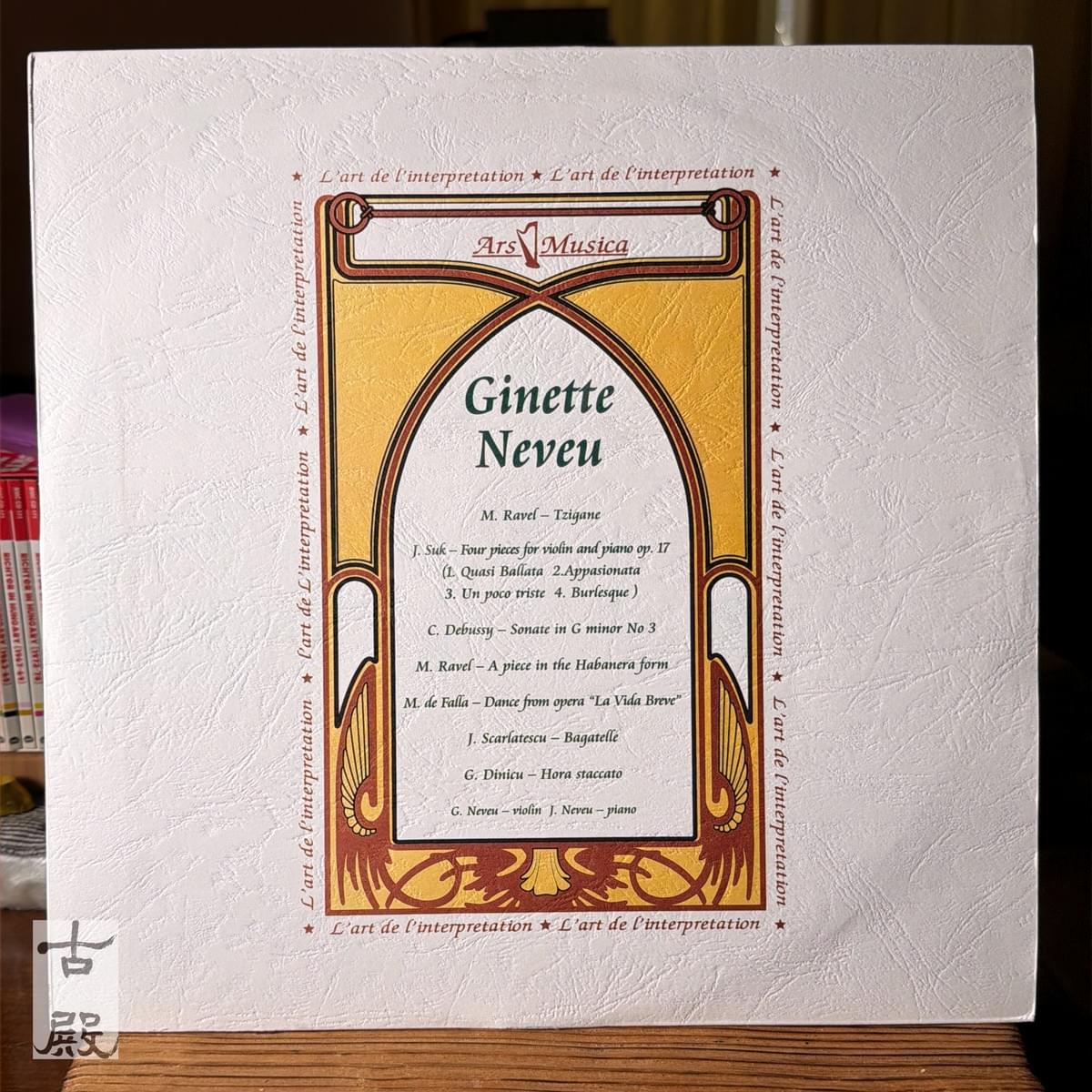
最近我手上拿到的這張唱片——吉娜特.努娃(Ginette Neveu,1919-1949)的《詮釋的藝術》(L'art de l'interpretation),廠牌是 Ars Musica。這不是一張你在大賣場或一般串流平台能輕易定義的專輯。這是一張由**「頂尖藏家」為了「頂尖同好」所製作的「私人特別版」**,專門給資深玩家們分享交流的藝術品,是一張市面買不到的非賣品。
它的催生者,是一位傳奇人物:Mieczyslaw Stoch。
來自波蘭高地的「聲音獵人」
Mieczyslaw Stoch 是誰?在歐洲的黑膠圈,他簡直是神一般的存在。 想像一下,一個人家裡收藏了將近 40,000 張黑膠唱片,張張都是精彩的經典。這不是倉庫,這是博物館。他在華沙經營著一家傳奇唱片行「Art Reco」,他對聲音的挑剔程度,尤其是對日本版唱片(Japanese pressings)的造詣,讓許多發燒友既敬畏又崇拜。
更有趣的是他的背景,彷彿註定了他這一生都要追求「極致的高度」:
他出生在波蘭海拔最高的村莊 Ząb,從小就習慣呼吸稀薄但純淨的空氣。
他的生日是1月31日,跟「歌曲之王」舒伯特(Franz Schubert)同一天。這彷彿是一種宿命的傳承,註定要與音樂糾纏一生。
他的家族血液裡流著「金牌」的基因:他是波蘭國寶級跳台滑雪名將、三屆奧運金牌得主 卡米爾·斯托赫(Kamil Stoch) 的親叔叔。
侄子在雪地上飛翔,追求物理極限的距離;叔叔則在唱片溝槽裡飛翔,追求藝術極限的深度。
當狂人遇上知音,才有了這張「極品」。
這張唱片最珍貴的地方,不僅在於它是 Stoch 先生與一群日本黑膠唱片行同好、專家們跨國聯手搞出來的「私房菜」,更在於它誕生的時間點——大約在 1980 年代末期到 1990 年代初期。
那是一個什麼樣的年代?那是全世界都在瘋狂擁抱數位 CD、急著把黑膠丟進垃圾桶的年代。
但 Stoch 先生與這群日本同好卻選擇「逆風而行」。因為他們都是歷史音樂的狂熱者與黑膠店老闆,對聲音有著近乎潔癖的堅持。他們不想做商業妥協,也不隨波逐流,堅持用黑膠這個載體,製作了這張**「同好私人限定盤」**。
正因為這群人的品味已經達到了藝術頂尖,所以這張努娃的小品集,不再只是一張唱片,它是這群「聲音守護者」眼中的極品。他們把努娃那種燃燒生命的琴音,用最懂行的方式保存了下來。
這就是古殿為什麼要介紹這張唱片的原因:因為唯有極致的偏執,才能留住極致的真實。
二、這不是演奏,這是生命的「燃燒殆盡」
如果說 Stoch 先生的品味為這張唱片打造了骨架,那麼**吉娜特.努娃(Ginette Neveu)**的琴音,就是它的血肉。
這張唱片之所以被我稱為「極品」,是因為它不僅僅是把聲音錄下來而已。這是一群對歷史、文化、藝術有著潔癖般要求的狂熱者,從唱片蒐集、播放設備研究、轉錄技術微調,一直到最後的封面設計,每一個環節都用藝術品的標準在打磨。
他們鎖定的,是努娃生命最後、也是最燃燒的三年——1946 年至 1948 年。
1. 殿主的「行家認證」:為什麼我敢說這是神作?
在這裡,我想用「古殿殿主」的身分,跟各位分享一個真實的聽感。 古殿樂藏本身就收藏了這張唱片裡大部分的原始蟲膠唱片(78rpm)。我有《茨岡》的原始盤,我有蘇克的原始盤,我知道要把這些脆弱、充滿歲月痕跡的蟲膠唱片,播放得如此充滿生命力,需要多麼高深的功力。
正因為我有原件,所以我才聽得出來 Stoch 先生與這群日本同好的可怕之處。 他們不是在消除雜訊,他們是在「還原靈魂」。
特別是其中收錄的 1948年德布西小提琴奏鳴曲,這套蟲膠連古殿目前都還沒能收藏到(因為太稀有,當時發行量極少)。當我從這張唱片聽到那段錄音時,我真的被震撼了。那種高度與難度,只有同樣在玩蟲膠的人才懂。
這些轉錄必須建立在蟲膠收藏,蟲膠播放、轉錄製作的種種費時費功費力的經驗上,這不是一般人可以做的,很多唱片公司的專業人員,也不見得有這個全部的能力。
2. 《茨岡》:請聽那毫不修飾的「松香粉末」 舉世聞名的傑作
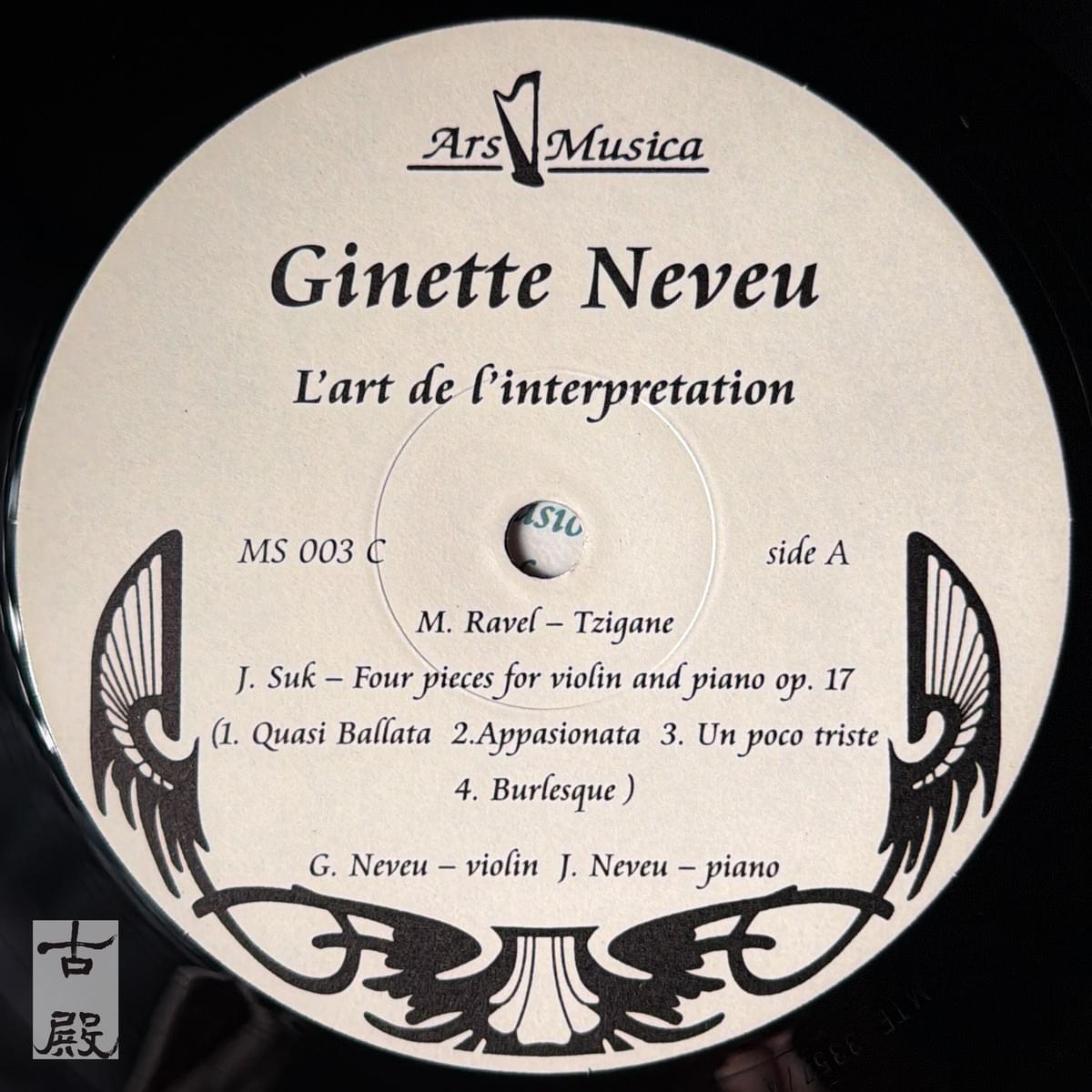
(M. Ravel – Tzigane | 1946 Abbey Road)
唱片的第一軌,拉威爾的《茨岡》。 在他們精準的轉錄下,努娃的拉威爾一點都不「優雅」,甚至有點「野」。你可以清楚聽到弓毛死死咬住琴弦的聲音,那種聲音帶有顆粒感,甚至有點刺耳。
這就是古殿常說的「反轉缺點」: 現代人怕雜訊,怕聲音粗。但在這裡,那個粗糲的摩擦聲、那個彷彿能看見松香粉末在空氣中炸開的「觸感」,被這群專家完整保留了下來。它強迫你的聽覺神經瞬間醒過來,告訴你:「這才是活著的聲音。」
3. 蘇克《四首小品》:給成年人的情緒釋放
(J. Suk – 4 Pieces for Violin and Piano Op. 17 | 1946 Abbey Road)
這是我最想推薦給忙碌大人的曲目,特別是第三首**《有點悲傷》(Un poco triste)**。 努娃的悲傷不是軟弱的,她有一種近乎男性的深沈與剛毅。透過 Stoch 先生挑選的原始蟲膠母盤(HMV DB 6360),那種中低頻的厚度被完整保留。
4. 德布西《奏鳴曲》:生命盡頭的預言
(C. Debussy – Sonata No. 3 | 1948 Abbey Road)
這就是那份連古殿都還在尋覓的珍稀錄音(1948年3月)。 在這份轉錄中,努娃的琴聲已經超越了技巧,進入了一種「純精神」的狀態。情感濃度之高,讓人起雞皮疙瘩。她彷彿在用琴聲預言自己的終點,每一顆音符都拉得那麼決絕。
5. 那些短小的「極品」
(Short Pieces | HMV DA Series)
最後,別忘了那些像是餐後烈酒般的小品:《哈巴奈拉》、《頓弓霍拉》,還有那首努娃最愛的安可曲**《Bagatelle》**。
聽完這張唱片,你會明白一件事: 為什麼這張「同好私人版」如此珍貴? 因為它是由一群懂歷史、懂聲音、懂藝術的人,用生命在守護另一段(努娃的)生命。 這不是一張普通的黑膠,這是一份穿越時空的「聲音遺囑」。
三、【歷史現場解密】當完美的阿波羅,遇上燃燒的火山
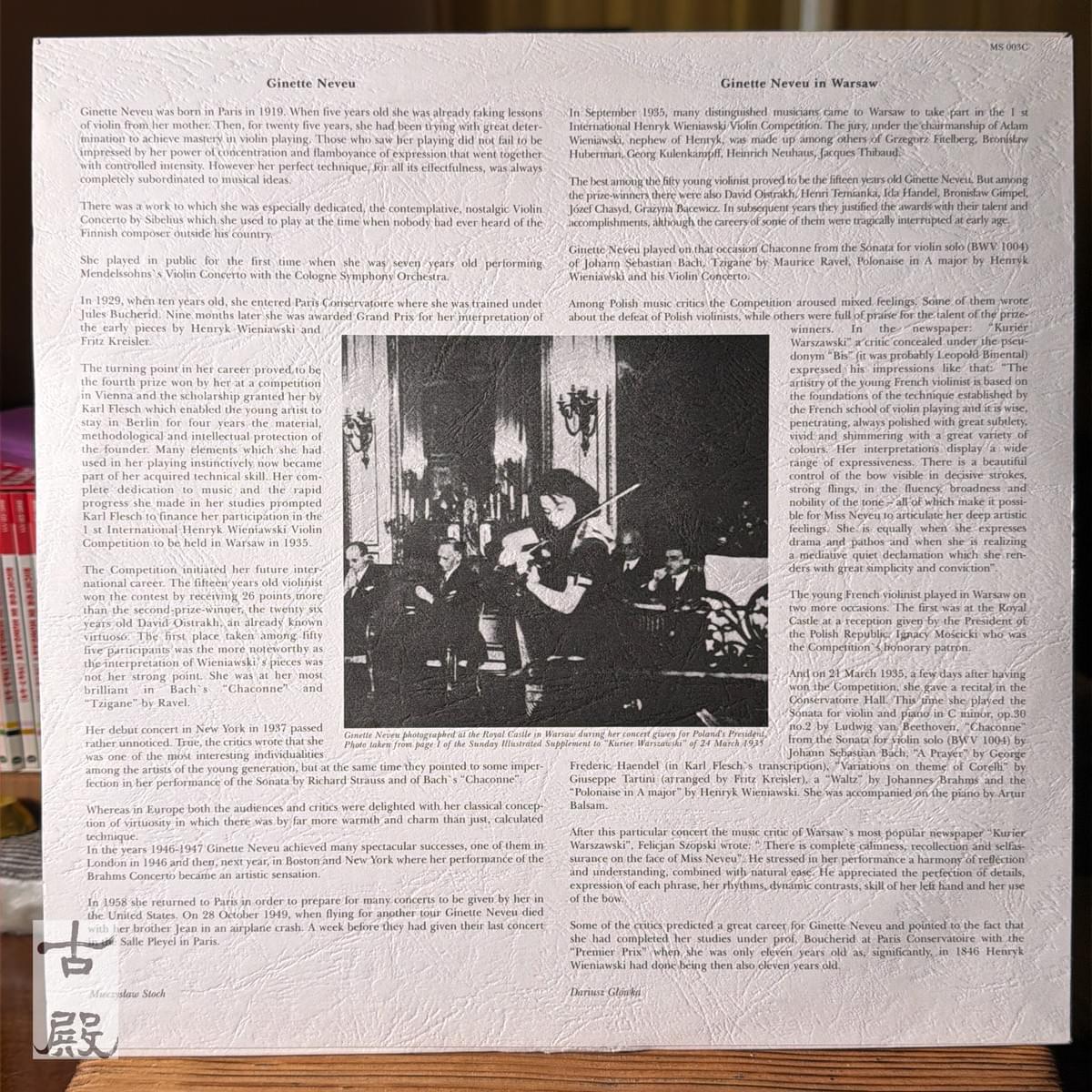
如果說唱片正面的音樂是「感性」的極致,那麼唱片背面的文字,以及隱藏在文字背後的歷史證言,就是這張唱片最沉重的壓艙石。
當我翻到唱片背面,看到解說撰寫者是 Dariusz Główka 博士(波蘭科學院物質文化史教授)時,我就知道這不是一般的商業文案。在他眼裡,這張唱片不只是娛樂,而是人類歷史上珍貴的「物質遺存」。
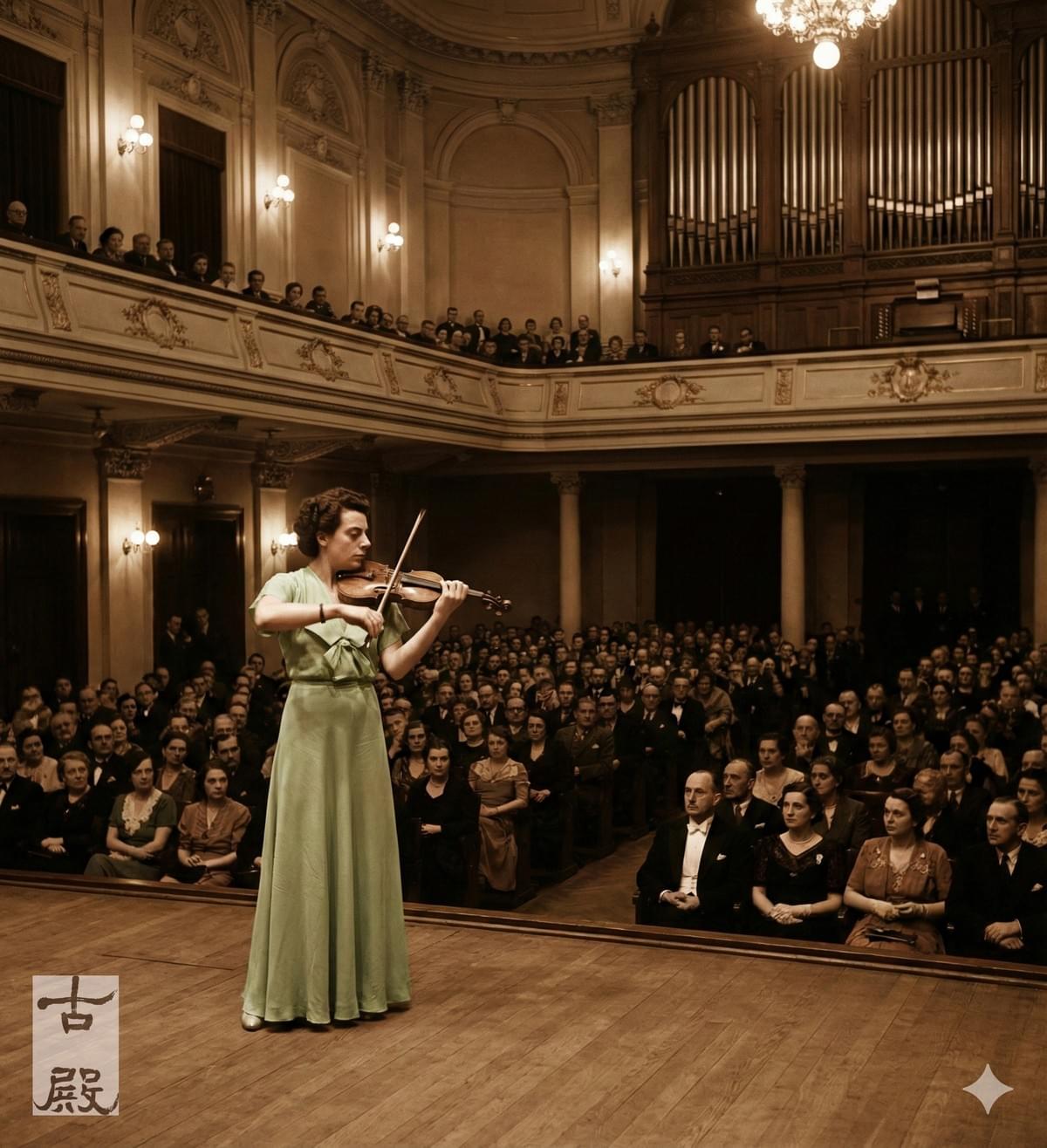
他帶我們回到了那個傳奇的現場:1935 年 9 月,華沙,第一屆維尼奧夫斯基大賽。
眾神面前的加冕:
這場比賽的評審團陣容,攤開來簡直是當時音樂界的「奧林匹斯山諸神」。 由亨里克·維尼奧夫斯基的親侄子 亞當·維尼奧夫斯基 (Adam Wieniawski,1879-1950) 擔任主席,成員包括:
波蘭指揮泰斗 格熱戈日·菲泰爾貝格 (Grzegorz Fitelberg, 1879-1953)
波蘭傳奇小提琴家 布羅尼斯拉夫·胡貝爾曼 (Bronisław Huberman, 1882-1947)
德國小提琴大師 格奧爾格·庫倫坎普夫 (Georg Kulenkampff, 1898-1948)
法國小提琴學派的靈魂人物 雅克·蒂博 (Jacques Thibaud, 1880-1953)
以及蘇聯鋼琴一代宗師 海因里希·涅高茲 (Heinrich Neuhaus, 1888-1964)
想像一下,一個默默無名的 15 歲小女孩,要在這群大師面前拉琴。而她的對手,是當時蘇聯傾盡國力培養的「小提琴沙皇」、技巧已臻化境的:大衛·歐伊斯特拉赫 (David Oistrakh, 1908-1974)。
「非強項」的逆襲:為什麼是《茨岡》定江山?
唱片製作人 Mieczyslaw Stoch 在解說中點出了一個極為關鍵的細節:
「在五十五名參賽者中獲得第一名更顯難能可貴,而詮釋維尼奧夫斯基的作品並非她的強項。」
這是一個多麽危險的處境!參加維尼奧夫斯基大賽,居然演奏維尼奧夫斯基的作品並非她的強項。那她要怎麼贏? Stoch 指出,努娃真正的殺手鐧,是巴哈的《夏康舞曲》與拉威爾的《茨岡》(Tzigane)。尤其是演奏《茨岡》,才贏得了比賽。
為什麼是《茨岡》?這首曲子天生就拒絕「安全」,它需要狂野、需要撕裂。而這正是努娃戰勝歐伊斯特拉赫的關鍵。
《涅高茲談藝錄》裡的秘密:26分的真相
在古殿的資料庫裡,我們找到了一份珍貴的證詞——來自當時的評審 海因里
希·涅高茲。他在回憶錄中,誠實地記錄下了那場「人性」與「神性」的對決。
涅高茲承認,當時 27 歲的歐伊斯特拉赫是**「阿波羅式」**的勝利——他的演奏光明、溫暖、秩序井然,技巧達到了人類的極限,是絕對的「安全(Safe)」與「無懈可擊」。
但當 15 歲的努娃上台時,一切都變了。 涅高茲用一種近乎敬畏的語氣寫道:
「當她開始演奏時,我忘記了技巧,忘記了她是個孩子。我只感覺到一股*『火山般』*的生命力在噴發。」
他看到努娃的技巧或許沒有歐伊斯特拉赫那麼安全,她甚至是在冒險。但正是這種**「把靈魂放在刀尖上跳舞」**的狀態,讓在場的所有大師評審們都無法抗拒。
也正因為涅高茲紀錄下的這個現場狀態,我們終於讀懂了唱片解說裡那個驚人的歷史數據: 為何這位年僅 15 歲的少女,能以領先第二名(歐伊斯特拉赫)整整「26分」的懸殊差距奪冠?
在這種頂尖對決裡,1 分的差距就是高手過招,但 26 分的差距,代表的已經不是技術的高低,而是**「生命維度」的不同。努娃不是在比賽拉琴,她是在燃燒靈魂。那種「魔性(Daemonic)」的穿透力,讓大師們不得不臣服,承認她就是那一刻「附體的音樂之神」**。
聽見「火山」的聲音證據
這就是為什麼「古殿」要推薦這張唱片,並且強烈建議你從第一軌開始聽—— 因為這首《茨岡》,就是當年的「奪冠證明」。
雖然這張唱片收錄的是努娃 1946 年的錄音,但那種「火山」般的特質,在經過戰爭與生命的洗禮後,反而更加濃烈。 在那段粗糲的開場獨奏中,你會聽到弓毛與琴弦劇烈摩擦的聲音,那不只是雜訊,那就是她在刀尖上跳舞的腳步聲。
那種聲音會會救贖你的靈魂。
【結語:讓古殿帶你聽見歷史的肉身】
這張由 Art Reco 發行的《詮釋的藝術》(L'art de l'interpretation),從製作人、轉錄師、到解說撰寫者,全都是該領域的頂尖人物。
Mieczyslaw Stoch(製作人): 用 40,000 張收藏的眼光,挑選出最對味的聲音。
Dariusz Główka(解說): 用波蘭在地歷史學家的筆,提供珍貴的歷史紀錄資料。
海因里希·涅高茲(見證者): 用大師的良知,證明了這份燃燒的價值。
吉娜特·努娃(演奏者): 用生命的最後三年,留下了這些不可複製的聲響。
這就是古殿想帶給你的價值。 我們不賣「好聽」,我們賣「真實」。 我們不談「音響規格」,我們談「生命狀態」。
實體音樂:
******
[Gu Dian Music Story] The Art of Interpretation: Ginette Neveu
I. When a Polish Madman with 40,000 Records Decides to Leave a Monument to Sound
Today, I don't want to talk about music first; I want to talk about "taste."
At Gu Dian, I often tell friends: "When listening to vinyl, sometimes you aren't just listening to the music; you are listening to the 'vision' of the producer behind it." If a producer’s standard is merely 'passable,' the sound you hear will be just okay. But if the producer’s vision is in the clouds, then what you hear will be a tremor of the soul.
The record I recently got my hands on—Ginette Neveu (1919-1949): L'art de l'interpretation (The Art of Interpretation), released by the label Ars Musica—is not an album you can easily define on a streaming platform or find in a big-box store. This is a "Private Special Edition" created by a "Top Collector" for "Top Enthusiasts." It is an artifact specifically for seasoned players to share and exchange; it is a "not-for-sale" item that cannot be bought on the open market.
Its creator is a legendary figure: Mieczyslaw Stoch.
The "Sound Hunter" from the Polish Highlands
Who is Mieczyslaw Stoch? In European vinyl circles, he is practically a god. Imagine a man whose home houses nearly 40,000 vinyl records, each one a brilliant classic. This isn't a warehouse; it's a museum. He runs a legendary record store in Warsaw called "Art Reco." His fastidiousness regarding sound—especially his expertise in Japanese pressings—makes many audiophiles view him with both awe and reverence.
Even more interesting is his background, which seems to have destined him to pursue "extreme heights" his entire life:
He was born in Ząb, the highest-altitude village in Poland, accustomed since childhood to breathing thin but pure air.
His birthday is January 31st, the same day as the "King of Song," Franz Schubert. It’s like a destined heritage, binding him to music for life.
His family blood carries the "Gold Medal" gene: He is the uncle of Poland's national treasure, the ski jumper and three-time Olympic Gold Medalist Kamil Stoch.
The nephew flies over the snow, pursuing the physical limits of distance; the uncle flies within the record grooves, pursuing the extreme depths of art.
When a Madman Meets a Soulmate: The Birth of a "Masterpiece"
The most precious thing about this record is not just that it is a "private kitchen dish" cooked up by Mr. Stoch and a group of Japanese record store enthusiasts and experts across borders, but also the time of its birth—around the late 1980s to the early 1990s.
What kind of era was that? It was a time when the whole world was frantically embracing digital CDs and rushing to throw vinyl into the trash.
But Mr. Stoch and this group of Japanese enthusiasts chose to "run against the wind." Because they were historical music fanatics and record store owners, they held a near-obsessive persistence regarding sound. They didn't want to make commercial compromises, nor did they drift with the tide. They insisted on using the vinyl medium to produce this "Private Enthusiast Limited Edition."
Precisely because the taste of this group had reached the pinnacle of art, this collection of Neveu's small pieces is no longer just a record; it is a masterpiece in the eyes of these "Guardians of Sound." They preserved Neveu's life-burning violin tone in the most knowledgeable way possible.
This is why Gu Dian wants to introduce this record: Because only extreme paranoia can retain extreme truth.
II. This is Not a Performance; This is Life "Burning Out"
If Mr. Stoch’s taste built the skeleton of this record, then Ginette Neveu’s tone is its flesh and blood.
The reason I call this record a "Masterpiece" is that it didn't just record the sound. This is a group of fanatics with obsessive requirements for history, culture, and art. From record collection, playback equipment research, and transfer technology fine-tuning, all the way to the final cover design, every link was polished with the standards of an art object.
They locked onto the last, and most burning, three years of Neveu's life—1946 to 1948.
1. The Master's "Expert Certification": Why do I dare call this a divine work?
Here, I want to use my identity as "The Master of Gu Dian" to share a real listening experience. Gu Dian's archives actually contain most of the original shellac records (78rpm) found on this album. I have the original disc of Tzigane; I have the original disc of Suk. I know how much profound skill is required to play these fragile, time-worn shellac records with such vitality.
Because I have the originals, I can hear just how terrifyingly good Mr. Stoch and his Japanese enthusiasts are. They are not removing noise; they are "restoring the soul."
Especially the 1948 Debussy Violin Sonata included here. This set of shellac records is so rare (the issuance quantity was extremely low at the time) that even Gu Dian has not yet been able to collect it. When I heard that recording from this LP, I was truly shaken. That level of height and difficulty is something only those who also play with shellac can understand.
These transfers must be built upon distinct experiences in shellac collection, playback, and transfer production. This entails time, effort, and labor that ordinary people cannot manage. Even professionals in many record companies may not necessarily possess this full range of capabilities.
2.
Tzigane: Please Listen to the Unadorned "Rosin Dust" (A World-Renowned Masterpiece)
(M. Ravel – Tzigane | 1946 Abbey Road)
The first track of the record, Ravel’s Tzigane. Under their precise transfer, Neveu’s Ravel is not "elegant" at all; it is even a bit "wild." You can clearly hear the sound of the bow hair biting dead onto the strings. That sound has a grainy texture, perhaps even a bit harsh.
This is what Gu Dian calls "Flipping the Flaw": Modern people are afraid of noise; they fear rough sounds. But here, that coarse friction sound, that "tactile sensation" where you can almost see the rosin dust exploding in the air, has been completely preserved by these experts. It forces your auditory nerves to wake up instantly, telling you: "This is the sound of being alive."
3. Suk
4 Pieces: Emotional Release for Adults
(J. Suk – 4 Pieces for Violin and Piano Op. 17 | 1946 Abbey Road)
This is the track I most want to recommend to busy adults, especially the third piece, "Un poco triste" (A Little Sad). Neveu’s sadness is not weak; she possesses a depth and fortitude that is almost masculine. Through the original shellac master (HMV DB 6360) selected by Mr. Stoch, that thickness in the mid-low frequencies is completely preserved.
This is a form of "Sensory Rehabilitation." It is like a pair of thick, solid hands catching the grievances and repression you feel in the workplace.
4. Debussy
Sonata: A Prophecy at the End of Life
(C. Debussy – Sonata No. 3 | 1948 Abbey Road)
This is the rare recording that even Gu Dian is still searching for (March 1948). In this transfer, Neveu’s violin sound has transcended technique and entered a state of "pure spirit." The emotional concentration is so high it gives you goosebumps. It is as if she is using the violin sound to prophesy her own end; every note is played with such finality.
5. Those Short "Masterpieces"
(Short Pieces | HMV DA Series)
Finally, don't forget those small pieces that are like a strong digestif: Habanera, Hora Staccato, and Neveu’s favorite encore, "Bagatelle."
After listening to this record, you will understand one thing: Why is this "Private Enthusiast Edition" so precious? Because it was created by a group of people who understand history, sound, and art, using their lives to guard another life (Neveu's). This is not an ordinary vinyl record; this is a "Sound Testament" that travels through time.
III. [Deciphering the Historical Scene] When the Perfect Apollo Met the Burning Volcano
If the music on the front of the record is the ultimate in "sensibility," then the text on the back, and the historical testimony hidden behind that text, is the heaviest ballast of this album.
When I flipped to the back of the record and saw that the commentary writer was Dr. Dariusz Główka (Professor of Material Culture History at the Polish Academy of Sciences), I knew this was no ordinary commercial copy. In his eyes, this record is not just entertainment, but a precious "material remain" of human history.
He takes us back to that legendary scene: September 1935, Warsaw, the 1st Wieniawski International Violin Competition.
The Coronation Before the Gods
The jury lineup for this competition, when laid out, was simply the "Gods of Mount Olympus" of the music world at that time. Chaired by Adam Wieniawski (1879-1950), the nephew of Henryk Wieniawski, the members included:
The titan of Polish conducting: Grzegorz Fitelberg (1879-1953)
The legendary violinist: Bronisław Huberman (1882-1947)
The German violin master: Georg Kulenkampff (1898-1948)
The soul of the French violin school: Jacques Thibaud (1880-1953)
And the grandmaster of the Soviet piano generation: Heinrich Neuhaus (1888-1964)
Imagine a virtually unknown 15-year-old girl having to play before this group of masters. And her opponent was the "Violin Tsar" cultivated with the full national power of the Soviet Union, whose technique had reached perfection: David Oistrakh (1908-1974).
The Counterattack of the "Non-Forte": Why Did
Tzigane Decide the Outcome?
Record producer Mieczyslaw Stoch points out an extremely critical detail in the commentary: "Winning first place among fifty-five contestants is even more commendable because interpreting Wieniawski's works was not her forte."
What a dangerous situation! To participate in the Wieniawski competition when playing Wieniawski's works is not one's strong suit. How could she win? Stoch points out that Neveu’s true killer moves were Bach’s Chaconne and Ravel’s Tzigane. Specifically, it was playing Tzigane that won her the competition.
Why Tzigane? This piece inherently refuses to be "safe." It requires wildness; it requires tearing apart. And this was the key to Neveu defeating Oistrakh.
The Secret in
The Neuhaus Memoirs: The Truth of the 26 Points
In Gu Dian's database, we found a precious testimony—from one of the judges at the time, Heinrich Neuhaus. In his memoirs, he honestly recorded that duel between "Humanity" and "Divinity."
Neuhaus admitted that the then 27-year-old Oistrakh was an "Apollonian" victory—his playing was bright, warm, and orderly; his technique reached the limits of humanity; it was absolutely "Safe" and "impeccable."
But when 15-year-old Neveu took the stage, everything changed. Neuhaus wrote in a tone bordering on awe:
"When she began to play, I forgot about technique; I forgot she was a child. I only felt a 'Volcanic' life force erupting."
He saw that Neveu’s technique might not have been as safe as Oistrakh’s; she was even taking risks. But it was precisely this state of "dancing with her soul on the tip of a blade" that made all the master judges unable to resist.
And precisely because of this live state recorded by Neuhaus, we finally understand that astonishing historical statistic in the record notes: Why was this 15-year-old girl able to win the championship with a gap of a full "26 points" ahead of the runner-up (Oistrakh)?
In this kind of top-tier duel, a gap of 1 point is a clash of experts, but a gap of 26 points represents not a difference in technical level, but a difference in "Life Dimension." Neveu was not playing the violin in a competition; she was burning her soul. That "Daemonic" penetrating power forced the masters to submit and admit that she was, in that moment, the "Music God Incarnate."
Evidence of the "Volcano"
This is why "Gu Dian" recommends this record and strongly suggests you start listening from the first track— Because this piece, Tzigane, is the "Proof of Victory" from that year.
Although this record contains Neveu’s recording from 1946, that "Volcanic" quality became even more intense after passing through the baptism of war and life. In that rough opening solo, you will hear the sound of the bow hair violently rubbing against the strings. That is not just noise; that is the sound of her footsteps dancing on the tip of the blade.
That sound will redeem your soul.
[Conclusion: Let Gu Dian Help You Hear the Flesh and Blood of History]
This release of L'art de l'interpretation by Art Reco features top figures in their fields, from the producer and transfer engineer to the commentary writer.
Mieczyslaw Stoch (Producer): Using the vision of a 40,000-record collection to select the most correct flavor of sound.
Dariusz Główka (Commentary): Using the pen of a local Polish historian to provide precious historical records.
Heinrich Neuhaus (Witness): Using the conscience of a master to prove the value of this burning passion.
Ginette Neveu (Performer): Using the last three years of her life to leave behind these unrepeatable sounds.
This is the value Gu Dian wants to bring to you. We don't sell "good sounding"; we sell "reality." We don't talk about "audio specs"; we talk about "life state."