
【古殿唱片音樂故事】聽見失傳的「絕學」:一張20萬也買不到的感動,與兩位傳奇的靈魂相遇
古殿殿主
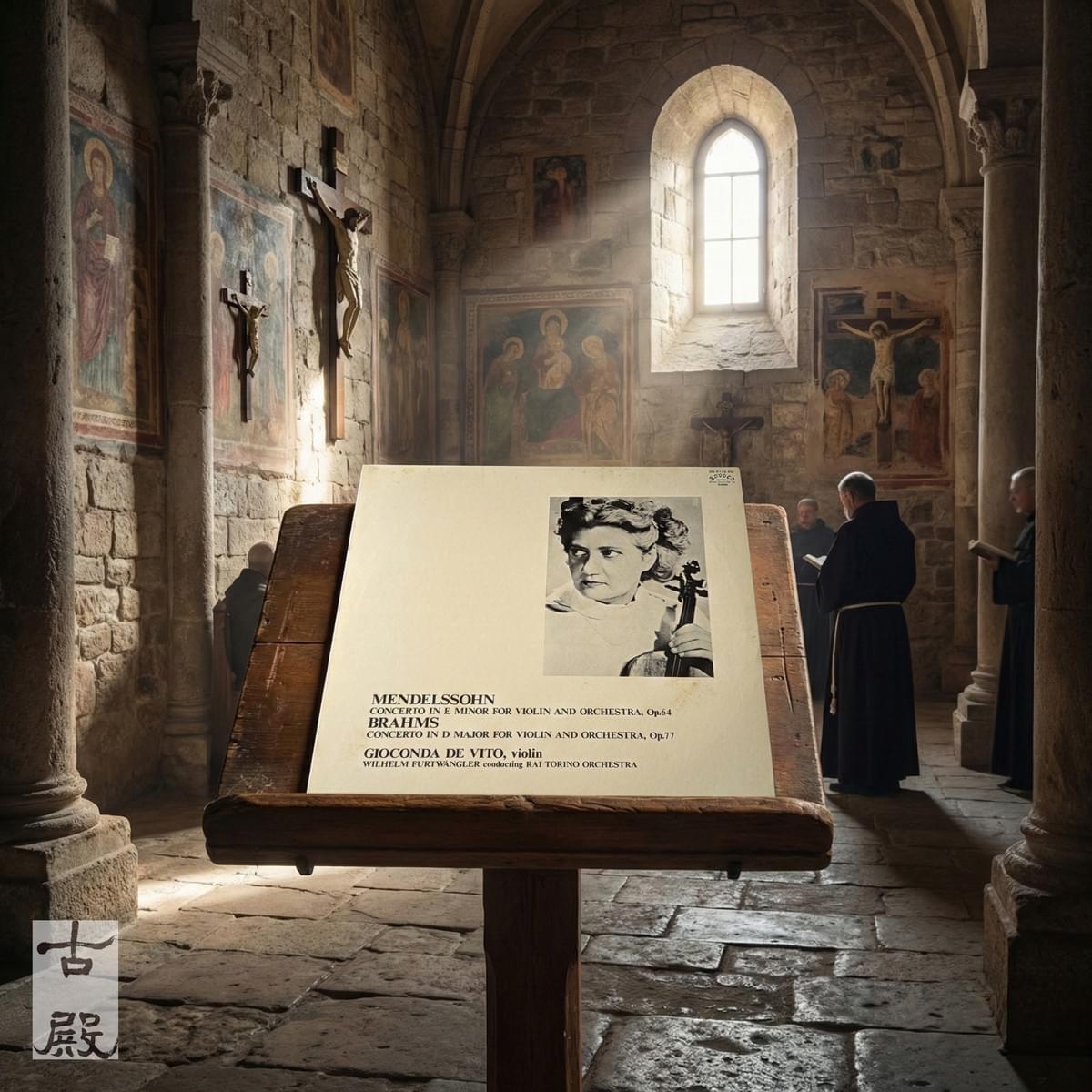
唱片廠牌與編號: ROCOCO/JAPAN/OS-7119-RC
演出: Gioconda de Vito (小提琴) & Wilhelm Furtwängler (指揮) RAI 都靈交響樂團(Orchestra Sinfonica di Torino della RAI)
曲目: 孟德爾頌 & 布拉姆斯 小提琴協奏曲
時間: 1952年3月 義大利都靈現場
前言
如果我告訴你,有一張黑膠唱片在拍賣市場上曾標出 5629 英鎊(約合台幣 22 萬) 的天價,你會想到什麼?
是因為它好聽嗎?是因為它稀有嗎? 是的,那張唱片是小提琴家 喬孔達·德·維托(Gioconda de Vito) 唯一的立體聲錄音(ASD 429),封面上她像個精緻的瓷偶,聲音乾淨、漂亮、身價不凡。
但今天在古殿,我不放那張 20 萬的唱片。 我要放一張你也許沒聽過,封面只是黑白照片,甚至錄音裡還帶點單聲道沙沙聲的唱片——這是 1952 年,她與指揮之神 福特萬格勒(Furtwängler) 的現場錄音。
為什麼? 因為那張 20 萬的唱片,是穿著禮服的「瓷偶」;而今天這張,是脫下禮服、有血有肉、甚至為了音樂在懸崖邊搏命的「女人」。
在這個數位音樂乾淨到像「無菌室」的時代,我們需要的不是完美,我們需要的是一點點「人味」,一點點瑕疵,和一種已經失傳的、名為「德·維托」的聲音。
而聆聽這張「現場」的錄音,你會發現,真正昂貴的不是黑膠的市價,而是那種一旦錯過,就再也回不去的——對音樂的虔誠與敬畏。
一、傳說的起點:當「烈火」遇上了「大地」
在談這張唱片之前,我們得先認識這位長期被歷史遺忘的義大利女人——喬宮達·迪·維托(Gioconda de Vito, 1907-1994)。
現在提到 20 世紀的女性小提琴家,大家第一個想到的名字通常是 吉娜特·努娃(Ginette Neveu, 1919-1949)。努娃是傳奇,她像一團烈火,琴聲剛烈、充滿戰鬥力,甚至在 1935 年擊敗了蘇聯大師歐伊斯特拉赫(David Oistrakh, 1908-1974)。加上她 30 歲就因空難早逝,更讓她成為永遠的悲劇女神。
但若把時間往前倒回 1932 年的維也納國際音樂比賽。 那一年的評審團陣容豪華到讓人膝蓋發軟:安奈斯可(George Enescu, 1881-1955)、卡爾·弗萊什(Carl Flesch, 1873-1944)、讓·庫貝利克(Jan Kubelik, 1880-1940)……全是世界琴壇的神級人物。
那一年,才華洋溢的努娃也參賽了,她拿了第四名。 而拿走第一名首獎的,正是當年 24 歲的 喬宮達·迪·維托。
為什麼?為什麼連燃燒的「烈火」努娃都輸給了她?
其實,那年努娃才 12 歲。 那是一塊璞玉與一件完成品的對決。努娃在比賽中展現了驚人的爆發力,甚至讓評審卡爾·弗萊什看見了她的未來,決定免費把她帶回柏林親手培養。
正是因為這場「輸」,才開啟了努娃日後的沈潛與修煉,讓她在 1935 年達到了更上一層樓的境界。這就是良性競爭最珍貴的價值——它帶來的不是打擊,而是更大的發展與進化。若沒有當年的德·維托像高山一樣擋在那裡,或許就沒有後來那個無堅不摧的努娃。
但即使是天才的火種,在當年的德·維托面前,依然顯得稚嫩。因為評審們聽到了另一種境界: 如果說努娃是「火」,要把一切阻礙燒盡,展現生命的強度; 那德·維托就是「土」,她是義大利南部的黑土,厚實、溫暖、包容一切,展現生命的厚度。
努娃讓人腎上腺素飆升,讓人想燃燒;但德·維托讓人呼吸變慢,讓人想沈靜冥想。 當年的評審聽到了這一點:技巧可以練,天才可以培養,但那種彷彿從土地裡長出來的歌唱性,那種**「母性的寬容」**,是練不出來的。
可惜的是,德·維托不像努娃那樣悲壯地離開,她選擇了更特別的路——她在 1961 年,54 歲正值巔峰時,毅然封琴引退,並銷毀了許多她不滿意的錄音。
這不是任性,而是一種極致的自律。 德·維托的偉大,正是在於她比誰都清楚自己藝術的價值,所以她絕不濫用這份價值。 當她覺得無法再以100%的狀態面對上帝與聽眾時,她選擇了沈默。
她親手把自己變成了「傳說」。而我們今天聽的,就是這份倖存下來的傳說。
二、聽見「失傳」的絕學與物理學
許多樂友第一次聽到德·維托的琴音,都會有一種奇怪的感覺:「明明這首曲子我聽過幾百遍了,為什麼在她手裡,像是第一次聽到的新歌?」
這不是你的錯覺,這是一種已經**「物理性失傳」**的聲音美學。聽這張唱片,本身就是一場聽覺的考古與復健。
1. 被鋼弦殺死的「羊腸靈魂」
現代的小提琴家為了在幾千人的音樂廳裡讓聲音穿透,多半使用鋼弦或合成弦。聲音很亮、很準、很乾淨,像日光燈。 但德·維托堅持使用傳統的羊腸弦(Gut Strings)。羊腸弦很難搞,對濕度敏感,容易走音,但它有一種現代琴弦沒有的「肉感」與「毛邊」。 那是溫暖的、有人體溫度的聲音,像燭光。在這個充滿 LED白光的數位時代,這種帶有雜質的溫暖,才是我們最渴望的擁抱。
2. 失傳的「慢速揉弦」:不是表演,是祈禱
現代演奏講求華麗,揉弦(Vibrato)通常很快、很密。 但你仔細聽這張唱片,德·維托的揉弦非常寬、非常慢,有時候甚至不揉。這讓她的小提琴聽起來不像是樂器,更像是**「中世紀教堂裡的人聲吟唱」**。
這不只是形容詞,這是發生過的歷史。 1957年,她在梵蒂岡為教宗庇護十二世演奏孟德爾頌小提琴協奏曲(正是這張唱片裡的曲目)。演出後,她收到一位現場觀眾的信。這位觀眾自稱原本是堅定的無神論者,但在聽了她演奏的第二樂章(行板)後,那種純淨、深邃的聲音讓他感覺到**「這世界上一定有神存在」**,從此改變了他的信仰。
為什麼她的聲音能改變一個人?因為對德·維托來說,拉琴不是為了表演,而是為了祈禱。
3. 漫步在聖神之道:被陽光烘烤過的土地味
德·維托和福特萬格勒的音樂是**「時間的藝術」**。你會發現他們想快就快,想慢就慢(這就是 Rubato,彈性速度)。她願意為了樂譜上的一個美妙音符,停下來多駐足一秒。 這種「浪費時間」的奢侈,在現代講求效率的音樂界,已經絕種了。
這或許跟她的出身有關。她出生於義大利南部的馬丁納弗蘭卡(Martina Franca),家裡是釀酒世家。評論家常說她的聲音有一種**「被陽光烘烤過的土地味」**,溫暖、深沈、甚至帶有一點點粗糙的質地。 這與現代追求「水晶般完美」的錄音美學截然不同。聽她的琴,就像喝一口南部家釀的老酒,不精緻,但那股濃烈的後勁,會讓你記一輩子。
三、1952年的奇蹟:當「大地」遇見「深淵」
我們終於要來談這張唱片的核心價值——1952年,都靈(Torino),現場錄音。
德·維托一生留下的錄音極少。對於這張唱片裡的兩首曲子(孟德爾頌、布拉姆斯),其實她都有錄音室版本。
孟德爾頌: 她在 1951 年跟薩金特(Sargent)錄過。
布拉姆斯: 她在 1953 年跟舒瓦茲(Schwarz)錄過。
那些錄音室版本都很珍貴,但為什麼我們仍是要特別關注這張 1952 年的現場版?
因為這兩次,指揮台站著的人,是:福特萬格勒,還有就是「音樂會現場實況」
1. 孟德爾頌:拋開輕柔甜美的冒險
孟德爾頌的小提琴協奏曲,通常被拉得很甜美、很流暢。德·維托其實不喜歡這樣,她覺得一般人的演奏都太輕了,太甜了。 但在這張現場錄音裡,因為她不想演奏得太「女性化」,她反而用盡全力去挖掘這首曲子的深刻感動。
更重要的是,福特萬格勒不是來「伴奏」的。他給出的樂團聲響如波濤洶湧,逼得德·維托必須完全打開感官去接招。 你聽不到錄音室裡的謹慎,你聽到的是兩個人在懸崖邊的**「拉扯」**。你會聽到樂團在等她,她在等樂團,那種因為互相傾聽而產生的「微秒時差」,才是人類真正的呼吸。
這正如福特萬格勒在《談音樂》(Gespräche über Musik)書中所說的:「真正的詮釋,是一種即興的再創造。」 音樂不是固定的建築,而是流動的生命。在這張唱片裡,你聽到的不是孟德爾頌的樂譜,而是兩個偉大的靈魂,在1952年那個當下,共同孕育出的生命體。這不是協奏,這是一場靈魂的相遇。
2. 布拉姆斯:生命僅此一次的交會
德·維托被稱為「布拉姆斯的女祭司」。她錄過這首曲子四次(1941, 1952, 1953, 1956)。 1941 年太早,聲音太硬;1956 年太晚,火氣已消。 只有 1952年這一次,剛好處於她技巧的最高峰,與藝術心靈的最成熟期。
而且,她遇到了唯一能跟她在精神層面上互搏的對手。福特萬格勒的布拉姆斯是厚重的、哲學的,這剛好跟德·維托那種「義大利黑土」般的琴音完美融合。這張唱片記錄的,是兩位大師生命中**「不可複製」**的瞬間。錄音室可以重來一百次,但這個現場的情感濃度,錯過就沒了。
【古殿解密:福特萬格勒的極稀有遺產】
最後,我們必須透過數據,讓你明白這張唱片的「重量」。 指揮之神福特萬格勒一生留下的錄音雖多,但在這兩首重要的德奧協奏曲上,他留下的紀錄卻稀少得驚人:
孟德爾頌小提琴協奏曲: 一生只有兩份錄音(1952 曼紐因、1952 德·維托)。
布拉姆斯小提琴協奏曲: 一生只有兩份錄音(1949 曼紐因、1952 德·維托)。
也就是說,這張唱片一次收錄了這兩首極其珍貴的「二分之一」。 在福特萬格勒龐大的錄音遺產中,能同時擁有這兩首曲子、且是由同一位獨奏家演出的,僅此一張。這不僅是德·維托的顛峰,也是福特萬格勒留給世人的特殊禮物。
最後:比天價更珍貴的,是「真實」
回到最開始的話題。 那張 20 萬台幣的立體聲(Stereo)唱片(ASD 429)固然珍貴,它記錄了德·維托最完美的「音效」。
但今天古殿推薦給你的這張 ROCOCO 1952 Live,雖然沒有華麗的立體聲包裝,雖然市價沒有那麼驚人,但它記錄了比金錢更珍貴的東西——「真實」。
它記錄了一位傳奇女性,在面對指揮之神時,如何拋開一切束縛,燃燒自己的靈魂。 它記錄了那個還沒有被數位科技修飾過的年代,音樂家是如何用生命在呼吸。

實體音樂:
******
[Gu Dian Music Story] Hearing a Lost "Secret Art": A Touching Encounter Money Can't Buy, Where Two Legendary Souls Meet
- Label & Cat. No: ROCOCO / JAPAN / OS-7119-RC
- Performance: Gioconda de Vito (Violin) & Wilhelm Furtwängler (Conductor), Orchestra Sinfonica di Torino della RAI
- Repertoire: Mendelssohn & Brahms Violin Concertos
- Time & Place: March 1952, Live in Turin, Italy
Foreword
I
f I told you that a single vinyl record once sold at auction for £5,629 (approx. 220,000 TWD), what comes to your mind?
Is it because it sounds perfect? Is it because it’s rare? Yes, that record is violinist Gioconda de Vito’s only stereo recording (ASD 429). On that cover, she looks like an exquisite porcelain doll, and the sound is pristine, beautiful, and undeniably expensive.
But today at Gu Dian, I’m not playing that £5,000 record. I want to play you a record you might not have heard of. The cover is just a black-and-white photo. The recording even has a bit of that mono hiss. This is a live recording from 1952, where she met the "God of Conductors," Wilhelm Furtwängler.
Why? Because that expensive record is the "porcelain doll" in a formal gown. But the one we are listening to today? This is the woman taking off the gown, a woman of flesh and blood, a woman risking everything at the edge of a cliff for the sake of music.
In this era where digital music is scrubbed so clean it feels like a "sterile lab," we don't need perfection. We need a little bit of "human touch," a few flaws, and a sound that has been lost to time—a sound named "De Vito."
Listening to this "Live" recording, you will discover that the truly expensive thing isn't the market price of the vinyl. It’s that sense of piety and awe toward music—once you miss it, you can never go back.
I. The Origin of the Legend: When "Fire" Met "Earth"
Be
fore we dive into the record, we need to meet this Italian woman who has long been forgotten by history: Gioconda de Vito (1907-1994).
When people mention 20th-century female violinists today, the first name that usually pops up is Ginette Neveu (1919-1949). Neveu was a legend. She was like a raging fire—her sound was fierce, full of combativeness. She even defeated the Soviet giant David Oistrakh in 1935. Her tragic death in a plane crash at age 30 cemented her status as an eternal tragic goddess.
But let's rewind the clock to the 1932 Vienna International Music Competition. The jury that year was so star-studded it would make your knees weak: George Enescu, Carl Flesch, Jan Kubelik... all gods of the violin world.
That year, the incredibly talented Neveu competed too. She took fourth place. The person who took the First Prize was the 24-year-old Gioconda de Vito.
Why? Why did even the burning "Fire" of Neveu lose to her?
In truth, Neveu was only 12 years old then. It was a duel between an unpolished gem and a finished masterpiece. Neveu showed shocking explosive power—so much so that judge Carl Flesch saw her future and offered to teach her for free in Berlin. That loss was actually a gift; it pushed Neveu to evolve. Without the mountain of De Vito standing in her way, perhaps the unstoppable Neveu of later years would never have existed.
But even the spark of a genius seemed tender in front of De Vito back then. The judges heard a different realm of existence: If Neveu was "Fire," burning through obstacles to show the intensity of life; Then De Vito was "Earth." She was the dark, rich soil of Southern Italy—thick, warm, embracing everything, showing the depth of life.
Neveu makes your adrenaline spike; she makes you want to burn. De Vito makes your breathing slow down; she makes you want to settle into meditation.
The judges heard it: Technique can be practiced, genius can be cultivated, but that singing quality that feels like it grows directly out of the ground—that "Motherly Tolerance"—is something you cannot practice.
Sadly, De Vito didn’t leave tragically like Neveu. She chose a unique path. In 1961, at just 54 and in her prime, she abruptly retired and destroyed many recordings she wasn't satisfied with.
This wasn't arrogance; it was extreme discipline. De Vito’s greatness lay in knowing the value of her art better than anyone else, so she refused to dilute it. When she felt she could no longer face God and her audience at 100%, she chose silence.
She turned herself into a "legend" with her own hands. And what we are hearing today is a fragment of that legend that survived.
II. Hearing the "Lost" Secret Art and Physics
Man
y friends hearing De Vito for the first time say the same thing: "I’ve heard this piece a hundred times, but in her hands, it sounds like a new song."
This isn't an illusion. It is an aesthetic of sound that is "physically lost." Listening to this record is an act of auditory archaeology and rehabilitation.
1. The "Soul of Gut Strings" Killed by Steel Modern violinists, needing to project sound across massive halls, mostly use steel or synthetic strings. The sound is bright, precise, and clean—like fluorescent light. But De Vito insisted on traditional Gut Strings. Gut strings are difficult; they are sensitive to humidity and go out of tune easily. But they possess a "fleshy texture" and "grain" that modern strings lack. It is a warm sound with body temperature, like candlelight. In a digital age full of white LED light, this warmth—with all its impurities—is the embrace we crave most.
2. The Lost "Slow Vibrato": Not Performance, but Prayer Modern playing demands dazzle; vibrato is usually fast and tight. But listen closely to this record. De Vito’s vibrato is very wide, very slow, and sometimes she doesn’t vibrate at all. This makes her violin sound less like an instrument and more like "human chanting in a medieval cathedral."
This isn't just a metaphor; it’s history. In 1957, she played this very Mendelssohn concerto for Pope Pius XII at the Vatican. Afterward, she received a letter from an audience member. He claimed to be a staunch atheist, but after hearing her second movement (Andante), that pure, profound sound made him feel that "God must exist," changing his faith forever. Why could her sound change a person? Because for De Vito, playing wasn't performing—it was praying.
3. Walking the Sacred Path: The Scent of Sun-Baked Earth De Vito and Furtwängler’s music is the "Art of Time."You’ll notice they speed up when they want, and slow down when they want (Rubato). She is willing to stop and linger for an extra second just for one beautiful note in the score. This luxury of "wasting time" is extinct in the modern, efficiency-obsessed music world.
Perhaps it’s her background. Born in Martina Franca, Southern Italy, to a family of winemakers, critics often said her sound had the "scent of sun-baked earth"—warm, deep, even slightly rough in texture. This is the opposite of the "crystal perfection" of modern recording aesthetics. Listening to her is like drinking a sip of old, southern homemade wine. It’s not refined, but that strong aftertaste? You’ll remember it for a lifetime.
III. The Miracle of 1952: When "Earth" Met the "Abyss"
Fina
lly, we arrive at the core value of this record—1952, Turin, Live.
De Vito left very few recordings. She actually has studio versions of both pieces on this record (Mendelssohn & Brahms).
Mendelssohn: Recorded with Sargent in 1951.
Brahms: Recorded with Schwarz in 1953.
Those studio versions are precious, but why must we focus on this 1952 Live version? Because this time, the man on the podium was Furtwängler. And because it was "Live."
1. Mendelssohn: An Adventure Beyond Sweetness Mendelssohn’s concerto is usually played to be sweet and flowing. De Vito disliked that; she felt most people played it too lightly, too sweetly. In this live recording, because she didn't want to sound too "feminine," she used every ounce of strength to dig out the profound emotion of the piece.
More importantly, Furtwängler wasn't there to "accompany." The orchestral sound he unleashed was like a tidal wave, forcing De Vito to fully open her senses to respond. You don't hear the caution of the studio; you hear two people "struggling" at the edge of a cliff. You hear the orchestra waiting for her, and her waiting for the orchestra. That "micro-second time lag" born of deep listening—that is the true breath of humanity.
As Furtwängler said in his book Gespräche über Musik: "True interpretation is an improvised re-creation." Music isn't a fixed building; it's a flowing life. In this record, you aren't hearing Mendelssohn's score; you are hearing two great souls birthing a living entity in that moment in 1952. This isn't a concerto; it's a meeting of souls.
2. Brahms: A Once-in-a-Lifetime Intersection De Vito was called the "High Priestess of Brahms." She recorded this piece four times. 1941 was too early (too hard); 1956 was too late (the fire had faded). Only 1952 was exactly right—the peak of her technique meeting the maturity of her artistic soul.
And she met the only opponent who could spar with her spiritually. Furtwängler’s Brahms is heavy, philosophical—a perfect fusion with De Vito’s "Italian dark soil" sound. This record documents a moment that is "unrepeatable." You can redo a studio take a hundred times, but the emotional density of this live performance? Once you miss it, it’s gone.
[Gu Dian Declassified: Furtwängler’s Ultra-Rare Legacy]
Final
ly, I must use some data to let you understand the "weight" of this record. While the God of Conductors, Furtwängler, left many recordings, his records of these two major German-Austrian concertos are shockingly rare:
Mendelssohn Violin Concerto: Only two recordings in his life (1952 Menuhin, 1952 De Vito).
Brahms Violin Concerto: Only two recordings in his life (1949 Menuhin, 1952 De Vito).
This means this single record contains the incredibly precious "one-half" of both works. In Furtwängler’s massive legacy, this is the only disc that holds both pieces performed by the same soloist. This is not just De Vito’s peak; it is a special gift Furtwängler left to the world.
Final Thought: More Precious Than Price is "Truth"
Let's
go back to the start. That £5,000 stereo record (ASD 429) is certainly valuable; it records De Vito’s most perfect "sound effects."
But the ROCOCO 1952 Live disc that Gu Dian recommends to you today, even without the fancy stereo packaging, even if the market price isn't as shocking, records something far more valuable than money—"Truth."
It records a legendary woman who, when facing the God of Conductors, threw away all constraints and burned her soul. It records an era before digital polishing, showing us how musicians used their very lives to breathe.