
【古殿唱片音樂故事】法國巴黎音樂學院博物館典藏歷史名琴~
~打破博物館的玻璃櫃:讓這些樂器復活回到音樂的本源
古殿殿主
殿主繼昨天的歷史上第一張名琴錄音後,今天想繼續跟你分享兩張也是非常特別的歷史名琴黑膠唱片。
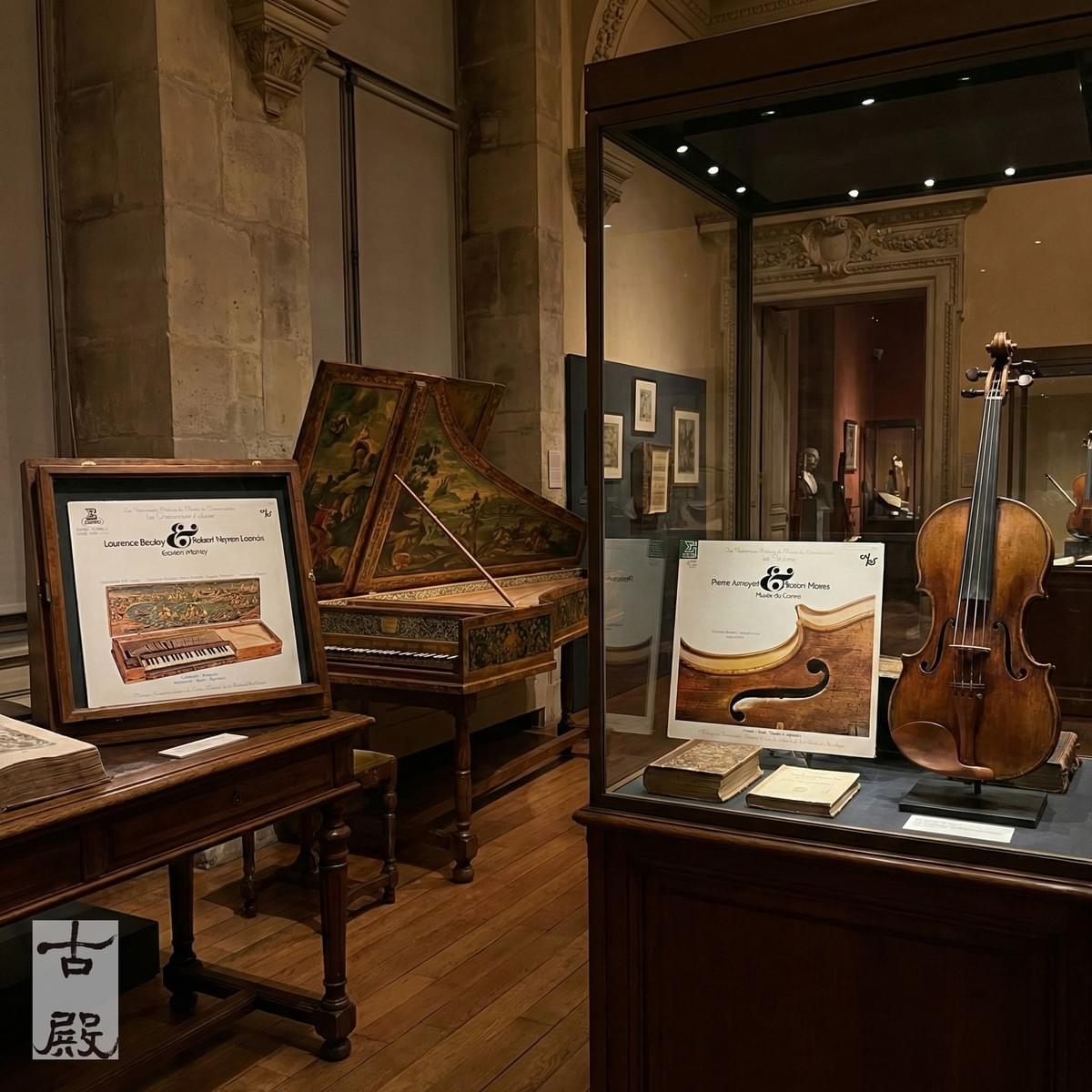
你知道嗎?大多數的歷史名琴,最後的歸宿都是博物館。這其實挺殘忍的。想像一下,一把為了歌唱而誕生的史特拉第瓦里(Stradivarius),最後卻被鎖在冰冷的玻璃櫃裡,變成了編號 E.1111 或 E.1730。它依然美麗,但它「死」了,因為它不再振動,不再呼吸。
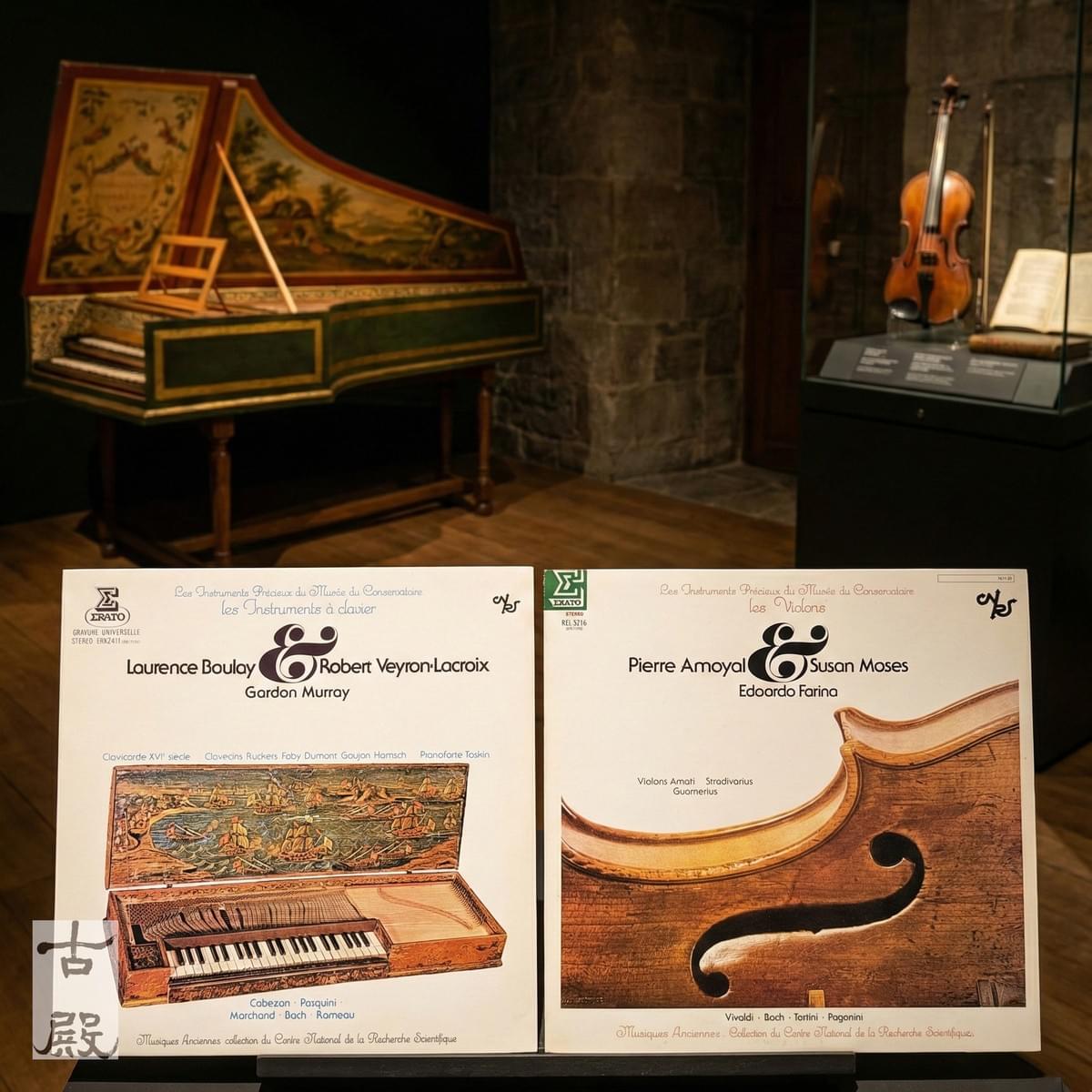
但這兩張唱片——《名器的響聲:小提琴》與《名器的響聲:鍵盤樂器》,背後是一件讓歷史名琴復活的行動。
1976-1977年,法國巴黎音樂學院歷史博物館館長尚比爾夫人(Madame de Chambure,1902-1975)。她不甘心這些樂器只是博物館的靜態「傢俱」。她說:「這些樂器必須回到音樂的本源。」於是,她聯合法國國家科學研究中心(CNRS)和 Erato 唱片公司,把這些沈睡了兩三百年的「睡美人」叫醒,修復它們,然後找來法國當代最好的演奏家,演奏錄下了這些聲音。
這兩張唱片,就是那次「喚醒歷史靈魂儀式」的紀錄。
為什麼這兩張唱片能讓「長岡鐵男」瘋狂?
在我們進入音樂之前,我要先提到一個人:日本的音響之神,長岡鐵男(1926-2000)。
玩音響的人都知道,長岡鐵男有一份「外盤 A 級榜」。這份榜單不是選好聽的音樂,而是選「真」的聲音。長岡鐵男這輩子只在乎一件事:
「閉上眼睛,那裡有沒有一個活人?」
這兩張唱片,就是長岡鐵男的摯愛。
為什麼?
因為這兩張錄音沒有任何後期修飾,沒有加味精。錄音師 Yolanta Skura 就像一個誠實的紀錄片導演(她後來在1990年成立傳奇Opus 111唱片公司,自己當製作人與錄音師),她把麥克風架在那裡,捕捉的不只是樂譜上的音符,還有琴弦摩擦的松香粉末感、大鍵琴撥子勾動琴弦的瞬間,甚至是演奏者的呼吸聲、空氣在古老木頭箱體裡共鳴的殘響。這張是Yolanta Skura 早期在法國 Erato 擔任錄音師的傑作。
但當你聽這張黑膠時,你的聽覺會突然「看見」東西。你看見那把琴的木紋,看見演奏者阿莫亞(Pierre Amoyal,1949-)眉頭深鎖的樣子。
第一張:小提琴家譜裡的「祖孫三代」
來,我們先把《小提琴的歷史名器》這張放上唱盤。唱針落下,第一個聲音出來時,你可能會驚訝:「這聲音怎麼這麼...溫柔?」
1. 溫柔的祖父:阿瑪蒂(Nicolo Amati, 1639)
這張唱片的第一軌,用的是一把 1639 年的阿瑪蒂。這是小提琴家族裡的「爺爺」。 你想想看,1639 年是什麼概念?那是明朝末年。這把琴不是為了現在這種幾千人的大音樂廳做的,它是為了貴族的客廳、為了沙龍做的。 阿瑪蒂的聲音,有一種非常有教養的甜味。它的音量不大,但穿透力很強,像是一個很有智慧的老紳士,不需要大吼大叫,輕聲細語就能說服你。演奏者用它來拉塔替尼(Tartini)的曲子,你會聽到那種「室內樂」特有的親密感,好像他就在你對面的一公尺處拉琴。
2. 完美的標準:史特拉第瓦里(Stradivari)
接下來,主角登場了。史特拉第瓦里是阿瑪蒂的學生,但他是一個革命家。唱片裡收錄了好幾把史特拉第瓦里,每一把都有自己的個性。 特別要聽的是那把 1699 年的「長型史特拉第(Longuet)」。這是年輕的史特拉第瓦里想搞點叛逆,故意把琴身做長了一點點(約 5-8mm)。結果呢?聲音變得修長、優雅。 還有一把叫「達維多夫(Le Davidoff)」,這是他全盛時期(1708年)的作品。它的漆是那種帶有血色的橘色,聲音豔麗、飽滿。當巴赫的無伴奏組曲響起時,你會明白為什麼後世三百年的製琴師都想模仿他,卻從來沒人能超越他。那是一種黃金比例的平衡,既強韌又優雅。
3. 疲憊的英雄:薩拉沙泰(Sarasate, 1724)
這張唱片裡有一個最讓我心疼的故事,就是那把叫「薩拉沙泰」的史特拉第瓦里。 這把琴曾經屬於那位偉大的小提琴家薩拉沙泰(就是創作《流浪者之歌》那位)。解說書裡寫得很感傷:「這把琴處於相當疲憊的狀態。」 為什麼?因為它被薩拉沙泰用了一輩子,經歷了無數的練習和演出。它的漆已經褪色,面板變薄,甚至有點承受不住現代音高的張力。 但在唱片裡,當它響起韋瓦第的音樂時,你會聽到一種「歷經滄桑的美」。它不像新的琴那麼衝,它的聲音裡有一種故事感,像是一個身上帶著舊傷的老兵,在火堆旁講述他當年的戰役。這就是歷史的重量。
4. 狂野的天才:瓜奈里(Guarneri del Gesu, 1742)
氣氛會突然變了,這是瓜奈里。 如果史特拉第瓦里是完美的模範生,瓜奈里就是那個不修邊幅的天才。他製作這把琴的時候已經是晚年(1742年),生活很潦倒,琴做得歪歪扭扭,刀痕都很明顯。 但是!當阿莫亞用這把琴拉巴赫的 G 小調奏鳴曲時,你會聽到一種充滿戲劇張力的聲音。它粗獷、深沈,有一種野性。難怪後來帕格尼尼(Paganini)最愛用瓜奈里,因為只有這種琴,才受得住那種魔鬼般的演奏。
第二張:鍵盤樂器的演化史
換第二張唱片:《鍵盤樂器的歷史名器》。這張稍微冷門一點,但對於「訓練聽覺感知力」來說,它甚至比小提琴更厲害。
1. 深夜的耳語:克拉維科德琴(Clavichord)
你聽第一軌,聲音非常非常小。這是克拉維科德琴。它是鋼琴很早期的祖先。 它的發聲原理很簡單,用一個金屬片去「擊打」琴弦。因為沒有複雜的共鳴箱,它的聲音小到幾乎只能給演奏者自己聽。 這就是我說的「深夜的音樂」。想像一下,一個十六世紀的夜晚,沒有電燈,只有蠟燭。你睡不著,坐在這台琴前面,輕輕彈奏。那個聲音不是要表演給誰看的,是跟自己的靈魂對話。 在黑膠系統上聽這一段,你要把心靜下來。你會聽到那種極其細微的強弱變化,那是手指直接觸摸琴弦的感覺。
2. 華麗的宮殿:大鍵琴(Harpsichord)
接著,聲音突然變得宏亮輝煌。大鍵琴登場了。 這裡有一個很有趣的「偵探故事」。博物館裡有一台標示為 1590 年漢斯·魯克斯(Hans Ruckers,大鍵琴界的史特拉第瓦里)製作的琴。大家都以為它是魯克斯做的。 結果,在 1968 年修復的時候,修復師拆開響板,竟然在背面發現了另一個簽名:「古戎(Goujon)」。 原來,這是一台 18 世紀的頂級仿冒品!但雖說是仿冒,古戎本身也是巴黎的大師。他做的這台琴聲音太好了,好到連專家都被騙了幾百年。 這張唱片收錄了這台「假魯克斯、真古戎」的聲音。它是用撥子去「撥」弦的,聲音像水晶一樣清脆,充滿了金屬的光澤。這是巴洛克宮廷的聲音,是路易十四的聲音,充滿了秩序和榮耀。
我們為什麼要聽這些?
聽到這裡,你可能會問我:「殿主,這些老古董跟我有什麼關係?我每天上班下班,累得像條狗,聽這些能幹嘛?」
這問題問得真好!
當你聽這兩張唱片時,你聽到的不只是音樂。 你聽到的是 300 年前的木頭在震動。 你聽到的是薩拉沙泰曾經用過的那把琴,在訴說它的疲憊。 你聽到的是阿瑪蒂那種優雅的堅持。 最重要的是:
你聽到了「真實」。
這兩張唱片之所以被長岡鐵男列為「外盤」,之所以被我這麼推崇,不是因為它們貴,而是因為它們:
沒有說謊。
這就像我們在「古殿」辦的活動一樣,不只是為了灌輸你知識,而是為了讓你找回狀態。 當你在這張黑膠的溝槽裡,聽見了那個 1716 年的空間感,你的大腦會從焦慮的「現在」抽離,回到一個長久的「時間當下」。
下一步你的儀式
有空的時候,來古殿一趟。我會把這兩張唱片拿出來,我們不要聊頻率響應,不要聊器材規格。 我們就做一件事:
關掉手機,閉上眼睛。
花三分鐘,調整呼吸,讓心跳穩下來。 然後,我會放下唱針。 我們一起去見見那位 1639 年的阿瑪蒂老爺爺,去聽聽那位疲憊的薩拉沙泰,去感受那個深夜裡的克拉維科德琴。
當音樂結束,你會發現,你不僅聽見了歷史,你也重新找回了那個安靜、真實的自己。
實體音樂 小提琴:
實體音樂 鍵盤樂器:
*******
[Gu Dian Music Stories] Smashing the Glass Case: Bringing Historic Instruments Back to Life
Following yesterday’s story about the first recording of a famous violin in history, today I want to share two more incredibly special vinyl records with you.
Did you know? The final resting place for most legendary instruments is usually a museum. To be honest, that’s actually quite cruel.
Imagine a Stradivarius—born to sing—locked away in a cold glass cabinet, turned into a catalog number like E.1111 or E.1730. It is still beautiful, yes, but it is "dead." It no longer vibrates; it no longer breathes.
However, the two albums I’m holding—The Sound of Historic Instruments: Violin and The Sound of Historic Instruments: Keyboard—are the result of a mission to bring these instruments back to life.
In the mid-70s, Madame de Chambure, the curator of the Paris Conservatory Museum, refused to let these instruments sit there as static "furniture." She said, "These instruments must return to the source of music." So, she teamed up with the French National Centre for Scientific Research (CNRS) and Erato Records to wake up these "Sleeping Beauties" that had been slumbering for two or three hundred years. They restored them and invited the best musicians in France to play them.
These records are the documentation of that "Resurrection Ritual."
Why Did "Nagaoka Tetsuo" Go Crazy for These Records?
Before we drop the needle, I need to mention a specific person: Nagaoka Tetsuo (1926-2000), the "God of Audio" in Japan.
Audiophiles know that Nagaoka had a list of "A-List Imported Records." This list wasn't about choosing "pretty" music; it was about choosing "Real" sound. Nagaoka only cared about one thing his entire life:
"When you close your eyes, is there a living human being there?"
These two albums were Nagaoka’s absolute favorites. Why?
Because the recording engineer, Yolanta Skura, acted like an honest documentary filmmaker. She didn’t add any "MSG" (artificial flavoring) or post-production polish. She placed the microphones there to capture not just the notes on the sheet music, but the powder of the rosin falling from the strings, the click of the harpsichord mechanism, the breathing of the player, and even the air swirling inside the old wooden bodies of the instruments.
When you listen to this vinyl, your ears suddenly "see" things. You see the wood grain of the violin; you see the furrowed brow of the young violinist, Pierre Amoyal.
Record 1: Three Generations of the Violin Family
Come, let’s put The Sound of Historic Instruments: Violin on the turntable. When the needle drops and the first sound emerges, you might be surprised: "Why is this sound so... gentle?"
1. The Gentle Grandfather: Amati (Nicolo Amati, 1639) The first track features an Amati from 1639. Think of this as the "Grandpa" of the violin family. 1639... that was the end of the Ming Dynasty in China! This violin wasn’t made for the giant concert halls of today; it was made for a noble’s living room, for a salon. Amati’s voice has a very educated, sweet tone. It isn't loud, but it pierces through to your heart. It’s like a wise old gentleman who doesn't need to shout; he convinces you with a whisper. It sounds so intimate, like the musician is standing just one meter away from you.
2. The Perfect Standard: Stradivari Next, the protagonist enters. Stradivari was Amati’s student, but he was a revolutionary. The album features several of his violins, each with a distinct personality.
The "Longuet" (1699): Young Stradivari wanted to be rebellious, so he made the body a tiny bit longer. The result? A sound that is slender and elegant.
The "Davidoff" (1708): Made during his golden era. The varnish is a bloody orange color, and the sound is glamorous and full. When Bach’s suites play, you realize why makers for the last 300 years have tried to copy him but never beat him. It’s the Golden Ratio—strong yet elegant.
3. The Weary Hero: Sarasate (1724) There is a story on this record that breaks my heart. It’s about a Stradivarius named "Sarasate." It once belonged to the legendary violinist Sarasate (the one who wrote Zigeunerweisen). The liner notes say something sad: "This instrument is in a state of exhaustion." Why? Because Sarasate used it his whole life. It endured endless practice and performances. The varnish has faded, the wood has thinned, and it struggles to handle the high tension of modern tuning. But, when it plays Vivaldi, you hear a "weathered beauty." It isn't as aggressive as a new violin. Its voice holds a story, like an old soldier sitting by a fire, recounting his past battles. This is the weight of history.
4. The Wild Genius: Guarneri (del Gesu, 1742) Suddenly, the atmosphere changes. This is Guarneri. If Stradivari is the perfect model student, Guarneri is the unkempt genius. He made this violin in his final years, living in poverty. The craftsmanship looks crooked, and knife marks are visible. But! When Amoyal plays Bach on it, you hear a sound full of dramatic tension. It’s rough, deep, and wild. No wonder Paganini loved Guarneri later on—only a violin like this could handle his devilish playing.
Record 2: The Evolution of Keyboards
Let’s swap to the second record: The Sound of Historic Instruments: Keyboard. This one is a bit more niche, but for "Perception Training," it’s even more powerful than the violin.
1. A Midnight Whisper: Clavichord Listen to the first track. The sound is tiny, very quiet. This is the Clavichord, a distant ancestor of the piano. It makes sound by striking the string with a metal blade. Because it lacks a complex resonance box, the sound is so small it’s almost meant only for the player’s ears. This is "Midnight Music." Imagine a night in the 16th century—no electric lights, just a candle. You can't sleep, so you sit at this instrument and play softly. You aren't performing for anyone; you are talking to your own soul. You have to quiet your heart to hear the subtle changes in volume—that is the feeling of fingers directly touching the strings.
2. The Magnificent Palace: Harpsichord Suddenly, the sound becomes bright and grand. The Harpsichord enters. There is a funny "detective story" here. The museum had an instrument labeled as a 1590 "Hans Ruckers" (the Stradivari of harpsichords). Everyone thought it was real. However, during a 1968 restoration, they took it apart and found a different signature hidden inside: "Goujon." It turns out, this was a top-tier 18th-century fake! But even as a fake, Goujon was a master in Paris. The sound was so good it fooled experts for centuries. This record captures that "Fake Ruckers, Real Goujon" sound. It plucks the strings, sounding crisp like crystal with a metallic shimmer. This is the sound of the Baroque court, the sound of Louis XIV—full of order and glory.
Why Should We Listen to This?
You might be asking me: "Owner, what does this old antique stuff have to do with me? I work all day and come home tired as a dog. What’s the point?"
That is a great question.
When you listen to these two records, you aren't just hearing music. You are hearing wood from 300 years ago vibrating. You are hearing the violin that Sarasate used, whispering its exhaustion. You are hearing Amati’s elegant persistence. Most importantly, you are hearing "Truth."
I recommend these records not because they are rare or expensive, but because they do not lie.
This is exactly like what we do at Gu Dian. We aren't here to lecture you on knowledge; we are here to help you recover your "state of being." When you are deep in the grooves of this vinyl, hearing the spatial atmosphere of 1716, your brain detaches from the anxious "Now" and returns to a timeless "Present."
Your Next Ritual
When you have time, come visit Gu Dian. I’ll pull these two records out.
We won’t talk about frequency response. We won’t talk about equipment specs. We will do just one thing: Turn off our phones and close our eyes.
We will spend three minutes adjusting our breathing to steady our heartbeats. Then, I will drop the needle.
We will go meet Grandpa Amati together. We will listen to the weary Sarasate. We will feel the midnight whisper of the Clavichord.
And when the music ends, you will find that you haven't just heard history—you have rediscovered that quiet, real version of yourself.