
在世界毀滅的前一秒,我們按下了錄音鍵:二戰前維也納的「最後一口氣」~~1938年馬勒第九號交響曲的世界首次錄音
古殿殿主
如果上一篇是關於馬勒與華爾特的「繼承」,那麼這一篇,就是關於「搶救」。
歡迎回到1938年的維也納。
二十六年的等待:不可能的任務
自從1912年,華爾特強忍著悲痛,代替剛過世的恩師馬勒指揮了《第九號交響曲》的世界首演後,他就像個苦行僧一樣,把推廣馬勒的音樂當成了自己一生的十字架。
接下來的二十幾年裡,他的成就非常耀眼。他當過慕尼黑、柏林、萊比錫各大樂團的總監,甚至接下了馬勒生前坐過的大位——維也納國家歌劇院藝術總監。他跟當時樂壇的神主牌托斯卡尼尼、福特萬格勒齊名,是薩爾茨堡音樂節的核心靈魂。
但有趣的是,華爾特的個性和馬勒完全相反。馬勒在排練時是個出了名的「專制暴君」,脾氣一來雷霆萬鈞;但華爾特卻是個出奇溫和的人,他像個充滿耐心的老師,總是用溫暖、引導的方式帶領樂團。這其實很顛覆我們的直覺:
我們總以為要成就偉大,就必須展現出強勢與霸氣;但華爾特卻用他一貫的溫柔,扛起了最沉重的傳承。
可是,就算華爾特已經是世界頂尖的大指揮家,要在當時錄製馬勒的《第九號交響曲》,簡直是天方夜譚。
這首曲子就像一座險峻的高山。它編制太龐大、情緒太複雜,而且當時的蟲膠唱片容量很小,要錄完整首曲子,成本高得嚇人。對唱片公司來說,這根本是「票房毒藥」,連碰都不想碰。
一場原本「不可能發生」的賭局:蓋斯伯格的搶救行動
從 1912 年的首演,到 1938 年這份世界首次錄音,中間整整隔了漫長的二十六年。
在這二十六年間,華爾特苦心孤詣地推廣恩師的作品,但《第九號交響曲》的演出機會依然非常稀少。蓋斯伯格(Fred Gaisberg,1873-1951)點出了現實的殘酷:「這部作品太困難了,永遠不可能在錄音室中錄製,因為它需要無數次的排練和一個龐大的管弦樂團。同樣的原因,它也很少出現在音樂會的節目單上。」
你想想,連湊齊人馬「演出」都幾乎不可能了,更何況還要砸大錢「錄音」?
在1938年的唱片市場,錄製馬勒第九號根本是商業上的自殺行為。當時大眾普遍認為馬勒的音樂「冗長、神經質、結構鬆散」,唱片公司高層隨便撥個算盤都知道,這絕對是一筆賠錢的爛帳。
但蓋斯伯格面對這個「不可能的任務」,卻做了一個顛覆常理的決定。那時的他,其實已經準備要在隔年(1939年)退休了。身為資深總監,他大可舒舒服服地打個安全牌,漂亮下莊。但他卻幾乎拿自己一生的職業生涯當賭注,跑到高層辦公室去「抗命」,死命地爭取:
「我們必須去維也納,把華爾特指揮的馬勒第九號錄下來!」
蓋斯伯格會算命嗎?他當然不知道幾個月後德奧就會合併,納粹會徹底摧毀那個優雅的維也納。但他有一種極度敏銳的直覺,他嗅到了空氣中那股越來越濃的硝煙味與不安。他心裡有個聲音不斷催促著:如果現在不錄,這首偉大作品的某種「靈魂」,可能就永遠消失了。
對他來說,這根本不是商業發行,這是一場不折不扣的「歷史搶救行動」。
預算的妥協與沒有回頭路的「真實感」
為了解決經費問題,蓋斯伯格只拿到了一筆少得可憐的預算。HMV高層開出了一個嚴苛的條件:「為了省錢,你只能去錄現場音樂會(Live)。」
在現在,現場錄音聽起來很熱血;但在當時,這可是技術人員的噩夢。因為現場不能喊卡,台下觀眾咳嗽、樂手不小心出錯,全都會被刻進唱片裡。但蓋斯伯格別無選擇,這是唯一的機會。他在 1944 年的回憶文章中寫道:
「我建議留聲機公司應該在維也納老音樂協會舉行的一場演出中錄製完整的交響曲......由布魯諾·華爾特——與馬勒的直接聯繫——擔任指揮。」
這份妥協,反而造就了這張唱片最無可取代的價值。 這意味著,我們現在聽到的每一個音符,都是「沒有回頭路」的一次性演出。
1938年的極限挑戰:埋在地下的電纜與「4分鐘生死交接」
讓我們先來看看這場瘋狂錄音的「履歷表」:
- 日期: 1938年1月15日(樂團排練與錄音技術測試),1月16日(現場實況錄音)
- 地點: 維也納音樂協會金色大廳(Musikvereinssaal)
- 指揮與樂團: 布魯諾·華爾特 / 維也納愛樂管弦樂團
- 製作人: 弗雷德·蓋斯伯格
- 總時長: 約71分鐘
- 唱片載體: 10張20面78轉蟲膠唱片
這場錄音的技術設置,本身就是一場驚心動魄的諜報片。
蓋斯伯格團隊沒有現在那種舒舒服服、隔音完美的控制室。他們在金色大廳的一個小房間裡,架設了兩台笨重的刻片機。為了順利收音,技術人員必須像間諜一樣,偷偷把麥克風的電纜藏在舞台裝飾底下,一路牽到後台。
當時的78轉蟲膠唱片,一面最多只能錄4到4.5分鐘。要錄完70多分鐘的巨作,兩台刻片機必須像大隊接力一樣輪流工作(Overlap)。
你可以想像那個畫面嗎?一位工程師死盯著樂譜讀秒,當音樂進行到大約 4 分鐘時,他必須精準給出暗號,另一位工程師瞬間啟動第二台機器。切換慢了,音樂就會硬生生斷掉;切得太快,又會浪費寶貴的蠟盤空間。如果你現在仔細聽這張唱片的某些段落轉換處,你會明顯感受到樂團的氣息帶著一種「急促感」——因為所有人都知道,他們正在跟時間賽跑,搶下歷史的見證。
坐在定音鼓旁的製作人:見證大師的燃燒
這場極限挑戰中,資深工程師查理·格雷戈里(Charlie Gregory,1880-1946)守著一個「開關控制箱」,旁邊還跟著一位懂總譜的音樂家,隨時警告他避開「陷阱」:比如定音鼓突然的重擊,或是極端的強弱音轉換。工程師甚至得在每個樂章結束、觀眾掌聲爆發的前一秒,完美切斷電流。
而身為製作人的蓋斯伯格呢?他並沒有躲在安全的後台。
他做了一個特殊的決定:他擠進了舞台上樂團的「定音鼓」區最頂端的角落,直接面對著指揮台上的華爾特。
蓋斯伯格回憶:「這是一次大膽的冒險。當時馬勒的交響曲在唱片目錄中幾乎是一片空白......但我深知,除華爾特之外,當今世上沒有任何人能如此權威地詮釋這部作品。」
坐在那個被巨大聲浪包圍的角落裡,蓋斯伯格清楚地看見了華爾特臉上的每一絲神情。他親眼見證了這位平時溫和的大師,如何像著了魔般,帶著一種嚴峻的決心,用盡全身最後一絲力氣,將生死掙扎的悲劇力量從樂團中擰出來。他看著華爾特燃燒自己,只為了在世界毀滅前,將馬勒的音符永遠刻印下來。
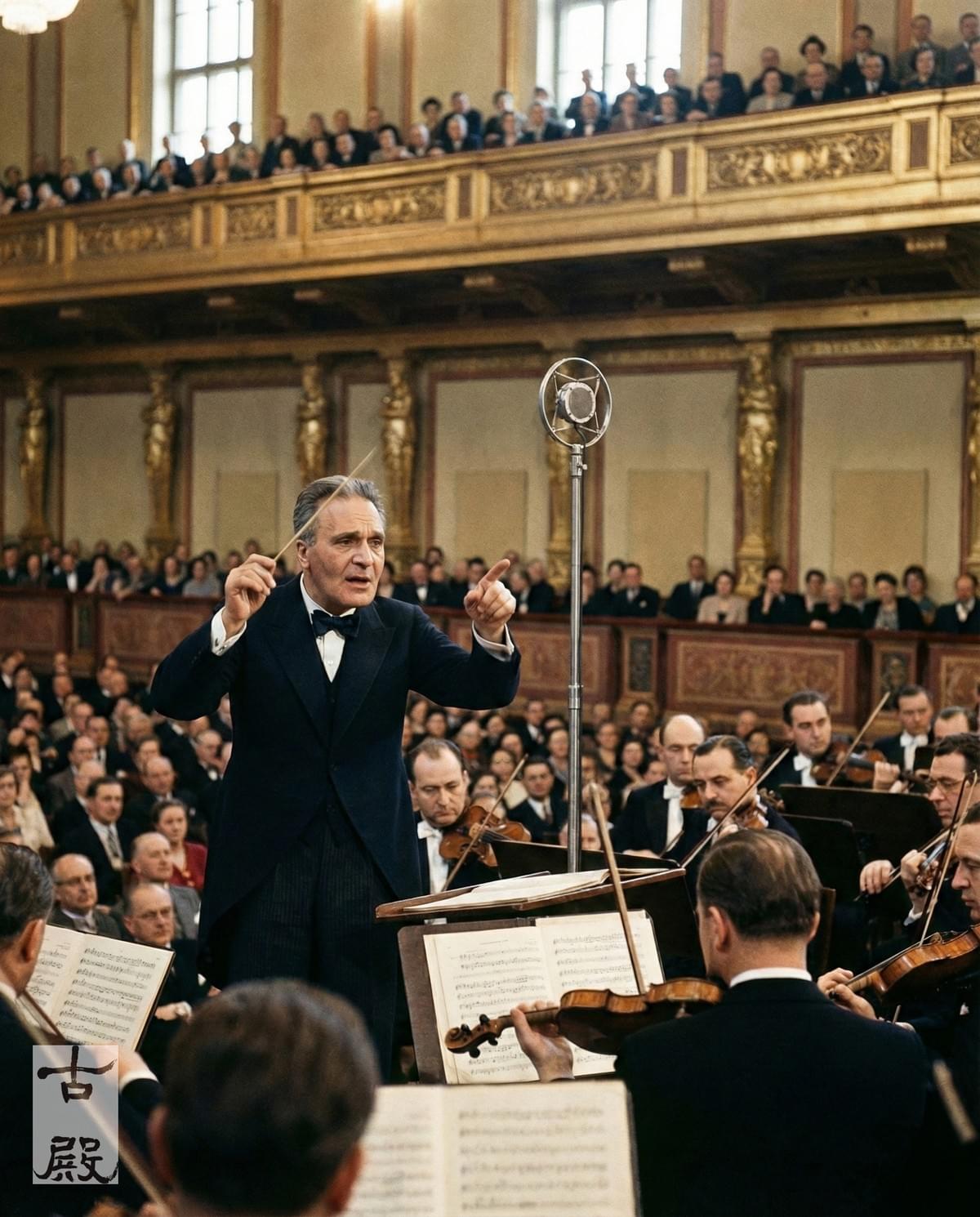
在絕望中擠出的最後一絲和諧:撕裂的維也納愛樂
如果你剛剛已經在腦海中,想像了那個在地下室拉著電纜、跟時間賽跑的窒息感;現在,我想請你把目光移回到舞台上。
因為在那些冰冷的錄音設備之上,正在上演的,是人類歷史上最痛心、也最不可思議的人性衝突。
台上的100個人,心已經不在同一個世界了
我們通常對「交響樂團」的直覺是什麼?是一群默契十足、心靈相通的音樂家,共同為了完美的和聲而努力,對吧?
但在 1938 年 1 月的維也納金色大廳,台上的這 100 位音樂家,心早就已經被撕裂了。 那時,納粹的毒素已經深深滲透進維也納愛樂。樂團裡有一半的人是納粹的支持者,他們甚至偷偷在西裝翻領底下,別上了當時還算非法的納粹「卐」字徽章。你可以想像嗎?他們就這樣冷眼看著站在指揮台上、身為猶太人的華爾特。
而樂團的另一半,是猶太裔的樂手。他們坐在自己的位子上,心裡充滿了無盡的恐懼,因為每一天的空氣都在告訴他們:這可能是我這輩子最後一次坐在這裡演出了。
其中最讓人心碎的,是坐在第一小提琴首席位置上的阿諾·羅塞(Arnold Rosé,1863-1946)。他不只是樂團的支柱,他還是馬勒的親妹婿。幾個月後,他的女兒就會被納粹逮捕,最終死在集中營裡;而他自己,也只能倉皇流亡到倫敦。這張1938年的唱片,錄下了這位傳奇小提琴家最後、也最輝煌的琴音。
這是一個充滿仇恨、恐懼與對立的舞台。但奇蹟發生了。
蓋斯伯格在筆記裡感嘆,儘管這些團員在台下政治立場敵對,甚至私底下根本互不交談;但是,當華爾特手中的指揮棒一揮下,當馬勒的音符流淌出來的那一刻,音樂強迫他們「暫時忘記了仇恨」。
那種整齊劃一的弦樂音色,不是出自於彼此相愛,而是一種「絕望中的團結」。這是多麼令人震撼的「人味」?在世界即將毀滅的前一秒,這群立場撕裂的人,依然用盡全力,共同撐起了一個偉大藝術的最後尊嚴。
偷運出境的「最後的聲音」與沒有慶功宴的最後晚餐
這場耗盡所有人氣力的錄音,沒有帶來任何歡慶。
你可以想像,如果是現代完成了一項如此艱鉅的企劃,錄音結束後大家一定會開香檳、吃頓豐盛的慶功宴。但那天晚上,什麼都沒有。
錄音結束後,華爾特對著製作人蓋斯伯格表達了深深的感激,但神情卻無比凝重。在華爾特後來寫的回憶錄《主題與變奏》中,他把這段日子稱為「奧地利的沉沒」(Untergang Österreichs)。雖然這幾年維也納給了他短暫的避風港,但他心裡比誰都清楚,暴風雨就要來了。這場錄音,就是他對這座音樂之都最後的「告別」。
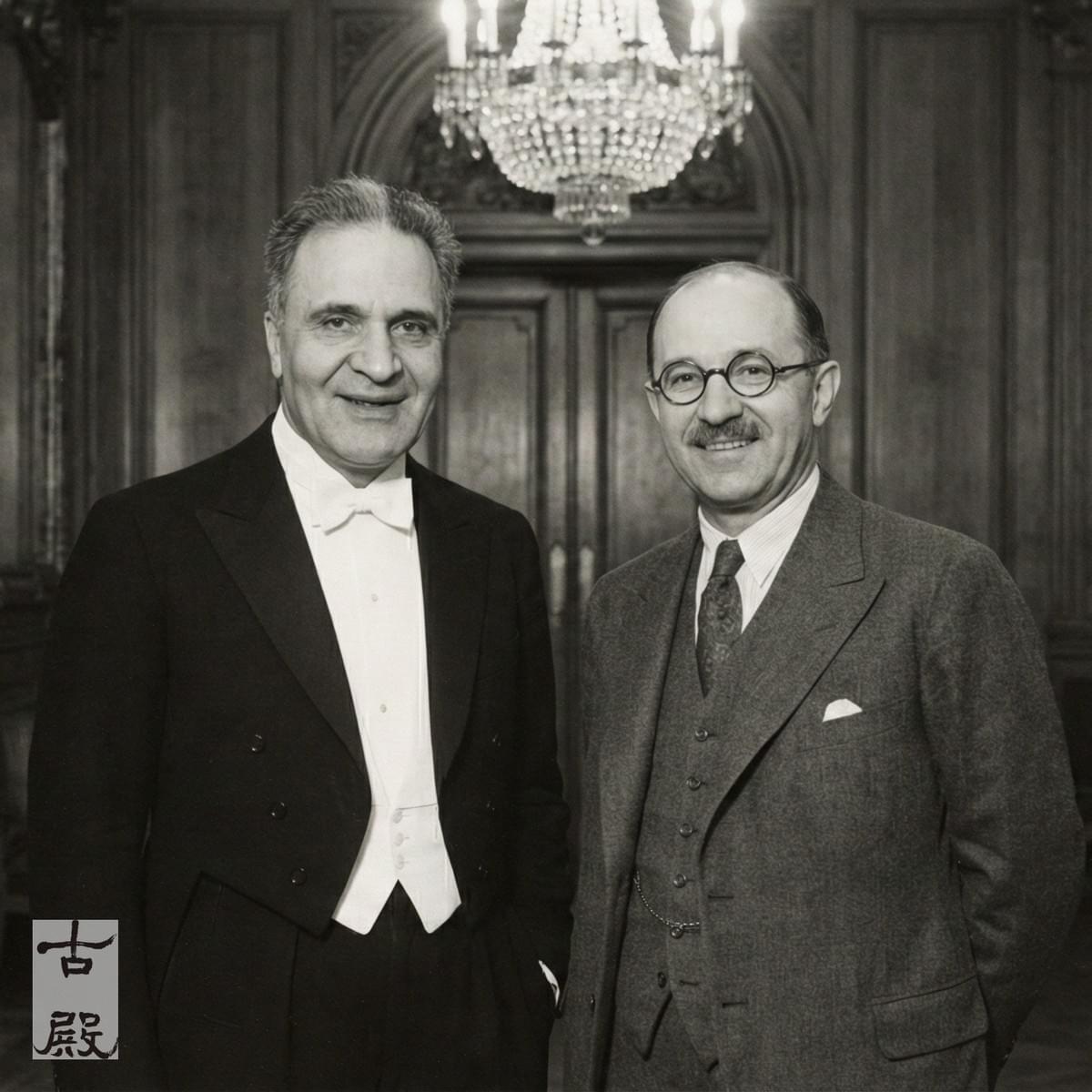
蓋斯伯格後來回憶,當他看著華爾特轉身離開金色大廳那疲憊的背影時,心裡湧上了一股強烈的預感:
「我可能再也見不到這個維也納了。」
基於這個直覺,蓋斯伯格做了一個極度果斷的決定。他不等了。那些剛剛刻好、沉甸甸的蠟盤母片,連夜透過英國的外交豁免管道,像走私一樣從瑞士輾轉偷運回了英國的工廠。
這是一個救命的決定。
因為就在這場錄音結束短短兩個月後,1938年3月,納粹全面接管維也納。所有跟馬勒有關的資料、樂譜,都被當成「墮落藝術」給無情銷毀。如果當天蓋斯伯格把那些母盤留在維也納慢慢處理,它們絕對會被砸得粉碎。
原來,蓋斯伯格做的不只是錄音,他是在納粹的眼皮底下,把維也納的「最後一口氣」,給硬生生偷運出境。
那麼,華爾特是什麼時候才終於聽到這份錄音的呢?
是在一段時間之後流亡到巴黎。蓋斯伯格帶著在英國壓製好的試聽片,親自跑了一趟巴黎,放給已經成為流亡者的華爾特聽。
錄音完成後僅八週,即1938年3月12日至13日,納粹德國吞併了奧地利(德奧合併,Anschluss)。這一事件徹底改變了歐洲的政治格局,也改變了華爾特的人生。
蓋斯伯格寫道:
「華爾特以一個困惑的難民身份出現在巴黎,我在那裡與他見面,播放並獲得他對錄製的交響曲的批准……他對結果如此滿意,以至於他通常嚴肅的臉龐明顯亮了起來。」
然而,華爾特後來在1954年給RCA Victor的總經理喬治·馬雷克(George Marek,1902-1987)的信中承認:
「你會注意到這次錄音的音樂和技術缺陷。1938年3月奧地利發生的動蕩政治事件極大地干擾了我專注於轉發給我的測試壓片的優點,使我難以做出明確的批准或不批准。」
儘管如此,這次錄音還是於1939年由HMV發行。這是馬勒《第九號交響曲》的首次商業錄音,也是華爾特與維也納愛樂管弦樂團為HMV錄製的最後一張唱片。
對歷史巨變的感觸~~前後「兩個世界」的斷裂
華爾特在回憶錄中多次對比了1938年以前充滿文化底蘊的歐洲,與納粹掌權後「野蠻入侵文化」的慘狀。他對維也納的告別,不僅是地理上的離開,更是精神上與一個美好時代的永別。他提到這種「強迫的流亡」雖然痛苦,但也讓他與法國、荷蘭(阿姆斯特丹)以及後來的美國建立了更深的連結 。
在美國的新生活
1939年,華爾特全家遷往美國洛杉磯,在比弗利山莊定居。他在美國繼續指揮馬勒的作品,並在1940年代成為美國公民。
在美國,華爾特成為馬勒音樂最重要的推廣者之一。他與紐約愛樂、NBC交響樂團等樂團合作,多次演出馬勒的作品。1957年,他創立了「洛杉磯愛樂音樂節」(Los Angeles Philharmonic Mahler Festival),這是美國首次完整的馬勒交響曲系列演出。
1961年華爾特與哥倫比亞交響樂團錄下歷史首次立體聲錄音的馬勒第九號交響曲。
華爾特在回憶錄中指出,他的1938年世界首次錄音比1961年的立體聲錄音快了約11分鐘,而更接近1912年世界首演時約1小時13分鐘的演奏長度。
這種較快的速度被評論家描述為「白熱的火焰」和「熾熱的強度」。特別是在輪旋曲-諷刺曲中,「樂團演奏得好像他們的集體生命危在旦夕」。
相比之下,1961年的哥倫比亞交響樂團錄音(立體聲)更加精緻,管弦樂演奏更加精湛,但情感強度稍遜。
這兩個版本代表了華爾特對這部作品的不同理解:1938年的版本是「活著的歷史見證」,而1961年的版本是「回顧一生的沉思」。
*******
【古殿歷史名曲音樂喫茶第40場:邀你開啟黑盒子】
這2月27日週五晚上,古殿將帶你重回那個驚心動魄的歷史現場。
我們不聽音效,我們聽歷史。 我們不聽演奏,我們聽見證。
當音樂響起,請閉上眼。你會發現,你聽到的不只是馬勒的遺囑,還有華爾特在暴風雨前,為全人類留下的一份關於「愛」的證明。
【活動資訊:見證歷史的聲音】 古殿歷史名曲音樂喫茶|第40場:布魯諾·華爾特 (Bruno Walter) 之夜
特別收錄: 現場將實體播放1938年馬勒第九號交響曲世界首次錄音
時間: 2026年2月27日 (週五) 19:30 - 21:00
地點: 古殿樂藏 (台北市北投區西安街一段169號2樓)
費用: 600元 (含精緻咖啡飲品)
席位: 僅限 10 位 (請填表單報名,表單在留言中)
(「古殿歷史名曲音樂喫茶」是台灣目前唯一固定舉辦此類深度歷史聆聽活動的空間。)
👉 立即預約您的時空席位 (需匯款確認):
*******
Pressing Record a Second Before the World Ended: The "Last Breath" of Pre-WWII Vienna — The 1938 World Premiere Recording of Mahler's Symphony No. 9
If the previous article was about the "inheritance" between Mahler and Bruno Walter, then this one is about a "rescue mission."
Welcome back to Vienna in 1938.
A 26-Year Wait: Mission Impossible Ever since 1912, when a grieving Bruno Walter stepped in to conduct the world premiere of the Symphony No. 9 in place of his recently deceased mentor, Gustav Mahler, he carried the promotion of Mahler’s music like a lifelong cross, much like an ascetic monk.
Over the next two decades, his achievements were dazzling. He served as the music director for major orchestras in Munich, Berlin, and Leipzig, and even took up the prestigious mantle once held by Mahler himself—Artistic Director of the Vienna State Opera. He stood shoulder-to-shoulder with the conducting gods of his time, Arturo Toscanini and Wilhelm Furtwängler, and was the core soul of the Salzburg Festival.
But interestingly, Walter's personality was the exact opposite of Mahler’s. While Mahler was a notoriously "authoritarian tyrant" in rehearsals, unleashing thunder and lightning when his temper flared, Walter was surprisingly gentle. Like a remarkably patient teacher, he always led the orchestra with warmth and guidance. This actually subverts our intuition: we often assume that achieving greatness requires dominance and an aggressive aura, but Walter shouldered the heaviest of legacies with his consistent gentleness.
However, even though Walter was already one of the world's top conductors, the idea of recording Mahler's Symphony No. 9 back then was little more than a fantasy.
The piece was like a treacherous mountain. Its orchestration was too massive, its emotional landscape too complex, and the capacity of shellac records at the time was extremely limited. Recording the entire symphony would incur terrifying costs. To record companies, it was sheer "box office poison" that they didn't even want to touch.
A Gamble That Was "Impossible": Gaisberg's Rescue Mission From its premiere in 1912 to this world-first recording in 1938, a long twenty-six years had passed.
Throughout these twenty-six years, Walter painstakingly promoted his mentor's work, yet performances of the Ninth Symphony remained exceptionally rare. Fred Gaisberg (1873-1951), the legendary HMV producer, pointed out the cruel reality: "This work is difficult, and could never be recorded in a studio, because it requires numerous rehearsals and a massive orchestra. For the same reason, it rarely appears on concert programs."
Think about it: if simply gathering the musicians for a "performance" was almost impossible, let alone pouring massive amounts of money into a "recording"?
In the 1938 record market, recording Mahler's Ninth was commercial suicide. At the time, the general public considered Mahler's music "lengthy, neurotic, and loosely structured." Any record company executive running the numbers knew it was an absolute money-loser.
Yet, facing this "mission impossible," Gaisberg made an entirely unconventional decision. At the time, he was actually preparing to retire the following year (1939). As a senior director, he could have comfortably played it safe and bowed out gracefully. Instead, he virtually wagered his entire career, storming into the executives' offices to "defy orders" and fight tooth and nail:
"We must go to Vienna and record Walter conducting Mahler's Ninth!"
Was Gaisberg a fortune teller? He certainly didn't know that just months later, the Anschluss would happen, and the Nazis would utterly destroy that elegant Vienna. But he possessed an extremely sharp intuition; he smelled the increasingly thick scent of gunpowder and unease in the air. A voice inside him kept urging: If we don't record this now, the very "soul" of this magnificent work might vanish forever.
For him, this wasn't a commercial release at all. It was, without a doubt, a "historical rescue mission."
Budget Compromises and the "Authenticity" of No Return To solve the funding issue, Gaisberg was granted a pitifully small budget. The HMV executives gave him a harsh ultimatum: "To save money, you can only record a live concert."
Today, a live recording sounds thrilling; but back then, it was a technical nightmare. Because you couldn't yell "cut" during a live show, every cough from the audience and every mistake from a musician would be permanently etched into the record. But Gaisberg had no choice—this was his only window. As he wrote in a 1944 memoir:
"I suggested that the Gramophone Company should record the complete symphony during a performance at the old Musikverein in Vienna... conducted by Bruno Walter—the direct link to Mahler."
This compromise, however, forged the irreplaceable value of this record. It means that every single note we hear today is a one-off performance with "no turning back."
The Extreme Challenge of 1938: Underground Cables and the "4-Minute Life-or-Death Handover" Let's first look at the "resume" of this insane recording:
Dates: January 15, 1938 (orchestra rehearsal and recording technical tests), January 16 (live concert recording)
Location: Golden Hall of the Musikverein, Vienna (Musikvereinssaal)
Conductor & Orchestra: Bruno Walter / Vienna Philharmonic Orchestra
Producer: Fred Gaisberg
Total Duration: Approx. 71 minutes
Format: Ten 78-rpm shellac records (20 sides)
The technical setup for this recording was a thrilling espionage movie in itself.
Gaisberg's team didn't have the comfortable, perfectly soundproofed control rooms of today. They set up two bulky cutting lathes in a small room inside the Golden Hall. To capture the sound successfully, the technicians had to act like spies, secretly hiding the microphone cables under the stage decorations and routing them all the way backstage.
A 78-rpm shellac record of that era could only hold a maximum of 4 to 4.5 minutes per side. To record a 70-plus-minute epic, the two cutting lathes had to work in an overlapping relay race.
Can you picture the scene? An engineer sweating as he stares at the score, counting the seconds. When the music reaches the 4-minute mark, he must give a precise signal, and the second engineer instantly fires up the other machine. Switch too slowly, and the music abruptly cuts out; switch too fast, and you waste precious space on the wax disc. If you listen closely to the transitions in certain passages of this record today, you can distinctly feel a sense of "urgency" in the orchestra's breath—because everyone knew they were racing against time to capture history.
The Producer Beside the Timpani: Witnessing the Maestro Burn During this extreme challenge, senior engineer Charlie Gregory (1880-1946) manned a "switch control box," accompanied by a musician reading the full score to warn him of impending "traps"—such as sudden timpani strikes or extreme dynamic shifts. The engineer even had to perfectly cut the current at the end of every movement, a split second before the audience's applause erupted.
And what about Gaisberg, the producer? He wasn't hiding in the safety of the backstage area.
He made a highly unusual decision: he squeezed himself into the highest corner of the orchestra's timpani section right on the stage, directly facing Walter on the podium.
Gaisberg recalled: "It was a bold adventure. At the time, Mahler's symphonies were virtually a blank page in the record catalogs... But I knew deeply that, aside from Walter, no one alive could interpret this work with such authority."
Sitting in that corner engulfed by massive waves of sound, Gaisberg clearly saw every nuance on Walter's face. He witnessed firsthand how this usually mild-mannered maestro worked like a demon, carrying a grim determination, wringing the tragic power of life-and-death struggles out of the orchestra with every last ounce of his strength. He watched Walter burn himself out, solely to forever engrave Mahler's notes before the world ended.
The Last Ounce of Harmony Squeezed from Despair: The Torn Vienna Philharmonic If you have just imagined the suffocating tension of pulling cables in the basement and racing against time, now, I want you to shift your gaze back to the stage.
Because hovering above those cold recording devices was the most heartbreaking and unimaginable human conflict in history.
100 People on Stage, Hearts No Longer in the Same World What is our usual intuition about a "symphony orchestra"? A group of highly synchronized, spiritually connected musicians, working together for perfect harmony, right?
But in the Golden Hall of Vienna in January 1938, the hearts of the 100 musicians on stage had long been torn apart.
By then, the poison of Nazism had deeply infiltrated the Vienna Philharmonic. Half of the orchestra were Nazi sympathizers; they had even secretly pinned the then-still-illegal Nazi swastika badges under their suit lapels. Can you imagine it? They sat there, looking coldly at the Jewish conductor on the podium.
The other half of the orchestra consisted of Jewish musicians. They sat in their seats, their hearts filled with endless dread, because the air every single day was telling them: This might be the last time in my life I sit here and perform.
The most heartbreaking among them was Arnold Rosé, sitting in the concertmaster's chair. Not only was he the pillar of the orchestra, but he was also Mahler's brother-in-law. A few months later, his daughter would be arrested by the Nazis and ultimately perish in a concentration camp; he himself would be forced into a frantic exile to London. This 1938 record captured the final, most glorious tone of this legendary violinist.
It was a stage brimming with hatred, fear, and antagonism. But a miracle happened.
Gaisberg marveled in his notes that even though these musicians were politically hostile off-stage and barely spoke to one another in private, the moment Walter's baton came down and Mahler's notes began to flow, the music forced them to "temporarily forget their hatred."
That remarkably unified string tone did not stem from mutual love, but from a "unity in despair." What a profoundly staggering display of "humanity"? A second before the world was destroyed, this deeply divided group of people still gave everything they had to collectively uphold the final dignity of a great work of art.
Smuggling the "Last Sound" and a Last Supper Without Celebration This exhausting recording session, which drained every ounce of everyone's energy, brought no celebration.
You can imagine, if such a monumental project were completed today, everyone would be popping champagne and enjoying a lavish wrap party. But that night, there was nothing.
After the recording ended, Walter expressed deep gratitude to producer Gaisberg, but his expression was incredibly grim. In his later memoir, Theme and Variations, Walter referred to this period as "The Sinking of Austria" (Untergang Österreichs). Although Vienna had provided him a brief sanctuary in recent years, he knew better than anyone that the storm was about to break. This recording was his final "farewell" to this city of music.
Gaisberg later recalled that as he watched Walter's exhausted figure turn and leave the Golden Hall, a powerful premonition surged within him:
"I might never see this Vienna again."
Driven by this intuition, Gaisberg made a highly decisive move. He didn't wait. Those freshly cut, heavy wax master discs were smuggled overnight through British diplomatic channels, routed from Switzerland, and spirited back to the factory in England.
It was a life-saving decision.
Because just two short months after this recording, in March 1938, the Nazis fully took over Vienna. All materials and scores related to Mahler were ruthlessly destroyed as "degenerate art." Had Gaisberg left those master discs in Vienna to be processed slowly, they would have been smashed to pieces.
It turns out Gaisberg was doing more than just recording; right under the noses of the Nazis, he was forcefully smuggling the "last breath" of Vienna out of the country.
So, when did Walter finally get to hear this recording?
It was some time later, after he had fled to Paris. Gaisberg brought the test pressings manufactured in England and personally traveled to Paris to play them for the now-exiled Walter.
Just eight weeks after the recording was completed, on March 12-13, 1938, Nazi Germany annexed Austria (the Anschluss). This event completely altered the political landscape of Europe and changed Walter's life forever.
Gaisberg wrote: "Walter appeared in Paris as a bewildered refugee, where I met him, played back and obtained his approval for the recorded symphony... He was so pleased with the result that his usually serious face noticeably lit up."
However, Walter later admitted in a 1954 letter to RCA Victor's General Manager, George Marek (1902-1987): "You will notice the musical and technical flaws of this recording. The turbulent political events in Austria in March 1938 greatly interfered with my ability to concentrate on the merits of the test pressings forwarded to me, making it difficult for me to give a definitive approval or disapproval."
Despite all this, the recording was issued by HMV in 1939. It was the first commercial recording of Mahler's Symphony No. 9, and it also marked the final record Walter and the Vienna Philharmonic Orchestra would make for HMV.
Reflections on Historical Upheaval: The Rupture Between "Two Worlds" In his memoirs, Walter repeatedly contrasted the culturally rich Europe prior to 1938 with the tragic reality of the "barbaric invasion of culture" after the Nazis took power. His farewell to Vienna was not just a geographical departure, but a spiritual, permanent goodbye to a beautiful era. He mentioned that while this "forced exile" was agonizing, it also allowed him to build deeper connections with France, the Netherlands (Amsterdam), and eventually the United States.
A New Life in America In 1939, Walter and his family relocated to Los Angeles, California, settling in Beverly Hills. He continued to conduct Mahler's works in the U.S. and became an American citizen in the 1940s.
In America, Walter became one of the most vital promoters of Mahler's music. Collaborating with ensembles like the New York Philharmonic and the NBC Symphony Orchestra, he performed Mahler's works extensively. In 1957, he founded the "Los Angeles Philharmonic Mahler Festival," which was the first comprehensive cycle of Mahler symphonies performed in the United States.
In 1961, Walter and the Columbia Symphony Orchestra laid down the historically first stereo recording of Mahler's Symphony No. 9.
Walter noted in his memoirs that his 1938 world premiere recording was about 11 minutes faster than his 1961 stereo recording, bringing it much closer to the roughly 1 hour and 13 minutes duration of the 1912 world premiere.
This faster tempo was described by critics as possessing a "white heat" and "searing intensity." Especially in the Rondo-Burleske, "the orchestra played as if their collective lives were at stake."
In contrast, the 1961 Columbia Symphony Orchestra recording (in stereo) is more refined, with more polished orchestral execution, yet it slightly lacks that same emotional ferocity.
These two versions represent Walter's different understandings of the piece: the 1938 version is a "living historical testament," while the 1961 version is a "lifelong retrospective meditation."