
【古殿唱片音樂故事】鍵盤上的修道士:米開蘭傑里與他留給世界的「文化遺產」
古殿殿主
今天,殿主想透過三套黑膠,跟你聊聊這位被稱為「鋼琴界修道士」——阿圖羅·貝內德蒂·米開蘭傑里(Arturo Benedetti Michelangeli,1920-1995)。
那不是「難搞」,而是極致的「犧牲」
米開蘭傑里在樂壇最出名的不是他的琴藝,而是他的「取消紀錄」。他可能因為音樂廳的一扇窗沒關好、空氣流動影響了調音,就轉身走人。本身也很難搞與神經質的鋼琴大師霍洛維茲(Vladimir Horowitz,1903-1989)甚至曾開玩笑說:
「跟我比的話算什麼,他才是真正的瘋子。」
但讀他的生平,看到的卻是另一種東西。他出生於義大利北部布雷西亞的貴族家庭,開過飛機、研究過醫學,甚至在二戰期間被德軍俘虜、遭受虐待。這些極端的生命體驗,讓他對「鋼琴家」這個光鮮亮麗的職業充滿了厭惡。
他曾說:
「音樂不是一個成為鋼琴家與音樂家的職業。它是一種哲學,一種生活(生命)的概念:這並非奠基於好的動機與天份就能成就的。若要成就,第一要件,也是最重要的事,就是一種『犧牲』的精神。」
這裡的「犧牲」,他的意思是無私的「奉獻」——將自己全身心投入音樂,並且只演奏那些與自己內心產生真正共鳴的作品。這種態度使他的演出曲目遠比一般大師更為精簡,但每一首曲目都經過數年乃至數十年的深度鑽研。
很多人覺得他「難搞」,但那是他為了守護音樂「真實性」所做的「犧牲」。
他犧牲了名聲、犧牲了財富,只為了在那僅有的一次現場。
他對「藝術家」一詞感到反感,認為那是業餘愛好者的自稱,他更傾向於自稱為「演奏者」(suonatore) 。在他看來,音樂的本質在於音符之間的關係與宣告,即所謂的「邏輯」 。這種邏輯體現在他對樂句處理的極度精確性上,他在演出前會花費數小時與鋼琴技師一起調校琴槌,確保每一個音的音色完全均勻且能實現「如蠟般溶解」的音質 。
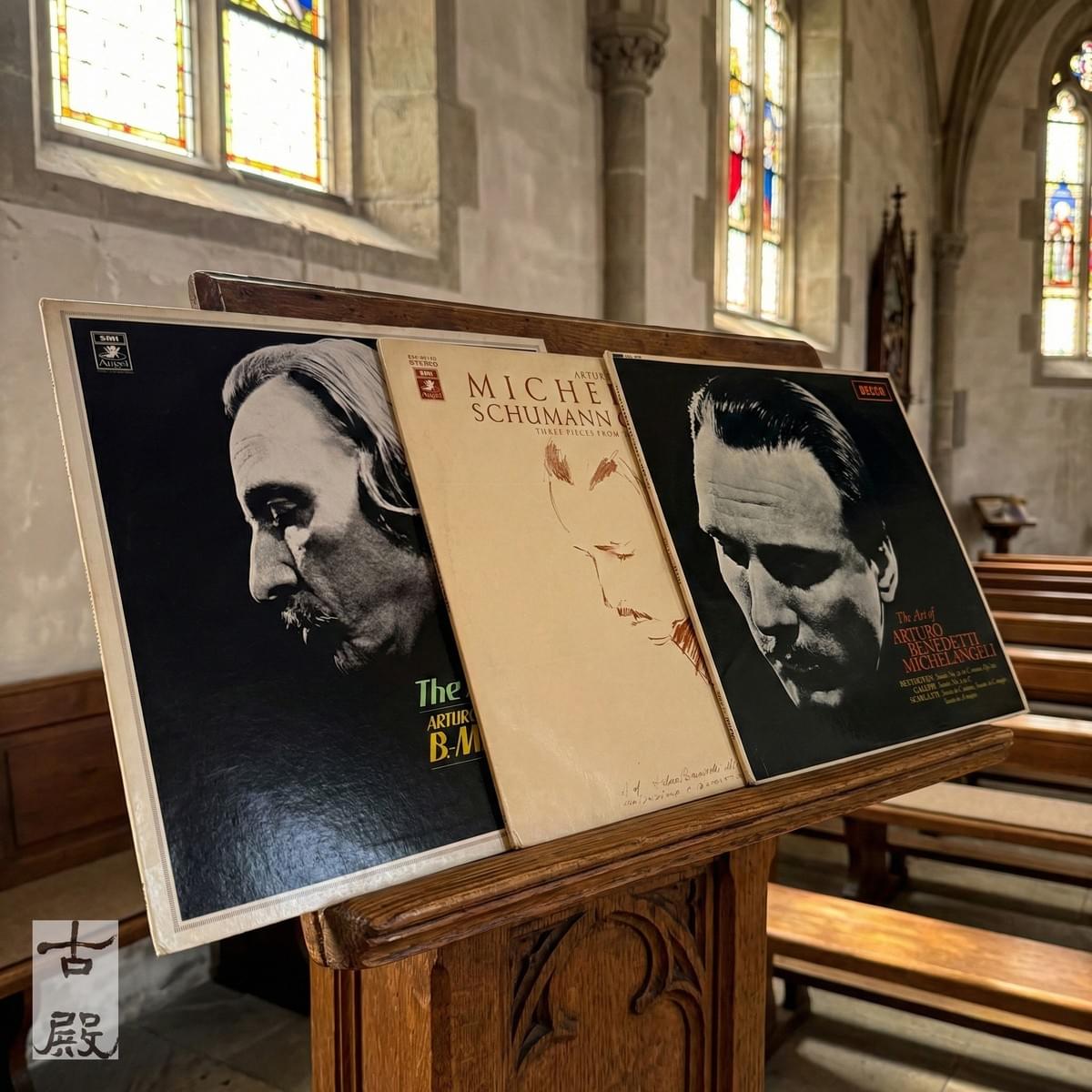
以下從他依照時間順序介紹他留下的三套「文化遺產」
第一套遺蹟:鋼琴超人的「爆發與克制」
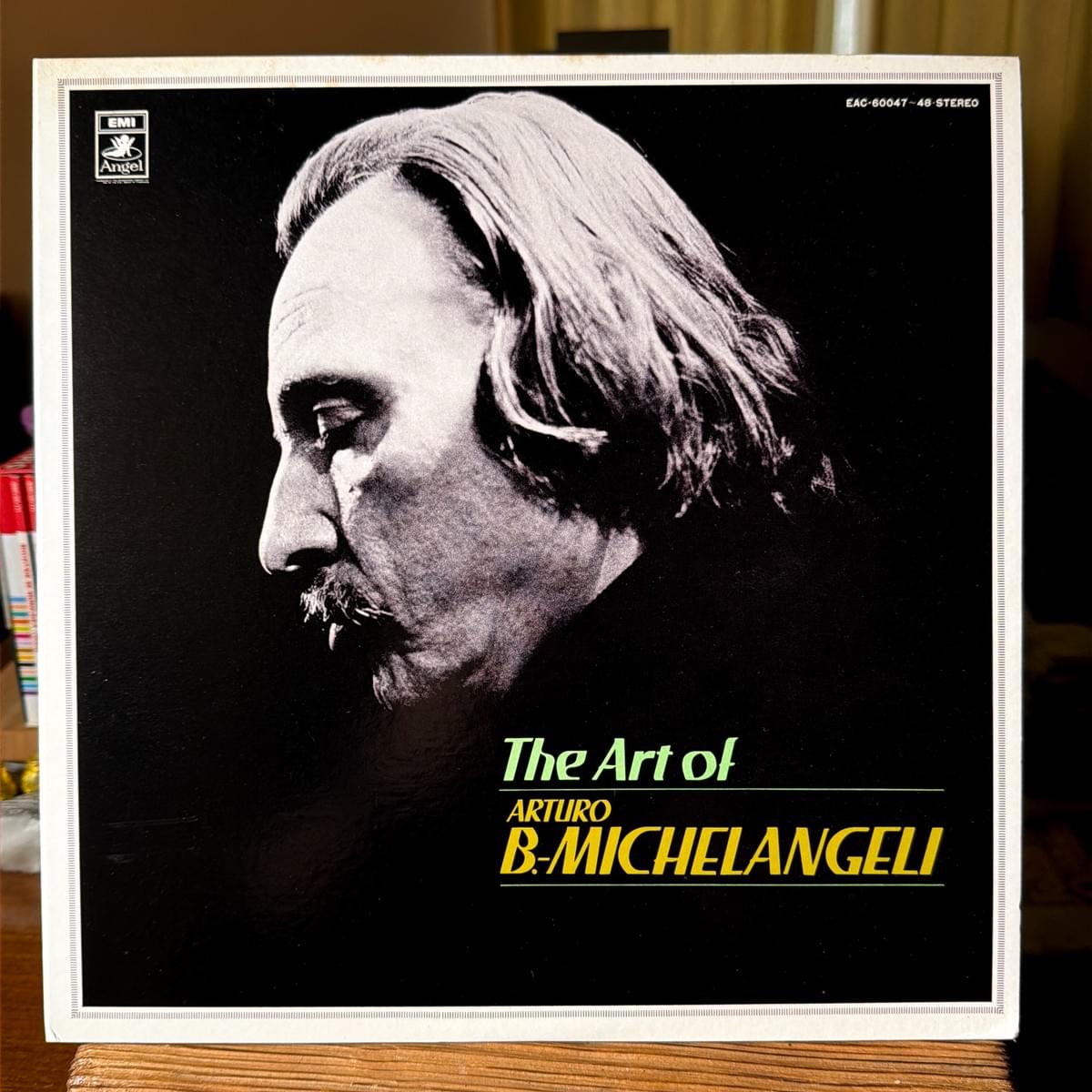
【EMI 1948/50s 早期錄音:巴哈、布拉姆斯、莫札特】
當我們放下這套復刻自SP蟲膠唱片的黑膠,你會驚訝於一個28歲青年的能量。那是 1948年,他在倫敦艾比路錄下的「傳奇」。
1. 被「重組」的靈魂
在錄製布拉姆斯的《帕格尼尼主題變奏曲》時,米開蘭傑里展現了他那驚人的主觀立場。他竟然不按譜面順序,而是自由重組了變奏的序列。這在嚴謹的古典樂界簡直是異端,但在他的邏輯裡,這是為了構建一個更完美的「技術與情感張力」。
2. 鋼琴上的管風琴:巴哈-布梭尼《夏康舞曲》
這是我最常在「古殿」播放的一首。米開蘭傑里透過精準的踏板與指間力度,在鋼琴上模擬出了管風琴般的層次感。這就是我們說的「聽覺的看見」。當你閉上眼,你會感覺到一個巨大的空間在你面前展開。
第二套遺蹟:通往天堂的「透明窺視窗」
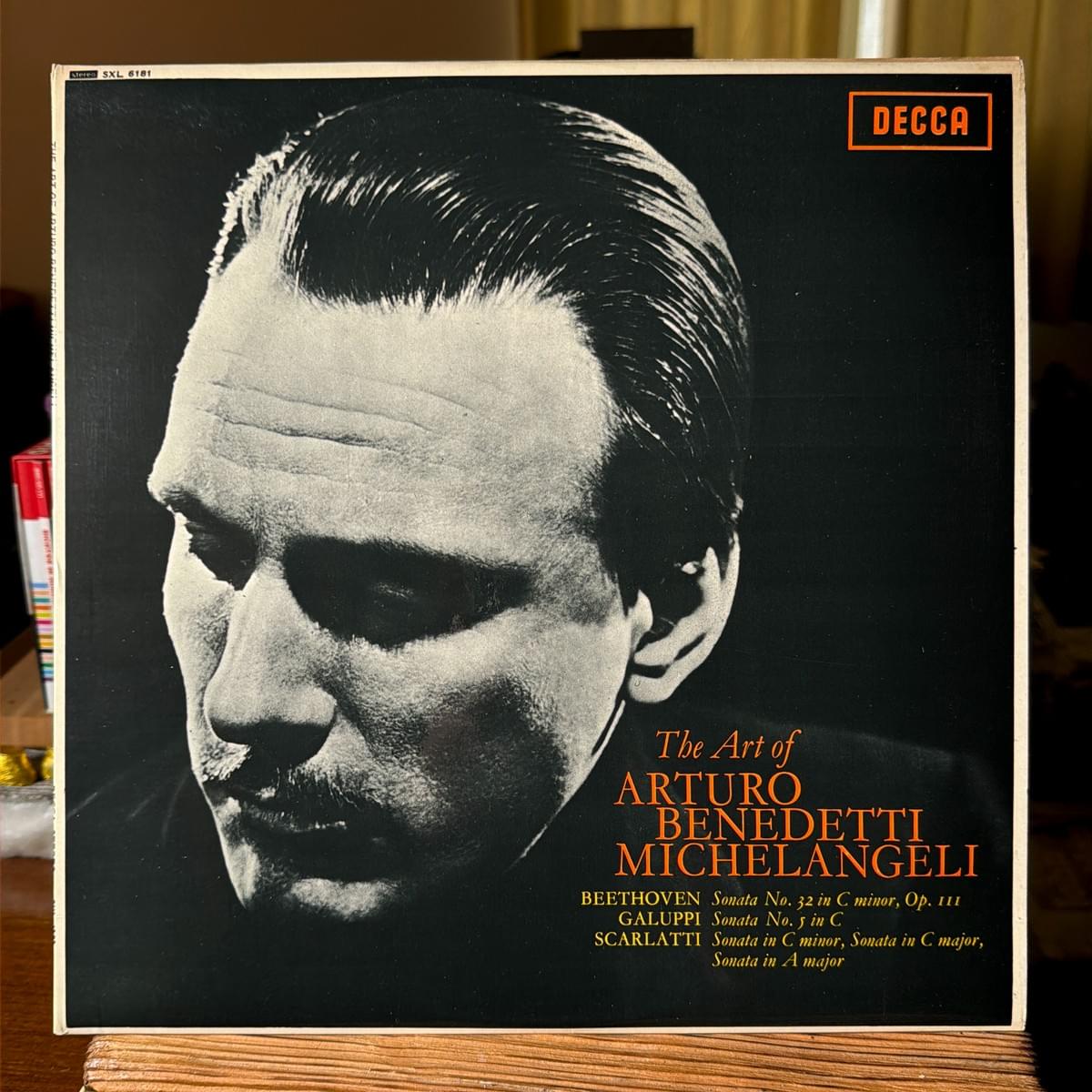
【Decca 1965年錄音:貝多芬 Op.111、史卡拉第、加路比】
到了1965年,米開蘭傑里的聲音變得更具「靈性深度」。這套唱片是我非常珍視的收,尤其是它隨附的解說文,探討了從史卡拉第到貝多芬的歷史縱軸。
1. 人生共鳴:在貝多芬的遺言中找回寧靜
貝多芬最後一首奏鳴曲 Op.111,是他在失聰與孤獨中的精神總結。米開蘭傑里的詮釋,有一種「貴族式的清晰」。
第二樂章的《詠嘆調》,被樂評家形容為「開啟了一扇通往天堂的窺視窗」。他彈奏那些長顫音的方式,不像是在敲擊琴鍵,而是在撥動空氣。
2. 歷史的復興:加路比與史卡拉第
他對義大利前輩作曲家加路比(Galuppi)的挖掘,展現了他對歷史的敬畏。他彈出的史卡拉第,既有大鍵琴的閃爍感,又有現代鋼琴的溫潤。聽這些曲子時,你會感覺到心跳穩了下來,呼吸變慢了。這就是感知的復健。
當極致的機械,遇見最終的昇華——法布里尼與 Op.111
米開蘭傑里的一生,在解決一個矛盾:
如何用一件沈重、冰冷、由鋼鐵與木頭組成的巨大機械(鋼琴),去表達最輕盈、最純淨、最超脫的靈魂?
為了這件事,他把自己逼成了極致的瘋子,也把他的合作夥伴——傳奇調音師安傑洛·法布里尼(Angelo Fabbrini)逼成了藝術家。
現代人追求數位科技音訊的「零失真」,但米開蘭傑里追求的是「零機械感」。
他對鋼琴的苛求,在當時的樂壇是個笑話。他隨行攜帶兩台專屬的漢堡史坦威鋼琴(Steinway D型),並要求法布里尼對其進行「毀滅性的改造」。法布里尼不是普通的調音師,他更像是一位聲音的工程師。他會拆開全新的鋼琴,微調弦橋與音板的相互作用,甚至重塑擊弦機的每一個零件,只為了達成一個目標:
讓鋼琴聽起來不像鋼琴。
「世界上沒有一台鋼琴好到足以演奏拉威爾的《夜之幽靈》。」 —— 米開蘭傑里
這句話聽起來傲慢,不過當你聽他在Decca唱片1965年錄製的史卡拉第時,那種晶瑩剔透,不是冰冷的數位感,而是一種帶有呼吸溫度的透明——即使是機械,也要磨出人的體溫。
偏執,是為了保護那脆弱的「留白」
為什麼他要這麼麻煩?這就帶到了我們這張Decca唱片的靈魂:貝多芬第32號鋼琴奏鳴曲(Op. 111)。
這首曲子是貝多芬的絕筆,是他對世界的告別。全曲只有兩個樂章,從第一樂章那種埃斯庫羅斯悲劇般的黑暗、激烈,轉入第二樂章《小詠嘆調》(Arietta)的無盡昇華。
如果鋼琴的機械性能不夠好,第二樂章那些著名的長顫音(Trills)聽起來就會像是一台故障的打字機,嘈雜且沈重。但因為有法布里尼的極致打磨,米開蘭傑里的琴音在那一刻「隱形」了。
在那種極度細微的 pp(極弱音)中,他營造出了一種空間感。當你閉上眼,你會感覺到音符不再是敲擊出來的點,而是一道道交織的光影。他在那些顫音裡,為我們開啟了一扇通往天堂的窺視窗。
這哪裡是難搞?這分明是一位修道士,為了不讓雜訊干擾他與神靈的對話,而對那具名為「鋼琴」的法器進行的極限修煉。
在「斷捨離」中找回生命的主體
聽Op. 111的米開蘭傑里,其實是在聽一種「生命狀態」。
貝多芬在寫這首曲子時,耳朵已經全聾了,他聽不見聲音,只能感覺到振動。米開蘭傑里在演奏這首曲子時,只專注於那個完美的振動。
這對我們現代人有什麼啟發? 米開蘭傑里告訴我們:
要得到極致的自由,必先有極致的自律。
最後當聽眾在台下起立歡呼時,米開蘭傑里則冷冷地說:
「掌聲是給貝多芬的,不是給我的。」
第三套遺蹟:在嚴冬中打磨的「絕對完美」
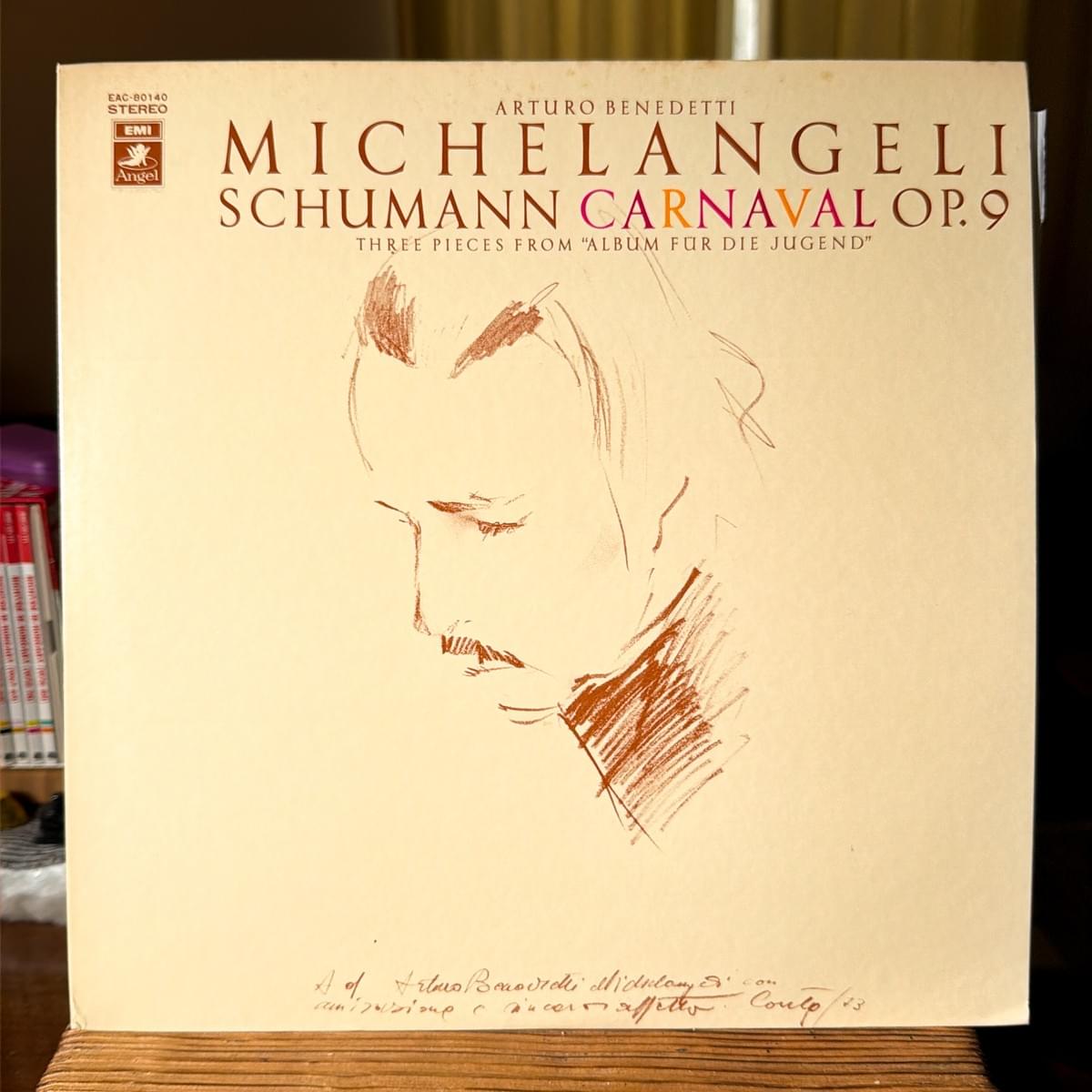
【EMI 1975 瑞士圖恩錄音:舒曼《狂歡節》】
1975年1月,米開蘭傑里在瑞士圖恩的一座古老教堂裡,錄下了這套震撼世界的唱片。當時是他與鋼琴調音技師法布里尼更緊密合作的時期。
1. 法布里尼的史坦威加強版
米開蘭傑里對鋼琴硬件的執著是近乎病態的。他心中真正的完美是靠「生理機能的絕對控制」與「機械結構的物理極限」換來的。
2. 舒曼的內心戲:弗羅斯坦與歐塞比烏斯
在《狂歡節》中,舒曼展現了自己分裂的人格。米開蘭傑里用極致的邏輯,把這些混亂的情緒梳理得清清楚楚。他不是在煽情,他是在「解構」情感。這對現代焦慮的我們來說,是一劑良藥。
教育遺產:鋼琴修道院裡的「感知訓練」
米開蘭傑里不只是演奏,他還在故鄉布雷西亞創辦了「鋼琴修道院」。他的學生——阿格麗希(Martha Argerich,1941-)、波里尼(Maurizio Pollini,1942-2024)、莫拉維茲(Ivan Moravec,1930-2015)——後來都成了世界頂尖的大師。
但他教給他們的從來不只是技術。他規定學生在學習期間不准公開演出,必須學會自律與敬畏。波里尼曾說,米開蘭傑里代表了「鋼琴演奏的絕對頂峰」。
這種「學徒制」的傳承,與古殿想做的「感知訓練」異曲同工。我們不是在灌輸資訊,我們是在建立一種「狀態」。當你學會了如何聽見音色中的細節,你就學會了如何活得更真實。
結語:在孤高背後,真實的自己
1995 年,這位孤高的修道士在瑞士辭世。他留下的錄音並不多,但每一份都是他「不情願下留給世界的遺產」。
他曾說過:「掌聲是給貝多芬、蕭邦、德布西的,不是給我的。」
在他眼裡,演奏者應該是透明的,那才是真實的自己。
*******
實體音樂:
實體音樂:
實體音樂:
*******
[Gu Dian Vinyl & Music Stories] The Monk on the Keyboard: Michelangeli and the "Cultural Heritage" He Left the World
Today, I want to chat with you over three sets of vinyl records about a man known as the "monk of the piano"—Arturo Benedetti Michelangeli (1920-1995).
It Wasn't "Being Difficult," It Was the Ultimate "Sacrifice" Michelangeli was most famous in the music world not for his piano skills, but for his track record of cancellations. He might turn around and leave just because a window in the concert hall wasn't closed properly and the draft affected the tuning. Even the famously difficult and neurotic piano master Vladimir Horowitz (1903-1989) once joked: "Compared to him, I am nothing. He is the real madman."
But reading his biography reveals something entirely different. Born into an aristocratic family in Brescia, northern Italy, he flew planes, studied medicine, and was even captured and tortured by German forces during World War II. These extreme life experiences left him with a deep aversion to the glamorous profession of being a "pianist."
He once said: "Music is not a profession for becoming a pianist or a musician. It is a philosophy, a concept of life: this cannot be achieved simply based on good intentions and talent. To achieve it, the first and most important requirement is a spirit of 'sacrifice.'"
By "sacrifice," he meant selfless "devotion"—throwing oneself wholeheartedly into the music and only performing works that truly resonated with his inner soul. This attitude made his repertoire far smaller than that of other masters, but every single piece had undergone years, even decades, of profound study.
Many people thought he was "difficult to work with," but that was the "sacrifice" he made to protect the "authenticity" of the music. He sacrificed fame and wealth, all for the sake of that one, unrepeatable live performance.
He abhorred the term "artist," considering it a title claimed by amateurs; he preferred to call himself a "player" or "executant" (suonatore). In his view, the essence of music lay in the relationships and proclamations between notes—what he called "logic." This logic was reflected in the extreme precision of his phrasing. Before a performance, he would spend hours with a piano technician adjusting the hammers, ensuring that every single note had a perfectly even timbre and could achieve a sound that "melted like wax."
Below is a chronological introduction to the three sets of "cultural heritage" he left behind.
The First Relic: The "Explosion and Restraint" of a Piano Superman [EMI 1948/50s Early Recordings: Bach, Brahms, Mozart] When we drop the needle on this vinyl, restored from 78rpm shellac records, you will be amazed by the energy of a 28-year-old youth. That was 1948, the "legend" he recorded at Abbey Road in London.
1. The "Reassembled" Soul When recording Brahms's Variations on a Theme of Paganini, Michelangeli displayed his astonishingly subjective stance. He actually ignored the printed order of the score and freely rearranged the sequence of the variations. In the strict classical music world, this was practically heresy, but in his logic, it was done to construct a more perfect "technical and emotional tension."
2. A Pipe Organ on the Piano: Bach-Busoni's Chaconne This is one of the pieces I play most often at Gu Dian. Through precise pedaling and fingertip dynamics, Michelangeli simulated the layered textures of a pipe organ on the piano. This is what we call "seeing through hearing." When you close your eyes, you feel a massive physical space opening up right in front of you.
The Second Relic: A "Transparent Peep-Hole" to Heaven [Decca 1965 Recordings: Beethoven Op. 111, Scarlatti, Galuppi] By 1965, Michelangeli's sound had acquired a greater "spiritual depth." This album is a collection I deeply cherish, especially for its accompanying liner notes, which explore the historical axis from Scarlatti to Beethoven.
1. Life Resonance: Finding Peace in Beethoven's Final Testament Beethoven's final sonata, Op. 111, is his spiritual summary forged in deafness and solitude. Michelangeli's interpretation possesses an "aristocratic clarity." The second movement, the Arietta, has been described by critics as "opening a peep-hole to heaven." The way he played those long trills didn't sound like striking piano keys, but rather like plucking the air itself.
2. Historical Revival: Galuppi and Scarlatti His unearthing of the early Italian composer Galuppi showed his reverence for history. The Scarlatti he played possessed both the shimmering quality of a harpsichord and the warmth of a modern piano. When you listen to these pieces, you can feel your heart rate steadying and your breathing slowing down. This is the rehabilitation of perception.
When Ultimate Mechanics Meet Ultimate Sublimation—Fabbrini and Op. 111 Michelangeli spent his entire life trying to solve a single contradiction: How do you use a heavy, cold, massive machine made of steel and wood (the piano) to express the lightest, purest, and most transcendent soul?
To achieve this, he pushed himself to become an absolute madman, and he pushed his collaborator—the legendary piano tuner Angelo Fabbrini—to become an artist. Modern people pursue "zero distortion" in digital audio technology, but what Michelangeli pursued was a "zero mechanical feel."
His demands on the piano were a running joke in the music world at the time. He traveled with two personal Hamburg Steinways (Model D) and demanded that Fabbrini perform "destructive modifications" on them. Fabbrini was no ordinary tuner; he was more like an acoustic engineer. He would dismantle brand-new pianos, finely adjust the interaction between the bridge and the soundboard, and even reshape every single component of the action mechanism, all to achieve one goal: To make the piano sound unlike a piano.
"There is no piano in the world good enough to play Ravel's Gaspard de la nuit." — Michelangeli
This quote sounds arrogant, but when you listen to his 1965 Decca recording of Scarlatti, that crystalline clarity isn't a cold, digital sensation, but a transparency that carries the warmth of a human breath—even out of machinery, human warmth must be polished out.
Paranoia as a Shield for Fragile "Blank Space" Why did he go to so much trouble? This brings us to the soul of this Decca record: Beethoven's Piano Sonata No. 32 (Op. 111). This piece is Beethoven's swan song, his farewell to the world. The entire piece has only two movements. It transitions from the Aeschylean tragedy, darkness, and intensity of the first movement into the endless sublimation of the second movement, the Arietta.
If the mechanical performance of the piano wasn't perfect, those famous long trills in the second movement would sound like a broken typewriter—noisy and heavy. But thanks to Fabbrini's extreme polishing, Michelangeli's piano sound effectively "turned invisible" in that moment.
In those incredibly subtle pianissimo (pp) passages, he created a profound sense of space. When you close your eyes, you feel that the notes are no longer struck points of sound, but interwoven rays of light and shadow. In those trills, he opened a peep-hole to heaven for us. How is this being difficult? This is clearly a monk engaging in extreme cultivation of a ritual instrument called the "piano," just to ensure that no background noise would interfere with his conversation with the divine.
Reclaiming the Subject of Life through "Detachment" Listening to Michelangeli play Op. 111 is actually listening to a "state of life." When Beethoven wrote this piece, he was completely deaf; he couldn't hear sound, he could only feel vibrations. When Michelangeli played this piece, he focused solely on that perfect vibration.
What inspiration does this hold for us modern people? Michelangeli tells us: To achieve ultimate freedom, one must first possess ultimate self-discipline. In the end, when the audience gave him a standing ovation, Michelangeli simply said coldly: "The applause is for Beethoven, not for me."
The Third Relic: "Absolute Perfection" Polished in the Harsh Winter [EMI 1975 Thun, Switzerland Recordings: Schumann's Carnaval] In January 1975, in an ancient church in Thun, Switzerland, Michelangeli recorded this world-shaking album. This was a period when he was collaborating even more closely with his piano technician, Fabbrini.
1. Fabbrini's Enhanced Steinway Michelangeli's obsession with piano hardware bordered on pathological. The true perfection in his heart was earned through "absolute control of physiological functions" and pushing the "physical limits of mechanical structure."
2. Schumann's Inner Drama: Florestan and Eusebius In Carnaval, Schumann revealed his own split personalities. Michelangeli used extreme logic to sort out these chaotic emotions with absolute clarity. He wasn't pandering to sentimentalism; he was "deconstructing" emotion. For those of us dealing with modern anxieties, this is a potent remedy.
Educational Legacy: "Perceptual Training" in the Piano Monastery Michelangeli didn't just perform; he also founded a "piano monastery" in his hometown of Brescia. His students—Martha Argerich (1941-), Maurizio Pollini (1942-2024), and Ivan Moravec (1930-2015)—later all became world-class masters.
But what he taught them was never just technique. He forbade his students from performing in public during their studies, requiring them to learn self-discipline and reverence. Pollini once said that Michelangeli represented "the absolute zenith of piano playing."
This kind of "apprenticeship" legacy aligns perfectly with the "perceptual training" we aim to do at Gu Dian. We are not just spoon-feeding information; we are building a "state of being." When you learn how to hear the details in a timbre, you learn how to live a more authentic life.
Conclusion: Behind the Aloofness, the True Self In 1995, this solitary and aloof monk passed away in Switzerland. He left behind very few recordings, but every single one is a "reluctant legacy he left to the world."
He once said, "The applause is for Beethoven, Chopin, and Debussy, not for me." In his eyes, the performer should be transparent—because only then can the true self emerge.