
【古殿唱片音樂故事】那個冬天,他帶著一把琴越過了鐵幕——1957至1958年,列奧尼德·柯岡(Leonid Kogan,1924-1982)的美國登陸
古殿殿主
1955年秋天,鋼琴家吉利爾斯(Emil Gilels,1916-1985)也來了。他是第一個被允許訪美的蘇聯音樂家,卡內基廳人滿為患,《紐約先驅論壇報》的評論說,他是「征服了美國的俄羅斯人」。
1955年年底,大歐(David Oistrakh,1908-1974)在卡內基廳登台,五千人無票求票,聽眾在舞台上站著。
蘇聯音樂家登陸美國,在1950年代中期成為一個固定的震撼事件。每一次,都是鐵幕後的傳說第一次獲得了真實的身體——一個真實站在舞台上的人,而不只是一個名字,一段錄音,一個從旅行者口中輾轉傳回的傳言。
1957年底,終於輪到他了。
列奧尼德·柯岡(Leonid Kogan,1924-1982),33歲,登陸美國。
記者在機場等著,問他對美國的第一個印象。
他說:「最大的驚訝,是路上的汽車數量。」
這個答案讓所有人笑了。但笑聲背後有一層薄薄的震驚——一個在蘇聯生活了三十三年的人,第一眼看到的美國,是馬路上的汽車。那是兩個世界之間的距離,用一個最日常的細節說出來了。
這個距離,以及他在那個距離之間留下的聲音,是這篇文章想說的事。
一、他是誰?以及他等了多久
列奧尼德·柯岡,1924年11月生於烏克蘭第聶伯羅彼得羅夫斯克。
十歲,父母把他送進莫斯科音樂院,進入亞姆波爾斯基(Abram Yampolsky,1890-1956)的班級。這條師承線索非常清楚:亞姆波爾斯基是奧爾(Leopold Auer,1845-1930)的嫡傳弟子,而奧爾,正是蘇聯小提琴學派的根源。柯岡踏進音樂院的那一天,腳下踩著的,是從奧爾一路傳下來的技術脈絡。
但課堂以外,有一件事更深地決定了他的方向。
1934年,海飛茲(Jascha Heifetz,1901-1987)到莫斯科演出。十歲的柯岡在台下,場場必到。他後來說:「至今記得他演奏的每一個音符。他對我來說是理想的藝術家。」
這個記憶,在他後來的一張唱片裡有一個安靜的回聲。普羅高菲夫《假面》(Prokofieff: Masques)的小提琴版本,改編者是海飛茲本人。柯岡演奏的,是他十歲時的理想藝術家,親手為他改編的曲子。
1948年,柯岡從莫斯科音樂院畢業。此後,他的老師換成了大歐。這個師承關係,後來被印在了他的一張美國 RCA 唱片封底的最後一行——「他師從亞伯拉罕·亞姆波爾斯基,後來又師從大衛·奧伊斯特拉夫。」
師與生之間,相差十六歲。我們後面會再回到這個細節。
1951年,布魯塞爾意沙易國際小提琴大賽,柯岡拿了第一名。評委席上坐著法國小提琴家提博(Jacques Thibaud,1880-1953),他曾在十五年前聽過莫斯科音樂院一個少年的演奏,預言他將有偉大的前途。那個少年現在站在布魯塞爾的舞台上,預言兌現了。
布魯塞爾之後,西方的邀請紛至沓來。但柯岡是蘇聯的人,人民藝術家——每一場西方演出,都需要通過國家藝術機構 Gosconcert 的審批與同意。
蘇聯人造衛星Sputnik升空幾個月後,他終於獲准赴美。LM-2220 的封底,RCA 安排讓《波士頓先驅報》(The Boston Herald)擔任專欄主筆與音樂評論家的艾利(Rudolph Elie,1909-1958)撰寫,開頭這樣描述他:「一個謙遜的年輕人,身材不高,卻有著大量的魅力、對音樂的熱情,以及一種令人印象深刻的親切氣質。」然後筆鋒一轉,說他的演奏讓波士頓的批評家異口同聲:「一顆偉大的新星出現了。」
二、1958年1月10日,波士頓,下午
柯岡的美國之行,有一個具體的起源。
1956年,波士頓交響樂團赴蘇聯巡演——那是冷戰時代美蘇文化交流最早的幾次正式往來之一。柯岡當時在莫斯科,以官方代表的身份接待了到訪的樂團。這次接觸,讓雙方留下了印象,也為後來的安排埋下了伏筆。
蘇聯方面接受了美國提出的回訪邀請:以派遣柯岡赴美演出,作為對波士頓交響樂團訪蘇的回應。這不是柯岡個人的選擇,而是一次外交層面的文化交流。
柯岡在接受採訪時,解釋了自己為什麼選擇波士頓交響樂團作為美國首演的合作夥伴:他要以這場演出,向在莫斯科接待過他的樂團表示致謝。那是一種非常蘇聯式的禮數——官方行程裡的私人情誼。
指揮是孟都(Pierre Monteux,1875-1964)。那個年已八十三歲的老人,曾在1913年主持《春之祭》的世界首演,見過整個二十世紀音樂史的轉折。此刻他站在指揮台上,為一個從鐵幕後剛剛走出來的年輕人伴奏。
曲目是布拉姆斯小提琴協奏曲。
柯岡走上舞台,一身黑色西裝,打著黑色領結,腋下夾著他的史特拉底瓦里——那把1707年的琴,是屬於蘇聯國家收藏,配給給他專門使用。
演出結束後,四次謝幕,聽眾開始跺腳,震動響徹整個音樂廳。
艾利的文字繼續寫道,樂評人描述柯岡的琴聲:「圓潤而飽滿,動態幅度卓越,弓法沉穩而優雅,在樂句的清晰度上令人嘆為觀止」。而艾利本人,在封底最後給出了他自己的裁決——這是他所聽過最優秀的小提琴演奏之一。
這場演出結束後不到四十八小時,柯岡、孟都、波士頓交響樂團,回到同一個波士頓交響廳。這次面對的是麥克風和 RCA Victor 的錄音技師。
他們錄下了哈察都量的小提琴協奏曲,以及聖桑的《哈瓦奈斯》(Havanaise, Op. 83)。那成為 LM-2220。封面印著四個字:「American Recording Debut」。
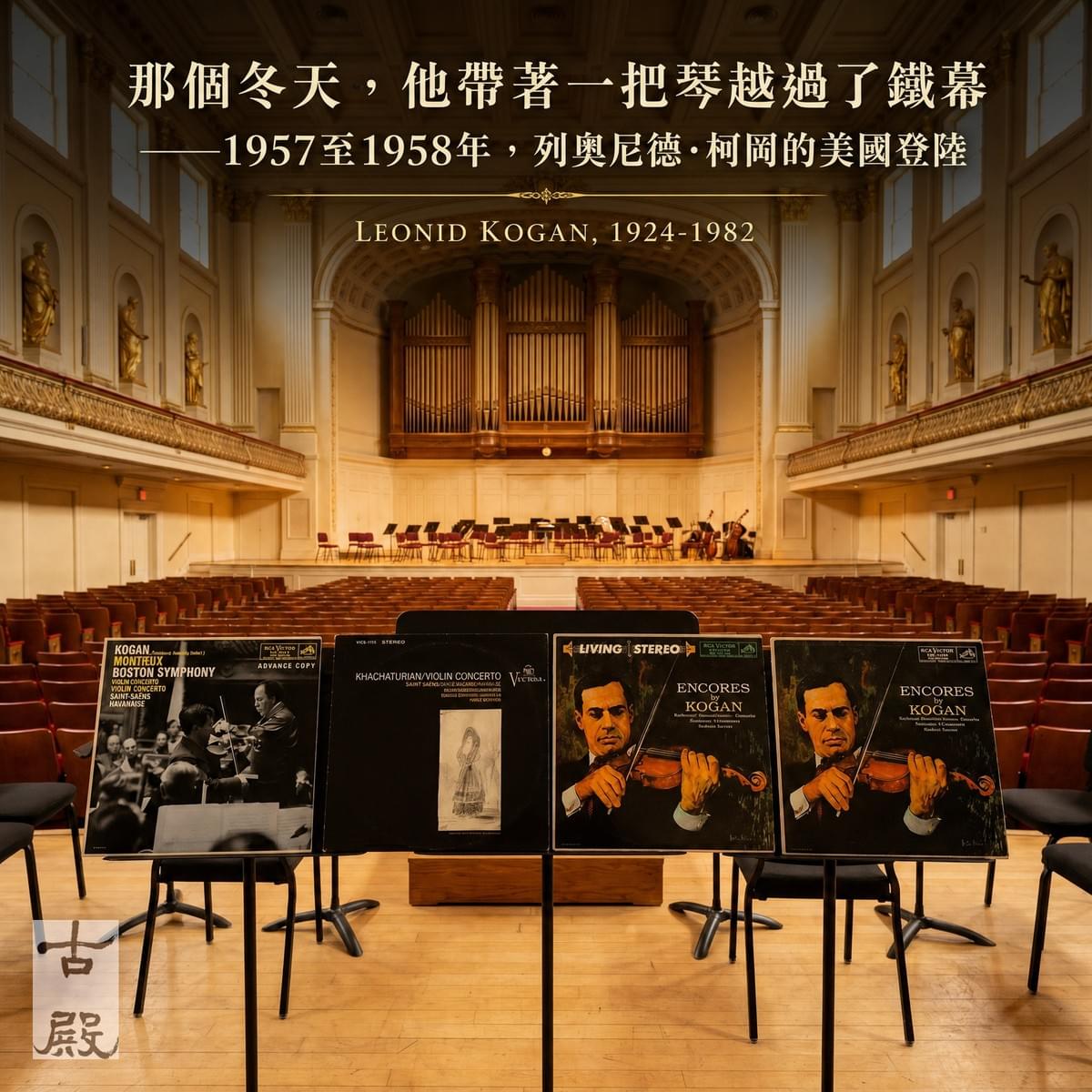
LM-2220 的封套,有一張現場照片——柯岡演奏,孟都在旁指揮,波士頓交響廳的管風琴在他們身後。照片是黑白的,但那個下午的溫度是真實的。那個封套本身,就是一份現場紀錄。(因為據悉當天的錄音兩首曲子都是採用一氣呵成的方式,順利地完成錄音)
三、1958年2月,紐約,三個下午
LM-2220 之後,RCA 安排了第二組錄音。
地點換到了紐約:美國藝術與文學學院(Academy of Arts and Letters)。
時間:1958年2月,分三天完成——11日、12日、21日。
製作人:理查·莫爾(Richard Mohr)。錄音師:約翰·克勞福德(John Crawford)。鋼琴伴奏:安德烈·米特尼克(Andrei Mitnik),柯岡長期合作的默契搭檔。
這次錄的,是一張安可曲集。
曲目:
1.Nardini: Adagio 納爾迪尼:慢板
2.Shostakovich: Four Preludes 蕭士塔高維契:四首前奏曲
3.Mendelssohn: Song Without Words May Breezes 孟德爾頌:無言歌「五月的微風」(arr. Kreisler)
4.Kerisler: Caprice Viennois 克萊斯勒:維也納隨想曲
5.Khachaturian: Dance of Ayshe 哈察都量:艾斯之舞
6.Vieuxtemps: Rondino 魏歐當:輪旋曲
7.Debussy: Clair De Lune 德布西:月光
8.Prokofieff: Masques 普羅高飛夫:假面舞
9.Bloch: Nigun 布洛赫:曲調
10.Glazounoff: Entr'acte 葛拉祖諾夫:間幕曲
11.Sarasate: Capriccio Basque 薩拉沙泰:巴斯克隨想曲
曲目橫跨兩百年的小提琴演奏史:從1722年的納迪尼(Pietro Nardini)的慢板,到哈察都量的《艾斯之舞》;從克萊斯勒的維也納隨想曲,到布洛赫的《曲調》;從薩拉沙泰的西班牙舞曲,到德布西的《月光》。
安可曲,是演奏家的私人珍藏。不是最難的,不是最能炫技的。是那些他願意在音樂會結束後、聽眾要求再一曲時,留在身邊的那些曲子。
封底的文字,由當時美國最重要的音樂評論家之一喬治·傑利內克(George Jellinek)撰寫。他這樣介紹柯岡:
「他的多才多藝在這張錄音裡得到了充分的呈現,收錄了來自不同時期、不同學派、不同國籍的作曲家音樂,並且以一種讓聆聽者專注於它們之間差異的順序排列。以這樣的方式欣賞這些作品的聆聽者,將獲得一個橫跨超過兩個世紀的小提琴寫作全景。」
最後一句說得精準:這不是一張炫技的唱片。這是一張告訴你「這個人是誰」的唱片。
三天的錄音,有一個細節值得注意。
2月11日,柯岡一天錄完了整個A面的六首曲子,以及B面的《月光》與《曲調》。那個效率說明了一件事:他在錄音室裡的狀態,和他在音樂會舞台上完全一致。
2月21日,最後一天,只錄了兩首——布拉姆斯《匈牙利舞曲第一號》,以及薩拉沙泰《巴斯克隨想曲》。技術難度最高的,留到了最後。
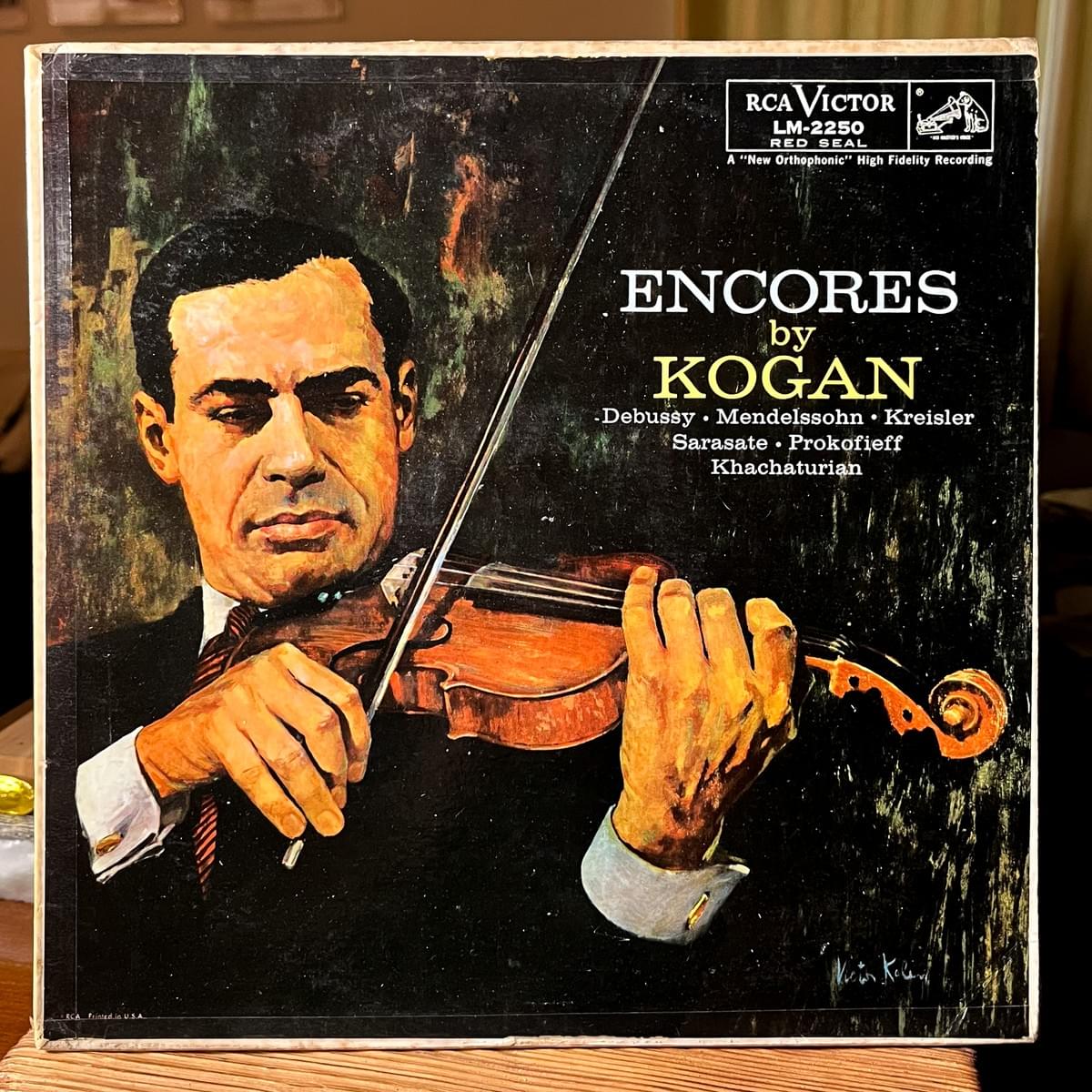
這張唱片發行時,編號是 LM-2250。標籤是紅色影子狗,印著「New Orthophonic High Fidelity」。封面,是畫家 Victor Kalin 的油畫——柯岡側著臉,目光向下注視著琴,不看觀眾,神情凝定。那幅畫,在某種意義上比任何照片都更準確地捕捉了他的性格。
四、那張唱片裡藏著的幾個細節
把這張 LM-2250 拿在手裡,仔細讀封底,有幾個細節值得停留。
關於哈查都量《艾斯之舞》。 這首曲子的小提琴版本,是海飛茲改編的。柯岡演奏的,是他少年時代的理想藝術家親手改編的曲子——而哈查都量本人,後來也成為了和柯岡有深厚情誼的作曲家,他的小提琴《協奏曲-狂想曲》就是題獻給柯岡的。
關於普羅高菲夫《假面》。 這是從《羅密歐與茱麗葉》裡取出的片段,小提琴版本同樣由海飛茲改編。普羅高菲夫,1953年剛過世,與史達林同日。這首曲子的悲劇意涵,在1958年柯岡演奏它的時候,帶著一層還未走遠的陰影。
關於布洛赫《曲調》。 封底說,這是布洛赫《巴爾神殿組曲》的中間樂章,以即興風格寫成,靈感來自希伯來吟唱。柯岡是猶太人,這首曲子在他手裡有一個特殊的重量——那不只是演奏,是某種更私密的聲音。
關於這張唱片最後沒有收入的那首曲子。 2月21日那天,柯岡在錄完薩拉沙泰之前,還錄了一首布拉姆斯《匈牙利舞曲第一號》。那首曲子,最後因為 LP 的播放時間限制,沒有被收入 LM-2250。它在磁帶上等了將近六十年,直到2016年的 CD 盒裝版本才第一次被公開。
一個完整的演奏,因為黑膠的物理容量不夠,消失在歷史裡。
五、兩張唱片,兩個不同的命運
柯岡這次訪美,留下了兩批 RCA 錄音。它們後來各自走上了完全不同的命運。
*LM-2220(哈察都量小提琴協奏曲,1月錄音)**的立體聲版本,在1958年同樣沒有隨著 Living Stereo 系列一同發行。但它等了七年,在1965年以 RCA 副牌 Victrola 的形式出現,編號: VICS-1153。深綠色封底,暗紅色 Victrola 標籤,靜靜地上市。不是光環閃耀的 Living Stereo,是副牌系列,但它至少出現了。
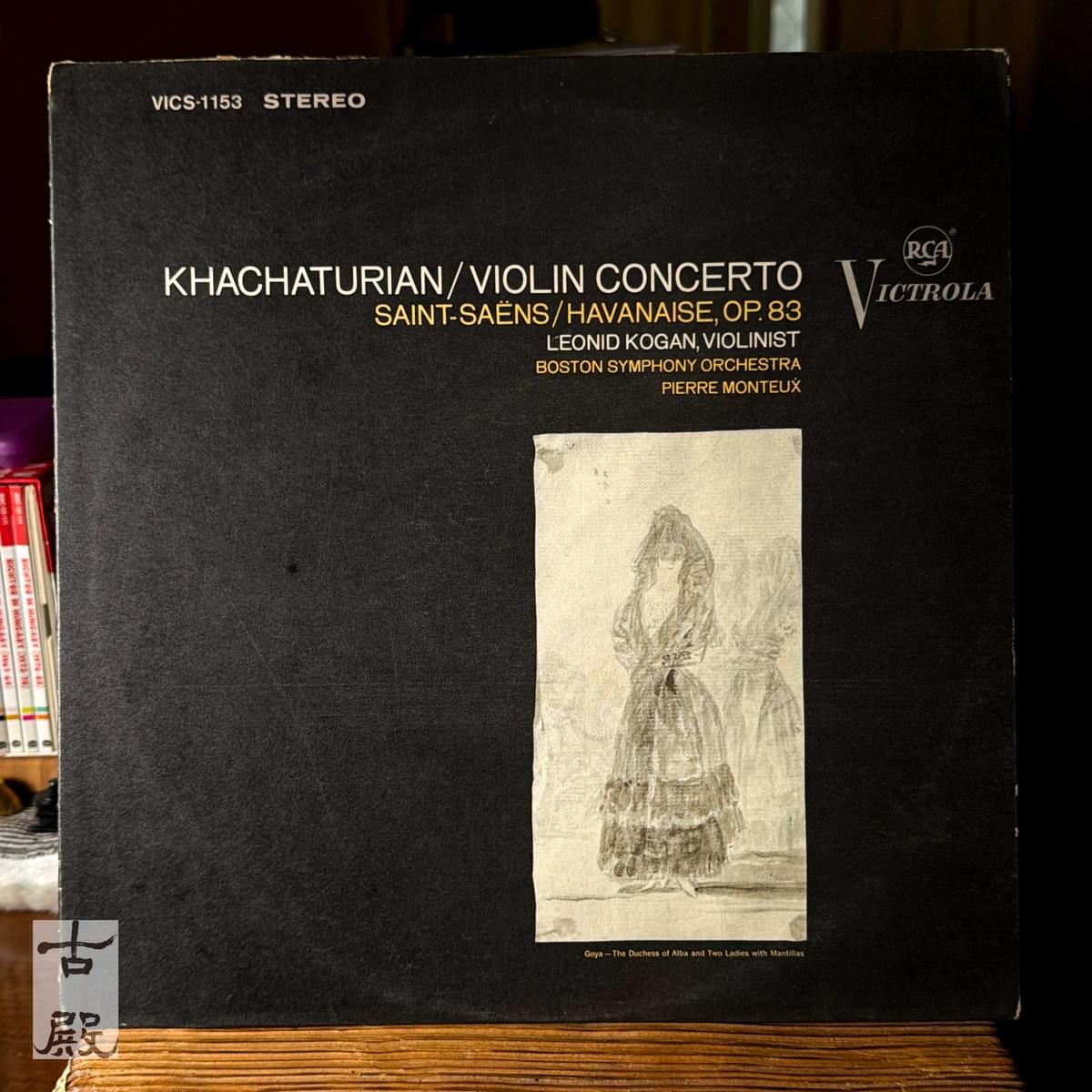
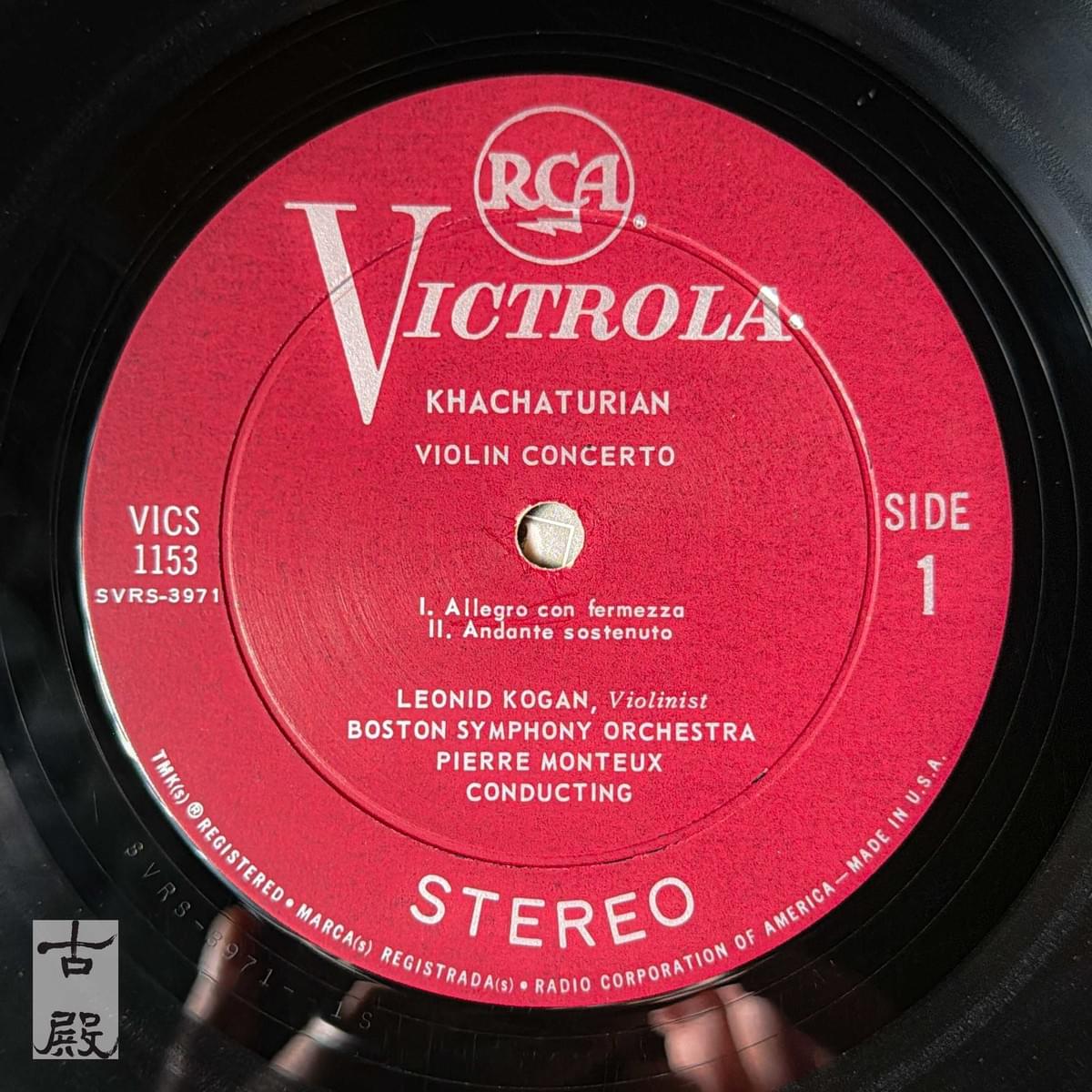
*LM-2250(安可曲集,2月錄音)**的立體聲版本,連出版機會也沒有。
- 1958年,LSC-2250 的號碼已分配,立體聲三聲道母帶刻板號 J2RY-4452/4453 已存在,發行日期已定:1958年11月21日。LM-2250(單聲道)如期出現,但 LSC-2250(立體聲),消失了。
- 1965年,VICS-1153 發行,把 LM-2220 的立體聲版本帶到了聽眾面前——但那是哈察都量協奏曲,不是安可曲集。安可曲集的立體聲母帶,繼續在倉庫裡等著。
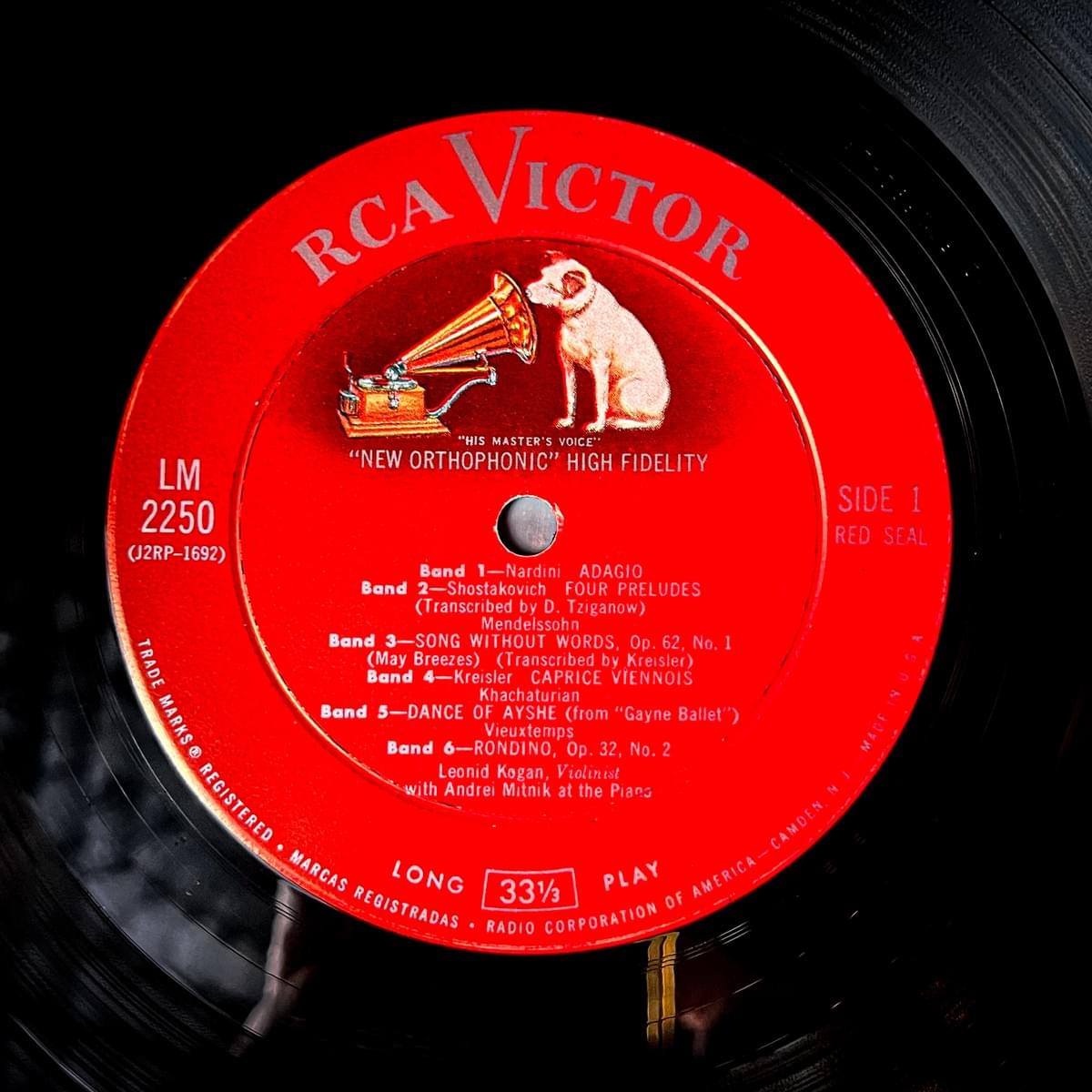
等了多久?
六十年。
六、為什麼?一個至今沒有答案的問題
為什麼 LM-2220 的立體聲版本七年後以 Victrola 出現,而 LM-2250 的立體聲版本連 Victrola 也沒有份?
這個問題在版本史裡從來沒有被正式追問過。
可以排除幾個可能性:不是技術問題(立體聲刻版早已準備好,隨時要出版);不是商業判斷(RCA 顯然重視這批錄音);不是母帶損壞(六十年後仍然可以轉錄發行)。
剩下的,最可能的方向指向柯岡的蘇聯身份。
他不是以個人身份來美國的。他是 Gosconcert——蘇聯國家藝術機構——派出的文化使節。他的 RCA 錄音合約,通過 Gosconcert 仲介,不是個人直接簽約。
1958年,是蘇聯人造衛星Sputnik 升空後不到一年的時間點。美蘇之間的文化交流既在進行,政治上的敏感度也到了某個高峰。蘇方是否同意了 Mono 版的發行,卻對 Stereo 版提出了額外的授權條件?RCA 是否在某個談判節點選擇了放棄?
LM-2250 封面印著「Advance Copy」——這個標記印在所有正式發行的版本上,是 RCA 對這批錄音製作技術的聲明。封底的「Important Notice」說得清楚:「這是一份採用『New Orthophonic』高傳真技術製作的錄音,在今天的唱機上播放,可獲得最高品質的重現;在立體聲唱機上播放,效果更為出色。」這份錄音,在製作技術上已超前於當時的一般水準——Mono 系統下是最高規格,立體聲普及後同樣可以良好重現。
但那個「立體聲普及後同樣可以良好重現」的承諾,最終沒有在黑膠的形式裡兌現。
是誰做的決定,基於什麼理由——這是版本史裡一個至今沒有答案的空白。
七、六十年後,首爾,那個號碼終於出現了
2018年,首爾馬場洞,Machang Music & Pictures。
這是韓國唯一擁有從刻版到壓製全流程的黑膠工廠,2017年重新開業。他們取得了 Sony Music Entertainment(RCA 版權現任持有者)的授權,推出 Acoustic Groove 系列。其中一張,號碼是: LSC-2250。
封面是同一幅 Victor Kalin 的油畫。Living Stereo 的橫幅印在頂端。RCA Victor 的標誌在右上角。180克純處女膠。封底印著:「World's 1st 'Living Stereo' Series Released by Vinyl in Stereo Version」。
這個聲明是真的——2018年,確實是 LSC-2250 第一次以黑膠立體聲形式面向市場。那個空了六十年的號碼,終於出現了。
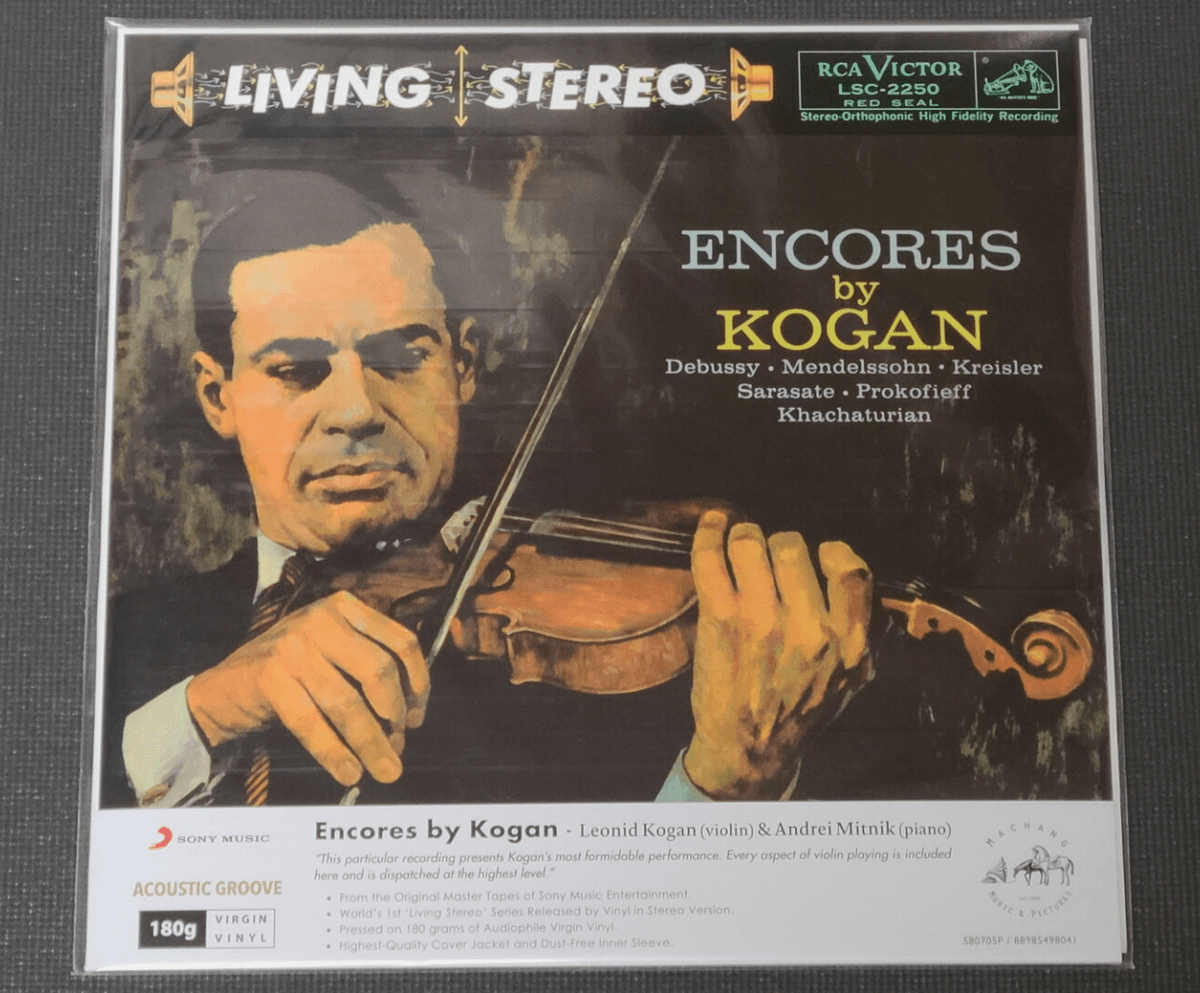
但它的製程,與1958年的 LM-2250 完全不同。
Sony 提供1958年的類比三聲道母帶,送進 Iron Mountain Digital Studios,轉錄為 24bit/192kHz 高解析數位檔,再由 b-sharp 在數位工作站裡混音後製,輸出新的數位母帶,然後從這個數位母帶刻版,壓製成180克黑膠。
類比,在第一個步驟就終止了。
親耳聆聽過這張唱片的人,給出了一個直接的判斷:那是現代數位版本的聲音,不是1958年的聲音。
這個判斷有它的製程根據。那不是批評它的音質,而是指出一個事實:你聽到的,是2016年某個工程師在數位工作站前,對1958年那份母帶所做的詮釋——不是那份母帶本身。
九、兩張唱片,兩個不同的「類比」
這裡有一個問題值得認真思考。
什麼是「類比」?
「類比」不是指載體的物理形式,而是指信號從來源到載體的傳遞過程是否全程保持類比狀態。
LM-2250(1958年 Mono 原版):1958年2月,紐約藝術與文學學院的空氣振動,被電容式麥克風捕捉,記錄在高速磁帶上,以加熱唱針刻入醋酸漆盤,壓製成黑膠。從空氣到溝槽,整條鏈,全程類比。
LSC-2250(2018年 Acoustic Groove)的信號鏈:1958年的類比磁帶,在第一個步驟就被轉為數位。後面全部在數位域裡完成,最後輸出為黑膠。物理形式是黑膠,但信號本質已是數位製品的類比化輸出。
而且,LM-2250 保存了整套1958年的物理製程——RCA Camden 工廠的壓製機器特性、那年那批膠料的配方、刻版技師的手感——這些都構成了唱片實體的一部分。那個製程,不可能被複製第二次。
2018年,Acoustic Groove LSC-2250 在 eBay 拍賣,曾以起標 $5,28次競標, 美金$1,595成交。2023年,全新未拆版本仍以美金$900 流通。
那個追價的邏輯並不難理解——Stereo 格式、Living Stereo 光環、限量發行、「史上第一張立體聲黑膠」的稀缺性標籤,這些對重視器材展示的發燒友而言幾乎是無法抗拒的組合。但那28次競標,競的是一個符號,不是1958年的聲音。
十、那份磁帶,還在
1958年2月那份三聲道類比母帶,此刻仍然在 Sony/RCA 的倉庫裡。
那裡面有柯岡的瓜奈里德耶穌,有米特尼克的鋼琴,有紐約藝術與文學學院那個空間的聲學殘響,有1958年2月那幾個下午的歷史空氣。
那個本應在1958年以 Living Stereo 標準問世的版本——從類比母帶直接刻版,用當年的技術和製程,讓那個下午的聲音第一次真正以它本來的樣子出現在溝槽裡——從來沒有在這個世界上存在過。
這是本系列三篇文章共同指向的一件事:
1954年萊納的《英雄的生涯》,立體聲母帶等了將近四十年才出現,而那個號碼——LSC-1807——是由市場自己補回來的,不是 RCA 補的。
1955年大歐的美國首演錄音,立體聲母帶等了八年,以副牌 Victrola(VICS-1058)出現,而最重要的普羅高菲夫那一面,至今仍未出版。
1958年柯岡的兩批錄音,命運分岔:哈察都量協奏曲(LM-2220)等了七年,以副牌 Victrola(VICS-1153)出現,和大歐的情形結構相同;而《安可曲集》(LM-2250)的立體聲母帶,連 Victrola 也沒有份,等了六十年,以一個數位重置的版本出現,而那個出現,只填了號碼的形狀,沒有填它本來應該承載的聲音。
三個時代,相似的結構,不同長度的等待。但那個最應該存在的東西,一直都不存在。
******
[Guden Record Stories] That Winter, He Crossed the Iron Curtain with a Violin — Leonid Kogan’s American Debut, 1957–1958
In the au
tumn of 1955, the legendary pianist Emil Gilels (1916–1985) arrived in America. As the very first Soviet musician permitted to tour the United States, he drew a packed house at Carnegie Hall. The New York Herald Tribunedescribed him in its review as "the Russian who conquered America."
By the end of that same year, David Oistrakh (1908–1974)—the beloved "Big O"—made his own debut at Carnegie Hall. Five thousand desperate music lovers pleaded for tickets outside, and the crowd inside was so immense that some listeners had to stand right on the stage.
During the mid-1950s, the arrival of a Soviet musician in America was always a seismic event. Each time it happened, a mythical legend hidden behind the Iron Curtain suddenly materialized into a real, breathing human being standing under the stage lights—no longer just a distant name, a rare bootleg recording, or a rumor passed along by travelers.
Then, in late 1957, it was finally his turn.
Leonid Kogan (1924–1982), at 33 years old, landed in America.
Reporters swarmed him at the airport, eagerly asking for his first impression of the United States.
Kogan smiled and replied, "The biggest surprise is the sheer number of cars on the streets."
The press corps laughed. But beneath that laughter lay a faint, subtle shock. For a man who had spent all thirty-three years of his life in the Soviet Union, the first thing that caught his eye in America was simply traffic. It expressed the vast distance between two entirely different worlds through a single, ordinary detail of daily life.
That distance—and the profound, unfiltered sound he left within it—is exactly what I want to talk about today.
I. Who Was He, and How Long Did He Wait?
Leonid Ko
gan was born in November 1924 in Dnipropetrovsk, Ukraine.
When he was ten, his parents sent him to the Moscow Conservatory, where he was placed in the class of Abram Yampolsky (1890–1956). This lineage is incredibly pure: Yampolsky was a direct disciple of Leopold Auer (1845–1930), the grandfather of the entire Soviet violin school. The day Kogan stepped into the conservatory, he was inheriting a pristine technical lineage passed down straight from Auer.
But outside the classroom, a single event shaped his artistic destiny far more deeply.
In 1934, Jascha Heifetz (1901–1987) came to Moscow for a series of concerts. The ten-year-old Kogan sat in the audience, attending every single performance. He later recalled: "I still remember every single note he played. To me, he was the ideal artist."
That childhood memory left a quiet echo on one of his later records. In Kogan's performance of Prokofiev’s Masques, the violin arrangement used was written by Heifetz himself. Kogan was playing a piece arranged by the very man who had been his childhood ideal.
By 1948, Kogan graduated from the Moscow Conservatory and continued his studies under David Oistrakh. This master-disciple relationship was later stamped onto the very last line of his American RCA liner notes: "He studied with Abraham Yampolsky and later with David Oistrakh."
There was a sixteen-year age gap between master and student—a detail we will return to shortly.
In 1951, Kogan won first prize at the Queen Elisabeth Competition in Brussels. Sitting on the jury was the great French violinist Jacques Thibaud (1880–1953), who had heard a young boy play at the Moscow Conservatory fifteen years earlier and predicted a glorious future for him. Now, standing on the stage in Brussels, that prophecy was fulfilled.
After Brussels, invitations from the West flooded in. But Kogan belonged to the Soviet Union; he was a "People's Artist." Every single Western performance had to clear the strict approval and bureaucracy of Gosconcert, the state arts agency.
Finally, just a few months after the Soviet Union launched the Sputnik satellite, he was permitted to travel to America. On the back cover of the resulting LP, LM-2220, RCA brought in Rudolph Elie (1909–1958), a prominent music critic for The Boston Herald, to write the liner notes. Elie introduced him like this: "A modest young man, small of stature, but possessed of an immense amount of charm, a passion for music, and an impressive warmth of character." Then, shifting focus to his playing, Elie noted that Boston critics declared with one voice: "A great new star has arrived."
II. January 10, 1958: Boston, Afternoon
Kogan’s A
merican journey had a very specific origin story.
In 1956, the Boston Symphony Orchestra toured the Soviet Union—one of the earliest official cultural exchanges between the US and the USSR during the height of the Cold War. Kogan, who was in Moscow at the time, hosted the visiting orchestra as an official representative. The interaction left a deep impression on both sides, paving the way for what was to come.
The Soviet government accepted America's invitation for a return visit, sending Kogan to perform in the US as a direct diplomatic response to the Boston Symphony's tour. This wasn't Kogan’s personal commercial choice; it was state-level cultural diplomacy.
When interviewed, Kogan explained why he chose the Boston Symphony Orchestra for his American debut: he wanted to use the performance to express his gratitude to the musicians who had visited him in Moscow. It was a very Soviet gesture—finding a pocket of genuine personal warmth within an official state itinerary.
The conductor that afternoon was Pierre Monteux (1875–1964). At eighty-three years old, Monteux had conducted the world premiere of Stravinsky's The Rite of Spring back in 1913, witnessing the tectonic shifts of 20th-century music history firsthand. Now, he stood on the podium, gently cradling the performance of a young man who had just stepped out from behind the Iron Curtain.
The piece was the Brahms Violin Concerto.
Kogan walked onto the stage in a black suit and black bow tie, his Stradivarius tucked under his arm—the 1707 instrument from the Soviet State Collection, loaned exclusively to him.
When the final note faded, the applause was deafening. After four curtain calls, the audience began stomping their feet, sending a physical rumble through the floorboards of the entire hall.
Rudolph Elie’s liner notes captured how the critics described Kogan's tone: "round and full, with extraordinary dynamic range, his bowing calm and elegant, and his phrasing breathtakingly clear." Elie delivered his own verdict at the end of the sleeve: it was simply one of the finest violin performances he had ever heard.
Less than forty-eight hours after that concert, Kogan, Monteux, and the Boston Symphony returned to the exact same Boston Symphony Hall. This time, they faced microphones and the recording engineers of RCA Victor.
In a single afternoon, they captured Khachaturian’s Violin Concerto and Saint-Saëns’ Havanaise, Op. 83. This became LM-2220, with the words boldly emblazoned on the cover: "American Recording Debut."
The jacket of LM-2220 features a candid session photograph—Kogan playing intensely, Monteux guiding the orchestra beside him, and the massive pipe organ of Symphony Hall looming in the background. The photo is black and white, but the human warmth of that afternoon leaps off the cardboard. It stands as a living document of a session where both demanding pieces were famously captured smoothly, essentially in unbroken, single takes.
III. February 1958: New York, Three Afternoons
Following
the success of LM-2220, RCA arranged a second set of sessions.
This time, the venue shifted to New York City, at the American Academy of Arts and Letters. The recordings took place over three days in February 1958: the 11th, 12th, and 21st.
The team was top-tier: producer Richard Mohr and engineer John Crawford. At the piano was Andrei Mitnik, Kogan’s long-time collaborative partner who shared an almost telepathic musical understanding with him.
What they recorded was an intimate collection of encores.
Track List
Side A
Nar
dini: Adagio
- Shostakovich: Four Preludes
Mendelssohn: Song Without Words "May Breezes" (arr. Kreisler)
Kreisler: Caprice Viennois
Khachaturian: Dance of Ayshe
Vieuxtemps: Rondino
- Side B
Debussy: Clair De Lune
Prokofiev: Masques
- Bloch: Nigun
- Glazunov: Entr'acte
Sarasate: Capriccio Basque
The repertoire spanned over two centuries of violin literature: from Pietro Nardini’s 1722 Adagio to Khachaturian’s Dance of Ayshe; from Kreisler’s nostalgic Caprice Viennois to Bloch’s soulful Nigun; from Sarasate’s fiery Spanish dances to Debussy’s impressionistic Clair de Lune.
An encore is a musician’s private sanctuary. It isn't necessarily about tackling the grandest architectural structures or putting on an aggressive display of technical gymnastics. Encores are the pieces a violinist keeps close to their heart, saved for that intimate moment at the end of a long concert when the audience refuses to leave and asks for one more story.
The liner notes were penned by George Jellinek, one of America's most influential music critics at the time. He introduced Kogan’s curation beautifully:
"His versatility is fully demonstrated in this recording, which brings together music by composers of different eras, schools, and nationalities, arranged in a sequence that invites the listener to focus on their contrasts. A listener approaching these works in this manner will be treated to a panoramic view of violin writing spanning more than two centuries."
Jellinek hit the nail on the head. This wasn't an album designed to show off a technician; it was an album designed to reveal who this human being truly was.
Looking closely at those three days in the studio, a remarkable detail emerges. On February 11, Kogan recorded the entirety of Side A plus Clair de Lune and Nigun on Side B all in a single day. That level of efficiency tells us something profound about his artistry: his focus in the cold isolation of a recording studio was exactly the same as it was in front of a live, breathing audience.
They left the most technically punishing pieces—Brahms’ Hungarian Dance No. 1 and Sarasate’s Capriccio Basque—for the final day on February 21.
When the album was released, it bore the catalog number LM-2250, featuring the iconic "Shaded Dog" red label with the words "New Orthophonic High Fidelity." The cover featured a beautiful oil painting by Victor Kalin, showing Kogan from the side, his eyes cast downward toward his instrument, completely oblivious to any onlooker, locked in a state of absolute, quiet concentration. In a way, that painting captured his true character far better than any photograph ever could.
IV. The Hidden Details in the Groove
When you
hold an original copy of LM-2250 in your hands and read the back cover closely, there are several poignant details that make you pause.
On Khachaturian’s Dance of Ayshe: This violin transcription was arranged by Heifetz. Kogan was playing music crafted by the idol of his youth. Furthermore, Khachaturian would become a close personal friend of Kogan, eventually dedicating his towering Concerto-Rhapsody to him.
On Prokofiev’s Masques: Extracted from the ballet Romeo and Juliet, this piece was also arranged for violin by Heifetz. Prokofiev had passed away in 1953, on the exact same day as Joseph Stalin. When Kogan played this piece in 1958, the tragic shadow of that era had not yet dissipated.
On Bloch’s Nigun: The liner notes mention that this is the central movement of Bloch's Baal Shem Suite, written in an improvisational style inspired by traditional Hebrew chants. Kogan was Jewish, and in his hands, this piece carries a unique weight—it transcends mere performance and becomes a deeply private, ancestral cry.
The phantom track that never made the cut: On February 21, right before finishing the Sarasate piece, Kogan also recorded Brahms' Hungarian Dance No. 1. Due to the physical time limitations of a single LP side, that performance had to be omitted from LM-2250. It languished on a reel of magnetic tape for nearly sixty years, only seeing the light of day in a 2016 CD box set.
Think about that: a flawless, soulful performance vanished from history for decades simply because a physical piece of black vinyl didn't have enough room.
V. Two Records, Two Divergent Fates
Kogan's h
istoric trip to America produced two precious sets of RCA recordings. Yet, the fates of these two albums drifted down completely different paths.
Album Details
Mono Release (1958)
Stereo Release Status
LM-2220
(Khachaturian Concerto)
Released as scheduled.
Shelved in 1958. Issued 7 years later (1965) on the budget reissue sub-label Victrola (VICS-1153) with a deep green back and dark red label.
LM-2250
(Encore Collection)
Released as scheduled.
Completely abandoned. The catalog number LSC-2250 had been assigned, three-channel stereo master stampers (J2RY-4452/4453) were cut, and a release date was set for November 21, 1958. It never hit shelves.
While the stereo tapes of the Khachaturian concerto finally reached the public in 1965 via Victrola, the stereo master tapes for the encore album remained completely forgotten in a dark corner of a warehouse.
For how long?
For sixty years.
VI. Why? A Question Without an Answer
Why did LM-2
220’s stereo master get a second lease on life via Victrola after seven years, while LM-2250’s stereo counterpart was denied even that modest entry?
This is a blank spot in discographical history that has never been officially addressed.
We can easily rule out technical issues—the stereo stampers were already cut and ready for production. It wasn't a commercial calculation either, as RCA clearly valued these historic sessions. Nor was it due to tape damage, since the masters were successfully transferred sixty years later.
The most logical answer lies in Kogan's identity as a Soviet citizen.
He did not travel to America on his own terms. He was a cultural diplomat dispatched by Gosconcert. His recording contract with RCA was brokered through this state apparatus, not signed by him personally.
The year 1958 was less than a year after the launch of Sputnik. Cultural exchanges were happening, but political sensitivities between the US and the USSR were at an all-time high. Did the Soviet authorities sign off on the Mono release but demand astronomical additional royalties for a Stereo release? Did RCA simply walk away from the negotiating table at a critical juncture?
The original mono cover of LM-2250 prominently features the words "Advance Copy." This text, printed on the standard commercial run, was RCA's proud declaration of their technical achievement. The "Important Notice" on the back states clearly: "This is a true 'New Orthophonic' High Fidelity recording... played on a Stereo phonograph, it will yield even more brilliant results." Technologically, this recording was a step ahead of its time—built to sound magnificent on contemporary mono gear and scale beautifully as stereo systems went mainstream.
Yet, that promise of stereo vinyl playback was never fulfilled in its own era. Who made that final call, and for what reason, remains a mystery lost to the Cold War.
VII. Sixty Years Later in Seoul, the Number Finally Appears
In 2018, in
the Machang-dong neighborhood of Seoul, a company called Machang Music & Pictures made waves.
As South Korea’s only fully integrated vinyl pressing plant capable of everything from mastering to pressing, they secured an official license from Sony Music Entertainment (the current custodian of the RCA catalog) to launch their "Acoustic Groove" series. One of the crown jewels of this series bore a long-lost catalog number: LSC-2250.
The cover featured Victor Kalin’s original oil painting. The famous "Living Stereo" banner was proudly restored across the top, alongside the classic RCA Victor logo. It was pressed on 180-gram virgin vinyl. The back cover read: "World's 1st 'Living Stereo' Series Released by Vinyl in Stereo Version."
That claim was absolutely true. In 2018, sixty years after its conception, LSC-2250 finally existed as a stereo vinyl record.
However, its manufacturing process was completely alien to the world of 1958.
Sony unearthed the original 1958 three-channel analog master tapes from their vault and sent them to Iron Mountain Digital Studios, where they were digitized into a high-resolution 24-bit/192kHz file. From there, the engineers at b-sharp mixed and mastered the track within a digital audio workstation (DAW) to output a new digital master. It was this digital master that was used to cut the lacquers and press the 180g vinyl.
The true analog chain was broken at step one.
Audiophiles who have listened to this reissue side-by-side with the original have noted a distinct difference: it sounds like a pristine, modern digital remaster, not the organic sound of 1958.
This isn't an insult to the record's sonic quality; it is a statement of manufacturing fact. What you are hearing is a 21st-century engineer's digital interpretation of a 1958 tape—not the raw tape itself.
When the Acoustic Groove LSC-2250 hit the collector market, an copy on eBay fetched $1,595 after 28 intense bids. Even years later, mint copies regularly command around $900.
The psychology behind those bidding wars isn't hard to understand. The allure of the Stereo format, the romanticism of the "Living Stereo" banner, the extreme scarcity, and the sticker of "World's First Stereo Release" create an irresistible cocktail for audiophiles who love to showcase their high-end audio gear. But those 28 bids weren't chasing the actual sound of 1958; they were chasing a historic symbol.
IX. Two Records, Two Different Definitions of "Analog"
This brings
us to a question that anyone who cares about listening deeply needs to ponder: What does "analog" actually mean?
Analog isn't defined by the physical shape of the medium you hold in your hands. It is defined by whether the musical signal preserves a continuous, unbroken physical state from the moment it leaves the instrument to the moment it hits the groove.
LM-2250 (The 1958 Mono Original): In February 1958, the physical vibrations of the air inside the American Academy of Arts and Letters were captured by a condenser microphone, etched onto a high-speed magnetic tape, cut directly into an acetate lacquer using a heated stylus, and stamped into vinyl. From the air to the groove, the entire chain remained strictly, beautifully analog.
LSC-2250 (The 2018 Acoustic Groove Reissue): The 1958 analog tape was immediately converted into a digital file at the very beginning of the process. The entire subsequent journey took place inside a computer before being output back into a physical groove. The final medium is vinyl, but the soul of the signal is a digital artifact converted into an analog shape.
Furthermore, the 1958 original preserves an entire physical ecosystem of the mid-20th century—the specific quirks of the pressing machinery at the RCA Camden plant, the unique chemical recipe of the vinyl compound used that year, and the physical touch of the cutting technician. These tactile elements are baked right into the artifact. That human process can never be truly replicated.
X. The Tape is Still There
That three-c
hannel analog master tape from February 1958 still sits quietly inside Sony’s climate-controlled vault.
Locked within those magnetic particles is the rich, woody texture of Kogan's Guarneri del Gesù, the supportive resonance of Mitnik's piano, the natural echo of the room at the American Academy of Arts and Letters, and the very air of those three winter afternoons in 1958.
The version that should have been born in 1958 under the Living Stereo standard—cut directly from the fresh analog tape using the technology, the machinery, and the human touch of its own era, allowing that afternoon to live natively within the grooves—never actually existed in our world.
This is the common thread that binds this entire series of stories together:
In 1954, Fritz Reiner's stereo master of Ein Heldenleben waited nearly forty years to be heard, and its legendary catalog number—LSC-1807—had to be retroactively manifested by the collector market, not RCA.
In 1955, David Oistrakh’s American debut recordings waited eight years only to be relegated to the budget Victrola label (VICS-1058), while the vital Prokofiev side remains unreleased in stereo to this day.
In 1958, Leonid Kogan’s two historic sessions saw their fates split: the Khachaturian concerto (LM-2220) waited seven years for a budget Victrola release (VICS-1153), mirroring Oistrakh's fate. Meanwhile, the stereo master of the Encore Collection (LM-2250) was denied even that, waiting sixty years only to emerge as a digitally processed ghost. It filled the empty shape of a long-lost catalog number, but it could not bring back the true sound it was meant to carry.
Three distinct eras, an identical institutional pattern, and varying lengths of waiting. Yet, through it all, the one thing that deserved to exist the most has always been missing.