
【古殿唱片音樂故事】一個人,兩種靈魂(鋼琴家&作曲家):當蘇聯偉大指揮家史維特諾夫(Yevgeni Svetlanov,1928-2002),獨自坐在鋼琴前~~
古殿殿主
哈察都量(Aram Khachaturian,1903-1978)在他的音樂會之後,說了一句讓所有人都沉默的話。
不是讚美他的指揮。是讚美他的鋼琴。
「他是傑出的鋼琴家。可惜我們在這個身份上聽到他的機會太少了。」
說這句話的時候,葉夫根尼·史維特諾夫已經是蘇聯國家交響樂團的首席指揮,已經把俄羅斯音樂幾乎所有重要作品都留進了磁帶。他是世界上最繁忙的指揮家之一,帶著百人樂團走遍了半個地球。
然而哈察都量在說:我們太少聽到他彈鋼琴了。
他最初是個鋼琴家
這件事,幾乎所有人都忘了。
史維特諾夫在格涅辛音樂學校(Gnessin Russian Academy of Music)的少年時代,他的世界是鋼琴,是他的老師古爾維奇(M. A. Gurvich)——而古爾維奇是梅特涅(Nikolai Medtner,1880-1951)的親傳弟子。梅特涅是拉赫曼尼諾夫一生的摯友,是那個在整個二十世紀都不肯向現代主義妥協的人,那個把德奧浪漫主義的深沉傳統一路扛進1951年才離世的人。
從古爾維奇的手指,流傳到史維特諾夫的手指,是一種帶著溫度的音樂血脈。
史維特諾夫後來立下過一個志願:要把梅特涅所有鋼琴作品都搬上舞台。這個志願,藏在他身後幾十年的指揮生涯裡,始終沒有完全實現——指揮的工作太重了,把他的時間全部吞掉。
後來進入莫斯科音樂學院,他同時主修指揮和作曲,鋼琴老師換成了海因里希·涅高茲(Heinrich Neuhaus,1888-1964)。
涅高茲的學生,你可能知道幾個名字:李希特(Richter),吉利爾斯(Gilels)。史維特諾夫和他們師出同門——這件事,幾乎沒有人提過。
但那雙鋼琴家的手,從來沒有真正放下。
1980年,史維特諾夫52歲。他是當時蘇聯最重要的指揮家。就在這一年,他走進莫斯科格拉姆扎比斯錄音室,不帶任何人,獨自坐在鋼琴前。
曲目是德布西和拉威爾。不是俄羅斯作品。
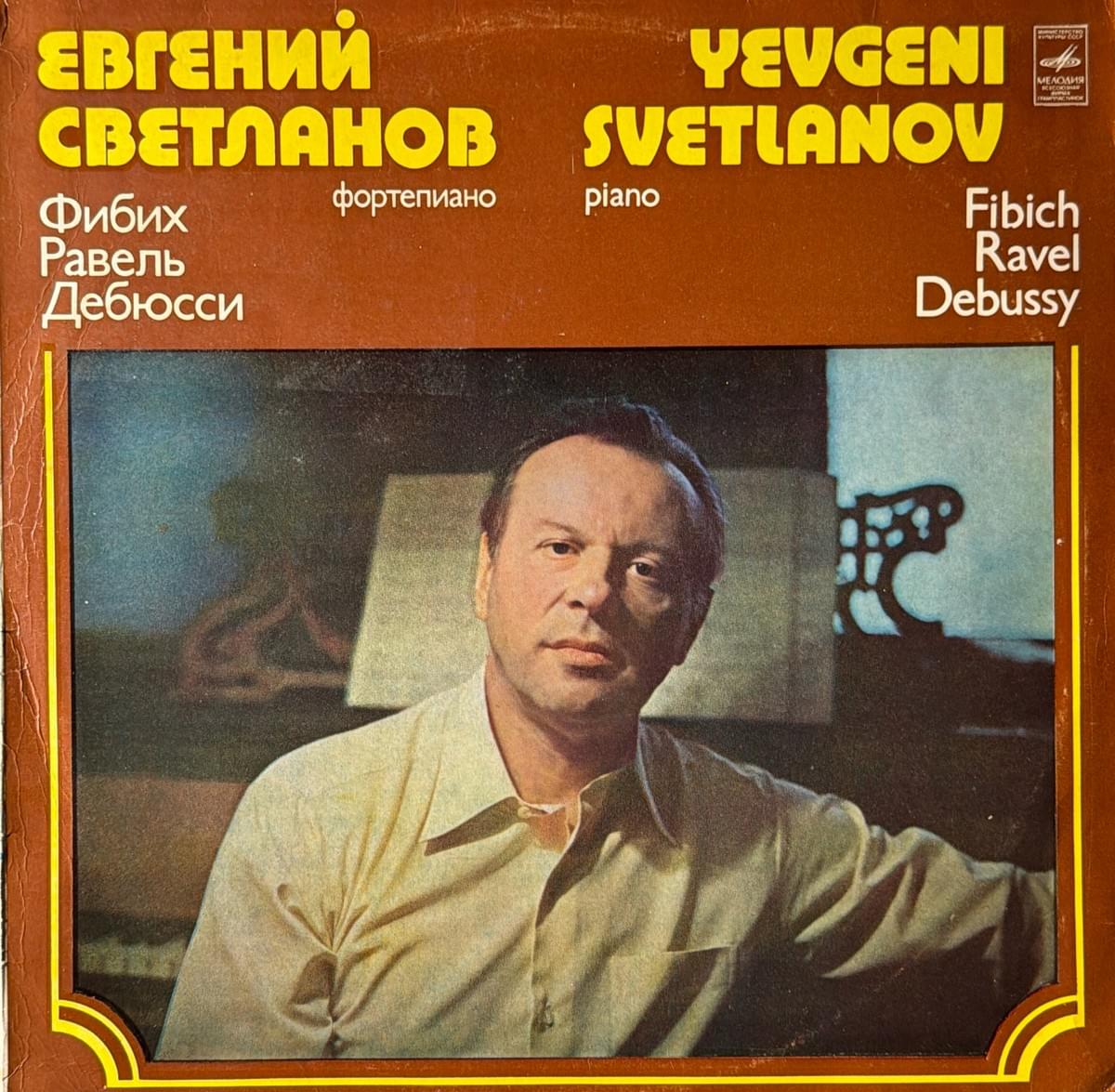
封套上沒有寫「蘇聯國家交響樂團首席指揮」。只寫了:葉夫根尼·史維特諾夫,鋼琴。
把這張唱片放上轉盤,你才會明白為什麼這個師承重要。菲比赫的《詩曲》和拉威爾的《帕凡公主之舞》,在他手下,雙手彈出了非常多的層次與細節,長線條的音樂起伏出弦樂般的質感。那是一種如歌似的唱法,讓音樂流動,意蘊深長——不像鋼琴家在彈琴,更像一個指揮家在用十根手指,指揮一個只有他自己才聽得見的樂團。
那張紅標Melodiya藏著什麼
今天古殿手裡這張,是Melodiya C10-15431,1981年壓製,紅色標籤,Melodiya C10高品質系列。
紅標「格拉姆扎比斯工廠製作」是整個Melodiya體系裡品質最高的——它製作的是全系統的母版,才向其他工廠輸出壓製矩陣。手裡這張,是從最靠近聲音源頭的位置壓出來的。
曲目是這樣的:
A面:
菲比赫(FIBICH,1850—1900):C大調《詩曲》
拉威爾:《帕凡公主之舞》帕凡舞曲
德布西:第一、二號《阿拉貝斯克》/前奏曲第十二首〈吟遊詩人〉/《比慢還慢》降G大調圓舞曲
B面:
德布西:〈乘船〉(《小組曲》第一樂章,奧列涅夫改編為鋼琴獨奏)/前奏曲第六首〈雪上足跡〉/前奏曲第十首〈沉沒的教堂〉/前奏曲第八首〈亞麻色頭髮的少女〉/《月光》(《貝加馬斯克組曲》第三樂章)
整張唱片,只有A面開頭的菲比赫和拉威爾各一首——其餘,全部是德布西。
A面以拉威爾《帕凡公主之舞》開場。那個緩慢的帕凡節奏,拉威爾自己後來說,它只是一首古雅的西班牙宮廷舞曲,不要賦予太多悲劇意涵。但在史維特諾夫彈的這個版本裡——一個俄羅斯指揮家,在生涯最繁忙的頂點,獨自在鋼琴前——那個緩慢,有另外一種意思。
B面末尾是德布西《月光》。德布西要求演奏者把踏板踩到底,讓泛音在空間裡漂浮,讓音符之間的沉默也成為音樂的一部分。在一個習慣了操控百人管弦樂隊的指揮家手中,這種只屬於一個人的細膩,以它的孤獨程度打中你。
他說:「對我而言,德布西和拉威爾是無可取代的作曲家。無論我的心情如何,我都隨時準備好去聆聽並演奏他們的音樂。」
這句話的意思是:這不是工作。這是愛。
大歐走了,他用音符說出了他能說的話
1974年10月24日,大衛·歐伊斯特拉夫(David Oistrakh,1908-1974)在阿姆斯特丹心臟驟停,死在那個異國城市。他那天早上還指揮完了一套勃拉姆斯音樂會。他的遺體被送回莫斯科,安葬於新聖女公墓。
史維特諾夫和大歐是多年老友。
他拿起筆,開始寫那首詩曲。
然後他做了一個讓所有人動容的決定:邀請大衛的兒子伊格爾來演奏這首悼念他父親的作品。
伊格爾·歐伊斯特拉夫(Igor Oistrakh,1931-2021),大衛之子,用他從小在那個家庭長大的那雙手,拉出了這首為父親而寫的音樂。那弓毛觸碰弦線的每一個瞬間,都帶著一個只有他才能帶來的重量。
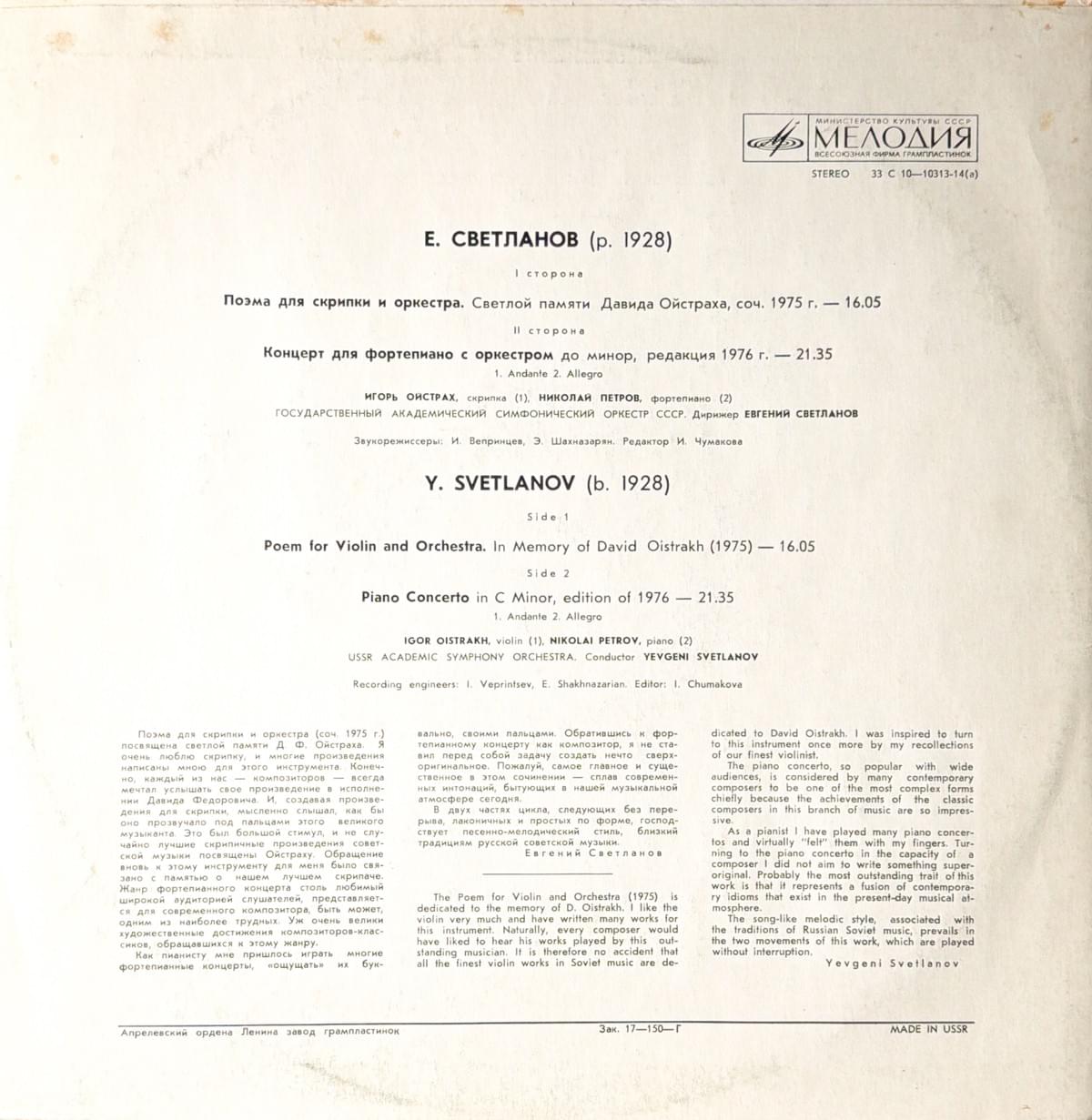
史維特諾夫在封底寫道:
「我非常喜愛小提琴,為這件樂器寫了很多作品。我的腦海中,總能想像出那些作品在大衛·費奧多羅維奇的手指下會如何鳴響。這是一個巨大的動力——所有最優秀的蘇聯小提琴音樂都獻給了奧伊斯特拉赫,這絕非偶然。」
這首紀念大歐的詩曲,Melodiya先後出了兩個版本,編號相同,封面不同。
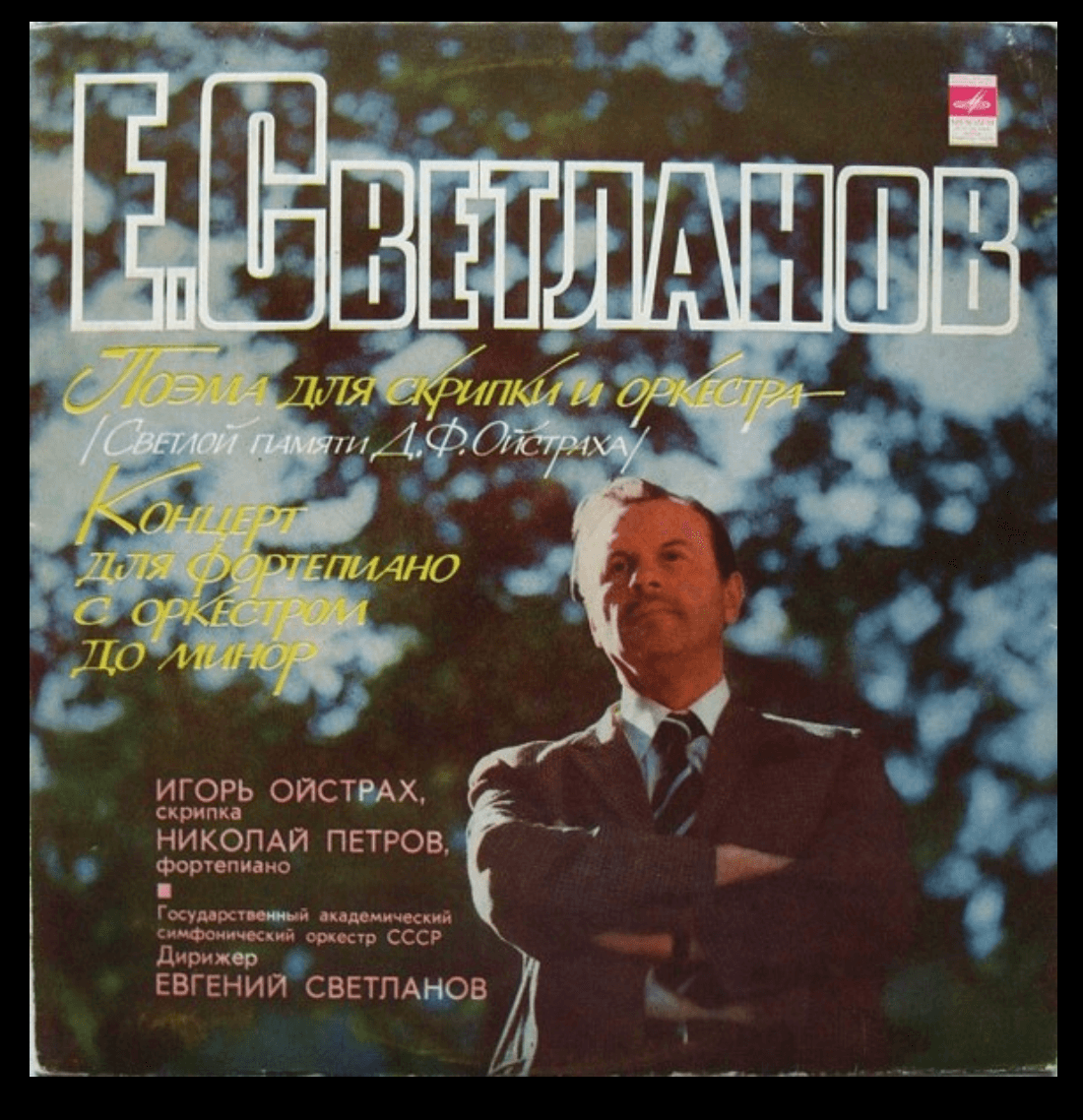
大量發行的那個,封面是史維特諾夫的肖像——作曲家的臉,這張唱片要說的是:作曲家史維特諾夫。
古殿手裡這張是限定150份製作的,封面是莫斯科音樂學院大廳入口的建築。沒有人臉。只有那棟樓。
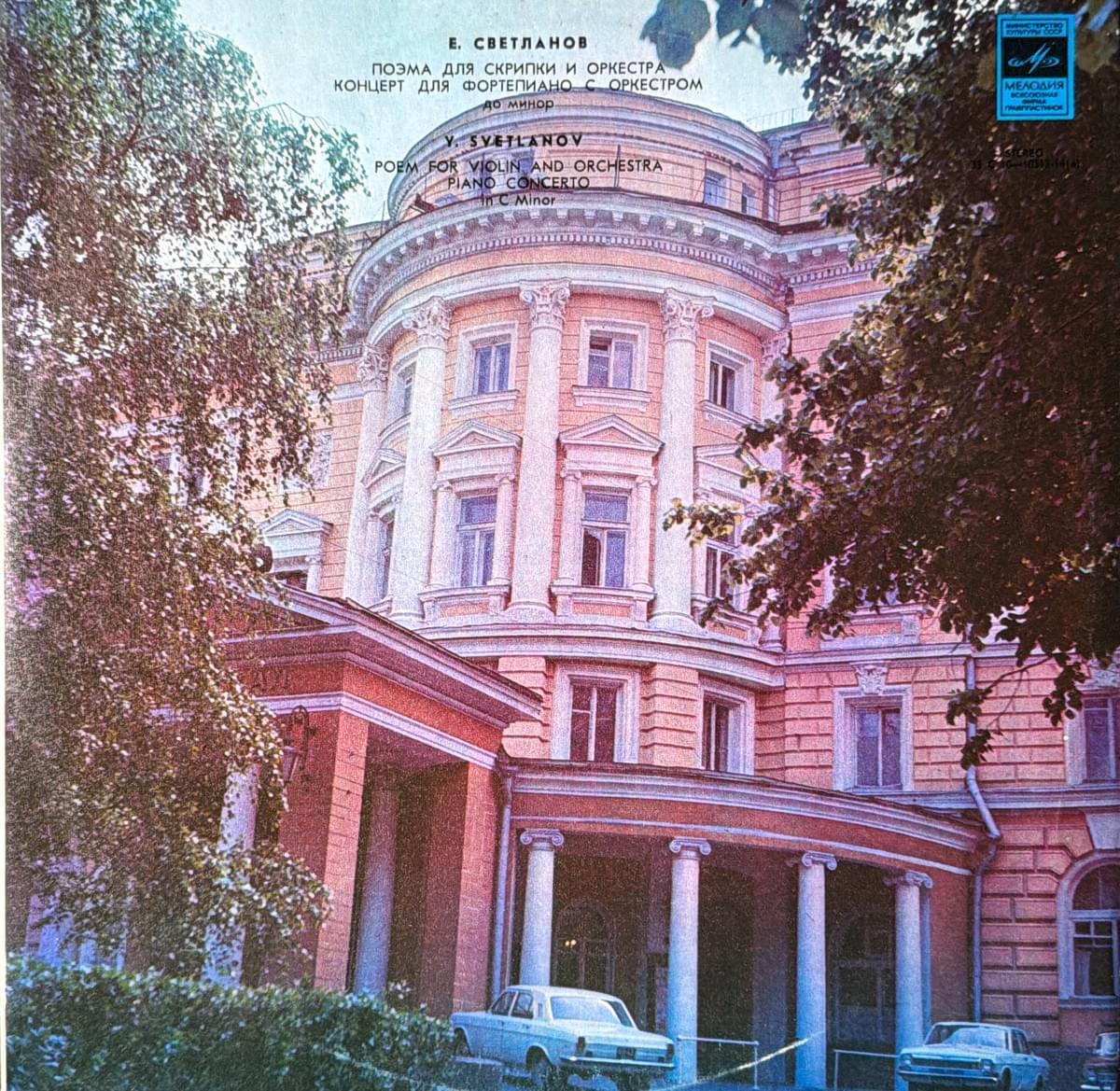
因為收到這張唱片的人,看到那棟樓,就知道這是什麼意思。那是史維特諾夫和大歐共同走出來的地方。
封底印著那個數字:150。殿主研究蘇聯黑膠這麼多年,從來沒有見過第二次。Melodiya就算最冷僻的學術品項,最小批量通常也在幾百份以上。這150份,當年根本不是拿來賣的——它們被直接送出去:送給親近的音樂家朋友、送給相關的文化單位。它從來不在任何唱片行的架子上出現過。
現在是2026年,距離這批唱片壓製已過了半個世紀。蘇聯垮了,那些收到唱片的人散了,東西輾轉流落各處。150份,經過五十年——破損的、遺失的、被丟棄的——保守估計,目前存世的可能不到一百張。悲觀一點,幾十張也有可能。
古殿手裡這一張,是其中之一。
評論家尼基塔·克里洛夫曾這樣描述這首音樂:
「從遠方,從虛無,從無邊的俄羅斯曠野,管弦樂團開始響起。然後,同樣悄悄地,小提琴加入。一個非常脆弱而尖銳的旋律被管弦樂輕柔地托住,之後,一段令人窒息的美麗旋律向我們走來,轉化為整個管弦樂團與獨奏者共同發出的強大聲音。」
這首詩曲的錄音,總譜現在由史維特諾夫遺產慈善基金會保存,研究者可以聯繫購買樂譜。後來也出過CD,串流平台上也找得到。
但你在串流平台上聽到的那個聲音,和這條溝槽裡的聲音,不是同一件事。
串流是數位檔案的複製。這張黑膠,是1970年代那個錄音室空氣振動的直接物理印記——史維特諾夫站在指揮台上的那個下午,伊格爾的弓毛觸碰弦線的那個瞬間,以完整的類比形式,就在這條溝槽裡。而且,全世界現在能找到的這個真正紀念大歐的最早的莫斯科音樂學院封面的版本,可能只剩幾十張。
兩種靈魂,同一個人
把這兩張唱片放在一起,你才看見一個完整的史維特諾夫。
那個每天掌控百人樂隊的指揮家,在沒有人看見的時候,獨自坐在鋼琴前面對德布西。彈奏著在生涯頂點仍然記得少年時代梅特涅師承傳下來的那種手感。那個在老友死去之後,不是發表演講,不是舉行紀念音樂會,而是拿起筆,用音符,寫下了他能說出的,最富有情感的音樂語言。
最偉大的音樂家,往往有一個只有他們的至親或至友才看得見的私密面。
史維特諾夫把兩個私密面,分別置入在這兩張唱片中。
******
【Ancient Palace Records — Music Stories】One Man, Two Souls (Pianist & Composer): When the Great Soviet Conductor Yevgeni Svetlanov (1928-2002) Sat Alone at the Piano...
After
one of his concerts, Aram Khachaturian (1903-1978) said something that made everyone in the room fall silent.
He didn't praise his conducting. He praised his piano playing.
"He is a magnificent pianist. It is a pity that we have so few opportunities to hear him in this capacity."
When those words were spoken, Yevgeni Svetlanov was already the chief conductor of the USSR State Symphony Orchestra, having recorded almost every major work of Russian music onto magnetic tape. He was one of the busiest conductors in the world, traveling across half the globe with a hundred-piece orchestra.
Yet, Khachaturian was saying: We hear him play the piano far too rarely.
He Was a Pianist First
This i
s a fact that almost everyone has forgotten.
During Svetlanov’s youth at the Gnessin Russian Academy of Music, his entire world revolved around the piano and his teacher, M. A. Gurvich. Gurvich, in turn, was a direct disciple of Nikolai Medtner (1880-1951). Medtner was Sergei Rachmaninoff’s lifelong closest friend—a man who refused to compromise with modernism throughout the 20th century, carrying the deep traditions of Austro-German Romanticism all the way to his passing in 1951.
Passed down from Gurvich’s fingers to Svetlanov’s fingers was a warm, living musical lineage.
Svetlanov later made a vow: to bring all of Medtner’s piano works to the stage. This vow remained hidden beneath the decades of his conducting career, never fully realized—the sheer weight of his conducting duties swallowed all his time.
Later, when he entered the Moscow Conservatory, he double-majored in conducting and composition, and his piano teacher became Heinrich Neuhaus (1888-1964).
You probably know a few of Neuhaus’s other students: Sviatoslav Richter and Emil Gilels. Svetlanov came from the exact same lineage—yet this is something almost no one ever mentions.
But those pianist's hands were never truly put down.
In 1980, Svetlanov was 52 years old. He was the most important conductor in the Soviet Union at the time. In that exact year, he walked into the Melodiya recording studio in Moscow. He brought no one with him; he just sat alone in front of the piano.
The repertoire was Claude Debussy and Maurice Ravel. Not Russian works.
The album jacket didn't bear the title "Chief Conductor of the USSR State Symphony Orchestra." It simply read: Yevgeni Svetlanov, Piano.
Only when you place this record onto the turntable do you truly understand why this lineage matters. Under his fingers, Fibich’s Poème and Ravel’s Pavane pour une infante défunte reveal incredible layers and details. The long, arching musical lines possess the rich texture of a string section. It is a cantabile, singing style that allows the music to flow with profound meaning—it doesn't sound like a pianist playing the piano; it sounds like a conductor using his ten fingers to lead an orchestra that only he can hear.
What Lies Hidden Within That Red-Label Melodiya?
The co
py we hold here at the Ancient Palace today is Melodiya C10-15431, pressed in 1981, featuring the red label from the high-quality Melodiya C10 series.
The red-label records "Made by the Aprelevka Factory" represent the absolute pinnacle of quality within the entire Melodiya system. This factory produced the master copies for the entire network before exporting the pressing matrices to other plants. The copy in our hands was pressed from a place closest to the original source of the sound.
Here is the tracklist:
Side A
Zdeněk Fibich (1850–1900): Poème in C Major
Maurice Ravel: Pavane pour une infante défunte
Claude Debussy: Deux Arabesques / Preludes, Book 1: No. 12 Minstrels / Valse (La plus que lente) in G-flat Major
Side B
Claude Debussy: En bateau (From Petite Suite, Mov. 1, arranged for solo piano by Olenev) / Preludes, Book 1: No. 6 Des pas sur la neige / No. 10 La cathédrale engloutie / No. 8 La fille aux cheveux de lin / Clair de lune (From Suite bergamasque, Mov. 3)
Aside from the single pieces by Fibich and Ravel that open Side A, the entire rest of the album is dedicated to Debussy.
Side A opens with Ravel’s Pavane. Ravel himself later remarked that it was merely an archaic Spanish court dance and shouldn't be given too much tragic weight. But in this version played by Svetlanov—a Russian conductor, at the absolute peak of his busiest years, alone at the piano—that slowness carries a completely different meaning.
The final track on Side B is Debussy's Clair de lune. Debussy required the performer to hold down the pedal completely, letting the overtones float in the air, allowing the silence between the notes to become a part of the music. In the hands of a conductor accustomed to controlling a hundred-piece orchestra, this kind of intimacy, belonging only to a single soul, strikes you with the sheer depth of its loneliness.
Svetlanov once said: "For me, Debussy and Ravel are irreplaceable composers. No matter what my mood is, I am always ready to listen to and play their music."
What this phrase really means is: This wasn't work. This was love.
King David Is Gone; He Spoke His Heart Through the Notes
On Oct
ober 24, 1974, David Oistrakh (1908-1974) suffered a sudden cardiac arrest in Amsterdam, passing away in that foreign city. Just that morning, he had finished conducting an all-Brahms concert. His body was returned to Moscow and laid to rest at the Novodevichy Cemetery.
Svetlanov and "King David" were old friends for many years.
Svetlanov picked up his pen and began to write a Poème.
Then, he made a decision that moved everyone deeply: he invited David's son, Igor, to perform this piece written in memory of his father.
Igor Oistrakh (1931-2021), using those hands raised in that very household since childhood, drew the bow across the strings to play the music written for his father. Every single moment the bow hair touched the strings carried a profound weight that only he could bring.
Svetlanov wrote on the back cover: "I love the violin very much and have written many works for this instrument. In my mind, I could always imagine how those pieces would sound under the fingers of David Fyodorovich. This was a tremendous motivation—it is no coincidence that all the finest Soviet violin music was dedicated to Oistrakh."
For this Poème dedicated to David Oistrakh, Melodiya released two subsequent versions with the same catalog number but different covers.
The widely distributed version features a portrait of Svetlanov—the face of the composer. That record wanted to say: Svetlanov the Composer.
The copy we have at the Ancient Palace is from a limited run of only 150 copies. The cover depicts the architectural entrance of the Great Hall of the Moscow Conservatory. No human faces. Just that building.
Because anyone who received this specific copy would look at that building and know exactly what it meant. That was the place from which Svetlanov and Oistrakh had walked out together.
The back cover is stamped with that very number: 150. In all my years researching Soviet vinyl, I have never seen this a second time. Even for the most obscure academic items, Melodiya’s smallest batch size was usually at least a few hundred copies. These 150 copies were never meant to be sold—they were given away directly to close musician friends and relevant cultural institutions. It never once sat on the shelf of any record store.
It is now 2026, half a century since these records were pressed. The Soviet Union has collapsed, the people who received these records have scattered, and these objects have drifted to various corners of the world. Out of those 150 copies, after fifty years of being damaged, lost, or discarded, a conservative estimate suggests that fewer than a hundred exist today. Pessimistically, there might only be a few dozen left.
The one in the Ancient Palace is one of them.
The critic Nikita Krylov once described this music: "From afar, from nothingness, from the boundless Russian steppes, the orchestra begins to sound. Then, just as quietly, the violin joins. A very fragile and sharp melody is gently cradled by the orchestra, and then, a breathtakingly beautiful melody approaches us, transforming into a powerful sound uttered together by the entire orchestra and the soloist."
The score of this recorded Poème is currently preserved by the Yevgeni Svetlanov Legacy Charity Foundation, and researchers can contact them to purchase the sheet music. It was later released on CD, and you can find it on streaming platforms as well.
But the sound you hear on a streaming platform and the sound inside these grooves are entirely different things.
Streaming is the duplication of digital files. This vinyl record is the direct physical imprint of the air vibrations in that 1970s recording studio. The very afternoon Svetlanov stood on the podium, the exact moment Igor's bow hair touched the string—it is all preserved right here in these grooves in its complete, pure analog form. Furthermore, this earliest Moscow Conservatory cover version, which truly commemorates David Oistrakh, likely has only a few dozen copies left worldwide.
Two Souls, One Man
When y
ou place these two records side by side, you finally see the complete Yevgeni Svetlanov.
The conductor who controlled a hundred-piece orchestra every single day, when no one was watching, sat alone in front of the piano to face Debussy—playing with that touch passed down from the lineage of Medtner from his youth, remembered even at the peak of his career. The man who, after his old friend passed away, didn't deliver a speech or hold a memorial concert, but instead picked up his pen to write out the most emotionally charged musical language he could speak through notes.
The greatest musicians often have an intimate, private side that only their closest kin or dearest friends ever get to see.
Svetlanov placed these two private sides separately into these two records.