
【古殿唱片音樂故事】先找回自己,再回到家鄉:霍洛維茲(Vladimir Horowitz,1903–1989)兩張黑膠裡,一段返老還童的生命敘事
古殿殿主
如果你聽到唱片開頭有一陣騷動,那不是壓片瑕疵
放上《Horowitz in Moscow》這張唱片,第一首史卡拉第奏鳴曲剛開始的幾秒鐘,你會聽到一陣不太尋常的雜音——像是有人在推擠、拉扯。
大多數黑膠收藏者遇到這種情況,第一反應是:這張壓片有問題,或者運送途中受潮變形了。
都不是。
那是1986年4月20日,莫斯科音樂學院大廳裡,蘇聯警察正試圖把一群沒有票、硬闖進二樓看台的音樂院學生架離現場的聲音。學生們寸步不讓,警察最終撤退妥協——於是音樂會就在這群「非法聽眾」的注視下,繼續進行。
這段被完整保留下來、沒有剪掉的雜音,其實是整張唱片裡最誠實的一段錄音。它告訴你,你手上這張黑膠,不是錄音室裡精雕細琢出來的產物——它是一個歷史現場,被直接實況地壓進了唱片溝槽裡。
而這,只是這兩張唱片故事的開頭。
一個81歲的老人,決定把自己家的客廳交給攝影機
要理解這段雜音為什麼會存在,得先從一年前說起。
這次「打開自己」不是一時興起,背後有幾層鋪墊。1982年到1983年間,霍洛維茲的復出音樂會表現並不理想——當時他正服用抗憂鬱藥物,藥效明顯干擾了演奏狀態,一度讓外界預期他會就此徹底息影。直到1985年,他戒掉了那些影響演奏的抗憂鬱藥物,經過幾年休養與居家調養,才重新覺得自己準備好了。
另一層鋪墊來自經紀人彼得·蓋伯(Peter Gelb,1953-)。蓋伯自1980年起擔任他的經紀人,一路協助他重返舞台——1982年重返睽違28年的倫敦,1985年又到米蘭、巴黎舉行闊別歐陸30年的獨奏會。把紀錄片拍攝和居家錄音安排在這個階段,某種程度上是一次「低風險復出」的設計:比起直接把81歲、狀態未知的鋼琴家推上音樂廳舞台,先在他熟悉、放鬆的居家環境裡錄下演奏,風險小得多。
同一年,他也結束了與RCA長達十年的合作,轉投 Deutsche Grammophon——對他而言,這既是錄音生涯的重新開始,也重新接上了1926年他國際生涯起步的漢堡。紀錄片取名《The Last Romantic》,呼應的正是三年前過世、生前常被稱為「最後的浪漫派」的另一位鋼琴巨匠魯賓斯坦(Arthur Rubinstein,1887–1982)——這個稱號轉移到霍洛維茲身上,也是蓋伯團隊為他打造「碩果僅存的浪漫派巨匠、重獲新生」形象的一部分。
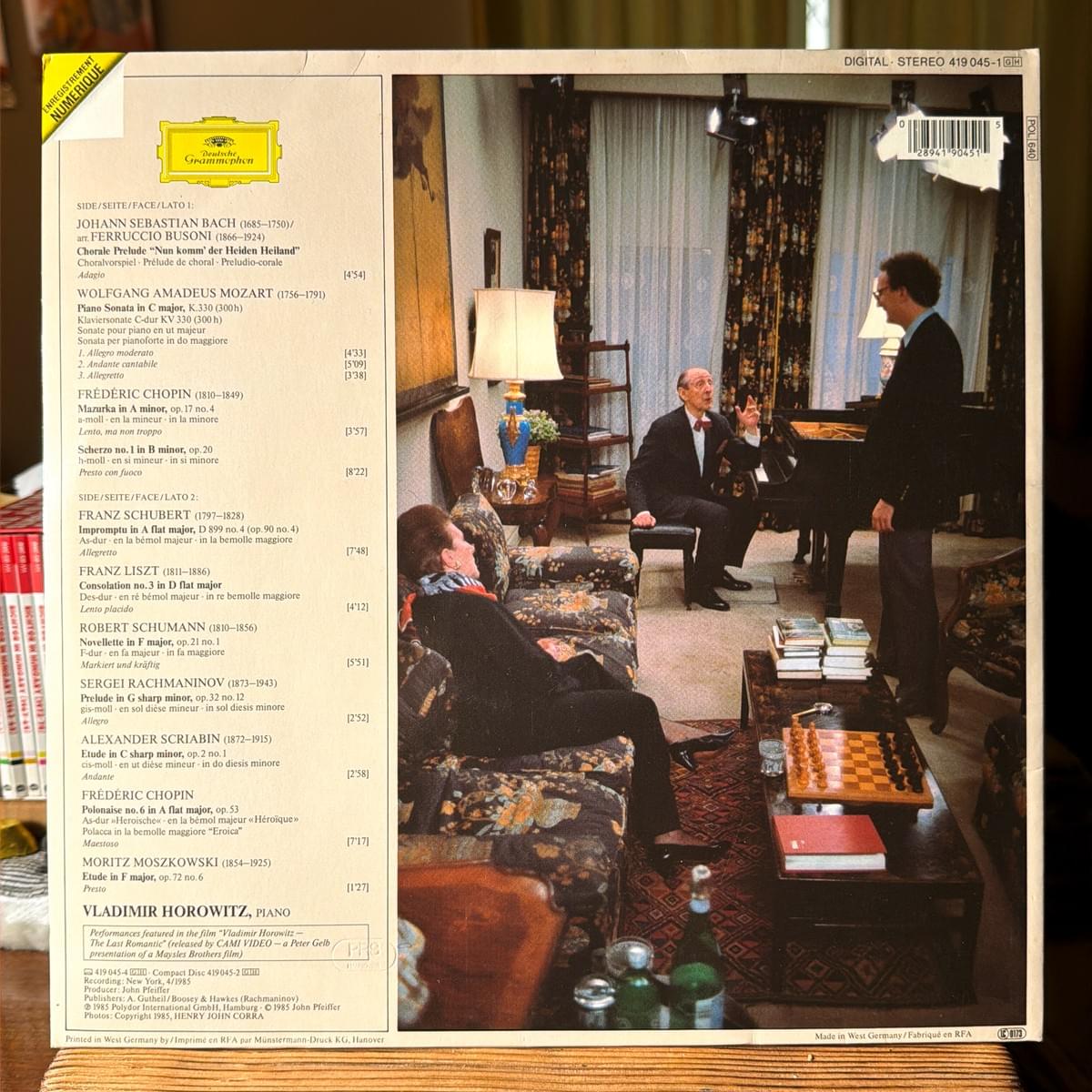
1985年4月19日,紐約下著小雨。霍洛維茲(Vladimir Horowitz,1903–1989)——81歲,已經歷過生涯中至少三次自我封閉、退出舞台,也曾在1980年代初期因為濫用藥物和酗酒導致演出品質低落——正坐在自己曼哈頓上東城公寓的工作室裡,讓人替他戴上無線麥克風。
他對錄音製作人約翰·菲佛(John Pfeiffer,1920–1996)說的第一句話是:「你今天可別指望能從我這錄到什麼。」
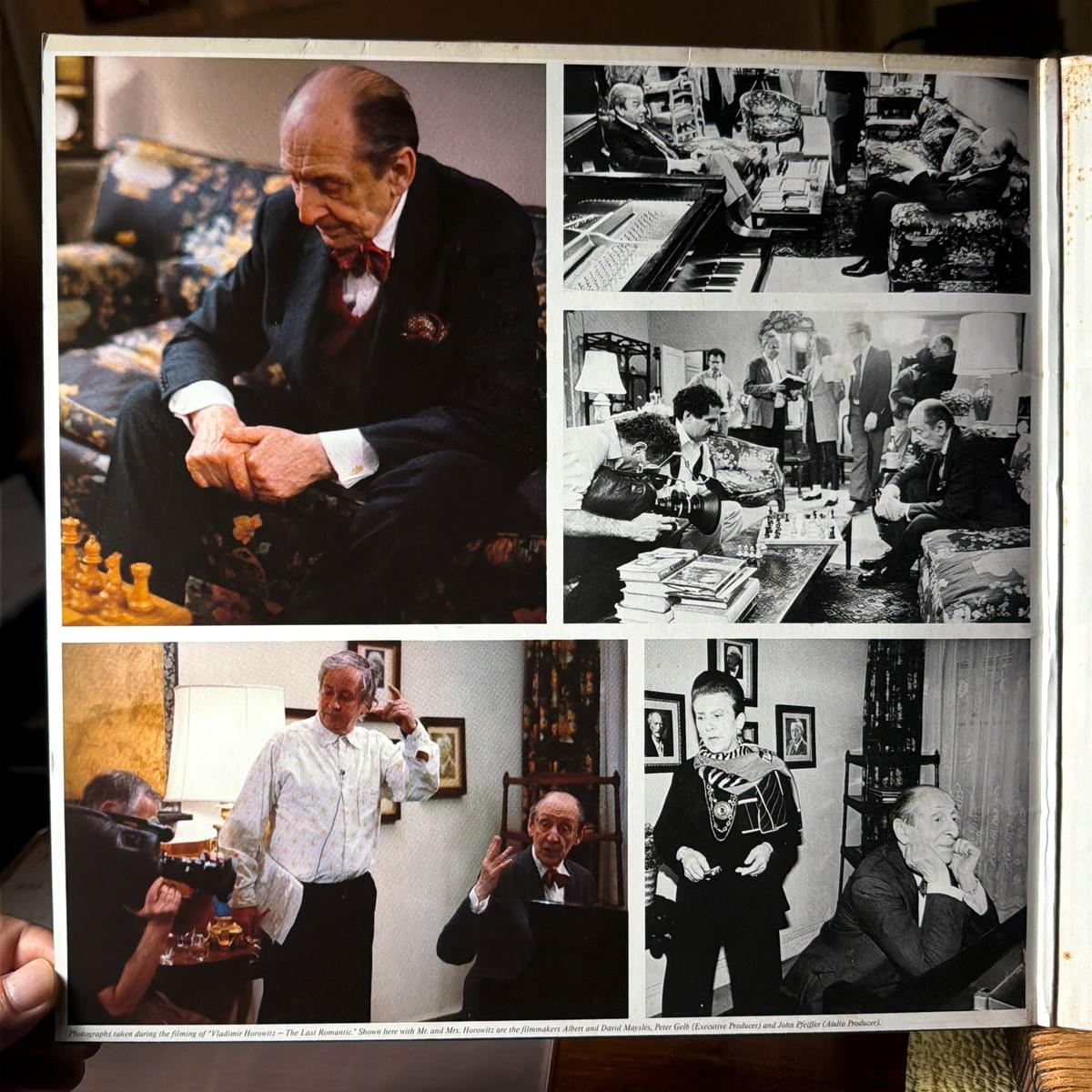
這不是一次普通的錄音。這是紀錄片《Vladimir Horowitz – The Last Romantic》的拍攝現場,由梅索斯兄弟(Albert Maysles,1926–2015;David Maysles,1931–1987)執導——這對兄弟正是美國「直接電影」(Direct Cinema)紀錄片傳統的奠基者,代表作包括《推銷員》與《灰色花園》,以「不介入、不擺拍」聞名。整套拍攝計畫,前置作業只花了一個月。
霍洛維茲的工作室在不到兩天內被改裝成片場兼錄音間。因為空調運轉聲音太大,必須整組關掉,房間因為燈光很快變成三溫暖。霍洛維茲夫人萬妲(Wanda Toscanini Horowitz,1907–1998)坐在一旁看著眼前這一切,說了一句意味深長的話:「既然是為了歷史性的盛事,那你們就儘管照辦吧。」
最耗人的,是霍洛維茲自己。他堅持絕不重複彈奏同一種詮釋——「我從來沒有兩次演奏得完全一樣」,這是他一輩子反覆說的一句話。這讓菲佛在挑選最佳版本時傷透腦筋:每次請他為了不同的攝影機位重奏一段,他總是驚訝地反問:「為什麼還要錄?剛才那一軌明明很好啊。」但他每次都耐心地重來一遍。
到了拍攝最後一天,攝影師甚至在他頭頂搭建了一個平台,只為了拍到「霍洛維茲自己俯瞰琴鍵的視角」。從旁邊看過去,整套裝置像一隻巨大的螳螂。開拍前,製作人一如往常透過對講機確認:「開機轉動了嗎?」霍洛維茲笑著回話:「我也準備開滾轉動了!」
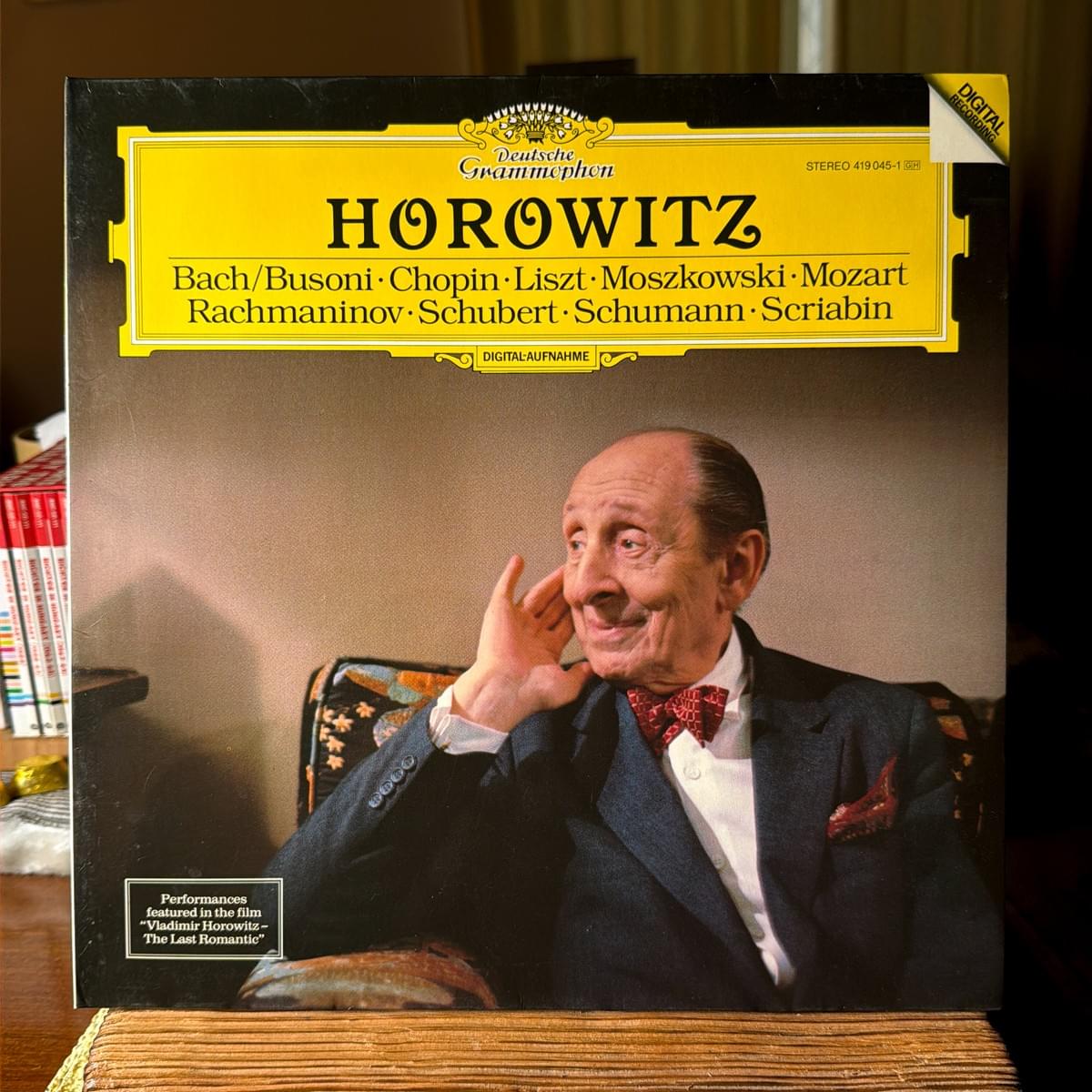
這張唱片——DG 419 045-1,西德首版,唱片編號結尾清楚標示為「-1」,以與CD版(-2)和卡帶版(-4)區別——就是這五天拍攝所留下的音樂:巴哈(Johann Sebastian Bach,1685–1750)/布梭尼(Ferruccio Busoni,1866–1924)改編、莫札特(Wolfgang Amadeus Mozart,1756–1791)、蕭邦(Frédéric Chopin,1810–1849)的馬厝卡與詼諧曲、舒伯特(Franz Schubert,1797–1828)、李斯特(Franz Liszt,1811–1886)、舒曼(Robert Schumann,1810–1856)、拉赫瑪尼諾夫(Sergei Rachmaninoff,1873–1943)、史克里亞賓(Alexander Scriabin,1872–1915),一直到收尾的蕭邦《英雄》波蘭舞曲。這些曲目都是他自己選的,它是霍洛維茲簽約 Deutsche Grammophon 之後的第一張專輯。
一年後,同一個人,飛回了闊別61年的祖國
如果這張唱片只是「一位老鋼琴家決定把私生活公開」,故事到這裡就結束了。但真正讓這兩張唱片連成一體的,是接下來發生的事。 1925年,22歲、來自基輔的霍洛維茲以「短期赴西歐巡演」為名離開蘇聯。邊境衛兵拍著他的肩膀說:「你出國期間,不要忘記你的祖國。」霍洛維茲當時鬆了一口氣——因為衛兵沒有要求他脫鞋檢查,鞋底藏著資助他歐洲巡演的美元。
他當時持有的出境簽證有效期限僅為六個月。然而這一去就是整整60年,他於1942年取得了美國國籍,並曾多次表示自己無意重返蘇聯。但隨著年歲漸長,他心中開始萌生**「死前想再看看俄羅斯一次」**的渴望。
但1985年那次「打開自己」,似乎鬆動了什麼。隨著美蘇兩國重啟文化交流協議(正是雷根(Ronald Reagan,1911–2004)與戈巴契夫(Mikhail Gorbachev,1931–2022)日內瓦高峰會後的產物),霍洛維茲半開玩笑地問經紀人彼得·蓋伯,自己能不能以「和平大使」的身份回鄉一趟。蓋伯向他保證一切都會按照「霍洛維茲式」的規格安排——入住美國大使官邸、隨行運送他自己的史坦威鋼琴、每天從巴黎空運新鮮的多佛鰈魚。霍洛維茲點頭了。因為霍洛維茲的意願,經紀人動用關係把這個想法報給白宮,當時正值美蘇博弈與和談的階段,美國政府透過談判把這個文化交流提到談判桌上。
1986年4月20日,82歲的他站上莫斯科音樂學院的舞台。公開發售的門票不到400張,一夜之間被搶購一空;其餘1800個座位,全數保留給政府官員與外交使節。彩排那天,台下擠滿了聞訊而來、沒有票的學生,正式演出當天,這群學生繞過安全防線,衝進二樓看台——也就是我們在唱片開頭聽到的那陣雜音的由來。
演出當週,正逢美國空軍轟炸利比亞、蘇聯強烈抗議、全球電視畫面整整一週充斥戰爭影像的高度緊張時刻。而就在同一批電視螢幕上,突然出現了一位82歲的美國鋼琴家,正為滿場俄羅斯觀眾深情彈奏舒曼《夢幻曲》作為安可。紐約的電視評論家安德魯·魯尼(Andy Rooney,1919–2011)在隔天專欄裡寫下,鏡頭切到台下一位蘇聯觀眾的臉——他閉著眼,一滴眼淚滑落——「那一滴淚水,正與我臉上滑落的一模一樣。」
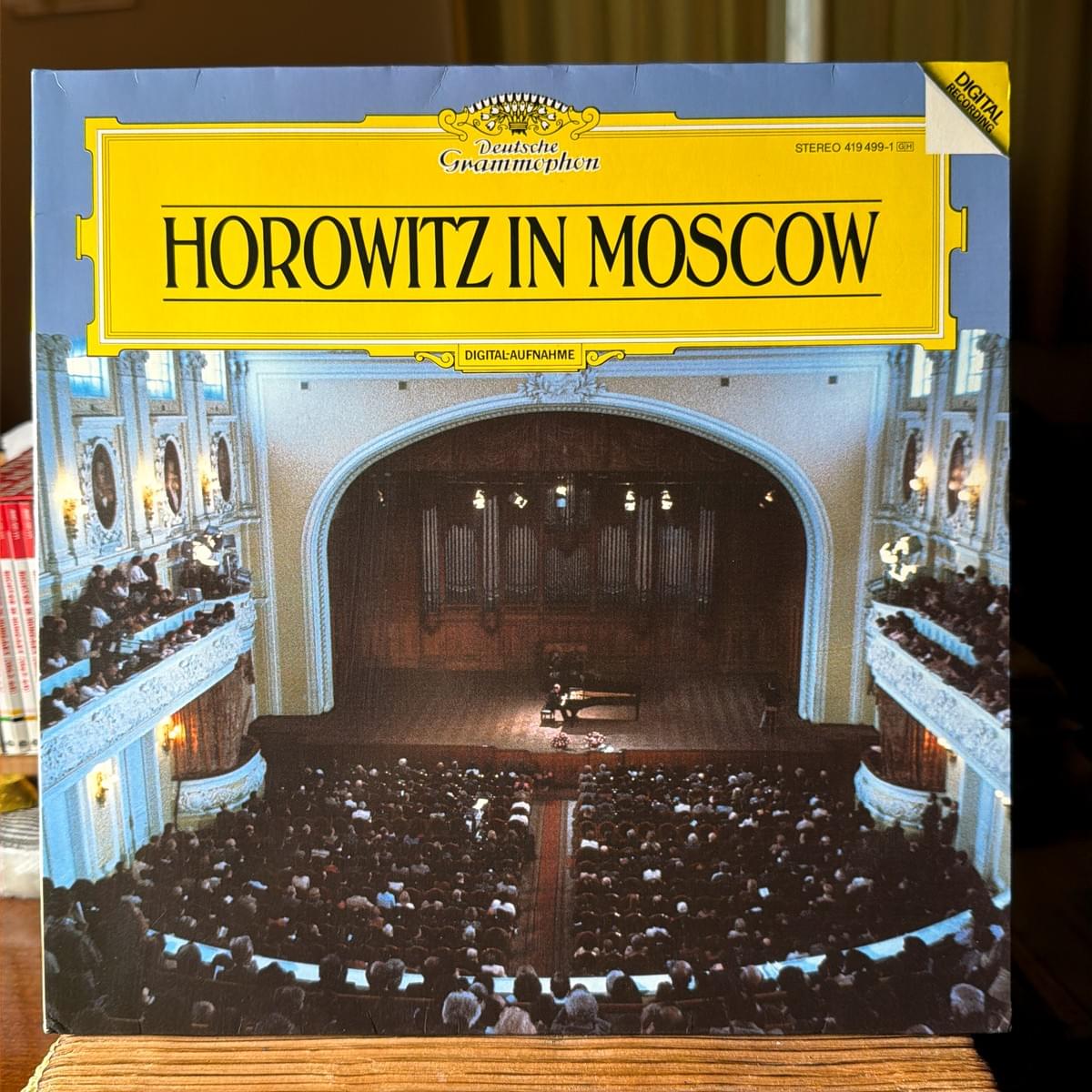
這場音樂會由哥倫比亞藝術經紀公司與 DG 聯合製播,全球電視轉播;唱片編號 419 499-1,錄音師湯瑪斯·佛羅斯特(Thomas Frost,1925–2026),同樣是西德首版。它後來在1988年拿下葛萊美最佳古典專輯獎與最佳器樂獨奏演出獎;同名紀錄片則入圍艾美獎。
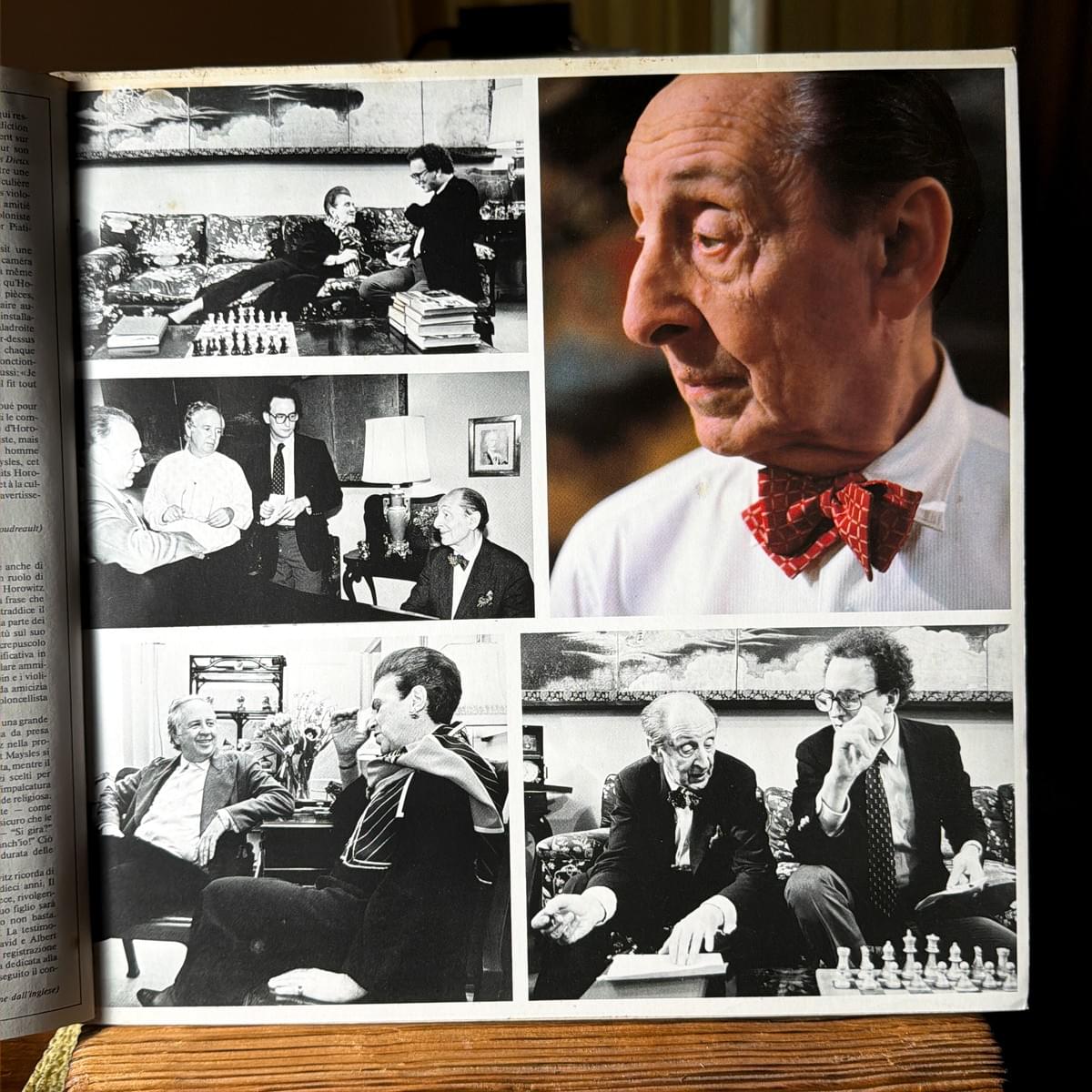
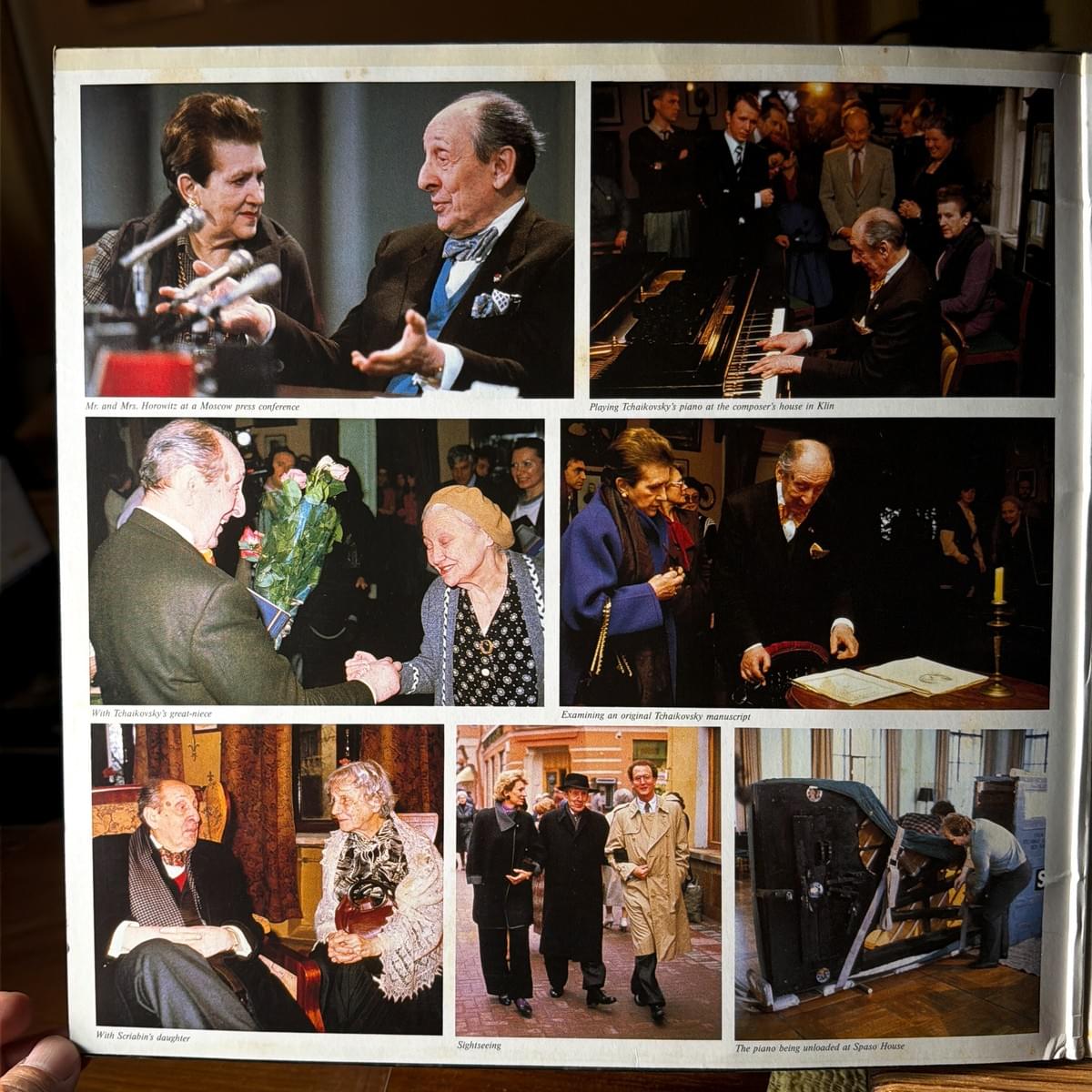
這兩首壓軸的史克里亞賓練習曲,會出現在這張唱片的曲目裡,其實也不是巧合。霍洛維茲十歲那年,曾經被安排彈給史克里亞賓本人聽——因為他的舅舅正是史克里亞賓的學生與摯友。這段淵源,不只解釋了曲目為何會選史克里亞賓,也讓封套內頁那張「與史克里亞賓之女會面」的照片,讀來別具意義。另一張「在柴可夫斯基故居克林彈奏他鋼琴」的照片裡,站在一旁陪同的年輕人,正是1978年柴可夫斯基大賽金牌得主普雷特涅夫(Mikhail Pletnev,1957-)——同樣不是隨手拍下的路人。
發燒圈的試金石——這張黑膠為什麼特別難播好
如果你在黑膠發燒圈待過,可能聽過《Horowitz in Moscow》這張黑膠的另一個身份——不是「歷史唱片」,而是系統調校的「試金石」。
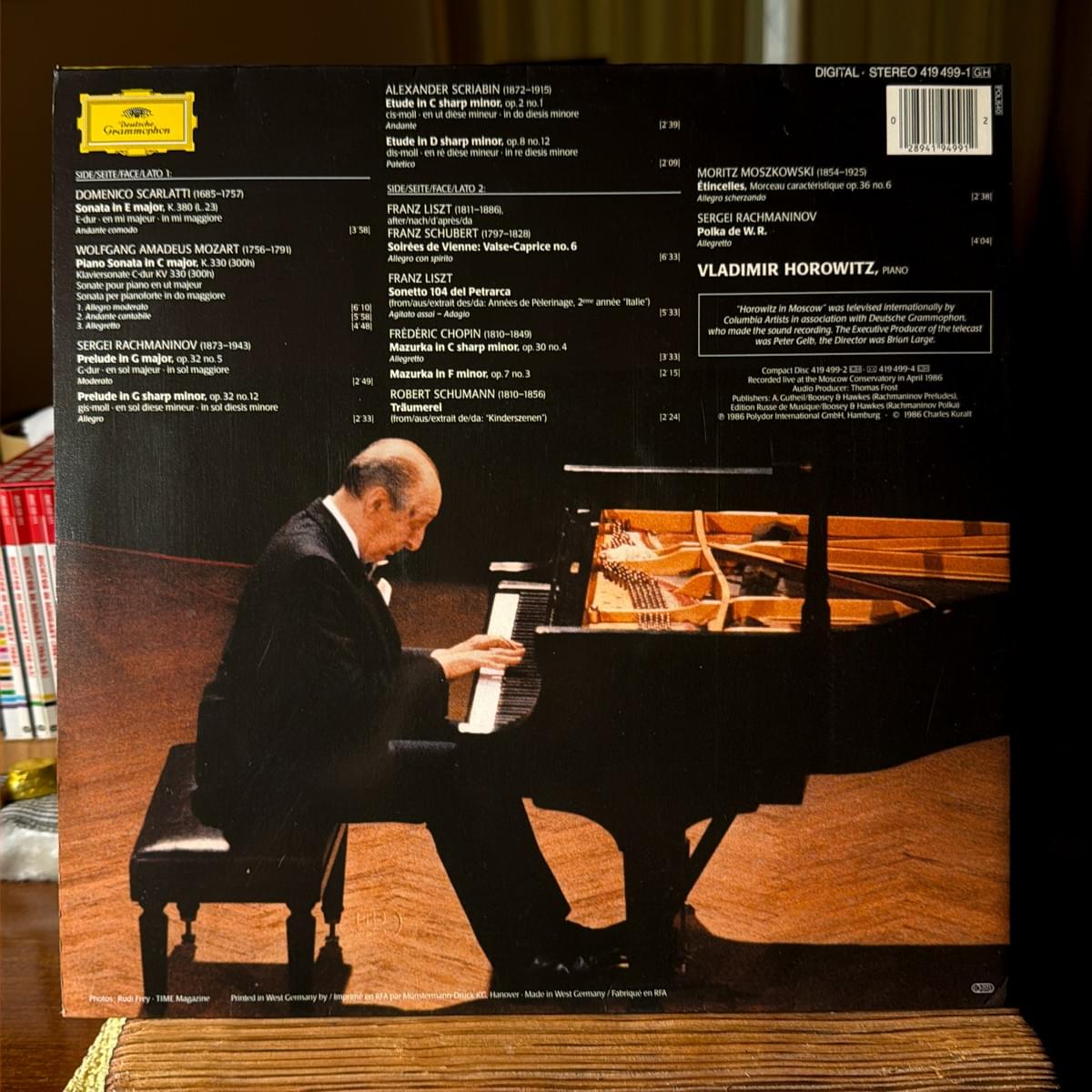
原因藏在唱片本身的物理條件裡。把第一面標籤上的曲目時間加起來:史卡拉第3'58、莫札特三個樂章6'10、5'58、4'48、拉赫曼尼諾夫兩首前奏曲2'49、2'33、史克里亞賓兩首練習曲2'39、2'09,總長大約31分鐘——比一般黑膠一面常見的20分鐘出頭,多出近三分之一。
33⅓轉黑膠要在同一面塞進更多分鐘,溝槽必須刻得更密,原始刻片時能容許的動態與刻痕深度,也就必須相應收窄——鋼琴恰好是最考驗這件事的樂器:踏瓣延音、突強和弦、大跨度的音域,全都需要夠深的溝槽才能忠實刻下。
更關鍵的是曲目順序:整面壓軸的兩首史克里亞賓練習曲,剛好落在唱片的最內圈。內圈半徑最小,唱針在同樣角速度下要應付的線速度變化最劇烈,循軌誤差與失真風險本來就比外圈高;再加上前面莫札特、拉赫曼尼諾夫已經佔用了大半刻片動態空間,留給這兩首練習曲的餘裕就更有限。
這就是為什麼,這張黑膠在發燒圈變成一塊試金石——能不能把最內圈的史克里亞賓乾淨、不失真地播出來,幾乎成了檢驗一套黑膠系統(唱盤水平、循軌力、抗滑、唱頭校準)調整得夠不夠精確的公開擂台。不少發燒友會特地錄下自己完整播過這兩首的成果,當作某種通關證明。
值得一提的是,1986年黑膠出版的同時,CD已經問世——這張唱片正是以LP(419 499-1)、CD(419 499-2)、卡帶(419 499-4)三種格式同步發行的。DG完全可以讓習慣聽數位無失真版本的樂迷改聽CD;但黑膠版本依然照原樣壓製,把這個物理極限留在了溝槽裡,沒有迴避。
還有一件事,是很多人挑戰這張唱片時容易忽略的:市面上流通的原版二手黑膠,大多數在你拿到手之前,已經被前任主人反覆播放過。第一面通常會比第二面先聽、聽得更多次;再加上內圈本來就是磨耗最快、也最難維護的位置——史克里亞賓練習曲,剛好又座落在這個位置。也就是說,很多「播不乾淨」的案例,未必是系統沒調好,而是唱片本身內圈早已磨損。真正能拿來當作系統調校基準的,得是一張幾乎沒被播放過、接近全新狀態的原版。
這兩張黑膠,其實是同一段生命敘事的前後兩章
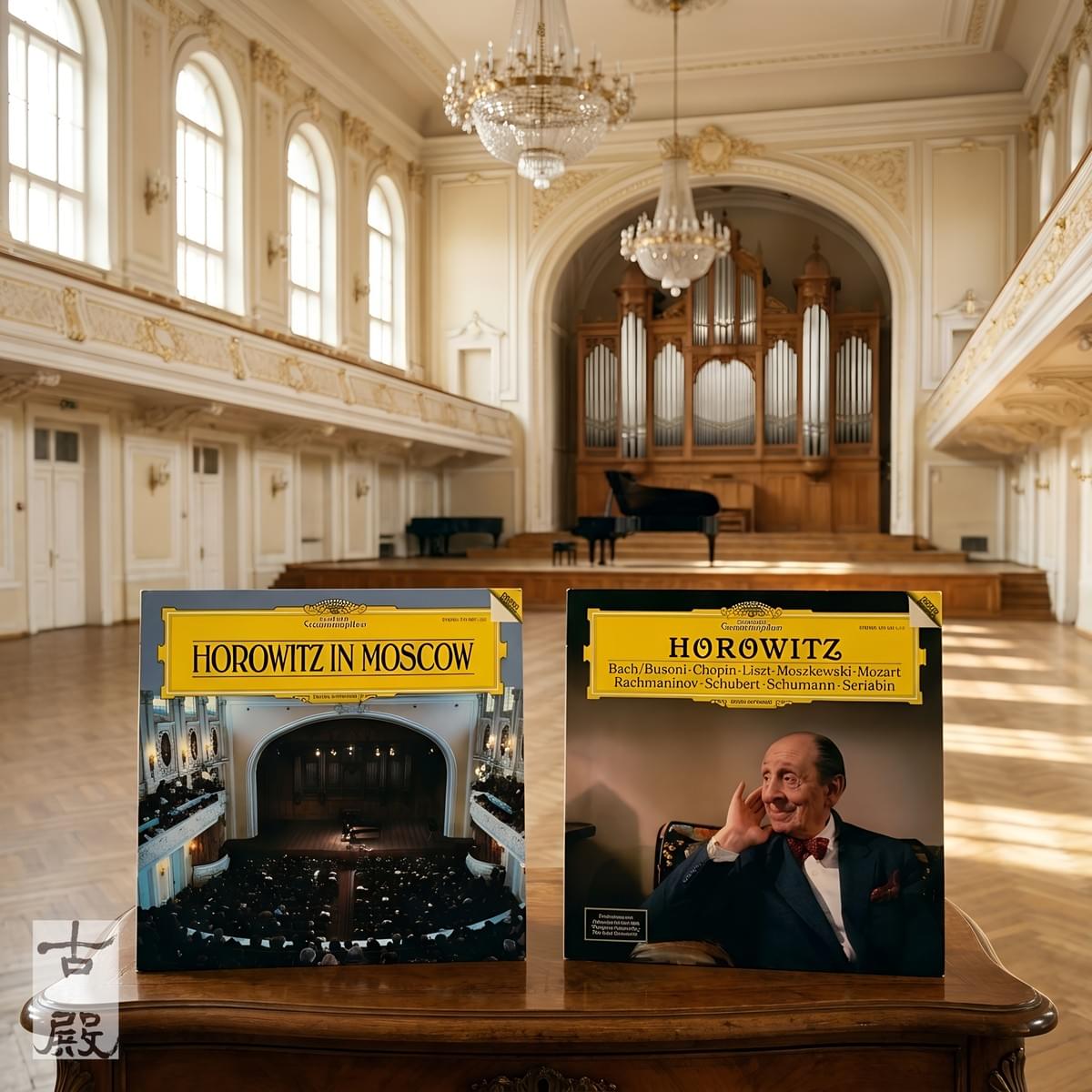
把兩張唱片並排放在一起看,你會發現一個很難不注意到的結構:
1985年,在紐約自己家的客廳裡,一個81歲的人先「找回了自己」;1986年,他帶著找回的那個自己,回到了闊別61年的莫斯科舞台。前者是私密空間的開放,後者是公共舞台的復歸——兩個動作,其實是同一件事的兩個階段。
而且,兩張唱片都不是在錄音室完成的。一張是在自己家客廳裡、以紀錄片拍攝現場的形式錄下;另一張是在音樂會現場實況收音。兩張都同步搭配了完整的影像作品,也都各自拿下音樂與影視兩邊的獎項——這在整個古典唱片史上,其實是相當罕見的組合,應該可以說是前所未見。但這真的是一個天時地利人和的組合,缺一不可——背後有那個時代特有的背景與各種因素合起來的需求與緣故,各方面都百分之百投入了非常巨大的資金與人力物力,才得以達成——這在今天,幾乎已經不可能再發生了。
值得說清楚的是,這兩張唱片並不是霍洛維茲人生的終點,而是一連串「返老還童」的開端。這次復出之後,他又持續在 DG 錄下多張錄音室專輯,一路彈到生命最後階段。他真正的最後一次錄音,其實是在1989年,他重新回到年輕時代簽約過的 CBS(此時已併入 Sony),用當時最新的20bit數位錄音技術完成的一張專輯——錄音時他精神狀態依然極佳。錄完幾天後,他在睡夢中安詳辭世,享壽86歲。
也就是說,1985年那個悶熱的紐約客廳,開啟的不是一段終章,而是他人生最後、也最燦爛的一段黃金歲月的序幕。
這段與 DG 的合作,後續還產出了《The Studio Recordings, New York 1985》、《Horowitz Plays Mozart》,直到晚年的《Horowitz at Home》與《Horowitz in Hamburg》——形成他晚年藝術生命裡最完整的一套錄音檔案庫。2019年,適逢他辭世30週年,DG特別將這批唱片(包括本文這兩張)重新壓製成180克黑膠,正是這套「晚年錄音體系」持續被珍惜的證明。
******
【Gudian Music Stories】Finding Oneself Before Returning Home: Vladimir Horowitz (1903–1989) and a Narrative of Rejuvenation Across Two Vinyl Records
If You Hear Commotion at the Opening, It Isn’t a Pressing Defect
Lower the stylus onto Horowitz in Moscow. In the first few seconds, just as the opening Scarlatti sonata begins, you catch an unusual ripple of background noise—the unmistakable sound of shoving, scuffling, and muffled struggle.
For most vinyl collectors, the instinctive reaction is dismay: a bad pressing, or a disc warped by humidity during transit.
Neither is true.
What you are hearing took place on April 20, 1986, inside the Great Hall of the Moscow Conservatory. Soviet police were attempting to forcefully eject a crowd of ticketless conservatory students who had broken their way into the second-tier balcony. The students held their ground, refusing to budge an inch. Outmatched by sheer will, the police backed down—and the concert proceeded under the intense, watchful gaze of this "unauthorized" audience.
That noise—left entirely intact and uncut in the final release—is the single most honest passage on the entire record. It reminds you immediately: the vinyl spinning under your needle is no sterile, airbrushed studio creation. It is an unvarnished historical scene, stamped directly into the grooves.
And that is merely the opening measure of a much larger story spanning two companion albums.
An 81-Year-Old Man Decides to Surrender His Living Room to the Cameras
To understand why that noise exists at all, one must wind the clock back by a single year.
This willingness to open himself up did not happen overnight. Between 1982 and 1983, Horowitz’s comeback concerts had been painful to witness. Doped on prescribed antidepressants, his playing suffered severely from erratic motor control and sluggish memory, leading many critics to assume he would retire from the concert platform for good. By 1985, however, he had weaned himself off the medication. After several years of quiet domestic rest and convalescence, he finally felt ready again.
Another crucial factor was his manager, Peter Gelb (b. 1953). Having managed Horowitz since 1980, Gelb had steadily guided his steps back to the stage—first to London in 1982 after a 28-year absence, and then to Milan and Paris in 1985 for recitals that marked his return to continental Europe after three decades. Framing this domestic recording session as a documentary was, in truth, an ingenious, low-risk comeback strategy: rather than immediately throwing an 81-year-old pianist of unpredictable temperament before a hall of paying patrons, capturing his playing inside his own comfortable, familiar living room presented far fewer hazards.
That same year, Horowitz severed his decade-long association with RCA and signed with Deutsche Grammophon. To him, this meant not only a fresh chapter in his recording career, but also an emotional reconnection to Hamburg, the city where his international career had caught fire in 1926. The documentary was christened The Last Romantic—a deliberate nod to Arthur Rubinstein (1887–1982), who had passed away three years earlier and had long carried that moniker. Bestowing the title upon Horowitz was a deliberate stroke of branding by Gelb's team: presenting him as the sole surviving colossus of the Romantic tradition, reborn before the world.
On April 19, 1985, a gentle rain fell across New York City. Vladimir Horowitz—now 81, a man who had weathered at least three periods of deep self-imposed seclusion and whose early-1980s recitals had been compromised by pharmaceutical dependency—sat quietly in his Upper East Side Manhattan townhouse studio, letting technicians strap a wireless microphone to his chest.
The first words he muttered to his longtime recording producer, John Pfeiffer (1920–1996), were dry and dismissive: "Don't expect to get anything out of me today."
This was far from an ordinary recording session. It was the film set for Vladimir Horowitz – The Last Romantic, directed by the legendary Maysles brothers (Albert Maysles, 1926–2015; David Maysles, 1931–1987). As pioneers of the American Direct Cinema movement, renowned for masterpieces like Salesman and Grey Gardens, their golden rule was strictly hands-off: no intervention, no staged shots. The entire production had been assembled with a mere month of prep time.
Horowitz’s living room studio had been retrofitted into a hybrid soundstage and recording booth within 48 hours. Because the air conditioning units hummed far too loudly for the microphones, the cooling had to be shut off completely. Under the blazing studio lights, the drawing room rapidly turned into a sauna. Wanda Toscanini Horowitz (1907–1998), seated in a corner watching the chaos, uttered a wry, pragmatic remark: "Since this is for a historic event, you might as well go ahead and do whatever you need."
Yet the most exhausting element in the room was Horowitz himself. He adamantly refused to play any piece the same way twice. "I never play anything twice the same," was an artistic axiom he repeated his entire life. This drove Pfeiffer to near despair when attempting to assemble a cohesive master take: whenever Horowitz was asked to repeat a passage for a different camera angle, he would look up in genuine bewilderment and ask, "Why record it again? The one I just played was wonderful!" Yet, without fail, he would sit back down and play it once more with infinite patience.
On the final day of filming, the camera crew went so far as to rig an overhead platform suspended directly above the piano keys, solely to capture the keyboard from Horowitz’s own point of view. Viewed from the side, the contraption looked like a giant mechanical praying mantis. Just before the tape began rolling, Pfeiffer ran through his routine radio check: "Are you rolling?" Horowitz beamed back into the microphone: "I'm ready to roll, too!"
That record—catalog number DG 419 045-1, West German first pressing (the "-1" suffix explicitly distinguishing it from the "-2" CD and "-4" cassette issues)—was the sonic yield of those five intense days: Bach arranged by Busoni, Mozart, Chopin's mazurkas and scherzo, Schubert, Liszt, Schumann, Rachmaninoff, Scriabin, and closing with Chopin’s "Heroic" Polonaise. Every piece was hand-picked by the maestro himself. It stood proudly as his inaugural release for Deutsche Grammophon.
A Year Later, the Same Man Flew Back to the Homeland He Left 61 Years Ago
Had this release simply been the story of an aging maestro opening his private sanctuary to the public, the tale might have ended there. But what welds these two albums into an inseparable whole is what unfolded next.
In 1925, a 22-year-old Horowitz departed Soviet Ukraine from Kyiv under the guise of a "brief Western European concert tour." At the border, an officer clapped him on the shoulder and said, "When you are abroad, do not forget your motherland." Horowitz breathed an internal sigh of relief—the guard had not asked him to take off his shoes, in the soles of which he had concealed American dollars to fund his European travels.
His exit visa was valid for just six months. Yet that departure stretched into an exile of sixty full years. He became an American citizen in 1942 and repeatedly insisted he had no desire to ever return. But as old age deepened, an undeniable yearning began to stir within him: "Before I die, I want to see Russia one last time."
The catharsis of opening himself up in 1985 seemed to have loosened something locked tight within his spirit. As the cultural exchange accords between the US and the USSR thawed following the historic Geneva Summit between Ronald Reagan and Mikhail Gorbachev, Horowitz half-jokingly asked Peter Gelb whether he might return home as an "ambassador of peace." Gelb assured him that every detail would be tailored to "Horowitzian" standards—residing in the private quarters of the US Ambassador, shipping his personal Steinway D across the Atlantic, and flying in fresh Dover sole from Paris every single day. Horowitz gave his nod. Spurred by his willingness, his management pulled strings at the White House; amid the high-stakes geopolitical maneuvering and détente of the era, the American government officially tabled Horowitz's musical return as part of the cultural negotiation package.
On April 20, 1986, at 82 years of age, he walked out onto the stage of the Moscow Conservatory. Fewer than 400 tickets had been placed on public sale, vanishing overnight; the remaining 1,800 seats were reserved strictly for party bureaucrats and foreign diplomats. During rehearsals, the hall had been ringed by hundreds of young conservatory students desperate for a glimpse. On the day of the recital, these students slipped past the security barricades and stormed the second-floor gallery—giving rise to the very commotion immortalized at the start of our record.
That recital took place in a week of razor-sharp international tension: American warplanes had just carried out air strikes on Libya, Soviet officials were issuing blistering diplomatic protests, and world news broadcasts were filled with harrowing war footage. And yet, across those very same television screens, the world suddenly witnessed an 82-year-old American pianist playing Schumann’s Träumerei as an encore for a weeping hall of Russian listeners. Andy Rooney (1919–2011), the veteran CBS commentator in New York, wrote the next morning of a shot of a Soviet gentleman in the hall with eyes closed and tears rolling down his cheeks: "That tear falling down his face was the exact same tear falling down mine."
Co-produced by CAMI and DG, the concert was beamed worldwide via satellite; pressed as catalog number 419 499-1 and engineered by Thomas Frost (1925–2026), it too was a West German first pressing. It went on to sweep the 1988 Grammy Awards for Best Classical Album and Best Instrumental Soloist Performance, while its companion film garnered an Emmy nomination.
The inclusion of the two closing Scriabin études on this album was anything but arbitrary. At age ten, young Vladimir had been brought to play for Alexander Scriabin in person—Horowitz’s uncle had been Scriabin’s devoted student and close friend. This lineage explains not only the choice of repertoire, but also imbues the gatefold photograph inside the jacket—showing Horowitz meeting Scriabin’s daughter—with profound historical weight. In another photo, depicting Horowitz playing Tchaikovsky's personal piano at his home in Klin, the young man standing respectfully at his side is none other than Mikhail Pletnev (b. 1957), Gold Medalist of the 1978 Tchaikovsky Competition.
The Audiophile Crucible: Why This LP Is Notoriously Difficult to Track
If you move in audiophile circles, you likely know Horowitz in Moscow not merely as a historic landmark, but as a ruthless "litmus test" for vinyl playback systems.
The reason is etched directly into the physical geometry of the medium. Tally the track timings on Side One: Scarlatti at 3'58", three movements of Mozart totaling 16'56", two Rachmaninoff preludes totaling 5'22", and two Scriabin études totaling 4'48". The cumulative playing time approaches 31 minutes—nearly a third longer than the conventional 20-to-22-minute ceiling for a single side of an LP.
To squeeze over half an hour of audio onto a single 33⅓ RPM vinyl side, the sound grooves must be cut exceptionally close together. In doing so, the cutting lathe must dramatically restrict the maximum groove swing (lateral dynamics) and depth. The piano is the single most unforgiving instrument under these constraints: sustained damper pedals, explosive sforzando chords, and wide-ranging registers all demand deep, well-spaced physical grooves to be faithfully inscribed.
Making matters far more precarious is the running order: the grand climax of Side One—the two ferocious Scriabin études—sits right at the absolute innermost grooves of the disc. The inner radius presents the tightest circumference; the stylus must negotiate the sharpest drop in linear velocity while maintaining the same rotational speed, making tracking error and tracing distortion vastly higher than along the outer edge. With Mozart and Rachmaninoff having already eaten up the lion's share of dynamic real estate, the mechanical headroom left for those two concluding études was razor-thin.
This is precisely why this record became a torture track for high-end analog rigs. Whether a turntable can resolve those innermost Scriabin tracks cleanly, without mistracking or breakup, has long served as a trial by fire for tonearm geometry, tracking force, anti-skate bias, and cartridge alignment. Many seasoned audiophiles take pride in recording their turntables clearing these two tracks without distortion, treating it as an official badge of system setup mastery.
Remarkably, by the time this LP hit shelves in 1986, the Compact Disc had already arrived. DG issued the recording simultaneously across LP (419 499-1), CD (419 499-2), and Cassette (419 499-4). The label could easily have directed purists toward the distortion-free digital medium; instead, they cut the vinyl without compromise, pressing the physical limitations of the analog groove directly onto lacquer.
There is another reality that collectors often miss: most vintage original copies on the secondary market have already been spun hundreds of times by previous owners. Side One was inevitably played far more frequently than Side Two, and the innermost band is always the first area to suffer irreparable groove wear from misaligned needles. Thus, when an audiophile hears breakup on those Scriabin études, it is often not a flaw of their setup, but physical damage left behind by decades of playback. To truly use this record as a reliable tuning benchmark, one must seek out a virtually unplayed, pristine copy.
Two Records, One Narrative: Two Acts of a Single Soul Reclaimed
Place these two album sleeves side by side, and a striking narrative architecture reveals itself:
In 1985, inside his Manhattan drawing room, an 81-year-old man found himself again. In 1986, carrying that reclaimed self, he walked back onto the Moscow stage he had left 61 years before. The former was an opening of private sanctuary; the latter was a triumphant reclamation of the public stage. They are not separate projects, but two acts of a single spiritual arc.
Furthermore, neither recording was captured inside a standard studio. One was tracked live in his home amidst documentary film equipment; the other was recorded raw and direct from the concert hall. Both were paired with landmark visual feature films, and both swept prestigious honors across music and cinema alike. Such a confluence is extraordinarily rare in classical recording history—perhaps entirely without equal. It was a miraculous alignment of timing, geopolitical circumstance, and collective dedication: immense capital, technical prowess, and human passion were pooled to make it reality. In today’s fractured cultural landscape, such an endeavor could scarcely happen again.
Crucially, these two albums did not mark the twilight of Horowitz's life; rather, they sparked an astonishing late-career rejuvenation. Following this triumphant return, he went on to record a string of celebrated studio albums for Deutsche Grammophon right up to his final days. His true farewell session occurred in late 1989, when he returned to his historic early label, CBS (by then absorbed into Sony), capturing a magnificent recital using cutting-edge 20-bit digital mastering—his playing and spirits still blazing with youthful vitality. Just days after those sessions concluded, he passed away peacefully in his sleep at the age of 86.
The sweltering Manhattan living room of 1985 was not an epilogue. It was the prologue to the most radiant, liberated autumn of his life.
His artistic partnership with DG blossomed into subsequent triumphs—The Studio Recordings, New York 1985, Horowitz Plays Mozart, Horowitz at Home, and Horowitz in Hamburg—leaving behind the most cohesive and radiant sonic archive of his twilight years. In 2019, commemorating the 30th anniversary of his passing, Deutsche Grammophon reissued this collection on 180-gram heavyweight vinyl, ensuring that this poignant testament of life restored continues to spin for generations to come.