
【古殿唱片音樂故事】鑽到鋼琴底下的鋼琴家:認識英國鋼琴家彼德·卡汀(Peter Katin,1930-2015),一位選擇安靜的天才
古殿殿主
鑽到鋼琴底下的鋼琴家
在肯亞的奈洛比,一場鋼琴演奏會中,琴的踏板卡住了。
換作別的鋼琴家,大概會停下來,等工作人員找技師。這位英國鋼琴家沒有。他自己鑽到鋼琴底下,把踏板修好,再回到琴椅上。
這件小事,記在英國《蘇格蘭人報》(The Scotsman)為他寫的訃聞裡。他叫彼德·卡汀(Peter Katin,1930-2015)。
今天大部分樂迷,可能從沒聽過這個名字。這不奇怪:卡汀一生沒有參加過任何鋼琴比賽,不愛宣傳,沒有留下一張被列入「史上最佳」清單的暢銷唱片。可是如果把他的唱片按年代排開,你會看到一條很少見的路——
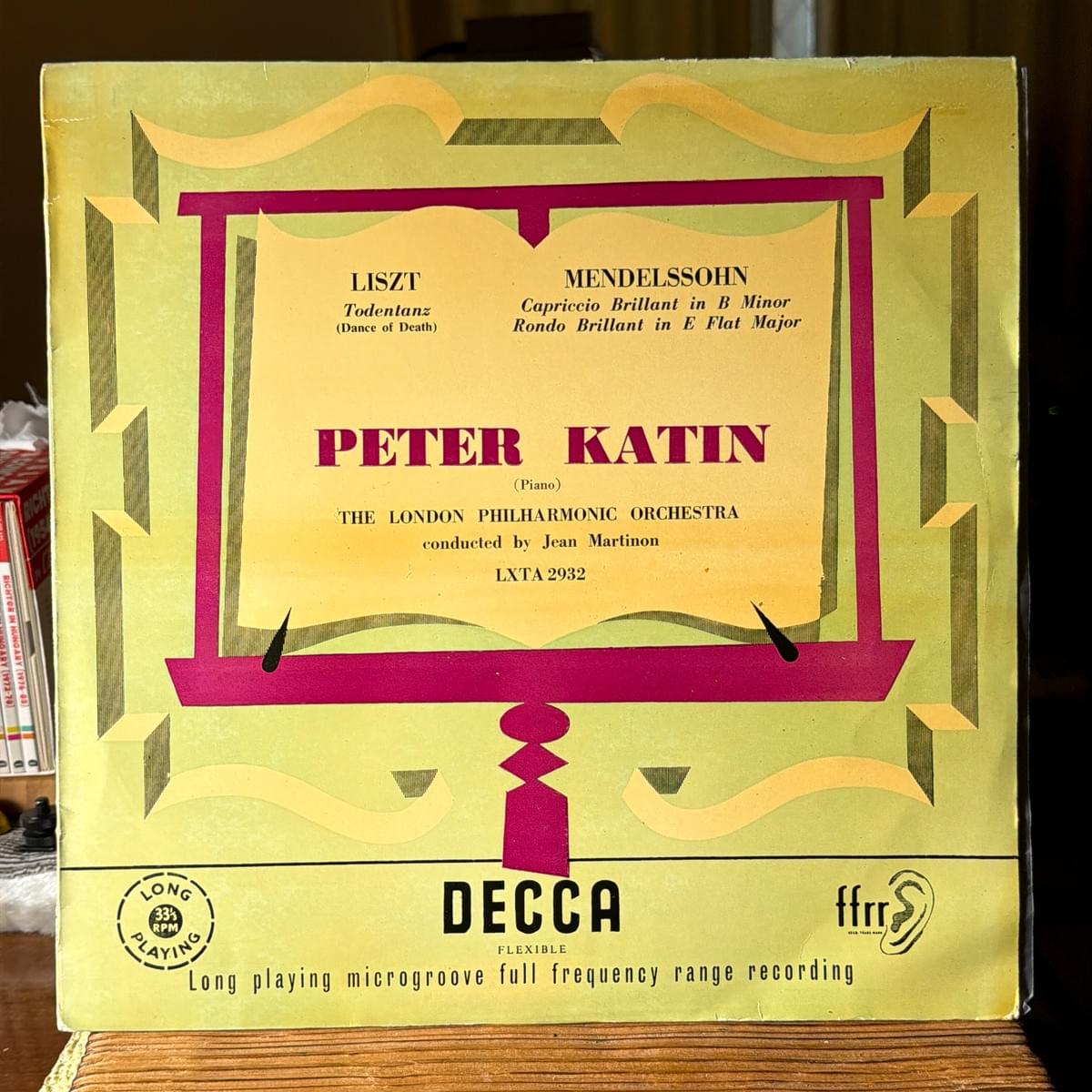
1954年,23歲的卡汀為英國 Decca 錄下李斯特(Franz Liszt,1811-1886)的《死神之舞》,那是李斯特筆下最狂暴、最「惡魔」的一首協奏作品。
二十二年後,1976年,45歲的卡汀在日本埼玉縣的一座市民會館裡,錄下德布西(Claude Debussy,1862-1918)的〈月光〉。
從《死神之舞》走到〈月光〉,從一位被大唱片公司力捧的年輕天才,走到一位「只受少數知音賞識」的行家。很多人會以為這是一條下坡路。
這篇文章想說的是:這不是下坡,而是一個人的選擇。
倫敦的早熟天才
1930年11月14日,卡汀生於倫敦。父親是立陶宛出生的招牌畫師,家族是俄羅斯裔猶太人——一個移民家庭的孩子,後來成為「全英國最受期待的青年鋼琴家」。
他四歲開始學琴,十二歲就被破格錄取進入倫敦皇家音樂院,比一般入學年齡早了整整五年。老師是英國鋼琴教育的重鎮哈洛德·克拉克斯頓(Harold Craxton,1885-1971)。十三歲,他開了第一場個人獨奏會。
那是1943年,二戰仍在打。一個十三歲的少年,在戰時的英國開獨奏會——這是我們很難想像的童年。
1948年12月13日,18歲的卡汀在倫敦威格摩爾音樂廳(Wigmore Hall)正式首演,踏上職業演奏家的路。
一個下午,勝過五年
要理解卡汀後來是什麼樣的鋼琴家,有一句話比任何學歷都重要。他曾經說,他在克利福德·柯爾榮(Clifford Curzon,1907-1982)那裡一個下午學到的,比在皇家音樂院五年還多。
柯爾榮是英國鋼琴界出了名的「不討好」的鋼琴家,以苛求音樂細節著稱。一個從小被稱作天才、年紀輕輕就開過獨奏會的學生,說自己在學院裡五年的收穫,比不上在一位前輩身邊的一個下午——這句話裡沒有抱怨,只有一種判斷:他很清楚自己要的是什麼。
他要的不是技巧,技巧他早就有了。他要的是柯曾那種「音樂先於一切」的態度。
被看好的十年
接下來的十年,卡汀幾乎做對了所有「成為明星」該做的事:
- 1952年,首登倫敦逸廳音樂節(The Proms)。
- 1953年,以拉赫曼尼諾夫(Sergei Rachmaninoff,1873-1943)第三號鋼琴協奏曲大獲好評——這是鋼琴協奏曲裡最吃技巧的曲目之一。
- 1954年,為 Decca 與法國指揮家尚·馬蒂農(Jean Martinon,1910-1976)、倫敦愛樂管弦樂團,錄下李斯特《死之舞》與孟德爾頌(Felix Mendelssohn,1809-1847)的兩首「華麗」曲。
- 1958年,成為二戰後第一位在蘇聯巡迴獨奏的英國鋼琴家,以拉赫曼尼諾夫贏得掌聲。同年二月,與亞德里安·包爾特(Adrian Boult,1889-1983)在倫敦 Kingsway Hall 為 Decca 錄協奏曲。
- 1959年,又為 Decca 錄了柴可夫斯基(Pyotr Ilyich Tchaikovsky,1840-1893)與拉赫曼尼諾夫的協奏曲,並發行一張獨奏會唱片。
短短兩年裡,Decca 為他錄了四首協奏曲和一張獨奏會。一家大唱片公司這樣密集地錄一位年輕人,他們正在投資一位未來的明星。
兩張 Decca 唱片,兩種樣貌
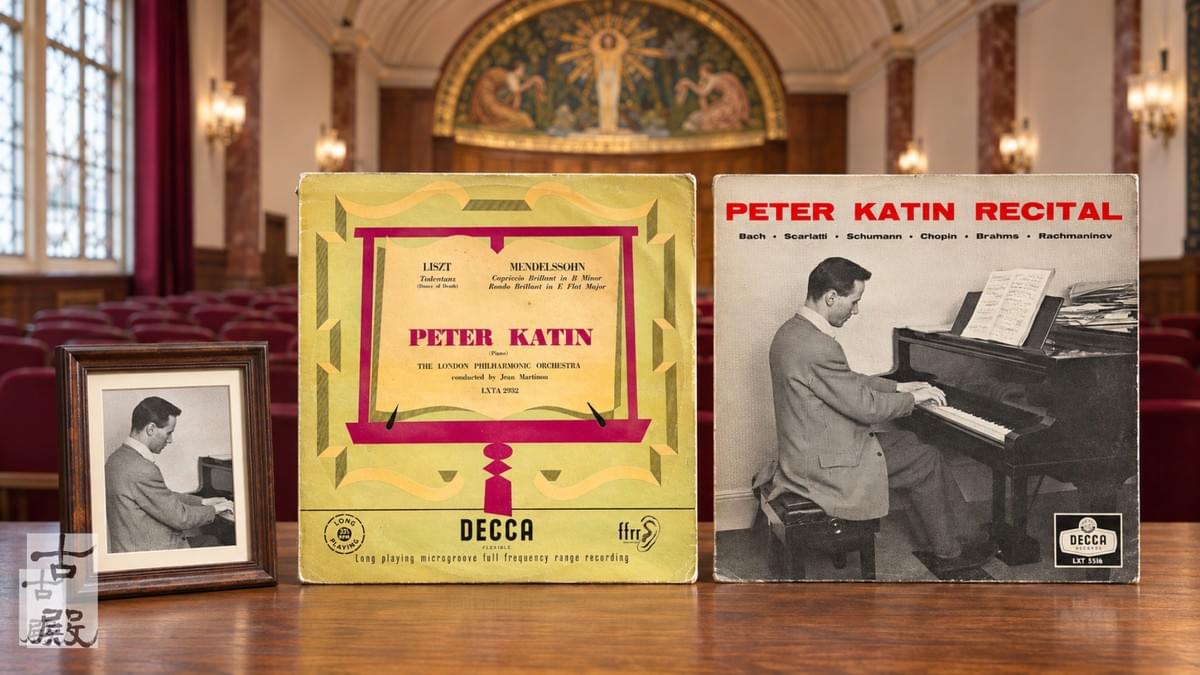
第一張是1954年的《死神之舞》,李斯特的《死神之舞》以中世紀聖詠《末日經》為主題,鐘聲般的低音、狂暴的變奏、費加段落與裝飾奏,最後停在一個「沒有三度」的空五度和弦上——既不是大調,也不是小調。這是一首要求鋼琴家「炫」的曲子。
第二張是1959年的獨奏專輯,編號: LXT 5516,英國原版。封面是一張黑白照:卡汀穿著千鳥格外套,坐在一台堆滿樂譜的小平台鋼琴前,像是在家裡練琴。
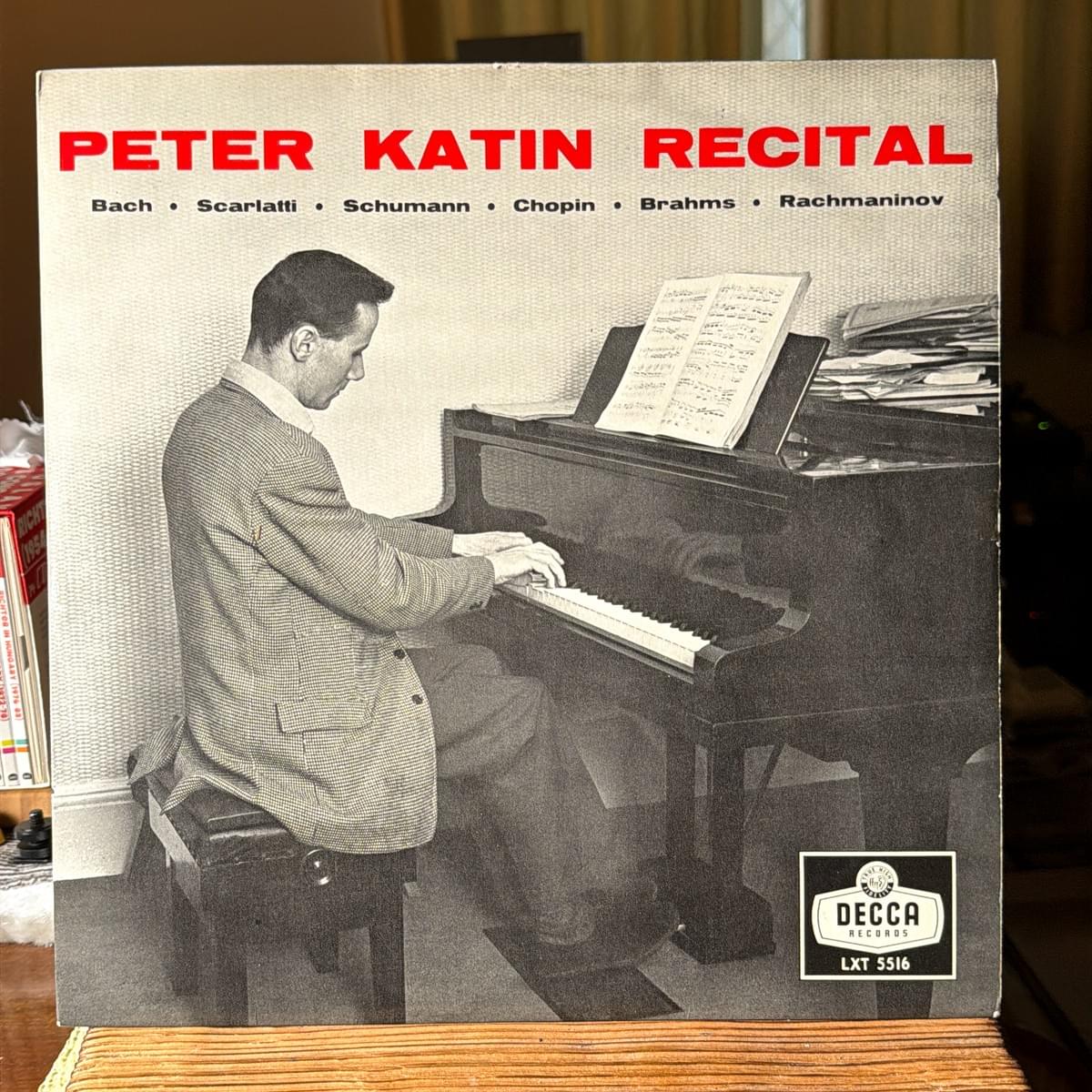
而這張獨奏會的曲目,很值得停下來看一眼。
他選擇了另一條路
想像一下:若你是一位28歲的鋼琴家,剛以拉赫曼尼諾夫第三號成名,剛在蘇聯贏得掌聲,大唱片公司要為你發行一張個人獨奏專輯。你會想彈什麼?
最直覺的答案,大概是李斯特的匈牙利狂想曲、拉赫曼尼諾夫的前奏曲——讓人一聽就知道有多厲害的曲子。
卡汀的個人獨奏專輯 (LXT 5516) 不是。從巴哈(Johann Sebastian Bach,1685-1750)的《半音階幻想曲與費加》開始,接著是史卡拉第(Domenico Scarlatti,1685-1757)的兩首小奏鳴曲、舒曼(Robert Schumann,1810-1856)的《浪漫曲》與《小說曲》、蕭邦(Frédéric Chopin,1810-1849)的《搖籃曲》與一首圓舞曲、布拉姆斯(Johannes Brahms,1833-1897)的間奏曲與狂想曲。拉赫曼尼諾夫——他成名的作曲家——他只選了一首三分鐘的早期小品《旋律》,放在最後。
這是一份「品味」與「鑒賞」的曲目。
不是柔弱的蕭邦
為這張唱片寫封底解說的,是一位27歲的年輕作曲家,亞歷山大·戈爾(Alexander Goehr,1932-2024)——他後來成為英國戰後最重要的作曲家之一。戈爾在解說裡寫道:
「世俗流傳的浪漫神話,在相當程度上曲解了蕭邦的真實天才。就其古典主義的嚴謹精確、克制自持……蕭邦完全足以與最偉大的古典主義巨匠平起平坐。」
十六年後,1975年,在東京為卡汀另一張唱片寫解說的樂評人津守健二,寫下了幾乎一樣的話:蕭邦追求的「絕非纖弱病態的音樂與演奏,而是正面迎向兼具古典明澄與貴族優雅的崇高藝術」,要「超越十九世紀將蕭邦片面女性化的刻板印象」。
一位在英國倫敦,一位在日本東京;一位是前衛作曲家,一位是樂評家,相隔16年。兩人都是為卡汀的唱片下筆,談的雖然是蕭邦這位作曲家,卻不約而同地從卡汀的音樂中,理解到了卡汀的想法:蕭邦不是感傷、柔弱的蕭邦,而是精確、節制的蕭邦。
這並不是巧合。這正是卡汀原本的想法,他用音樂把它呈現了出來。後來在日本最先聽到卡汀現場的那位錄音師,形容他的蕭邦是「冷靜自持」;為他的德布西寫解說的樂評家,形容他的節奏「帶有一種獨特的乾爽質地」,「徹底擺脫了演奏蕭邦或德布西時常見的感傷軟弱」。卡汀的「節制」不是年紀大了才有的,它從一開始就是他的樣子。
這件事本身,就是一個很重要的主題。音樂非常抽象,看不見,也無法等同於語言。但音樂的核心,仍然是傳達情感、意境與想法。卡汀沒有寫文章宣揚他的蕭邦觀,他只是把它彈出來;而在倫敦與東京,相隔十六年,都有人聽懂了。
從不比賽,也從不張揚
1958年的春天,莫斯科舉辦了第一屆柴可夫斯基國際音樂大賽。23歲的美國青年范·克萊邦(Van Cliburn,1934-2013)拿下鋼琴組金牌,一場比賽,讓一個年輕人一夜之間成為全世界的明星。
同一年,卡汀也去了蘇聯。但他不是去比賽的,而是以戰後第一位英國鋼琴家的身分去進行文化交流,彈拉赫曼尼諾夫,贏得了掌聲。然後他回到英國,繼續彈琴。
這是卡汀一生的縮影。他從不參加鋼琴比賽,也不愛宣傳。或許這也是今天談到二十世紀的英國鋼琴家,很少有人會想到他的名字的原因。這和他不走那兩條路有沒有關係?也許有,也許沒有。
他只彈他相信的音樂
他還有幾個原則,放在一起看,幾乎每一條都和「成為明星」背道而馳。
他不演奏自己無法認同的音樂。 他曾引用女高音卡拉絲(Maria Callas,1923-1977)的話:她無法說服觀眾相信一個她自己都不相信的角色。普羅高菲夫(Sergei Prokofiev,1891-1953)的第三號鋼琴協奏曲,是許多鋼琴家用來展現技巧的熱門曲目;卡汀只演了六場就放棄了,因為他想不通這首曲子的鋼琴寫法。對他來說,「彈得動」和「彈得通」是兩回事。
他拒絕把音樂分成「男性的」與「女性的」。 前面提到,戈爾與津守健二在兩張卡汀唱片的解說裡,都在破除「女性化的蕭邦」。而這原本就是卡汀自己的立場:音樂沒有性別,蕭邦不必柔弱,李斯特也不必哮哮。
唱片市場喜歡容易記住的標籤:「比賽冠軍」「鋼鐵手指」「鋼琴詩人」,一個詞就能讓聽眾記住一位演奏家。卡汀身上找不到這樣的詞。
這是不是他後來少被提起的原因?很難說。一個人會被記住還是被遺忘,牵涉的東西太多:時代的口味、唱片公司的去留、有沒有人在對的時候寫下對的文字。歷史很少只有一條因果線。
但把這些原則和他後來的安靜放在一起看,至少有一種意味:他在意的事,和市場在意的事,本來就不太一樣。
1975年,一位日本錄音師在卡汀唱片的解說裡寫道:
「在當今商業包裝與浮誇藝人氾濫的洪流中,此類追求至高內涵的純粹藝術往往極易被世人所忽視。對於一心一意潛心深耕個人鋼琴藝術的卡汀而言,追逐音樂大賽名次或經營政治人脈從來都不是他在意之事。」
這段話寫於五十多年前。今天讀來,它一點都沒有過時,反而更刺耳了。在一個「被看見」幾乎等於「存在」的時代,一個人選擇不大聲,是什麼樣的一種力氣?
在東京被聽見
1974年,44歲的卡汀第一次到日本。
這是一趟很安靜的巡演。東京只有一場日場音樂會,其餘是群馬的太田、宮城的仙台、九州的佐賀等地的幾場小型演出,之後他就回國了。以一位在蘇聯、波蘭、奧地利、美國都獲得好評的鋼琴家來說,這樣的日本首演實在太過低調。
但在這趟旅程中,他遇到了日本錄音師菅野沖彥(Okihiko Sugano,1932-2018)。接下來的十五個月裡,菅野在埼玉縣的入間市民會館為他錄了兩張唱片:1974年11月25日錄音的蕭邦與舒伯特(Franz Schubert,1797-1828),以及1976年2月錄音的整張德布西。一個握手如何變成兩張唱片,古殿會另文詳述。
這裡只想留意一件事:這兩張唱片的曲目順序,和卡汀自己說過的一句話剛好對得上。他認為蕭邦是史上最偉大的鋼琴作曲家,而他建議學蕭邦的人去學德布西——從德布西身上,學到蕭邦的紀律。在日本的兩張唱片,第一張是蕭邦,第二張是德布西,剛好就走在這條路上。對卡汀而言,德布西不是一片朦朧的音霧,而是一門精確的功課。
卡汀的琴聲是什麼樣子?
如果只能用一個詞形容卡汀,最容易想到的是「冷靜」。但這個詞只對了一半。
樂評家小林利之為卡汀1976年錄音的德布西唱片寫了一篇很詳細的解說,是我們今天能讀到、對卡汀演奏風格最完整的描述之一。他的關鍵詞,可以分成兩組來看。
第一組,是「他不做什麼」:
「卡汀的鋼琴演奏,絕無嘩眾取寵的虛飾炫耀,不刻意故作深沉的『大藝術家姿態』,更毫無為了吸引聽眾注意而特意營造的人工音效。」
他的節奏「帶有一種獨特的乾爽質地」,讓他「徹底擺脫了演奏蕭邦或德布西時常見的感傷軟弱,亦遠離了曖昧模糊、渙散拖沓的印象派陳腔濫調」。
第二組,是「他用什麼取而代之」:
「深邃的寧靜、極具節制的表現力、交織著純淨剔透的音質美感、自始至終絕不鬆懈的緊湊張力、高層次的幻想意境,以及質樸純真的溫暖人情味。」
注意這一連串裡的「緊湊張力」。兩年前菅野沖彥第一次聽到卡汀,用的也是同一個方向的詞:「近乎神經質般的高度內在緊繃感」、「如鮮血噴湧般銳利鮮活的靈性觸感」。
所以,卡汀的「冷靜」不是溫度低,而是一種壓住的熱度。表面平靜,底下繃緊——像一條拉得很準的琴弦,不發聲的時候也充滿力量。
「不夠張揚」的代價
小林利之也沒有只說好話。他坦白寫道,卡汀「略顯過度纖細的神經與深沉知性的自我反省」,讓他避開了燃燒激情的狂熱姿態——「若要吹毛求疵,這或許正是讓某些人覺得卡汀在某些層面上『不夠張揚顯眼』的特點」。
這句話解釋了卡汀為什麼沒有成為明星。明星需要「顯眼」,而卡汀把「顯眼」當成一種干擾。小林的結論是:
「他並非用炫目的光芒使人眼花繚亂,而是透過心靈深處靜謐的觸動建立彼此的信賴。」
一位讓人「信賴」的鋼琴家。在所有形容演奏家的詞裡,這可能是最少被用到、也最難得到的一個。
誠實與節制
把卡汀的一生放在一起看——不比賽、不張揚、只彈他相信的音樂、踏板卡住了就自己修好——會發現它們其實是同一件事:誠實與節制。
對自己誠實,所以他分得清「彈得動」和「彈得通」,只彈他想通了、相信了的音樂。對音樂誠實,所以他不讓自己的炫技、情緒或名氣擋在音樂前面。他的琴聲表面平靜、底下繃緊,也是同一種節制:熱度一直都在,只是不拿出來展示。
明星的光芒,往往依附在一個時代的口味上,時代一變,光芒就跟著換人。卡汀的價值不依附在這些東西上。一位鋼琴家「讓人信賴」、「把事情做對」,在哪個年代都一樣珍貴。他有沒有大紅大紫,改變不了這件事。
他是誰?
從日本回去之後,卡汀的生活繼續安靜地往前走。
1978年到1984年,他在加拿大的西安大略大學任教;1992年到2001年,他在倫敦的皇家音樂學院教琴。他也繼續錄音,只是不再是 Decca,而是 Lyrita、Unicorn、Olympia 這些規模較小的唱片公司。
1987年,他為 Olympia 唱片錄了一張《Portrait of a Pianist》,裡面有巴哈的《半音階幻想曲與費加》——正是28年前,他在 Decca 獨奏會唱片上開場的那一首。一位鋼琴家在五十多歲時,回頭再彈一次自己二十多歲時錄過的曲子。沒有人要求他這麼做,他選了。
2015年3月19日,彼德·卡汀辭世,享年84歲。
******
【Gudian Music Stories】The Pianist Who Crawled Under the Instrument: Meet Peter Katin (1930–2015), A Quiet Genius by Choice
The Pianist Who Crawled Under the Instrument
During a solo recital in Nairobi, Kenya, the piano’s pedal linkage suddenly jammed.
Almost any other touring virtuoso would have stopped, walked off stage, and waited for hall technicians to address the fault. This British pianist did no such thing. He dropped to his knees, crawled directly beneath the instrument, fixed the pedal mechanism himself, and climbed back onto the bench to resume the performance.
This small episode was recounted in The Scotsman’s obituary for Peter Katin (1930–2015).
Today, most music lovers have likely never encountered his name. That is hardly surprising: Katin never competed in an international piano competition, shunned publicity, and left no mass-market commercial best-seller enshrined on popular "greatest of all time" lists. Yet arrange his discography chronologically, and a rare path comes into view:
In 1954, at age twenty-three, Katin recorded Franz Liszt’s (1811–1886) Totentanz for British Decca—the most volcanic, demonic concerted score in the composer's catalog.
Twenty-two years later, in 1976, forty-five-year-old Katin sat inside a municipal civic hall in Saitama Prefecture, Japan, to record Claude Debussy’s (1862–1918) "Clair de lune."
Moving from the thunder of Totentanz to the nocturnal quiet of "Clair de lune"; shifting from a prodigy championed by a major record label to an introspective master appreciated by a discerning few. Many might assume this represents a career in decline.
This essay argues the opposite: it was not a decline, but a deliberate human choice.
A Precocious Prodigy in Wartime London
Katin was born in London on November 14, 1930. His father was a Lithuanian-born commercial sign painter and his family was of Russian-Jewish stock—an immigrant household raising a son destined to become hailed as "Britain's most promising young keyboard talent."
He began piano lessons at four, and at twelve was admitted to the Royal Academy of Music five years ahead of standard admission age. He studied under Harold Craxton (1885–1971), a cornerstone of British piano pedagogy. By thirteen, he had mounted his first full solo recital.
That was 1943, with the Second World War raging across Europe. A thirteen-year-old boy giving solo recitals in wartime London—a childhood almost unimaginable to contemporary minds.
On December 13, 1948, eighteen-year-old Katin made his formal debut at Wigmore Hall, embarking on a professional concert career.
One Afternoon That Outweighed Five Years
To grasp the artist Katin became, one sentence matters more than any conservatory credential. He once remarked that he learned more in a single afternoon with Clifford Curzon (1907–1982) than he did across five full years at the Royal Academy of Music.
Curzon was renowned in British musical circles as an uncompromising, exacting perfectionist who refused to court public favor. For a prodigy groomed in the academy to declare that five years of institutional study fell short of an afternoon beside a veteran master was no complaint; it was an artistic judgment. He knew precisely what he was searching for.
He was not seeking technical mechanics—he already possessed them in abundance. He sought Curzon’s uncompromising ethos: an absolute reverence where the score takes precedence over everything else.
The Decade of Stardom
Over the following ten years, Katin executed every move expected of a rising star:
- 1952: Debuted at the London Proms.
- 1953: Scored an overwhelming critical triumph with Sergei Rachmaninoff’s (1873–1943) Piano Concerto No. 3—one of the most physically and technically demanding mountains in the literature.
- 1954: Cut Liszt’s Totentanz alongside Felix Mendelssohn’s (1809–1847) two concertante works for Decca, partnered by French conductor Jean Martinon (1910–1976) and the London Philharmonic Orchestra.
- 1958: Became the first postwar British pianist to embark on an extensive solo recital tour of the Soviet Union, winning acclaim for his Rachmaninoff. That same February, he joined Sir Adrian Boult (1889–1983) at Kingsway Hall to record for Decca.
- 1959: Completed further concerto recordings of Pyotr Ilyich Tchaikovsky (1840–1893) and Rachmaninoff for Decca, alongside a solo recital LP.
Within a short span, Decca had tracked four major concertos and a full solo recital album with him. When a major international label invests that heavily in a young man in his twenties, they are backing a future star.
Two Decca Artifacts, Two Divergent Faces
The first is the 1954 Totentanz. Built upon the Gregorian plainsong Dies irae, the score unfolds through tolling bass octaves, percussive variations, fugal counterpoint, and double-octave cadenzas, culminating in an open fifth chord lacking the third—neither major nor minor. It is an unvarnished showcase for keyboard virtuosity.
The second is his 1959 solo recital LP, catalog number LXT 5516 (UK original mono pressing). The front jacket features a black-and-white portrait: Katin, dressed in a houndstooth sports coat, seated before a modest baby grand piano piled high with open sheet music, as if practicing quietly at home.
The programming of that solo recital deserves a closer look.
Choosing the Alternate Path
Consider the scenario: you are a twenty-eight-year-old pianist, newly acclaimed for conquering Rachmaninoff’s Third, fresh from a triumphant tour of the Soviet Union, and a major international label is handing you a dedicated solo recital LP. What do you choose to record?
The instinctive commercial answer would be Liszt’s Hungarian Rhapsodies or Rachmaninoff’s Preludes—showpieces engineered to blow the listener away.
Katin’s recital disc (LXT 5516) took the opposite path. It opened with Johann Sebastian Bach’s (1685–1750) Chromatic Fantasia and Fugue, moved through two Domenico Scarlatti (1685–1757) sonatas, Schumann’s (1810–1856) Romanceand Novelette, Chopin’s (1810–1849) Berceuse and a waltz, and Brahms’s (1833–1897) Intermezzo and Rhapsody. Rachmaninoff—the composer who made him famous—was represented only by a three-minute early miniature, Mélodie, placed at the very end.
It was an architecture of connoisseurship, refinement, and balance.
A Chopin Free of Fragility
The liner notes for that 1959 Decca album were contributed by a twenty-seven-year-old composer, Alexander Goehr (1932–2024), who would become one of Britain’s foremost postwar modernist voices. Goehr observed:
"The popular romantic myth has done much to obscure the true nature of Chopin’s genius. In his classical discipline, restraint, and precision... Chopin is fully worthy of standing alongside the greatest classical masters."
Sixteen years later, in 1975, writing for another Katin release in Tokyo, Japanese critic Kenji Tsumori penned a parallel observation: Chopin sought "neither fragile nor sickly affectations, but confronted a noble art balancing classical transparency and aristocratic poise," urging listeners to "transcend the nineteenth-century stereotype that reduced Chopin to one-sided effeminacy."
One author in London, another in Tokyo; an avant-garde composer and a music critic, separated by sixteen years. Both were writing for Katin’s albums; and while addressing Chopin, both independently arrived at the same conclusion through Katin’s playing: this was not a sentimental, fragile Chopin, but an articulate, classical one.
This was no accident. It was Katin’s conviction made audible through his hands. The Japanese balance engineer who first heard Katin live described his Chopin as "composed and self-possessed"; the annotator of his Debussy cycle noted that his rhythmic pulse carried "a crisp, dry transparency that sweeps away the cloying sentimentality often brought to Chopin and Debussy." Katin's emotional economy was not an artifact of old age; it was his artistic voice from the outset.
Music remains an abstract art, defying literal translation into words. Yet its purpose is the communication of interior states. Katin never wrote polemics defending his view of Chopin; he simply played it. And across sixteen years, from London to Tokyo, listeners understood.
No Competitions, No Fanfare
In the spring of 1958, the inaugural International Tchaikovsky Competition unfolded in Moscow. Twenty-three-year-old Texan Van Cliburn (1934–2013) carried off the gold medal in piano, transformed into a global celebrity overnight.
That same year, Katin also traveled to the Soviet Union. Yet he went not as a competitor, but as the first British pianist of the postwar era to undertake an official cultural exchange, playing Rachmaninoff to warm applause. When the tour concluded, he returned home to Britain and resumed his practice.
This summarizes Katin’s artistic life: he never entered competitions, and took no interest in public relations. This may explain why his name is rarely the first mentioned in discussions of twentieth-century British pianists.
Playing Only What He Believed In
His artistic principles ran contrary to the machinery of stardom:
- He refused scores he could not embrace. He often cited soprano Maria Callas (1923–1977), who remarked that she could never convince an audience of a character she did not believe in herself. Sergei Prokofiev’s (1891–1953) Piano Concerto No. 3 was a reliable warhorse for virtuosos; Katin dropped it after six performances because he could not reconcile its keyboard writing. To him, physical capability and musical conviction were two distinct matters.
- He rejected gendered stereotypes in music. As Goehr and Tsumori noted, Katin dismantled the trope of a "fragile Chopin." Music required no gendered lens: Chopin need not sound sickly, nor Liszt blustering.
The record industry depends on tidy catchphrases: "Competition Winner," "Iron Fingers," "Poet of the Keyboard." None fit Katin.
Whether this explained his relative obscurity remains complex. An artist's enduring profile depends on changing tastes, catalog deletions, and whether championing essays are written at the opportune moment.
Yet placed beside his quiet later years, his choices suggest a consistent truth: what mattered to him was entirely different from what mattered to the market.
In 1975, a Japanese balance engineer wrote in the notes to a Katin release:
"In today's flood of commercial packaging and theatrical posturing, pure art pursuing the highest interior truth is easily overlooked by the world. For an artist like Katin, devoted entirely to the quiet cultivation of his craft, chasing competition prizes or cultivating political connections was never a concern."
Written half a century ago, those words remain timely. In an era where visibility is equated with existence, choosing quietness requires an uncommon kind of strength.
Heard in Tokyo
In 1974, forty-four-year-old Katin made his first journey to Japan.
It was an understated tour: a single afternoon recital in Tokyo, followed by modest dates in regional cities such as Ota in Gunma, Sendai in Miyagi, and Saga in Kyushu, before returning home. For an artist who had performed across Europe and the United States, it was an unusually low-key Japanese debut.
Yet during that visit, he encountered Japanese balance engineer Okihiko Sugano (1932–2018). Over the following fifteen months, Sugano recorded two albums with him inside the Iruma Civic Hall in Saitama: a Chopin and Schubert (1797–1828) program taped on November 25, 1974, followed by an all-Debussy recital in February 1976.
The repertoire sequence of those two albums reflects Katin’s pedagogy. He regarded Chopin as the supreme composer for the keyboard, and advised students of Chopin to study Debussy—to learn from Debussy the architectural discipline demanded by Chopin. The two Japanese albums—Chopin first, Debussy second—traced that exact path. For Katin, Debussy was not an ambient mist, but an exercise in structural precision.
What Did Katin’s Playing Sound Like?
To describe Katin in a single word, commentators often settled on "cool." But that captures only half the picture.
Music critic Toshiyuki Kobayashi contributed an essay to Katin’s 1976 Debussy LP, offering a detailed appraisal of his style, organized around two perspectives:
First, what he avoided:
"In Katin's playing there is no theatrical ostentation, no contrived posturing of the 'grand maestro,' and no calculated acoustic trickery designed to court an audience.
His pulse carries a crisp, dry transparency, liberating the music from the sentimental fragility often brought to Chopin and Debussy, steering clear of blurry, sluggish Impressionist clichés."
Second, what he offered in its place:
"Profound serenity, an expressive voice held under immaculate control, a luminous tone of crystalline purity, an unyielding tension sustained from first measure to last, imaginative reverie, and an honest human warmth."
Notice that phrase: "an unyielding tension." Two years earlier, when Sugano first heard Katin, he reached for similar imagery: "a high interior tension bordering on the nervous; a spiritual touch as vivid and incisive as surging blood."
Katin’s "coolness" was not coldness; it was contained heat. Calm on the surface, taut underneath—like a finely tuned piano wire holding immense potential energy while silent.
The Cost of Reticence
Kobayashi did not shy from criticism. He observed that Katin’s introspective intellect led him to avoid extroverted passion:
"If one were to be unsparingly critical, this may be the very attribute that leads some listeners to feel Katin is not 'assertive or eye-catching' enough on the platform."
That observation explains why Katin did not pursue stardom. The commercial sphere demands a spectacle, and Katin viewed spectacle as a distraction. Kobayashi concluded:
"He does not dazzle with theatrical fireworks; rather, he builds mutual trust through a quiet communion with the listener's inner self."
A pianist who built trust. Among all the words applied to virtuosos, that may be the rarest and most difficult to earn.
Honesty and Restraint
Surveying Katin’s life—avoiding competitions, shunning hype, performing only what he believed in, and crawling under the instrument to fix a broken pedal—reveals that these acts sprang from the same virtues: honesty and restraint.
Honest with himself, he separated what was physically playable from what was musically convincing, playing only what he had internalized. Honest with the music, he refused to let technique, sentimentality, or ego obscure the score. The quiet exterior containing deep inner tension was an expression of that restraint: the fire was always present, but never exhibited for applause.
Celebrity depends on the fashions of an era; when tastes turn, the spotlight moves elsewhere. Katin’s worth was unmoored from those shifting currents. An artist who earns trust and serves the score with integrity remains rare in any generation. Commercial visibility does nothing to alter that reality.
The Final Chapters
Following his Japanese sessions, Katin’s life continued along its quiet course.
From 1978 to 1984, he taught at the University of Western Ontario in Canada; from 1992 to 2001, he served on the faculty of the Royal College of Music in London. He continued to record, moving from Decca to specialized independent labels: Lyrita, Unicorn, and Olympia.
In 1987, he recorded an album for Olympia titled Portrait of a Pianist, opening with Bach’s Chromatic Fantasia and Fugue—the exact work that had opened his Decca solo recital LP twenty-eight years earlier. An artist in his late fifties returning to the music of his youth, unprompted by commercial packaging.
On March 19, 2015, Peter Katin passed away at the age of eighty-four.