
【古殿唱片音樂故事】那座禮拜堂已經拆了,聲音還在唱片裡:普列文(André Previn,1929-2019)1973年《行星組曲》超級錄音與東芝EMI「PRO-USE」發燒專業工藝盤
古殿殿主
一句唱片公司不能對客人說的話
這套唱片的附冊裡,東芝EMI首席製作人兼首席錄音師行方洋一,寫下一句很少有唱片公司肯印在紙上的話。
他說,一般市售大量發行的普及版唱片必須在任何一台便宜唱機上都能順利播放;只要跳針、破音,就會被退貨。而唱片公司不能對客人說:「那是因為您的唱機太便宜了。」
所以一般唱片在刻片時,要用限幅器(limiter)、去齒音器(de-esser)與等化處理,先把溝紋裡最大的振幅削掉一點。不是技術做不到,而是商品必須遷就所有人。
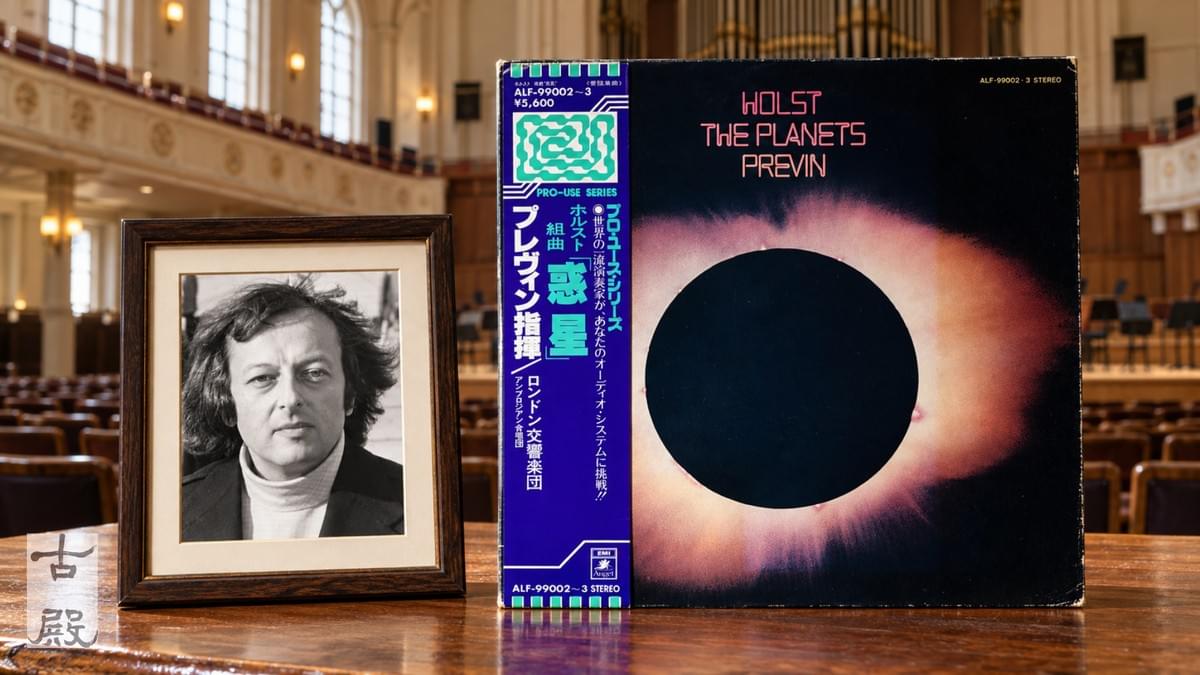
東芝EMI的「PRO-USE」(專業使用)系列,是一次決定不再遷就的實驗。腰帶上的標語說得很直接:「世界一流演奏家,向您的音響系統挑戰!!」而他們選來挑戰的錄音之一,是1973年安德烈·普列文(André Previn,1929-2019)指揮倫敦交響樂團的霍爾斯特《行星》。
為什麼是這份錄音?要回答這個問題,得先回到1973年9月,倫敦一座地鐵從底下駛過的禮拜堂。
1973年9月:一個曾在作曲家手下演奏《行星》的樂團
封底內側的小字記下了時間與地點:1973年9月28、29日,倫敦金斯威廳(Kingsway Hall)。〈海王星〉結尾那段從遠方飄來的女聲,由安布羅西亞合唱團(The Ambrosian Singers)演唱,合唱指導是約翰·麥卡錫(John McCarthy)。
那年普列文44歲,擔任倫敦交響樂團首席指揮(1968–1979)已是第五年。他生於柏林,1938年隨家人逃離德國,經巴黎輾轉到洛杉磯;十幾歲就進了米高梅(MGM)片廠做編曲與配器,一生參與五十多部電影配樂,四度獲得奧斯卡獎。小倉重夫在本張解說裡特別提到,他與鼓手雪利·曼恩(Shelly Manne,1920-1984)合作的爵士版《窈窕淑女》,在當年賣得極好。
這樣一位好萊塢出身的音樂家,在聲名最盛時轉向古典指揮。他曾向皮耶·蒙都(Pierre Monteux,1875-1964)學習指揮,接上了法國管弦樂清晰、透明、節奏精確的傳統。這恰好是《行星》最需要的能力:七個樂章、龐大的銅管與打擊樂、管風琴與女聲合唱,每一個聲部都必須聽得清楚。
但這份錄音還有一條更深的線。古斯塔夫·霍爾斯特(Gustav Holst,1874-1934)本人,曾親自指揮倫敦交響樂團為Columbia錄下《行星》:先是1920年代初的聲學錄音,再是1926年的電氣錄音,都是78轉蟲膠唱片。
也就是說,1973年普列文舉起指揮棒時,他面對的是一個曾在作曲家本人手下演奏過這部作品的樂團。中間隔了將近半個世紀,團員早已換過幾代,但這部作品與這個樂團之間,早有一段血緣。
控制室裡的兩個克里斯多福
封底印著另外兩個名字:製作人克里斯多福·畢夏普(Christopher Bishop,1931-),錄音師克里斯多福·帕克(Christopher Parker)。在1970年代的EMI,這兩個名字並列,幾乎就是品質保證,業界直接稱他們「Bishop & Parker」。
畢夏普是製作人,坐在控制室裡和指揮一起決定哪一段要重錄、哪一個速度最對,再把無數片段剪成一場完整的演出。他在EMI錄過巴畢羅里(John Barbirolli,1899-1970)、朱里尼(Carlo Maria Giulini,1914-2005)、亞德里安·包爾特(Adrian Boult,1889-1983)、早期音樂先驅大衛·門羅(David Munrow,1942-1976),以及普列文的大量錄音。
帕克是平衡工程師,決定麥克風放在哪裡、每支麥克風開多大。他原本是音樂老師,1951年進入EMI;1950年代末立體聲剛誕生時,他就在金斯威廳裡摸索立體聲麥克風該怎麼擺。同事在他過世時,只用一句話形容他的作品:誠實的錄音。
兩人的合作大約從1970年延續到1979年;那年畢夏普離開EMI,轉任愛樂管弦樂團總經理,團隊就此解散。這九年,剛好是EMI類比錄音最後的黃金年代。
這裡有一個少有人注意的細節。1966年,包爾特指揮新愛樂管弦樂團,在同一座金斯威廳為HMV錄下《行星》,錄音師也是帕克。七年後,他在同一座廳、為同一部作品再錄一次。普列文版的音場,可以說是帕克在這座廳裡累積多年之後的成熟答案。
日本錄音評論家嶋護在書中曾歸納過這組團隊的優勢:EMI多年累積的多麥克風技術、金斯威廳這樣的好場地,加上兩人獨有的美學與老手經驗。他也點出普列文自己的功勞——承自蒙都的精準樂團控制,以及在電影片廠練出來、能有效率推進錄音進度的本事。
一位電影圈出身的指揮,遇上一位從立體聲誕生就在那座廳裡工作的錄音師,和一個曾在作曲家手下演奏過這部作品的樂團。幾條累積已久的線,在同樣的兩天裡交會。
同一座廳,兩種真實
金斯威廳是倫敦霍本區一座衛理公會的佈道廳。圓頂讓它有溫暖豐厚的殘響,但倫敦地鐵剛好從它底下經過。EMI的前身HMV早在1925年就在這裡錄音;Decca從1944年起加入,傳奇錄音師肯尼斯·威金斯(Kenneth Wilkinson,1912-2004)認為這是倫敦最好的錄音場地。
嶋護寫道,這份錄音裡不時闖入的地鐵震動,是因為錄音時沒有切掉低頻。換句話說,他們寧可讓地鐵聲進來,也不願為了乾淨,犧牲樂團最底層的低音與空間的重量。而若以日本另外一位音響評論家長岡鐵男(Tetsuo Nagaoka,1926-2000)的說法,他的經驗法則是:錄到車聲、小鳥叫聲或是地鐵聲音的唱片,十之八九是優秀錄音。因為這代表兩件事——麥克風放得夠遠,收進了廳堂本來的空間;後製也沒有用低頻切除濾波器,把這一層「修乾淨」。
然而同一座廳、同樣不切低頻,EMI與Decca錄出來的聲音卻截然不同。1970年代的Decca以「比現場更壯觀」聞名:Decca Tree麥克風陣列加上點麥克風,積極推展最高與最低的頻率,錄音人員還會逐小節重新平衡,把某個聲部拉到聽者面前。聽Decca,像坐在指揮台旁邊。
帕克走另一條路。他其實也用了很多麥克風——嶋護推測舞台前緣一排約五支主麥克風,全場加起來二十多支——但他把這些麥克風重新融合成一個整體。你聽到的,是坐在音樂廳好位置上,樂團和空間一起呼吸的聲音。廳堂的殘響不是背景,而是樂團的一部分。
兩種聲音沒有高下,只是對「真實」的定義不同。
Decca的真實,是把音樂放大到比現場更清楚;EMI的真實,是讓你相信自己就坐在那座音樂廳裡。
而那座音樂廳,今天已經不在了。EMI與Decca在金斯威廳的錄音合約於1983年底到期;兩家公司都曾有機會買下它,EMI評估翻修費用太高而放棄。建築日漸破敗,儘管有音樂家與唱片雜誌出面請願,仍在1998年被拆除,原址改建為同名的金斯威廳飯店(Kingsway Hall Hotel),2000年開幕。據記載,飯店的接待櫃台,大約就在當年樂團坐著錄音的位置。
今天走進那間飯店,聽不到任何殘響。那座廳的聲音,只剩下溝槽裡的這一份。
一份沒有被自己取代的錄音
這份錄音1974年由英國HMV以ASD 3002首度發行(另有四聲道相容版),美國Angel S-36991、西德EMI Electrola四聲道版、日本Angel EAA-85040(1974年5月)相繼問世。
評價幾乎是一致的。英國《Hi-Fi News》給它95/100的音質分數,認為它的立體聲音場與動態衝擊勝過後來所有錄音,並說普列文的音樂性常因他的電視娛樂形象而被低估。英國《留聲機》雜誌音響編輯約翰·博威克(John Borwick)讚許樂器音色逼真、樂團內部平衡被忠實捕捉。美國《絕對之聲》(The Absolute Sound)將它列為示範級錄音;日本淘兒唱片2019年的介紹,則把它與包爾特版並列為最受推崇的版本,稱之為類比時代錄音的頂點之一。
演奏上,它初聽明快,但MusicWeb International的評論者實際比對後發現,普列文其實比包爾特1953年版還慢;明快感來自節奏的精確與銅管的咬字,而不是求快。同一篇評論認為,普列文的〈土星〉無與倫比。
最能說明它地位的,是普列文自己。1986年,他以皇家愛樂管弦樂團為Telarc重錄《行星》,數位錄音、低頻更深、聲音更響;但多數評論仍偏愛1973年的舊版。《絕對音響》2013年的評論說得清楚:以音樂而論,舊版更可取。
技術進步了十三年,同一位指揮重錄同一部作品,卻沒有取代自己。差別不在器材,而在那兩天交會的東西:44歲正值巔峰的普列文、與他共事五年的樂團、在同一座廳錄過《行星》的帕克。這些,不是下一次錄音可以重新安排的。
七年後,賽蒙·拉圖(Simon Rattle,1955-)同樣在金斯威廳、同樣為EMI、同樣用安布羅西亞合唱團,錄下數位版《行星》。普列文版,是他必須面對的標竿。
五年後的東京:PRO-USE 走進古典
這份錄音在英國發行後大約五年,東京赤坂的東芝EMI,決定把它重新做一次。
時間點很重要。解說冊裡,音響評論家若林駿介描述了當時的情況:MC唱頭日益普及,唱盤走向直驅與石英鎖定,擴大機與喇叭都在快速進步。硬體突飛猛進,那麼唱片呢?他列出業界正在嘗試的方向:提高母帶走帶速度、繞過磁帶直接刻片的「直刻唱片」、電鍍與材料的改良,甚至把轉速提高到45轉。
東芝EMI當時已有三條高音質產品線:「Professional」系列、「PRO-USE」系列與「PRO-USE 直刻」系列。PRO-USE過去以流行音樂為主,這一次才首度跨入古典。若林駿介說明了其中的差別:古典錄音的第一條件是原音重現——樂器像不像、像不像在舞台上演奏、有沒有傳達音樂廳的氣氛——這和流行音樂主動創造聲響的思維,在根本上不同。
古典盤第一回發行三套,都是從EMI錄音中挑出「能發揮錄音效果」的作品:
- ALF-99001|理查·史特勞斯《唐吉訶德》:卡拉揚(Herbert von Karajan,1908-1989)指揮柏林愛樂;羅斯托波維契(Mstislav Rostropovich,1927-2007)大提琴、柯赫(Ulrich Koch)中提琴
- ALF-99002~3|霍爾斯特《行星》:普列文指揮倫敦交響樂團;安布羅西亞合唱團
- ALF-99004|柴可夫斯基《天鵝湖》精選:普列文指揮倫敦交響樂團;伊達·韓黛爾(Ida Haendel,1928-2020)小提琴、卡明斯(Douglas Cummings)大提琴
選曲理由寫得很白:《唐吉訶德》是大編制樂團加獨奏大提琴,音響厚重;《行星》是銅管與打擊樂大活躍的作品;《天鵝湖》織體單純,正因如此響得乾淨。三套裡有兩套是普列文與倫敦交響樂團;在當年東芝EMI的眼中,這個組合代表的正是EMI錄音的高點。《天鵝湖》裡拉獨奏的,則是古殿先前介紹過的韓黛爾。

三道工序:讓唱片離漆盤更近
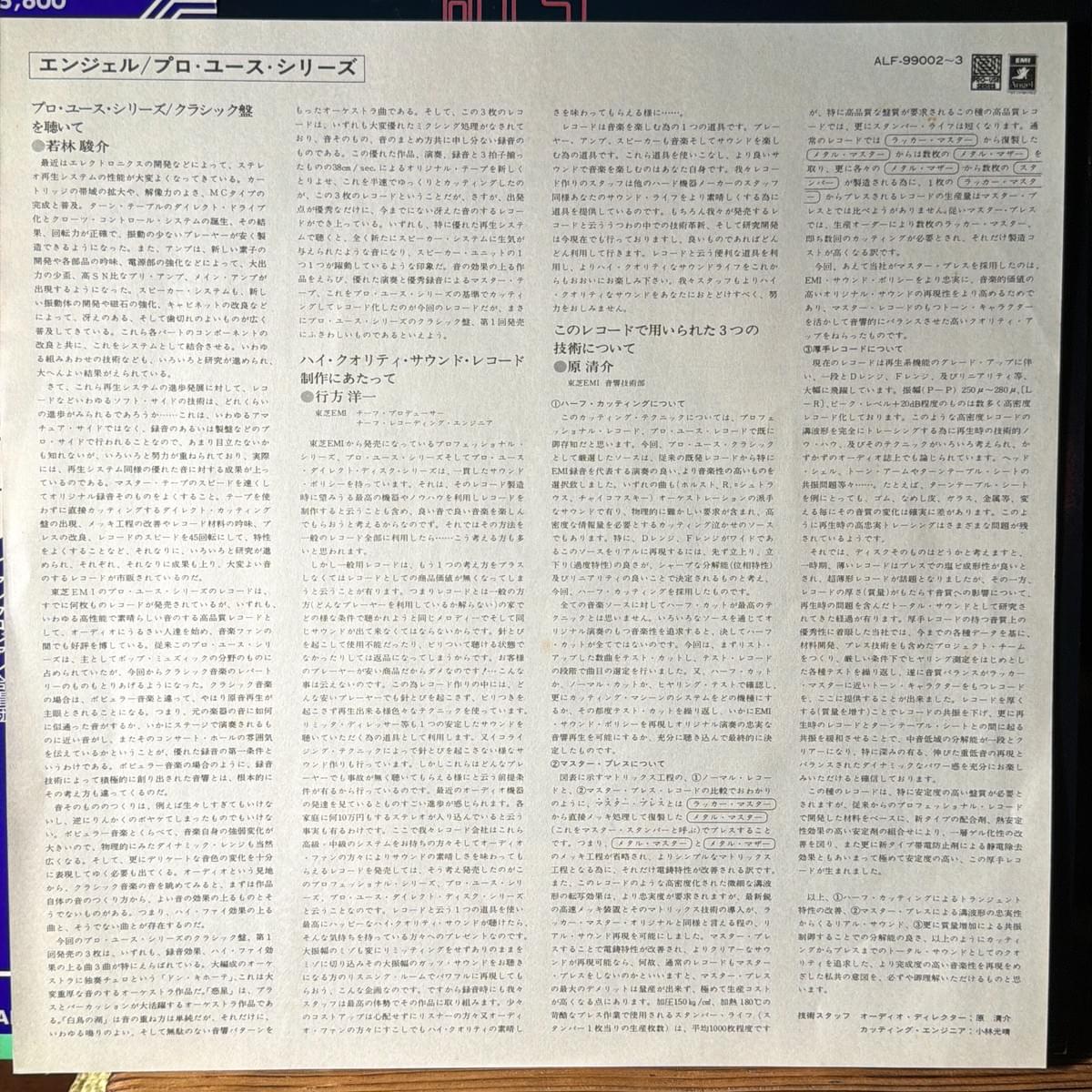
東芝EMI音響技術部的原清介(本盤音響總監)在附冊中,把這套唱片的工藝拆成三項;刻片工程師是小林光晴。
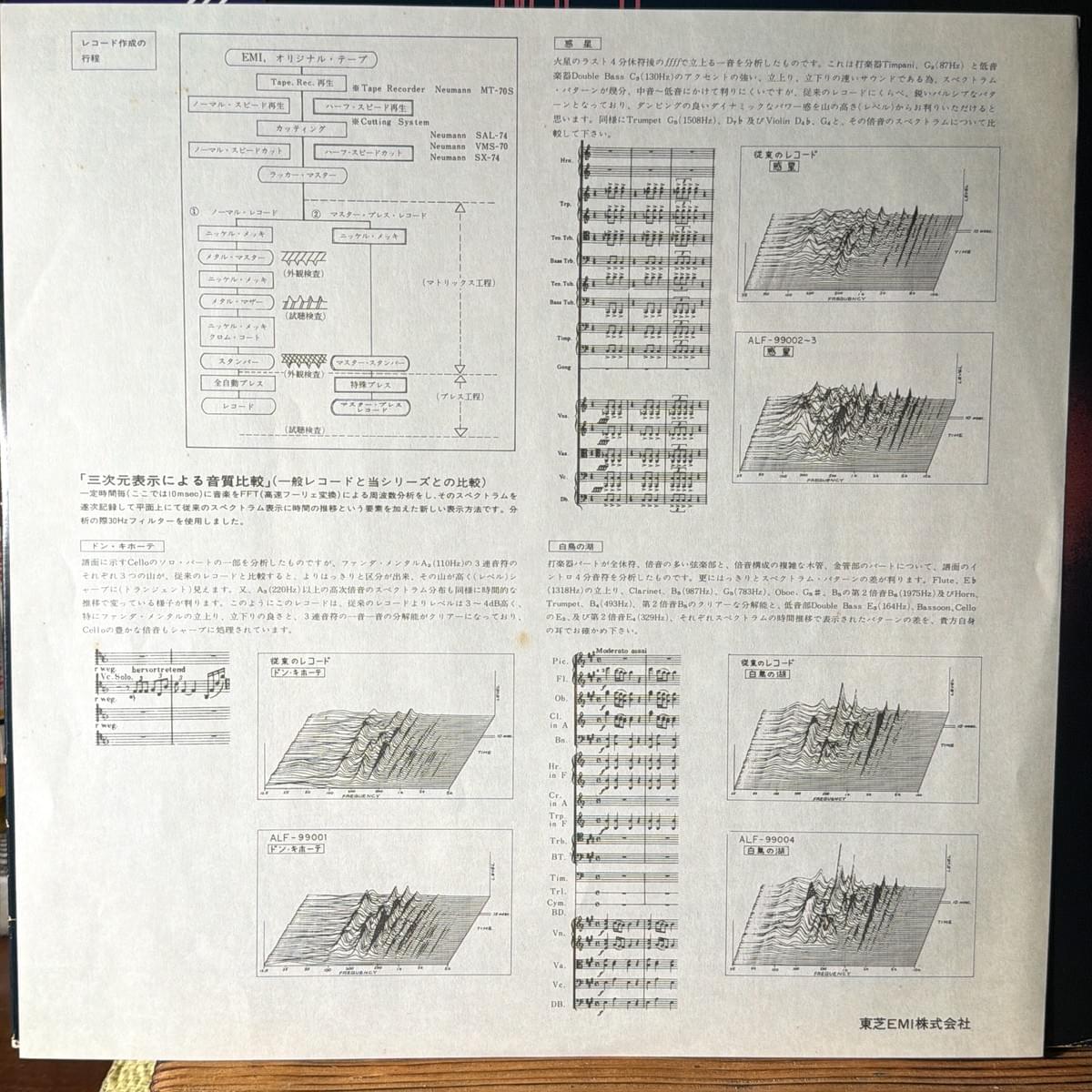
這裡要先說明「音響技術部」是什麼。當年的東芝EMI設有這個部門,它幾乎就是一座音響技術研究所:裡面的人專門研究錄音技術,以及製作唱片的科學與工藝,任務是開發與研發。PRO-USE系列,正是這個部門的研發成果。附冊裡從母帶、刻片到壓片的工程流程圖,以及一張張三維頻譜圖,讀起來就像一個研究單位交出的報告。
一、半速刻片。 他們向EMI重新調來一份38cm/s的原始母帶拷貝,以Neumann MT-70S磁帶機半速播放,刻片車床也以半速運轉;刻片系統是Neumann SAL-74刻片放大器、VMS-70刻片車床與SX-74刻頭。高頻在刻片時被「降」成中頻,刻針更容易精準跟上,瞬態更清楚。
原清介特別強調一件事:半速並不是萬能。他們先把候選曲目逐一試刻、做成試聽樣盤,再用耳朵決定每一首該用半速還是常速,甚至該配哪一種刻片系統。最後的判斷,不是規格,而是聽。
二、Master Press。 一般唱片的流程是:漆盤電鍍出金屬母版(Metal Master),再翻出金屬母盤(Metal Mother),再從每片母盤翻出好幾片壓模(Stamper),最後上機量產。每多一代翻模,溝紋就多一次物理複製。Master Press跳過中間步驟,直接拿漆盤第一道電鍍得到的金屬模當壓模用。
代價很清楚。壓片時要承受150kg/cm²的壓力與180℃的高溫,一片壓模平均只能壓約1,000片就報廢,高品質盤的壽命更短。一般流程一片漆盤可以衍生出成千上萬張唱片,Master Press則每多壓一批,就得重新刻一片漆盤。原清介說,這就是一般唱片不這樣做的原因:不能量產,成本太高。
三、厚手盤。 增加唱片的厚度與質量,降低盤片本身的共振,緩和唱片與轉盤墊之間的干擾,讓中低頻更清楚、低音更深。材料也重新調配,加入熱安定劑與新型抗靜電劑。
這三道工序加起來,意思只有一個:這張唱片的溝紋,和刻針當年在漆盤上留下的溝紋,中間只隔了一次電鍍。
拆成四面的唱片
一般單張LP,把《行星》約50分鐘分在兩面。PRO-USE版把它拆成兩張、四面:
- 第1面:火星(6'57")、金星(8'36")
- 第2面:水星(3'45")、木星(7'35")
- 第3面:土星(9'48")
- 第4面:天王星(5'59")、海王星(7'27")
每面只有十到十六分鐘,溝紋間距可以放寬,刻得更深、振幅更大——這是為了動態而犧牲便利。最有意思的是第3面:整面只刻了〈土星〉一個樂章。評論者認為普列文的〈土星〉無與倫比,而這套唱片在物理上,也正好給了這個樂章最寬裕的溝紋空間。這或許只是時間分配的巧合,却是詮釋重心與唱片結構的一次重叠。
實物上還有幾處細節。四面標籤都是紅底Angel天使標,中央印著「PRO-USE SERIES」,這是辨識此版本最直接的依據。腰帶訂價¥5,600,在當年這是超過兩張高品質市售黑膠的兩倍以上。
發行年份也需要說明。錄音在1973年9月底才完成;日本初版EAA-85040已在1974年5月發行;附冊明言PRO-USE這次才首度跨入古典,而東芝EMI的直刻系列已在運作,直刻盤在日本是1977至1979年間的風潮;刻片系統的SX-74、VMS-70也是1970年代中期以後的機型。綜合推定,這套唱片約在1978至1979年間發行。
用科學數據證明聲音的年代
這套附冊最讓人意外的,是幾張三維頻譜圖。東芝EMI用FFT(快速傅立葉變換)每10毫秒分析一次聲音,把頻率、電平與時間畫成一座座起伏的山脈,並排比較一般唱片與PRO-USE版。
《行星》選的取樣點是〈火星〉結尾:休止之後,以ffff猛然爆出的那一記全奏,定音鼓G₂(87Hz)與低音提琴C₃(130Hz)同時重擊。附冊說,PRO-USE版的山峰更高、更陡,像一道道銳利的脈衝。同批的《唐吉訶德》比較大提琴三連音,宣稱電平高出3至4dB。
這些圖是唱片公司自己做的比較,屬於宣傳的一部分,不能直接當成客觀定論。但它們本身就是一份音響史的史料:1970年代末的日本唱片業,相信聲音可以被科學測量、被畫出來、被證明。
同樣的時代氣味,也出現在志鳥榮八郎(Shidori Eihachiro,1926-2001)的曲目解說裡。他沒有從霍爾斯特寫起,而是從1969年7月21日尼爾·阿姆斯壯(Neil Armstrong,1930-2012)踏上月球寫起,談美蘇太空競賽,期待兩國攜手解開宇宙之謎。他還把冥王星列為第九大行星,解釋霍爾斯特並非刻意漏掉它——它在1930年才被發現。
今天讀來,這段解說自己也成了一件歷史文物。冥王星在2006年被重新歸類為矮行星;當年人們以為即將到來的太空時代,也走成了另一個樣子。一張唱片的封套,把1970年代的日本人怎麼聽《行星》,連同他們對宇宙的想像,一起保存了下來。
你要找的,是最新的,還是最近的?
五十多年來,這份1973年的母帶被反覆重製:1980年代的早期CD與德國DMM重刻、2001年的DVD-Audio四聲道、2012年的XRCD24與180克黑膠、2019年普列文逝世後的SACD與UHQCD。每個時代都用當時最好的技術,重新「讀」它一次。
而PRO-USE版,是其中最早、也最徹底的一次類比工藝重讀。它誕生在日本昭和時代經濟最鼎盛,黑膠工業技術與自信的最高點:不遷就最便宜的唱機,不削掉最大的振幅,不追求量產。這和1982年CD問世後,唱片工業在市場崩落中的反擊不同,更和今天大量低成本的新壓盤是兩回事。
做出這套唱片的音響技術部,後來也消失了;全球化興起之後,這個單位不復存在。PRO-USE能夠誕生,是因為一家唱片公司願意養著一群人,專門去研究「怎麼把唱片做好」:反覆試刻、用耳朵判斷、用儀器測量。這樣的條件,今天已經很難再出現。
日本拍賣市場上,這套ALF-99002~3的價格,常是日本初版EAA-85040的好幾倍。市場認的不是「第一版」,而是「離漆盤最近的那一片」,還有這套存世數量非常有限。
******
【Gudian Music Stories】The Chapel Is Gone, Yet Its Sound Lives in the Grooves: André Previn’s (1929–2019) 1973 The Planets Audiophile Benchmark and Toshiba-EMI’s "PRO-USE" Artisan Master Pressings
What a Record Company Can Never Say to Its Customers
In the monograph accompanying this album set, Yōichi Namekata—Toshiba-EMI’s chief producer and chief audio balance engineer—set down a truth that commercial record labels almost never dare to put into print.
He observed that standard, mass-market commercial LPs must track reliably on any entry-level turntable; the moment a stylus skips, chatters, or distorts, the disc is returned to the retailer as defective. Yet no record label can turn to a customer and say: "The fault lies in your equipment being far too cheap."
Consequently, conventional commercial mastering chains routinely engage dynamic peak limiters, high-frequency de-essers, and aggressive corrective equalization to tame large groove excursions. It was never a question of engineering capability; it was simply that a mass-market commodity had to compromise to accommodate the lowest common denominator.
Toshiba-EMI’s "PRO-USE" series was a deliberate rebellion against that compromise. The bold marketing slogan printed across its obi strip stated the challenge without apology: "World-Class Masters Challenge Your Audio System!!" And among the benchmark performances chosen to issue that challenge was André Previn’s (1929–2019) 1973 recording of Gustav Holst’s The Planets with the London Symphony Orchestra.
Why this specific performance? To understand that choice, one must first return to September 1973, inside a London hall where the Underground rumbled directly beneath the floorboards.
September 1973: An Orchestra That Played
The Planets Under the Composer's Own Baton
Tucked inside the lower gatefold sleeve, fine print documents the session parameters: September 28 and 29, 1973,Kingsway Hall, London. The wordless female chorus that drifts into ethereal silence at the conclusion of Neptune was sung by The Ambrosian Singers, prepared by chorus master John McCarthy.
Previn was forty-four years old, in his fifth season as Principal Conductor of the London Symphony Orchestra (a tenure that spanned 1968 to 1979). Born in Berlin, he fled Nazi Germany with his family in 1938, arriving in Los Angeles via Paris. Still in his teens, he joined the music department at Metro-Goldwyn-Mayer (MGM) as an arranger, orchestrator,and conductor, eventually contributing to more than fifty film scores and winning four Academy Awards. In the Japanese liner notes, Shigeo Ogura specifically highlights Previn’s legendary jazz trio collaboration with drummer Shelly Manne (1920–1984) on My Fair Lady, an album that became an international commercial runaway hit.
Here was a musician steeped in Hollywood's demanding studios who, at the peak of his commercial renown, turned toward the classical podium. Having studied conducting under Pierre Monteux (1875–1964), Previn inherited the French symphonic tradition of textural clarity, translucent balance, and metric precision. That pedigree was precisely what The Planets demanded: across its seven distinct movements—scored for augmented brass, massive battery, pipe organ, and off-stage choir—every contrapuntal strand must be articulated cleanly.
Yet this recording traces an even deeper lineage. Gustav Holst (1874–1934) himself had twice conducted the London Symphony Orchestra in complete recordings of The Planets for Columbia: first in an acoustic shellac set in the early 1920s, followed by an electrical 78 RPM remake in 1926.
When Previn raised his baton in 1973, he was leading an ensemble that had realized this cosmic canvas under the composer's own hands half a century earlier. Generations of players had turned over in the interim, but the spiritual connection between this score and this orchestra ran in its blood.
The Two Christophers in the Control Booth
The sleeve credits two further figures: producer Christopher Bishop (b. 1931) and balance engineer Christopher Parker. In 1970s Britain, the pairing of those two names was an industry hallmark of quality, known colloquially among engineers simply as "Bishop & Parker."
Bishop was the producer, seated behind the glass alongside the conductor, evaluating takes, judging tempos, and supervising the razor blade to assemble disparate passages into a seamless architectural whole. His production ledger for EMI encompassed historic sessions with Sir John Barbirolli (1899–1970), Carlo Maria Giulini (1914–2005), Sir Adrian Boult (1889–1983), early music pioneer David Munrow (1942–1976), and a vast swath of Previn’s discography.
Parker was the balance engineer, deciding where to hang each capsule and riding the gain faders. A former music teacher who joined EMI in 1951, Parker had been inside Kingsway Hall experimenting with stereo mic arrays since the birth of commercial stereo in the late 1950s. At his memorial, colleagues distilled his lifetime of work into two words: honest recordings.
Their working partnership ran roughly from 1970 until 1979, dissolving when Bishop departed EMI to become General Manager of the Philharmonia Orchestra. Those nine years represented the final golden decade of EMI's analog recording era.
A small detail is often overlooked: in 1966, Sir Adrian Boult led the New Philharmonia Orchestra in a celebrated recording of The Planets for HMV in this very same Kingsway Hall—engineered by Christopher Parker. Seven years later, Parker stood in the exact same hall, tracking the exact same score. The soundstage achieved for Previn was Parker’s fully matured acoustic answer to that room.
Japanese audio critic Mamoru Shima summarized the technical virtues of the team: EMI’s refined multi-microphone techniques, the acoustic volume of Kingsway Hall, and the shared taste of seasoned masters. He noted Previn’s complementary strengths: the discipline inherited from Monteux, paired with a studio efficiency honed on Hollywood scoring stages that kept sessions moving with focus.
A cinematic maestro, an engineer who had balanced stereo in that hall since its inception, and an orchestra that had recorded the score with the composer. Several historical lines converged over those two days.
One Hall, Two Acoustic Truths
Kingsway Hall was a Methodist church hall situated in London's Holborn district. Its high barrel-vaulted ceiling yielded a warm reverberant bloom, but the tracks of the London Underground Central and Piccadilly lines passed directly beneath its foundation. HMV had recorded there as early as 1925; Decca made it a primary recording venue from 1944 onward,with balance engineer Kenneth Wilkinson (1912–2004) praising it as the finest acoustic venue in London.
Mamoru Shima observed that the sporadic rumble of Underground trains throughout this recording stems from the fact that the engineers refused to engage high-pass rumble filters. They preferred to capture the ambient tremor of the city rather than sacrifice the bottom-end weight of the organ pedals and the physical breathing of the room. This aligns with Tetsuo Nagaoka’s (1926–2000) audio maxim: any recording that captures passing cars, birdsong, or subterranean train rumbles is nine times out of ten an exceptional acoustic document. It proves that the main microphones were positioned far enough back to integrate the ambient volume of the hall, and that mastering engineers avoided filtering the bottom octaves.
Yet inside the same hall and without bass cutoffs, EMI and Decca produced radically divergent acoustic portraits. In the 1970s, Decca was renowned for a presentation that was "more spectacular than live concert reality": the Decca Tree array flanked by directional spot mics pushed high-frequency transients and subterranean bass, with engineers actively riding faders measure by measure to spotlight individual desks. Listening to a Decca Kingsway recording feels like standing beside the podium.
Parker charted a different path. While he employed an extensive microphone setup—Shima deduced roughly five primary capsules strung across the stage lip, integrated within a web of over twenty ambient and spot mics—he blended those inputs into a cohesive perspective. What the listener hears is the perspective from prime stalls seating, where the orchestra and the hall breathe together as an acoustic whole. The reverberation of Kingsway Hall is not a backdrop; it is an active voice of the ensemble.
Neither aesthetic is inherently superior; they represent two divergent philosophies of realism.
Decca’s realism magnifies musical details so they register more vividly than in the concert hall; EMI’s realism convinces the listener that they are sitting inside the room.
That historic hall no longer exists. EMI and Decca’s recording lease expired at the end of 1983; while both houses had opportunities to acquire the property, EMI concluded the necessary structural renovations were cost-prohibitive. The hall fell into disrepair and, despite petitions from musicians and gramophone journals, was demolished in 1998 to make way for the Kingsway Hall Hotel, which opened in 2000. It is documented that the hotel’s front reception desk sits approximately where the orchestra was once seated.
Step into that hotel lobby today, and the acoustic decay has been silenced. The voice of Kingsway Hall survives exclusively within these analog grooves.
A Benchmark That Defied Its Own Successor
The recording debuted in 1974 on British HMV under catalog number ASD 3002 (with an SQ quadraphonic-compatible pressing), accompanied by releases on American Angel (S-36991), West German EMI Electrola (quadraphonic), and Japanese Angel (EAA-85040, May 1974).
Critical reception was unanimous. Hi-Fi News awarded the release an audio rating of 95/100, concluding that its expansive stereo soundstage and dynamic impact outclassed subsequent digital accounts, noting that Previn's serious musicianship was too often discounted due to his television persona. John Borwick, audio editor for Gramophone, praised the truthful instrumental timbres and internal orchestral balance. The Absolute Sound placed the LP on its demonstration roster, while Tower Records Japan noted in 2019 that alongside Boult’s accounts, Previn’s reading stood as an apex of analog orchestral recording.
Heard casually, the performance feels urgent and fleet. Yet comparative measurements published by MusicWeb International revealed that Previn’s tempos were actually broader than Boult’s 1953 reading; the impression of forward drive stems from rhythmic articulation and crisp brass attacks rather than hurried tempos. The same review singled out Previn’s Saturn as unmatched in its tragic weight.
The endurance of the recording is best illustrated by Previn himself. In 1986, he rerecorded The Planets for Telarc with the Royal Philharmonic Orchestra: an all-digital production boasting deeper bass extension and hotter levels. Yet critical consensus remained anchored to the 1973 HMV release. The Absolute Sound put it plainly in 2013: on musical terms, the older reading remains superior.
Thirteen years of technological evolution, the same conductor, and the same score—yet the digital remake could not eclipse the analog predecessor. The difference lay not in the electronics, but in the convergence of that September weekend: Previn in his prime at forty-four, an orchestra that had lived with his phrasing for five seasons, and Parker balancing the microphones in a hall he understood intimately. Those human factors could not simply be booked again.
Seven years later, Sir Simon Rattle (b. 1955) recorded his own digital traversal of The Planets for EMI—similarly utilizing Kingsway Hall and The Ambrosian Singers. Previn’s 1973 reading remained the benchmark against which Rattle’s effort was measured.
Five Years Later in Tokyo: PRO-USE Embraces the Classical Realm
Roughly five years after the British release, Toshiba-EMI in Akasaka, Tokyo, decided to remaster and recut the recording.
The historical context is instructive. In the companion monograph, audio critic Shunsuke Wakabayashi described the hardware landscape of late-1970s Japan: moving-coil (MC) cartridges were entering the mainstream, turntables were adopting quartz-locked direct-drive motors, and solid-state amplifiers and loudspeaker transducers were advancing in resolution. With playback hardware leaping forward, how was the vinyl record keeping pace? He noted the avenues explored by Japanese engineering labs: doubling tape transport speeds, mastering direct-to-disc (cutting directly from live console feeds onto the lacquer), refining electroplating baths, and migrating to 45 RPM microgrooves.
Toshiba-EMI had established three distinct high-fidelity product tiers: the "Professional" series, the "PRO-USE" series,and the "PRO-USE Direct-Cutting" line. PRO-USE had previously focused on progressive rock, jazz, and fusion; this set marked its inaugural entry into classical repertoire. Wakabayashi explained the philosophical distinction: the primary demand of a classical recording is absolute acoustic fidelity—do the instruments sound true to life, do they project a cohesive stage perspective, and does the disc convey the acoustic space of the hall? This objective was fundamentally different from commercial pop production, which constructs artificial studio soundscapes.
The classical PRO-USE catalog debuted with three releases, each curated from EMI's master vault to highlight dynamic capability:
- ALF-99001 | Richard Strauss: Don QuixoteHerbert von Karajan conducting the Berlin Philharmonic; Mstislav Rostropovich (cello), Ulrich Koch (viola)
- ALF-99002–3 | Gustav Holst: The PlanetsAndré Previn conducting the London Symphony Orchestra; The Ambrosian Singers (Two-LP set)
- ALF-99004 | Pyotr Ilyich Tchaikovsky: Swan Lake (Highlights)André Previn conducting the London Symphony Orchestra; Ida Haendel (violin), Douglas Cummings (cello)
The engineering rationale was explicit: Don Quixote combined large orchestral forces with a solo cello, offering dense symphonic weight; The Planets showcased brass attacks and heavy battery transients; Swan Lake presented transparent textures that demanded low surface noise. Two of the three initial releases featured Previn and the LSO, an ensemble that Toshiba-EMI regarded as the peak of EMI's analog catalog. The violin soloist on Swan Lake was Ida Haendel, whose artistry the Ancient Palace has documented in previous essays.
Three Artisan Processes: Closing the Gap to the Original Lacquer
Kiyosuke Hara of Toshiba-EMI’s Audio Technology Division (serving as audio director for the project) detailed the three specialized processes developed for the release, working alongside disc-cutting engineer Mitsuharu Kobayashi.
The role of the "Audio Technology Division" deserves context. In that era, Toshiba-EMI maintained this division as an internal acoustic research institute: an engineering team dedicated to recording science, vinyl chemistry, and disc-cutting physics, tasked with R&D rather than commercial operations. The classical PRO-USE series was the direct output of that laboratory. The monographs—replete with master-to-plating flowcharts and three-dimensional FFT spectral waterfalls—read like technical research white papers.
Master Tape Source: 15 ips (38 cm/s) 1/4-inch analog tape copy supplied by EMI UK
Cutting Lathe System: Neumann VMS-70 lathe, SAL-74 cutting amplifiers, SX-74 cutterhead
Mastering Technique: Half-Speed Mastering via Neumann MT-70S tape transport
Electroplating Method: Master Press (Single-step plating, using the Metal Master directly as Stamper)
Vinyl Formulation: High-mass Heavyweight profile with heat stabilizers and antistatic compounds
Physical Layout: Four disc sides across two 12-inch 33⅓ RPM LPs (10 to 16 minutes per side)
1. Half-Speed Disc Mastering. The team secured a fresh 15 ips (38 cm/s) first-generation tape copy from EMI UK. The playback deck (a specialized Neumann MT-70S) and the cutting lathe were driven at half speed (16⅔ RPM to cut a 33⅓ RPM master). The signal chain paired a Neumann VMS-70 lathe with SAL-74 cutting amplifiers and an SX-74 cutterhead. By running at half speed, high-frequency transients of 15 kHz were presented to the cutterhead as 7.5 kHz mid-band frequencies, allowing the cutting stylus to trace complex modulations with lower tracing distortion and greater transient accuracy.
Hara stressed that half-speed mastering was no panacea. The team cut test lacquers for candidate titles, evaluating test pressings by ear to decide whether a given score benefited from half-speed or real-time cutting, and matching the tape to specific lathe electronics. The final arbiter was critical listening rather than technical theory.
2. The Master Pressing Process. In conventional vinyl production, the lacquer disc undergoes three successive electroplating stages: the silvered lacquer is immersed in a nickel bath to form a negative Metal Master (Matrix); this is plated to yield a positive Metal Mother; and the Mother is plated repeatedly to produce multiple production Stampers,which are mounted onto hydraulic presses for mass manufacturing. Every plating generation introduces minor mechanical generational losses to the groove profile.
The Master Press process discarded those intermediate generations entirely. The initial Metal Master pulled directly from the first electroplating bath of the lacquer was mounted onto the press as the production stamper.
The manufacturing cost was punishing. Under hydraulic pressures of 150 kg/cm² and steam temperatures of 180°C, a nickel Master stamper degrades after pressing roughly 1,000 discs. In standard multi-step manufacturing, a single lacquer cut yields dozens of stampers producing tens of thousands of consumer records; under the Master Press regime, once that single metal stamper showed wear, an entirely new lacquer had to be cut from the master tape. Hara noted that this was why commercial labels never adopted the process: it precluded mass production and carried unsustainable overhead.
3. Heavyweight Flat Profile Vinyl. Increasing the physical mass and thickness of the vinyl suppressed internal mechanical disc resonances while optimizing acoustic coupling between the vinyl and the turntable mat. The resin compound was reformulated in-house, incorporating specialized thermal stabilizers and antistatic compounds to minimize tick-and-pop artifacts.
These three processes served a singular engineering goal: the pressed groove in your hands is separated from the cutting stylus that cut the lacquer by a single electroplating generation.
Unfolding Across Four Sides
A standard commercial LP squeezes the fifty minutes of The Planets across two sides, forcing twenty-five minutes of music into inner-groove territory. The PRO-USE edition split the suite across two discs and four sides:
- Side 1: Mars (6'57"), Venus (8'36")
- Side 2: Mercury (3'45"), Jupiter (7'35")
- Side 3: Saturn (9'48")
- Side 4: Uranus (5'59"), Neptune (7'27")
With each side running only ten to sixteen minutes, the lathe carriage could spread the groove pitch wide, allowing the cutting stylus to carve deeper, higher-amplitude undulations without fear of adjacent-groove pinch-effect distortion.Convenience was surrendered to dynamic range.
Side 3 is structurally striking: the entire disc face is dedicated solely to Saturn. Critics consider Previn’s interpretation of this movement among the finest committed to disc; the PRO-USE engineering gave that meditative movement the widest groove geometry and linear velocity on the album. Whether a deliberate programmatic choice or an artifact of duration, it aligned the artistic peak of the performance with the physical mechanics of the medium.
Physical details identify the pressing: all four labels feature the red Angel design with "PRO-USE SERIES" stamped across the center. The original obi strip carries a retail price of ¥5,600—more than double the price of two standard high-grade commercial LPs in 1978.
Regarding the release date: while the sessions were tracked in late September 1973 and the standard Japanese edition (EAA-85040) shipped in May 1974, the PRO-USE insert notes that the classical line arrived while direct-to-disc production was active—a trend that crested in Japan between 1977 and 1979. The cutting electronics (VMS-70, SX-74) confirm a release window between 1978 and 1979.
When Audio Was Proved Through Science
The companion insert includes three-dimensional Fast Fourier Transform (FFT) spectral waterfall charts. Toshiba-EMI’s lab sampled the master tapes every 10 milliseconds, plotting frequency, amplitude, and time decay into topographical graphs to contrast a standard commercial LP against the PRO-USE cut.
The sample point selected for The Planets was the coda of Mars: following the sudden grand pause, the orchestra erupts in a ffffffff tutti, with the timpani striking a low G2G2 (87 Hz87 Hz) locked against the double basses' C3C3 (130 Hz130 Hz). The documentation illustrates that the PRO-USE peaks rise steeper and higher, resembling sharp dynamic impulses. In the companion Don Quixote analysis, the cello triplet transients register roughly 3 to 4 dB higher in dynamic headroom.
While these comparative plots functioned as technical marketing for the label, they serve today as historical artifacts:documenting an era when the Japanese recording industry believed that musical fidelity could be objectively analyzed,mapped, and demonstrated through measurement.
A similar period sensibility permeates the program notes by Eihachirō Shidori (1926–2001). Rather than opening with Holst's biography, he began with Neil Armstrong setting foot on the lunar surface on July 21, 1969, detailing the US-Soviet Space Race and expressing the hope that both superpowers would unite to explore the cosmos. He listed Pluto as the ninth planet of the solar system, explaining that Holst had not omitted it by design, but because it remained undiscovered until 1930.
Read today, that commentary is a historical artifact in its own right. Pluto was reclassified as a dwarf planet in 2006; the space age envisioned in the 1970s unfolded along an entirely different trajectory. The album packaging preserves not only how Japanese listeners encountered The Planets in the late 1970s, but the space-age optimism of their generation.
Do You Seek What Is Newest, or What Is Closest?
Over the past fifty years, this 1973 master has been digitized and reissued repeatedly: early CD transfers and German Direct Metal Mastering (DMM) cuts in the 1980s, DVD-Audio multi-channel mixes in 2001, XRCD24 remasters and 180-gram reissues in 2012, and SACD and UHQCD editions following Previn’s death in 2019. Every era has deployed its tools to reassess the performance.
Yet this PRO-USE edition stands as the earliest, most uncompromised analog reassessment of that tape. It was conceived at the economic apex of Japan's Showa era, when vinyl manufacturing craft and engineering confidence reached their zenith: refusing to compromise for cheap phonographs, refusing to compress dynamic excursions, and rejecting the demands of mass production. This was entirely distinct from the defensive marketing that followed the CD’s arrival in 1982, and worlds apart from modern mass-market vinyl pressings.
The Audio Technology Division that developed this set was dissolved as corporate consolidation swept the industry. The PRO-USE series existed because a record label chose to fund a dedicated team of engineers whose sole mandate was to research how to make an analog disc sound true: test-cutting lacquers, evaluating balances by ear, and confirming results through measurement. Those operational conditions are unlikely to be seen again.
On the Japanese secondary market, clean copies of ALF-99002–3 regularly command prices several times higher than the 1974 first edition (EAA-85040). Serious collectors look past the label of "first edition," seeking instead the pressing that sits closest to the original lacquer.