
【古殿唱片音樂故事】好到讓人忘了錄音:葛羅米歐(Arthur Grumiaux,1921-1986)一生唯一的《四季》,與兩個「不加料」
古殿殿主
一份不在任何人名單上的《四季》
想到韋瓦第(Antonio Vivaldi,1678-1741)的《四季》,很多人第一個聯想到的,是義大利音樂家合奏團(I Musici)。他們一次又一次地錄這部作品,發行數量可謂破了紀錄。1980 年,日本樂評家宇野功芳(Koho Uno,1930-2016)仍然寫道,唱片市場上他們的版本「依然穩坐王座」。
如果問的是發燒友——要一張錄音最好的《四季》——答案多半會換成 TELARC、DELOS 這些以錄音聞名的發燒廠牌。
不論哪一份名單,大概都不會出現阿圖爾・葛羅米歐(Arthur Grumiaux,1921-1986)的名字。
但葛羅米歐這份《四季》,卻可能是歷史上錄音效果最好的前幾名;在演奏與音樂上,也是。
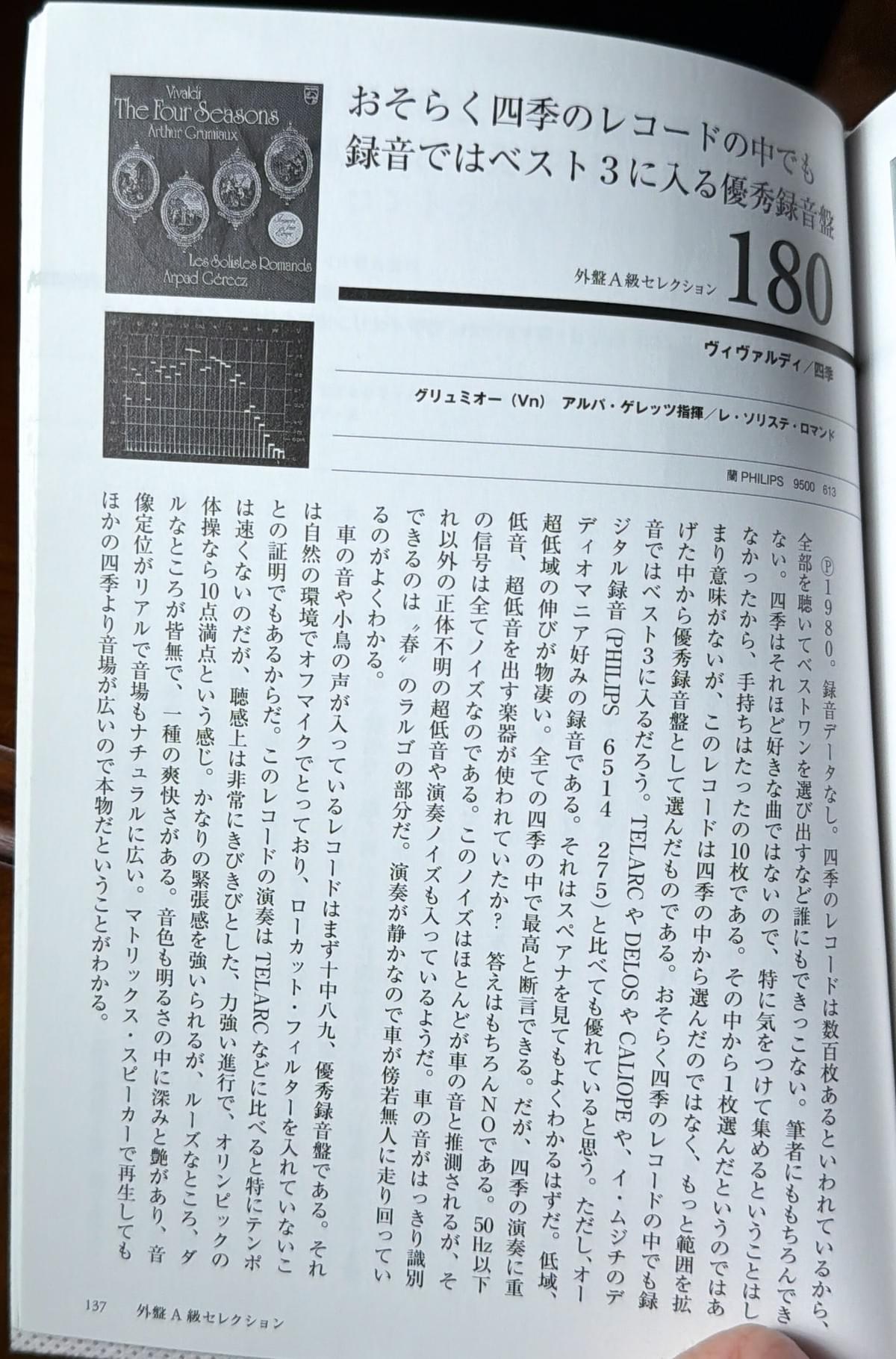
這不是殿主一個人的偏愛。日本音響評論家長岡鐵男(Tetsuo Nagaoka,1926-2000)在《外盤 A 級精選》裡把它列為第 180 號,標題下得很重:在所有《四季》唱片中,就錄音成就而言大概可以排進前三名。而他拿來比較的,正好就是讀者剛才想到的那些名字——TELARC、DELOS、CALLIOPE,以及義大利音樂家合奏團後來的數位錄音。他的結論是:葛羅米歐這一版,都更勝一籌。
至於演奏,寫下「王座」那句話的宇野功芳,在同一篇解說裡接著說:在各種個性化詮釋百花齊放之後,葛羅米歐這一版是一次睙違已久、回到作品原點的演奏。
一位聽音響的人,一位聽音樂的人,兩個完全不同的耳朵,對同一張唱片下了最高的評價。
可是這張唱片有一個奇怪的地方:一般人聽到它,幾乎不會想到「原來錄音這麼好」。 殿主的看法很直接——因為演奏與音樂實在太美了,美到聽的人根本不會分心去注意音響。一張頂級錄音,最好的地方卻是讓你忘了錄音。
解開這個矛盾的鑰匙,只有三個字:不加料。
這張唱片在兩個地方都「不加料」。錄音上,它沒有切掉低頻、沒有把空間修乾淨,連窗外的車聲都留著。演奏上,葛羅米歐不放大鳥鳴與雷電,始終拒絕炫耀技巧。兩個「不加料」,各自走到了極致:一個是錄音上的成就,一個是演奏與音樂上的成就。 也正因為兩邊都沒有在「表現」,聽的人最後只聽到音樂。
錄音的不加料:窗外的車聲,為什麼是好錄音的證據
長岡的評法很有意思。他先坦白說,自己並不特別喜歡《四季》,手上只有十張左右;這張不是從「四季」裡選的,而是從所有古典黑膠裡,以「優秀錄音」的標準挑出來的。
接著他拿出頻譜儀的圖,指出一件怪事:這張唱片的低頻與超低頻延伸驚人。但《四季》的編制裡,有發得出這種超低音的樂器嗎?他自己回答:當然沒有。50Hz 以下的訊號,全是噪音——他推測絕大部分來自外頭街上的汽車。 而聽得最清楚的,就是《春》第二樂章的廣板——獨奏小提琴為熟睡的牧羊人唱搖籃曲,中提琴輕輕模仿牧羊犬的吠聲:音樂太安靜了,車子反而「旁若無人」地來來去去。
一般人聽到這裡,會覺得是缺點。長岡卻把它當作證據。他的經驗法則是:錄到車聲或小鳥叫聲的唱片,十之八九是優秀錄音。因為這代表兩件事——麥克風放得夠遠,收進了廳堂本來的空間;後製也沒有用低頻切除濾波器,把這一層「修乾淨」。
換句話說,這張唱片的錄音成就,不是靠「多做了什麼」,而是靠「少做了什麼」。 沒有拉近的麥克風,沒有人工混響,沒有低頻切除——留下來的,就是那座廳、那個下午的真實。
那座音樂廳本身也有來歷。拉紹德封是瑞士鐘錶重鎮,音樂廳 1955 年啟用,約千座,就在市中心的主幹道旁。它以聲學著稱,Philips、EMI、DG 等廠牌都專程到此錄音。唱片封套上只寫了城市名,但那輛車和那份空間感,都是這個地方的聲音。
長岡對演奏的評語也很有画面。它的速度其實不比 TELARC 等版本快,聽起來卻乾淨利落、力道十足,他用體操比賽作比:是「10 分滿分」的動作。音色明亮,底下卻有深度與光澤;音像實在,音場自然地開闊。
下次聽到一張唱片裡有「雜音」,不妨先問一句:這是瑕疵,還是那個下午真的存在過的證據?

一生只有一次,而且等到 57 歲
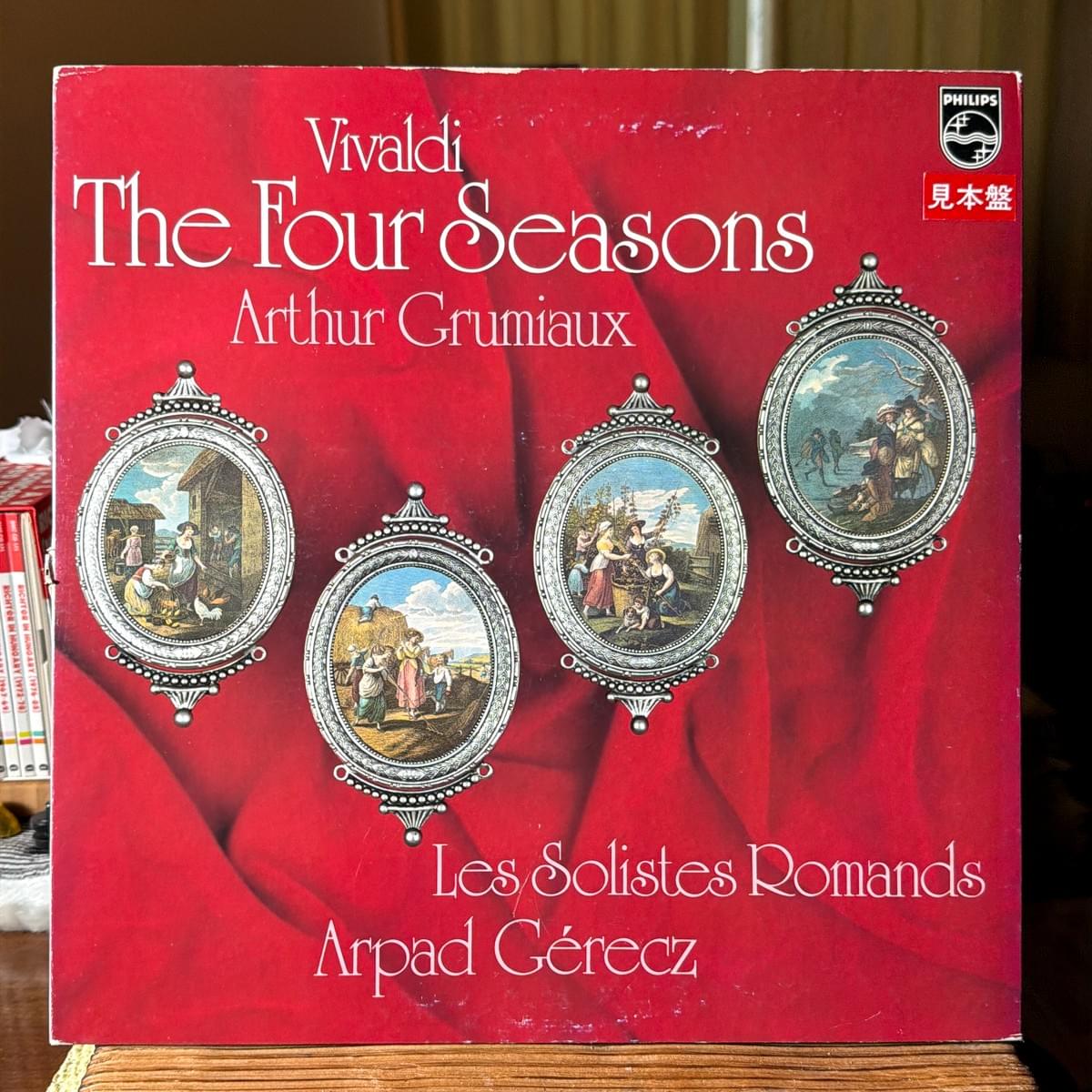
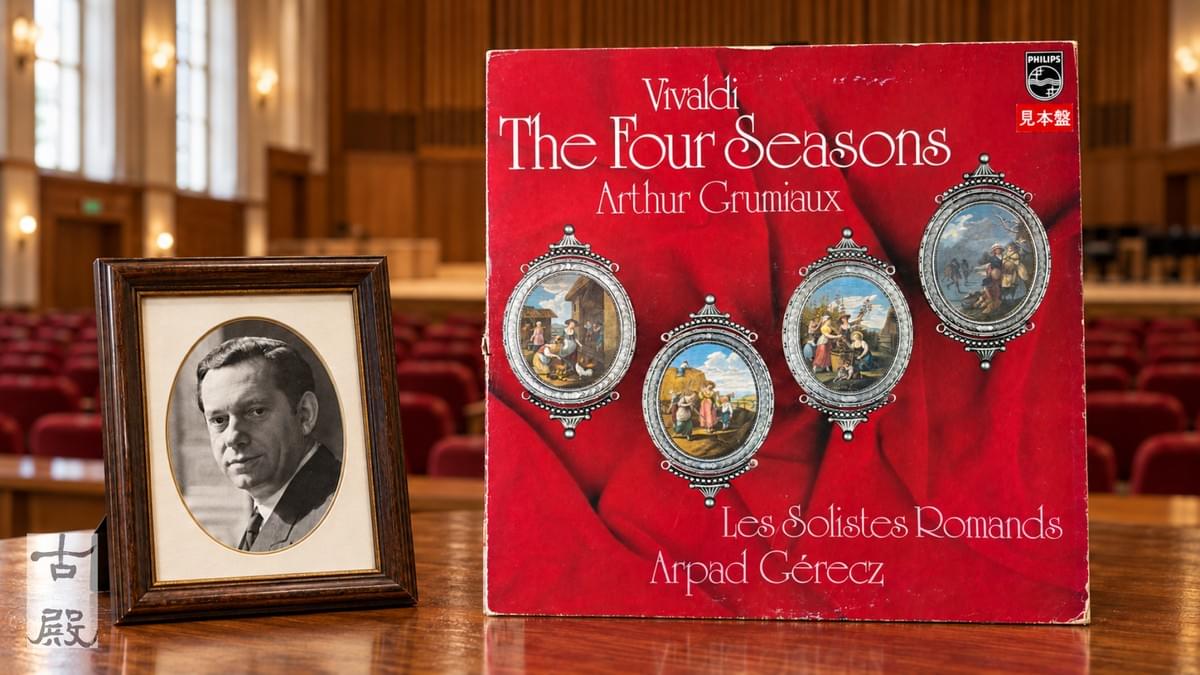
拉小提琴的是阿圖爾・葛羅米歐(Arthur Grumiaux,1921-1986)。這是他一生中唯一的一份《四季》錄音,錄製時他已經 57 歲。
這件事放在他的錄音履歷裡看,特別醒目。他是 Philips 合作超過二十年的「廠牌小提琴家」,巴哈小提琴協奏曲錄過三次,孟德爾頌、柴可夫斯基協奏曲也各錄三次,貝多芬協奏曲也有四次。不過唱片市場上最流行的《四季》,他卻一直沒有碰。
1950 到 1970 年代,是《四季》從冷門曲目變成暗銷曲目的年代。義大利音樂家合奏團的版本坐穩王座,馬利納(Neville Marriner,1924-2016)和哈農庫特(Nikolaus Harnoncourt,1929-2016)則把個性化的詮釋推到了極致。葛羅米歐是在這個熱潮已經走完一輪之後,才第一次,也是最後一次,走進這部作品。
往回看他的一生,有幾個選擇很能說明他是什麼樣的人。他生於比利時鄉間,祖父開樂譜行,四歲前就拿起小提琴。二戰德軍佔領比利時,納粹要他去擔任德國一流樂團的首席,他選擇躲藏起來,不為佔領者演奏。戰後,他回到母校布魯塞爾皇家音樂院,接下老師杜波斯(Alfred Dubois,1898-1949)的教職。1973 年,比利時國王授予他男爵爵位。
錄這張《四季》的 1978 年,他的生命也在轉彎。同一年,葛羅米歐三重奏的大提琴家察科(Eva Czakó)辭世,他的室內樂戰友散了。八年後,他自己也在布魯塞爾中風辭世,得年 65 歲。
這次陪他錄音的,也不是什麼大牌樂團。指揮阿爾帕德・蓋雷茲(Árpád Gérecz,1924-1992)是匈牙利出身、在瑞士落地的小提琴家——唱片解說裡提到,他以前常在葛羅米歐演奏弦樂五重奏時,坐在他身邊拉第二小提琴。蓋雷茲帶領的羅曼德獨奏家室內樂團(Les Solistes Romands),是 1969 年在瑞士法語區成立的弦樂合奏團。同一個月的 6 日到 11 日,他們才剛一起錄完巴哈的小提琴協奏曲;《四季》是這一週合作的最後三天。
所以這張唱片不是「明星配名團」的商業安排,而是一位老師,和一位老朋友、一個合得來的小團,在一座好廳裡的一週。
演奏的不加料:拒絕炫耀,卻是音樂的極致
唱片內頁的解說,出自日本樂評家宇野功芳(Koho Uno,1930-2016)。他的標題大意是:一場讓人重新體會《四季》原點的演奏。在個性化詮釋百花齊放之後,他認為葛羅米歐這一版是「睽違違已久」的回歸,讓人重新認識這部作品「未經雕琢的純真樸實之美」。
《四季》是標題音樂,每一首都配有一首十四行詩,鳥鳴、雷電、犬吠、獵槍——樂譜裡全都寫了。所以很多演奏者會把這些「音效」放大。這一版反其道而行。宇野的描述是:全曲完全屏除刻意的描寫性誇張,把音樂的流動放在第一位,大鍵琴也很沉穩。
拒絕炫耀,在很多人耳裡等於平淡。宇野的判斷正好相反:這並不單調,也不乾癟,因為它的音樂性高到無可比擬;他最後只用「令人心曠神怡」一語總結全曲。他點名了幾個值得留意的地方,可以當作聽這張唱片的地圖:
- 《春》第一樂章:樂句收尾處那個極輕、極溫柔的漸弱;以及氣氛轉換時,大幅度放慢的那一下。
- 《夏》第一樂章:精妙的極弱音,酷暑里的人與牲畜都無精打采。
- 《夏》第三樂章:暴風雨裡,重音一個一個精準地落下,表情卻仍然清爽。
- 《秋》第二樂章:加弱音器的弦樂緩緩推動,只是樸素的八分音符連續,沒有任何故作驚人之處。
- 《秋》第一樂章:宇野說,葛羅米歐在蓋雷茲鋪好的框架裡自在穿梭,那種瀟灑,是只屬於他的境界。
宇野也不是全盤稱讚。他對《冬》第二樂章被處理得偏重律動感,留了一點保留。這個保留反而讓他的評論更可信——也留了一個問題給聽者:壁爐邊、窗外下雨的那段旋律,你想聽到的是歌,還是節奏?
這種「不加料」有它的來歷。葛羅米歐的師承,可以一路追到比利時小提琴學派的主幹:貝里奧(Charles de Bériot,1802-1870)、魏歐當(Henri Vieuxtemps,1820-1881)、易沙意(Eugène Ysaÿè,1858-1931),再到他的老師杜波斯。這個學派講究的是弓的平順、音色的純淨、分句的典雅。英國樂評家葛林菲爾(Edward Greenfield,1928-2015)說過大意是這樣的話:他是大師級的炒技家,却始終拒絕炫耀技巧。
宇野聽到的,正是這個學派的極致:技巧全都在,却從不拿出來展示。 就像錄音不靠修飾取勝,演奏也不靠炫技取勝——兩者都把功夫花在聽不出「功夫」的地方。
兩個不加料,同一個答案
回到開頭那個矛盾:為什麼一張頂級錄音,會讓人忘了錄音?
答案可能就在那 57 歲裡。宇野聽到的「不用力、不做作」,不是技術選擇,而是生命選擇。年輕的炒技家需要證明自己,所以會放大鳥鳴與雷電;一個已經成為男爵、失去室內樂戰友的人,只需要讓音樂自己流過去。
而一個不必再證明什麼的演奏,配上一個不必再修飾什麼的錄音——麥克風放遠,低頻不切,車子經過就讓它經過。兩件事其實是同一個態度。聽的人忘了錄音,正是因為錄音和演奏都沒有在「表現」,只剩下音樂。
這不是技術問題,是生命深度問題。一位法比學派的老師,在最通俗的曲目上,用「不加料」寫下他唯一的答案。很多音樂家是年輕時錄最熱門的曲子;葛羅米歐是等到一生的東西都積累到了,才把它拿出來。
*****
【Gudian Music Stories】So Fine You Forget the Recording: Arthur Grumiaux’s (1921–1986) Sole Four Seasons, and Two Refusals to Meddle
A Four Seasons on Nobody's Shortlist
Mention Antonio Vivaldi’s (1678–1741) The Four Seasons, and most listeners think first of I Musici. They returned to the score repeatedly across the decades, logging a catalog presence that set industry records. As late as 1980, Japanese music critic Kōhō Uno (1930–2016) observed that their readings "still sat securely upon the throne" of the commercial market.
Ask an audiophile searching for the sonic benchmark, and the recommendations shift toward labels celebrated for acoustic engineering: Telarc, Delos, or Calliope.
On neither ledger is the name Arthur Grumiaux (1921–1986) likely to appear.
Yet Grumiaux’s sole traversal of The Four Seasons stands among the finest audio engineering achievements in the work's discography—matched note for note by its musicianship.
This is no private indulgence of the Ancient Palace. In his definitive reference guide A-Class Selected Imports, Japanese audio critic Tetsuo Nagaoka (1926–2000) designated this release as Entry No. 180, delivering an uncompromising verdict:among all recordings of The Four Seasons, in terms of acoustic engineering, it likely ranks among the top three. He measured it against the benchmarks listeners recall first—Telarc, Delos, Calliope, alongside I Musici's digital remakes—and concluded that Grumiaux’s release surpassed them all.
As for the playing itself, Kōhō Uno—who had noted I Musici’s commercial reign—wrote in his liner essay that after decades of idiosyncratic, stylized readings competing for attention, Grumiaux offered a long-overdue return to the unvarnished roots of the score.
An audio critic evaluating physical acoustics, and a musicologist assessing artistic interpretation: two listeners with divergent priorities, arriving at an identical appraisal.
Yet the recording presents a curious paradox: when people listen to it, they rarely think, "What magnificent engineering." The reason is straightforward: the playing and the score unfold with such natural grace that the listener never pauses to analyze the sound system. The finest virtue of this reference recording is that it makes you forget the recording entirely.
The key to resolving that paradox lies in three words: refusing to meddle.
This album abstains from interference in two distinct realms. In the engineering chain, the low frequencies were not filtered, the hall boundaries were not sanitized, and passing traffic outside the auditorium was allowed to remain on tape.In the musical execution, Grumiaux refused to inflate the programmatic birdsong and thunder, declining to flaunt his virtuosity. Two acts of quiet restraint pursued to their conclusions: one an engineering achievement, the other an interpretive triumph. Because neither the microphones nor the bow were busy "performing," what remained was pure music.
Engineering Without Intervention: Why Passing Traffic Proves Sonic Purity
Tetsuo Nagaoka’s critique took an unconventional turn. He admitted candidly that he had no special affection for The Four Seasons, keeping barely ten copies on his shelves; this LP was chosen not from comparative surveys of Vivaldi, but selected from the whole expanse of classical vinyl strictly by the criteria of acoustic excellence.
Examining real-time spectrum analyzer curves, he pointed out a physical anomaly: the disc exhibits subterranean low-frequency and infrasonic extension. Yet does Vivaldi’s chamber orchestration include an instrument capable of generating 30 Hz energy? As Nagaoka noted, of course not. Every trace of energy beneath 50 Hz is ambient rumble—primarily vehicular traffic traversing the city street outside the hall. The bleed surfaces with crystalline clarity during the Largo of Spring, where the solo violin spins a lullaby over a sleeping goatherd while the viola murmurs the barking of his sheep:the hall grows so quiet that passing cars rumble by outside undisturbed.
A conventional audiophile might dismiss this ambient bleed as a technical defect; Nagaoka seized upon it as proof of acoustic integrity. His rule of thumb was simple: a record that captures distant traffic or chirping birds nine times out of ten represents an exceptional acoustic document. It proves two parameters: the balance engineer set the microphones back far enough to capture the volume of the room, and the post-production mastering engineer refrained from applying a high-pass filter to scrub the lower octaves clean.
In short, the engineering triumph of this LP was achieved not by what was added, but by what was withheld. No spot mics pushed into the bridge, no artificial plate reverb, no high-pass filtering—leaving the physical reality of that auditorium on that specific afternoon intact.
The venue has its own pedigree. La Chaux-de-Fonds, a watchmaking center nestled in the Swiss Jura mountains, features the Salle de Musique: an auditorium opened in 1955 seating roughly one thousand listeners, located directly along a central urban artery. Renowned for natural reverberant decay, it drew production teams from Philips, EMI, and Deutsche Grammophon across Europe. The sleeve credits only the city, but the spatial decay and the faint engine rumbles outside belong to the room.
Nagaoka’s assessment of the performance was vivid. The tempos are not driven as aggressively as contemporary digital editions, yet the execution remains clean and muscular—a display he likened to an artistic gymnastics routine executed with a perfect ten. The tone is bright with depth and core warmth; the imaging is tangible, set within a three-dimensional soundstage.
The next time an ambient artifact surfaces on a vinyl record, pause and consider: is it a defect, or the physical proof that an afternoon in history truly occurred?
Once in a Lifetime, and Waiting Until Age 57
The violinist drawing the bow is Arthur Grumiaux. This was his only recorded encounter with The Four Seasons, set down when he had reached the age of fifty-seven.
Set against his broader discography, this single entry stands out. As an exclusive artist for Philips for more than two decades, Grumiaux recorded Bach’s violin concertos three times, returned to the Mendelssohn and Tchaikovsky concertos three times each, and set down four traversals of Beethoven. Yet The Four Seasons—the most commercially successful title in the violin catalog—went untouched by his bow for decades.
Between the 1950s and 1970s, Vivaldi’s cycle evolved from an obscure Venetian score into an international best-seller. I Musici secured the mainstream audience, while Neville Marriner (1924–2016) and Nikolaus Harnoncourt (1929–2016) pushed expressive mannerisms to dynamic extremes. Grumiaux entered the arena only after that initial wave of fashion had spent its force, offering a solitary reading late in his career.
Reviewing the choices of his life illuminates the character of the man. Born in rural Belgium to a grandfather who operated a music-sheet shop, he held a quarter-size instrument before his fourth birthday. When the German Wehrmacht occupied Belgium, the authorities offered him the concertmaster chair of a German orchestra; Grumiaux chose to go into hiding, refusing to perform for the occupying forces. Following the Liberation, he returned to the Royal Conservatory of Brussels to assume the teaching studio left vacant by his late mentor, Alfred Dubois (1898–1949). In 1973, King Baudouin created him a Baron.
By 1978, when this session took place, his personal circle was changing. That same year, cellist Éva Czackó of the Grumiaux Trio passed away, bringing an end to his long-standing chamber partnership. Eight years later, Grumiaux suffered a stroke in Brussels, passing away at sixty-five.
The ensemble supporting him was no high-profile touring orchestra. Conductor Árpád Gérecz (1924–1992) was a Hungarian-born violinist who had made Switzerland his home—the liner notes recall that he had sat alongside Grumiaux as second violin in string quintet performances. Les Solistes Romands, the ensemble Gérecz founded in French-speaking Switzerland in 1969, was a modest, disciplined chamber band. From February 6 to 11 of that month, they had tracked Bach’s violin concertos together; The Four Seasons was captured during the final three days of that week.
This album was no manufactured studio showcase pairing an international soloist with a celebrity orchestra. It was a respected teacher, an old chamber colleague, and an ensemble gathered inside an acoustic space for seven days of unhurried music-making.
Musicianship Without Interference: Technique in Service of the Score
The Japanese liner notes were drafted by critic Kōhō Uno. His premise was simple: a reading that returns the listener to the core of the music. Following decades of eccentric, interventionist interpretations, Uno welcomed Grumiaux’s reading as a return to the unforced purity of Vivaldi’s design.
The Four Seasons is programmatic music accompanied by descriptive sonnets—birdsong, flash storms, barking dogs,hunter firearms—all annotated in the printed stave. Many virtuosos exploit these passages for aggressive sonic mimicry.Grumiaux took the opposite path. Uno observed that the entire traversal eschews theatrical exaggeration, placing natural harmonic flow and contrapuntal momentum above all else, anchored by an unhurried, grounded continuo harpsichord.
Restraint is frequently mistaken for emotional reserve. Uno reached the opposite conclusion: the performance is neither flat nor dry, but informed by musical taste, summarizing the experience as an unburdened, serene joy. He mapped several hallmarks:
- Spring, First Movement: The pianissimo decrescendo tapering the phrase ends, and the broad, natural ritardando bridging the expressive transitions.
- Summer, First Movement: The hushed dynamics sketching the exhaustion of man and flock under the oppressive heat.
- Summer, Third Movement: Dynamic accents landing with precision through the squall, delivered with timbral clarity rather than coarse sawing.
- Autumn, Second Movement: Muted strings stepping through a steady eighth-note pulse, unhurried and devoid of melodramatic pacing.
- Autumn, First Movement: Grumiaux tracing his solo line within the framework set by Gérecz, displaying a buoyant aristocratic ease.
Uno was not blind in his praise. He maintained reservations regarding the second movement of Winter, noting that the forward metric pulse slightly outpaced the vocal, cantabile line. That caveat lends his critique credibility, leaving an open question for the listener: by the fireside as the rain taps against the glass, do you seek an aria, or an unyielding pulse?
This restraint carries a direct pedigree. Grumiaux’s artistic ancestry traces directly through the spine of the Franco-Belgian school: Charles-Auguste de Bériot (1802–1870), Henri Vieuxtemps (1820–1881), Eugène Ysaÿe (1858–1931),and Alfred Dubois. The hallmark of that school was an unhurried right arm, pure intonation, and aristocratic phrasing.Critic Edward Greenfield characterized him as a virtuoso who consistently refused to make a show of his technique.
Uno recognized the culmination of that tradition: the technical mastery was intact, but held back from display. Just as the sound engineering avoided dynamic compression and cosmetic filtering, the violin playing avoided theatrics—both reserving their craft for nuances that never call attention to themselves.
Two Refusals, One Conclusion
Why does an exceptional audio recording make you forget the recording entirely?
The answer resides in the age of the artist: fifty-seven years old. The unforced ease Uno heard was not a calculated technique, but a way of being. A young prodigy must conquer the world, leaning on every storm and birdsong to prove technical authority; a fifty-seven-year-old artist, honored by his sovereign and mourning departed colleagues, needs only to step back and let the music breathe.
An interpretation that needs to prove nothing, captured by an engineering setup that needs to hide nothing: microphones pulled back, low frequencies intact, letting the passing traffic roll by. The two philosophies spring from the same root. The listener forgets the medium because neither the player nor the engineer was trying to perform. All that remained was the work.
This is not a matter of audio specifications; it is a question of artistic depth. An heir to the Franco-Belgian lineage took the most popular score in the literature and answered it with unforced simplicity. Many instrumentalists record the warhorses in their youth; Grumiaux waited until a lifetime of living had accumulated in his hands, and only then set it down.
Want to explore how Grumiaux’s Vivaldi compares sonically with I Musici's analog Philips pressings?