
【古殿唱片音樂故事】他寫下「他突破了一道牆」的那天,他已經離世了六天:柯岡(Leonid Kogan, 1924–1982)的「遺作」貝多芬小提琴協奏曲
古殿殿主
一份遲到八天的訃告
1982年12月11日,日本樂評人宇野功芳(Uno Kōhō, 1930–2016)伏案寫完一篇唱片解說。
他是受日本Victor唱片公司委託撰寫這份解說的——也就是說,他是唱片正式出版前,少數能搶先聽到這份錄音的人之一。他聽完柯岡(Leonid Kogan, 1924–1982)第四次貝多芬《D大調小提琴協奏曲》出版錄音,激動得幾乎壓不住筆下的讚嘆。他寫道這位年過半百的小提琴家,這一次又「突破了一道牆」——開拓出嶄新世界、抵達了藝術生涯的巔峰造詣。他甚至不吝把讚美分給站在指揮台上的柯岡之子帕維爾(Pavel Kogan, 1952–):那份具備極高音樂性與敏銳度、由帕維爾所創造出的新鮮聲響創造力,同樣絕對值得由衷讚賞。
一篇再正常不過的委託解說文,讚美一位正值藝術巔峰的大師,以及他初露頭角的指揮家兒子。身為正式出版前搶先聽見這份錄音的少數人之一,宇野功芳當下沒有理由懷疑——他描述的,是一位還站在舞台上、還會繼續往前走向下一個藝術之巔的音樂家。
八天後,1982年12月19日,宇野功芳才輾轉聽到消息:柯岡已經去世了。而且去世的日期,比他寫完這篇讚美文章的日子還早——12月17日,柯岡在前往音樂會途中的火車上,心臟病猝發身亡,得年58歲。
也就是說,宇野在寫下「柯岡再次突破了一道牆,抵達巔峰」的那個下午,柯岡其實已經在六天前過世了。他寫作的當下渾然不知,一路寫到最後一個句點,都以為自己描述的,是一位還要繼續往前走的音樂家。
這份震撼,恐怕不是三言兩語說得清的。他是正式出版前,少數搶先聽見這份錄音、並確認柯岡「突破了一道牆」的人——這份第一手的喜悅,此刻卻與另一個事實正面撞上:原來他所讚美的那個瞬間,其實已經是尾聲,而不是新的起點。一篇原本朝向未來寫的文章,一夕之間變成終點。那種既震驚、又難以名狀的複雜心緒——讚美是真的,藝術突破也是真的,只是他描述的那個「正要繼續往前走」的柯岡,已經不在了。
宇野功芳能做的,只有在文章末尾,倉促加上一行「追記」:本稿脫稿後的12月19日,聽聞了柯岡的訃報,謹此致上哀悼之意。
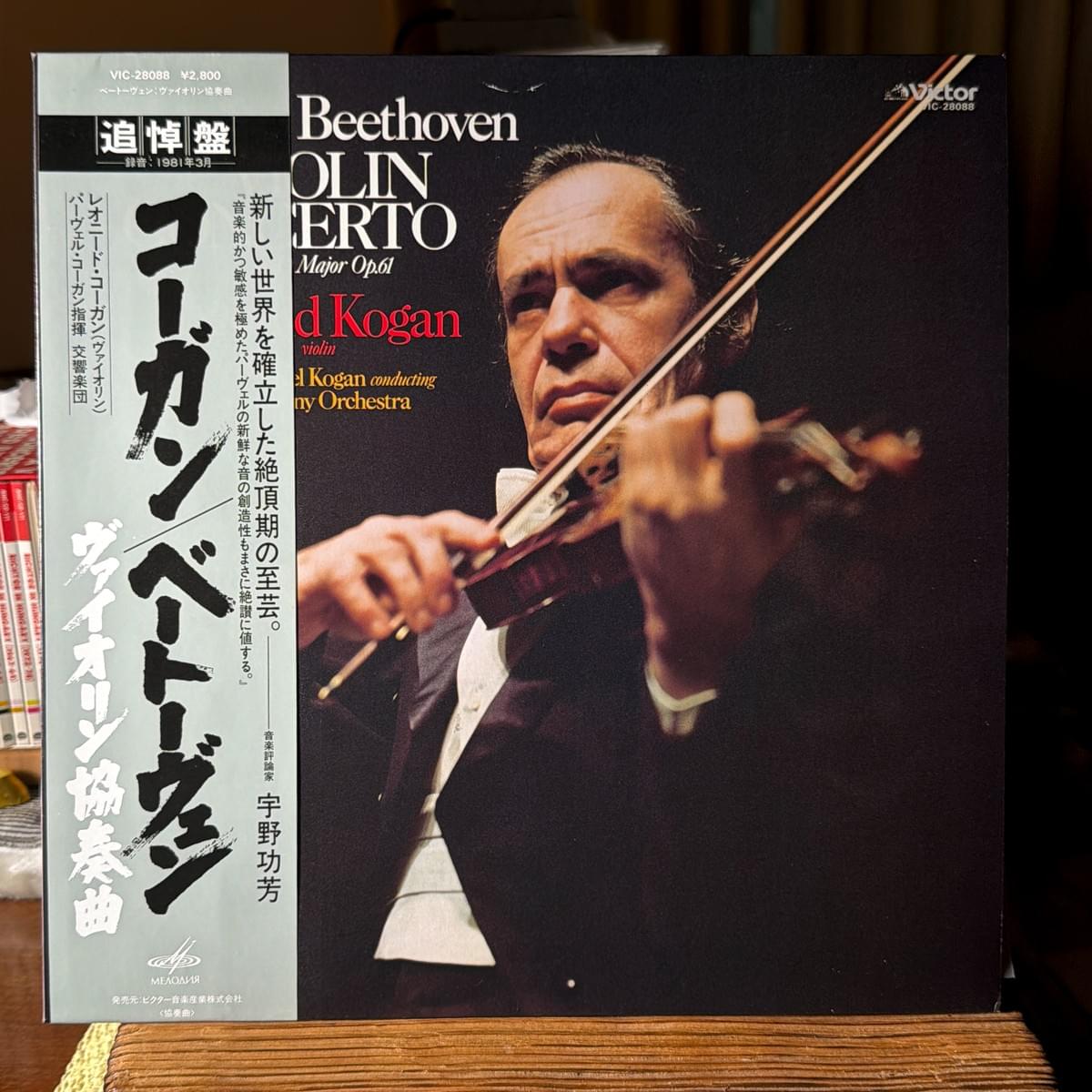
於是這篇原本單純的演奏評論,意外變成了一份時間錯位的文獻——一個人在不知情的狀態下,寫給一位已經不在人世的藝術家的悼詞,只是悼詞用的是讚美的語氣。日本Victor後來把這篇解說連同錄音,印上「追悼盤」發行——這正是眼前這張唱片,封套帶標上那三個字的由來。
從中提琴到指揮台:上一次我們說到哪裡
(承續之前殿主曾寫過的一篇文章:〈柯岡一家兩張最重要的家族錄音〉)
在那篇文章裡,我們比較了三對演奏莫札特《協奏交響曲》K.364的父子檔:歐伊斯特拉夫(David Oistrakh, 1908–1974)把小提琴讓給兒子伊果(Igor Oistrakh, 1931–2021),自己退到中提琴的暗處,而且一連兩代人都是這麼做;柯岡沒有這麼做。他跟帕維爾合錄同一首曲子時,自己留在小提琴的位置,讓帕維爾拉中提琴——單純只是想跟兒子一起演奏,沒有讓位的必要,因為「柯岡」這個姓氏,還沒有變成會壓垮帕維爾的重量。
那篇文章的結尾,我們留下一個伏筆:帕維爾後來沒有走上小提琴家這條路,而是逐漸把重心轉向指揮,1980年代初,父子倆再度一起走進錄音室——這一次,帕維爾不再是拉中提琴的兒子,而是站上了指揮台,父親則以獨奏家的身分,站在兒子的指揮棒下拉奏貝多芬。
這一次不一樣——宇野功芳到底聽到了什麼?
先把時間軸攤開來看。柯岡一生總共錄過四次貝多芬小提琴協奏曲:
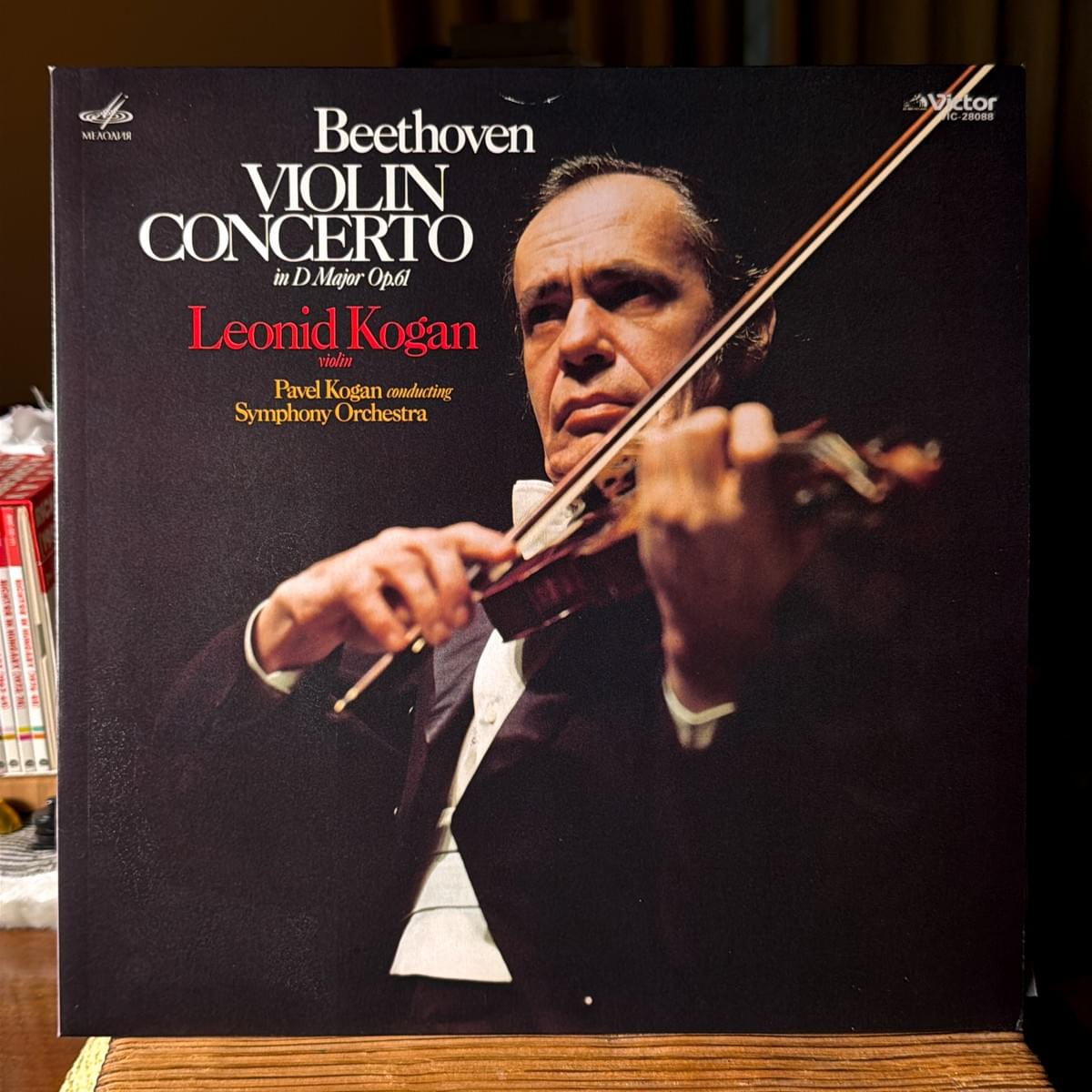
最早,單聲道時期,與孔德拉辛(Kirill Kondrashin, 1914–1981)合作;接著是立體聲初期,與席維斯特里(Constantin Silvestri, 1913–1969)指揮巴黎音樂院管弦樂團合作;第三次是1969年,與史維特諾夫(Evgeny Svetlanov, 1928–2002)合作;第四次,也是最後一次,就是眼前這張——1981年3月,莫斯科,兒子帕維爾親自執棒。
宇野功芳在解說裡,把前三次錄音一次講完:技巧圓熟,風格柯岡式的滑順漂亮,但他坦白寫下自己的猶豫——「是好演奏,但要稱之為名演,他還是有些遲疑。」
第四次,他的語氣整個變了。他形容柯岡「彷彿判若兩人般徹底釋放」,建立起一個前三次錄音裡從未出現過的新世界。年輕時代那個以凌厲快速著稱、被形容為「妖刀村正」的柯岡,這一次懂得從容不迫,速度可以放得極慢卻絲毫不顯拖沓,即興式的強弱轉折、突如其來的漸強、細膩的猶豫,貫穿全曲。第二樂章Larghetto,他寫「自始至終情感浸透無遺,近乎一場祈禱。」
這次演奏所用的華彩樂段,是姚阿幸(Joseph Joachim, 1831–1907)所作——19世紀後半葉以降最權威、也是布拉姆斯至交所留下的貝多芬協奏曲華彩版本。一個把畢生功力都投注在這段華彩裡的老練靈魂,選用的是音樂史上最莊重的一份文獻。
有一件事,必須先說清楚,才能理解宇野功芳這番讚美的真正份量。
這首貝多芬協奏曲,音符本身其實不難。獨奏聲部沒有帕格尼尼式的炫技賣弄,沒有柴可夫斯基式的密集雙音,也沒有布拉姆斯協奏曲那種對體力與跨度近乎殘酷的要求。純粹看譜面,任何一位音樂院高年級學生都能把音符完整拉完。
但正因為如此,這首曲子在許多演奏家與樂評人心中,才是小提琴文獻裡最難的一首——難不在手指,難在如何把那些「不難」的音符,綿延出真正的深刻。沒有炫技可以躲藏,稍一流於表面,就會顯得空洞;要撐得住四十分鐘的分量,靠的不是速度與力量,而是演奏者自己的生命裡,有沒有足夠的重量可以填進去。
這正是宇野功芳前三次都遲疑、不肯輕易稱之為「名演」的真正原因——年輕時代的柯岡,技巧無懈可擊,卻還沒有足夠的生命厚度,去填滿這首曲子真正要求的深刻。直到1981年,58歲,走過大半生,他才第一次真正把這首曲子「拉滿」。
也因此,宇野功芳所說的那道「牆」,根本不是一道技術上的牆,而是一道精神世界的牆。柯岡跨過去的,不是更快的運弓、更準的音準,而是用四十多年活過的時間,換來的一次精神突破。這場錄音之所以成為他的「遺言」,不是因為時間點恰好落在死前,而是因為它本身,就是柯岡精神世界所抵達的最高處。
帕維爾:不是配合,是共同創造
宇野功芳沒有把這場演奏的功勞全記在柯岡一個人頭上。他特別點出帕維爾的指揮——「極為音樂化、極為敏銳的處理,帶著一種近乎細膩體貼的節奏感」。這不是兒子小心翼翼地跟隨父親,而是一位剛剛開始建立自己指揮生涯的音樂家,拿出了真正屬於自己的聲音創造力,去回應父親。
這正好呼應了上一篇文章的伏筆。柯岡沒有像歐伊斯特拉夫那樣,需要用「退位」去替兒子清出空間——因為帕維爾根本沒有走父親那條路,他找到了指揮,找到了完全屬於自己的位置。而這張唱片,正是那個選擇開花結果的證據:父子倆不是在重複同一件事,而是各自站在自己的位置上,一起完成了一次連專業樂評都認為「突破了一道牆」的演出。
帕維爾後來真的走完了那條路。1989年,他出任莫斯科國立交響樂團音樂總監,一路做到2022年,超過三十年。柯岡沒能活著看到這件事——但1981年3月那個錄音室裡,他其實已經聽見了答案的開頭。
這道「牆」,是一條傳承鏈
柯岡能在58歲這一年「突破一道牆」,不是憑空發生的。
他10歲起師從蘇聯小提琴教育巨擘揚波爾斯基(Abram Yampolsky, 1890–1956)。而揚波爾斯基本人,1913年畢業於聖彼得堡,師從科爾古耶夫(Sergej Korguyev,生卒年不詳)——科爾古耶夫正是里奧波德·奧爾(Leopold Auer, 1845–1930)的學生兼助教。也就是說,柯岡所承接的,是「奧爾→科爾古耶夫→揚波爾斯基→柯岡」這條血脈——與海飛茲(Jascha Heifetz, 1901–1987)、艾爾曼(Mischa Elman, 1891–1967)、津巴利斯特(Efrem Zimbalist, 1889–1985)、米爾斯坦(Nathan Milstein, 1903–1992)這些名字,共享同一位宗師所開創的根源,只是走的是不同的支線。
四十多年的演奏生涯,兩次國際大賽的淬鍊(1947年布拉格、1951年布魯塞爾伊麗莎白女王大賽),四度錄音同一首協奏曲——前三次,技巧完美,卻始終差了一口氣。宇野功芳那句猶豫,說的其實不是柯岡拉得不夠好,而是還沒有「夠深」。直到第四次,58歲,辭世前一年,與親生兒子同台,某種只有走過大半生才能抵達的東西,才終於顯露出來。技巧沒有變得更快——宇野特別強調技巧完全沒有衰退的痕跡——變的是那個拉琴的人,走過的路更長了。
巔峰,剛好停在生命的最後一哩路上
這張唱片錄音於1981年3月,莫斯科。不到兩年後,1982年12月17日,柯岡在前往一場音樂會的火車上,心臟病猝發辭世,得年58歲。他此行的目的地,正是與兒子帕維爾同台演出。
而就在死前不久,柯岡才剛在維也納的舞台上,演出過同一首貝多芬協奏曲。這首曲子,幾乎貫穿了他生命的最後篇章——1981年錄音室裡那場被宇野功芳稱為「突破一道牆」的演出,1982年底維也納舞台上的最後一次公開演出,然後是那班再也沒有抵達目的地的火車。
宇野功芳寫下讚美的那一刻,並不知道自己正在為一段已經畫下句點的旅程做總結。他以為自己在描述一位藝術家攀上新高峰、正要繼續往前走;而事實是,那個高峰,就是終點本身。
最後:一個問題留給你
一篇樂評,讚美的是一場演出的「突破」;八天後,作者才知道,那場突破後面,其實已經沒有下一次了。
如果宇野功芳提早八天知道柯岡已經過世,他還會不會用「突破了一道牆」這樣的字眼?還是說,正因為他當時完全不知情,才寫出了一份最誠實、最不受死亡陰影干擾的評價——一份純粹針對音樂本身的判斷,剛好在事後,變成了一份告別?
我們評價一件藝術作品的時候,到底是在評價作品本身,還是在評價它落在了創作者生命的哪一個位置上?
******
【Gudian Music Stories】 The Day He Wrote "He Broke Through a Wall," the Master Had Already Been Gone for Six Days: Leonid Kogan’s Farewell Beethoven Violin Concerto
An Obituary Eight Days Late
On December 11, 1982, Japanese music critic Uno Kōhō (1930–2016) sat at his desk, putting the final touches on a set of album liner notes.
He had been commissioned by Victor Musical Industries in Japan to write this commentary. In other words, he was among the privileged few granted an advance listening before the record’s official release. Having just heard Leonid Kogan’s (1924–1982) fourth commercial recording of Beethoven’s Violin Concerto in D major, Uno was so moved that he could barely contain his awe on the page. He wrote that the violinist, now past fifty, had once again "broken through a wall"—forging a completely new world and reaching the absolute summit of his artistic life. He even lavished praise on the conductor, Kogan’s son Pavel Kogan (b. 1952), noting that the younger Kogan brought exceptional musicality, sensitivity, and a fresh, creative orchestral sonority that deserved profound admiration.
It was, on the surface, an ordinary commissioned review: praising a master at the peak of his powers alongside his emerging conductor son. As one of the few who had heard the recording ahead of the public, Uno had no reason to doubt that he was describing a living artist standing firmly on stage, poised to march toward his next artistic milestone.
Eight days later, on December 19, 1982, word finally reached Uno: Leonid Kogan had passed away. What is more, he had died even before Uno completed that glowing text. On December 17, while aboard a train traveling toward a concert, Kogan suffered a fatal heart attack at the age of fifty-eight.
In truth, on the very afternoon Uno penned the words declaring that Kogan had "broken through a wall and reached the summit," Kogan had already departed this world six days earlier. Completely unaware while writing, right down to the final period, Uno believed he was documenting a musician destined to keep journeying forward.
The weight of that shock is difficult to overstate. Uno was among the first to hear the recording and affirm this monumental breakthrough; yet that firsthand elation crashed head-on into a stark reality: the moment he celebrated as a glorious new dawn was, in fact, the final curtain. A piece written looking toward the future had turned overnight into an epitaph. The emotions were profoundly disorienting: the praise was genuine, the breakthrough was undeniable, but the Kogan who was supposed to keep moving forward was gone.
All Uno could do was hastily append a brief postscript to his essay: After completing this manuscript, on December 19, news of Leonid Kogan's passing arrived. I offer my deepest and most sincere condolences.
Thus, what was meant to be a straightforward review became an accidental document of temporal displacement—a eulogy written in complete ignorance of death, framed entirely in the language of triumph. Victor Japan later released the recording alongside this text, stamped with the label "Memorial Edition" (Tsuitō-ban)—the very origin of those poignant words printed on the album's obi strip.
From the Viola to the Podium: Picking Up Where We Left Off (Continuing from an earlier essay: "The Two Most Important Family Recordings of the Kogan Household")
In that previous piece, we compared three father-son duos performing Mozart’s Sinfonia Concertante, K. 364. David Oistrakh (1908–1974) yielded the violin to his son Igor (1931–2021), retreating into the shadows of the viola—a gesture sustained across two generations. Kogan chose a different path. When recording the same piece with Pavel, Kogan remained at the violin and had Pavel take up the viola. It was simply an act of making music together, free from the burden of stepping aside, because the surname "Kogan" had not yet become a weight that threatened to crush the younger musician.
We ended that article with a narrative thread left hanging: Pavel would eventually step away from a solo violin career to focus on conducting. By the early 1980s, father and son stepped into the recording studio once more. This time, Pavel was no longer the son accompanying on viola; he stood on the conductor’s podium, while his father stood before him as soloist, playing Beethoven beneath his son’s baton.
This Time Was Different: What Did Uno Kōhō Actually Hear?
Let us map out the timeline. Over his lifetime, Kogan recorded the Beethoven Violin Concerto four times:
First, in the mono era, with Kirill Kondrashin (1914–1981); then in early stereo, with Constantin Silvestri (1913–1969) leading the Orchestre de la Société des Concerts du Conservatoire; a third time in 1969, under Evgeny Svetlanov (1928–2002); and the fourth and final time, the recording before us—taped in Moscow in March 1981, with his son Pavel conducting.
In his essay, Uno summarized the first three recordings in a single breath: consummate technique, delivered with Kogan’s signature sleek, pristine polish. Yet Uno candidly confessed his reservations—admitting that while they were fine performances, he hesitated to label them true masterworks.
By the fourth recording, his tone shifted entirely. He described Kogan as having undergone a total liberation, emerging "as though transformed into an entirely different soul," building a spiritual realm unseen in the earlier traversals. The younger Kogan—famed for fierce, razor-sharp speed and once likened to the lethal Muramasa blade—had learned to embrace unhurried serenity. His tempo could broaden to an extreme without feeling lethargic; improvisatory dynamic shifts, sudden crescendos, and delicate hesitations breathed through the entire score. Of the second movement, the Larghetto, Uno wrote: From beginning to end, it is so thoroughly saturated with emotion that it feels almost like a prayer.
For the cadenza, Kogan chose the setting by Joseph Joachim (1831–1907)—the definitive nineteenth-century version left by Johannes Brahms’s dearest confidant. A veteran soul channeling a lifetime of mastery chose the most reverent, solemn document in the violin's history.
To grasp the true weight of Uno’s praise, one fundamental truth about this concerto must be made plain.
On paper, Beethoven’s concerto is not technically formidable. The solo part contains no Paganinian acrobatics, no dense thickets of Tchaikovskian double stops, none of the punishing physical span demanded by Brahms. Purely as written notes, almost any advanced conservatory student can execute the score cleanly.
Yet for this very reason, the work remains in the eyes of many artists and critics the most formidable mountain in the entire violin repertoire. Its difficulty lies not in the fingers, but in how to sustain true depth across notes that are deceptively simple. There are no virtuoso pyrotechnics behind which to hide; the slightest lapse in interiority leaves the music utterly hollow. To bear the weight of forty minutes requires neither pure velocity nor brute force, but whether the performer’s own lived experience possesses enough gravitas to fill the silence.
This was precisely why Uno hesitated over the first three recordings, withholding the title of "immortal performance." The youthful Kogan commanded flawless mechanics, but had not yet accumulated the spiritual depth demanded by the work. Only in 1981, at fifty-eight, having walked through the greater part of a lifetime, did he finally fill this vessel to the brim.
The "wall" Uno spoke of was never a barrier of technique; it was a threshold of the spirit. What Kogan crossed was not faster bowing or pinpoint intonation, but a spiritual breakthrough earned through four decades of living. That this recording became his swan song is not merely a matter of chronology; it is because the performance itself marks the highest altitude his soul ever reached.
Pavel: Not Mere Accompaniment, but True Co-Creation
Uno did not credit this triumph solely to the elder Kogan. He paid deliberate attention to Pavel’s conducting, praising it as "extraordinarily musical, deeply sensitive, carrying an almost tender sense of rhythm." This was not a tentative son deferentially following his father; it was a young maestro carving his own path, offering a distinct, authentic sonic voice in dialogue with the violin.
This brings our earlier story full circle. Unlike Oistrakh, Kogan never had to "step down" to clear space for his son—because Pavel never walked in his father’s shadow. He discovered the podium, finding a domain that belonged entirely to him. This album stands as the radiant fruit of that choice: father and son did not mirror one another, but stood firm in their respective roles, achieving a performance that compelled seasoned critics to proclaim a barrier had fallen.
Pavel would go on to fulfill that promise. In 1989, he was appointed Music Director of the Moscow State Symphony Orchestra, leading it for over three decades until 2022. Leonid Kogan did not live to witness that tenure, but in that Moscow studio in March 1981, he had already heard the opening bars of that future.
The "Wall" as an Unbroken Lineage
That Kogan was able to break through this wall at fifty-eight was no accident of fate.
From the age of ten, he studied under Abram Yampolsky (1890–1956), a towering patriarch of Soviet violin pedagogy. Yampolsky had graduated from the Saint Petersburg Conservatory in 1913 under Sergej Korguyev, who was himself the prize pupil and teaching assistant of Leopold Auer (1845–1930). Kogan therefore inherited the direct artistic bloodline of Auer → Korguyev → Yampolsky → Kogan. He shared an ancestral root with Jascha Heifetz (1901–1987), Mischa Elman (1891–1967), Efrem Zimbalist (1889–1985), and Nathan Milstein (1903–1992), even as he traveled down a distinct branch of that lineage.
Through more than four decades of performance, tempered by two major international triumphs (Prague in 1947, the Queen Elisabeth Competition in Brussels in 1951), he revisited this single concerto four times on record. In the first three, technical perfection was absolute, yet something essential remained unsaid. Uno’s earlier hesitation was not an indictment of Kogan's playing, but a recognition that it had not yet plunged to the depths. Only on this fourth occasion—at fifty-eight, a year before his death, sharing the stage with his own son—did that hard-won maturity finally reveal itself. His technique had not grown faster (Uno explicitly observed that his mechanics showed no sign of decay); what had changed was the soul behind the bow, bearing the weight of a longer journey.
The Summit, Paused on the Final Mile
This album was recorded in Moscow in March 1981. Less than two years later, on December 17, 1982, Kogan suffered a fatal heart attack aboard a train en route to a concert. He was fifty-eight. His destination on that journey was another shared performance with his son, Pavel.
Shortly before his passing, Kogan had performed this very Beethoven concerto on the concert stage in Vienna. The piece wove through the final movements of his life: the 1981 studio recording that Uno hailed as the crossing of a threshold, his final appearance on the Viennese stage in late 1982, and finally that train that never reached its destination.
When Uno penned his admiration, he had no way of knowing he was writing the summary of a journey already ended. He thought he was describing an artist ascending a new crest, ready to stride toward fresh horizons. The reality was that the crest was the horizon itself.
A Question Left for You
A music critic writes a review praising a performance for "breaking through a wall"; eight days later, he learns that beyond this breakthrough, there would never be another.
Had Uno known eight days earlier that Kogan was gone, would he still have chosen the phrase "broken through a wall"? Or was it precisely his complete ignorance of the tragedy that allowed him to produce an evaluation of pristine honesty, free from the lingering shadow of death—a judgment rendered purely on the terms of the music itself, which only by fate transformed into a farewell?
When we evaluate a work of art, are we judging the creation in its own right, or are we measuring where it fell along the fragile timeline of a creator’s life?