
【古殿唱片音樂故事】唱片上的冷戰史:「這是一場國際性的勝利!」——伯恩斯坦(Leonard Bernstein,1918-1990)的蕭士塔高維契第五號交響曲「革命」
古殿殿主
一個握手,三種說法
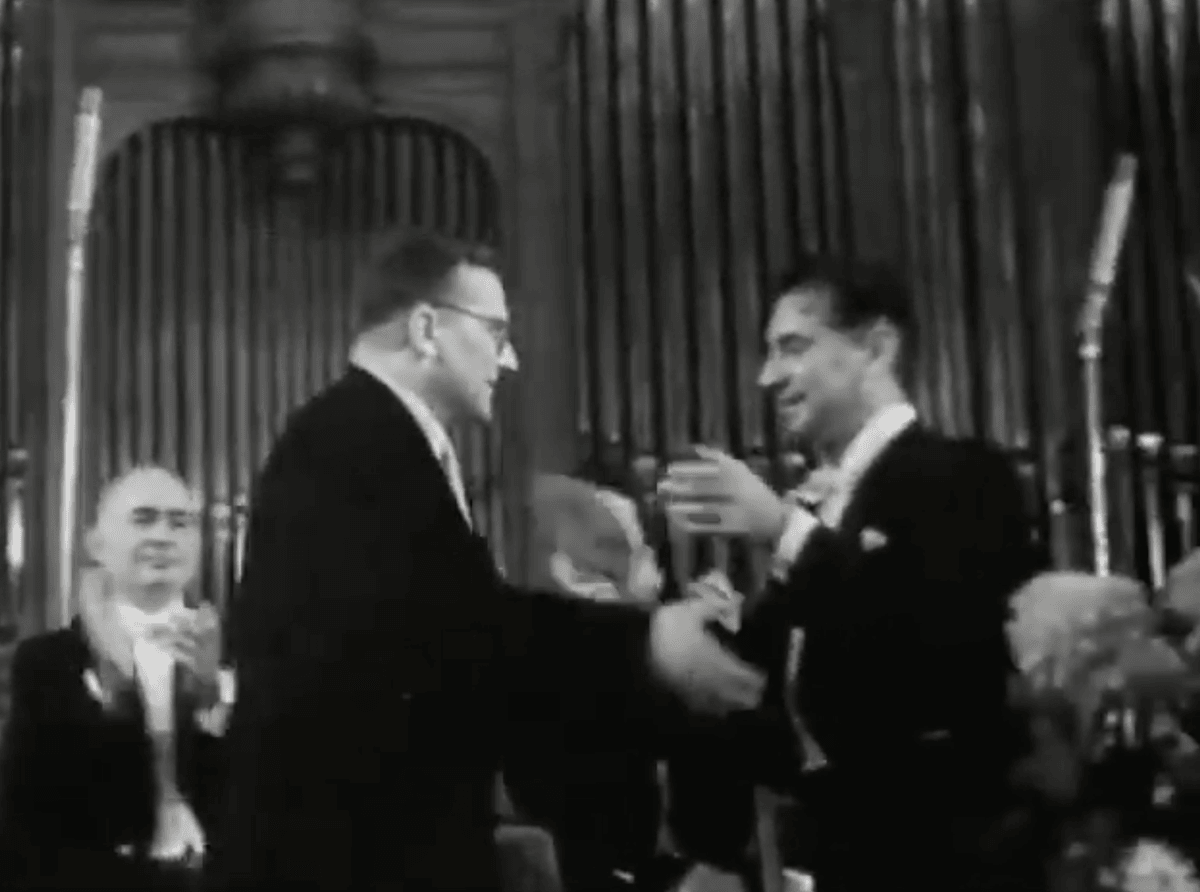
1959 年 9 月 11 日,莫斯科音樂院大廳。紐約愛樂在蘇聯的最後一場音樂會,剛演完蕭士塔高維契(Dmitri Shostakovich,1906-1975)的第五號交響曲。作曲家走上舞台,與 41 歲的指揮李奧納德·伯恩斯坦(Leonard Bernstein,1918-1990)並肩接受喝采,兩人的手握在一起。
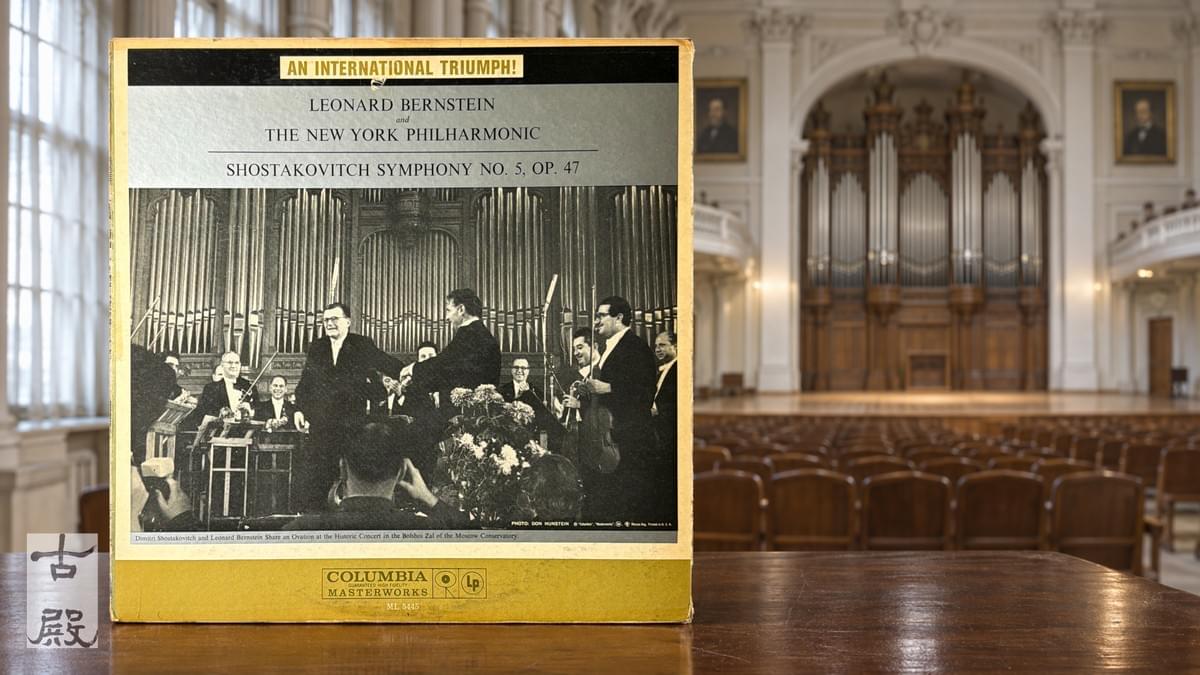
攝影師唐·亨斯坦(Don Hunstein,1928-2017)拍下了兩人共享喝采的畫面。幾個月後,這張照片印在 Columbia 的唱片封面上,頭頂是一行大字:AN INTERNATIONAL TRIUMPH!——一場國際性的勝利。
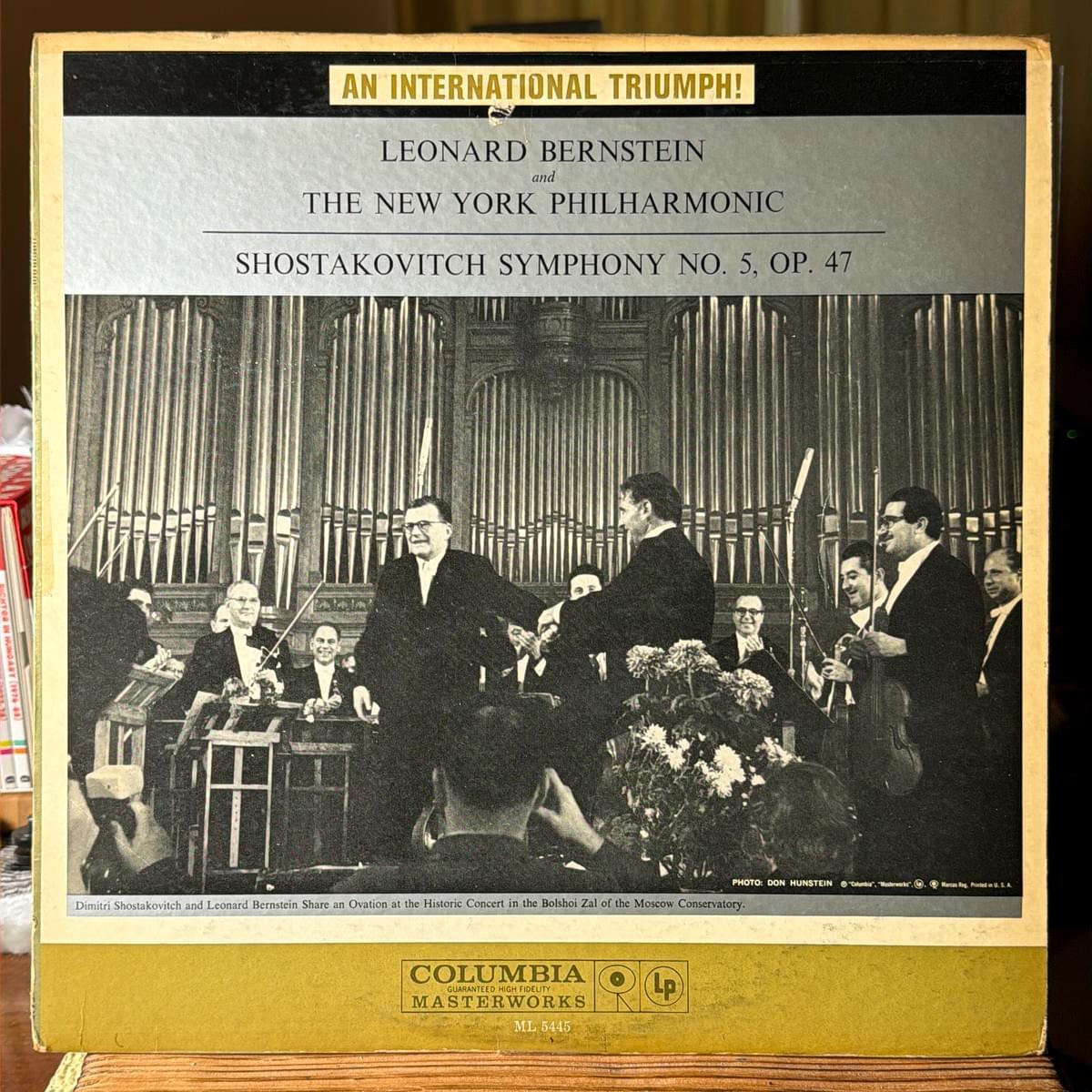
伯恩斯坦這版第五號的終樂章,後來引起了六十年的爭論。關鍵問題只有一個:蕭士塔高維契本人喜不喜歡它?
答案有三種:
- 有人說,作曲家讓人知道他「非常喜歡這個演出」。
- 有人說,他只是「勉強同意」。
- 也有人說,他「一點都不喜歡」。說這句話的,是從蘇聯出走的鋼琴家阿胥肯納吉(Vladimir Ashkenazy,1937-)。他接受焦元溥訪問時說,作曲家「一點都不喜歡伯恩斯坦對此曲的詮釋」,還強調「這是他親口說的」。
三種說法,都是別人轉述的。至於那一晚的影像與封面上那個握手,成為這一張唱片上最大的宣傳畫面。
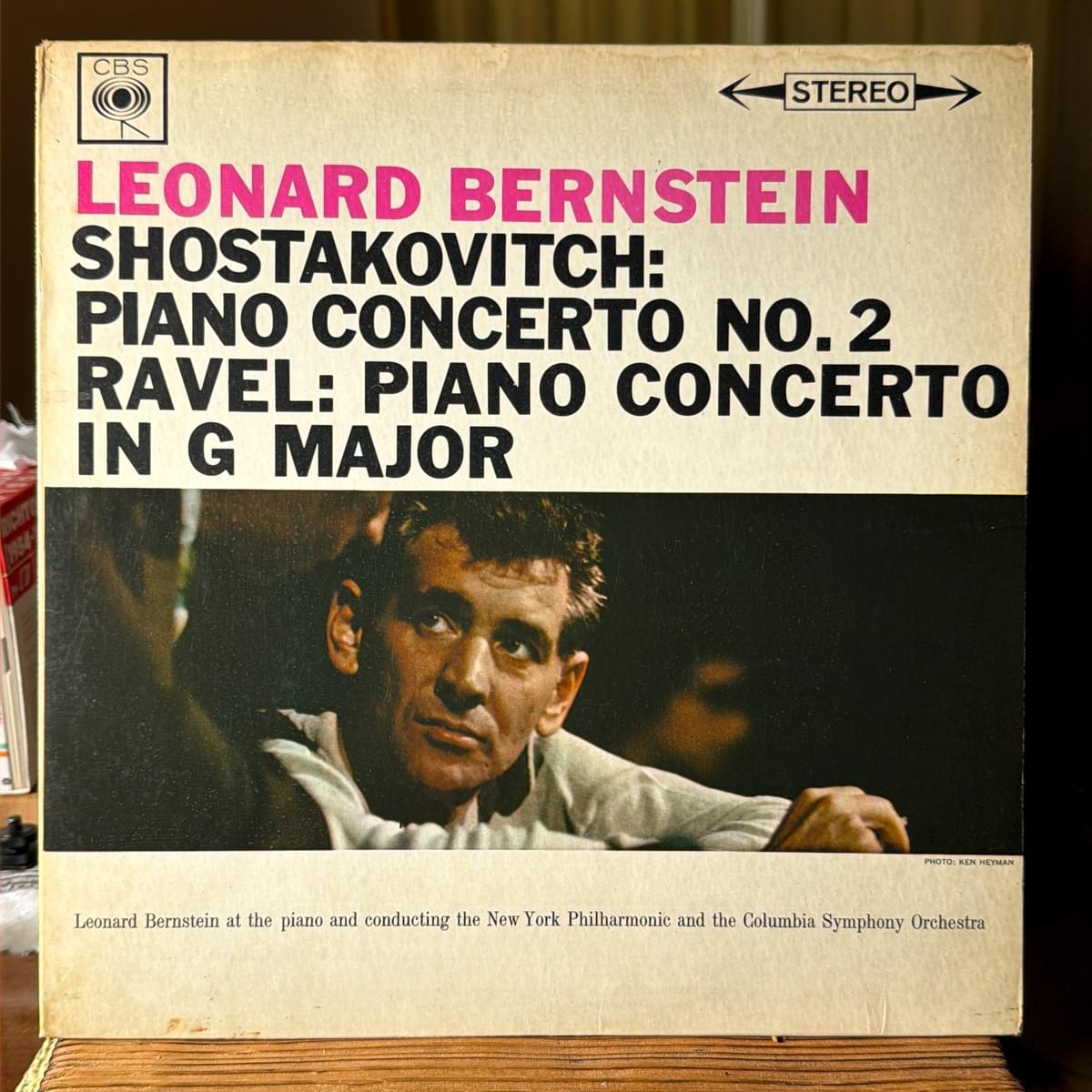
這篇文章要從兩張唱片說起:1959 年的 Columbia ML 5445 第五號交響曲,和一年前的《第二號鋼琴協奏曲》(英國版 CBS SBRG 72170)。一個在伯恩斯坦見到作曲家之前,一個在之後。
1958 年 1 月:三週,三種身分
要理解 1959 年那個握手,得先回到一年半以前。
1957 年 9 月 26 日,伯恩斯坦作曲的《西城故事》在百老匯冬園劇院首演。三個多月後,他接下紐約愛樂音樂總監。接下來的三週,是他一生中最密集的一段日子:
- 1 月 2、3、5 日,他坐在卡內基音樂廳的鋼琴前,自彈自指蕭士塔高維契的《第二號鋼琴協奏曲》。節目單註明:西半球首演。距離這首曲子在莫斯科首演,還不到八個月。
- 1 月 6 日,演完的第二天,他就帶著樂團到布魯克林的聖喬治飯店宴會廳錄音。
- 1 月 18 日,他站在電視鏡頭前,主持第一場全國轉播的青少年音樂會,題目是《音樂的意義是什麼?》。
三週之內,他是鋼琴家、指揮、錄音藝術家,又是電視教育家。再加上百老匯的作曲家,美國音樂界很難再找到第二個這樣的人。
把「at the piano」放在「conducting」前面。封面照片也不是指揮台,而是一個靠在鋼琴邊、抬眼看著鏡頭的年輕人。這是一個「什麼都能做」的人。
兩種蕭士塔高維契
伯恩斯坦帶到美國的第一個蕭士塔高維契,是一個父親。
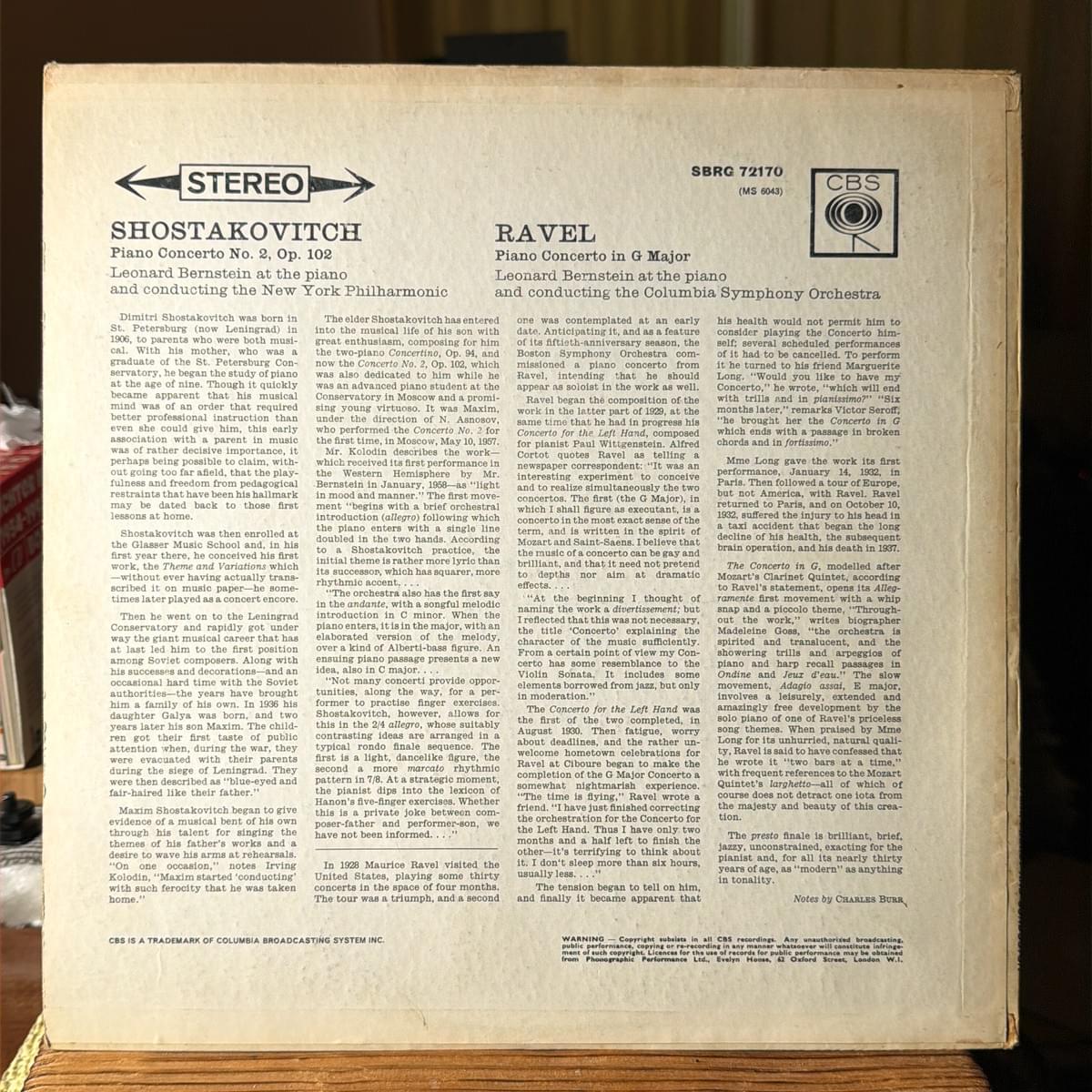
《第二號鋼琴協奏曲》是寫給兒子馬克西姆·蕭士塔高維契(Maxim Shostakovich,1938-)的。1957 年 5 月 10 日在莫斯科首演,由馬克西姆獨奏,那天正好是他的 19 歲生日。在唱片解說中,介紹起來幾乎像家庭相簿:小馬克西姆曾在排練時「指揮」得太激動,被帶回家去;終樂章裡,鋼琴突然彈起了哈農的五指練習曲,就是每個學鋼琴的孩子都彈得很痛苦的那種練習。解說作者的評語很有趣:這是不是父親與兒子之間的私人玩笑,「檯面上並不知道」。
這句話不經意地道出了西方對蕭士塔高維契的處境:連一個家庭玩笑,都無法確認。
而第二個蕭士塔高維契,是 1937 年的那一個。
第五號交響曲「革命」寫於大清洗最恐怖的一年。前一年《真理報》以「混亂代替音樂」批判他的歌劇,他身邊的人接連消失。第五號就是在這樣的空氣中寫成的,每個音符後來都被放在政治的顯微鏡下。
一張唱片封面封背,就是一份冷戰史檔案
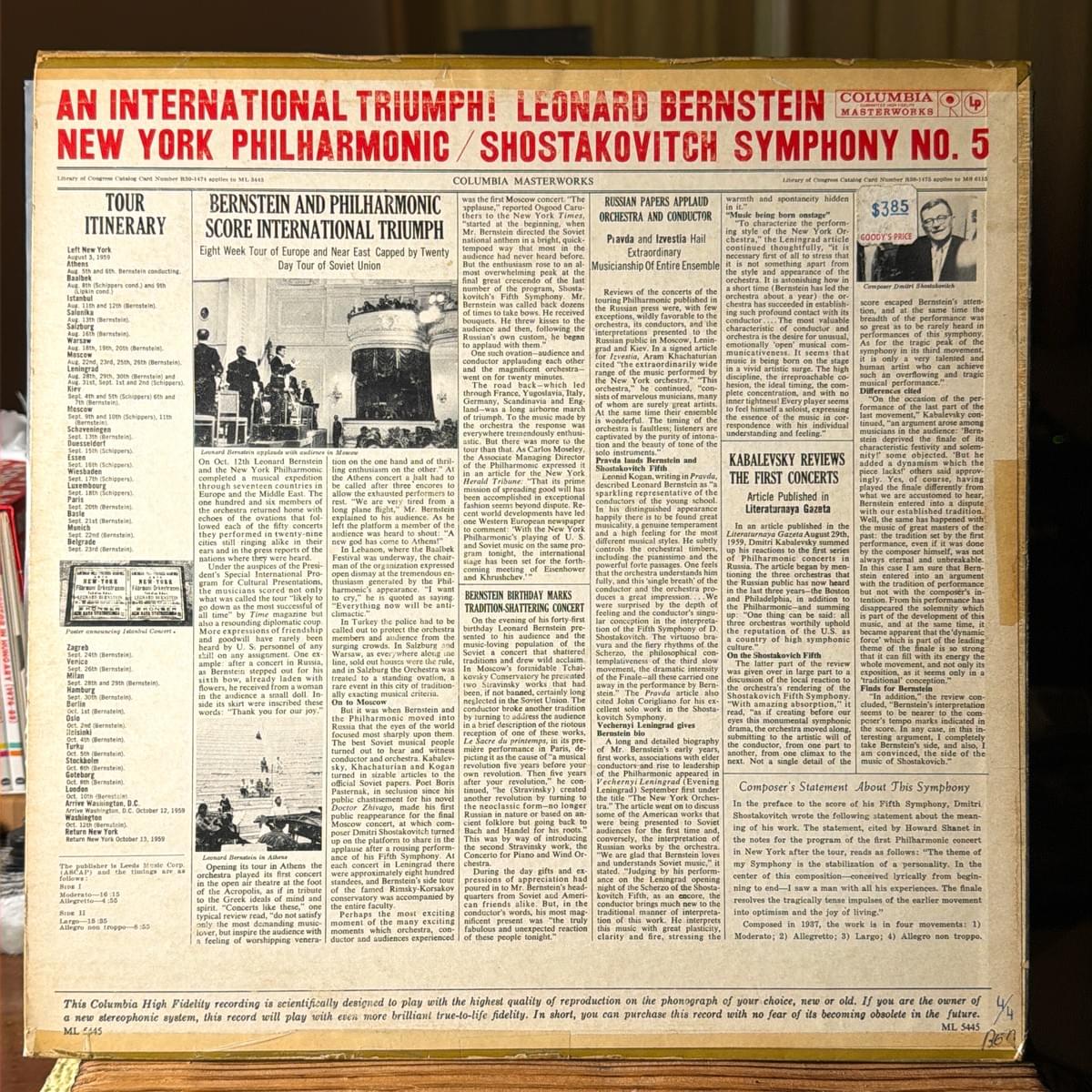
1959 年 8 月 3 日,一百零六位團員離開紐約。接下來十週,他們在十七個國家、二十九個城市開了五十場音樂會,其中二十天在蘇聯,這些都印在唱片背面封底。
這張封底值得仔細看。它被做成一版報紙頭版:紅色大標題、分欄內文、新聞照片,左欄是從雅典到莫斯科的完整巡演行程。各篇文章的標題一個比一個響亮:「伯恩斯坦與愛樂贏得國際勝利」、「俄國報紙喝采樂團與指揮」、「伯恩斯坦生日打破傳統的音樂會」。
最巧妙的是,這份「美國勝利」的證據,大多來自對手。《真理報》上小提琴家柯岡(Leonid Kogan,1924-1982)的評論、《消息報》上作曲家哈察都量(Aram Khachaturian,1903-1978)的文章、《文學報》上作曲家卡巴列夫斯基(Dmitri Kabalevsky,1904-1987)的長評,都被翻成英文,整齊排在美國唱片的背面。
但這些評論不能當作真心話。寫它們的人都是蘇聯音樂界的官方代表,在官方報紙上評論一個美國訪問團,寫的本來就是外交文字。而美國方的宣傳,也不需要去核實這些話是否真心。宣傳就是挑選對自己有利的話,把它放大,放在最顯眼的地方,告訴世界:美國代表自由世界贏了。
蘇聯方的卡巴列夫斯基在文章中記下,莫斯科聽眾裡的音樂家曾當場為終樂章爭論起來。到了封底上,這份爭論變成了英雄敘事的一部分:一個敢於「打破傳統」的美國指揮。
這個英雄本人伯恩斯坦,十年前還是一位被懷疑者。1949 年,他和蕭士塔高維契在世界和平會議上相識,因此被美國極右派貼上「共產黨」的標籤。十年後,他卻成了艾森豪總統文化計畫的大使。有學者把這趟巡演,視為伯恩斯坦在政治上「洗清名聲」的關鍵一步。
終樂章之爭
爭論的焦點,是第五號的最後幾分鐘。
終樂章伯恩斯坦把結尾的速度加快了幾乎一倍,音樂像一列衝向終點的火車,光芒萬丈。慢速派則認為,照樂譜上的慢速演奏,那份歡慶會變成一種被強迫的、沉重的尖叫。
阿胥肯納吉的看法正好相反。他在焦元溥 《黑白遊藝》的訪談中指出,第四樂章一開始樂譜就寫著「勿太快的快板」(Allegro non troppo),伯恩斯坦卻像賽馬一樣一路狂飆。他認為,作曲家還在世,伯恩斯坦却沒有去請教他;如果問了,蕭士塔高維契一定會告訴他不能這樣快,因為這個樂章的意義是「被強迫的歡樂,被鞭打、被命令下的歡樂」。他還說,就算不談《見證》,單從音樂來看,過快的速度也會讓整首交響曲的結構失衡,缺乏結束的感覺。他的結論是:伯恩斯坦無疑是傑出的音樂家,但他對這個終曲的詮釋並不理想。
「被強迫的歡愉」這種讀法,1979 年,所羅門·伏爾科夫(Solomon Volkov,1944-)在西方出版《見證》,宣稱是蕭士塔高維契口述的回憶錄。書裡那句著名的話——終樂章的歡慶,就像有人拿棍子打著你,一邊說「你的事就是歡慶」——從此改變了世界聆聽這首交響曲的方式。
但這本書的真偽,至今爭論不休。學者發現,作曲家在書稿上簽名的那幾頁,全是早已公開發表過的無害文字,一字不差。而那些尖銳的、反體制的話,都落在他沒有簽名的頁面上。伏爾科夫的速記筆記,據稱已經遺失。
蕭士塔高維契是一個小心到令人覺得古怪的人。鋼琴家李希特(Sviatoslav Richter,1915-1997)形容他神經質、焦慮;他的公開發言是官方語言,唯一的「回憶錄」只在無害的頁面上簽名,對伯恩斯坦的第五號交響曲,他留下一個握手。
而他的處境也不容他開口。他是蘇聯音樂界的代表,要接待來訪的美國樂團,幾週後自己還要率團回訪美國。他不方便否定伯恩斯坦。但要小心:「不方便否定」只能說明他的公開讚美不可信,不能證明他私下反對。
不比對錯:一個人用一生守住的速度
如果我們一直追問「誰的詮釋才對」,這張唱片只會剩下一個答不出來的問題。換一個問法:這首曲子,對伯恩斯坦自己意味著什麼?
同一個詮釋,站在不同的地方看,就是不同的東西。
從蘇聯內部的角度,伯恩斯坦不是蘇聯人,沒有在那個體制下生活過,不懂這些音符背後的恐懼與壓抑。他的速度,可以被視為一種誤讀。
阿胥肯納吉就是從這個角度說話的。他在訪談中強調自己在蘇聯出生、成長,到二十六歲才離開,也批評費依(Laurel E. Fay)等西方學者不了解蘇聯。對他來說,第五號結尾的 D 大調聽起來就是在用政治暴力命令你:「要快樂!要快樂!要喜悅!」
但從蘇聯以外、從美國的角度看,伯恩斯坦的詮釋代表的是另一件事:他所屬的地區與陣營的立場,以及他本人的特色與風格。一個在自由世界長大、相信光明、把情感全部放到舞台上的美國音樂家,自然會這樣指揮這個結尾。
兩個角度都是真的。而把它們一起放在眼前,我們看到的就不只是一個詮釋,而是一個時代的兩個世界。
他一生不斷回到它身邊。1959 年在莫斯科,在作曲家面前演奏;1966 年 12 月在倫敦皇家節慶廳,與倫敦交響樂團演出,留下了影像;同一年,他的青少年音樂會播出了《向蕭士塔高維契致敬的生日禮物》,那年作曲家 60 歲。他形容這位作曲家是「躲在眼鏡後面的害羞男人」,卻寫出了史上最強悍、最不害羞的音樂。
二十年後的 1979 年 7 月,作曲家已經過世四年,他在東京文化會館現場重錄第五號。三個月後,《見證》出版。東京版的終樂章放寬到比 1959 年慢了一分多鐘,但依然很快,依然是一場坦然的勝利。
這不是無知,是選擇。伯恩斯坦自己也曾活在政治的陰影下,他不會不懂「被強迫的歡愉」是什麼。他只是相信,音樂最後可以抵達光明。他的速度,就是他面對現實時,對自己理想的呈現。
41 歲的他跨過鐵幕,速度是那一刻的熱血;61 歲的他放慢了一分多鐘,但沒有放棄信念。同一首曲子,記錄的是同一個人在不同人生階段的生命狀態。
這個人的存在本身,就有多重意涵:百老匯作曲家、鋼琴家、指揮、電視教育家、曾被懷疑的左派、國家的文化大使。而正是他的個性與能力,讓這些互相矛盾的身分都變成了力量。
Columbia 唱片公司也很清楚,伯恩斯坦這個人的價值本身就是一個故事。
一段影片:兩種身體
封面的握手是靜止的。但那一晚,其實還留下了會動的影像。
蘇聯導演阿拉諾維奇(Semyon Aranovich,1934-1996)與蘇古諾夫(Alexander Sokurov,1951-)拍攝的紀錄片《中提琴奏鳴曲》,片名取自蕭士塔高維契的最後一部作品。這部片大量使用曾被審查的檔案影像,其中有一段,把穆拉汶斯基與伯恩斯坦指揮第五號終樂章的畫面並列。伯恩斯坦那一半,正是 1959 年訪蘇的現場錄影。
看過這段影片,發現可以比較的不只是速度快慢,還有指揮的動作與面部表情。伯恩斯坦非常激動,激動到整個人都跳了起來。演完之後,作曲家走上台道謝,與他握手。穆拉汶斯基則非常克制:不論音樂的張力如何,他的臉上都沒有太大的表情,動作十分克制與明確。
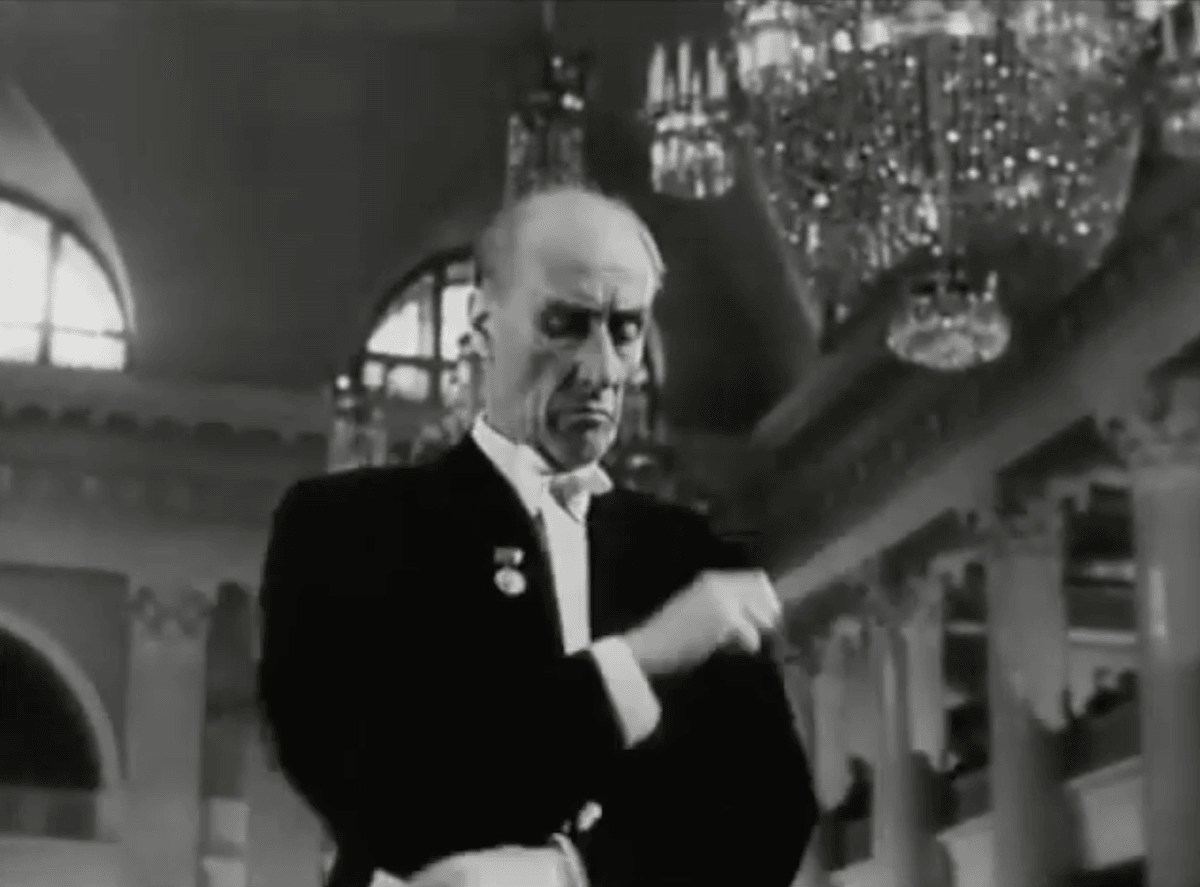
這不是隨意的剪接。在一部揭露作曲家遭受國家迫害的紀錄片裡,導演刻意把同一個終樂章的兩種演出放在一起,對比鮮明到不需要任何旁白:一快一慢,一跳一靜,一個把情感全部寫在身上,一個什麼都不寫在臉上。
一個是在自由世界長大的美國指揮,把終樂章當成一場勝利來慶祝;一個是在同一個體制下與作曲家一起活過來、指揮了這首曲子世界首演的人,把同樣的音符指揮得面無表情。
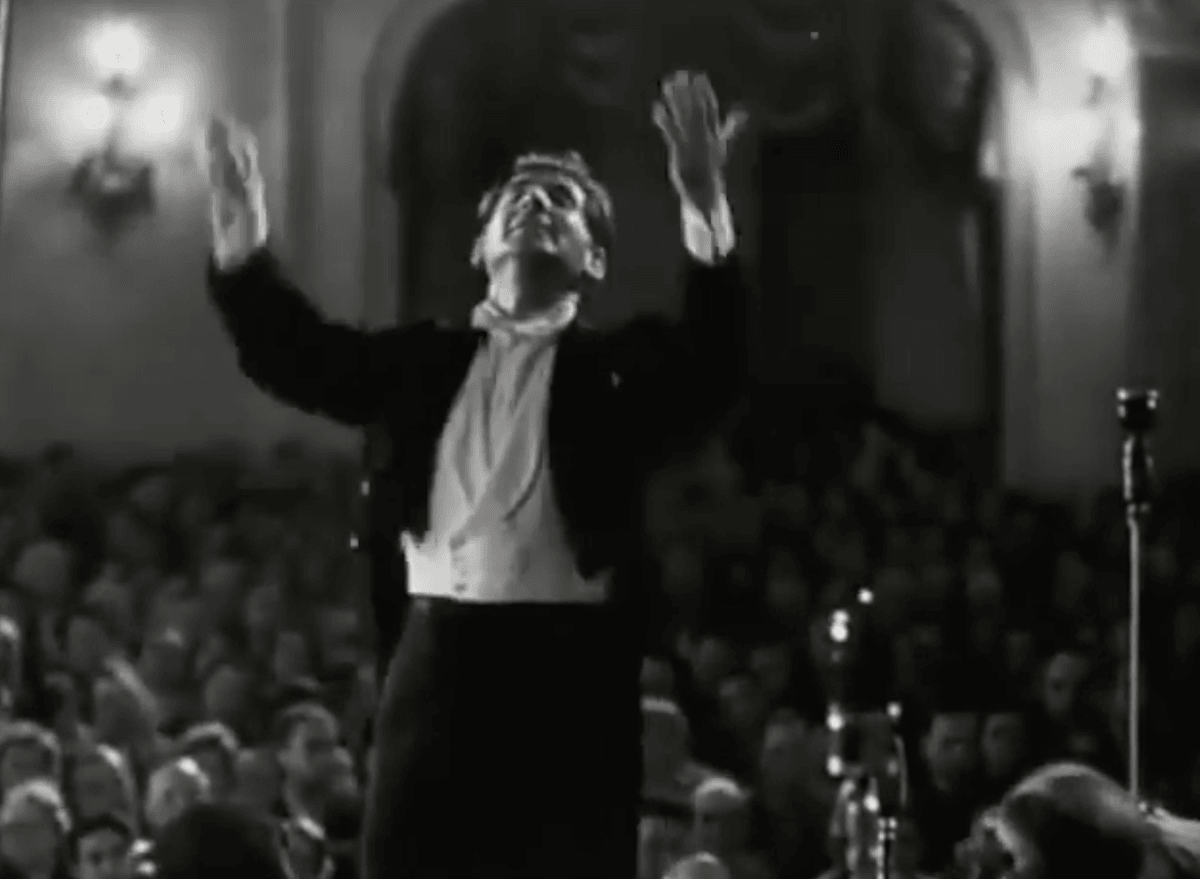
而開場那個問題——作曲家喜不喜歡——在影片裡只留下一個動作:他走上台,向伯恩斯坦道謝。
最後,一個握手留下的問題
把兩張唱片並排放在一起,故事就完整了。
一張的封面,是一個靠在鋼琴旁的年輕人,封底寫著一對父子的玩笑。另一張的封面,是同一個人與作曲家並肩接受喝采,封底是一版宣告勝利的報紙式宣傳。後來的 CD 常把這兩個錄音合輯在一起,不過這兩個封面就不見了;只有拿著兩張原來的實物,才看得到同一家唱片公司,如何把同一位作曲家包裝成兩種完全不同的樣子。
蕭士塔高維契什麼都沒有說。留下的是:走上舞台、握手、並肩站著。美國宣傳說了「這是一場國際性的勝利」。六十年後,他的真實想法?還是只能從三種互相矛盾的轉述裡去拼湊。這種「無法確知」,恰恰正是在蘇聯時代的生存方式。
音樂本來就是一面鏡子,也是一個載體。它照出演奏者是誰、來自哪裡,也照出聆聽者站在哪裡。一個演出的好壞,要看我們看的是什麼、看的是哪一個層次,還要看我們是怎麼看的。把兩張唱片、一段影片和三份轉述放在一起,我們看到的是伯恩斯坦,是穆拉汶斯基,是一個冷戰時代,也是我們自己。
那麼,如果你是法官,面前放著「非常喜歡」、「勉強同意」、「一點都不喜歡」三份證詞,和一張握手的照片,你會相信哪一個?
再想遠一點:如果有一天,別人替你說了你從沒說過的話,而你也不能開口反駁,你希望後世的人,用什麼來理解你?
******
[Gudian Record Stories] Cold War History on Vinyl: "An International Triumph!"—Leonard Bernstein’s (1918–1990) Shostakovich Symphony No. 5, "Revolution"
One Handshake, Three Accounts
September 11, 1959. The Great Hall of the Moscow Conservatory. The New York Philharmonic had just delivered the final notes of Dmitri Shostakovich’s (1906–1975) Symphony No. 5 at the close of its historic Soviet tour. The composer walked onto the stage, standing shoulder to shoulder with forty-one-year-old conductor Leonard Bernstein (1918–1990) to acknowledge the roar of the hall, their hands clasped tightly together.
Photographer Don Hunstein (1928–2017) captured that shared ovation on film. Months later, the photograph graced the cover of a Columbia LP beneath a bold banner headline: AN INTERNATIONAL TRIUMPH!
Bernstein’s handling of the finale in that performance sparked a critical debate that has raged for over sixty years. It boils down to a single question: Did Shostakovich himself actually like it?
History offers three contradictory answers:
- Some maintain the composer made it known he "loved the performance."
- Others claim he merely "reluctantly approved" of it.
- Still others insist he "did not like it at all." That testimony comes from Soviet-émigré pianist Vladimir Ashkenazy (b. 1937), who stated in an interview with Taiwanese critic Yuan-Pu Chiao that Shostakovich "detested Bernstein’s interpretation of the work," adding emphatically, "He told me so himself."
All three versions are secondhand reports. Meanwhile, the stage footage and that cover photograph of the handshake became the centerpiece of Columbia’s promotional campaign.
This story unfolds through two vinyl artifacts: Columbia’s 1959 release of the Fifth Symphony (ML 5445), and his recording of the Piano Concerto No. 2 made a year earlier (issued in the UK as CBS SBRG 72170). One was cut before Bernstein met the composer; the other, immediately after.
January 1958: Three Weeks, Three Identities
To understand the Moscow handshake of 1959, one must step back a year and a half.
On September 26, 1957, Bernstein’s musical West Side Story opened at Broadway’s Winter Garden Theatre. Just over three months later, he assumed the podium as Music Director of the New York Philharmonic. The three weeks that followed were among the most compressed of his life:
- January 2, 3, and 5, 1958: Seated at a concert grand inside Carnegie Hall, he played and conducted Shostakovich’s Piano Concerto No. 2 from the keyboard. The printed program billed it as the Western Hemisphere Premiere, less than eight months after the work’s Moscow debut.
- January 6: The morning after the final concert, he led the orchestra into the ballroom of the Hotel St. George in Brooklyn to commit the concerto to tape.
- January 18: He stepped before television cameras to host his inaugural nationally televised Young People’s Concert, titled What Does Music Mean?
Within three weeks, he operated as concert pianist, symphonic conductor, recording artist, and television educator—on top of being a Broadway composer. Few figures in American musical history could match that range.
On the concerto jacket, the billing placed "at the piano" ahead of "conducting." Nor did the cover show him on the podium; instead, it pictured a young man leaning casually against a grand piano, gazing directly into the lens. Here was an artist who seemed capable of doing everything.
Two Faces of Shostakovich
The first Shostakovich that Bernstein introduced to American audiences was a devoted father.
The Piano Concerto No. 2 was written as a gift for the composer’s son, Maxim Shostakovich (b. 1938), who premiered the score in Moscow on May 10, 1957—his nineteenth birthday. The album’s liner notes read almost like a family scrapbook: young Maxim had allegedly grown so carried away "conducting" during rehearsals that he had to be sent home; in the finale, the solo piano unexpectedly breaks into Hanon’s five-finger technical exercises—the exact drills every young piano student dreads practicing. The annotator remarks wryly that whether this was a private joke between father and son "is not officially known."
That offhand line captures the Cold War predicament of Western observers: they could not even verify an affectionate family joke behind the Iron Curtain.
The second Shostakovich was the man of 1937.
The Symphony No. 5, dubbed "Revolution," was composed at the height of Stalin’s Great Terror. The previous year, Pravda had denounced his opera Lady Macbeth of the Mtsensk District as "Muddle Instead of Music," and colleagues around him were vanishing into the night. Written under that suffocating air, every measure of the Fifth was placed beneath an ideological microscope.
A Record Jacket as a Cold War Archive
On August 3, 1959, one hundred and six musicians of the New York Philharmonic departed New York. Over the next ten weeks, they performed fifty concerts across twenty-nine cities in seventeen countries, spending twenty days inside the Soviet Union—an itinerary documented in full on the back cover of ML 5445.
That rear sleeve rewards close inspection. Designed to mimic a newspaper front page—complete with crimson banner headlines, multi-column newsprint, and press wire photos—its left column maps the tour from Athens to Moscow. The headlines ring out like victory dispatches: "Bernstein and Philharmonic Score International Triumph," "Russian Press Hails Orchestra and Conductor," and "Bernstein Birthday Concert Breaks Tradition."
Cleverly, the "evidence" of this American triumph was drawn largely from Soviet voices. Reviews by violinist Leonid Kogan (1924–1982) in Pravda, composer Aram Khachaturian (1903–1978) in Izvestia, and an extended critique by composer Dmitri Kabalevsky (1904–1987) in Literaturnaya Gazeta were translated into English and laid out neatly across the back of the American LP.
Yet those reviews cannot be read at face value. Written by official spokesmen of the Soviet musical establishment in state newspapers regarding a visiting American orchestra, their prose was carefully calibrated diplomacy. Nor did American publicity departments feel any urge to interrogate the sincerity of those lines. Propaganda selects favorable quotes, magnifies them, and places them front and center to announce to the world: America, representing the Free World, has won.
In his essay, Kabalevsky noted that musicians in the Moscow audience had argued heatedly over Bernstein’s pacing of the finale. Re-framed on the American LP jacket, that musical dispute was folded into an heroic narrative: an American maestro daring to "break tradition."
Yet this cultural hero had himself been a political suspect a decade earlier. In 1949, Bernstein had met Shostakovich at the Cultural and Scientific Conference for World Peace in New York, earning a "Communist" label from the American far right. Ten years later, he stood as President Eisenhower’s foremost cultural ambassador. Historians rightly view this Soviet tour as the decisive step in Bernstein’s political rehabilitation.
The Battle Over the Finale
The controversy centers on the final pages of the Fifth Symphony.
In the closing coda, Bernstein accelerates the tempo to nearly double the markings of many Russian readings, driving the orchestra like an express train hurtling toward the horizon in blazing triumph. Advocates of broader tempos argue that taken at the measured pace indicated in the score, that jubilation transforms into a forced, agonizing scream.
Vladimir Ashkenazy took the latter view. In his conversation with Yuan-Pu Chiao, Ashkenazy pointed out that the fourth movement opens with the explicit marking Allegro non troppo, yet Bernstein charged ahead like a racehorse. Ashkenazy argued that the composer was alive and standing right there, yet Bernstein never consulted him; had he asked, Shostakovich would have insisted the music could not go that fast, because the movement depicts "forced rejoicing—joy under the whip, joy commanded from above." Setting aside the controversies surrounding Testimony, Ashkenazy contended that on purely musical grounds, an excessive tempo unbalances the symphonic architecture and robs the work of genuine closure. His conclusion was measured: Bernstein was undeniably an extraordinary musician, yet his conception of this finale missed the mark.
That reading of "forced rejoicing" gained global currency in 1979 with the Western publication of Testimony, compiled by Solomon Volkov (b. 1944) and presented as Shostakovich’s dictated memoirs. Its famous image—that the finale’s celebration is like someone beating you with a stick while shouting, "Your business is rejoicing!"—permanently altered how the world heard the symphony.
Yet the authenticity of Testimony remains fiercely contested. Scholars have demonstrated that the pages bearing Shostakovich’s signature consist verbatim of innocuous, previously published official articles, while the sharpest anti-Soviet passages fall on unsigned pages—and Volkov’s original shorthand notes have reportedly vanished.
Shostakovich was cautious to the point of eccentricity. Pianist Sviatoslav Richter (1915–1997) described him as perpetually nervous and anxious; his public statements were veiled in bureaucratic prose, his sole "memoir" was signed only on harmless pages, and to Bernstein’s Fifth Symphony, he offered an enigmatic handshake.
Nor did his political position permit open dissent. As the official figurehead of Soviet music hosting a visiting American orchestra—and preparing to lead a reciprocal Soviet delegation to the United States weeks later—he could scarcely condemn Bernstein in public. Still, prudence requires a distinction: the fact that he could not publicly criticize Bernstein proves only that his diplomatic praise cannot be taken literally; it does not prove he privately rejected the performance.
Beyond Right and Wrong: A Tempo Kept for a Lifetime
If we persist in asking "Whose interpretation is correct?", this record leaves us trapped in an unanswerable riddle. Ask a different question instead: What did this music mean to Bernstein himself?
The same performance looks entirely different depending on where you stand.
Viewed from inside the Soviet Union, Bernstein was an outsider who had never lived under totalitarian terror and could not feel the dread encoded beneath those notes. From that vantage point, his brisk tempo appears a fundamental misreading.
Ashkenazy spoke directly from that lived reality, emphasizing that he had been born and raised in the USSR until age twenty-six and criticizing Western scholars like Laurel E. Fay for failing to grasp Soviet life. To Ashkenazy’s ear, the concluding D-major fanfares barked a political command: "Be happy! Be happy! Rejoice!"
Viewed from outside the Iron Curtain, however, Bernstein’s reading embodied something else: his cultural camp, his personal temperament, and his artistic conviction. An American musician raised in an open society, inclined toward optimism and wearing every emotion openly on stage, was bound to conduct those closing pages as an affirmation.
Both perspectives hold truth. Placing them side by side reveals not merely an interpretive disagreement, but two divided worlds of the Cold War era.
Bernstein returned to the Fifth Symphony throughout his life: performing it before the composer in Moscow in 1959; filming it with the London Symphony Orchestra at the Royal Festival Hall in December 1966; and dedicating a Young People’s Concert that same year to Shostakovich’s sixtieth birthday, describing the composer as "a shy man hiding behind thick glasses" who nevertheless wrote some of the most uncompromising, uninhibited music in history.
Twenty years later, in July 1979—four years after Shostakovich’s death, and three months prior to the publication of Testimony—Bernstein recorded the Fifth live again at the Tokyo Bunka Kaikan. In Tokyo, he broadened the finale by more than a minute compared to his 1959 Moscow traversal, yet the reading remained swift, incandescent, and unashamedly triumphant.
That was not ignorance; it was deliberate choice. Having weathered political blacklists during the McCarthy era himself, Bernstein was no stranger to political coercion. He simply believed that music could ultimately break through into light. His tempo was his personal answer to reality.
At forty-one, crossing the Iron Curtain, his tempo carried the heat of youthful conviction; at sixty-one, he eased the reins by a minute without surrendering his faith. The same score documented the evolving inner state of a single artist across two decades.
Bernstein’s very existence carried layered meanings: Broadway composer, concert pianist, symphonic conductor, television educator, former political suspect, and cultural ambassador. His temperament turned those apparent contradictions into creative force—a narrative Columbia Records understood how to package.
A Reel of Film: Two Bodies on the Podium
The cover handshake is frozen in a still photograph, yet moving images from that evening also survive.
In the documentary Sonata for Viola—named after Shostakovich’s final composition—Soviet directors Semyon Aranovich (1934–1996) and Alexander Sokurov (b. 1951) assembled rare censored archival footage, including a sequence that juxtaposes Yevgeny Mravinsky and Leonard Bernstein conducting the finale of the Fifth Symphony. Bernstein’s segment is drawn directly from the 1959 Moscow concert film.
Watching that footage reveals a contrast far deeper than metronome markings: it lies in physical gesture and facial expression. Bernstein conducts in a state of ecstatic abandon, leaping bodily off the podium; when the final chord cuts off, the composer walks onstage to thank him and clasp his hand. Mravinsky stands in stark opposition: regardless of the orchestral fury erupting before him, his face remains an inscrutable mask, his baton gestures economical and razor-sharp.
That juxtaposition was no casual edit. Within a film exposing the state persecution endured by the composer, the directors placed two readings of the exact same finale side by side—a visual contrast requiring no voiceover: one fast, one measured; one leaping into the air, one motionless; one pouring his heart outward through his body, the other revealing nothing on his face.
An American maestro raised in freedom celebrating the finale as an open victory; and the Russian conductor who had survived the Terror beside the composer and led the work’s 1937 Leningrad premiere, conducting those identical measures without a trace of outward emotion.
And as for the question posed at the outset—whether the composer approved—the archival film preserves only a single silent gesture: Shostakovich walking onto the stage to thank Bernstein.
The Question Left Behind by a Handshake
Set the two original LPs side by side on a table, and the narrative comes full circle.
One cover presents a young musician leaning beside a piano, its back sleeve recounting an affectionate joke between father and son. The other cover shows that same artist standing beside the composer beneath a roar of applause, its rear sleeve laid out like a newspaper front page proclaiming a Cold War victory. Subsequent CD reissues routinely couple both recordings onto a single disc, erasing those two original jackets; only by holding both vintage artifacts in hand can one see how a single record label packaged one composer in two irreconcilable guises.
Shostakovich himself left no written verdict. All that remains is the physical record: walking onto the stage, shaking hands, standing side by side. American publicity declared it "An International Triumph." Six decades later, his private thoughts can still only be pieced together from three contradictory secondhand accounts—an ambiguity that was itself the quintessential survival strategy of the Soviet era.
Music functions both as a mirror and a vessel: it reflects who the performer is and where they come from, while revealing where the listener stands. Evaluating a performance depends on what layer we examine and how we choose to listen. Placing two LPs, a documentary reel, and three conflicting testimonies side by side, we see Bernstein, we see Mravinsky, we see the Cold War—and ultimately, we see ourselves.
If you were seated on the bench as judge, presented with three testimonies—"loved it," "reluctantly approved," and "detested it"—alongside a photograph of a handshake, which witness would you believe?
And looking further ahead: if one day others put words into your mouth that you never spoke, and you were no longer able to answer back, what would you hope posterity would use to understand who you truly were?