
【古殿唱片音樂故事】一本四百多年前的「即興教室」:爵士樂誕生前三百多年,就有人寫好了即興課本——帕尼亞瓜(Gregorio Paniagua,1944–2026)的《奧爾蒂斯:裝飾變奏曲》
古殿殿主
1553 年 12 月,羅馬。一位自稱「托雷多人」的西班牙樂師,出版了一本教人拉古大提琴的書。
書裡教了三種和鍵盤樂器合奏的方法。講到第一種「幻想曲」時,他寫下一句很少有教本作者敢寫的話:這種演奏,就其本質,無法在此舉出譜例。
幻想曲是即興,是兩位樂師當下聽著彼此、你來我往的音樂。它一旦被寫成音符,就不再是它自己了。
所以這本教本從一開始就承認:它最重要的那一部分,印不出來。
這位樂師叫迪耶戈・奧爾蒂斯(Diego Ortiz,約1510–約1570),這本書叫《裝飾變奏論》(Trattado de glosas)。四百二十四年後,1977 年 7 月,帕尼亞瓜抱起他最有把握的樂器,把這本書裡印得出來的部分,從頭到尾拉了一遍,錄成兩張唱片。
側標上的「鬼才」,內頁裡的「原點」
日本發行版的橘色側標上,替這套唱片取了一個名字:「古樂變幻」。右側的宣傳語寫著,這是一套以古大提琴為核心的不朽樂典,由「那位鬼才帕尼亞瓜」完美集大成的名盤。
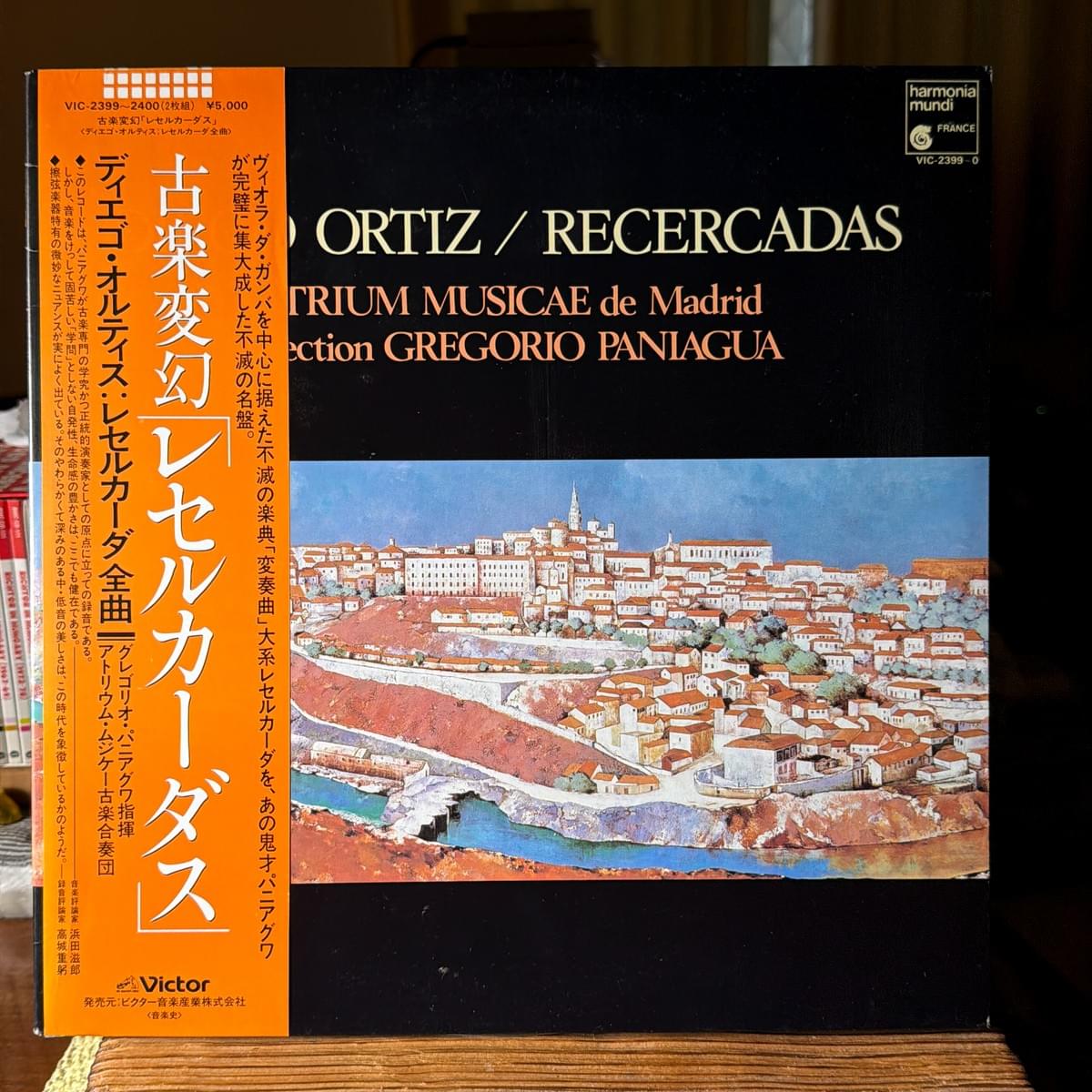
「鬼才」兩個字,是日本樂壇對他的印象。那是《古希臘音樂》開場的一聲爆炸、《La Folia》裡的割草機與香腸氣球留下來的名聲。
但打開對開封套,濱田滋郎(Hamada Jirō,1935–2021)在整整一層內頁的長篇日文解說裡,說的卻是另一回事。他寫道:比起帕尼亞瓜近年那些作品,這套 1977 年的錄音,是他以古樂專門學者、正統演奏家的身分,「站在原點上」錄下的唱片。那些經他「復原」的奇特中世紀樂器、甚至「樂器以外的東西」,在這裡收斂到極為節制。
接著濱田補上一句:然而帕尼亞瓜與馬德里古樂團真正的本色,那種自發性、那種絕不把音樂變成艱澀「學問」的生命力,在這裡依然健在。
封帶背面,錄音評論家高城重躬(Takajō Shigemi,1912–1999)則只談聲音:擦弦樂器特有的細微層次被極其精準地重現,那份柔軟而有深度的中低音之美,彷彿正象徵了那個時代。
同一條封帶,一邊喊「鬼才」,一邊說「原點」。這套唱片的趣味,就在這兩個詞之間。
托雷多人奧爾蒂斯
奧爾蒂斯是誰?濱田說,留下來的資料少得可憐。
他生在托雷多,這一點很確定,因為他在書上自稱「Toledano」,托雷多人。這套唱片的封底,也把他的名字完整印成「DIEGO ORTIZ TOLEDANO」,下面一行小字「né vers 1500」,約 1500 年生。今天的學界多半把他的生年推到約 1510 年;兩個說法都只是推測,沒有確證。
1553 年,他人已經在義大利。《裝飾變奏論》同年 12 月在羅馬出版,西班牙文與義大利文兩個版本同時印行,題獻給一位在西西里擁有里耶西(Riesi)男爵領地的西班牙貴族,佩德羅・德・烏列斯(Pedro de Urríes,生卒年不詳)。那時的那不勒斯與西西里,都在西班牙帝國的統治之下。
1558 年,他出任那不勒斯總督、第三代阿爾巴公爵費爾南多・阿爾瓦雷斯・德・托雷多(Fernando Álvarez de Toledo,1507–1582)的宮廷樂長,總督換人之後仍繼續任職。1565 年,他在威尼斯出版一部宗教複音音樂集,收了四到七個聲部的作品共 69 首。
1553 年奧爾蒂斯「正好以宮廷樂長的身分,出現在那不勒斯總督門下」。依今天通行的研究,出任樂長是 1558 年的事。這篇 1980 年代的日文解說寫得很紮實,這一處只是當時資料所限。
此後,他的名字只再出現過一次:1601 年那不勒斯出版的一份文獻,提到他是「一位已故的傑出作曲家,定居而成為那不勒斯公民的西班牙人」。
一個人一生的生命歷史痕跡,就剩下兩本書和一行身後的記載。讓他的名字留到今天的,主要是那本 1553 年的教本。
一本教人「即興」的書
《裝飾變奏論》分成兩部。
第一部教的是「裝飾」(glosa):在一段終止式、一個音程、一小串音符上,怎麼加上流動的細碎音符,讓旋律活起來。濱田說,它不只是一本古大提琴的演奏手冊,而是任何想了解十六世紀器樂風格的人都不能不讀的基本文獻。比它更早,義大利的加納西(Silvestro Ganassi,1492–卒年不詳)在 1542 至 1543 年出過古大提琴教本,但濱田認為,論內容的充實與技法的新穎,奧爾蒂斯明顯更勝一籌。今天的介紹也常稱它為第一本專講弓弦樂器裝飾法的印刷教本。
第二部講一把古大提琴如何與鍵盤樂器合奏,並附上實例。這套唱片收錄的,就是第二部的全部實例。
奧爾蒂斯說,合奏有三種方法:
- 幻想曲:鍵盤即興彈出有秩序的和弦,古大提琴即興加上優雅的裝飾,兩人互相聽、互相模仿。就是開頭那一種,「無法在此舉例」。
- 定旋律:鍵盤在低音彈一條固定的旋律或低音進行,古大提琴在上面加對旋律;鍵盤手還得即興補上和聲,配合古大提琴的變奏。
- 既成樂曲:鍵盤彈一首現成的多聲部歌曲,古大提琴從中挑一個聲部自由裝飾,一段之後可以換到另一個聲部。
濱田特別指出第二種方法的意義:低音固定,上面即興補和聲,這正是後來巴洛克時代「通奏低音」的觀念。一百多年後才普及全歐洲的做法,在這本 1553 年的書裡已經清楚成形。
奧爾蒂斯把這些實例叫做「Recercada」,中文可以音譯成「雷塞爾卡達」。這個字與義大利文的「ricercare」同源,意思是「探求」。義大利的 ricercare 通常指早期的模仿對位曲,奧爾蒂斯卻把當時西班牙通稱的「變奏曲」也包了進去。濱田的解讀是:他用這個名字,是想說這些曲子是「音樂探求的成果」。
回頭看,這本書其實很誠實。它把能寫下的全寫下了:裝飾的公式、兩種合奏方法的範例。然後它告訴你,還有一種最自由的,寫不下來。書上的音符,是那個活生生的演奏傳統留下的影子;真正的音樂,在每一次拉弓的當下。
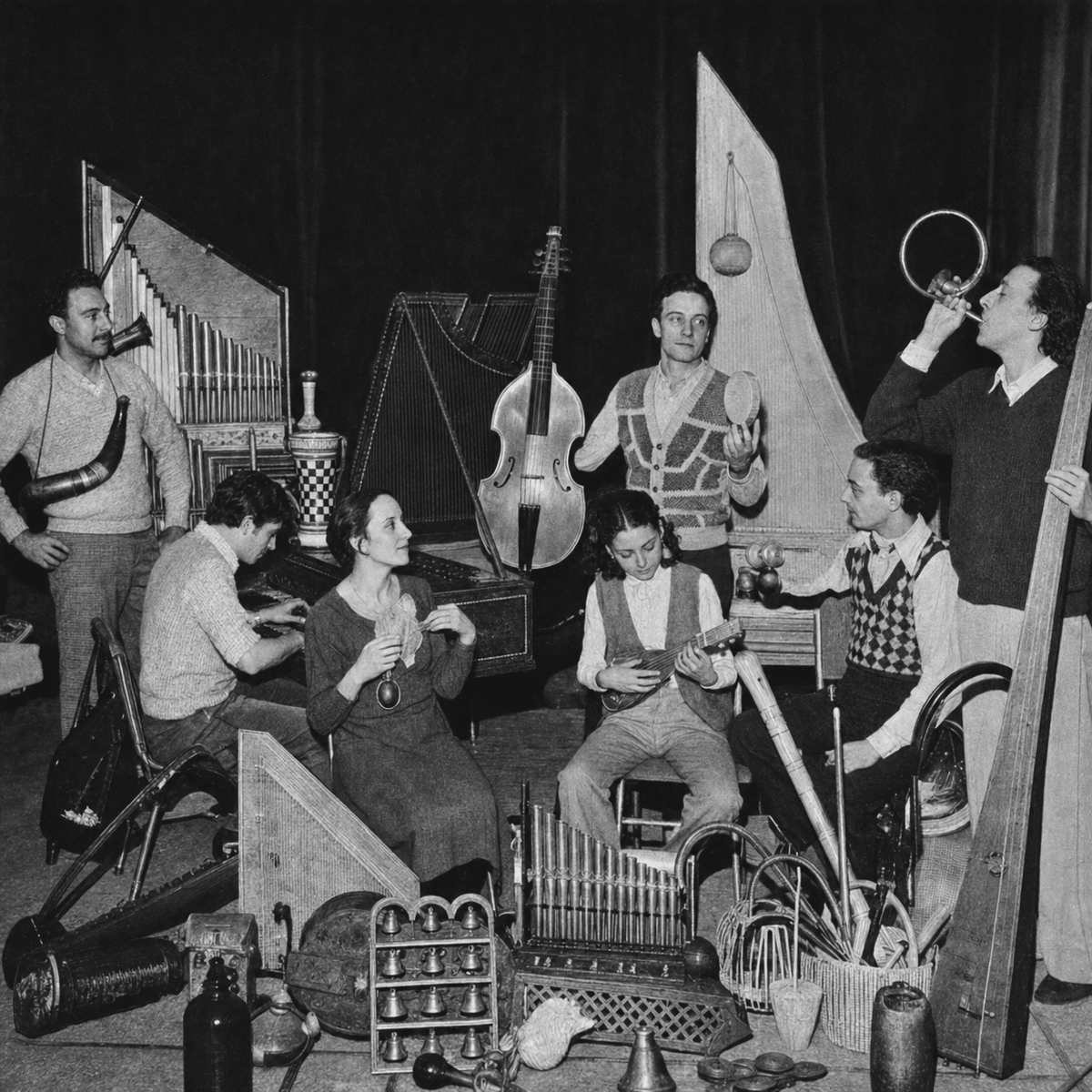
兩張、四面的唱片,一部教本
這套雙片裝把第二部的實例完整排進四面:
- 第一面:以義大利固定低音為基礎的雷塞爾卡達,第 1 至 8 首。
- 第二面:同一組的第 9 首;無伴奏古大提琴的雷塞爾卡達第 1、2 首;阿卡德爾特(Jacques Arcadelt,約1507–1568)的牧歌〈啊,我幸福的雙眼〉原曲,合奏版與鍵盤版各一;以這首牧歌為基礎的雷塞爾卡達第 1 至 4 首。
- 第三面:無伴奏雷塞爾卡達第 3、4 首;桑德蘭(Pierre Sandrin,約1490–1561以後)的香頌〈甜蜜的回憶〉原曲,合奏版與鍵盤版;以這首香頌為基礎的雷塞爾卡達第 1 至 3 首。
- 第四面:〈甜蜜的回憶〉雷塞爾卡達第 4 首;定旋律〈西班牙〉(La Spagna);以〈西班牙〉為基礎的雷塞爾卡達第 1 至 6 首。
第一面:巴洛克變奏曲的母題庫
第一面那八首曲子的低音,幾乎就是後來兩百年歐洲變奏曲的母題庫。濱田逐首寫明:第 1、5 首建立在「古式帕薩梅佐」的低音上;第 2、3 首是「新式帕薩梅佐」,第 2 首帶著西班牙舞曲味道的三拍子;第 6、7 首用的是「羅曼內斯卡」,這個低音在西班牙另有一個很鄉土的名字,叫〈替我看牛〉(Guárdame las vacas)。
讀過古殿曾寫過的《La Folia》那一篇的朋友,請特別留意第 4 首和第 8 首。
第 4 首的低音,正是後來在十七、十八世紀風靡全歐、被無數作曲家拿來寫變奏的 Folia;但它和後世定型的版本略有不同,是一個帶著獨特表情、極有魅力的早期形態。第 8 首又回到 Folia,是一首色彩繽紛的雷塞爾卡達。
1980 年,帕尼亞瓜在《La Folia》的封底寫了一篇短文,說 Folia 在十七世紀被馴服、變得莊重,而學究們想把它的起源拉離伊比利半島。三年前,他已經在這套唱片裡,用自己的古大提琴,拉過一位托雷多人在 1553 年寫下的 Folia。那是被馴服之前、尚未定型的 Folia。
第二面開頭的第 9 首叫〈第五聲部〉(Quinta pars):在當時標準的四聲部織體之上,再多寫一個聲部,低音用的是另一首名曲〈魯傑羅〉(Ruggiero)。
先讓你聽原曲
第二面與第三面,有一個很能看出帕尼亞瓜用心的安排。
奧爾蒂斯書裡,阿卡德爾特的牧歌與桑德蘭的香頌,只是讓古大提琴拿來變奏的底稿。帕尼亞瓜卻先把原曲完整奏出來,而且奏兩次:一次用小型管風琴與直笛合奏,一次只用擊弦古鋼琴(clavicorde)獨奏。聽者先認識這首歌原本的樣子,再聽四首雷塞爾卡達怎麼一層層拆開它:第 1 首裝飾低音聲部,第 2 首換成最高的女高音聲部,他也跟著改拿高音古大提琴,第 3 首回到下方兩聲部,第 4 首再以〈第五聲部〉的形式收尾。
第四面也一樣。六首〈西班牙〉雷塞爾卡達之前,他先讓低音古大提琴獨自把那條定旋律原原本本拉一遍。這條旋律在十五、十六世紀流傳全歐,法國人叫它〈新卡斯提爾〉,義大利人叫它〈西班牙國王〉。
這和他在《塔朗泰拉》、《古希臘音樂》、《La Folia》裡把出處一一印在表格上,是同一種態度:根據擺在明處,讓聽者自己對照。
聽這套唱片,最好就照這個順序:先把原曲聽熟,再聽變奏。聽到第三、第四首時,耳朵會開始自己在華麗的裝飾底下,找那條原本的旋律。
「被允許的自由」
封底右半,是一張法文的逐曲樂器表。光看第一面,就能看出這套唱片的配器有多細。
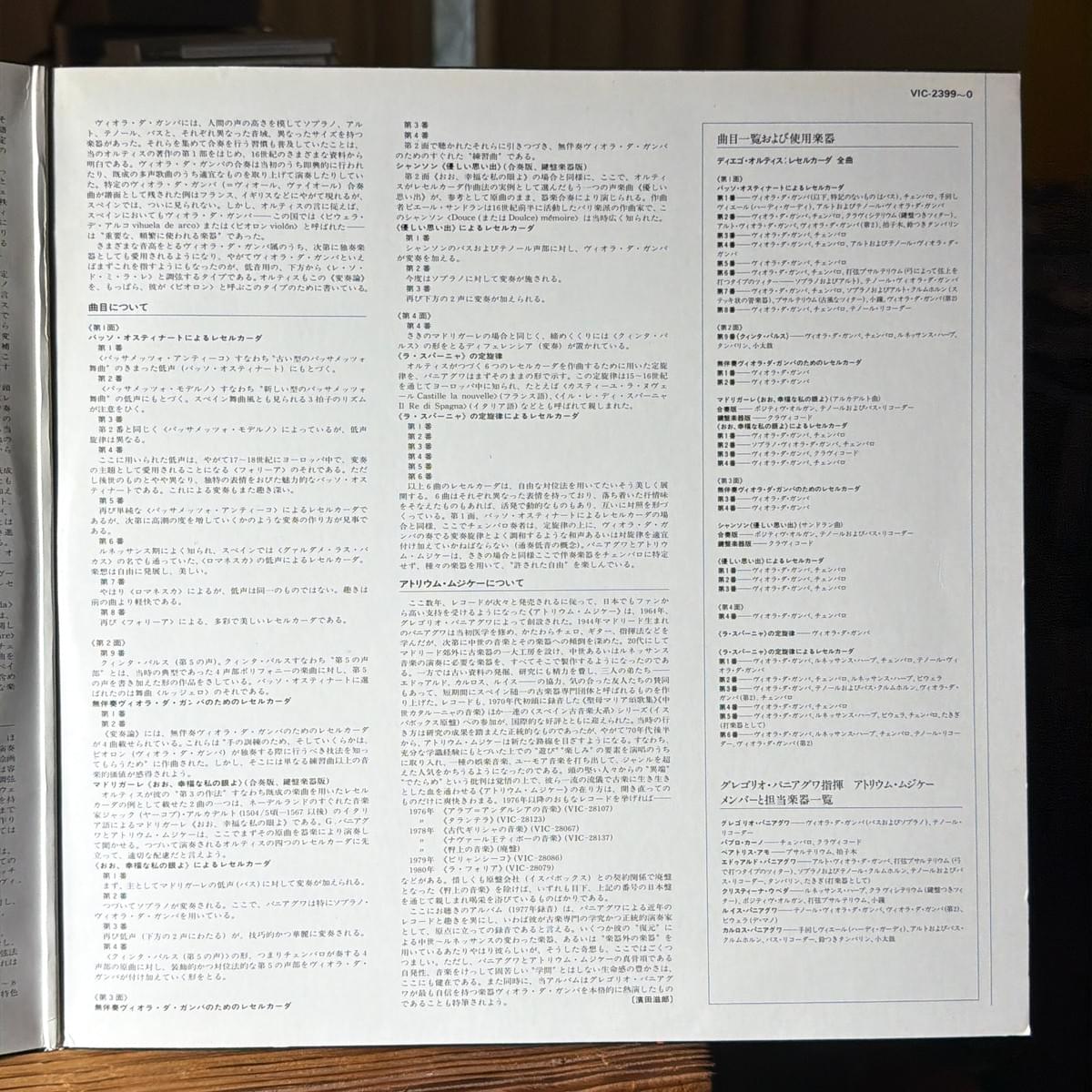
奧爾蒂斯書上指定的伴奏樂器是大鍵琴。帕尼亞瓜的第 1 首,在大鍵琴之外加上手搖弦琴,以及中音、次中音古大提琴;第 2 首加了立式大鍵琴、拍板與鈴鼓;第 6 首有弓奏的索爾特里琴;第 7 首加上克魯姆管、索爾特里琴、一組鐘片與另一把低音維奧爾;第 8 首加一支次中音直笛。到了第四面的〈西班牙〉,又輪番換上文藝復興豎琴、手彈比維拉琴、克魯姆管。
這算不算違背作曲家?濱田替他辯護,理由就印在奧爾蒂斯自己的書裡:沒有大鍵琴的時候,用其他樂器演奏這些雷塞爾卡達,也完全無妨。也就是說:帕尼亞瓜是在享受作曲家「被允許的自由」。
不過,今天站在「歷史演奏實踐」的角度,也有人會覺得,把一把古大提琴加一台鍵盤的設定,擴充成一整個樂團的音色,已經走得太遠。十三年後,薩瓦爾(Jordi Savall,1941–)的奧爾蒂斯錄音,編制就精簡、收斂得多。兩條路都有道理,聽者可以自己判斷。
一根「木柴」?
濱田說,這套唱片裡的「奇想」極為節制。他的日文樂器表裡,倒有一處看起來像奇想:第四面〈西班牙〉第 5 首,愛德華多・帕尼亞瓜(Eduardo Paniagua,1952–)負責的一件樂器,譯成:「木柴(作為打擊樂器)」。
回頭對照封底的法文樂器表,那裡寫的是「buche」。這個字在法文裡確實是「木柴」,但它也是一件樂器的名字。法國國家圖書館的主題詞表,把「Buche(樂器)」列為「孚日埃皮內特琴」(épinette des Vosges)的別名,那是法國孚日山區一種撥弦的箱型齊特琴。網路的唱片資料:法國原版唱片中也把愛德華多的這件樂器記作齊特琴。
濱田很可能把樂器名當成了日常用語。如果是這樣,整整兩張唱片裡,其實找不到一件「樂器以外的東西」。
要確定,還是得回到唱片本身:放下唱針,聽聽第四面〈西班牙〉第 5 首裡,那一件樂器發出的是撥弦的聲音,還是敲擊的聲音。
把這套唱片放回帕尼亞瓜在 Harmonia Mundi 的時間線上,對比就更清楚了:1976 年《塔朗泰拉》有木梳與拔瓶塞聲;1978 年《古希臘音樂》有研缽、陶罐與赫姆霍茲共鳴器;1980 年《La Folia》則是割草機與寶獅汽車喇叭。夾在中間的 1977 年,這套奧爾蒂斯幾乎是一片安靜。
他最有把握的樂器
這套唱片真正的分量:這是帕尼亞瓜對他最有自信的樂器,古大提琴,正式而熱烈的一次演奏。
翻一翻樂器表就明白了。二十七首雷塞爾卡達,每一首都有低音古大提琴,除了〈啊,我幸福的雙眼〉第 2 首換成高音古大提琴;而團員名單上,兩種古大提琴都記在帕尼亞瓜名下。四首無伴奏雷塞爾卡達,更是他一個人、一把琴。
奧爾蒂斯說,寫這四首無伴奏曲是「為了訓練手指,也讓人多少知道比奧隆獨奏時該用的技法」。比奧隆(violón)是當時西班牙對低音古大提琴的稱呼。這幾首曲子的音樂價值,遠遠超過練習曲。
帕尼亞瓜在馬德里音樂院學的是大提琴,之後隨溫辛格(August Wenzinger,1905–1996)學古大提琴。在《La Folia》與《古希臘音樂》裡,他常常是那個總攬全局、同時換好幾件樂器的人;在這裡,他是獨奏者。
高城重躬在封帶上稱讚的「柔軟而有深度的中低音」,指的就是這件樂器的聲音。
錄音與版本
日文內頁記錄:錄音,1977 年 7 月。日本版沒有寫錄音地點與錄音師。法國原版記得完整些:依網路唱片資料,法國原版編號 HM 2.393,雙片裝,標籤與封底都印「1979」,錄音師是保林(Alberto Paulin,生卒年不詳),內頁解說由愛德華多・帕尼亞瓜執筆。第一張唱片也曾單獨發行,編號 HM 393;日本版四面標籤上印的母源編號,正是 HM-393-1-A、1-B、2-A、2-B。
保林也是錄下《塔朗泰拉》(1976 年 10 月)與《古希臘音樂》、《納瓦拉的提博》(1978 年 6 月)的錄音師。夾在中間的這套奧爾蒂斯也出自他手,帕尼亞瓜在 Harmonia Mundi 這一批 1970 年代的錄音,是由同一雙耳朵貫穿起來的。錄音地點則仍未見記載;維基百科的古樂團唱片目錄記為「馬德里與法國普羅旺斯」。
濱田的那份唱片清單
濱田在介紹古樂團的段落裡,列出了 1976 年以後的主要唱片與日本編號。這份清單,正好替「古殿」的這個系列介紹專文做了一次對照:
- 1976 年:《阿拉伯=安達魯西亞的音樂》(VIC-28107)、《塔朗泰拉》(VIC-28123)
- 1978 年:《古代希臘的音樂》(VIC-28067)、《納瓦拉王提博的音樂》(VIC-28137),以及一張因與西班牙 Hispavox 公司的合約關係而廢盤的唱片
- 1979 年:《比利安西科》(VIC-28086)
- 1980 年:《La Folia》(VIC-28079)
清單上的《La Folia》寫 1980 年,和法國原版封底記載的錄音時間「1980 年 6 月」一致。網路上常見的 1982 年,是出版年份。
濱田說,除了那張廢盤,其餘都以清單上的編號在日本發行,深受樂迷喜愛。可見這個樂團的唱片,在 1980 年代的日本有一群固定的聽眾。
從原點出發
把這套唱片放回帕尼亞瓜的時間線上,它的位置就清楚了。
1977 年 7 月,他在這裡把奧爾蒂斯拉完:照著書,用他最熟的樂器,配器豐富,但幾乎沒有玩笑。濱田的解說也說明了古樂團的轉向:早年他們立足於學術研究,走正統路線;1970 年代後半起,才開始把「遊戲」與「樂趣」大膽帶進演奏,招來「異端」與「胡來」的批評。
這套唱片,正好站在那個轉彎處。
三年後,1980 年,帕尼亞瓜為瑞典 BIS 錄製雙唱片《La Spagna》,把奧爾蒂斯那六首〈西班牙〉雷塞爾卡達又錄了一次。這一回,它們不再是一本教本裡的實例,而被放進一條旋律穿越三個世紀的脈絡裡。美國音響雜誌《The Absolute Sound(絕對之聲)》形容那套唱片是「a rousing sonic spectacular」,一場激動人心的聲音奇觀。
同一年 6 月,他錄下《La Folia》。第一面那兩首 1553 年的 Folia 低音,在那裡變成了印度拉格、八音盒、割草機與一條永遠不會結束的溝槽。
我們常以為,一個人能玩得那麼自由,是因為他天生不守規矩。這套唱片給了另一個答案:他是先把規矩一首一首拉熟了,才開始玩。濱田說的「原點」,指的就是這個。
印不出來的那一種
奧爾蒂斯身後,1601 年那不勒斯的文獻只記得他是「一位已故的傑出作曲家」。2026 年 1 月 10 日,帕尼亞瓜在西班牙 Cercedilla 過世,享年 81 歲。
一位是寫下教本的托雷多人,一位是把教本拉完的馬德里人,中間隔了四百二十四年。把兩人連起來的,是一本書,也是書裡那句老實話:最自由的那一種音樂,印不出來。
奧爾蒂斯留下了他能寫下的一切,然後把最重要的部分,交還給每一位拿起琴弓的人。帕尼亞瓜照著樂譜拉完了全部,然後在接下來的幾年裡,去做那種印不出來的事。
******
An Improvisation Classroom from Four Centuries Ago
Gudian Record Music Stories | An improvisation textbook written more than three centuries before jazz was born — Gregorio Paniagua (1944–2026) and Diego Ortiz: Recercadas del Trattado de Glosas
Rome, December 1553. A Spanish musician who called himself "the man from Toledo" published a book on how to play the viola da gamba.
The book teaches three ways of playing together with a keyboard instrument. When he reaches the first of them, the "fantasia," he writes a sentence that few textbook authors would dare to write: this kind of playing, by its very nature, cannot be shown here in written examples.
The fantasia is improvisation — music made by two players in the moment, listening to each other, trading phrases back and forth. Once it is written down in notes, it is no longer itself.
So from the very start, this textbook admits that its most important part cannot be printed.
The musician was Diego Ortiz (c.1510–c.1570), and the book was the Trattado de glosas (Treatise on Ornamentation). Four hundred and twenty-four years later, in July 1977, Paniagua took up the instrument he was most sure of and played through every part of the book that could be printed, from beginning to end, recording it on two LPs.
"Wayward genius" on the obi, "the starting point" in the liner notes
The orange obi of the Japanese release gives the set a title: Kogaku Hengen — "Early Music Transformed." The blurb on the right calls it an immortal monument of early music centered on the viola da gamba, a famous recording brought to perfect completion by "that wayward genius, Paniagua."
"Wayward genius" (kisai) was how the Japanese music world saw him. It was a reputation built on the explosion that opens Musique de la Grèce antique, and on the lawnmower and sausage-shaped balloons of La Folia.
But open the gatefold, and Hamada Jirō (1935–2021), in a long Japanese essay filling an entire inner panel, says something else. Compared with Paniagua's recent work, he writes, this 1977 recording was made by Paniagua as an early-music scholar and orthodox performer, "standing at his starting point." The strange medieval instruments he had "reconstructed," and even the "things that are not instruments," are kept here to a strict minimum.
Then Hamada adds: and yet the true character of Paniagua and the Atrium Musicae de Madrid — that spontaneity, that vitality which never lets music turn into dry "scholarship" — is still fully alive here.
On the back of the obi, the audio critic Takajō Shigemi (1912–1999) speaks only of the sound: the fine gradations peculiar to bowed strings are reproduced with great precision, and the soft, deep beauty of the low and middle register seems to embody the spirit of that age.
The same obi shouts "wayward genius" on one side and speaks of "the starting point" on the other. The fascination of this set lies between those two phrases.
Ortiz, the man from Toledo
Who was Ortiz? Hamada says that very little documentation survives.
He was born in Toledo — that much is certain, because in his book he calls himself "Toledano," a Toledan. The back cover of this set prints his full name as "DIEGO ORTIZ TOLEDANO," with a small line below: "né vers 1500," born around 1500. Today most scholars place his birth around 1510; both dates are estimates, and neither is confirmed.
By 1553 he was already in Italy. The Trattado de glosas was published in Rome in December of that year, in Spanish and Italian editions printed simultaneously, and dedicated to Pedro de Urríes (dates unknown), a Spanish nobleman who held the barony of Riesi in Sicily. At that time both Naples and Sicily were under the rule of the Spanish Empire.
In 1558 he became maestro di cappella to Fernando Álvarez de Toledo (1507–1582), third Duke of Alba and Viceroy of Naples, and he remained in the post after the viceroy changed. In 1565 he published in Venice a collection of sacred polyphony containing 69 works for four to seven voices.
Hamada writes that in 1553 Ortiz "was already serving the Viceroy of Naples as his maestro di cappella." According to current research, the appointment came in 1558. This Japanese essay from the 1980s is very solid; this one point simply reflects the limits of the sources available then.
After that, his name appears only once more: a document published in Naples in 1601 mentions him as "a distinguished composer, now deceased, a Spaniard who settled in Naples and became a citizen."
The traces of a whole life come down to two books and one posthumous line. What has kept his name alive to this day is, above all, that textbook of 1553.
A book that teaches improvisation
The Trattado de glosas is in two books.
The first teaches the glosa, or ornamentation: how to add flowing, fine-grained notes to a cadence, an interval, or a short string of notes, and bring the melody to life. Hamada says it is not merely a performance manual for the viola da gamba, but a basic document that anyone wishing to understand sixteenth-century instrumental style must read. Before it, the Italian Silvestro Ganassi (1492–death date unknown) had published viol treatises in 1542–1543, but in Hamada's view Ortiz clearly surpasses him in richness of content and novelty of technique. Today it is also often described as the first printed treatise devoted specifically to ornamentation for bowed string instruments.
The second book explains how a single viola da gamba plays together with a keyboard instrument, with worked examples. This set records every one of the examples in that second book.
Ortiz says there are three ways to play together:
- Fantasia: the keyboard improvises well-ordered chords, while the viol improvises graceful ornaments above them; the two listen to and imitate each other. This is the one from the opening — the one that "cannot be shown here in examples."
- Cantus firmus (canto llano): the keyboard plays a fixed melody or bass line in the low register, and the viol adds a counter-melody above it; the keyboard player must also improvise the harmony to match the viol's variations.
- Composed pieces: the keyboard plays an existing polyphonic song, and the viol chooses one of its voices to ornament freely, moving to another voice after a section if it wishes.
Hamada singles out the significance of the second method: a fixed bass with harmony improvised above it is precisely the idea behind the basso continuo of the later Baroque. A practice that would spread across Europe more than a century later had already taken clear shape in this book of 1553.
Ortiz called these examples "Recercada." The word shares its root with the Italian "ricercare," meaning "to seek out." In Italy, a ricercare usually meant an early piece in imitative counterpoint, but Ortiz also included under the name what the Spanish of his day generally called diferencias, or variations. Hamada's reading is that by choosing this name, Ortiz meant these pieces to be "the fruits of musical inquiry."
Looking back, the book is remarkably honest. It writes down everything that can be written: the formulas of ornamentation, and examples of two of the ways of playing together. Then it tells you that there is one more, the freest of all, which cannot be written down. The notes on the page are the shadow cast by a living performance tradition; the real music exists in the moment of each stroke of the bow.
Two LPs, four sides, one textbook
This double album lays out the complete examples of the second book across four sides:
- Side 1: Recercadas on Italian ground basses, Nos. 1–8.
- Side 2: No. 9 of the same group; Recercadas for solo viol, Nos. 1 and 2; Jacques Arcadelt's (c.1507–1568) madrigal O felici occhi miei in its original form, once for ensemble and once for keyboard; Recercadas Nos. 1–4 on this madrigal.
- Side 3: Recercadas for solo viol, Nos. 3 and 4; Pierre Sandrin's (c.1490–after 1561) chanson Doulce mémoire in its original form, for ensemble and for keyboard; Recercadas Nos. 1–3 on this chanson.
- Side 4: Recercada No. 4 on Doulce mémoire; the cantus firmus La Spagna; Recercadas Nos. 1–6 on La Spagna.
Side 1: the motif library of Baroque variation
The basses of the eight pieces on Side 1 amount almost to a catalogue of the themes European variation would draw on for the next two hundred years. Hamada identifies them one by one: Nos. 1 and 5 are built on the bass of the passamezzo antico; Nos. 2 and 3 on the passamezzo moderno, No. 2 in a triple meter with the flavor of a Spanish dance; Nos. 6 and 7 use the romanesca, a bass that in Spain went by a very rustic name, Guárdame las vacas — "Watch the cows for me."
Readers who have read Gudian's earlier piece on La Folia should pay special attention to Nos. 4 and 8.
The bass of No. 4 is none other than the Folia, which would sweep across Europe in the seventeenth and eighteenth centuries and serve countless composers as a theme for variations. But it differs slightly from the version later fixed by convention: it is an early form, with its own particular expression and enormous charm. No. 8 returns to the Folia in a brilliantly colored recercada.
In 1980, on the back cover of La Folia, Paniagua wrote a short essay saying that the Folia was tamed in the seventeenth century and made dignified, and that pedants wanted to pull its origins away from the Iberian Peninsula. Three years earlier, on this set, he had already played on his own viol the Folia that a man from Toledo wrote down in 1553 — the Folia before it was tamed, before it took its fixed form.
No. 9, which opens Side 2, is titled Quinta pars: one more voice written on top of the standard four-voice texture of the day, over the bass of another famous tune, the Ruggiero.
Hearing the original first
Sides 2 and 3 contain an arrangement that shows Paniagua's care very clearly.
In Ortiz's book, Arcadelt's madrigal and Sandrin's chanson are only the raw material for the viol's variations. Paniagua, however, first plays the original pieces in full — and plays them twice: once with chamber organ and recorders, and once on solo clavichord (clavicorde). The listener first gets to know the song as it originally was, and then hears four recercadas take it apart layer by layer: No. 1 ornaments the bass voice; No. 2 moves to the top soprano voice, and Paniagua switches with it to the treble viol; No. 3 returns to the two lower voices; No. 4 closes in the form of a Quinta pars.
Side 4 works the same way. Before the six La Spagna recercadas, he has the bass viol play that cantus firmus alone, exactly as it is. This melody circulated all over Europe in the fifteenth and sixteenth centuries; the French called it Castille la Nouvelle ("New Castile"), and the Italians Il Re di Spagna ("The King of Spain").
It is the same attitude he showed in Tarentule – Tarentelle, Musique de la Grèce antique, and La Folia, where he printed every source in a table: put the evidence in plain sight, and let listeners compare for themselves.
The best way to listen to this set is in exactly that order: get to know the original first, then listen to the variations. By the third and fourth recercadas, your ears will start searching on their own for the original melody beneath the elaborate ornament.
"Permitted freedom"
The right half of the back cover is an instrument list in French, track by track. Side 1 alone shows how finely the set is orchestrated.
The accompanying instrument Ortiz specifies in his book is the harpsichord. Paniagua's No. 1 adds, besides harpsichord, a hurdy-gurdy and alto and tenor viols; No. 2 adds a clavicytherium (upright harpsichord), castanets and tambourine; No. 6 has a bowed psaltery; No. 7 adds crumhorn, psaltery, a set of bells and a second bass viol; No. 8 adds a tenor recorder. By La Spagna on Side 4, Renaissance harp, plucked vihuela and crumhorn take turns.
Does this go against the composer? Hamada defends him, and his reason is printed in Ortiz's own book: when no harpsichord is available, it is perfectly fine to play these recercadas on other instruments. In other words, Paniagua is enjoying the composer's "permitted freedom."
Still, from today's "historically informed performance" standpoint, some will feel that expanding a setting of one viol and one keyboard into the sound of a whole ensemble goes too far. Thirteen years later, Jordi Savall's (1941–) Ortiz recording used a much leaner, more restrained scoring. Both paths make sense; listeners can judge for themselves.
A "log"?
Hamada says the "fanciful touches" in this set are extremely restrained. His Japanese instrument list does contain one entry that looks like a fanciful touch: in La Spagna No. 5 on Side 4, one of the instruments played by Eduardo Paniagua (1952–) is translated as "log (used as a percussion instrument)."
Check the French instrument list on the back cover, and it reads "buche." In French the word does indeed mean a log of firewood — but it is also the name of an instrument. The subject headings of the Bibliothèque nationale de France list "Buche (musical instrument)" as another name for the épinette des Vosges, a plucked box zither from the Vosges mountains of France. Online discography sources for the French original also list Eduardo's instrument here as a zither.
Hamada very likely took the instrument's name for the everyday word. If so, across both LPs there is not a single "thing that is not an instrument" to be found.
To be sure, though, one has to go back to the record itself: lower the stylus on La Spagna No. 5 on Side 4, and listen to whether that instrument sounds plucked or struck.
Place this set back on Paniagua's Harmonia Mundi timeline and the contrast is even clearer: Tarentule – Tarentelle (1976) has a wooden comb and the pop of a cork; Musique de la Grèce antique (1978) has a mortar, clay pots and Helmholtz resonators; La Folia (1980) has a lawnmower and a Peugeot car horn. Sitting in between, in 1977, this Ortiz is almost silent.
The instrument he was most sure of
The real weight of this set is that it is a full-scale, passionate performance by Paniagua on the instrument he was most confident in: the viola da gamba.
A glance at the instrument list makes this clear. All twenty-seven recercadas feature the bass viol, except O felici occhi miei No. 2, which switches to treble viol — and in the personnel list, both kinds of viol are credited to Paniagua. The four unaccompanied recercadas are him alone, one man and one instrument.
Ortiz says he wrote these four unaccompanied pieces "to train the fingers, and to give some idea of the technique to be used when the violón plays alone." Violón was the Spanish name of the time for the bass viol. The musical value of these pieces goes far beyond that of études.
Paniagua studied cello at the Madrid Conservatory, and then viola da gamba with August Wenzinger (1905–1996). In La Folia and Musique de la Grèce antique he is usually the one running the whole show, switching among several instruments at once; here, he is the soloist.
The "soft, deep beauty of the low and middle register" that Takajō praises on the obi is the sound of this very instrument.
Recording and editions
The Japanese liner notes record: recorded July 1977. The Japanese edition gives neither the recording venue nor the engineer. The French original is more complete: according to online discography sources, the French original is catalogue number HM 2.393, a double album with "1979" printed on both labels and back cover; the engineer was Alberto Paulin (dates unknown), and the liner notes were written by Eduardo Paniagua. The first disc was also issued on its own as HM 393; the matrix numbers printed on the four labels of the Japanese edition are exactly HM-393-1-A, 1-B, 2-A, 2-B.
Paulin was also the engineer for Tarentule – Tarentelle (October 1976) and for Musique de la Grèce antiqueand Thibaut de Navarre (June 1978). This Ortiz, sitting between them, is his work too: Paniagua's batch of 1970s Harmonia Mundi recordings is held together by the same pair of ears. The recording venue remains undocumented; Wikipedia's Atrium Musicae discography gives "Madrid and Provence, France."
Hamada's discography
In his section introducing the Atrium Musicae, Hamada lists the ensemble's main recordings since 1976 with their Japanese catalogue numbers. The list makes a good cross-check for this Gudian series of articles:
- 1976: Arab-Andalusian Music (VIC-28107), Tarentule – Tarentelle (VIC-28123)
- 1978: Music of Ancient Greece (VIC-28067), The Music of King Thibaut of Navarre (VIC-28137), plus one record withdrawn because of contractual issues with the Spanish label Hispavox
- 1979: Villancicos (VIC-28086)
- 1980: La Folia (VIC-28079)
The list gives 1980 for La Folia, which matches the recording date "June 1980" printed on the back of the French original. The frequently cited 1982 online is the release year.
Hamada says that apart from the withdrawn record, all were released in Japan under the numbers listed and were much loved by listeners — evidence that this ensemble's records had a loyal audience in 1980s Japan.
Setting out from the starting point
Put this set back on Paniagua's timeline, and its place becomes clear.
In July 1977 he played Ortiz through to the end: by the book, on the instrument he knew best, richly scored but with almost no jokes. Hamada's essay also explains the ensemble's turn: in its early years it stood on academic research and followed an orthodox path; only from the late 1970s did it boldly bring "play" and "fun" into its performances, drawing criticism as "heretical" and "reckless."
This set stands right at that turning point.
Three years later, in 1980, Paniagua recorded the double album La Spagna for the Swedish label BIS, recording Ortiz's six La Spagna recercadas once again. This time they were no longer examples in a textbook but were set within the story of one melody travelling across three centuries. The American audio magazine The Absolute Sound described that set as "a rousing sonic spectacular."
In June of the same year he recorded La Folia. The two Folia basses of 1553 from Side 1 became, there, an Indian raga, a music box, a lawnmower, and a locked groove that never ends.
We often assume that someone who can play that freely must be a born rule-breaker. This set gives another answer: he learned the rules first, playing them through piece by piece, and only then began to play. That is what Hamada meant by "the starting point."
The kind that cannot be printed
After his death, the 1601 Neapolitan document remembered Ortiz only as "a distinguished composer, now deceased." On 10 January 2026, Paniagua died in Cercedilla, Spain, at the age of 81.
One was the man from Toledo who wrote the textbook; the other, the man from Madrid who played it through. Four hundred and twenty-four years lie between them. What connects them is a book — and the honest sentence inside it: the freest kind of music cannot be printed.
Ortiz left behind everything he could write down, and then handed the most important part back to everyone who picks up a bow. Paniagua played every note of the score, and then, in the years that followed, went off to do the kind of thing that cannot be printed.