
【古殿唱片音樂故事】迴盪在中世紀阿罕布拉宮的旋律:被趕出西班牙,在北非仍活了五百年的音樂——帕尼亞瓜(Gregorio Paniagua,1944–2026)與馬德里古樂團的《阿拉伯—安達魯西亞的音樂》
古殿殿主
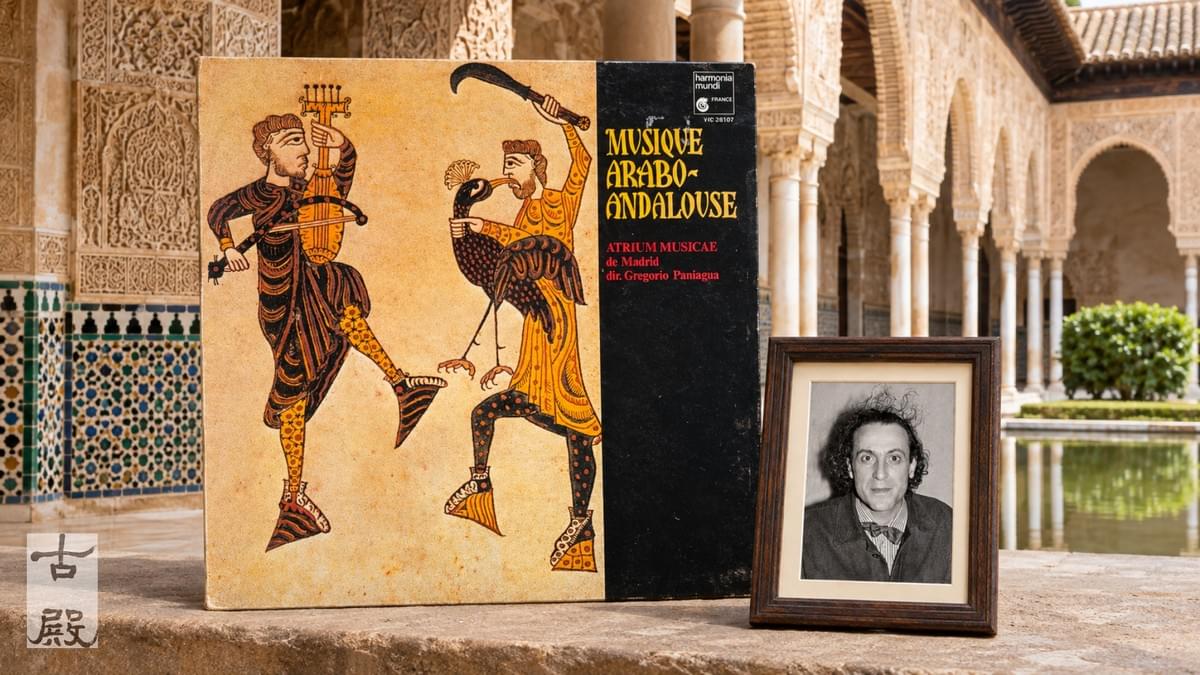
濱田滋郎(Hamada Jirō,1935–2021)替這張唱片寫的封底長文,標題是〈迴盪在中世紀阿罕布拉宮的旋律〉。
阿罕布拉宮就是這想像點。那裡曾經迴盪的音樂,1492 年格拉納達陷落之後,就不在西班牙了。它跟著被趕出西班牙的穆斯林渡過直布羅陀海峡,在摩洛哥、阿爾及利亞、突尼西亞的城市裡,一代一代傳了五百年。而且從頭到尾,它從來沒有被寫成樂譜。
1976 年 10 月,一群馬德里人穿過這五百年的流亡,在南法一座鄉村教堂裡,試著讓那座宮殿的聲音重新響起。
日本音響評論家長岡鐵男(Nagaoka Tetsuo,1926–2000)在這張唱片的側標上,只挑了一個地方來講:A 面最後的水聲。他說,那聲音一出來,唱頭和喇叭的性格瞬間就聽得出來,真實得令人害怕。
一位日本音響評論家,替一張中世紀伊斯蘭西班牙音樂的唱片背書,挑的不是旋律,也不是哪一件樂器,而是水。
翻開唱片附的「使用樂器一覽」,A 面最後一首的那一格,卡洛斯・帕尼亞瓜(Carlos Paniagua,生卒年不詳)名下寫著兩個字:「水音」。
一種從來不寫下來的音樂
介紹長文的開頭說:這張唱片裡的音樂,會讓人同時感到一種神祕的玄妙、一種古典的明朗。玄妙,是因為它屬於一個早已像夢一樣消失的世界;明朗,是因為那個世界曾經非常富足。
那個世界,是中世紀西班牙的伊斯蘭社會。711 年,穆斯林渡過直布羅陀海峡,很快就控制了幾乎整個伊比利半島;直到 1492 年,最後的格拉納達王國才降落。撰文的濱田特別提醒讀者:不要以為西歐就是先進、東方就是落後。中世紀的哥多華,是當時全歐洲最文明的城市,古文獻說那裡的市民在三千座清真寺裡祈禱、在三百座公共浴場裡休息。
依教義,世俗音樂並不受鼓勵。但安達魯西亞的王侯貴族很快就離不開它:重金從東方請歌手,為歌姬一擲千金,甚至聽歌聽到忽略政務。
這個音樂世界裡最重要的人,是九世紀的席爾亞布(Ziryab,約789–857)。他來自東方,因為歌聲優美、膚色偏深,得了一個意思是「黑鳥」的綽號。822 年他來到哥多華宮廷,從此定居。他一邊彈烏德琴一邊唱自己寫的歌;相傳是他在當時通行的四弦烏德琴上,多加了一根弦。他的歌與唱法,由十個子女和許多弟子一代一代傳下去。他在安達魯西亞住久了,音樂也慢慢帶上了這片土地的風味。
從他開始,到十二、十三世紀定型,安達魯西亞發展出一種最高規格的形式,叫「努巴」(nuba)。字面意思是「輪流、順序」,濱田拿它和巴洛克組曲相比:先有一段自由節奏的序奏,再接五個節奏型各不相同、但屬於同一個調式的樂章,中間穿插間奏。不同的是,努巴的本質是歌。
而且,努巴從來沒有被寫成樂譜。它全靠口耳相傳,從一個人的嗓子和手,傳到另一個人的嗓子和手。
1492 年之後,音樂跟著人走
十五世紀末,穆斯林被趕出伊比利半島,留下來的也被逼著改信基督教。一種從來不記譜的音樂,是怎麼活到今天的?
答案是:它不是在安達魯西亞活下來的,而是跟著流亡的人,渡海到了北非。瓦倫西亞的人去了突尼斯,哥多華的人去了阿爾及爾,塞維亞的人去了非斯,格拉納達的人去了德圖安。這些「落難者」的子孫,把安達魯西亞音樂當成家傳的財產,守了好幾個世紀。
傳說中世紀的努巴有二十四套,對應一天二十四個小時,今天完整留下來的只有十一套,其餘只剩碎片。十八世紀的摩洛哥音樂家哈伊克(Muhammad al-Ha'ik,生卒年不詳)把快要失傳的歌詞與唱法整理記下,濱田稱他為努巴的「中興之祖」。中世紀後期席捲伊斯蘭世界的土耳其風格,沒有伸到最西邊的摩洛哥,這也替古老的傳統擋下了一層。
今天摩洛哥、阿爾及利亞的努巴樂師,除了拉巴卜琴、塔爾手鼓、烏德琴、達拉布卡鼓,也用小提琴和中提琴。但他們把琴豎在膝蓋上拉,濱田說,這些樂器早就不是西方的東西了:樂器換了,音樂的本質還在。
他也很冷靜地補了一句:今天北非的安達魯西亞音樂,不可能和十三世紀一模一樣。但樂曲的組織方式、節奏型、以旋律與節奏為主而把和聲放在次要位置的想法,這些精髓應該沒有變。
這就是這張唱片背後的歷史文化最奇特的地方。一種從西班牙被趕出去的音樂,在北非的城市裡住了五百年。1976 年,一群馬德里人拿著自己做的樂器,穿過那五百年的流亡,去找它原本在安達魯西亞的聲音。
一幅馬賽克
唱片附的解說卡上,帕尼亞瓜的頭銜寫的是「採譜・編曲・指揮」。這張唱片沒有完整演奏任何一套努巴。濱田說,他從不同的努巴裡任意挑出段落,接在一起,做成一幅像樣本一樣的拼貼「馬賽克」。
解說卡把用到的努巴依出現順序列了出來,有編號的是十八世紀哈伊克定下的正式序號:第 4 號〈拉斯德・阿德代爾〉、第 1 號〈拉姆爾・阿爾瑪亞〉、第 5 號〈伊斯蒂赫拉爾〉、第 7 號〈加里巴赫・阿爾霍賽因〉、第 6 號〈拉斯德〉,最後是第 3 號〈阿爾瑪亞〉。沒有編號的,例如〈西卡〉、〈希賈茲〉,是殘存的碎片,或是演奏者從伊斯蘭世界的其他資料借來的。
每一套努巴都有自己的調式,也像印度的拉格一樣,有規定的演奏時辰。唱片最後一首用的〈阿爾瑪亞〉,是屬於日落時分的努巴。濱田轉述法文原版解說的說法:
古樂團的成員要用這段旋律,寄託他們對一個曾經繁華的文化的惜別之情。
這張唱片是在日落裡結束的。
一張樂器表
解說卡的另一面,是一張「使用樂器一覽」:每一段的曲種、節奏型、努巴名稱、時間,再加上七位樂手各自演奏什麼。讀過古殿前幾篇的人,一眼就認得出這個格式。這張表格是愛德華多・帕尼亞瓜(Eduardo Paniagua,1952–)手繪的。
樂器幾乎全是阿拉伯與北非的:半球形琴箱的卡曼賈琴、由樂團領導者掌管的拉巴卜琴、烏德琴、卡儒琴、奈伊笛、蘇爾奈管、達拉布卡鼓、塔爾手鼓,還有阿拉伯文獻早在九世紀就記載的風琴「阿爾烏爾加納」。濱田說,這些選擇都有中世紀文獻與繪畫作依據,例如阿方索十世(Alfonso X,1221–1284)《聖母頌歌集》的插畫,就畫了許多阿拉伯與摩爾樂師和他們的樂器。
這張唱片也和兩年後的《納瓦拉的提博》一樣:沒有人開口唱。濱田說努巴本質上是歌,但也常以器樂演奏,這張唱片走的就是器樂的路。
水聲、木梳與彈指
樂器表裡,有幾格寫的不是樂器:
- A 面第 5 首:碧雅翠絲・阿莫(Beatriz Amo,生卒年不詳)與卡洛斯負責「彈指」。
- A 面第 6 首:卡洛斯負責「水音」,就是長岡鐵男說的那段水聲。
- B 面第 2 首:愛德華多拍打「赫拉」,一只水缸。
- B 面第 3 首:烏貝達與阿莫負責「拍手」。
- B 面第 4 首:卡洛斯負責「木梳」。
木梳在同一個月錄的《塔朗泰拉》裡也出現過。彈指、拍手、水缸,都是北非與安達魯西亞的生活裡本來就有的聲音。這些還不是《La Folia》裡的割草機,而是一個家族樂團從研究裡發出來的聲音想像。
至於那段水聲是怎麼做出來的,唱片上沒有寫。聽的時候可以自己猜:那是倒水、撥水,還是水從高處滴下來?
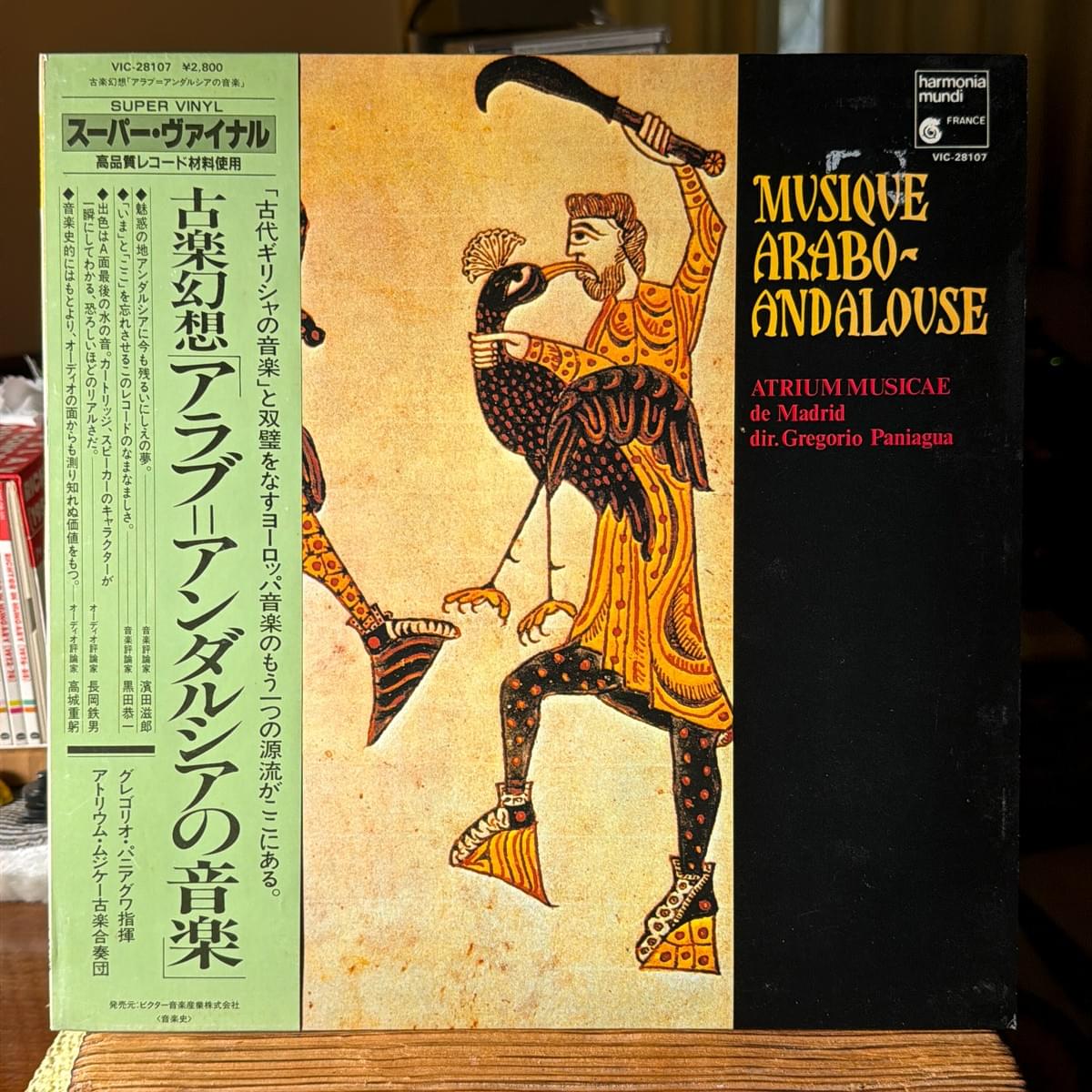
「古樂幻想」四個字
日本勝利替這張唱片取的日文標題,是「古樂幻想」。放回同一系列裡看很有意思:解說卡提到的《La Folia》叫「古樂狂想」,《比利安西科》叫「古樂追想」,古殿上一篇寫的奧爾蒂斯則是「古樂變幻」。每一張,都配了一個不同的字。
「幻想」這個字,濱田在封底長文的最後自己解釋了。他說,馬德里古樂團一方面發揮了大量創意,特別是在樂器的用法上;一方面又立足於縝密的研究。他們的目標不是照抄今天北非的傳統,而是把那個傳統當成唯一可靠的線索,讓中世紀安達魯西亞的音樂重新活過來。
接著他寫得很坦白:這樣的重建,免不了有「幻想」,也免不了有「虛構」。但這張唱片裡也確實流著一道澄澈的「真實」。如果說,那份真實來自演奏者身為西班牙人、血裡帶著的鄉愁,來自他們對安達魯西亞那個古老之夢的深深憧憬,這難道只是筆者個人的感傷嗎?
這個問句,就是「古樂幻想」四個字的註解。這張唱片從一開始就不宣稱自己是原貌,而是一次想像的重建。
也要公平地記下另一種看法:今天想聽努巴,很多人會直接找摩洛哥、阿爾及利亞本地樂團的錄音。從民族音樂學的角度,一個歐洲古樂團用自己重建的樂器、自己拼貼的曲目去詮釋北非的口傳傳統,是可以保留的。兩種立場都有道理:一個要聽活著的傳統,一個要聽一個西班牙人怎麼回頭。
封面:修道院抄本裡的兩個樂師
封面上是兩個跳著舞的人。左邊的人把一件長頸的弓弦樂器豎在胸前拉奏;右邊的人一手抱著一隻鳥,一手高舉一把彎刀。
封套上註明,這幅圖經大英圖書館授權複製,出自館藏手稿 Add MS 11695 的第 86 頁。這份手稿就是《西洛斯啟示錄》:西班牙布爾戈斯的聖多明哥西洛斯修道院抄寫的《啟示錄》註釋,1109 年完成,插畫家名叫彼得魯斯(Petrus,生卒年不詳)。
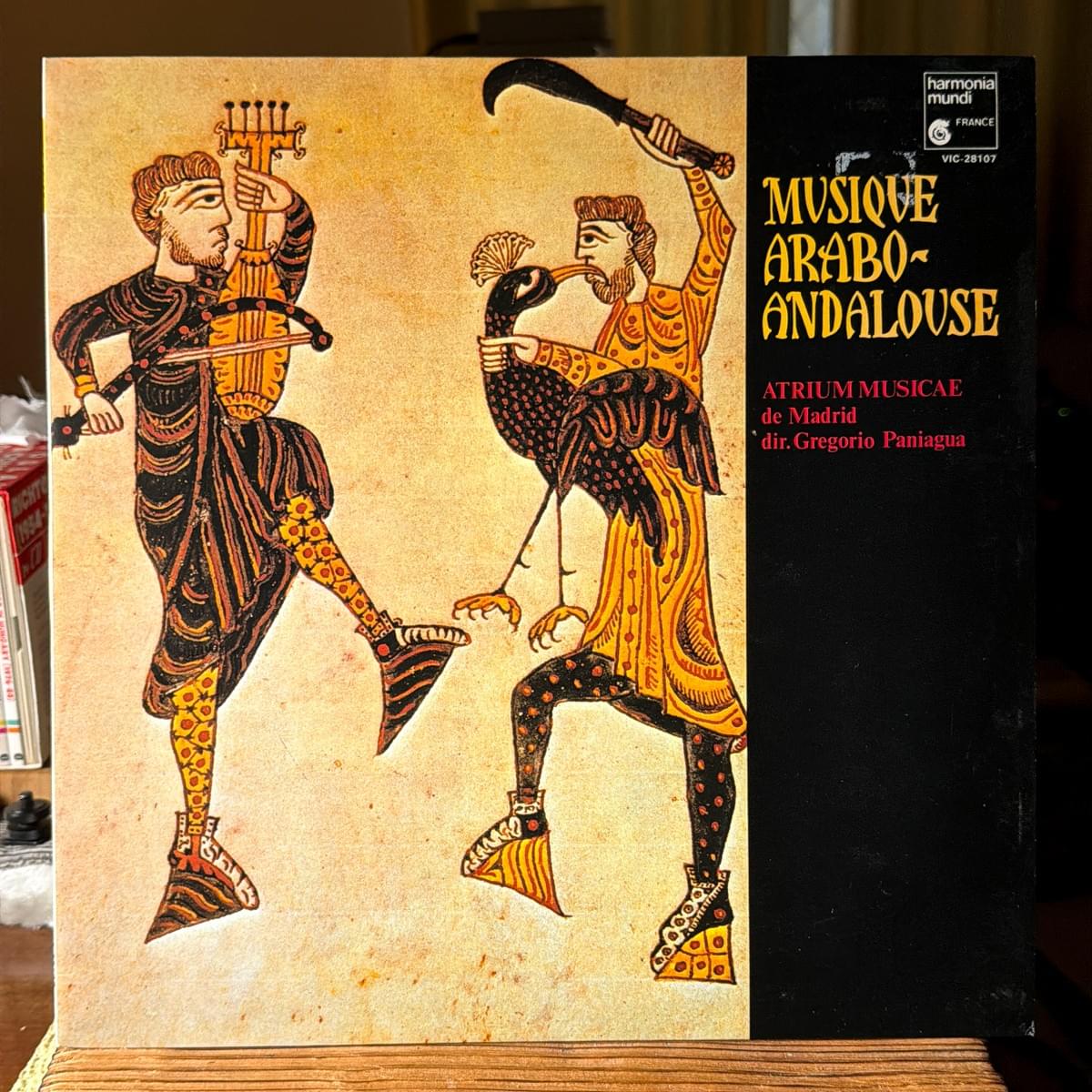
一張伊斯蘭西班牙音樂的唱片,封面用的是一座基督教修道院的《啟示錄》。而且在那本書裡,這兩個人並不是正面角色。以這份手稿介紹他們的研究者說法,這兩個雜耍藝人放在與罪有關的脈絡裡,全是負面的意義,眼神也比別的人物兇得多。他們也指出,那件弓弦樂器是一把北非長頸魯特琴,改成了用弓拉的琴。也有另一種說法,認為畫的是庇里牛斯山區的傳統舞蹈。
修道院的畫家或許不喜歡這兩個樂師,但他仔細畫下了他們手上那件來自北非的樂器。十二世紀初的西班牙,伊斯蘭與基督教的聲音就是這樣交織在一起的。
錄音與版本
錄音,1976 年 10 月;錄音師,保林(Alberto Paulin,生卒年不詳)。法文封套再補上了地點:帕拉亞教堂,錄音與剪輯都由保林負責。帕拉亞(Palaja)是法國南部卡卡頌附近的小村。
《塔朗泰拉》同樣錄於 1976 年 10 月、同樣由保林錄音,而且第六首塔朗泰拉裡響起的是「帕拉亞教堂的大管風琴」。兩張唱片很可能是同一個月、在同一座南法鄉村教堂裡錄下的:一張從南義大利的毒蛛走到安達魯西亞,一張從安達魯西亞走到北非。
長岡鐵男要聽的那段水聲,也就是這座教堂裡的空氣。
這張唱片 1977 年由 Harmonia Mundi 發行,編號 HM 389;1983 年日本勝利唱片以 VIC-28107 發行,標籤上標明母源 HM-389-A、HM-389-B。它留下兩份解說:一份是碧雅翠絲・阿莫寫的法文解說,英譯者是德瑞克・耶爾德(Derek Yeld,生卒年不詳);一份是濱田滋郎的日文長文與解說卡。濱田自己註明,樂器的名稱與說明大多依照原解說。兩份放在一起讀,就是這張唱片最完整的說明書。
- 錄音:1976 年 10 月,帕拉亞教堂,錄音與剪輯保林。
- 採譜、編曲、指揮:格雷戈里奧・帕尼亞瓜。
- 樂器表:愛德華多・帕尼亞瓜手繪。
- 解說:碧雅翠絲・阿莫(法文)、濱田滋郎(日文)。
- 封面:《西洛斯啟示錄》第 86 頁,大英圖書館授權複製。
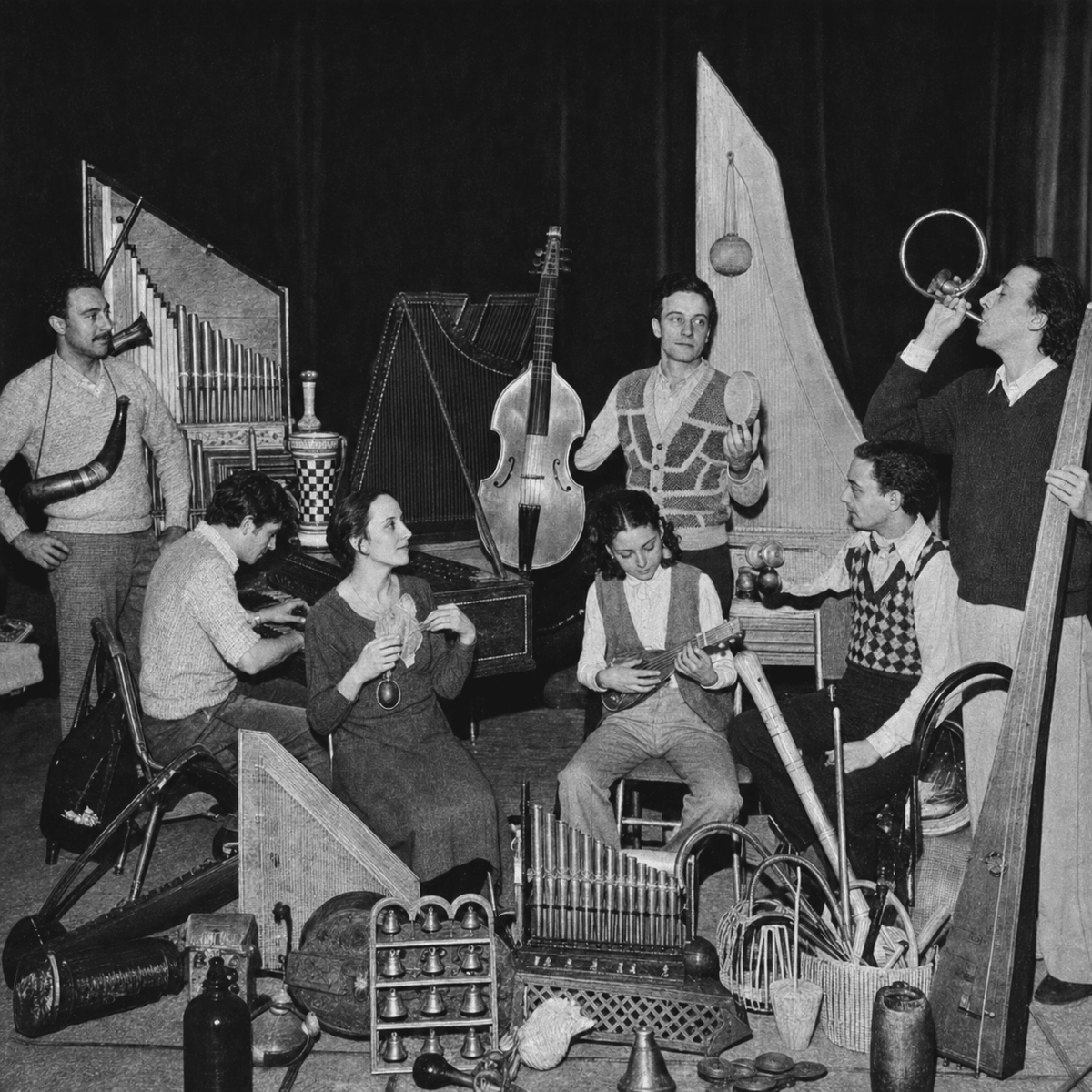
- 封底與解說卡:七位團員坐在一堆樂器中間的合照,一張掛滿樂器的房間照片,以及全張「使用樂器一覽」。
- 壓片:日本勝利以「Super Vinyl」高品質唱片材料壓製,分類〈音樂史〉。
側標的右側寫著一句:與《古代希臘的音樂》並稱雙璧,歐洲音樂的另一個源流就在這裡。下方印了四則短評,兩位音樂評論家、兩位音響評論家:
- 濱田滋郎:魅惑之地安達魯西亞至今仍殘留的古老之夢。
- 黑田恭一(Kuroda Kyōichi,1938–2009):這張唱片生動得讓人忘記「當下」與「此地」。
- 長岡鐵男:A 面最後的水聲,瞬間就聽得出唱頭與喇叭的性格,真實得令人害怕。
- 高城重躬(Takajō Shigemi,1912–1999):不論在音樂史上,還是在音響上,都有難以估量的價值。
一半的評論家是音響評論家。這張唱片同時給聽音樂史的人,和測試音響的人。
日落時分的努巴
把帕尼亞瓜在 Harmonia Mundi 的這幾張唱片排在一起,這一張的位置就清楚了。
1976 年 10 月,同一個月裡,他錄了兩張唱片。《塔朗泰拉》從南義大利的毒蛛走到西班牙南部的礦區,最後收在一首安達魯西亞的吉他獨奏。《阿拉伯—安達魯西亞的音樂》則繼續往南、往歷史的更深處走,走過直布羅陀海峡,去找那些 1492 年後離開的人。
兩年後,他往更東、更古的地方走,錄下《古希臘音樂》。封帶上那句「與《古代希臘的音樂》並稱雙璧」,其實把這條路說得很清楚:歐洲音樂有兩個源頭,一個在希臘,一個在安達魯西亞。帕尼亞瓜先去了安達魯西亞。
這也是他後來家族的路。弟弟愛德華多後來自己成立樂團與唱片公司,長年錄製安達魯西亞與中世紀伊比利的音樂。1976 年這張唱片上的那張樂器表,是他手繪的。
唱片的最後一首,是日落時分的努巴〈阿爾瑪亞〉。一個西班牙家族,用一種被趕出西班牙的音樂,為一個消失的文化送別。2026 年 1 月 10 日,帕尼亞瓜在西班牙 Cercedilla 過世,享年 81 歲。
努巴一千年來沒有寫成樂譜,它的「載體」是人的身體、人的記憶。這張唱片則把 1976 年 10 月帕拉亞教堂裡的一段空氣,刻進了唱片溝槽。
******
【Gudian Record Music Stories】Melodies That Once Echoed Through the Medieval Alhambra: The Music Driven Out of Spain That Lived On in North Africa for Five Hundred Years — Gregorio Paniagua (1944–2026) and Atrium Musicae de Madrid's Musique Arabo-Andalouse
The long essay that Hamada Jirō (1935–2021) wrote for the back of this record's jacket is titled "Melodies That Once Echoed Through the Medieval Alhambra."
The Alhambra is the point where the imagination begins. The music that once echoed there left Spain after Granada fell in 1492. It crossed the Strait of Gibraltar with the Muslims expelled from Spain, and was handed down, generation after generation, for five hundred years in the cities of Morocco, Algeria and Tunisia. And from beginning to end, it was never once written down as a score.
In October 1976, a group of people from Madrid reached back across those five hundred years of exile and, in a village church in the south of France, tried to make the sounds of that palace ring out again.
On this record's obi, the Japanese audio critic Nagaoka Tetsuo (1926–2000) chose to comment on only one thing: the sound of water at the end of Side A. The moment it appears, he wrote, the character of your cartridge and loudspeakers is laid bare — it is real to the point of being frightening.
A Japanese audio critic vouching for a record of medieval Islamic Spanish music, and what he singles out is not a melody, nor any instrument, but water.
Open the "List of Instruments" that comes with the record, and in the box for the last track on Side A, under the name of Carlos Paniagua (dates unknown), there is a single word: "water."
A Music That Was Never Written Down
The essay opens by saying that the music on this record makes one feel two things at once: a mysterious profundity and a classical clarity. Profound, because it belongs to a world that vanished long ago like a dream; clear, because that world was once enormously rich.
That world was the Islamic society of medieval Spain. In 711, Muslims crossed the Strait of Gibraltar and soon controlled nearly the whole Iberian Peninsula; not until 1492 did the last of them, the Kingdom of Granada, fall. Hamada makes a point of warning his readers: do not assume that Western Europe was advanced and the East backward. Medieval Córdoba was the most civilized city in all of Europe; old sources say its citizens prayed in three thousand mosques and rested in three hundred public baths.
Religious doctrine did not encourage secular music. But the princes and nobles of al-Andalus soon could not live without it: they paid fortunes to bring singers from the East, lavished money on singing girls, and some even neglected affairs of state to listen to songs.
The most important figure in this musical world was Ziryab (c. 789–857), in the ninth century. He came from the East, and his beautiful voice and dark complexion earned him a nickname meaning "blackbird." In 822 he arrived at the court of Córdoba and settled there for good. He sang his own songs while accompanying himself on the oud, and tradition holds that it was he who added a string to the four-string oud then in common use. His songs and his way of singing were passed down, generation by generation, through his ten children and many pupils. As he lived on in al-Andalus, his music gradually took on the flavor of that land.
Beginning with him and taking settled shape in the twelfth and thirteenth centuries, al-Andalus developed its most exalted musical form: the nuba. The word means "turn" or "succession." Hamada compares it to the Baroque suite: a prelude in free rhythm, followed by five movements, each in a different rhythmic pattern but all in the same mode, with interludes in between. The difference is that the nuba is, in its essence, song.
And the nuba was never written down as a score. It lived entirely by oral transmission, passing from one person's voice and hands to another person's voice and hands.
After 1492, the Music Followed the People
At the end of the fifteenth century, the Muslims were driven out of the Iberian Peninsula, and those who stayed were forced to convert to Christianity. How did a music that was never notated survive to this day?
The answer: it did not survive in al-Andalus. It followed the exiles across the sea to North Africa. The people of Valencia went to Tunis, the people of Córdoba to Algiers, the people of Seville to Fez, the people of Granada to Tetouan. The descendants of these refugees guarded the music of al-Andalus as a family inheritance for centuries.
Legend says there were once twenty-four nubas, one for each hour of the day; today only eleven survive complete, and the rest only in fragments. In the eighteenth century, the Moroccan musician Muhammad al-Ha'ik (dates unknown) collected and recorded the texts and ways of singing that were on the verge of being lost; Hamada calls him the restorer of the nuba. The Turkish style that swept across the Islamic world in the late Middle Ages never reached Morocco at its far western edge, and this, too, shielded the old tradition.
Today's nuba musicians in Morocco and Algeria play the rebab, the tar frame drum, the oud and the darbuka, but also the violin and viola. They hold these upright on the knee, however, and Hamada says these instruments long ago ceased to be Western: the instruments changed, but the essence of the music remained.
He adds, soberly, that the Andalusian music of North Africa today cannot possibly be identical to that of the thirteenth century. But the way the pieces are organized, the rhythmic patterns, and the idea of putting melody and rhythm first and harmony second — these essentials have probably not changed.
This is the most remarkable thing about the history behind this record. A music driven out of Spain lived for five hundred years in the cities of North Africa. In 1976, a group of people from Madrid, carrying instruments they had made themselves, reached back across those five hundred years of exile to look for the sound it once had in al-Andalus.
A Mosaic
On the insert card, Paniagua's credit reads "transcription, arrangement, direction." The record does not perform any single nuba in full. Hamada explains that he freely selected passages from different nubas and joined them together into a sampler-like collage — a "mosaic."
The card lists the nubas used in order of appearance; the numbered ones carry the official numbering fixed by al-Ha'ik in the eighteenth century: No. 4 Rasd al-Dhayl, No. 1 Ramal al-Maya, No. 5 Istihlal, No. 7 Gharibat al-Husayn, No. 6 Rasd, and finally No. 3 al-Maya. The unnumbered ones, such as Sika and Hijaz, are surviving fragments or material the performers borrowed from other sources in the Islamic world.
Each nuba has its own mode and, like an Indian raga, its appointed hour of performance. Al-Maya, used for the record's final track, is the nuba of sunset. Hamada relays what the original French notes say:
The members of the ensemble wished, through this melody, to express their farewell to a once-flourishing culture.
The record ends at sunset.
A Table of Instruments
The other side of the insert card holds a "List of Instruments": for each section, the genre, rhythmic pattern, nuba name and duration, plus what each of the seven players performs. Readers of earlier Gudian pieces will recognize the format at a glance. The table was drawn by hand by Eduardo Paniagua (1952–).
The instruments are almost all Arab and North African: the kamanja with its hemispherical body, the rebab played by the ensemble's leader, the oud, the qanun, the ney, the zurna, the darbuka, the tar, and the organ al-urghan, recorded in Arabic sources as early as the ninth century. Hamada notes that each of these choices rests on medieval texts and pictures — for instance, the illustrations in the Cantigas de Santa María of Alfonso X (1221–1284), which depict many Arab and Moorish musicians with their instruments.
Like Thibaut de Navarre two years later, this record has no singing at all. Hamada says the nuba is in essence song but is also often performed instrumentally, and this record takes the instrumental path.
Water, a Wooden Comb and Finger Snaps
A few boxes in the table do not name instruments:
- Side A, track 5: Beatriz Amo (dates unknown) and Carlos, "finger snaps."
- Side A, track 6: Carlos, "water" — the sound of water Nagaoka Tetsuo wrote about.
- Side B, track 2: Eduardo strikes a "jarra," a water jar.
- Side B, track 3: Úbeda and Amo, "hand claps."
- Side B, track 4: Carlos, "wooden comb."
The wooden comb also appears on Tarantella, recorded the same month. Finger snaps, hand claps, a water jar: these are sounds that already belonged to everyday life in North Africa and al-Andalus. They are not yet the lawnmower of La Folia, but a family ensemble's imagination of sound, born of research.
As for how the sound of water was made, the record does not say. You can guess as you listen: is it water being poured, water being stirred by hand, or water dripping from a height?
The Words "Early Music Fantasy"
JVC (Victor) gave this record the Japanese title Kogaku Gensō, "Early Music Fantasy." Seen alongside the rest of the series, this is interesting: La Folia, mentioned on the insert card, was called "Early Music Rhapsody"; Villancicos, "Early Music Reminiscence"; and the Ortiz record covered in Gudian's previous piece, "Early Music Transformations." Each record was given a different word.
Hamada himself explains the word "fantasy" at the end of his essay. Atrium Musicae, he says, on the one hand poured great creativity into the work, especially in their use of instruments; on the other, they stood on meticulous research. Their aim was not to copy today's North African tradition, but to treat that tradition as the only reliable clue for bringing the music of medieval al-Andalus back to life.
Then he writes with great candor: such a reconstruction cannot avoid "fantasy," nor can it avoid "fiction." Yet a clear stream of "truth" does run through this record. If one were to say that this truth comes from the nostalgia the performers carry in their blood as Spaniards, from their deep longing for the ancient dream of al-Andalus — would that be merely the writer's own sentimentality?
That question is the gloss on the words "Early Music Fantasy." From the very start, this record does not claim to be the original; it is an act of imaginative reconstruction.
It is only fair to record another view as well: today, many who want to hear the nuba go straight to recordings by local ensembles in Morocco and Algeria. From an ethnomusicological standpoint, a European early-music ensemble interpreting a North African oral tradition with its own reconstructed instruments and its own collage of repertoire is open to reservations. Both positions make sense: one wants to hear a living tradition; the other wants to hear how a Spaniard looks back.
The Cover: Two Musicians from a Monastery Manuscript
The cover shows two dancing figures. The one on the left holds a long-necked bowed instrument upright against his chest and plays it; the one on the right holds a bird in one hand and raises a curved sword high in the other.
The jacket notes that the image is reproduced by permission of the British Library, from page 86 of manuscript Add MS 11695 in its collection. This manuscript is the Silos Apocalypse: a commentary on the Book of Revelation copied at the Monastery of Santo Domingo de Silos in Burgos, Spain, completed in 1109, its illuminator named Petrus (dates unknown).
A record of Islamic Spanish music whose cover comes from the Apocalypse of a Christian monastery. And in that book, these two are not positive figures. According to researchers who have introduced them from this manuscript, the two entertainers are placed in a context associated with sin and carry an entirely negative meaning; their gaze is also far fiercer than that of the other figures. The same researchers point out that the bowed instrument is a North African long-necked lute converted into an instrument played with a bow. Another reading holds that the scene depicts a traditional dance of the Pyrenees.
The monastery's painter may not have liked these two musicians, but he carefully drew the North African instrument in their hands. In early twelfth-century Spain, this is how Islamic and Christian sounds were woven together.
Recording and Editions
Recorded October 1976; recording engineer, Alberto Paulin (dates unknown). The French jacket adds the location: the church of Palaja, with recording and editing both by Paulin. Palaja is a small village near Carcassonne in the south of France.
Tarantella was likewise recorded in October 1976, likewise by Paulin, and in its sixth tarantella one hears "the great organ of the church of Palaja." The two records were very likely made in the same month, in the same village church in southern France: one travelling from the tarantula of southern Italy to al-Andalus, the other from al-Andalus to North Africa.
The sound of water Nagaoka Tetsuo wanted us to hear is also the air inside that church.
The record was released by Harmonia Mundi in 1977 as HM 389; in 1983 JVC (Victor) issued it in Japan as VIC-28107, with the labels marking the source as HM-389-A and HM-389-B. It comes with two sets of notes: one in French by Beatriz Amo, translated into English by Derek Yeld (dates unknown); the other Hamada Jirō's Japanese essay and insert card. Hamada himself notes that the instrument names and descriptions largely follow the original notes. Read together, the two make up the most complete guide to this record.
- Recording: October 1976, church of Palaja; recording and editing by Paulin.
- Transcription, arrangement, direction: Gregorio Paniagua.
- Table of instruments: hand-drawn by Eduardo Paniagua.
- Notes: Beatriz Amo (French), Hamada Jirō (Japanese).
- Cover: Silos Apocalypse, page 86, reproduced by permission of the British Library.
- Back cover and insert card: a group photo of the seven members seated among a heap of instruments, a photo of a room hung with instruments, and the full "List of Instruments."
- Pressing: pressed by JVC on its high-quality "Super Vinyl" compound, classified under "Music History."
The right side of the obi carries the line: a twin masterpiece alongside Music of Ancient Greece — here lies the other source of European music. Below it are four short comments, from two music critics and two audio critics:
- Hamada Jirō: The ancient dream that still lingers in the enchanted land of Andalusia.
- Kuroda Kyōichi (1938–2009): This record is so vivid it makes you forget the "now" and the "here."
- Nagaoka Tetsuo: The sound of water at the end of Side A instantly reveals the character of your cartridge and loudspeakers; it is real to the point of being frightening.
- Takajō Shigemi (1912–1999): Of immeasurable value, both in music history and in sound.
Half the critics are audio critics. This record is for those who listen for music history and for those who test their sound systems alike.
The Nuba of Sunset
Line up Paniagua's records on Harmonia Mundi and the place of this one becomes clear.
In October 1976, within a single month, he recorded two albums. Tarantella travels from the tarantula of southern Italy to the mining districts of southern Spain, closing with an Andalusian guitar solo. Musique Arabo-Andalouse goes further south and deeper into history, across the Strait of Gibraltar, in search of those who left after 1492.
Two years later he went further east and further back in time, recording Music of Ancient Greece. The line on the obi — "a twin masterpiece alongside Music of Ancient Greece" — actually maps this path clearly: European music has two sources, one in Greece and one in al-Andalus. Paniagua went to al-Andalus first.
This was also the path his family would follow. His younger brother Eduardo later founded his own ensemble and record label, and for many years has recorded the music of al-Andalus and medieval Iberia. The table of instruments on this 1976 record was drawn by his hand.
The record's final track is the nuba of sunset, al-Maya. A Spanish family, using a music that was driven out of Spain, bids farewell to a vanished culture. On January 10, 2026, Paniagua died in Cercedilla, Spain, at the age of 81.
For a thousand years the nuba has never been written as a score; its "medium" is the human body and human memory. This record, in turn, has cut a stretch of the air inside the church of Palaja in October 1976 into the grooves of a disc.