
【古殿唱片音樂故事】一位吟遊詩人國王,用歌聲寫下自己的一生——帕尼亞瓜(Gregorio Paniagua,1944–2026)與馬德里古樂團的《納瓦拉的提博》(Thibaut de Navarre)
古殿殿主
西班牙潘普洛納大教堂,舊日修士的食堂,如今是一座博物館。門楣上有一件 1330 年的石雕:一隻鵜鶘,身旁站著兩位拉著維埃爾琴的樂師。
這隻鵜鶘,指的是一首歌。歌名是〈上帝一如鵜鶘〉,作者是七十多年前的納瓦拉國王提博(Thibaut IV de Champagne,1201–1253)。國王已經死了四分之三個世紀,他的都城裡的人,還記得他唱過的歌。
又過了六百四十多年,1978 年 6 月,帕尼亞瓜(Gregorio Paniagua,1944–2026)帶著馬德里古樂團,把這位國王的歌錄成了一張唱片。
古殿已經寫過帕尼亞瓜的《塔朗泰拉毒蛛舞曲》(1976)、《古希臘音樂》(1978)與《La Folia》(1980)。那三張唱片的主角,是一種病、一個消失的文明、一首被馴服的舞曲。這一張的主角,是一個有名有姓的人。
一、吟遊詩人國王
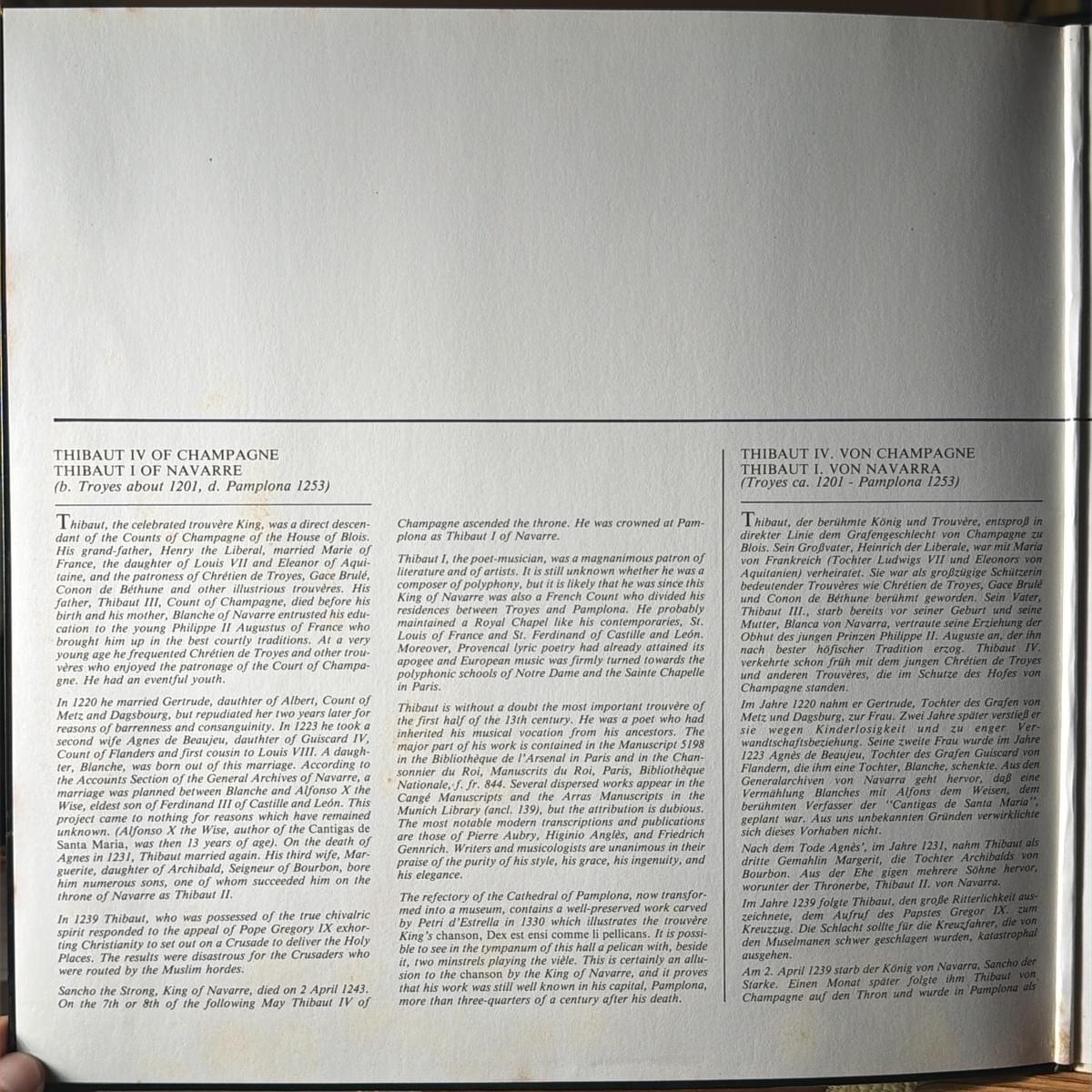
提博(Thibaut IV de Champagne,1201–1253)是香檳伯爵、也是納瓦拉國王。唱片內頁用法、英、德三種語言,詳細寫下了他的一生。
他出生在一個與吟遊詩人淵源極深的家族。他的祖母是香檳的瑪麗(Marie de Champagne,1145–1198),法王路易七世(Louis VII,1120–1180)與阿基坦的埃莉諾(Eleanor of Aquitaine,約 1122–1204)之女,庇護過克雷蒂安・德・特魯瓦(Chrétien de Troyes,約 1135–約 1190)等一整代著名的北法吟遊詩人。提博的父親在他出生前就已過世,母親是納瓦拉的布蘭琦(Blanche de Navarre,約 1177–1229)。
他的一生,濃縮了十三世紀歐洲貴族的典型命運:三次婚姻,其中第一任妻子以不孕與近親為由被休;女兒布蘭琦(Blanche de Navarre,1226–1283)曾與卡斯提利亞的王子阿方索十世(Alfonso X,1221–1284)議婚,就是後來編纂《聖母頌歌集》的那位「智者」;1234 年,舅舅納瓦拉國王桑喬七世(Sancho VII,約 1157–1234)無嗣而終,提博在潘普洛納加冕為納瓦拉國王;1239 年,他響應教宗額我略九世(Gregory IX,約 1170–1241)的號召帶領十字軍東征,結果態敗而歸。
這樣一位國王,最為後世記得的身分,卻是吟遊詩人。內頁說,他無疑是十三世紀上半葉最重要的北法吟遊詩人,所有研究他的學者都一致稱讚他風格的純淨、優雅與巧思。幾十年後,義大利詩人但丁(Dante Alighieri,1265–1321)在論著裡,也以「納瓦拉國王」為例,引述他的詩句。
他的作品大多保存在巴黎阿森納圖書館第 5198 號手稿,以及法國國家圖書館的《國王歌集》裡。
二、一張唱片,一段人生
這張唱片收錄了三十多首提博的歌,兩三首一組連續演奏。把歌名一首首讀下來,幾乎就是他一生的各個面向:
- 宮廷情歌:〈當純真之愛央求我歌唱〉、〈甜蜜的思緒與溫存的回憶〉,還有那首著名的〈我就像獨角獸一般〉。
- 牧羊女之歌:〈前日我隻身漫步〉、〈清晨時分〉,騎士在鄉間偶遇牧羊女的故事。
- 辯論歌:兩人一問一答、各持一方的對唱。歌名就是對話的開頭:〈腓力,我向您探問〉、〈羅貝爾,請看石階〉,還有別人反過來問國王的〈懑著上帝之名,香檳與布里的領主〉、〈提博國王,領主,請在歌聲中回答〉。
- 十字軍之歌:〈諸位領主,可知曉〉、〈在充滿背叛與罪惡的時代〉、〈女士,這意味著我必須啟程〉,出征前的號召與告別。
- 宗教與時論:〈上帝一如鵜鶘〉,也就是潘普洛納石雕所指的那一首。
還有一個小細節:A 面第二組的開頭是〈愛神令我啟唱新歌〉,整張唱片的最後一首,又回到〈愛神令我啟唱〉。從愛開始,也以愛結束。
這張唱片不是一首首歌的堆疊。它更像是用一位國王自己的歌,替他寫了一部傳記。
三、只有旋律的樂譜
北法吟遊詩人的手稿,只記下了歌詞與一條單純的旋律線。節奏怎麼走、誰來伴奏、用什麼樂器、在什麼場合唱,手稿上一個字也沒有。
內頁提到,現代最重要的提博作品轉寫,出自法國的歐布里(Pierre Aubry,1874–1910)、西班牙的安格列斯(Higinio Anglès,1888–1969)與德國的根里希(Friedrich Gennrich,1883–1967)。但學者能給的,只是旋律。剩下的一切,帕尼亞瓜都得自己決定。
這和《古希臘音樂》面對的難題不同,却又相通。《古希臘音樂》裡,缺的是殘篇之間的音符;這裡,音符是完整的,缺的是音符以外的整個聲音世界。帕尼亞瓜不假裝自己重現了提博當年的演出,而是根據他對那個時代、那片土地的理解,替這些歌建造一個可信的聲音世界。
四、沒有歌詞的歌
這張唱片還有一個最容易被忽略、卻最關鍵的特點:整張唱片,沒有一個人開口唱歌。
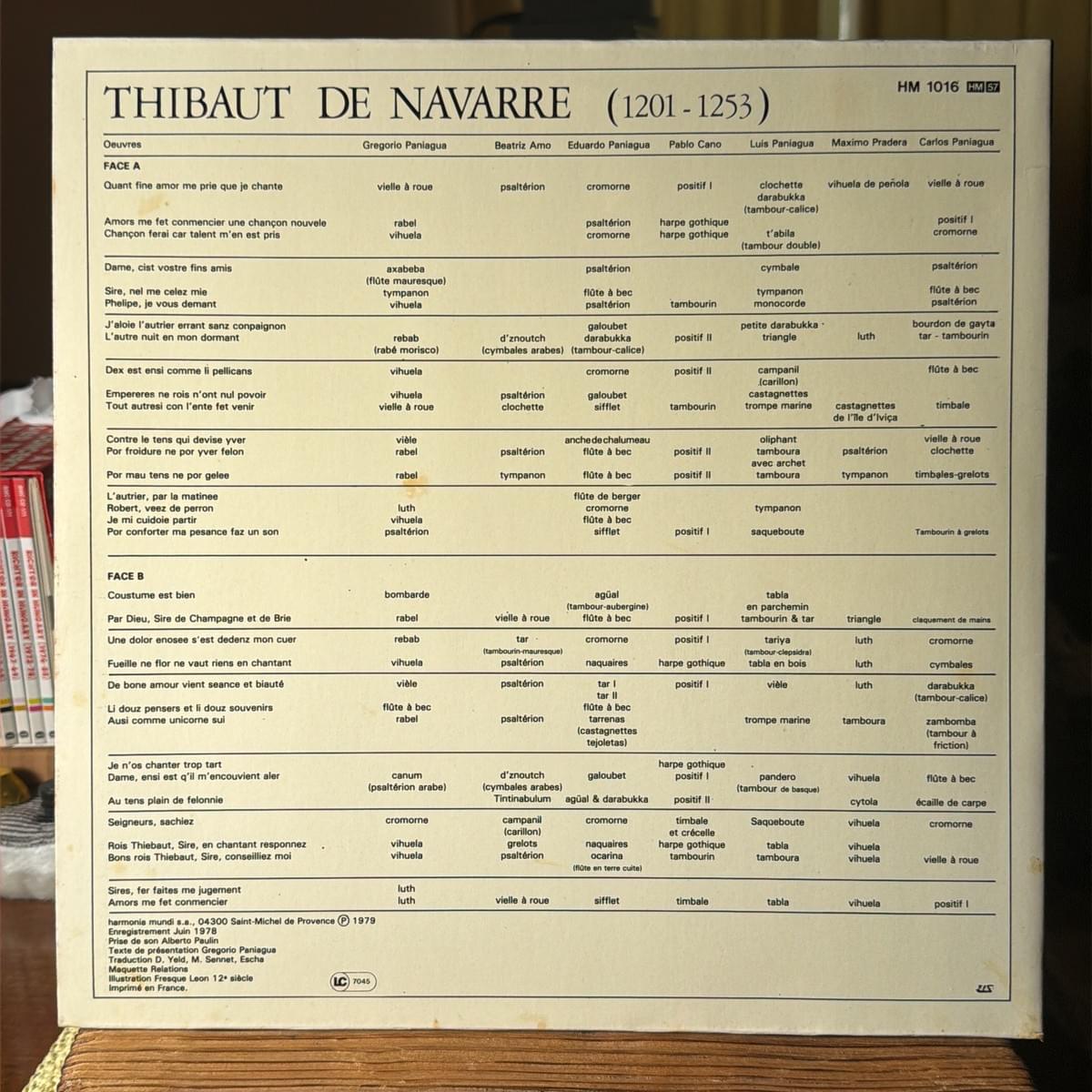
封底的表格只列了每位樂手演奏的樂器,沒有任何「演唱」的欄位;實際聆聽,也確實從頭到尾都是純器樂演奏。同一個月錄音的《古希臘音樂》,表格裡清清楚楚標明了誰負責唱;到了《納瓦拉的提博》,帕尼亞瓜卻讓所有人都放下了歌聲。
這是一個非常大膽的決定。提博是詩人,他的藝術是詩與旋律的結合,手稿裡最完整保存下來的,正是歌詞。帕尼亞瓜卻把歌詞整個拿掉,只留下旋律,再把每一條旋律交給不同的樂器去「唱」:摩爾人的拉貝琴、中世紀的維埃爾琴、克魯姆管、輪擺提琴。既然手稿只留下了旋律,他就乾脆只讓旋律說話。
五、法國詩人的歌,摩爾人的鼓
翻到封底的表格,會發現一件出人意料的事:一位法國伯爵的歌,用了大量阿拉伯與摩爾樂器。
- 阿拉伯與摩爾樂器:摩爾橫笛、拉貝琴、阿拉伯小手鈸、聖杯鼓、茄子形的陶鼓、漏壺形陶鼓、卡努恩琴、摩爾框鼓。
- 伊比利民間樂器:摩擦鼓(zambomba)、陶片拍板、伊比薩島響板、方形雙面手鼓、蓋塔風笛的持續音管。
- 歐洲中世紀樂器:輪擺提琴、維埃爾琴、索爾特里琴、哥德式豎琴、小型管風琴、象牙號角、海號角單弦琴、西托拉琴。
這個選擇並不隨意。提博的王國納瓦拉,就在伊比利半島,正是基督教與伊斯蘭文化長期交會的地帶。這也是帕尼亞瓜很早就在走的路:1969 年,馬德里古樂團就曾與摩洛哥特武安的管弦樂團合作,錄製一張把十二、十三世紀宮廷單音歌曲與阿拉伯—安達魯西亞音樂並列的唱片。
但表格裡也藏著一些明顯的「時代錯置」:克魯姆管與薩克布號,其實是十五、十六世紀才流行的樂器,比提博晚了兩三百年。這強調了一件事:帕尼亞瓜做的不是博物館式的復原,而是一次有根據的想像。
仔細看,還是找得到他的玩心:〈在充滿背叛與罪惡的時代〉裡,有人負責刮「鯉魚鱗」;〈懑著上帝之名,香檳與布里的領主〉裡,有人負責「拍手」。
六、封面:萊昂的牧羊人
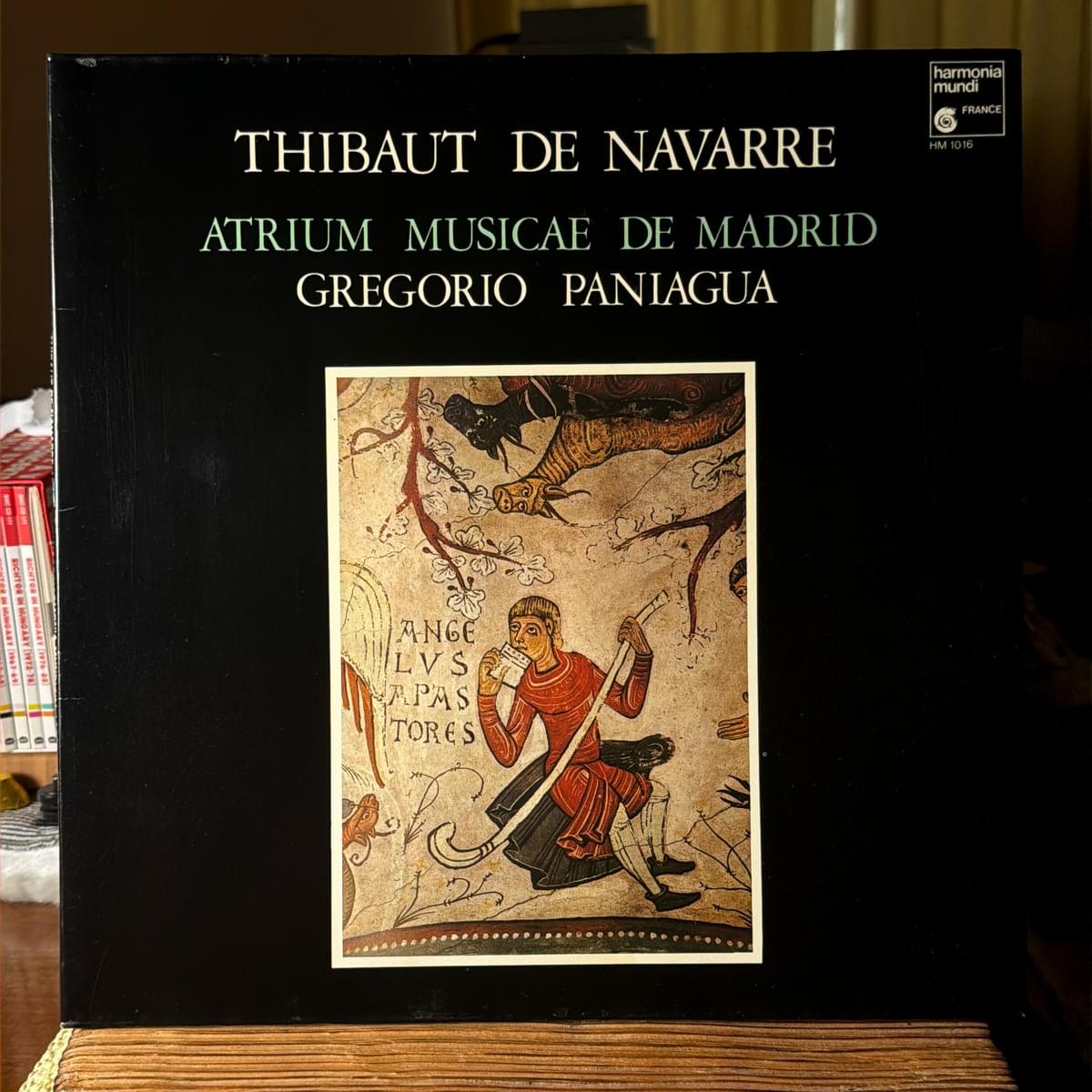
封面唱片寫著:萊昂十二世紀濕壁畫。畫中一位穿紅衣的牧羊人,手持彎角,把樂器湊到嘴邊。旁邊的拉丁文寫著「天使向牧羊人」,這是耶穌誕生時天使報信的場景。一般認為,這幅壁畫出自西班牙萊昂聖伊西多羅教堂的王室陵寝,是羅馬式壁畫最著名的傑作之一。
封面選的不是國王,而是一位吹奏的牧羊人。吟遊詩人的歌,從來不只屬於宮廷,也屬於田野裡吹奏的人。而這一次,帕尼亞瓜又選了一件西班牙的圖像。
七、錄音:與《古希臘音樂》同一個六月
封底記載:1978 年 6 月錄音,錄音師是保林(Alberto Paulin,生卒年不詳),唱片 1979 年出版。
這與《古希臘音樂》是同一個月、同一位錄音師,連演奏者也完全相同:格雷戈里奧與弟弟愛德華多(Eduardo Paniagua,1952–)、路易斯(Luis Paniagua,生年待查)、卡洛斯(Carlos Paniagua,生卒年不詳),加上阿莫(Beatriz Amo,生卒年不詳)、卡諾(Pablo Cano,生卒年不詳)與普拉德拉(Máximo Pradera,生卒年待查)。同一群人,在同一個夏天,一邊重建兩千年前的希臘殘篇,一邊替七百年前的國王配器。
這張唱片後來也由日本勝利發行(VIC-28137);在日本,長岡鐵男(Nagaoka Tetsuo,1926–2000)也把它收進了《外盤 A 級セレクション》。
八、他到底是怎麼想的?
這是整張唱片的核心問題,而帕尼亞瓜沒有留下答案。內頁只寫了提博的生平,一個字也沒有解釋為什麼不唱。我們只能從他留下的線索去推想。
這是選擇,不是限制。 同一個月錄音的《古希臘音樂》,阿莫與其他成員都開口演唱。古樂團手上有歌手,《提博》沒有歌聲,不是做不到,而是刻意不做。
七百年前的人,就是這樣記得提博的歌。 內頁特別提到潘普洛納大教堂 1330 年的那件石雕:一隻鵜鶘,旁邊是兩位拉著維埃爾琴的樂師。這是提博死後,他的歌在都城被記憶的圖像證據,而畫面上是兩位演奏樂器的人,沒有歌者。中世紀的遊唱樂師,本來就常把歌的旋律拿來純器樂演奏。帕尼亞瓜或許正是從這件石雕出發:七百年前的人用琴聲記得提博的歌,他也用琴聲。
手稿只有旋律,沒有節奏。 吟遊詩人的手稿只記下音高,沒有記下節奏。一旦用人聲唱出古法語的歌詞,就得先替它決定一套格律,而這正是學界爭論了一百年的難題。改成器樂,旋律就從歌詞的格律裡解放出來,可以依著樂器與舞蹈的性格自由呼吸。這和他在《古希臘音樂》裡「不假裝知道」的態度,是同一件事。
從巴黎的宮廷,移到伊比利半島。 古法語的歌詞,會把這些歌牢牢綁在法國宮廷。拿掉歌詞,讓摩爾人的拉貝琴、聖杯鼓與卡努恩琴來「唱」,提博就成了一位在潘普洛納加冕的納瓦拉國王,站在伊比利半島多元文化的交會點上。
他不願意無聊一秒。 古樂團後期的成員德爾加多(Luis Delgado,生卒年待查)回憶,帕尼亞瓜一秒鐘也不肯讓自己無聊,和他一起工作是一種會讓人筋疲力盡的經驗。他也說,帕尼亞瓜後來想擺脫「古樂」的標籤,去做自己的音樂。把歌變成器樂曲,已經不只是復原,而是一次再創作:尊重旋律,同時保留他作為作曲家的自由。
畫家與醫生的眼光。 學過繪畫的人,或許會把旋律看成線條、把樂器看成顏色;念過醫學的人,習慣把一個變數單獨抽出來觀察。拿掉歌詞,就是把旋律單獨抽出來,看它自己能不能活。
以上都是推想。但這正是帕尼亞瓜自己的方法:面對空白,不假裝知道,而是誠實地提出可能。
九、提博的唱片史
把這張唱片放回提博的錄音史裡,它的位置就更清楚了:
- 78 轉時代:勝利唱片 Victor 20227、法國 Columbia 的中世紀音樂選集,各收了提博一首歌,與其他吟遊詩人並列。
- 1979 年,帕尼亞瓜 HM 1016:就目前可查的資料,這是第一張整張獻給提博的唱片,也是唯一一張純器樂的版本。
- 1983 年,阿塔諾合奏團(Ensemble Athanor):法國 VDE-Gallo 的 LP《香檳的提博之歌:吟遊詩人國王》。
- 1987 年,珀西瓦爾合奏團(Ensemble Perceval):《中世紀國王與王侯之歌》,提博與其他幾位國王並列。
- 2011 年錄音,阿拉・弗蘭切斯卡合奏團(Alla Francesca)與萊斯內(Brigitte Lesne,生卒年待查):Aeon 唱片的《國王歌集》,以歌唱為主,並穿插同時代的匿名舞曲與經文歌。
這裡有一個耐人尋味的反諷。2021 年,英國樂評網站 MusicWeb 評論阿拉・弗蘭切斯卡這張唱片時寫道:提博雖被但丁譽為最偉大的吟遊詩人之一,唱片界卻一直虧待他,這似乎是唯一一張幾乎完全獻給他的專輯。
評論者不知道的是,帕尼亞瓜早在三十多年前,就已經做了一整張。這張唱片落在學科與市場的縫隙裡,連專業樂評都遺忘了它。
十、研究唱片,也是研究這個人
寫到這裡會發現,研究這張唱片的內容,其實也就是在研究帕尼亞瓜這個人。
要回答「為什麼沒有歌聲」,就得回到他念過的醫學、學過的繪畫、他的伊比利視角、他不願無聊的性格;反過來,要理解他這個人,也只能從他留下的這些唱片、表格與選擇去看。唱片與人之間,若即若離:唱片不等於他,他也不只是這些唱片;兩者是分開的,卻又彼此說明。
這或許也是理解帕尼亞瓜最好的方式。每一張唱片都是一個割裂的片段,各自處理一個完全不同的題目;但把它們放在一起,就拼出了一個人看世界的整體方式。是割裂的,也是總體的。
多樣之中的一條線
把帕尼亞瓜這幾年的唱片排在一起,它們的面貌差異極大:
- 1976 年《塔朗泰拉毒蛛舞曲》:一種病,與它的音樂療法。
- 1978 年《古希臘音樂》:一個消失的文明留下的殘篇。
- 1978 年錄音的《納瓦拉的提博》:一位國王的歌與人生。
- 1980 年《La Folia》:一首若有若無的舞曲,與它被馴服前的瘋狂。
在 Harmonia Mundi 的唱片裡,古樂團雖然也錄過單一作曲家的專輯,例如 1977 年的奧爾蒂斯《裝飾變奏論》器樂曲。但以一位詩人音樂家的歌為主體、並以他的人生為脈絡的「傳記式專輯」,只有這一張。
這些唱片看似各走各的路,背後却有一套一致的思維:
- 同一張表格:曲名、出處、每位樂手的樂器,每張唱片都把自己的根據攞在陸光下。
- 同一種誠實:面對史料的空白,不假裝知道,而是公開地想像。
- 同一雙手:樂器自己做,音樂自己演,從文獻一路連到錄音室。
- 同一個視角:每一張都穿過伊比利半島。塔朗泰拉最後收在安達魯西亞,La Folia 是「西班牙的瘋狂」,提博是在潘普洛納加冕的國王;連古希臘,也是整個地中海文化的源頭。
帕尼亞瓜的多樣,不是沒有方向的尋寶。他每次選一個不同的入口,走進的卻是同一個問題:過去的人,如何用聲音面對他們的世界?
十一、學科的邊界,與一個新的典範
為什麼帕尼亞瓜的題目這麼多樣,背後卻始終有一條線?我認為可以從四個層次來看。
第一,他問的不是「樂譜上寫了什麼」,而是「音樂在人的生活裡做了什麼」。《塔朗泰拉》是音樂作為醫療,《古希臘音樂》是音樂作為城邦的儀式與對失去的哀悼,《納瓦拉的提博》是音樂作為一個人的愛情、辯論、政治與信仰,《La Folia》是音樂作為集體的瘋狂。一般古樂團以作曲家或時代分類,帕尼亞瓜則以人類經驗分類。
第二,他在不同的尺度之間自由切換:一整個文明、一個人、一種社會現象、一個音樂形式。尺度一直在變,但他做的始終是同一件事,重建一個完整的聲音世界,而不只是演奏一首曲子。
第三,這種思維來自他的養成。籃球、醫學、繪畫、大提琴、古大提琴、指揮,他沒有被任何一個學科馴化。對一個念過醫學的人來說,音樂和身體、疾病、社會、信仰本來就連在一起。
第四,這批唱片錄製於 1976 到 1980 年,正是佛朗哥(Francisco Franco,1892–1975)去世後西班牙走向民主的轉型時期。帕尼亞瓜在這幾年反覆處理的,是伊比利半島的多元來源:阿拉伯與安達魯西亞的音樂、摩爾人的樂器、猶太塞法迪人的歌謠,還有一位在潘普洛納加冕的法國國王。這或許不是巧合。我們沒有查到他本人這樣說過,但這些唱片放在一起,彷彿是在用聲音重新說明,「西班牙」原本就是許多文化交會的地方。
人很難脫離自己的時代與當下的現實環境,帕尼亞瓜也不例外。但時代只是提供了條件,並不替人做決定。同樣生在轉型中的西班牙,大多數人並沒有走進莎草紙、醫學史與十三世紀的手稿。最終決定一個人做出什麼的,還是他自己如何選擇、如何去做。
知識的力量,而不是學科的權力
這一系列文章寫到這裡,我想說的其實不只是帕尼亞瓜。
長久以來,學科分科不只是一種分工,也是一種權力:誰掌握了某一門學科的知識,誰就有資格劃定那門學科的邊界,決定什麼可以說、誰可以說。AI 時代來臨,大量專門知識變得人人可以取得,這種靠壟斷知識而建立的邊界,勢必會被打破。那麼,我們接下來要靠什麼來思考?我們需要一個新的典範。
帕尼亞瓜正是這樣一個典範。他對學科的權力完全不屑一顧:醫學院和音樂院,他都在即將拿到文憑時轉身離開;在內頁的出處欄裡,他還寫下「一點點反音樂學的焦慮與不安」。他著迷的,是知識本身的力量。
為了追求真實,他願意用盡一切方式去了解:在圖書館裡讀手稿,在大教堂門口看石雕,在工坊裡親手做樂器,在錄音室裡和家人一起演奏,甚至用一聲爆炸、一段割草機的聲音,去逼近他想理解的東西。他研究塔朗泰拉,就去讀醫學史;研究提博,就去讀十字軍與王室婚姻;研究古希臘,就去讀莎草紙與大理石碑。
只有這樣以熱情走遍各個方向,最後才可能對「總體」有那麼一點點想像與理解。他從來沒有宣稱自己掌握了全部,他只是不讓任何一道學科的圍牆,擋住他去看的方向。
更有意思的是,帕尼亞瓜的成果之所以在將近半個世紀後,還能給我們新的啟發,正是因為他走過的這些地方,在後來的學科分界之下,幾乎仍然沒有什麼人碰觸。
音樂與醫學之間、音樂與考古之間、一位國王的情歌與十字軍史之間,這些領域不屬於任何一個學科,所以也沒有任何一個學科負責照顧它們。在 LP 時代,把古希臘殘篇系統性收成一整張唱片的,只有他;以「音樂作為醫療」為核心的古樂專輯,要等二十六年後才有第二張。學科的圍牆越高,牆與牆之間的空地就越大。
對一個還沒有背負任何學科包袱的年輕人來說,這片空地根本就是一個嶄新的未來。
在知識不再稀缺的時代,稀缺的是這種熱情,以及把一切重新連起來的能力。
十二、七百年後的鵜鶘
中世紀的傳說裡,鵜鶘會啸破自己的胸口,用鮮血養活雛鳥,所以成了犧牲與復活的象徵。提博用它寫了一首歌;1330 年,潘普洛納的雕工把這首歌刻進石頭;1978 年,帕尼亞瓜把它奏回了空氣裡。
一首歌的生命,就是這樣一代一代被接下去的。雕工記得國王的歌,帕尼亞瓜記得雕工記得的歌。2026 年,帕尼亞瓜也離開了;現在,輪到聽這張唱片的人來記得。
******
【Gudian Music Stories】A Troubadour King Who Wrote His Life in Song: Gregorio Paniagua (1944–2026) and Atrium Musicae de Madrid’s Thibaut de Navarre
In the Cathedral of Pamplona, northern Spain, what was once the monastic refectory now serves as a museum. Over a doorway rests a stone relief sculpted in 1330: a pelican, flanked by two musicians playing medieval vielles.
That pelican represents a song: Diex est ausi conme li pellicans ("God Is Like the Pelican"). Its composer was Theobald I of Navarre (Thibaut IV de Champagne, 1201–1253), who had ruled some seventy years prior. Though three-quarters of a century had elapsed since the monarch's death, the people of his capital still remembered the songs he sang.
More than six hundred and forty years later, in June 1978, Gregorio Paniagua (1944–2026) led Atrium Musicae de Madrid into the studio to commit this sovereign’s melodies to vinyl.
The Ancient Palace has previously explored Paniagua’s Tarentule – Tarentelle (1976), Musique de la Grèce Antique(1978), and La Folia (1980). Those three landmarks centered on a medical affliction, a vanished civilization, and a domesticated court dance unmasked to reveal its primal frenzy. This album centers on a flesh-and-blood historical figure with a known name and a documented life.
I. The Trouvère King
Thibaut IV of Champagne was both Count of Champagne and King of Navarre. The album's gatefold liner notes outline his life in meticulous detail across French, English, and German.
He was born into a lineage woven into the fabric of the courtly lyric tradition. His paternal grandmother was Marie of Champagne (1145–1198)—daughter of King Louis VII of France and Eleanor of Aquitaine—the famed patroness of Chrétien de Troyes and an entire generation of northern French trouvères. Thibaut’s father died before he was born; his mother was Blanche of Navarre (ca. 1177–1229).
His life traced the typical trajectory of thirteenth-century European high nobility: three marriages, the first annulled on grounds of barrenness and consanguinity; a daughter, Blanche of Navarre, betrothed in her youth to Prince Alfonso of Castile (later Alfonso X "The Wise," compiler of the Cantigas de Santa Maria); in 1234, upon the childless passing of his maternal uncle Sancho VII, coronation as King of Navarre in Pamplona; and in 1239, answering Pope Gregory IX’s summons to lead the Barons’ Crusade to the Holy Land, an expedition that ended in bitter military defeat.
Yet history remembers this monarch primarily as a poet-musician: a trouvère. The liner notes characterize him as the preeminent northern French lyricist of the first half of the thirteenth century, universally admired by musicologists for his formal purity, elegance, and poetic wit. Decades later, Dante Alighieri cited lines by the "King of Navarre" (rex Navarre) in De Vulgari Eloquentia as exemplary models of courtly composition.
Most of his surviving works are preserved in Manuscript 5198 at the Bibliothèque de l’Arsenal in Paris and the celebrated Chansonnier du Roi (King’s Songbook) at the Bibliothèque nationale de France.
II. An Entire Life Preserved on Disc
The album gathers over thirty of Thibaut’s compositions, performed in continuous groupings of two or three. Reading through the tracklist maps out the facets of his lived experience:
- Courtly Love Songs (Grand Chant Courtois): Ausi conme unicorne sui ("I Am Like the Unicorn"), Quant fine Amour me prie de chanter, and Douce dame, tout mon aage, reflecting the aristocratic ideals of chivalric devotion.
- Pastourelles: L'autrier cuidai avoir compaignon and De chanter me semont Amors, depicting encounters between knights and shepherdesses across the countryside.
- Debate Songs (Jeux-partis): Dialogues in verse where two interlocutors debate fine points of ethics and courtly conduct. Titles reflect these conversations: Phelipe, je vous demand, Robert, veez de Perron, alongside questions posed directly to the sovereign: Sire, ne me celez mie and Thiebaut, sire, en chantant responnez.
- Crusader Songs: Seigneurs, sachiez qui or ne s'en ira, Au tens plain de felonnie, and Dame, einsi est qu'il m'en convient aler—summons to take the cross, paired with sorrowful farewells to home and beloved.
- Sacred and Topical Allegories: Diex est ausi conme li pellicans, the very song commemorated on the stone lintel in Pamplona.
A subtle structural symmetry frames the album: Side One opens its second set with De chanter me semont Amors ("Love Commands Me to Sing a New Song"), and the final track on Side Two returns to an instrumental reprise of the same melody. Beginning in love, resolving in love.
This is no haphazard anthology of isolated medieval tunes. It is a musical biography of a medieval king, narrated using his own melodic voice.
III. Scores Preserving Melody Alone
Thirteenth-century trouvère manuscripts preserve only poetic texts paired with an unmeasured, monophonic melodic line. There are no tempo markings, no dynamic indications, no specified instrumentation, and no written accompaniments. The parchment is silent on matters of performance practice.
The liner notes credit modern transcriptions by Pierre Aubry (1874–1910), Higinio Anglès (1888–1969), and Friedrich Gennrich (1883–1967). Yet musicology could only provide the bare horizontal line of notes. Everything else—timbre, rhythm, counterpoint, ornamentation—fell entirely to Paniagua.
This dilemma was different from, yet linked to, the challenges of Musique de la Grèce Antique. In the ancient Greek project, notes were missing between fractured papyri; here, the melodic notes were intact, but the sonic world surrounding them was gone. Paniagua never claimed to stage an authentic reenactment of Thibaut's thirteenth-century court. Instead, he built a resonant acoustic world derived from his understanding of the region's shared geography and history.
IV. Songs Stripped of Words
The most daring aspect of the recording is often overlooked: throughout the entire album, not a single word is sung.
The analytical grid on the rear sleeve itemizes instruments, leaving the vocal column blank. The recording is purely instrumental from beginning to end. On Musique de la Grèce Antique, recorded in the exact same month, the jacket clearly identifies vocal credits. For Thibaut de Navarre, Paniagua chose to mute the human voice entirely.
This was an audacious decision. Thibaut was first and foremost a poet; his art was the synthesis of verse and lyric, and his poetry survives in intact stanzas across multiple manuscripts. Yet Paniagua stripped away the text, assigning the naked melodies to medieval and Mediterranean instruments: Moorish rababs, medieval vielles, crumhorns, and hurdy-gurdies. Because the manuscripts preserved only the bare melodic line, he let the instruments speak for themselves.
V. French Poetry, Moorish Drums
Scanning the instrumentation grid on the back reveals an unexpected timbral palette: the songs of a northern French count are performed using a vast array of Arab, Moorish, and Iberian instruments:
- Arab and Moorish Instruments: Moorish transverse flute, rabab, miniature zills, goblet drums (darbuka), eggplant-shaped ceramic drums, water-dropper ceramic drums (cántaro), qanun, and Moorish frame drums.
- Iberian Folk Percussion: Friction drum (zambomba), earthenware rattles, Ibizan castanets, square frame drums (adufe), and the drone pipes of the Galician gaita.
- Medieval European Instruments: Hurdy-gurdy, vielle, psaltery, Gothic harp, portative organ, ivory olifant, tromba marina, and citole.
This was no arbitrary hybrid. Thibaut’s kingdom of Navarre lay in northern Iberia, a crossroads where Christian and Islamic cultures had intersected for centuries. Paniagua had explored this cultural continuum early on: in 1969, Atrium Musicae de Madrid collaborated with the Orchestra of Tetouan, Morocco, producing a landmark disc that paired twelfth- and thirteenth-century monophonic court songs directly with Arabo-Andalusian traditions.
The chart also includes deliberate organological anachronisms: crumhorns and Renaissance sackbuts appear throughout, despite emerging two to three centuries after Thibaut's death. This highlights Paniagua’s core philosophy: he was not curating an inert museum display, but mounting an imaginative reconstruction grounded in living Mediterranean traditions.
Beneath the formal scholarship, his signature sense of humor glints through: on Au tens plain de felonnie, a performer is credited with scraping "carp scales"; on Sire, ne me celez mie, another is assigned "clapping hands."
VI. The Cover: The Shepherd of León
The front cover reproduces a detail from a celebrated twelfth-century Romanesque fresco in the Royal Pantheon of San Isidoro in León, Spain. A shepherd in rust-red robes raises a curved animal horn to his lips. Adjacent Latin lettering reads Angelus ad pastores ("The Angel Appearing to the Shepherds"), depicting the Nativity annunciation.
The cover does not depict a crowned monarch, but a solitary herdsman piping in an open pasture. Trouvère songs did not belong exclusively to the halls of feudal lords; their melodic contours belonged equally to rustic pipers in the hills. And once again, Paniagua framed his historical statement through a Spanish visual artifact.
VII. The Sessions: A Shared Summer with Ancient Greece
The jacket notes state: Recorded June 1978, Sound Engineer: Alberto Paulin, with the LP arriving in 1979 (HM 1016).
This was captured in the exact same month, by the exact same recording engineer, and with the exact same personnel as Musique de la Grèce Antique: Gregorio alongside his brothers Eduardo, Luis, and Carlos Paniagua, joined by Beatriz Amo, Pablo Cano, and Máximo Pradera. The same seven musicians, in the span of a single summer, balanced the reconstruction of two-thousand-year-old Hellenic papyri with orchestrating the songs of a thirteenth-century crusader king.
The album was subsequently issued in Japan by Victor Musical Industries (VIC-28137) and was inducted by audio critic Tetsuo Nagaoka (1926–2000) into his authoritative Import Disc Class-A Selection.
VIII. The Motive Behind the Mute
Why silence the voice on an album dedicated to a poet? Paniagua left no manifesto behind. The booklet details Thibaut's biography without explaining the absence of singing. The reasoning must be traced through the choices he made:
- A Deliberate Choice, Not a Practical Limitation: Recorded during the same month, Musique de la Grèce Antiquefeatured Beatriz Amo and the ensemble singing across multiple tracks. Atrium Musicae had capable vocalists on hand. The silence was an intentional aesthetic choice.
- How History Remembered the King: The liner notes cite the 1330 stone relief in Pamplona Cathedral: a pelican beside two instrumentalists playing vielles. Decades after Thibaut’s death, his subjects commemorated his melodies through instrumentalists rather than singers. Medieval jongleurs and minstrels routinely decoupled memorable vocal tunes for instrumental dances and processional use. Paniagua followed the testimony of that stone lintel: seven centuries ago, the city remembered its king through the bow of the vielle; he chose to do the same.
- Melody Without Rhythmic Dogma: Trouvère manuscripts record pitch, not rhythm. To set Old French poetry to song requires imposing a metric solution—a problem that has divided medievalists for over a century. By arranging the works for instruments, the melodies were liberated from linguistic scansion, allowing them to breathe freely as instrumental dances and meditative airs. This aligns with his ethos on Musique de la Grèce Antique: never feigning certainty where documentation is silent.
- From the Ile-de-France to the Iberian Peninsula: Sung in Old French, these works would remain bound to the court culture of northern France. Stripped of dialect and voiced by Moorish rababs, frame drums, and psalteries, Thibaut emerges as the King of Navarre crowned in Pamplona, standing at the cultural crossroads of the Iberian world.
- An Inability to Be Boring: Luis Delgado, a later member of Atrium Musicae, recalled that Paniagua refused to be bored for a single second, making work with him an exhausting, exhilarating experience. Delgado noted that Paniagua constantly fought to transcend the rigid constraints of "early music" to realize his own creative vision. Rendering vocal airs into instrumental polyphony was a creative transformation: honoring the skeletal melody while claiming the imaginative freedom of a composer.
- The Eye of the Painter and the Physician: Having studied painting, Paniagua perceived melody as contour and instrumental timbre as chromatic pigment; having studied medicine, he was trained to isolate a single variable for close analysis. Stripping the words isolated the naked melody, testing whether the musical line could sustain itself on its own terms.
These observations remain speculative. Yet they mirror Paniagua's broader method: confronting historical voids without pretense, offering creative possibilities grounded in research.
IX. Thibaut on Record
Placing this album within the broader recording history of Thibaut de Navarre clarifies its historical standing:
- 78 RPM Era: Victor 20227 and French Columbia anthologies of medieval song each included single vocal tracks by Thibaut tucked among other trouvères.
- 1979, Harmonia Mundi HM 1016 (Gregorio Paniagua): The first full-length LP in recording history devoted entirely to Thibaut, and the sole version rendered entirely as instrumental chamber music.
- 1983, Ensemble Athanor: Chansons de Thibaut de Champagne: "Le Roi Trouvère" (VDE-Gallo, Switzerland), a vocal collection.
- 1987, Ensemble Perceval: Chansons des Rois et des Princes du Moyen-Âge, featuring Thibaut alongside other medieval crowned figures.
- 2011 (Released 2012), Ensemble Alla Francesca & Brigitte Lesne: Le Chansonnier du Roi (Aeon), focusing on historical vocal performance interspersed with anonymous contemporary motets and estampies.
A curious irony emerged decades later. Reviewing Alla Francesca’s 2012 release, the British site MusicWeb Internationalnoted that despite Dante praising Thibaut as one of the greatest poets of the Middle Ages, the recording industry had long neglected him, suggesting Alla Francesca's disc was "the only collection devoted (almost) entirely to Thibaut."
The reviewer was unaware that Paniagua had recorded an entire album dedicated to the king more than thirty years earlier. Falling between academic musicology and commercial cataloging, Paniagua's release had slipped under the radar of modern critics.
X. To Study the Record Is to Study the Man
Analyzing this recording ultimately becomes an exercise in understanding Gregorio Paniagua.
To unpack why the voices are silent requires examining his medical background, his training in painting, his Iberian heritage, and his impatience with routine. Conversely, understanding the man is only possible by reading the artifacts he left behind: the charts, the pressings, and the aesthetic decisions. The recordings do not define him entirely, nor does his biography encompass all that lives in the grooves; yet each illuminates the other.
Every release tackled a divergent subject, but heard together, they assemble a coherent perspective on the world. Distinct fragments forming a single whole.
A Thread Running Through Diversity Paniagua’s Harmonia Mundi releases from this period present striking contrasts:
- 1976, Tarentule – Tarentelle: A medical affliction and its folk musicotherapy.
- 1978, Musique de la Grèce Antique: The shattered fragments of a vanished civilization.
- 1978 (Released 1979), Thibaut de Navarre: The melodies and lived biography of a thirteenth-century monarch.
- 1980, La Folia: An elusive dance unmasked down to its primal frenzy.
Atrium Musicae recorded monographic programs before—such as Diego Ortiz’s 1553 Trattado de Glosas in 1977. Yet Thibaut de Navarre stands as their sole "biographical" portrait, weaving the vocal output of a single poet-composer into the narrative of his life.
Beneath the divergent repertoire lies an unwavering methodology:
- The Same Analytical Grid: Title, historical source, and specific instrumentation laid bare on the jacket.
- The Same Honesty: Never pretending to possess complete knowledge; declaring imaginative reconstruction openly.
- The Same Workshop: Hand-building the instruments, arranging the parts, and performing them within the family circle.
- The Same Iberian Vantage Point: The tarantella journey concludes in Andalusia; La Folia uncovers the Iberian roots of the dance; Thibaut is framed as the monarch crowned in Pamplona; even ancient Greece is approached as the root of Mediterranean culture.
Paniagua’s eclectic programming was not aimless wandering. Approaching history from different entry points, he pursued a constant question: How did the people of the past use sound to navigate their lived reality?
XI. The Boundaries of Disciplines and a New Paradigm
Paniagua’s methodology operates across four distinct levels:
First, he rarely asked, "What is written on the page?" He asked, **"What did this music do in the fabric of human life?"**In Tarentule, music is medicine; in Grèce Antique, it is civic ritual and grief for lost worlds; in Thibaut, it is the personal arena of courtship, political debate, crusading zeal, and religious devotion; in La Folia, it is collective ecstasy. Standard ensembles classify repertoire by century or style; Paniagua categorized by human experience.
Second, he shifted scales without friction: an entire civilization, a single life, a sociological affliction, or an abstract musical form. The aperture changed continuously, but the goal remained constant: reconstructing a living acoustic world rather than playing isolated pieces.
Third, this perspective stemmed from his eclectic background. Basketball, medicine, painting, cello, viola da gamba, and conducting: he avoided early academic conditioning. To someone steeped in clinical anatomy, music is naturally bound to the body, illness, communal ritual, and faith.
Fourth, these recordings were made between 1976 and 1980, coinciding with Spain’s transition to democracy following the death of Francisco Franco in 1975. Throughout these years, Paniagua foregrounded the composite roots of the Iberian Peninsula: Arabo-Andalusian modes, Moorish instruments, Sephardic remnants, and a French king crowned in Navarre. While he did not leave political declarations on the subject, the recordings function collectively as an acoustic argument: reminding the world that Spain had always been an intricate meeting ground of cultures.
Historical context provides the soil, but individual human choices determine what grows. Many lived through Spain's democratic transition; very few spent those years deciphering papyri, medical treatises, and thirteenth-century manuscripts. What ultimately matters is what an individual chooses to build with their freedom.
The Power of Knowledge over Disciplinary Authority Academic boundaries have often served as instruments of institutional control: whoever holds specialized knowledge claims the right to demarcate its borders, deciding what may be said and who is credentialed to say it. In an age where information is widely accessible, gatekeeping based on monopolies of knowledge inevitably erodes. We require a different model of inquiry.
Paniagua offered such a model through his indifference to academic credentialism. He walked away from medicine and the conservatory just prior to formal graduation; inside his album notes, he wrote openly of "a little anti-musicological anxiety and unrest." What compelled him was the intrinsic vitality of knowledge itself.
In pursuit of historical substance, he engaged with materials directly: reading manuscripts in libraries, examining stone carvings on cathedral porches, building instruments with his own hands, and testing them in the studio alongside family members. When studying tarantism, he read Renaissance clinical treatises; when studying Thibaut, he examined the politics of the crusades and dynastic alliances; when studying ancient Greece, he parsed papyrological rolls and stone stelae.
Only through that uninhibited engagement can one glimpse the larger canvas of history. He never claimed to possess absolute answers; he simply refused to let disciplinary boundaries dictate where he was permitted to look.
The reason these recordings remain so vital nearly half a century later is that the intersections he explored remain largely untrodden by specialized academia.
The space between music and medicine, between sound and archaeology, between courtly lyricism and feudal crusader history—these interstitial zones belong to no single university department, and are rarely stewarded by any. During the vinyl era, he was the only musician to dedicate an entire disc to ancient Greek musical fragments; a second early music album centering entirely on "music as clinical medicine" did not appear for another twenty-six years. The higher the walls between disciplines, the wider the neglected ground between them.
For anyone entering historical study unburdened by institutional orthodoxies, that uncultivated ground represents a vast horizon.
When information is ubiquitous, the rare qualities are curiosity and the capacity to synthesize the fragments back together.
XII. The Pelican, Seven Centuries Later
In medieval bestiaries, the pelican was believed to pierce its own breast to nourish its young with its blood, becoming an enduring symbol of sacrifice and renewal. Thibaut set that legend into song; in 1330, a Pamplona stonecarver chiseled that song into a cathedral lintel; in 1978, Gregorio Paniagua cast it back into the air through wood and string.
That is how a melody survives down the generations. The sculptor remembered the king's song; Paniagua remembered what the stonecarver preserved. In 2026, Paniagua passed away; now, that memory passes to those who listen to the disc.