
【古殿唱片音樂故事】一首被鎖在抽屜七年的蘇聯協奏曲,為什麼先在紐約錄成了唱片?大衛·歐伊斯特拉夫(David Oistrakh,1908-1974) 1955 訪美,與蕭士塔高維契《第一號小提琴協奏曲》的紐約四天
古殿殿主
一個說不通的時間表
1955 年 10 月 29 日,列寧格勒。一位蘇聯作曲家的小提琴協奏曲終於首演。那一晚的現場錄音,要等到多年以後,才由加拿大的 St-Laurent Studio 發掘出版成 CD。
1956 年 1 月 2 日,紐約。這首協奏曲第一次在錄音室裡被錄成唱片。
1956 年 11 月 30 日,列寧格勒。作曲家的祖國,才錄下自己的第一份錄音室版本。
一首蘇聯協奏曲,在冷戰最緊繃的年代,第一份錄音室錄音不是在莫斯科完成,而是在紐約,比莫斯科早了將近一年。
作曲家是蕭士塔高維契(Dmitri Shostakovich,1906-1975)。帶著樂譜飛越鐵幕的,是這首曲子的受題獻者,大衛·歐伊斯特拉夫(David Oistrakh,1908-1974),樂迷暱稱「大歐」。而這首曲子在首演之前,已經在抽屜裡躺了七年。
這份時間表怎麼會是這樣?答案要從那個抽屜說起。
抽屜裡的七年
1947 到 1948 年,蕭士塔高維契為大歐寫下這首協奏曲。義大利FONIT CETRA唱片的解說撰寫者路易吉·佩斯塔洛扎(Luigi Pestalozza,1928-2017)說得精確:真正催生這首曲子的,是大歐那超凡的琴藝本身。
但作曲家動筆的同時,日丹諾夫(Andrei Zhdanov,1896-1948)正在蘇聯發動對「形式主義」的批判,蕭士塔高維契是被點名的作曲家之一。白天,他在批判會上接受公開檢討;晚上回到家,他繼續寫這首協奏曲。據他回憶,第三樂章帕薩卡利亞,正是在那些令人作嘔的會議結束後的夜裡寫成的。
手稿完成了,卻不能演出。作曲家把樂譜交給大歐時,只說了一句話,大意是:你不必現在就拉它。
於是大歐等。一等七年。
一位正處於巔峰的演奏家,手上握著一首為他而寫的傑作,卻只能看著它躺在抽屜裡。直到 1953 年史達林(Joseph Stalin,1878-1953)去世,「解凍」來臨,1955 年 10 月,這首曲子才終於在列寧格勒首演,由穆拉汶斯基(Yevgeny Mravinsky,1903-1988)指揮列寧格勒愛樂。
首演結束不久,大歐便啟程前往美國。行囊裡,帶著這首剛從抽屜裡解放出來的協奏曲。
1955 年秋天,一個看起來像職員的人
在此之前,大歐是少數從未踏上美國的蘇聯頂尖藝術家。他的名字卻早已在美國樂壇流傳:在歐洲聽過他現場的人,聽過他唱片的人,一點一點把期待種了下來。
日本COLUMBIA深溝首版唱片(日本COLUMBIA首版也是使用美國COLUMBIA金屬母盤幾乎與美國首版同步發行)的封底解說,保存了當時的熱度。他的美國首場獨奏會原定 10 月 13 日,因突發急病延期,改在 11 月 20 日於卡內基音樂廳舉行。消息一公布,預售票兩小時內售罄。
原本他預定 12 月 26 日離開美國,但需求遠遠超過音樂廳的容量,只好延長停留,追加三場與紐約愛樂的協奏曲演出:12 月 29 日、30 日,以及 1956 年 1 月 1 日。卡內基音樂廳每場約兩千七百個座位,一般席門票被搶購一空,館方甚至得全員出動、築起人牆,防範搶不到票的群眾。
站在這場風暴中心的人,是什麼模樣?解說者寫道:身高五呎六吋,外表看起來像個普通職員。一年大約六十場演出,平均一個月五場。
一把琴,一個不能回答的問題
還有一個細節,是日本首版唱片解說當年不可能寫進去的。
大歐這次帶到美國的,是一把 1719 年的史特拉第瓦里。這把琴原屬納粹德國的小提琴家古斯塔夫·哈夫曼(Gustav Havemann,1882-1960),1945 年蘇軍攻入柏林時被當作戰利品帶走,後來撥給國家收藏,交由大歐使用。
在美國的記者會上,有人問起這把琴的來歷。大歐回答:他不知道這把琴叫什麼名字,也不清楚它過去的歷史。
一位藝術家站在鐵幕另一側的麥克風前,手上拿著一段他不能說出口的歷史。他選擇了沉默。而正是這把琴,後來在列寧格勒首演、紐約首演,以及紐約與列寧格勒兩次錄音中,拉響了這首協奏曲。
紐約四天:三場音樂會與一場錄音
指揮台上的人,是希臘出身的密特羅普洛斯(Dimitri Mitropoulos,1896-1960;時任紐約愛樂藝術總監)。他以驚人的記憶力著稱,常常不看譜指揮,更是當時美國最積極推介新音樂的指揮家。前一個樂季,他才剛把蕭士塔高維契的《第十號交響曲》介紹給美國聽眾,總譜在蘇聯首演後立刻被送到紐約。這一次,同樣的事又發生了一次。
- 1955.12.29(四):美國首演,此曲史上第三次演出
- 1955.12.30(五):第二場
- 1956.01.01(日):第三場,經電台廣播,留下現場錄音;這是此曲現存第二份錄音,也是第一份在蘇聯境外留下的錄音
- 1956.01.02(一):同一批人,為哥倫比亞唱片錄音;這是此曲的首次錄音室錄音
首演當晚的節目單由樂評家歐文·科羅丁(Irving Kolodin,1908-1988)撰寫。他注意到,這首曲子的編制裡沒有小號和長號,卻加入了鋼片琴、豎琴與木琴,暗示作曲家追求一種輕快與透明的質地。首演隔天的外電形容,觀眾報以雷鳴般的掌聲,連樂團團員也一起鼓掌。
第二晚,12 月 30 日,意外發生了。大歐剛開始拉終樂章,E 弦應聲而斷。他沒有停下來等換弦,而是轉身和樂團的助理首席米沙·羅森克(Misha Rosenker,本名 Michael Rosenker,生卒年待查)交換了琴,用一把陌生的樂器把〈滑稽曲〉拉完。
那把從柏林帶走的史特拉第瓦里,在這首曲子的四次紐約演出與錄音裡,唯獨缺席了第二晚的終樂章。
四天之內,這首曲子在卡內基音樂廳響了四次。最後一次,面對的不是聽眾,而是麥克風。製作人大衛·歐本海姆(David Oppenheim,1922-2007)、錄音師弗雷德·普勞特(Fred Plaut,1907-1985),把大歐與密特羅普洛斯剛剛磨合了三場的演奏,刻進了母帶。這是這首協奏曲在世界上第一份錄音室錄音。
遠在莫斯科的作曲家得知錄音完成,發了一封新年電報給大歐。他用大歐的暱稱「多德克」稱呼他,向大歐夫婦致上新年祝福,也請大歐轉達他對密特羅普洛斯與紐約愛樂全體團員的感謝。電報結尾,是一個溫暖的擁抱。
一個七年前在批判會後深夜寫作的人,此刻隔著半個地球,向一群美國樂手說謝謝。
同一首曲子,兩條路徑
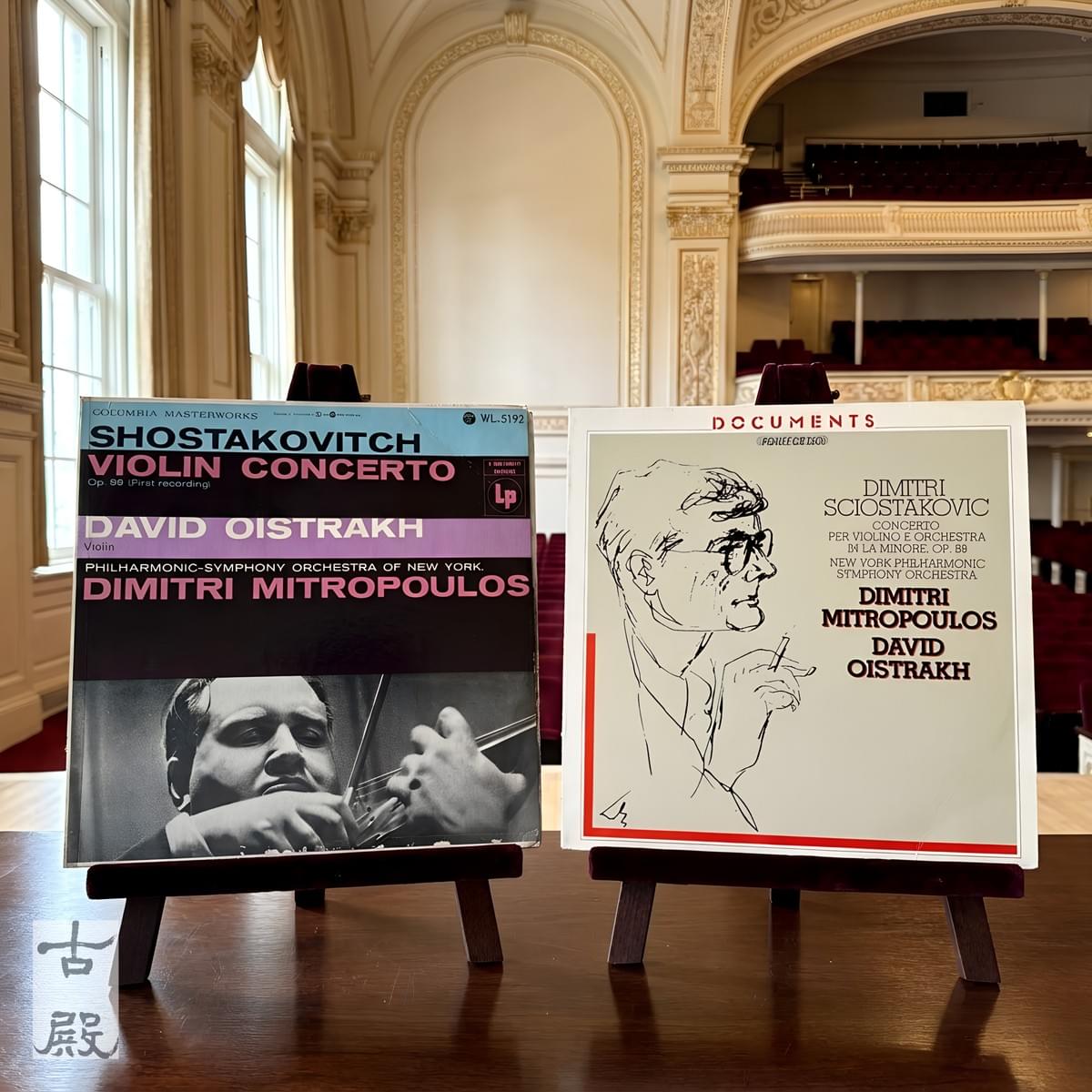
我的桌上,現在放著兩張唱片。一張記錄 1 月 1 日的音樂會,一張記錄 1 月 2 日的錄音。相隔不到二十四小時的兩份聲音,繞了地球大半圈,才在古殿會合。
1 月 2 日:美國COLUMBIA ML-5077(日本COLUMBIA WL-5192)
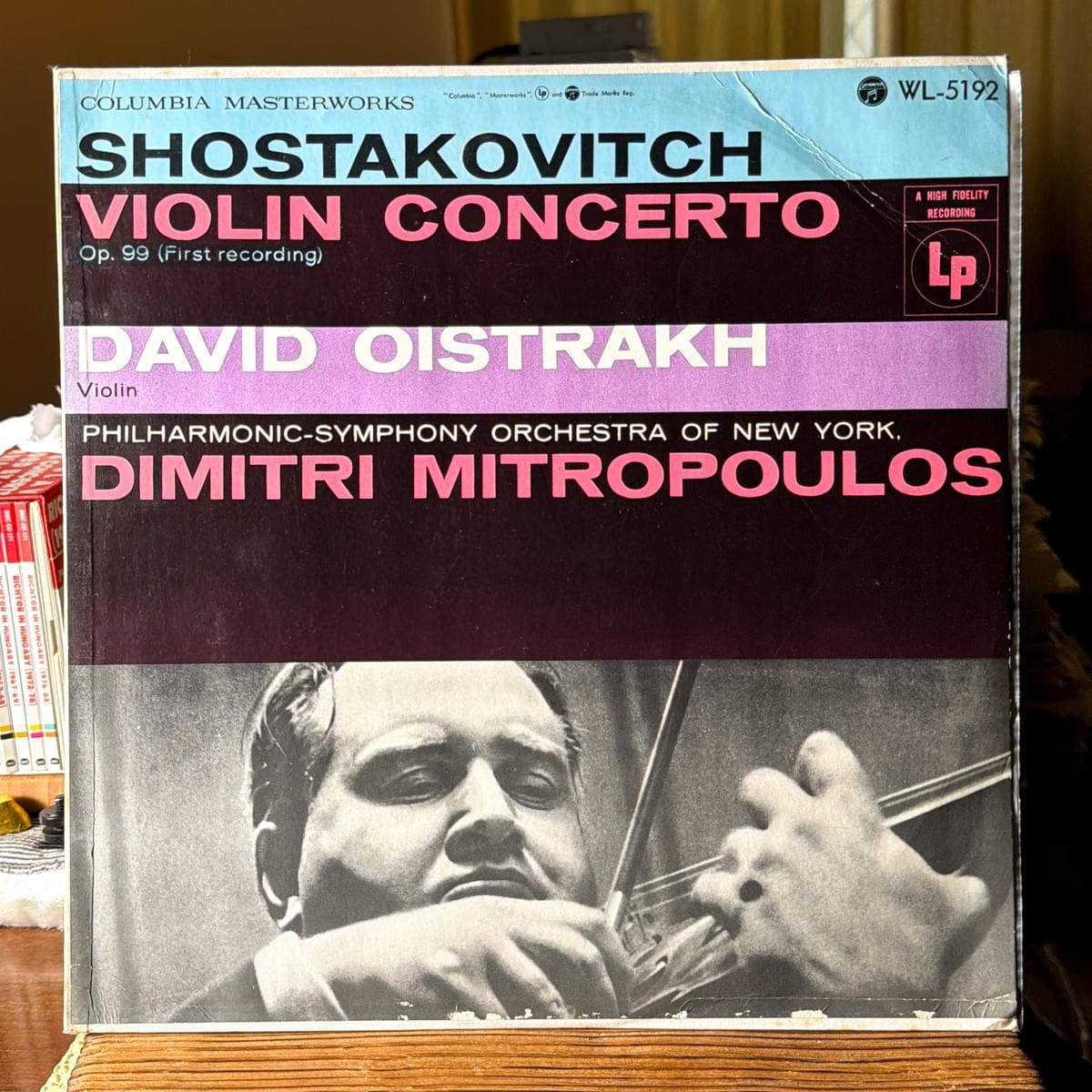
封面是 1950 年代哥倫比亞 Masterworks 的經典設計,淺藍、深紫、粉紅的色塊之下,是大歐低頭拉琴的黑白特寫。右上角印著「A High Fidelity Recording」,標題下方一行小字:First recording。1956 年這麼寫並沒有錯。直到後來列寧格勒首演的現場錄音被發掘出版(加拿大的St-Laurent Studio出版CD),今天更精確的說法,才成了「首次錄音室錄音」。
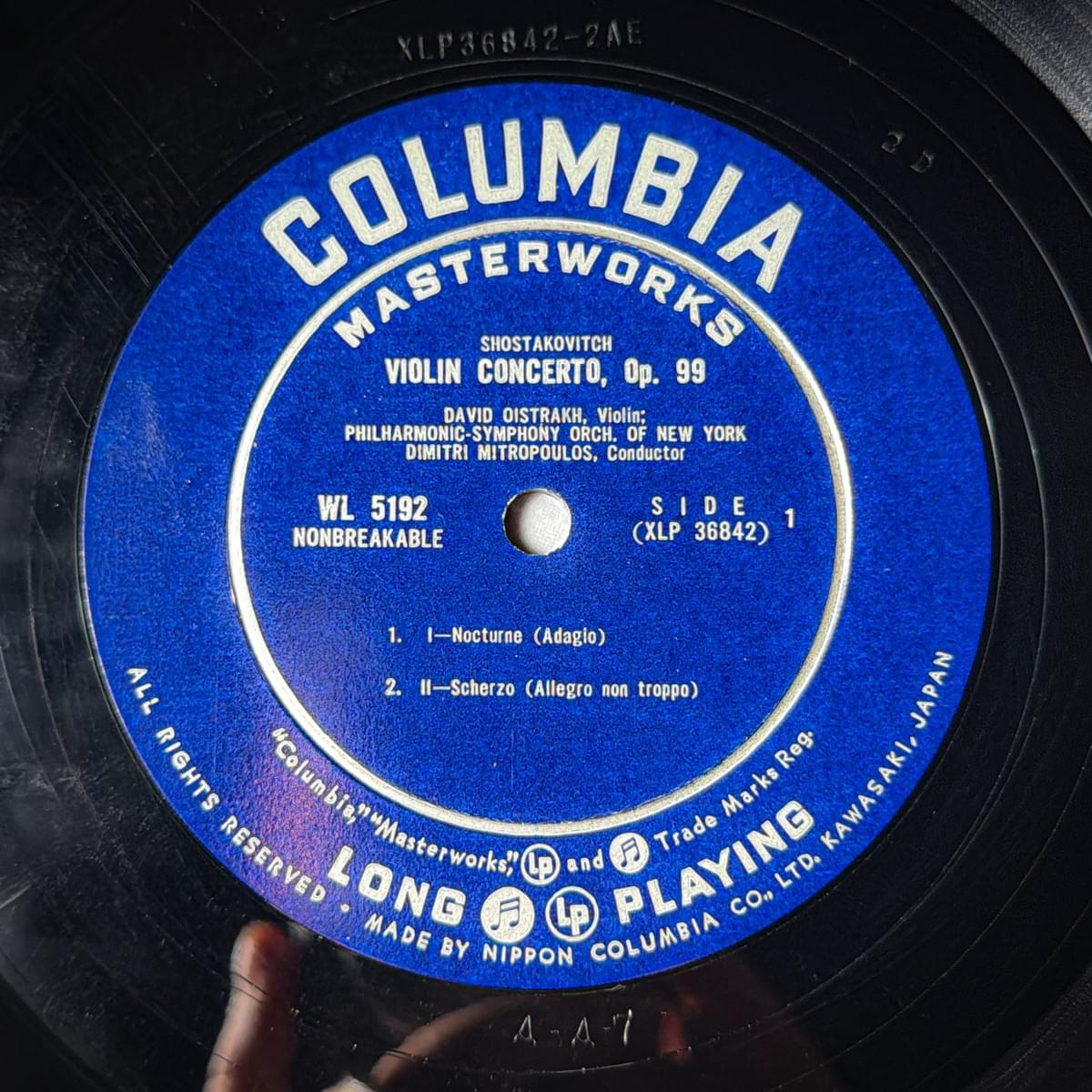
抽出唱片,是藍底銀字的 Masterworks 標籤,邊緣印著「MADE BY NIPPON COLUMBIA CO., LTD. KAWASAKI, JAPAN」。但它和美國哥倫比亞 ML 5077 是同一個版本,只是出版國不同:日本首版直接使用美國哥倫比亞提供的金屬母盤,在川崎壓製。溝尾刻著美國的矩陣號 XLP 36842 與 XLP 36843,A 面與美國早期首版是同一次刻片的兄弟盤。
封底是一整面日文長篇解說,前面提到的售票盛況、人牆、五呎六吋的身高、作曲家的電報,全都來自這裡。有趣的是,解說裡也留下了幾處錯誤:美國首演被寫成 12 月 31 日,大歐的生日被寫成 10 月 30 日。1956 年,資訊要越過太平洋才能抵達日本,這些錯誤本身,就是那段距離的痕跡。
一份整理大歐錄音的詳盡目錄,列出了這次錄音在美、英、荷等地的發行版本,卻沒有收錄這張日本版。它正好補上那份目錄的空白。
1 月 1 日:Fonit Cetra「Documents」DOC 6
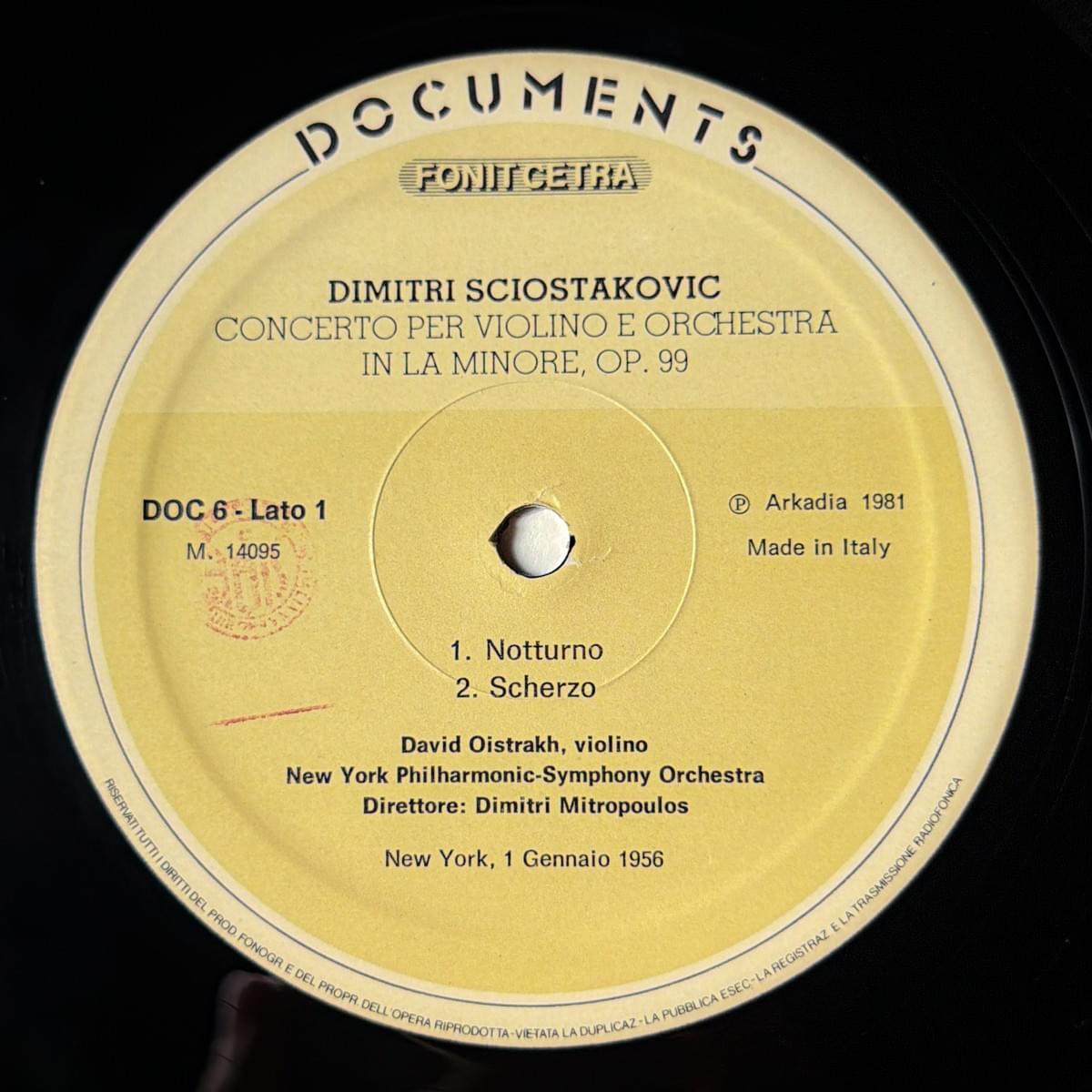
這一張晚了二十五年才誕生。1981 年,義大利 Fonit Cetra 在「Documents」系列中,把 1 月 1 日的廣播錄音壓成了唱片。至今,它仍是這場現場實況唯一的黑膠LP出版品;其餘只有兩份 CD:紐約愛樂 1997 年官方發行的廣播錄音套裝(NYP 9701),以及莫斯科音樂院的 SMC CD 0061。而聲音保存最完整的就是最早的黑膠LP版。
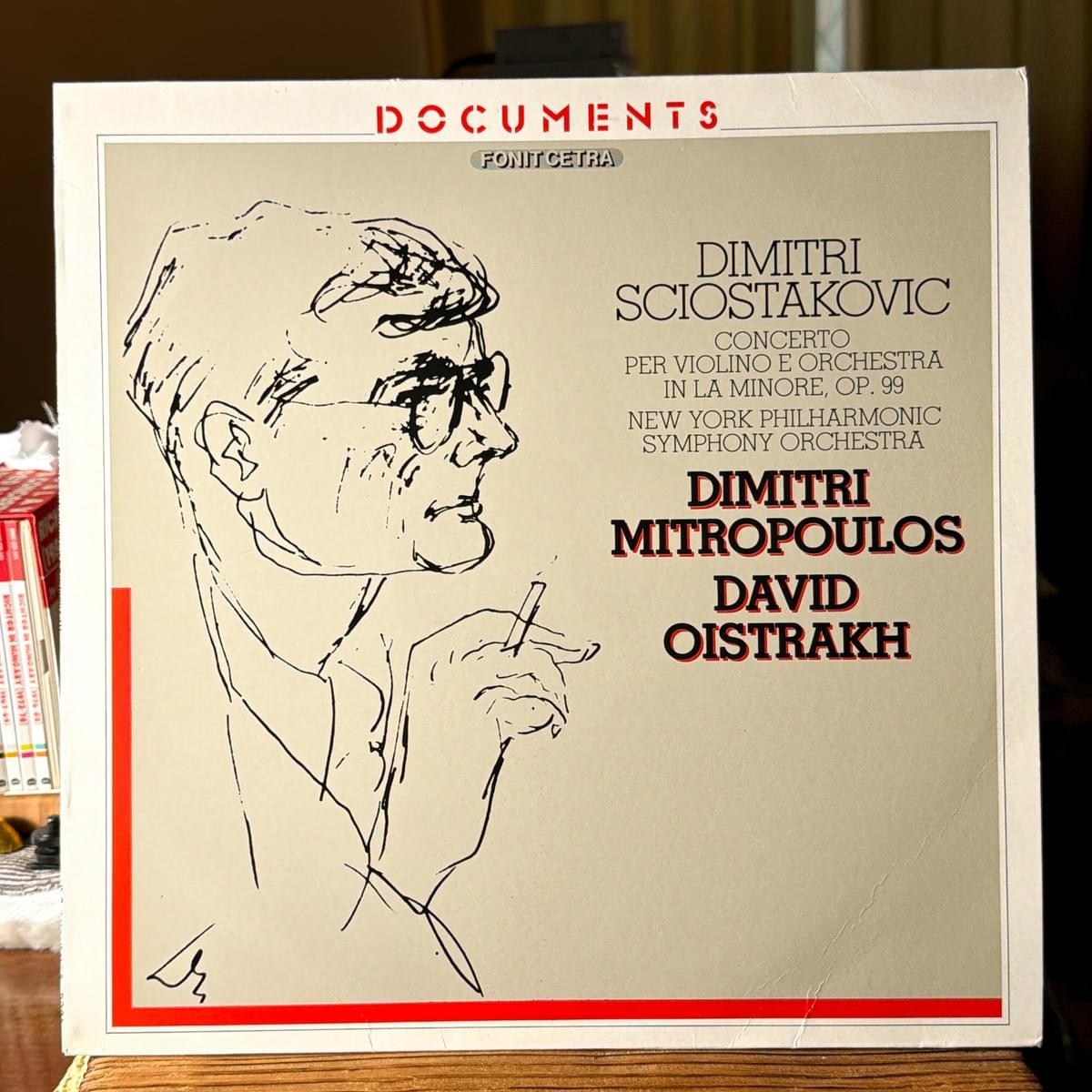
封面是由B.F.多爾賓(Benedikt Fred Dolbin,1883-1971)用鋼筆勾勒的蕭士塔高維契:側臉、圓框眼鏡、指間夾著一根菸。米黃色標籤上蓋著一枚紅色的 SIAE 印花,那是當年義大利唱片的著作權印記。
封底底部印著一句話,大意是:這些錄音的紀錄意義與藝術、歷史價值,應優先於技術音質。這是整個系列的宣言,也是這張唱片存在的理由。它不是最好聽的版本,卻是唯一能讓我們回到那個下午、那兩千七百個座位之間的版本。
根據大歐的錄音目錄,他一生留下十一份這首協奏曲的錄音。1 月 1 日這場是現存第二份錄音,僅次於列寧格勒首演,也是第一份在蘇聯境外留下的錄音。有樂迷認為,錄音室版已經很好,現場版還要更勝一籌。
******
【Gudian Music Stories】A Soviet Concerto Locked in a Drawer for Seven Years: Why Was It First Recorded in New York? David Oistrakh’s 1955 US Tour and Four Historic Days in New York with Shostakovich’s Violin Concerto No. 1
I. A Timeline That Defies Common Sense
October 29, 1955. Leningrad. A violin concerto by a Soviet composer finally receives its world premiere. Decades would pass before the live recording captured that evening was unearthed and released on CD by Canada’s St-Laurent Studio.
January 2, 1956. New York. The concerto enters a studio to be committed to vinyl for the very first time.
November 30, 1956. Leningrad. The composer’s homeland finally sets down its own first studio account.
Here was a Soviet masterwork born at the absolute apex of the Cold War, yet its maiden studio recording was completed not in Moscow, but in New York City—nearly a full year before the Soviet Union recorded it in a studio.
The composer was Dmitri Shostakovich (1906–1975). The man who carried the manuscript across the Iron Curtain was the work’s dedicatee, David Oistrakh (1908–1974), affectionately known to music lovers as "King David." And before that historic premiere took place, the score had languished locked inside a desk drawer for seven agonizing years.
How did such a timeline come to pass? The answer begins inside that very drawer.
II. Seven Years in a Drawer
Between 1947 and 1948, Shostakovich composed this concerto specifically for Oistrakh. As Italian musicologist Luigi Pestalozza (1928–2017) observed in his liner notes for Fonit Cetra: what truly brought this work into existence was the singular, monumental violin mastery of Oistrakh himself.
Yet, just as the composer set pen to paper, Andrei Zhdanov (1896–1948) unleashed his ideological purges against "formalism" across Soviet artistic life. Shostakovich was among the foremost figures denounced. By day, he sat through humiliating public sessions of criticism and forced self-examination; by night, returning home, he poured his soul into this concerto. He later recounted that the third movement—the devastating Passacaglia—was penned in the dark hours following those sickening, soul-crushing party assemblies.
The manuscript was finished, but it could not be heard. When Shostakovich entrusted the completed score to Oistrakh, he offered only a quiet, resigned remark to the effect of: You need not play this now.
And so, Oistrakh waited. He waited for seven long years.
Imagine an artist at the absolute zenith of his powers, holding a bespoke masterpiece crafted in his honor, forced to watch it collect dust in the dark. It was not until Joseph Stalin’s death in 1953 and the tentative onset of the "Thaw" that the work could finally step into the light. In October 1955, the piece was premiered in Leningrad by the Leningrad Philharmonic under the baton of Yevgeny Mravinsky (1903–1988).
Shortly after the final applause faded, Oistrakh packed his bags for the United States. Tucked securely inside his luggage was the concerto that had just broken free from seven years of confinement.
III. Autumn 1955: A Man Who Looked Like a Clerk
Until that tour, Oistrakh had been one of the very few supreme Soviet virtuosos who had never set foot on American soil. Yet his reputation had preceded him: travelers who had heard him live across post-war Europe and collectors who had spun his imported recordings had gradually nurtured an almost mythical anticipation.
The rear sleeve of the Japanese Columbia deep-groove first pressing preserves the fever pitch of the moment. (This Japanese first edition utilized original American Columbia metal stampers, arriving virtually in tandem with the US release.) His American debut recital was originally slated for October 13, but a sudden illness forced a postponement to November 20 at Carnegie Hall. When the announcement was made, advance tickets evaporated within two hours.
Oistrakh was initially scheduled to depart the United States on December 26. Demand, however, vastly overwhelmed the capacity of the hall. He was compelled to extend his visa and add three concerto appearances with the New York Philharmonic: December 29, December 30, and January 1, 1956. Carnegie Hall’s roughly 2,700 seats sold out instantly. The crush of desperate patrons was so intense that venue staff had to link arms, forming a human barricade to restrain the ticketless crowds outside.
What did the man at the epicenter of this cultural hurricane look like? The sleeve commentator painted a quiet portrait: five feet, six inches tall, bearing the unassuming demeanor of an ordinary office clerk. Maintaining a grueling itinerary of sixty concerts a year, averaging five appearances a month.
A Violin, and a Question That Could Not Be Answered
There is another historical detail that could never have made its way into Japanese liner notes in 1956.
The instrument Oistrakh carried on this historic American voyage was a 1719 Stradivarius. This violin had previously belonged to the German violinist Gustav Havemann (1882–1960), a figure with ties to the Nazi regime. When the Red Army took Berlin in 1945, the instrument was seized as war reparations, allocated to the Soviet State Collection, and subsequently entrusted to Oistrakh.
During an American press conference, an inquisitive journalist asked him about the pedigree of the violin in his hands. Oistrakh replied carefully: he did not know the instrument's name, nor was he familiar with its past history.
Here was an artist standing before microphones on the opposite side of the Iron Curtain, holding a physical object saturated with traumatic history he could not utter aloud. He chose silence. And it was this exact instrument that resounded across the Leningrad premiere, the New York premiere, and the historic recording sessions on both sides of the Atlantic.
IV. Four Days in New York: Three Concerts and One Recording Session
On the podium stood Greek-born maestro Dimitri Mitropoulos (1896–1960), then Music Director of the New York Philharmonic. Renowned for his photographic memory—often conducting sprawling modern scores entirely without music—Mitropoulos was the fiercest champion of contemporary composition in America. Just the previous season, he had introduced Shostakovich’s Symphony No. 10 to American audiences after receiving the score immediately following its Soviet premiere. Now, history was repeating itself.
- December 29, 1955 (Thursday): The American Premiere; the third performance of the work in history.
- December 30, 1955 (Friday): Second performance.
- January 1, 1956 (Sunday): Third performance, broadcast over live radio and captured off-air; this represents the second earliest surviving recording of the concerto, and the earliest recorded document made outside the Soviet Union.
- January 2, 1956 (Monday): The same artists convene in the studio for Columbia Records; yielding the work's very first studio recording.
The program notes for the premiere were authored by noted critic Irving Kolodin (1908–1988). He astutely observed that Shostakovich’s orchestration omitted trumpets and trombones, incorporating instead celesta, two harps, and xylophone—subtle hints that the composer sought an acoustic landscape of lightness, transparency, and biting irony. Wire reports published the following morning described thunderous applause, with the orchestra members themselves joining the standing ovation.
On the second night, December 30, an unexpected mishap occurred. Just as Oistrakh launched into the blistering final Burlesque, his E string snapped. Without missing a beat or stopping to replace it, he turned mid-phrase, swapped instruments with the assistant concertmaster Misha Rosenker (Michael Rosenker), and tore through the remainder of the ferocious finale on an unfamiliar violin.
That 1719 Stradivarius from Berlin was absent from the stage for only those few desperate minutes across four consecutive days in New York.
Within ninety-six hours, the concerto was mounted four times in Carnegie Hall. The final gathering, however, faced no audience—only hanging microphones. Producer David Oppenheim (1922–2007) and balance engineer Fred Plaut (1907–1985) etched the performance—honed across three consecutive concert performances—directly into the master tape. It stood as the world's maiden studio recording of Shostakovich's masterpiece.
Word of the successful session quickly crossed the ocean to Moscow. Shostakovich fired off a warm New Year's telegram to Oistrakh. Addressing him by his affectionate pet name, "Dodek," the composer extended his heartfelt holiday wishes to Oistrakh and his wife, asking him to convey his deepest gratitude to Mitropoulos and the musicians of the New York Philharmonic. The telegram closed with a warm, fraternal embrace.
A man who had written this score seven years earlier in the shadows of public humiliation was now, across half a planet, sending his gratitude to a roomful of American musicians.
V. One Masterpiece, Two Archival Trajectories
Resting on my turntable table today are two distinct phonograph records. One preserves the broadcast concert of January 1; the other captures the commercial studio session of January 2. Two performances separated by less than twenty-four hours, journeying across time to meet here at the Ancient Palace.
January 2: Columbia Masterworks ML 5077 (Japan Columbia WL-5192)
The jacket bears Columbia Masterworks' iconic 1950s design: bold, abstract color blocks in sky blue, deep violet, and muted magenta framing a stark, black-and-white close-up of Oistrakh leaning over his instrument in complete concentration. The upper right corner proudly proclaims "A High Fidelity Recording," while beneath the bold title sits a small line of text: First recording.
In 1956, that assertion was technically true. Only decades later, when the archival tape of the Leningrad premiere surfaced on CD via Canada’s St-Laurent Studio, did historical precision refine that claim to "first studio recording."
Withdrawing the vinyl from its sleeve reveals the classic deep-groove, blue-and-silver Masterworks label, its lower rim reading: “MADE BY NIPPON COLUMBIA CO., LTD. KAWASAKI, JAPAN.” Yet this Japanese first pressing is physically identical in sound to the original American ML 5077. It was pressed in Kawasaki using the original metal parts supplied directly by Columbia in New York. Inscribed in the dead wax are the original US matrix numbers: XLP 36842 and XLP 36843. Side A shares the exact lacquer cutting stamper as the earliest American copies.
The rear cover carries a comprehensive Japanese essay, from which the box-office pandemonium, the human barricades, Oistrakh’s five-foot-six stature, and the composer's telegram are documented. Interestingly, the notes contain minor factual errors characteristic of the era: the American premiere is misdated as December 31, and Oistrakh’s birthday is cited as October 30. In 1956, when news traveled across the Pacific by boat and cable, such slips were the inevitable footprints of physical distance.
Curiously, while standard discographies painstakingly document American, British, and Dutch pressings of this session, they routinely overlook this Japanese pressing. It fills a meaningful gap in that historical record.
January 1: Fonit Cetra "Documents" DOC 6
This document waited a quarter of a century to be born. In 1981, the Italian label Fonit Cetra pressed the live January 1 radio broadcast to vinyl within its celebrated historical line, "Documents." To this day, it remains the only release of this live performance on vinyl LP. Beyond this, only two CD releases exist: the 1997 New York Philharmonic archival broadcast box set (NYP 9701) and an issue from the Moscow Conservatory (SMC CD 0061). The earliest Italian vinyl edition remains the most tonally intact representation of the original broadcast signal.
The cover features an ink sketch of Shostakovich by artist B. F. Dolbin (Benedikt Fred Dolbin, 1883–1971): profile view, round wire-rimmed glasses, a smoldering cigarette held casually between his fingers. The cream label bears the red stamped SIAE seal—the hallmark of Italian copyright administration in that era.
Along the lower edge of the rear jacket is a printed manifesto: The documentary significance, artistic stature, and historical value of these recordings take precedence over technical audio perfection. That single line defines the purpose of the entire "Documents" series. It may not possess the pristine balance of a controlled studio environment, but it is the solitary acoustic portal capable of transporting us back into that hall on a Sunday afternoon, surrounded by 2,700 breathless listeners.
According to comprehensive discographies, Oistrakh recorded this concerto eleven times throughout his life. The January 1 concert stands as the second earliest performance preserved on tape—predated only by the Leningrad world premiere—and the very first recorded outside the Soviet Union. Many discerning listeners feel that while the studio version is magnificent, the live performance captured the day before burns with an even greater, unrepeatable electric intensity.