
【古殿唱片音樂故事】EMI歷史上的傳奇發燒錄音,歷久不衰的超級經典:普列文普列文(André Previn,1929-2019)與倫敦交響樂團的孟德爾頌《仲夏夜之夢》全曲版本
古殿殿主
一個告別的星期
如果我告訴你,有一張被全世界音響迷奉為「大考片」的古典唱片,裡面錄進了倫敦地鐵從音樂廳底下駛過的轟隆聲——錄音師沒有把它濾掉,唱片公司也沒有重錄——你大概會以為這是一張瑕疵品。
事實正好相反。這張唱片被美國《The Absolute Sound(TAS 絕對的聲音)》列入發燒榜,日本音響評論家嶋護把它寫進《古典名錄音106終極指南》,標題是:名曲、名演、名錄音三張王牌齊備的理想名盤。
而它誕生的那個星期,本身就是一個故事。
1976年12月4日,英國作曲家班傑明·布列頓(Benjamin Britten,1913-1976)辭世。三天後的12月7日晚上八點,安德烈·普列文(André Previn,1929-2019)帶領倫敦交響樂團,在倫敦皇家節日音樂廳演出孟德爾頌《仲夏夜之夢》全曲,把這場音樂會獻給布列頓——他寫過同名歌劇,也是普列文的朋友。
音樂會隔天,12月8日、9日,同一批人走進倫敦市中心一座叫金斯威廳(Kingsway Hall)的老禮拜堂,把這部關於夢、魔法與和解的音樂,錄了下來。
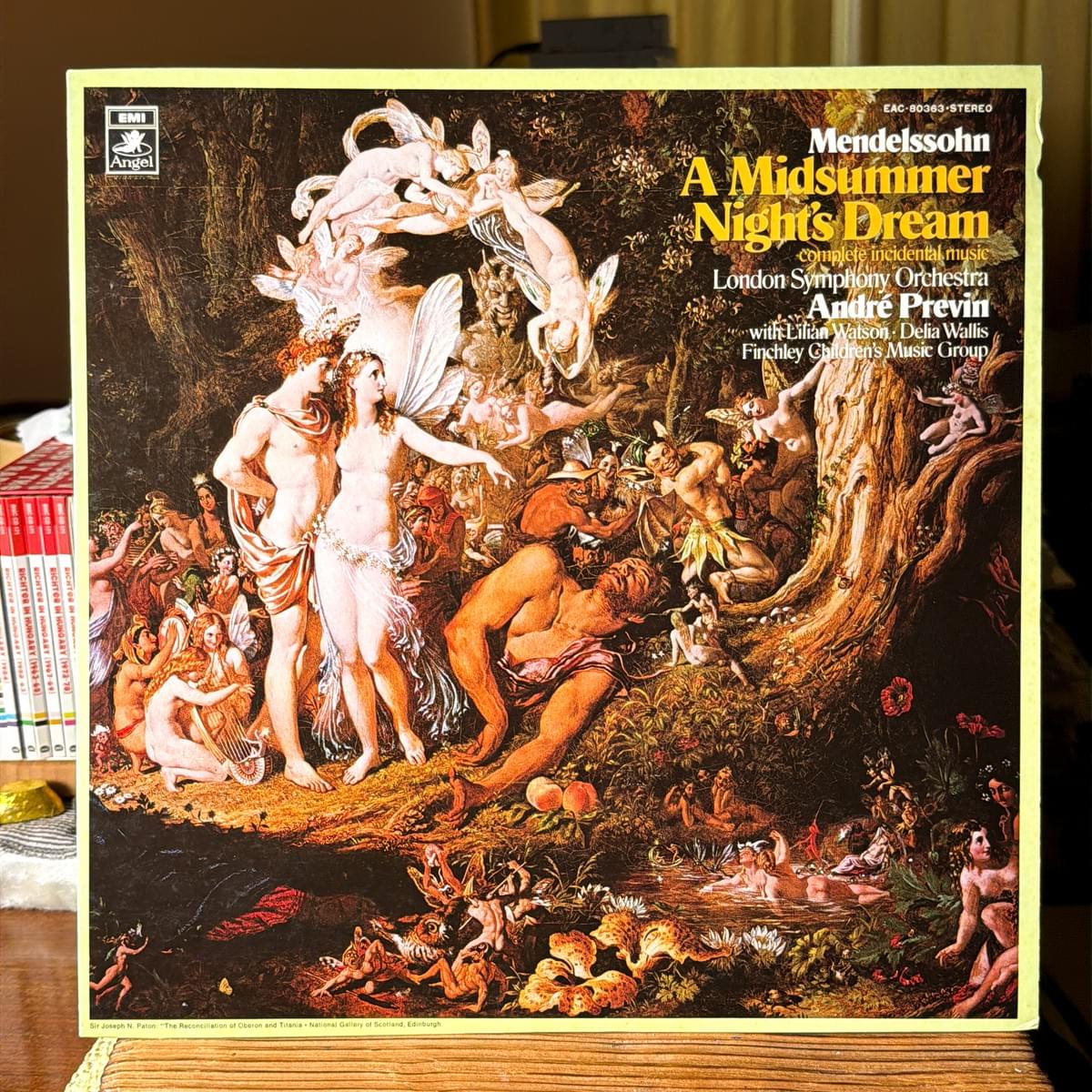
此刻我手上這張,唱片封面是維多利亞時代畫家帕頓的妖精畫,翻過來,紅色的Angel天使標籤上,小天使拿著羽毛筆坐在一張唱片上。四十多年了,那個告別的星期,還在溝槽裡。
一部橫跨17年的音樂
很多人以為《仲夏夜之夢》就是那首婚禮進行曲。但這張唱片收錄的,是一段跨越作曲家半生的對話。
費利克斯·孟德爾頌(Felix Mendelssohn,1809-1847),名字在拉丁文裡是「幸福的人」。祖父摩西·孟德爾頌(Moses Mendelssohn,1729-1786)是被稱為「德國蘇格拉底」的哲學家,父親是銀行家,母親能讀希臘原典。19世紀初,施萊格爾與蒂克合譯的莎士比亞德文版風靡德國,孟德爾頌一家人在餐桌旁輪流朗讀莎劇。姊姊芬妮·孟德爾頌(Fanny Mendelssohn,1805-1847)後來寫道:我們真的是在《仲夏夜之夢》裡長大的。
1826年,17歲的費利克斯寫下《仲夏夜之夢》序曲。開頭四個木管和弦,像有人輕輕推開一扇通往森林的門;接著弦樂以極弱的音量飛舞起來,那是妖精;後面還有低音銅管模仿的驢叫——劇中工匠波頓被施咒變成驢頭。
17年後的1843年,普魯士國王腓特烈·威廉四世(Friedrich Wilhelm IV,1795-1861)要在波茨坦上演這齣莎劇,委託已經34歲的孟德爾頌寫完整的劇樂。他新寫了13段音樂:輕巧的詼諧曲、法國號吟唱的夜曲、那首舉世皆知的婚禮進行曲、還有工匠演戲時荒腔走板的送葬進行曲。
最動人的是終曲。孟德爾頌把17歲時寫的序曲開頭原封不動嵌了進去,那四個魔法和弦,在全劇最後一刻再次響起。34歲的他沒有改寫少年的靈光,而是把它接住,為它畫上句點。
當年大多數唱片只收序曲、詼諧曲、夜曲、婚禮進行曲這幾首精選。普列文這張則收錄序曲與全部劇樂,讓聽者在一張LP上,完整聽完這段從17歲到34歲的旅程。
一位被質疑的指揮家
1976年的普列文47歲,是英國家喻戶曉的指揮家。但在古典樂界,他一直背著一個問號。
他1929年生於柏林的猶太家庭,九歲那年全家為了躲避納粹出走,最後落腳洛杉磯。少年時進入米高梅片廠做編曲、寫電影配樂,拿下四座奧斯卡;他也是出色的爵士鋼琴家。對許多古典樂評人來說,一個「好萊塢出身的人」指揮貝多芬、孟德爾頌,總讓人不放心。
可是他的指揮師承一點也不好萊塢。他在舊金山跟皮耶·蒙都(Pierre Monteux,1875-1964)學指揮——蒙都是史特拉汶斯基《春之祭》首演者,年輕時還曾在布拉姆斯面前拉中提琴。普列文與十九世紀德奧傳統之間,只隔一位老師。
1968年起,他出任倫敦交響樂團首席指揮,透過BBC電視節目把古典音樂帶進英國一般家庭。倫敦交響樂團是1904年由樂手自組、自己當股東的樂團,以臨場反應快、讀譜強著稱,管樂聲部尤其出色。唱片的解說引用樂界的一句話:論管樂手,世界上沒有樂團能與倫敦的樂團匹敵。
《仲夏夜之夢》正好是一部「管樂的作品」:詼諧曲的木管輕巧如風,夜曲裡法國號唱出森林深處的月光,巴松管偷偷幫工匠們扮鬼臉。普列文不把孟德爾頌演成厚重的德國交響曲,而是讓線條透明、讓節奏呼吸。
還有一件常被忽略的事:1976年秋天,普列文急病,取消了原定的華爾頓(William Walton,1902-1983)歌劇演出。12月7日那場布列頓紀念音樂會,是他病後恢復元氣的演出。《衛報》樂評家愛德華·格林菲爾德寫道,普列文提醒了大家,德國音樂不一定要沉重莊嚴才算正宗。
再加上兩位女聲獨唱——女高音莉莉安·華生(Lilian Watson)與女中音迪莉亞·華理斯(Delia Wallis,1946-)——以及一個大膽的選擇:用芬奇利兒童音樂團的童聲合唱,取代樂譜寫的女聲合唱。技巧不比專業女聲完美,但妖精那種中性、天真的神秘感,童聲才唱得出來。
錄音控制室裡的兩個克里斯多福
唱片封底有一行小字:Producer: Christopher Bishop/Balance Engineer: Christopher Parker。在1970年代的EMI,這兩個名字並列,幾乎就是品質保證。業界直接叫他們「Bishop & Parker」。
克里斯多福·畢夏普(Christopher Bishop,1931-) 是製作人。他在EMI錄過巴畢羅里(John Barbirolli,1899-1970)、朱里尼(Carlo Maria Giulini,1914-2005)、鮑爾特(Adrian Boult,1889-1983)、早期音樂先驅門羅(David Munrow,1942-1976),以及普列文的大量錄音。製作人的工作是坐在控制室裡,和指揮一起決定哪一段要重錄、哪一個速度最對,再把無數片段剪成一場完整的演出。
克里斯多福·帕克(Christopher Parker) 是錄音平衡工程師,也就是決定麥克風放哪裡、每支麥克風開多大的人。他原本是音樂老師,1951年進入EMI;1950年代末立體聲剛誕生時,他就在金斯威廳裡摸索立體聲麥克風該怎麼擺。同事在他過世時,只用一句話形容他的作品:誠實的錄音。
兩人的合作大約從1970年延續到1979年,那年畢夏普離開EMI,轉任愛樂管弦樂團總經理,團隊就此解散。這九年,剛好是EMI類比錄音最後的黃金十年。普列文的EMI錄音幾乎都出自他們之手:霍爾斯特《行星》、普羅高菲夫《羅密歐與茱麗葉》、布列頓《春之交響曲》,以及這張《仲夏夜之夢》。
嶋護在書中點出他們的優勢:EMI多年累積的多麥克風技術等新科技、金斯威廳這樣的好場地,再加上兩人獨有的美學與老手的經驗。他也提到普列文本身的功勞——承自蒙都的精準樂團控制,以及在電影片廠練出來、能有效率推進錄音進度的本事。
一位電影圈出身的指揮,遇上兩位從立體聲誕生就在現場的老手。 這是三個人都在最好狀態時的相遇。
同一座廳,兩種聽法
回到開頭的地鐵聲。
金斯威廳是一座衛理公會禮拜堂,圓頂讓它有溫暖豐厚的殘響,但倫敦地鐵剛好從它底下經過。EMI的前身HMV早在1925年就在這裡錄音,對手Decca則從1944年起加入,後來把它列為最常用的三大錄音場地之一,傳奇錄音師肯尼斯·威金斯(Kenneth Wilkinson,1912-2004)認為這是倫敦最好的錄音場地。
嶋護寫道,這張唱片裡不時闖入的地鐵震動,和Decca在同一場地的錄音一樣,是因為錄音時沒有切掉低頻。換句話說:他們寧可讓地鐵聲進來,也不願意為了乾淨,犧牲樂團最底層的低音與空間的重量。
同一座廳、同樣不切低頻,兩家公司錄出來的聲音卻截然不同。
1970年代的Decca,以「比現場更壯觀」聞名:用著名的Decca Tree麥克風陣列加上點麥克風,積極推展最高與最低的頻率,錄音人員還會逐小節重新平衡,把某個聲部「打光」拉到聽者面前。聽Decca,像坐在指揮台旁邊,每個細節都被放大。
Bishop & Parker的EMI走另一條路。帕克其實也用了很多麥克風——嶋護推測舞台前緣一排約五支主麥克風,全場加起來二十多支——但他把這些麥克風重新融合成一個整體,讓你聽到的是坐在音樂廳好位置上,樂團和空間一起呼吸的聲音。廳堂的殘響不是背景,而是樂團的一部分。
兩種聲音沒有高下,只是對「真實」的定義不同。Decca的真實,是把音樂放大到比現場更清楚;EMI的真實,是讓你相信自己就坐在那座廳裡。對殿主來說,後者特別珍貴:空間本身就是一件樂器,而這張唱片把一座如今已不存在的倫敦禮拜堂,連同它底下駛過的地鐵,一起保存了下來。
這句話不是比喻。EMI與Decca在金斯威廳的錄音合約,於1983年底到期;兩家公司都曾有機會買下這座廳,但EMI評估翻修費用太高而放棄。之後建築日漸破敗,儘管有音樂家與唱片雜誌出面請願,它仍在1998年被拆除,原址改建為一間同名的金斯威廳飯店(Kingsway Hall Hotel),2000年開幕。據記載,飯店的接待櫃台,大約就在當年樂團坐著錄音的位置。
今天走進那間飯店,你聽不到任何殘響。那座廳的聲音,只剩下溝槽裡這一份。
它拿到了什麼?
1977年,這份錄音以英國HMV ASD 3377首度發行,美國由Angel發行S-37268,日本則由東芝EMI發行EAC-80363。之後它從LP走到CD,又多次再版,近半世紀從未絕版。
它的地位,來自音樂與音響兩個圈子同時認可:
- 美國《The Absolute Sound》發燒榜:英國原版ASD 3377名列其中,成為全球音響迷追尋的示範級錄音。
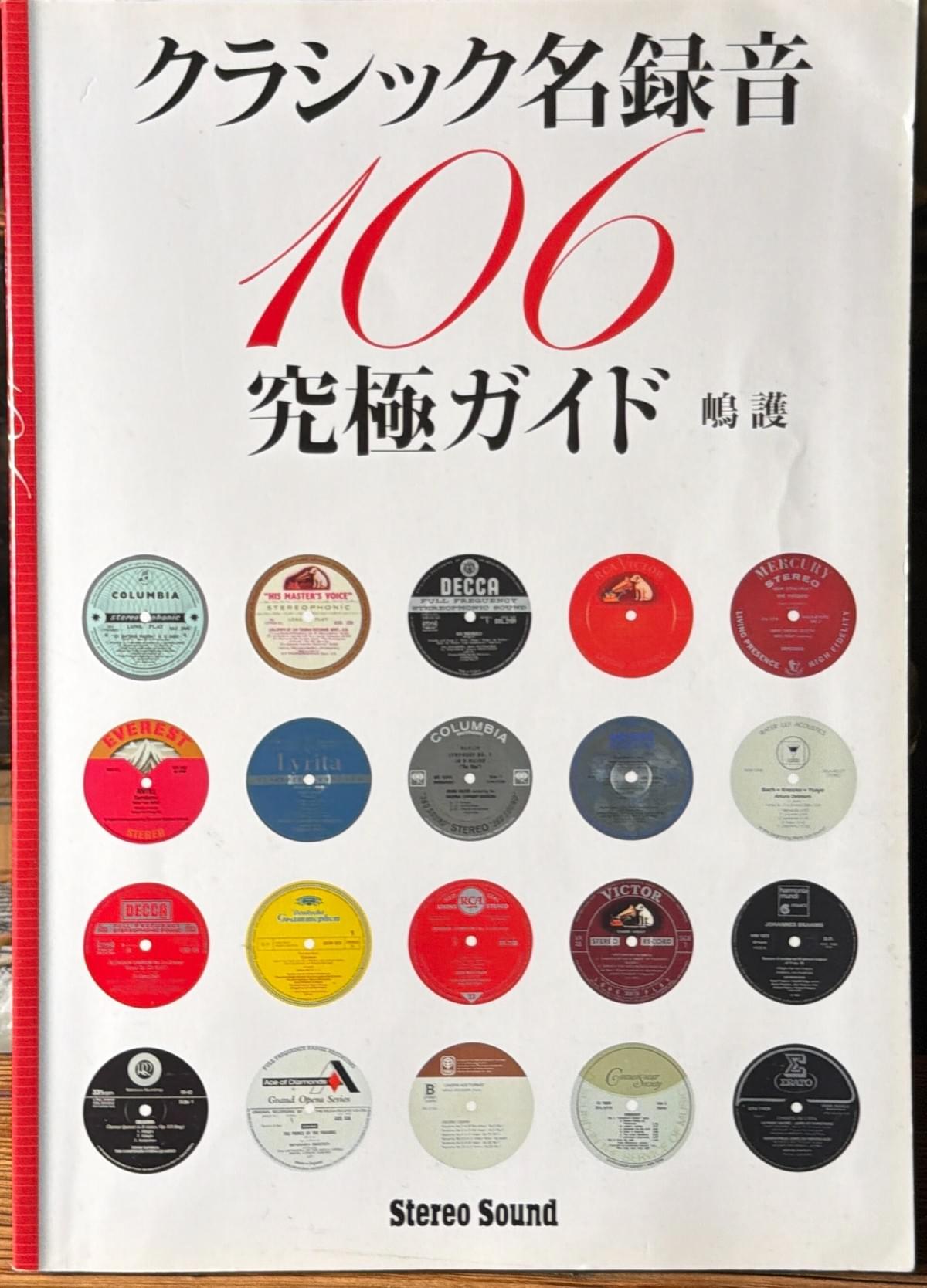
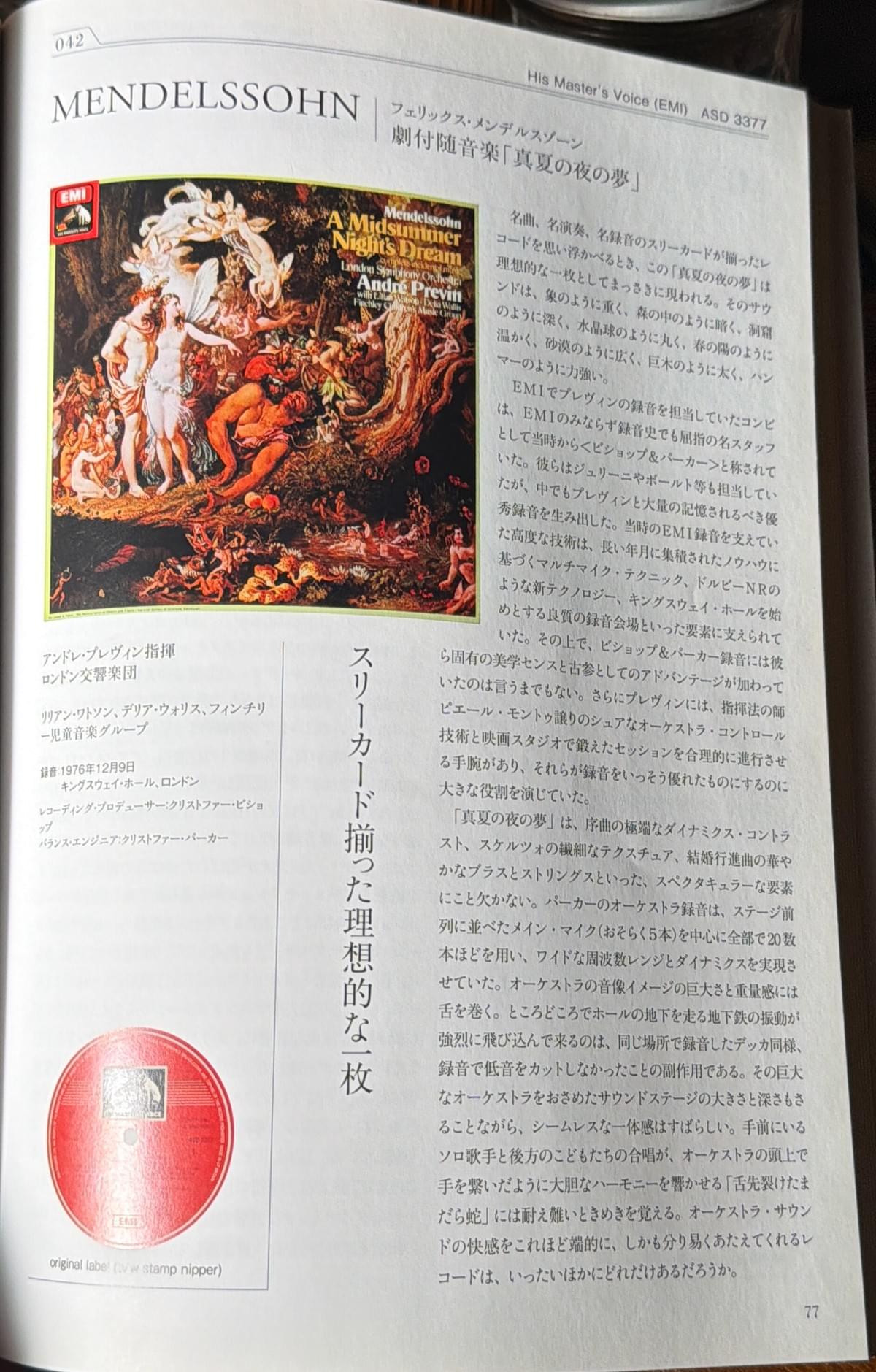
- 嶋護《古典名錄音106終極指南》第042篇:這本由Stereo Sound出版的書,是日本發燒圈的經典名盤清單。嶋護用一連串比喻形容它的聲音:像巨象般沉重、像森林般幽深、像水晶球般圓潤、像春陽般溫暖、像巨錘般有力。他特別點名〈你們這些斑點蛇〉——前方的獨唱與後方的童聲合唱,在樂團上方像手牽著手一樣交織出大膽的和聲。
- 台灣音響界的「大考片」:音響評論家劉漢盛在《劉漢盛精選100張鑒賞CD》中,把它當作檢驗音響的試金石。序曲開頭的弦樂細如蜂鳥振翅,緊接著是突然爆發的總奏;如果弱音聽不出變化、木管聽不出甜潤,他的結論很直接:問題在你的系統,不在錄音。
- 樂評的持續肯定:美國Classics Today評論CD再版時,特別稱讚序曲小提琴第一次進入時輕得驚人,卻每一條線都清晰可聞,而第一個強奏又展現巨大的動態範圍。
有趣的是,也有不少人第一次聽會覺得「這哪裡是好錄音?」——聲音太輕、太遠、不夠刺激。這恰恰說明了它的本質:它不是用來炫耀的錄音,而是一張需要好系統、也需要好耳朵的錄音。
市場也用價格投了票。在拍賣成交紀錄的資料裡,英國原版ASD 3377累積了五百多筆成交,品相良好的首版(黑色郵票狗)最高拍到約120至190英鎊,賣家標題幾乎都會打上「TAS」「1st」這兩個字。
日本東芝EMI的EAC-80363日本首版,長年被視為英國原版的平價替代:2012到2025年間,成交價多落在22到47美元之間。但就在2026年9月,一張標題寫著「TAS HP LIST」的日本首版,拍出了100美元,是過去紀錄的兩倍以上。這張日本首版仍長期被低估了:同一卷EMI母帶,日本壓片的膠質安靜,聲音的細節與密度都非常出色,潛力極高,日後的價格很可能還會再往上走。行情如何發展,時間會給答案;但可以確定的是,近五十年後,人們仍在為這張唱片出價。
為什麼將近五十年後,它仍然無可取代?
名曲、名演、名錄音——嶋護說的「三張王牌」,聽起來像一句宣傳詞。但仔細想,這三件事要同時成立,需要的條件今天幾乎不可能再湊齊。
第一,一個樂團在它的巔峰。 1970年代中期的倫敦交響樂團,在普列文手下處於最佳狀態;一年後,約翰·威廉斯(John Williams,1932-)就找他們錄下《星際大戰》的配樂。那一代管樂手的音色與默契,屬於那個時代。
第二,一個錄音團隊在它的巔峰。畢夏普&帕克(**Bishop & Parker)只合作了九年,而帕克的經驗,從1950年代末立體聲誕生的現場一路累積而來。1979年團隊解散;幾年後,數位錄音全面取代類比,金斯威廳的錄音合約在1983年底到期,1998年整座建築被拆除。場地、團隊、技術,三者同時消失了。
第三,一個有故事的時刻。 布列頓辭世、普列文病後復出、一場悼念音樂會的隔天。這些都不是錄音室能安排的東西,卻滲進了演奏的呼吸裡。普列文那種輕盈而不輕浮的處理,或許正是一種最英國式的告別:不哭泣,而是讓妖精在月光下再跳一次舞。
第四,它誠實,自然,直接。 它沒有為了讓人驚豔而放大細節,也沒有為了乾淨而切掉地鐵。它記錄的是1976年12月倫敦一座禮拜堂裡真實發生的事:樂團、童聲、殘響,以及底下駛過的列車。帕克的同事說他的錄音「誠實」,這兩個字,也是這張唱片能經得起近半世紀反覆聆聽的原因。
最後,還有作品本身給的啟示。34歲的孟德爾頌,把17歲的自己完整地留在終曲裡。好的錄音也是如此:它不是被新技術取代的舊檔案,而是一段被完整接住的時間。 技術會進步,但1976年12月那個星期,不會再有第二次。
最後:你願意讓地鐵聲留下來嗎?
如果這張唱片今天重錄,工程師一定會把那段地鐵聲濾掉,再把每個聲部修得乾乾淨淨。聲音會更「完美」,但那座禮拜堂的重量、那個告別的星期,也會一起被修掉。
所以我想把問題留給你:在你的生活裡,有沒有什麼東西,正是因為它不完美,才顯得真實? 你願意為了乾淨,切掉它嗎?
下次聽這張唱片,不妨把音量開得比平常稍大一些,在序曲開頭那幾個極弱的木管和弦之後,安靜地等。妖精飛起來的那一刻,也許你會聽見,1976年12月的倫敦,就在你的房間裡。
******
【Gudian Music Stories】A Legendary Audiophile Milestone in EMI History, an Enduring Super-Classic: André Previn (1929–2019) and the London Symphony Orchestra’s Complete Mendelssohn A Midsummer Night's Dream
A Week of Farewells
If I told you that an all-time reference recording—revered worldwide by audiophiles as a supreme trial disc—captured the low-frequency rumble of the London Underground running directly beneath the concert hall, and that the balance engineer never filtered it out, nor did the record company schedule a retake, you might assume it was a defective product.
The truth is precisely the opposite. This disc was enshrined on The Absolute Sound (TAS) Super LP List, and Japanese audio critic Mamoru Shima inducted it into his Ultimate Guide to 106 Classical Master Recordings under the definitive verdict: An ideal masterpiece uniting the three winning aces—a supreme work, a supreme performance, and a supreme recording.
The very week of its creation is a story in itself.
On December 4, 1976, British composer Benjamin Britten (1913–1976) passed away. Three nights later, at 8:00 PM on December 7, André Previn (1929–2019) led the London Symphony Orchestra in a complete performance of Felix Mendelssohn’s A Midsummer Night’s Dream at the Royal Festival Hall, dedicating the evening to Britten—who had composed an opera on the same Shakespearean play, and was a cherished personal friend.
The morning after the concert, on December 8 and 9, the exact same musicians walked into an old Methodist chapel in central London called Kingsway Hall. There, they committed this music of dreams, enchantment, and reconciliation to master tape.
The copy resting before me features Victorian painter Sir Joseph Noel Paton’s ethereal fairy canvas across the sleeve. On the reverse, the red Angel label displays the small angel seated on a record with a quill in hand. Nearly half a century on, that bittersweet week of farewells remains alive in the microgroove.
A Musical Dialogue Spanning Seventeen Years
Many listeners assume A Midsummer Night’s Dream consists merely of the ubiquitous Wedding March. In reality, this complete score documents an intimate dialogue spanning half a composer's lifetime.
Felix Mendelssohn (1809–1847) carried a name rooted in the Latin for "the fortunate one." His grandfather Moses Mendelssohn (1729–1786) was the revered philosopher known as the "German Socrates"; his father was a wealthy banker; his mother read ancient Greek in the original text. In early 19th-century Germany, the translation of Shakespeare by August Wilhelm Schlegel and Ludwig Tieck swept the cultural landscape. The Mendelssohn household gathered around the dining table to read Shakespeare’s plays aloud in rotation. His sister Fanny Mendelssohn (1805–1847) later reflected: We truly grew up inside "A Midsummer Night’s Dream."
In 1826, the seventeen-year-old Felix composed the Overture to A Midsummer Night’s Dream. Its four opening woodwind chords sound like someone gently pushing open a portal into an enchanted forest; then the strings dart forward in a hushed pianissimo—the fluttering wings of fairies; deeper in, the ophicleide and bass brass bray in mockery of the weaver Nick Bottom, cursed with the head of an ass.
Seventeen years later, in 1843, King Friedrich Wilhelm IV of Prussia (1795–1861) commissioned the thirty-four-year-old Mendelssohn to compose complete incidental music for a staging in Potsdam. He added thirteen new numbers: the airy Scherzo, the Nocturne with its singing solo French horn, the world-famous Wedding March, and the comic, unpolished Funeral March for the rustic mechanicals’ play.
The crowning touch rests in the Finale. Mendelssohn took the opening four woodwind chords of the overture written at seventeen and wove them verbatim into the conclusion of the entire drama. At thirty-four, rather than revising or modernizing the inspiration of his youth, he embraced it, letting it draw the final curtain.
Most standard LPs gathered only the familiar orchestral suite: Overture, Scherzo, Nocturne, and Wedding March. Previn’s recording includes the complete incidental music and vocal numbers alongside the overture, allowing the listener to travel the entire journey from seventeen to thirty-four on a single disc.
A Conductor Under Scrutiny
In 1976, André Previn was forty-seven years old and a household name across Great Britain. Yet within orthodox classical circles, he continued to face persistent skepticism.
Born in 1929 into a Jewish family in Berlin, he fled Nazi persecution with his family at age nine, eventually settling in Los Angeles. As a youth, he joined Metro-Goldwyn-Mayer as an arranger and film composer, winning four Academy Awards; he was also a brilliant jazz pianist. For many conservative classical critics, a musician "from Hollywood" conducting Beethoven or Mendelssohn was treated with wariness.
Yet his conducting pedigree was entirely divorced from Hollywood commercialism. In San Francisco, he studied conducting with Pierre Monteux (1875–1964)—the maestro who premiered Stravinsky’s The Rite of Spring and who, in his youth, had played the viola in the direct presence of Johannes Brahms. Between Previn and the Austro-German tradition of the 19th century stood only a single teacher.
In 1968, Previn was appointed Principal Conductor of the London Symphony Orchestra, bringing classical music into British living rooms through popular BBC broadcasts. Founded in 1904 as a self-governing cooperative where the players themselves served as shareholders, the LSO was famous for rapid sight-reading, spontaneous stage reflexes, and a peerless wind section. The liner notes quote an industry maxim: When it comes to orchestral wind players, no ensemble on earth rivals the London bands.
A Midsummer Night’s Dream is preeminently a woodwind and brass showcase: the flutes and clarinets in the Scherzo dart like breezes; the solo horn in the Nocturne invokes moonlight in the forest; the bassoons poke fun alongside the comic craftsmen. Previn avoids turning Mendelssohn into a heavy German symphonic monolith, keeping lines transparent and letting phrases breathe naturally.
There is another overlooked circumstance: in the autumn of 1976, Previn was stricken with sudden illness, forcing him to cancel scheduled performances of an opera by William Walton (1902–1983). The Britten memorial concert on December 7 marked his return to the podium after recovery. As The Guardian critic Edward Greenfield observed, Previn reminded everyone that German music need not be heavy and solemn to be authentic.
Add to this two vocal soloists—soprano Lilian Watson and mezzo-soprano Delia Wallis (b. 1946)—alongside a daring casting decision: engaging the Finchley Children’s Music Group instead of a conventional adult female choir. While their technique lacked the polished veneer of veteran opera singers, the choir brought an innocent, androgynous mystery that only children's voices could summon for Shakespeare’s woodland sprites.
Two Christophers at the Mixing Console
A small credit line appears on the rear sleeve: *Producer: Christopher Bishop / Balance Engineer: Christopher Parker.*Across EMI in the 1970s, those two names side by side were an absolute guarantee of sonic excellence. The industry simply knew them as "Bishop & Parker."
Christopher Bishop (b. 1931) was the producer. At EMI, he produced benchmark sessions for Sir John Barbirolli (1899–1970), Carlo Maria Giulini (1914–2005), Sir Adrian Boult (1889–1983), early music pioneer David Munrow (1942–1976), and a substantial portion of Previn’s recorded output. The producer's duty was to sit in the control booth, collaborating with the conductor to decide which take to preserve, which tempo served the architecture, and seamlessly assembling fragments into a living performance.
Christopher Parker was the balance engineer—the architect who determined microphone selection, physical placement, and level staging. Originally a music educator, he joined EMI in 1951; at the birth of commercial stereo in the late 1950s, he was already experimenting with stereo microphone arrays inside Kingsway Hall. Upon his passing, colleagues summarized his life’s work in two words: an honest recording.
Their creative partnership ran from roughly 1970 to 1979, dissolving when Bishop departed EMI to become General Manager of the Philharmonia Orchestra. Those nine years formed the final golden decade of EMI analog sound. Previn’s most enduring EMI recordings were cut by this duo: Holst’s The Planets, Prokofiev’s Romeo and Juliet, Britten’s Spring Symphony, and this very A Midsummer Night’s Dream.
In his book, Mamoru Shima identified their winning advantages: EMI’s mature multi-microphone techniques, the acoustic grandeur of Kingsway Hall, and the refined balance of two seasoned veterans. He highlighted Previn’s contributions—the orchestral discipline inherited from Monteux, paired with the efficiency honed on Hollywood scoring stages, keeping sessions moving with effortless momentum.
A conductor forged on film scoring stages meeting two recording veterans who had manned the consoles since the dawn of stereo: this was a confluence of three masters at their absolute peak.
One Historic Hall, Two Acoustic Philosophies
Let us return to the subway rumble.
Kingsway Hall was an active Methodist chapel whose high dome generated a warm, expansive natural reverberation. However, lines of the London Underground ran directly beneath its foundations. HMV (EMI's ancestor) had tracked recordings there as early as 1925; rival label Decca joined in 1944, eventually designating it one of their three primary London venues. Legendary Decca engineer Kenneth Wilkinson (1912–2004) considered Kingsway Hall the finest recording acoustic in London.
Mamoru Shima observed that the subway rumble bleeding into this recording—mirroring Decca’s own sessions in the venue—occurred because the engineering team refused to engage steep low-frequency high-pass filters. In other words: they chose to let the subway rumble remain rather than sacrifice the foundation of the orchestra and the physical weight of the hall's acoustic volume.
Yet inside the same hall, with neither team rolling off the bottom octaves, EMI and Decca achieved radically distinct sonic signatures.
In the 1970s, Decca was famous for an aesthetic described as "larger than life": employing the legendary Decca Tree flanked by outriggers and spot microphones, aggressively pushing the frequency extremes. Balance engineers would ride faders measure by measure, highlighting solo desks and thrusting specific choirs into the listener's lap. Listening to a classic Decca recording is like sitting inches from the conductor's podium, with every nuance magnified.
Bishop and Parker at EMI pursued an alternate aesthetic. Parker also deployed numerous microphones—Shima deduced roughly five main capsules across the stage apron, with over twenty transducers across the hall—yet he blended these inputs into an organic whole. The perspective is that of a patron seated in the prime row of the stalls, hearing the ensemble and the physical space breathe in harmony. The acoustic decay is not background noise; it is an active instrument of the orchestra.
Neither acoustic approach is superior; they simply embody two distinct definitions of fidelity. Decca’s reality brings details forward with hyper-realistic presence; EMI’s reality convinces you that you are sitting directly inside the room. To my mind, the latter carries rare value: the space itself functions as an acoustic instrument, preserving a now-lost London landmark alongside the subway cars passing beneath it.
This is literal history. The recording leases held by EMI and Decca on Kingsway Hall expired at the end of 1983. Both firms were offered the opportunity to purchase the site, but EMI deemed renovation and structural maintenance costs prohibitive. The building subsequently deteriorated. Despite petitions from prominent classical musicians and international record journals, Kingsway Hall was demolished in 1998. The property was redeveloped into the Kingsway Hall Hotel, opening in 2000. Archival blueprints indicate that the hotel reception desk sits roughly where the orchestra was once arranged for recording sessions.
Walk into that hotel lobby today, and the reverberation is entirely gone. The acoustic voice of Kingsway Hall survives only within the grooves of records like this.
Critical Acclaim and Market Reception
Released in the UK in 1977 on HMV ASD 3377, the album appeared in the United States on Angel S-37268 and in Japan on Toshiba-EMI EAC-80363. Migrating seamlessly from LP to CD, it has seen unbroken reissues and has remained continuously in print for half a century.
Its stature rests upon simultaneous reverence across both musical and audiophile communities:
- The Absolute Sound (TAS) Super LP List: The original UK HMV issue (ASD 3377) holds a coveted place on Harry Pearson's roster, serving as a worldwide reference disc.
- Entry No. 042 in Mamoru Shima’s Ultimate Guide to 106 Classical Master Recordings: In this guide published by Stereo Sound, Shima describes its sonics through vivid metaphors: heavy as an elephant, deep as an ancient forest, smooth as crystal, warm as spring sunlight, and powerful as a sledgehammer. He singled out "Ye spotted snakes"—noting how the front-stage soloists and the rear-stage children's choir intertwine above the orchestra like hands joined in bold harmony.
- The Ultimate "Trial Disc" in Audiophile Circles: Taiwanese critic Jack Liu featured it prominently in The Audio Art Top 100 CD Recommendations, treating it as a litmus test for stereo systems. The overture’s whispering string transients flutter like hummingbird wings, followed by explosive orchestral tuttis; if the low-level details lack dynamic nuance or the woodwinds sound brittle, Liu’s conclusion is uncompromising: the flaw lies in your playback chain, not in the recording.
- Enduring Critical Praise: Reviewing the CD transfer, Classics Today lauded the initial string entry in the overture—remarkably hushed, yet with every polyphonic strand distinct—followed by explosive dynamic reserve in the first full orchestral crescendo.
Curiously, many hearing it for the very first time on modest gear remark: "How is this an audiophile recording?" It sounds restrained, distant, and unhyped. That reaction reveals its nature: this is not a disc designed for cheap dynamic flash, but a recording that demands resolving playback gear and a discerning ear.
The market has confirmed its status. Auction registries document over five hundred confirmed sales of the original UK ASD 3377; clean first-label copies (the black-and-white "postage stamp" dog label) routinely realize between £120 and £190, with dealer listings almost universally highlighting "TAS" and "1st Pressing."
The Japanese first issue on Toshiba-EMI (EAC-80363) was long treated as an affordable alternative to the UK original, trading between $22 and $47 USD from 2012 through 2025. Yet in September 2026, a pristine Japanese first pressing carrying the designation "TAS HP LIST" realized $100 USD—more than doubling historic benchmarks. This Japanese issue has remained undervalued: cut from genuine EMI tape copies and pressed on quiet Japanese vinyl, its detail retrieval and dynamic density are exceptional, signaling further appreciation ahead. Market values will chart their own course; what remains certain is that nearly fifty years later, collectors continue to bid actively for its grooves.
Why It Remains Irreplaceable Nearly Fifty Years Later
A great work, a great performance, a great recording—Shima’s "three winning aces" sounds like commercial rhetoric. Yet examining the historical reality proves that uniting all three conditions is practically impossible to replicate today:
- An Orchestra at Its Peak: The mid-1970s London Symphony Orchestra stood at the summit of its technical and expressive powers under Previn; within a year, John Williams would engage these same musicians to record the score for Star Wars. The tonal signature and telepathic phrasing of that wind section belonged uniquely to that generation.
- An Engineering Team at Its Zenith: Bishop & Parker collaborated for just nine years, with Parker’s instincts accumulating since the late-1950s dawn of stereo. The team parted in 1979; within a few years, digital encoding displaced analog tape, Kingsway Hall’s recording lease expired in 1983, and the hall fell to wrecking balls in 1998. The venue, the team, and the analog technique vanished in unison.
- A Moment Steeped in Emotion: The death of Britten, Previn’s return to the podium following illness, and recording sessions commencing hours after a memorial concert. These elements cannot be manufactured by studio executives; they breathed directly into the performance. Previn’s buoyant, graceful phrasing was the quintessence of an understated British farewell: avoiding tears, choosing instead to let Shakespeare's fairies dance once more under the moon.
- Honest, Natural, and Unfiltered: The recording never hypes frequency extremes to generate artificial spectacle, nor does it cut the bottom octaves to hide the subway. It preserves what occurred inside a London church in December 1976: the orchestra, the children's voices, the natural room acoustic, and the trains rolling underground. Parker’s colleagues called his work "honest"—a virtue that explains why this recording rewards endless re-listening across half a century.
Finally, consider the score itself. At thirty-four, Mendelssohn preserved his seventeen-year-old self inside the finale. A great recording does the same: it is not obsolete data waiting to be displaced by higher sampling rates, but a living moment preserved intact. Technology marches forward, but that single week in December 1976 will never happen again.
Would You Keep the Sound of the Train?
Were this score to be recorded today, engineers would scrub the subway rumble with surgical software and tune every vocal track to sterile perfection. The result would sound cleaner, but the physical mass of the hall and the bittersweet week of farewells would be smoothed away with it.
I leave you with this question: in your own life, is there something that feels undeniably real precisely because it is imperfect? Would you strip it away simply for the sake of clinical neatness?
The next time you place this disc upon your turntable, try advancing the volume slightly beyond your usual setting. After those four hushed woodwind chords in the overture, wait in the quiet. The moment the fairies take flight, you may well discover that December 1976 in London is unfolding directly inside your room.