
【古殿唱片音樂故事】一個家族留下了上百張唱片,她自己的名字,只出現過幾次——相隔三十七年:柯岡夫人(Elisabeth Gilels, 1919–2008)的人生光華
古殿殿主
一個不對稱的數字
埃米爾·吉利爾斯(Emil Gilels,1916-1985),二十世紀最重要的蘇聯鋼琴家之一,錄音室與現場錄音加起來,數量超過上百張。
列奧尼德·柯岡(Leonid Kogan,1924-1982),他的妹夫,蘇聯小提琴學派最閃耀的代表之一,留下的錄音同樣以「百」為單位計算——RCA、Westminster、Melodiya,幾乎每個重要廠牌都有他的名字。
而這個家族裡的第三個人,一位四十多年職業生涯不間斷、與奧依斯特拉赫師出同門、十六歲就讓評審席動容的小提琴家,整個職業生涯裡,以她自己名字為主角發行的錄音:只有兩次。
第一次,是1938年,她十九歲那年,蘇聯國家唱片公司錄下她演奏帕格尼尼—威爾海密改編的《第一號小提琴協奏曲》,由亞歷山大·奧爾洛夫指揮,壓成78轉蟲膠唱片發行(編號5289-50)。
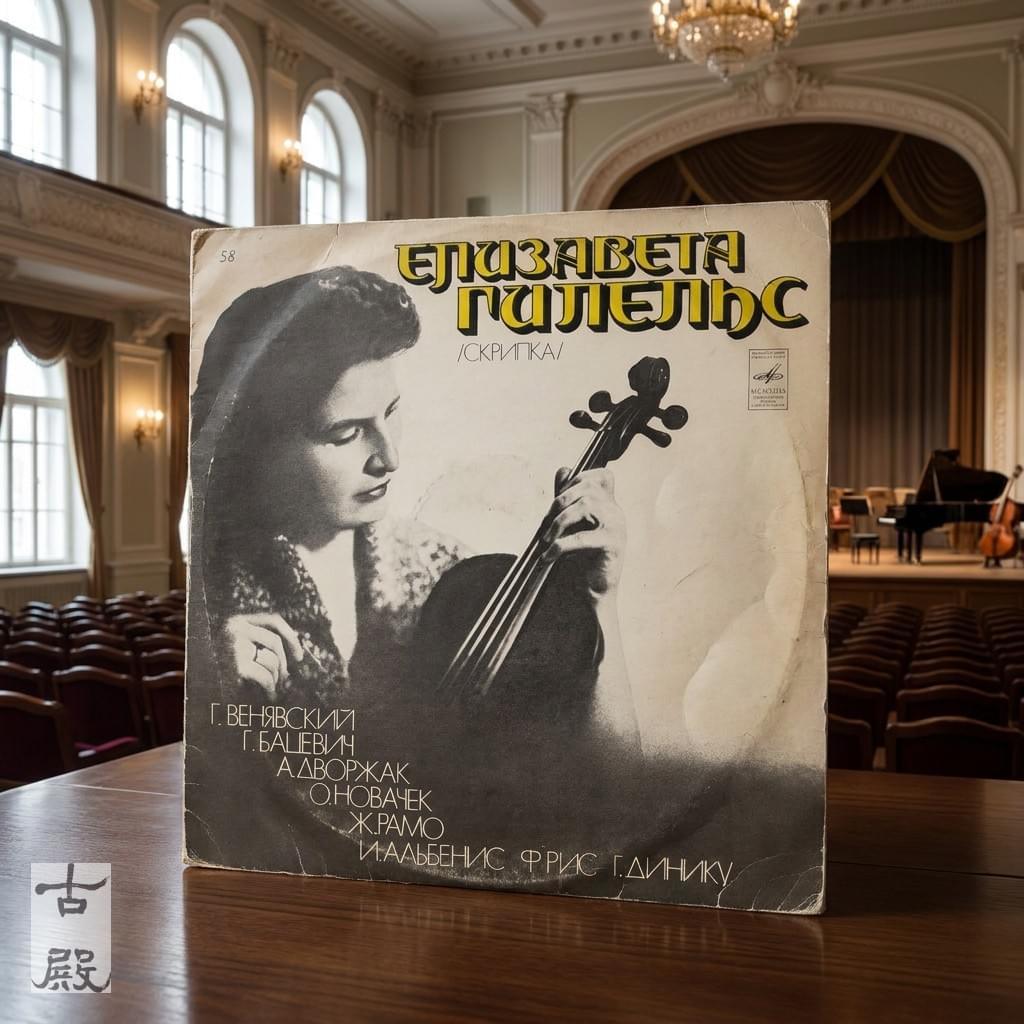
第二次,是將近四十年後,今天手上這張蘇聯藍標 Melodiya 黑膠專輯,編號 C10–08835。
中間這三十七年裡她沒有停止演奏——只是此後留下的每一份錄音,封面上印的都不再只是她一個人的名字,而是與丈夫、後來再加上兒子的合奏。
她叫伊莉莎白·吉利爾斯(Elisabeth Gilels, 1919–2008)。埃米爾·吉利爾斯的妹妹。列奧尼德·柯岡的妻子。
這兩個身份,幾十年來幾乎完全覆蓋了她自己的名字。
被遮蔽的,不是平庸,而是另一座高峰
如果伊莉莎白·吉利爾斯的演奏水準平庸,她被丈夫與哥哥的光芒蓋過,是再合理不過的事。
但事情完全不是如此。
她出生於烏克蘭敖德薩,那座二十世紀產出最多頂尖小提琴家的城市。教她的,是敖德薩小提琴學派的奠基者彼得·史托里亞爾斯基(Pyotr Stolyarsky,1871-1944)——大衛·奧依斯特拉赫(David Oistrakh,1908-1974)、納坦·米爾斯坦(Nathan Milstein,1904-1992),都出自他的門下。
1930年,史托里亞爾斯基把她帶到全烏克蘭音樂表演者大賽的評審席前。那一年贏得第一名的,是他另一個學生,奧依斯特拉赫。伊莉莎白因為年紀太小,連正式參賽資格都還沒有——但她的演奏,已經讓評審席留下深刻印象。
1936年,她進入莫斯科音樂學院,師從亞伯拉罕·揚波斯基(Abram Yampolsky,1890-1956),也是丈夫柯岡後來的老師。同一年,她去布魯塞爾參加伊薩伊國際大賽,拿下第三名,是那一屆所有蘇聯獲獎者裡第二年輕的(柯岡夫人當年是17歲,當時蘇聯代表還有一位更年輕是1922年出生的波里斯 戈德斯坦(Boris Goldstein,1922-1987),他當時只有14歲,獲得第四名)。
三十七年,兩張唱片
1940年,她以優異成績從莫斯科音樂學院畢業,成為莫斯科愛樂樂團的獨奏家。此後幾十年,她持續登台——協奏曲曲目橫跨莫札特、貝多芬、帕格尼尼、布拉姆斯、席曼諾夫斯基;與哥哥埃米爾的巡演,一路持續到1950年代初。
但在蘇聯龐大的國家唱片工業裡,她以自己名字單獨掛名的錄音,一生只有兩次。
第一次,1938年,她十九歲,蘇聯國家唱片公司把她詮釋的帕格尼尼《第一號小提琴協奏曲》(威爾海密改編版)壓成78轉蟲膠唱片,編號5289-50,指揮是亞歷山大·奧爾洛夫。那是她剛從莫斯科音樂學院起步、藝術生涯最早期的見證。
第二次,就是這張藍銀標 Melodiya。技術規格碼 ТУ-43.10.1.74,對應的是1974年版的蘇聯工業標準,搭配 Melodiya 在1975年7月後啟用的新編目系統(C10 開頭代表「古典音樂、30公分、立體聲」),可以推算這張唱片的壓製年代落在1975年之間——距離那張78轉蟲膠唱片,已經過了將近四十年。
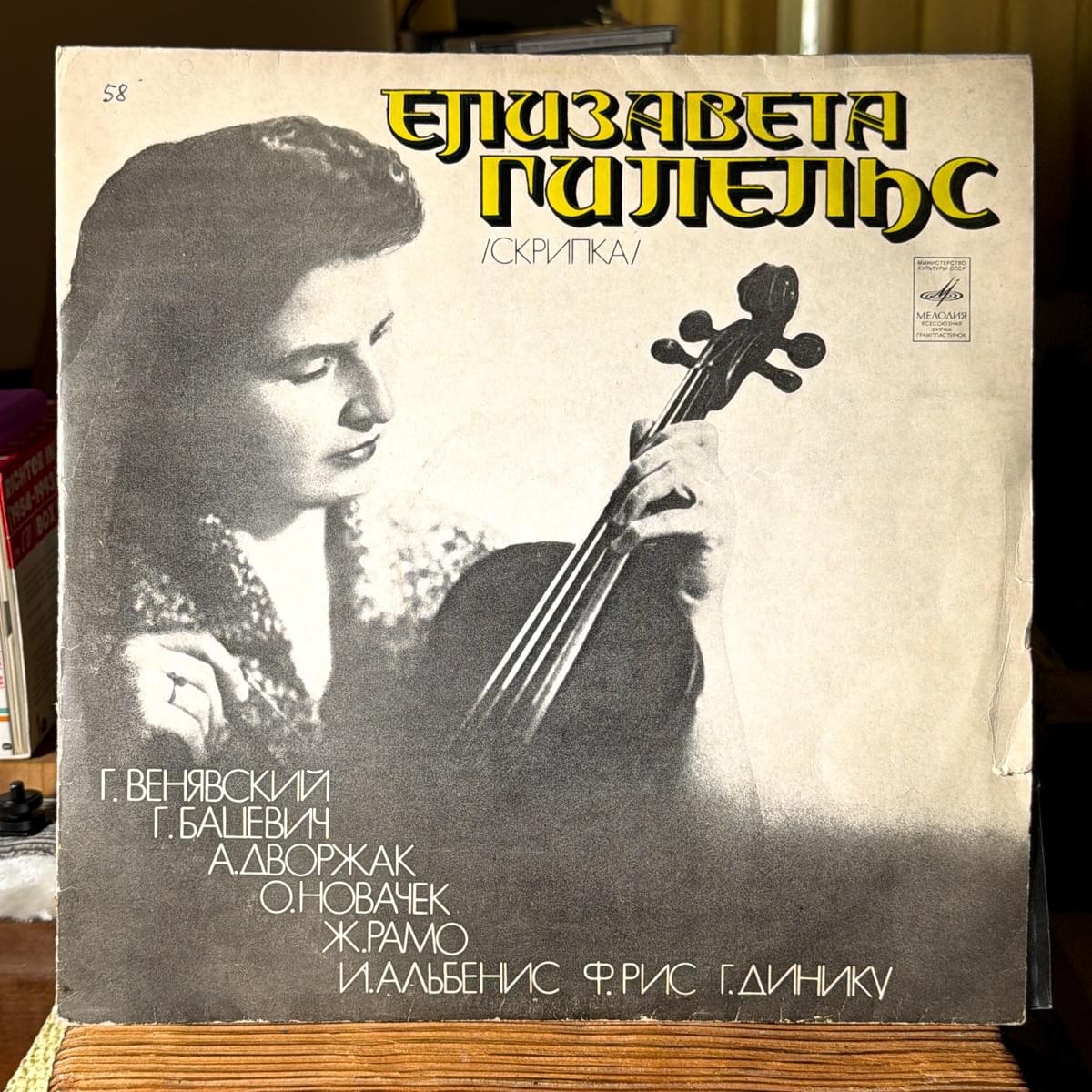
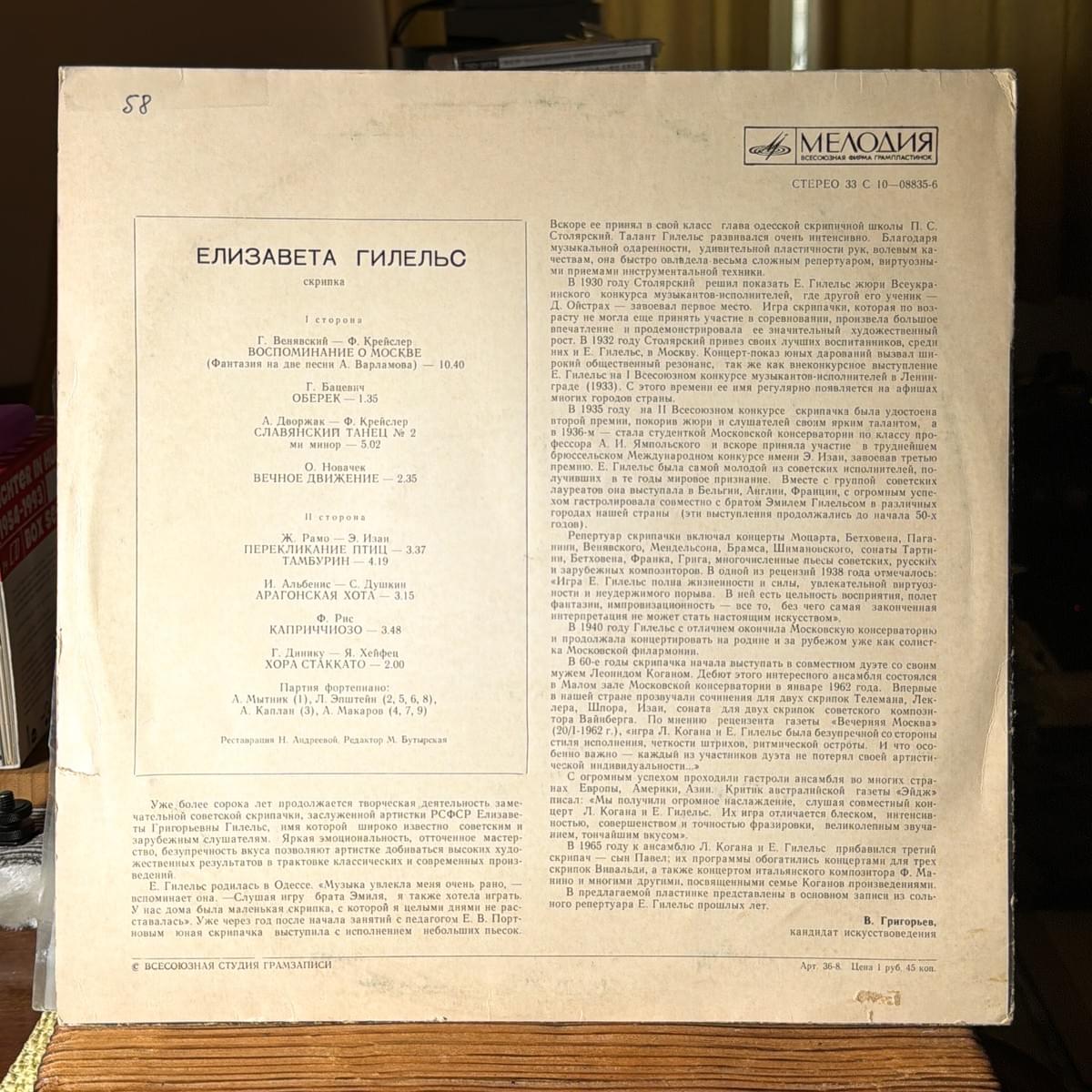
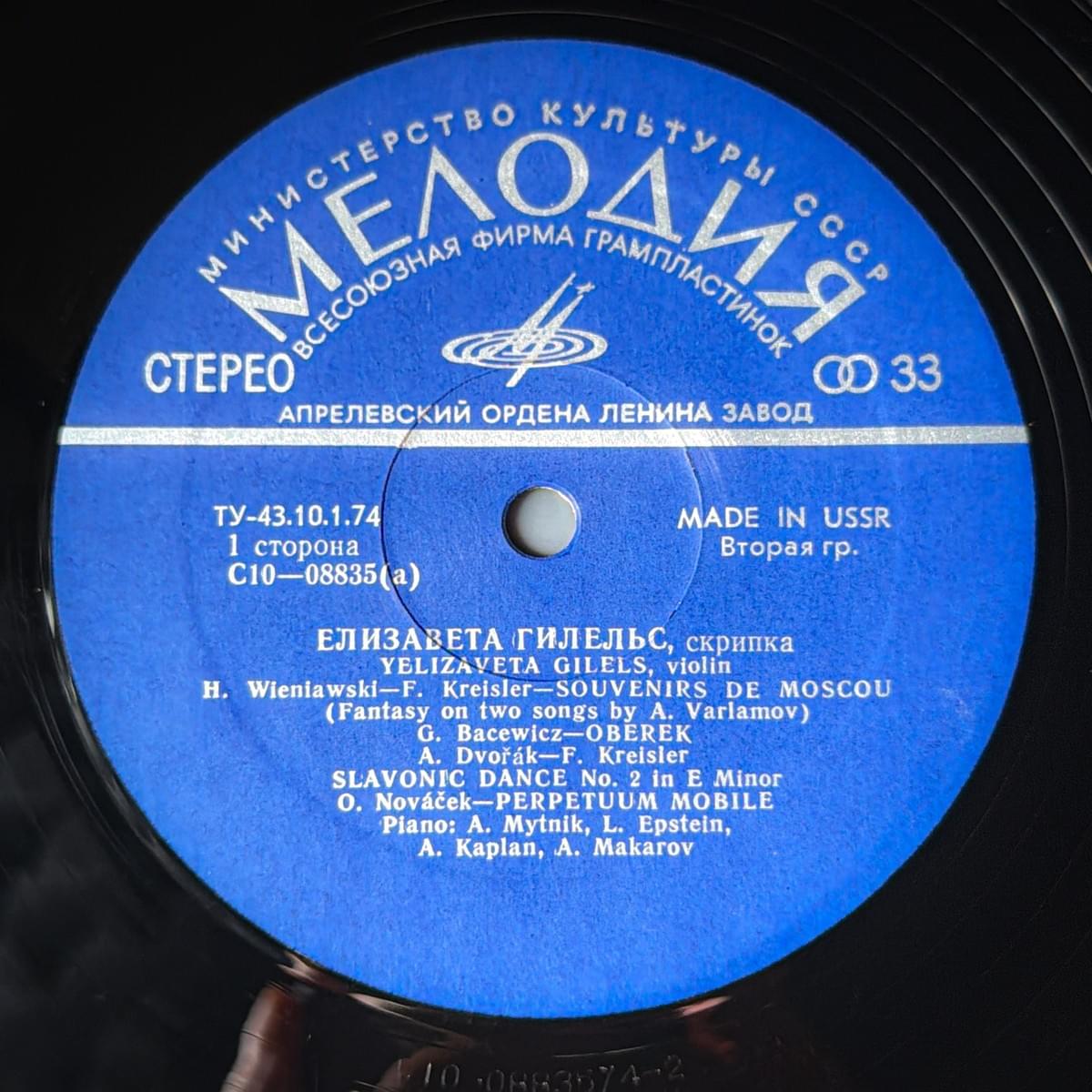
這三十七年之間,她不是沒有錄音——她與柯岡的二重奏、後來與兒子帕維爾(小柯岡)的三重奏,留下了相當數量的錄音。只是這些唱片的封面上,她的名字從來不是唯一一個。
換句話說:這張1975年前後的藍銀標 LP,是伊莉莎白·吉利爾斯一生中,唯一一張完整以她個人獨奏曲目構成的專輯——不是一首協奏曲的片段,而是一整張屬於她自己的選曲。
選曲裡藏著的一個小小反叛
A面收錄的維尼奧夫斯基—克萊斯勒《莫斯科的回憶》長達十分四十秒,是整張唱片份量最重的一首。B面則以海菲茲改編的迪尼庫《霍拉斷奏》收尾——一首以高難度撥奏與斷奏技巧聞名的炫技小品,向來是小提琴家展示自己的壓軸曲目。
但夾在中間的,有一首很容易被忽略、卻最值得停下來的曲子:巴采維奇的《奧貝雷克舞曲》。
葛拉辛娜·巴采維奇(G. Bacewic,1909-1969) ,二十世紀最重要的波蘭女性作曲家之一,《奧貝雷克(OBEREK)》是她自己於1949年在華沙首演的作品。在一張1970年代蘇聯官方唱片公司出版的專輯裡,收錄一位波蘭現代女性作曲家、風格遊走在新古典與現代主義邊緣、並非蘇聯官方美學主流的作品——這個選擇,非常特別。
我們無法確知這是誰的決定?但這首曲子留在這張唱片上,是一個值得關注的細節:在一個曲目選擇嚴格受到體制審視的年代,這位一生只留下兩次個人掛名錄音的小提琴家,把這唯一一張完整屬於自己的專輯裡,分出一小塊空間,留給了一位同樣不容易被體制重視的女性作曲家。
二重奏,三重奏,和那個始終排在後面的名字
1962年1月,伊莉莎白與丈夫柯岡在莫斯科音樂學院小音樂廳,首次以二重奏形式同台。這是蘇聯第一次演出泰勒曼、勒克萊爾、史波爾、易沙意的雙小提琴作品,也包括蘇聯作曲家魏因貝格特地為他們寫的雙小提琴奏鳴曲。
蘇聯《晚間莫斯科》新聞報紙的樂評寫道:兩人的演奏「在風格、弓法、節奏方面都無可挑剔——而特別重要的是,二重奏的每一位參與者都沒有失去自己的藝術個性」。
1965年,他們的兒子帕維爾加入,組成三重奏。一個家庭,三把琴。澳洲《時代報》的樂評形容他們的合奏「輝煌、熱情、完美的樂句處理」。
這個畫面很容易被講成一則溫馨的家庭故事。但換一個角度看:當柯岡的名字永遠排在海報最上方,當這個組合在歐洲、美洲、亞洲的巡演被冠以「柯岡與家人」之類的標題時,那個比他更早站上國際舞台、比他更早拿到布魯塞爾大賽獎項的女性,在敘事裡,慢慢退到了第二線。
她一直都安於擔任丈夫背後的賢內助,不搶任何風頭,安安靜靜地協助著他。
她活到2008年,比柯岡多活了二十六年。柯岡1982年去世後,她仍在莫斯科音樂學院繼續教書,直到晚年。那個在1937年讓布魯塞爾評審席動容的年輕女子,獨自又走完了人生的最後四分之一個世紀。
這張藍銀標唱片,值得被慢慢端詳的理由
手上這張 C10–08835,是目前市場上能找到的、最完整的伊莉莎白·吉利爾斯獨奏聲音紀錄之一。她留下的錄音本就稀少,在歐美市場幾乎無從取得,大多只存在於蘇聯國內發行的版本裡。
唱片每一道聲紋溝槽裡,刻著的不只是維尼奧夫斯基或迪尼庫的音符,還刻著一整套被遮蔽四十年才終於浮現的演奏生涯——史托里亞爾斯基的敖德薩教室、布魯塞爾評審席上的驚艷、與丈夫並肩卻始終站在第二排的舞台位置。
可能有人會問,如果妳的才華,足以跟世紀最頂尖的音樂家匹敵——但你的名字,終究被身邊更耀眼的兩個人覆蓋,這樣會不會太可惜了?
如果妳僅有一次完整屬於自己的機會,那妳會選擇留下什麼?
******
【Gudian Music Stories】A Family Left Behind Hundreds of Records, Yet Her Own Name Appeared Only a Handful of Times—Thirty-Seven Years Apart: The Radiant Life of Madame Kogan (Elisabeth Gilels, 1919–2008)
An Asymmetrical Set of Numbers
Emil Gilels (1916–1985), one of the most defining pianists of the 20th century, left behind a discography of studio and live recordings that easily numbers in the hundreds.
Leonid Kogan (1924–1982), his brother-in-law and one of the most brilliant representatives of the Soviet violin school, also left behind recordings counted by the "hundreds"—with RCA, Westminster, Melodiya, and virtually every other major label bearing his name.
Yet, the third person in this family—a violinist whose professional career spanned over forty uninterrupted years, who studied under the exact same master as David Oistrakh, and who deeply moved the jury panel at just sixteen years old—had only two releases throughout her entire career where she was the main protagonist.
The first was in 1938, when she was nineteen. The Soviet State Record Company recorded her performing the Paganini-Wilhelmj Violin Concerto No. 1, conducted by Aleksandr Orlov, pressed and released on a 78-rpm shellac record (Catalog No. 5289-50).
The second time was nearly forty years later. It is the very album I am holding in my hands today: a Soviet blue-label Melodiya vinyl, catalog number C10–08835.
During those thirty-seven intervening years, she never stopped playing. Yet, on every single recording she left behind, the name printed on the cover was no longer hers alone; it was always shared with her husband, and later, their son.
Her name was Elisabeth Gilels (1919–2008). Sister to Emil Gilels. Wife to Leonid Kogan.
For decades, these two identities almost completely overshadowed her own name.
What Was Obscured Was Not Mediocrity, But Another Peak
If Elisabeth Gilels’ playing had been mediocre, it would make perfect sense for her to be eclipsed by the blinding light of her brother and husband.
But that wasn't the case at all.
She was born in Odessa, Ukraine—the very city that produced the greatest number of top-tier violinists in the 20th century. Her teacher was Pyotr Stolyarsky (1871–1944), the founding father of the Odessa violin school, who also taught David Oistrakh (1908–1974) and Nathan Milstein (1904–1992).
In 1930, Stolyarsky brought her before the jury of the All-Ukrainian Music Performance Competition. That year, the first prize went to his other student, Oistrakh. Elisabeth was too young to even qualify as an official contestant—yet her playing left a profound, indelible impression on the judges.
In 1936, she entered the Moscow Conservatory to study under Abram Yampolsky (1890–1956), who would also become her husband Kogan's teacher. That same year, she traveled to Brussels for the Ysaÿe International Competition and took third place. She was the second youngest among all the Soviet prize-winners that year (Elisabeth was 17; the only younger Soviet representative was Boris Goldstein, born in 1922, who took fourth place at just 14 years old).
Thirty-Seven Years, Two Records
In 1940, she graduated with honors from the Moscow Conservatory and became a soloist with the Moscow Philharmonic Orchestra. For the next several decades, she continued to take the stage—her concerto repertoire spanning Mozart, Beethoven, Paganini, Brahms, and Szymanowski. Her concert tours with her brother, Emil, continued all the way into the early 1950s.
Yet, within the massive industrial complex of the Soviet state recording machinery, she was credited individually on a record only twice in her entire life.
The first, as mentioned, was in 1938. At nineteen, the Soviet State Record Company pressed her interpretation of Paganini's Violin Concerto No. 1 (Wilhelmj arrangement) onto a 78-rpm shellac, catalog number 5289-50, conducted by Aleksandr Orlov. It stands as a testament to the earliest dawn of her artistic journey, just as she was starting out from the Moscow Conservatory.
The second is this blue-and-silver label Melodiya. The technical specification code ТУ-43.10.1.74corresponds to the 1974 edition of the Soviet industrial standard. Combined with Melodiya's new cataloging system introduced after July 1975 (where the prefix "C10" denotes "Classical Music, 30cm, Stereo"), we can deduce that this record was pressed around 1975—nearly forty years after that initial 78-rpm shellac.
It wasn’t that she didn’t record anything during those thirty-seven years. Her duets with Kogan, and later her trios with their son Pavel (Kogan Jr.), left behind a considerable body of recorded work. It’s just that on the covers of those albums, her name was never the only one.
In other words, this blue-and-silver label LP from around 1975 is the only album in Elisabeth Gilels' entire life comprised completely of her own solo repertoire—not a snippet of a concerto, but an entire album of her own curated selections.
A Small Rebellion Hidden in the Repertoire
Side A features Wieniawski-Kreisler’s Souvenir de Moscou, lasting an impressive ten minutes and forty seconds, making it the heaviest piece on the album. Side B closes with Heifetz’s arrangement of Dinicu’s Hora Staccato—a virtuoso showpiece famous for its punishingly difficult pizzicato and staccato techniques, traditionally used by violinists as a grand finale to showcase their mastery.
Yet, sandwiched in the middle is a piece that is easy to overlook, but is precisely where we ought to pause: Grazyna Bacewicz’s Oberek.
Grazyna Bacewicz (1909–1969) was one of the most important Polish female composers of the 20th century, and Oberekwas a work she premiered herself in Warsaw in 1949. For an album published by the official Soviet state record label in the 1970s to include a piece by a modern Polish female composer—whose style hovered on the edge of neoclassicism and modernism, drifting far from the mainstream of official Soviet aesthetics—was a highly unusual choice.
We cannot know for sure whose decision this was. But the presence of this piece on the record is a detail worth noting: in an era when repertoire choices were strictly scrutinized by the system, this violinist, who only ever left two solo-credited recordings, carved out a small space in her only complete solo album for a fellow female composer who was equally marginalized by the establishment.
Duets, Trios, and the Name That Always Came Second
In January 1962, Elisabeth and her husband, Leonid Kogan, shared the stage as a duo for the first time at the Small Hall of the Moscow Conservatory. This marked the Soviet premiere of double violin works by Telemann, Leclair, Spohr, and Ysaÿe, and featured a sonata for two violins written specifically for them by Soviet composer Mieczysław Weinberg.
A music critic for the Soviet newspaper Vechernyaya Moskva (Evening Moscow) wrote that their performance was "impeccable in style, bowing, and rhythm—and what is particularly important, neither participant in the duet lost their own artistic individuality."
In 1965, their son Pavel joined them, forming a trio. One family, three violins. A critic for the Australian newspaper The Age described their ensemble playing as "brilliant, passionate, with flawless phrasing."
It is easy to paint this picture as a heartwarming family anecdote. But look at it from another angle: when Kogan's name was permanently placed at the very top of the playbills, and when this ensemble's tours across Europe, the Americas, and Asia were billed under titles like "Kogan and Family," the woman who had stepped onto the international stage earlier than him, and who had won a prize at the Brussels competition before him, gradually receded into the background of the narrative.
She was always content to be the supportive wife behind her husband, never stealing the spotlight, quietly assisting him.
She lived until 2008, outliving Kogan by twenty-six years. After Kogan passed away in 1982, she continued to teach at the Moscow Conservatory well into her later years. The young woman who had moved the Brussels jury back in 1937 walked the final quarter-century of her life entirely alone.
Why This Blue-and-Silver Label Record Deserves to Be Held and Contemplated Slowly
The a
lbum I have here, C10–08835, is one of the most complete audio documents of Elisabeth Gilels' solo playing available on the market today. Her recordings are inherently rare, virtually impossible to find in Western markets, and mostly exist only within pressings distributed inside the former Soviet Union.
In every groove of this record, what is etched is not just the notes of Wieniawski or Dinicu. It holds an entire performing career that was obscured for forty years before finally surfacing—the Odessa classroom of Stolyarsky, the awe she inspired on the Brussels jury bench, and a lifetime on stage standing shoulder-to-shoulder with her husband, yet always in the second row.
Some might ask: if your talent was enough to rival the absolute greatest musicians of the century—yet your name was ultimately covered by the two more dazzling figures beside you—isn't that a profound pity?
If you were given only one chance to have something truly your own, what would you choose to leave behind?