
【古殿唱片音樂故事】納粹驅逐了他們,英國關押了他們,德國人為他們起立——阿瑪迪斯弦樂四重奏誕生最初幾年的聲音
古殿殿主
1950年,德國漢堡。
演奏結束的瞬間,全場站了起來。
台下的德國聽眾知道台上的人是誰。三個維也納猶太人,1938年被納粹從奧地利驅逐,後來輾轉抵達英國,又被英國以「敵國外僑」的身份關進拘留營。然後戰爭結束,他們組成了一個弦樂四重奏,在1950年走進這個戰敗不到五年的德國城市,演奏莫扎特。
他們本來是沒有義務來的。
阿瑪迪斯弦樂四重奏的第一小提琴手諾伯特 布雷寧(Norbert Brainin,1923-2005)後來說,那個夜晚的反應之所以如此強烈,正是因為聽眾知道他們的身份——那裡有一個機會,一個透過藝術表達追求和平的機會。台上的人,是被迫害過的人,但他們卻選擇用音樂來表達願意和解。
他們選擇了一件當時沒有義務要做的事
先
把時間退回1938年。
德軍開入維也納那一天,三個猶太少年的命運永久改變了。諾伯特 布雷寧(Norbert Brainin)、西格蒙德 尼賽爾(Siegmund Nissel,1922-2008)、彼得 席多夫(Peter Schidlof,1922-1987)先後出逃,輾轉抵達英國。但英國當時視所有持有德奧護照者為潛在威脅,怕他們是特務,於是他們又以「敵國外僑」(enemy aliens)的身份被關進拘留營——逃離納粹的人,在盟軍這邊同樣被圍困。
布雷寧和席多夫正是在拘留營裡相識。席多夫又在那裡遇到了尼賽爾。三個流亡者,在鐵絲網後面,繼續練琴。
後來幫助他們獲釋的,是鋼琴家蜜拉海絲夫人(Dame Myra Hess,1890-1965)和作曲家佛漢 威廉斯(Ralph Vaughan Williams,1872-1958)——兩位英國音樂界核心人物,用聲望為三個奧地利猶太難民擔保。獲釋後,三人共同師事小提琴教育家馬克斯 羅斯塔(Max Rostal,1905-1991),羅斯塔免費幫他們授課。
後來英國大提琴家馬丁 洛維特(Martin Lovett,1927-2020)加入,四人組成了這個後來稱為「阿瑪迪斯弦樂四重奏(Amadeus String Quartet)」的組合。
1948年1月10日,他們在倫敦威格莫爾音樂廳(Wigmore Hall)正式首演。
兩年後,1950年,他們去了漢堡。
非常違背常理。二戰結束後數年,許多猶太音樂家拒絕踏上德國的土地,這是一個完全可以理解、在道德上無可指責的立場。他們沒有義務去德國演奏。但他們去了。
而且他們帶去的,不是憤怒,不是指控,是莫扎特。
英國樂壇給了他們一個親暱的綽號「Wolf-Gang」——因為這三個維也納人的藝術根源,正是 Wolfgang Amadeus Mozart 和他那個傳統的血脈深處。
Deutsche Grammophon 為什麼找上他們?
19
51年,Deutsche Grammophon(德意志留聲機公司) 正面臨一個問題。
他們需要一個世界級的弦樂四重奏合作夥伴。但戰時的德國音樂界,許多知名樂手都有程度不等跟納粹體制合作的污點紀錄——有些是主動配合,有些是沉默接受。但DG需要的,是一個在藝術上可以代表德國音樂傳統,而在道德上完全未被那段歷史汙染的組合。
阿瑪迪斯,則是一個沒有灰色地帶的答案。
他們是那個體制的受害者。他們被迫離開了維也納,在英國建立了自己的聲音,然後選擇回到德國演奏——因為他們相信音樂可以做到政治做不到的事。1950年漢堡的那場演出,證明了這一點。
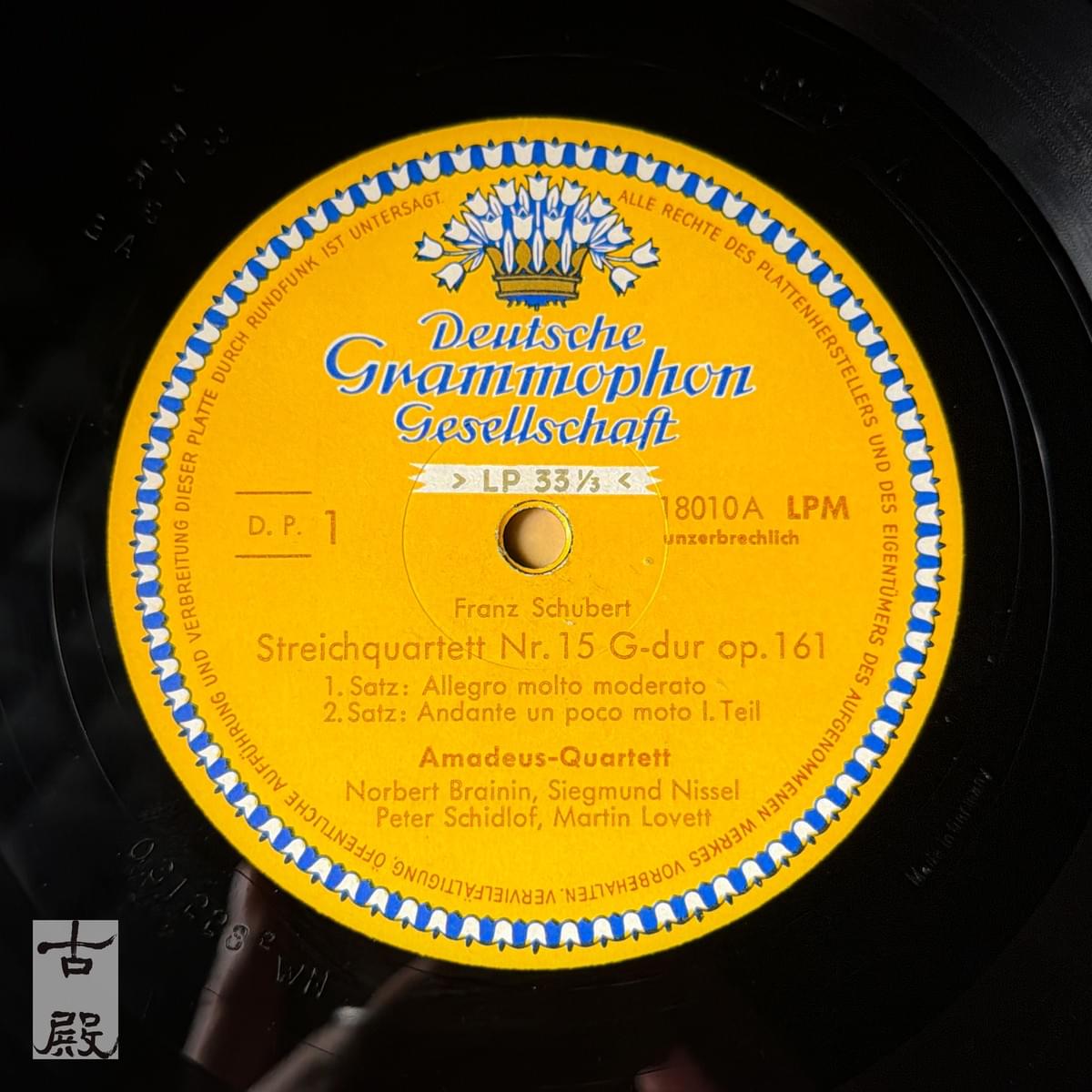
1951年9月,阿瑪迪斯來到漢諾威,走進 DG 的錄音室,錄下了這張舒伯特G大調第15號弦樂四重奏D887。這是他們與DG合作史上現知最早的正式商業出版錄音之一。之後的36年裡,他們為DG留下超過上百張的錄音,成為二十世紀最重要的室內樂錄音合作關係之一。
那張黃色的鬱金香標籤——DG 在1949年設計師 Hans Domizlaff 重新設計後的新品牌視覺——是 DG 進入 LP 時代後最初的出版物之一。而阿瑪迪斯,就在這個最初的時刻裡。
三張唱片,同一年的三個瞬間
今天桌
上這三張黑膠,都是1951年。
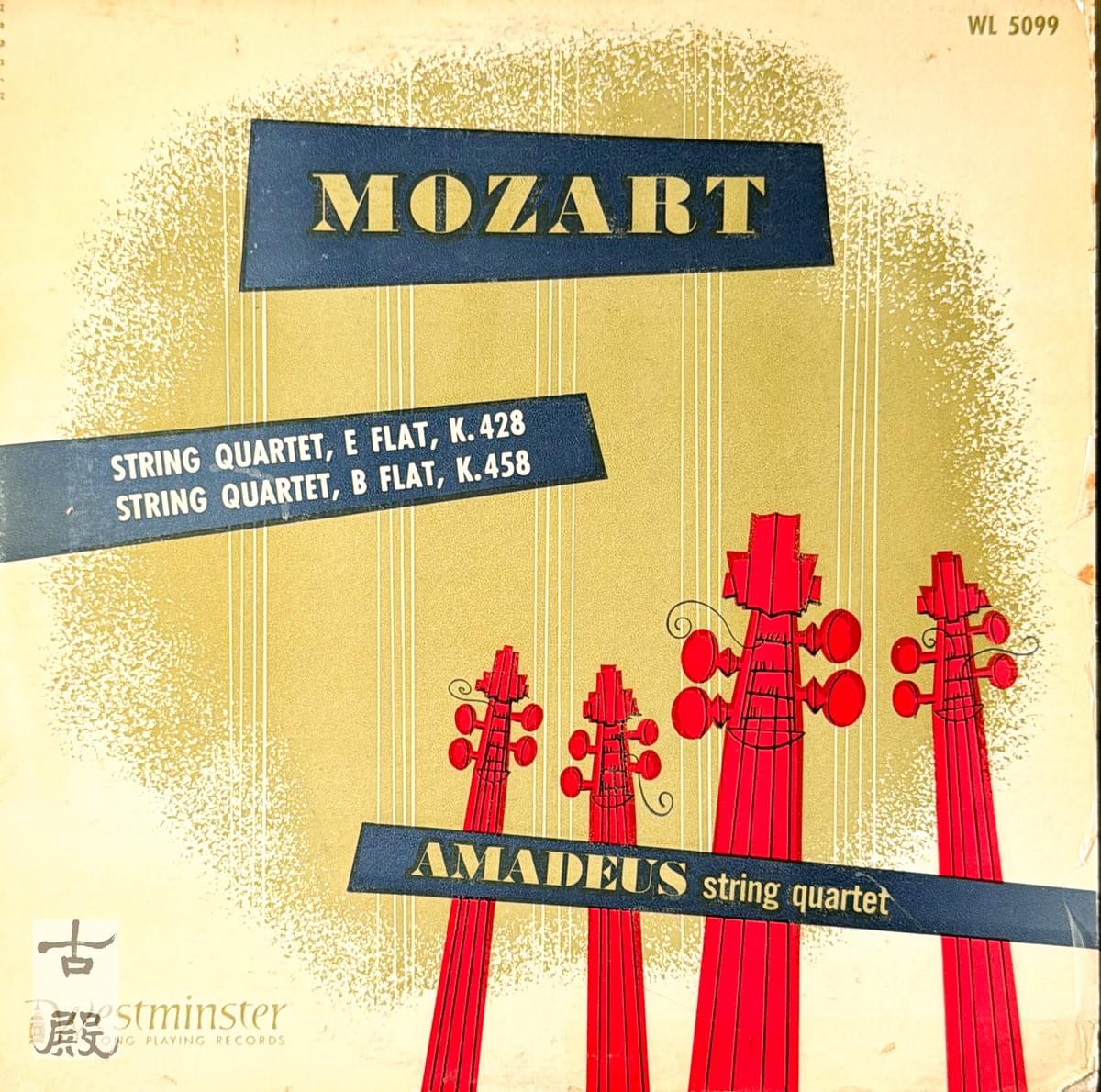
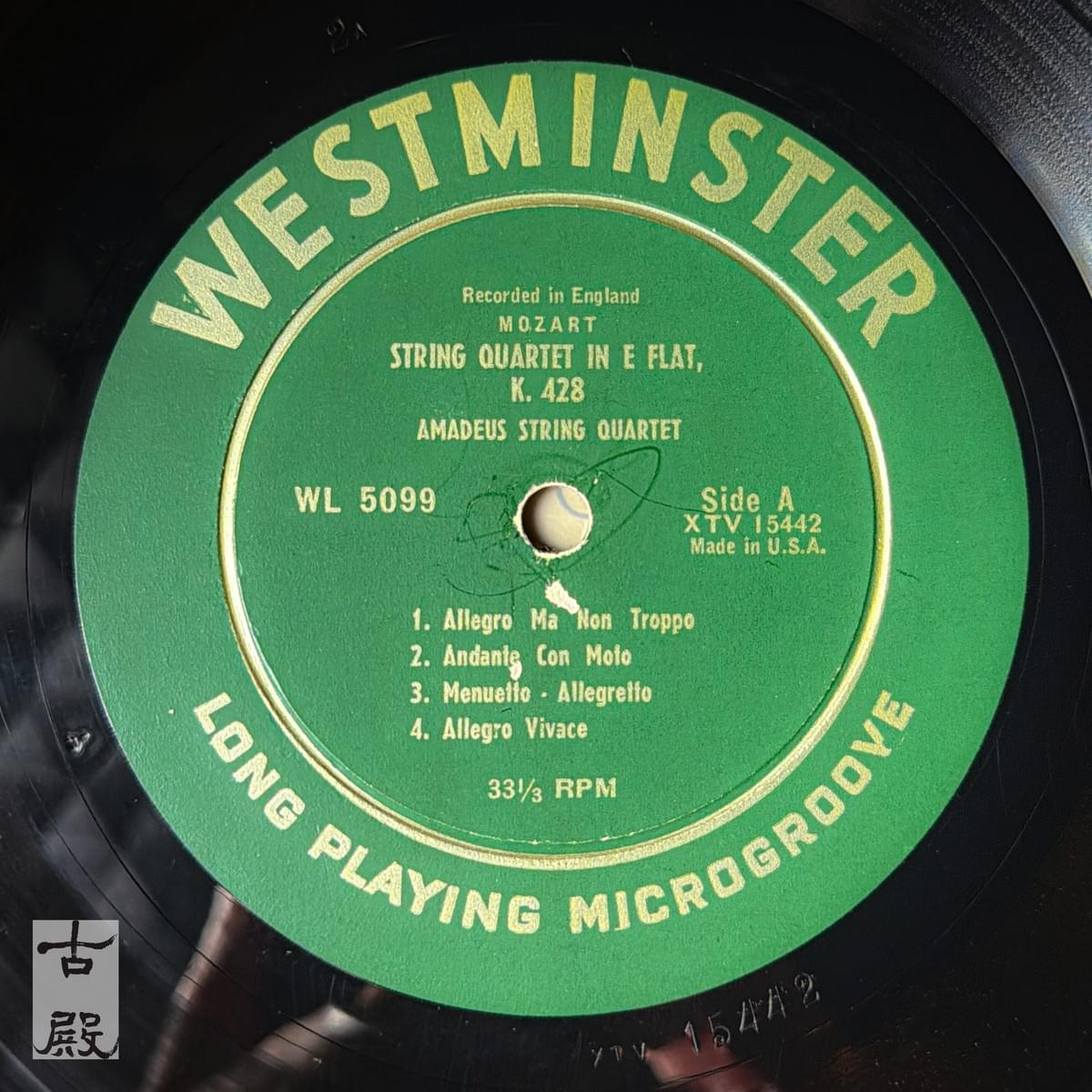
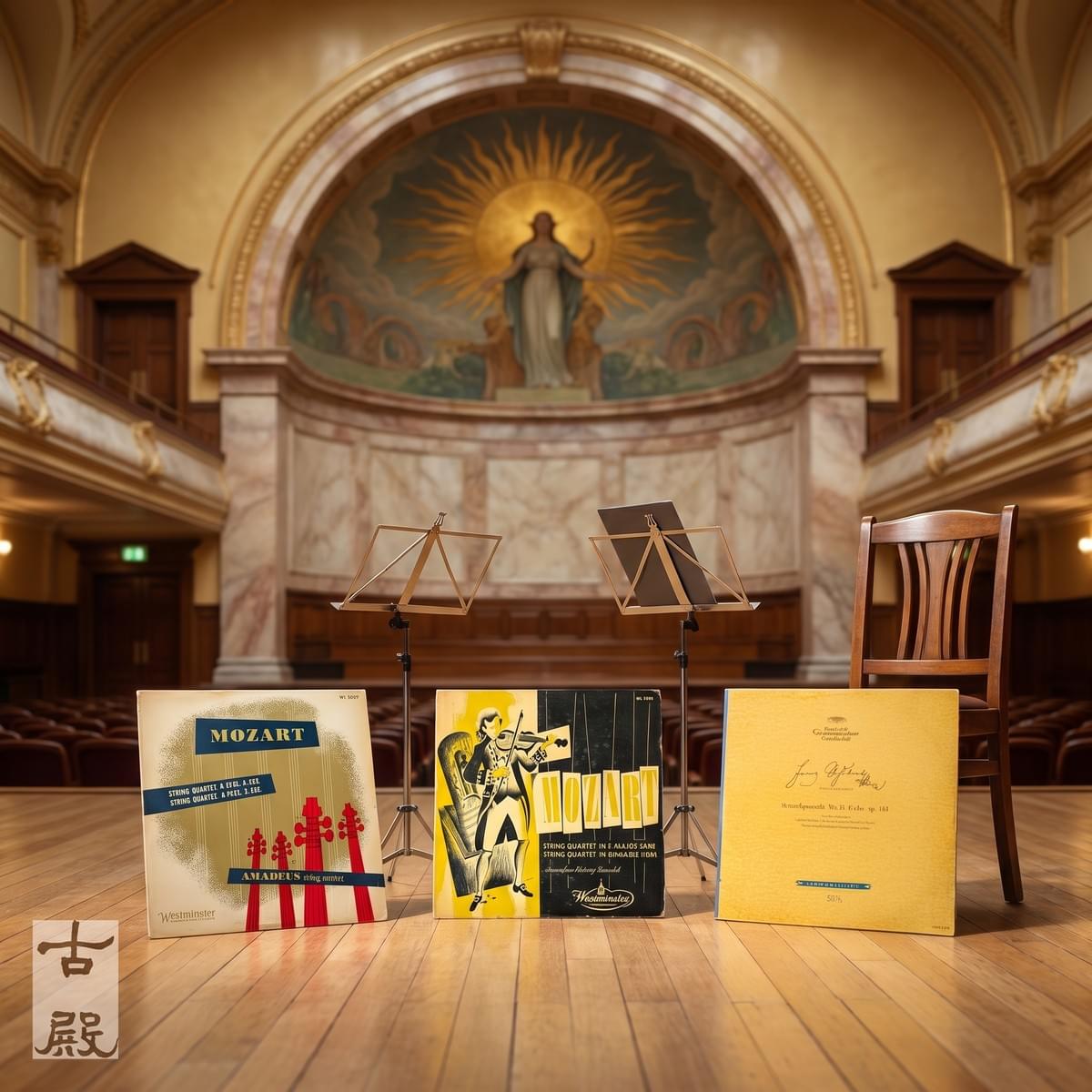
Westminster WL 5099(美國綠金深溝標重量首版):莫扎特 K.428 與 K.458「狩獵」,1951年1月,倫敦 Conway Hall 錄製。刻板號 XTV 15442/15443,連號,同一批次壓製。封面是四把紅色提琴頭立在金色底上,力道十足,是那個年代美國獨立廠牌最有設計意識的封面之一。
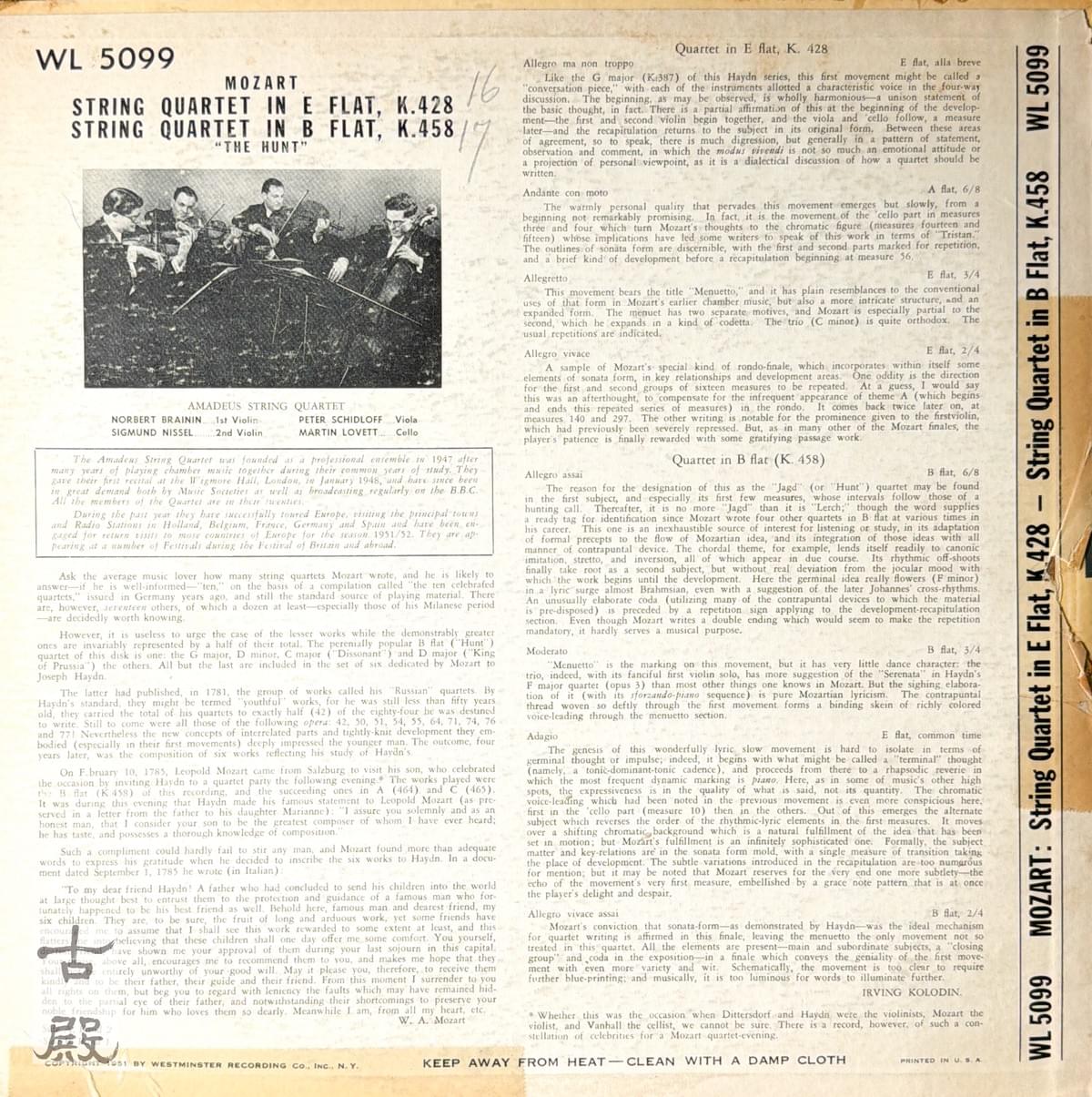
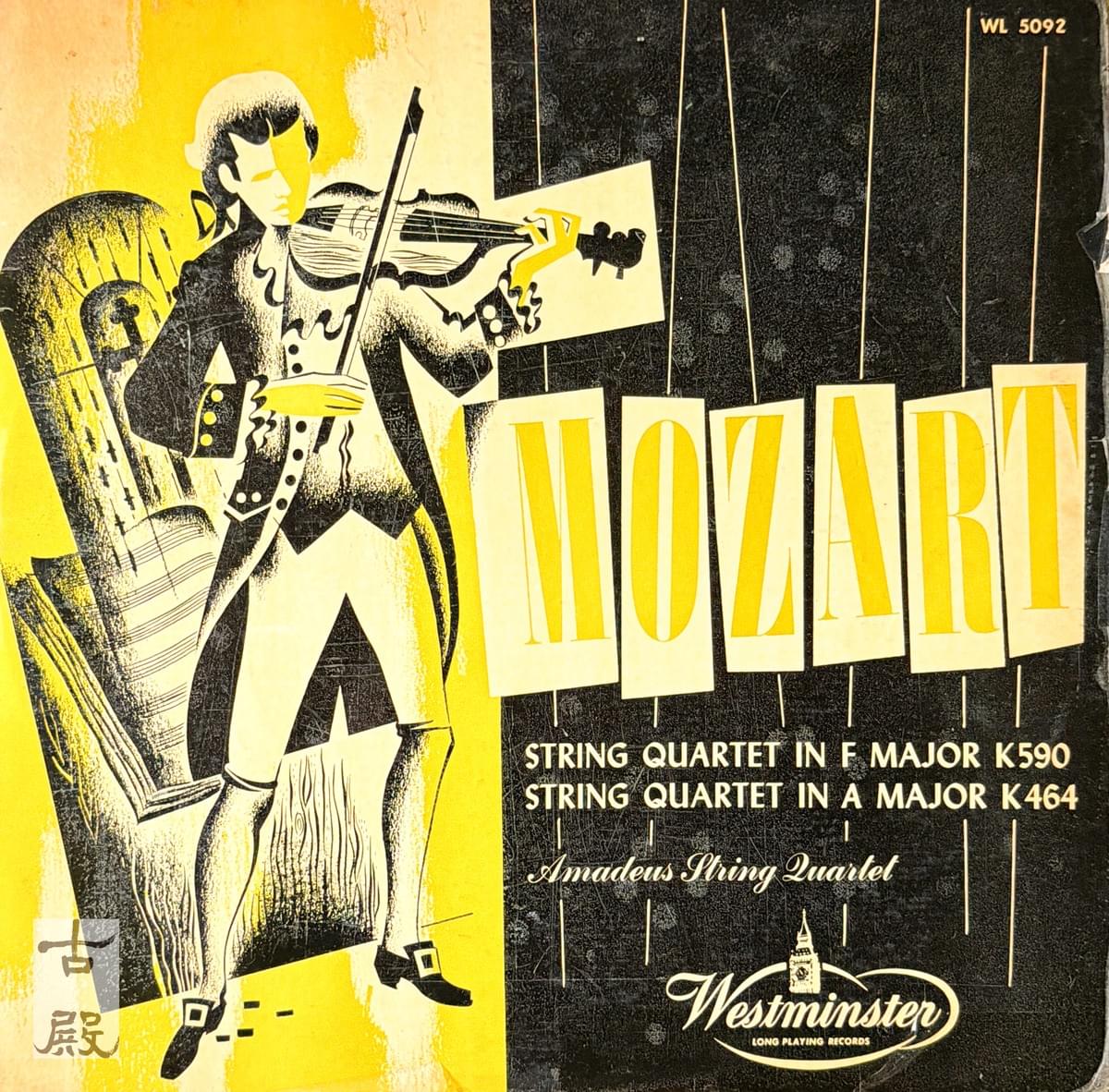
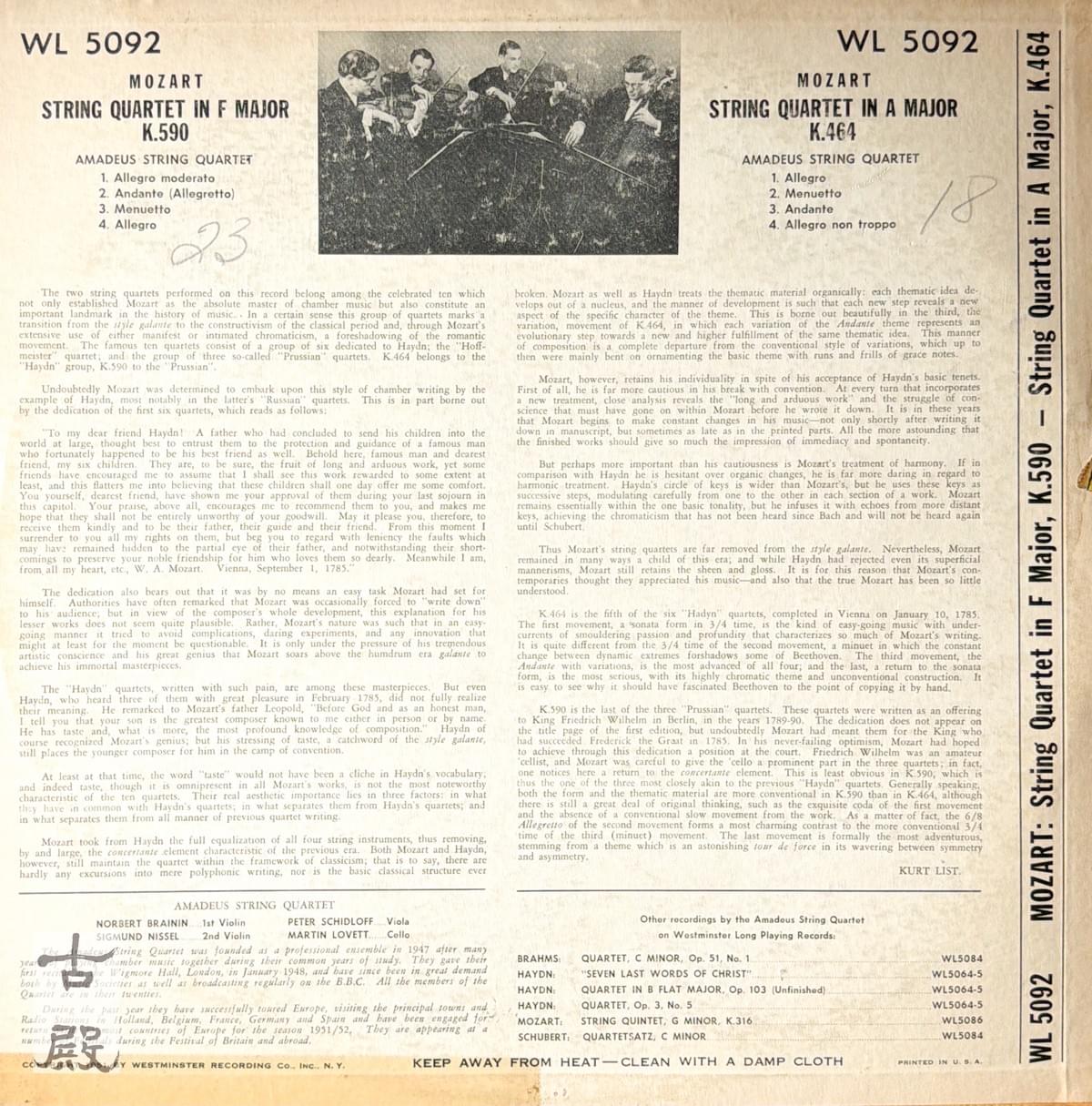
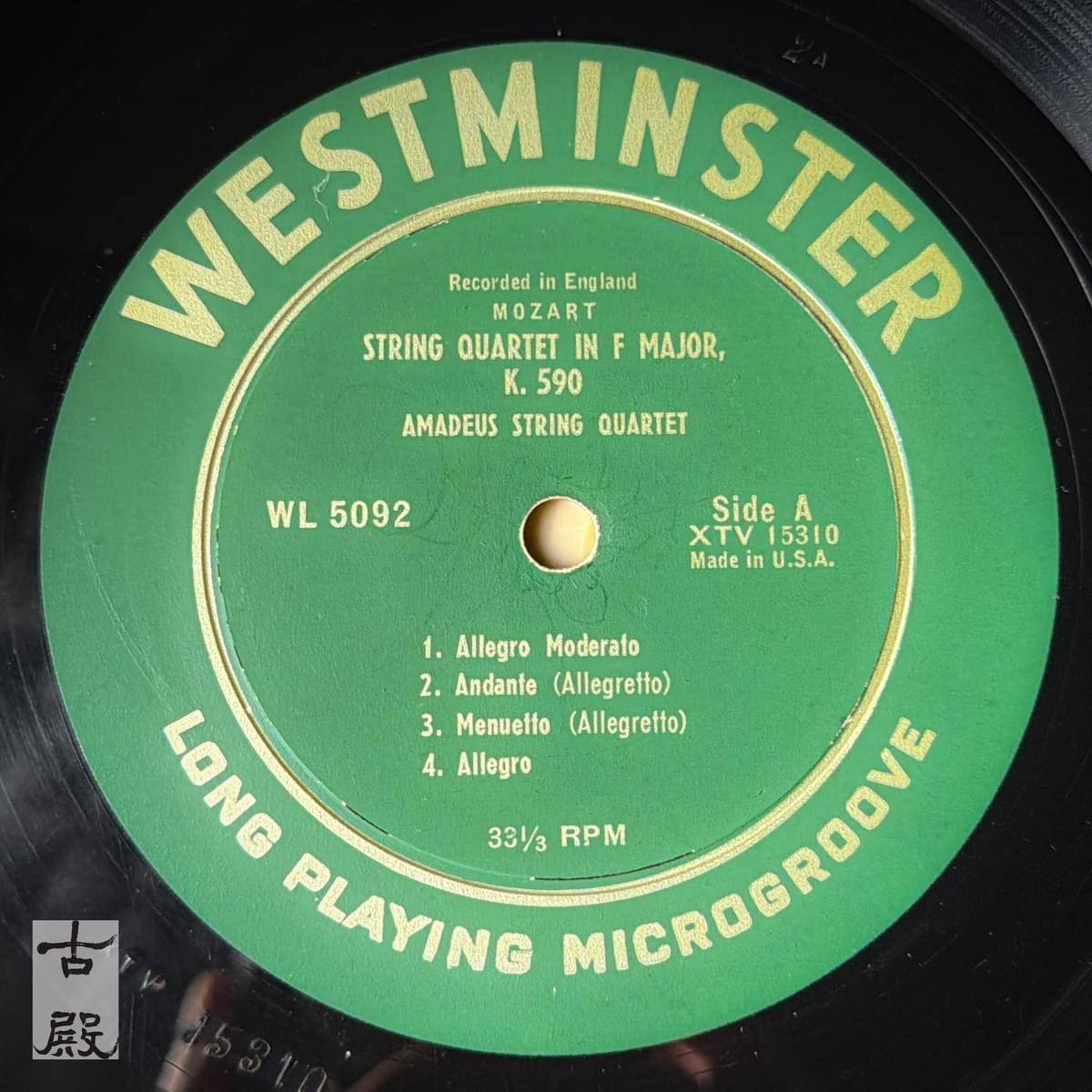
Westminster WL 5092(美國綠金深溝標重量首版):莫扎特 K.590 與 K.464,同樣錄製於1951年,地點是倫敦 Hampstead Parish Church。教堂的石材牆壁帶來更深的縱向殘響,與 Conway Hall 的木質共鳴是兩種截然不同的聲學環境,兩者都刻進了溝槽。封底解說由 Westminster 靈魂人物利斯特博士親筆執撰,矩陣號 XTV 15310/15311,與 WL 5099 的序號緊鄰,顯示兩張唱片屬於同一錄音計畫的連續輸出。
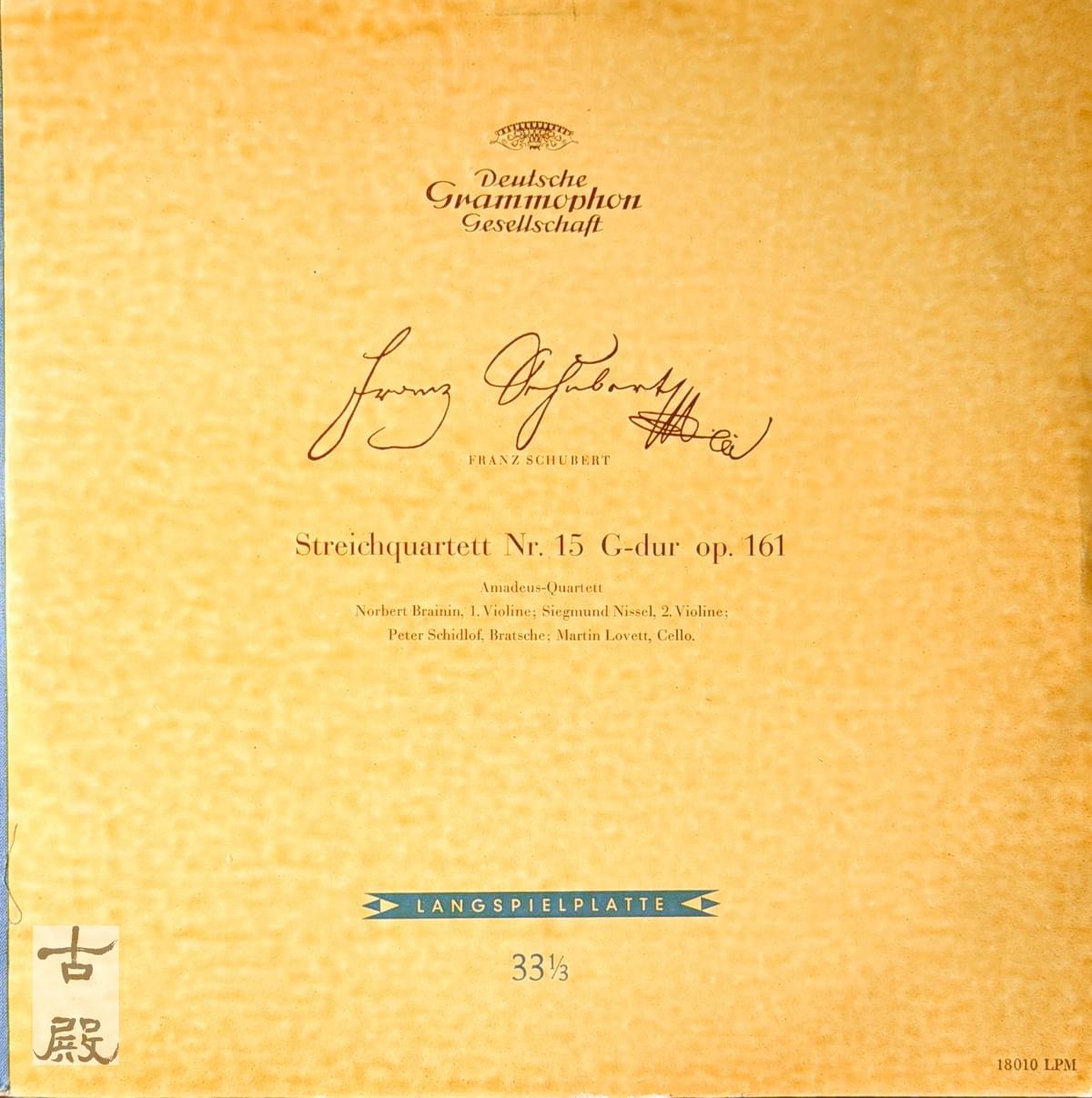
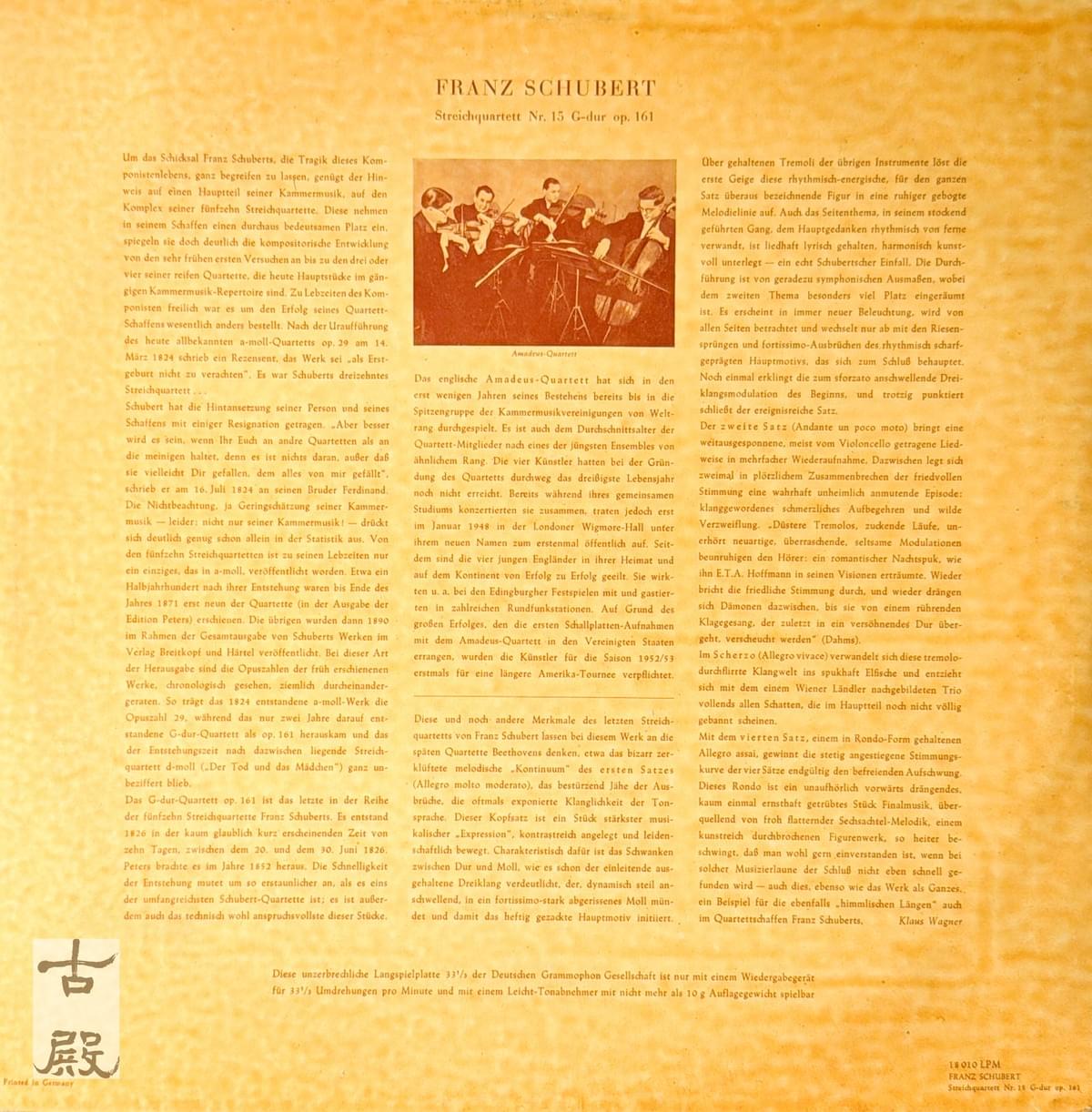
Deutsche Grammophon 18010 LPM(西德黃色鬱金香標首版):舒伯特 G大調第15號四重奏 D887,1951年9月,漢諾威貝多芬廳。封面以金黃壓紋紙為底,中央印著舒伯特的親筆簽名影印,右下角小字 18010 LPM,整個設計語言克制而典雅,與 Westminster 的現代主義美學走向完全不同的路線。
同一年,同一個四重奏,在倫敦兩個不同的聲學空間和漢諾威的錄音室,留下了這三個物理印記。
他們選擇了「最後的」那些作品
值得注意
的是,這批最早期的錄音裡,阿瑪迪斯選擇或被選擇面對的,幾乎都是「最後」的作品。
WL 5092 的曲目,西敏寺唱片(Westminster)的藝術總監庫爾特·利斯特博士(Dr. Kurt List,1913-1970)的安排有其深意:A 面是莫扎特 K.590,他最後一首弦樂四重奏,1790年,距離死亡一年半,在財務困境中完成;B 面是莫扎特 K.464,那首讓貝多芬驚嘆到親手抄寫第三和第四樂章的作品——貝多芬曾對弟子車爾尼(Carl Czerny) 說,翻開這首總譜時,他立刻意識到莫扎特在這裡向世界宣告:「如果時機成熟,看我能創造出什麼。」
DG 那張舒伯特 D887,是舒伯特15首弦樂四重奏中的最後一首,1826年6月,十天完成,他在世時從未有過完整公演,去世後二十三年才出版。
三個「最後」的作品,被三個「剛開始」的年輕人錄下來。
布雷寧28歲,尼賽爾29歲,席多夫29歲,洛維特24歲。他們的詮釋尚未定型,還帶著那種只有從最黑暗的歷史中剛走出來的年輕人才有的、某種不加保留的緊迫感。有樂評人說,這批最早期的錄音呈現了:「令人驚訝的、實驗性的詮釋路徑,開拓了從未被探索過的表現可能性」——後來的立體聲版本有其精鍊之處,但已是一個更趨於定型的阿瑪迪斯。
尼賽爾曾這樣描述他們的演奏風格,說它源於維也納流行音樂那種柔情感傷的傳統,但在阿瑪迪斯的訓練下,「schmaltz(多情)被精鍊、排練、紀律化了」。
這句話,聽起來像是整個生命軌跡的隱喻。從維也納帶走的感性,被戰爭、流亡、拘留、再出發的過程鍛造成更嚴格的東西。悲傷沒有消失,只是被管教了。
刻在黑膠裡的是時代的空氣凝結
WL 50
99 裡的是 Conway Hall 那個室內樂大廳的殘響——倫敦最重要的非商業演出場所,磚牆和木地板的共鳴。
WL 5092 裡的是 Hampstead Parish Church 的教堂石材殘響——一種更具縱深感的空間,帶著垂直的回響。
DG 18010 裡的是漢諾威貝多芬廳的殘響——德語世界,1951年9月。距離他們在英國被關進拘留營那年,剛過去十三年。
這些聲音是那些空間在那一刻的空氣震動,還是時代的凝結,此後七十餘年,那些振動仍然在那裡,等待每一次下針播放的時刻。
******
【Gudian Music Stories】Expelled by Nazis, Imprisoned by the British, Honored with a Standing Ovation by Germans — The Sound of the Amadeus String Quartet's Early Years
Hamburg, Germany, 1950.
The m
oment the performance ended, the entire audience rose to their feet.
The German listeners in the hall knew exactly who was on stage. Three Viennese Jews who, in 1938, had been expelled from Austria by the Nazis. They had fled to Britain, only to be locked away in internment camps as "enemy aliens." Yet, when the war ended, they formed a string quartet. And in 1950—less than five years after Germany's defeat—they walked into this war-torn German city to play Mozart.
They were under no obligation to be there.
Norbert Brainin (1923–2005), the first violinist of the Amadeus String Quartet, later recalled that the reaction that night was so overwhelming precisely because the audience knew who they were. It was a rare, precious moment—an opportunity to express a longing for peace through art. The men on stage had been persecuted, yet they chose to offer reconciliation through their music.
They chose to do something they were under no obligation to do.
Behind the Barbed Wire of Exile
Let u
s step back to 1938.
The day the German army marched into Vienna, the fates of three Jewish teenagers changed forever. Norbert Brainin, Siegmund Nissel (1922–2008), and Peter Schidlof (1922–1987) fled their homeland one after another, eventually finding their way to Britain.
However, the British government at the time viewed anyone holding a German or Austrian passport as a potential threat—fearing they might be spies. As a result, they were interned in camps as "enemy aliens." The very people who had escaped the clutches of the Nazis found themselves fenced in by the Allies.
It was behind the barbed wire of these internment camps that Brainin and Schidlof first crossed paths. There, Schidlof also met Nissel. Behind the wire, these three exiles kept practicing their instruments.
Eventually, it was the legendary pianist Dame Myra Hess (1890–1965) and the composer Ralph Vaughan Williams (1872–1958)—two pillars of the British musical establishment—who used their immense prestige to sponsor and secure the release of the three Austrian Jewish refugees.
Once freed, they studied together under the eminent violin pedagogue Max Rostal (1905–1991), who generously taught them free of charge.
With the addition of the young British cellist Martin Lovett (1927–2020), the four formed what would become the world-renowned Amadeus String Quartet. On January 10, 1948, they made their official debut at Wigmore Hall in London.
Two years later, in 1950, they traveled to Hamburg.
It was a decision that defied conventional expectation. In the years immediately following World War II, many Jewish musicians adamantly refused to set foot on German soil—a completely understandable and morally irreproachable stance. They owed Germany nothing. Yet, they went.
And what they brought with them was not anger, nor accusation, but Mozart.
The British music scene affectionately dubbed them the "Wolf-Gang"—because the artistic roots of these three Viennese men belonged to the very lifeblood and tradition of Wolfgang Amadeus Mozart.
Why Deutsche Grammophon Sought Them Out
In 19
51, Deutsche Grammophon (DG) faced a critical dilemma.
They urgently needed a world-class string quartet to partner with. However, in post-war Germany, many prominent musicians carried varying degrees of moral compromise from having cooperated with the Nazi regime—some through active collaboration, others through silent compliance. DG needed a quartet that could artistically represent the great German musical tradition, while remaining entirely untainted by the dark history of the previous decade.
Amadeus was the answer without a gray area.
They were survivors of that very regime. They had been forced out of Vienna, had forged their collective voice in Britain, and then chose to return to Germany to perform—firmly believing that music could achieve what politics never could. Their 1950 Hamburg performance was proof of that power.
In September 1951, the Amadeus Quartet traveled to Hannover and stepped into the DG recording studio to record Schubert’s String Quartet No. 15 in G major, D. 887. This stands as one of the earliest known commercial recordings of their legendary partnership with DG. Over the next 36 years, they would record over a hundred albums for the label, cementing one of the most significant chamber music legacies of the twentieth century.
That iconic yellow tulip label—redesigned in 1949 by designer Hans Domizlaff—was among the very first releases of DG’s LP era. The Amadeus Quartet was there at the absolute beginning.
Three Records: Three Moments in a Single Year
On th
e table today sit three vinyl records, all from the year 1951:
Westminster WL 5099 (US Green-Gold Deep Groove First Pressing):
- Program: Mozart’s Quartet K. 428 & K. 458 "Hunt."
Recorded: January 1951 at Conway Hall, London.
Matrix: XTV 15442/15443 (sequential pressings from the same batch).
Visual: The cover features four red violin scrolls standing boldly against a gold background—highly striking, and one of the most design-conscious covers from American independent labels of that era.
Westminster WL 5092 (US Green-Gold Deep Groove First Pressing):
- Program: Mozart’s Quartet K. 590 & K. 464.
Recorded: 1951 at Hampstead Parish Church, London.
Acoustics: The stone walls of the church yield a deeper, vertical resonance that contrasts beautifully with the warm wooden acoustics of Conway Hall. Both acoustic spaces are deeply etched into these grooves. The liner notes on the back were penned by Dr. Kurt List, the creative soul of Westminster. The matrix numbers (XTV 15310/15311) run adjacent to WL 5099, showing they were part of the same continuous recording project.
Deutsche Grammophon 18010 LPM (West German Yellow Tulip First Pressing):
- Program: Schubert’s String Quartet No. 15 in G major, D. 887.
Recorded: September 1951 at Beethoven-Saal, Hannover.
Visual: The cover is made of textured golden-yellow paper, featuring a facsimile of Schubert’s own signature in the center, with "18010 LPM" subtly printed in the bottom right corner. Its design language is restrained and elegant, representing a completely different aesthetic path from Westminster's modernism.
In a single year, the same quartet left these three physical imprints across two distinct acoustic spaces in London and a studio in Hannover.
Choosing the "Final" Works
It is
profoundly moving to note that in these earliest recordings, the works the Amadeus Quartet chose—or were chosen to confront—were almost entirely the "final" masterpieces of the composers.
For WL 5092, the repertoire selected by Westminster’s artistic director, Dr. Kurt List (1913–1970), carried immense weight:
Side A: Mozart’s K. 590, his very last string quartet, written in 1790 amidst severe financial distress, just a year and a half before his death.
Side B: Mozart’s K. 464, a piece so awe-inspiring to Beethoven that he copied its third and fourth movements by hand. Beethoven once remarked to his pupil Carl Czerny that upon looking at this score, he realized Mozart was declaring to the world: "Look what I could have produced, had the time been ripe."
Meanwhile, the DG recording of Schubert’s D. 887 is the last of his fifteen string quartets. Written in just ten days in June 1826, it was never performed in its entirety during Schubert's lifetime and was only published twenty-three years after his death.
These three monumental "final" works were recorded by three young men who were just at their "beginning."
At the time, Brainin was 28, Nissel was 29, Schidlof was 29, and Lovett was only 24. Their interpretations had not yet settled into a comfortable routine; they carried an unreserved, raw urgency that could only come from youth emerging from the darkest chapters of history. As one music critic noted of these early recordings:
"They present a startling, experimental interpretive path, opening up expressive possibilities that had never been explored before."
Their later stereo recordings certainly possessed a refined polish, but by then, the Amadeus sound had become institutionalized.
Siegmund Nissel once described their playing style as rooted in the sweet, sentimental traditions of Viennese popular music. But under the rigor of the Amadeus Quartet, he noted, "Schmaltz was refined, rehearsed, and disciplined."
This description feels like a metaphor for their entire lives. The emotional warmth they carried away from Vienna was forged into something stronger and more resilient by war, exile, internment, and starting anew. The sadness never disappeared; it was simply given discipline.
The Air of an Era, Frozen in Vinyl
In WL
5099, you hear the natural reverberation of Conway Hall—London's premier non-commercial performance space, with the resonance of brick walls and wooden floors.
In WL 5092, you hear the stone-walled acoustics of Hampstead Parish Church—a deeper, soaring space with vertical echoes.
In DG 18010, you hear the acoustics of the Beethoven-Saal in Hannover—the German-speaking world, September 1951. Just thirteen years prior, these musicians had been locked away in British internment camps.
These sounds are the vibrations of the air in those specific spaces at those exact moments. They are the frozen remnants of an era. More than seventy years later, those vibrations remain preserved in the grooves, waiting to come alive the moment the needle touches the record.