
【古殿唱片音樂故事】他們都不知道自己在歷史裡——談兩張 dell'Arte 歷史轉錄唱片教我們的事
古殿殿主
一個問題:你聽過「證言」與「傳說」的差別嗎?
1938年3月23日晚上,海牙一座空無一人的音樂廳裡,麥克風錄下了一場沒有觀眾鼓掌的音樂會。後來的人會告訴你:這是托斯卡尼尼(Arturo Toscanini,1867–1957)在此指揮的最後一次演出,此後華格納的音樂將會在這座音樂廳消失四十年。
聽起來像一則「命中註定」的傳說,對吧?
但那天晚上站在指揮台上的托斯卡尼尼,根本不知道這件事。他不知道自己還能不能再回到荷蘭,不知道這座城市六年後會不會還存在,甚至不知道自己還會活19年、還有一整段 NBC 交響樂團的傳奇等著他。他知道的只有一件事:奧地利在兩星期前已經被德國併吞,而他此刻正站在一整片看不到邊界的未知裡指揮。
十年前,在大西洋另一頭,一位45歲的英國指揮家把管風琴的和聲邏輯搬進交響樂團,錄下一批巴赫改編曲。他也不知道十二年後迪士尼會找上他,把其中一首放進電影開場;不知道自己90歲時還會重新錄一次同樣的曲子;更不知道半個世紀後,會有一整個「歷史考據演奏」運動反過來質疑他這麼做到底對不對。
這兩件事,都被寫進了同一家英國廠牌——dell'Arte——的黑膠唱片裡。而它們教我們的,其實是同一件事:歷史,從後面看永遠是一條清楚的路;但站在裡面的人,眼前永遠只有一片濃霧。
托斯卡尼尼:一場「意外倖存」的證言
dell'Arte 這張《托斯卡尼尼指揮海牙愛樂》,封套上寫著一段少有人知道的因緣。
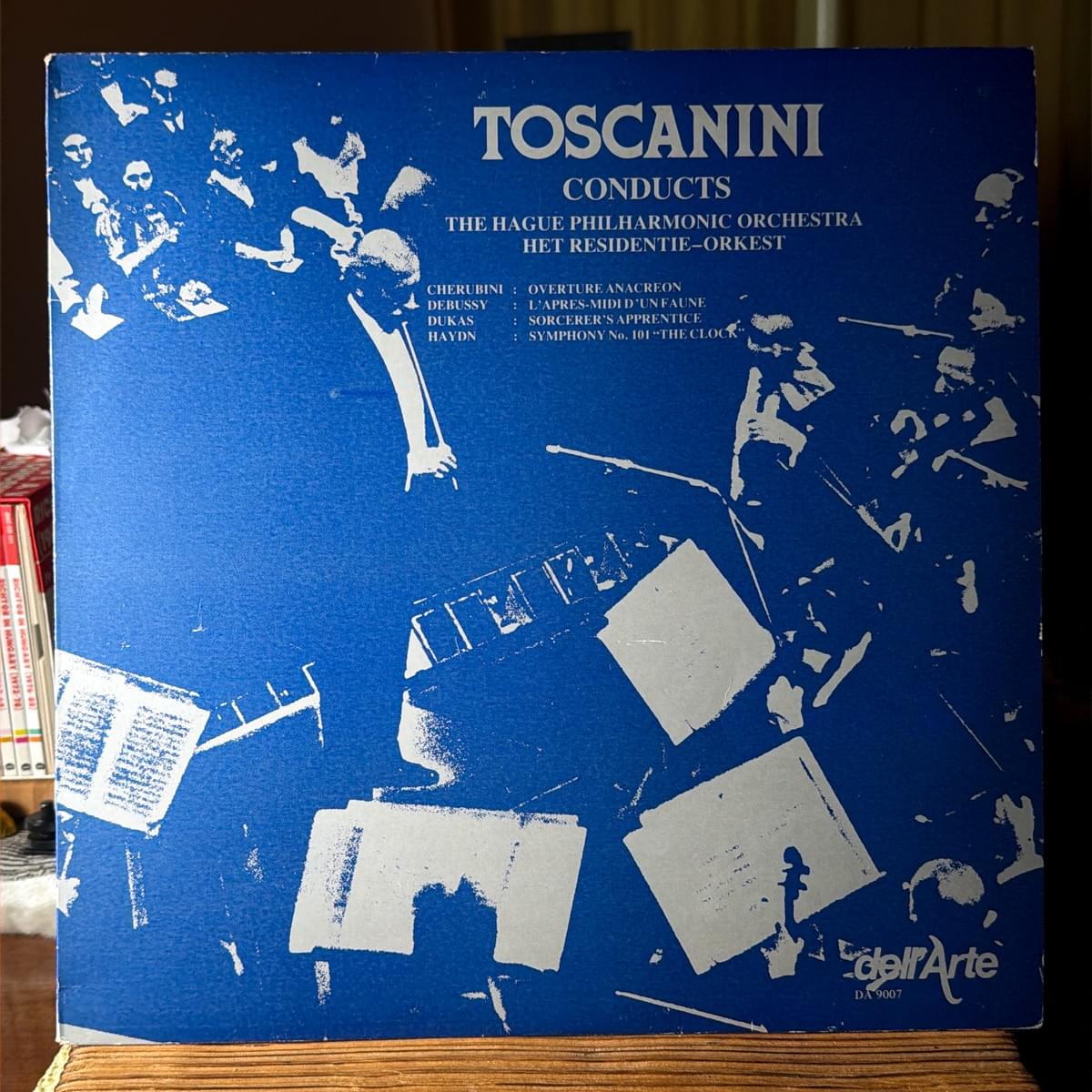
1936年,小提琴家胡伯曼(Bronisław Huberman,1882–1947)在巴勒斯坦籌組一支由逃離納粹迫害的音樂家組成的樂團,托斯卡尼尼答應免費指揮創團音樂會。排練時,樂團的雙簧管首席表現不如預期,團方緊急從海牙愛樂借調了一位荷蘭雙簧管手飛去特拉維夫救場——這個人叫亞普·斯托泰因(Jaap Stotijn,1891–1970)。托斯卡尼尼被他的演奏打動,當斯托泰因謙虛地告訴大師「海牙愛樂還有更厲害的人」時,托斯卡尼尼卻當場答應:那我就去海牙看看。
於是1937年、1938年,他兩度造訪海牙客席指揮。1938年3月23日這場,恰好被荷蘭 VARA 電台實況轉播、錄在玻璃基蟲膠採音盤上。
這裡有一個值得慢下來想的細節:這份錄音之所以能留到今天,純粹是運氣。它不是哪家唱片公司精心策劃的商業製作,而是一疊私人保存了將近半世紀的玻璃採音盤——直到1982年,一位叫漢斯·柯克霍夫(Hans Kerkhoff)的收藏者把它們借給了dell'Arte唱片公司,這段聲音才重見天日。晚了幾年,晚了一場火災,晚了一次搬家,這場音樂會可能就永遠消失了。
而封套上還藏著另一層時間的皺褶——如果拿到的是加貼了紅色圓形貼紙的版本,那代表這份錄音在1987年,又被海牙愛樂拿出來,慶祝新音樂廳 Dr. Anton Philipszaal 落成啟用。兩段相隔49年、彼此毫無關聯的歷史時刻,因為同一張唱片,疊在了一起。
托斯卡尼尼1938年3月23日那天晚上不知道自己正在留下「最後一次華格納」的紀錄。他甚至可能沒想過這場沒有觀眾的廣播,五十年後會被印成黑膠。
寫下這段唱片介紹文字的樂評人湯瑪斯·海尼茨(Thomas Heinitz,生卒年不詳),還補了一個更精確的時間座標:指揮這場音樂會時,托斯卡尼尼的指揮生涯已經邁入第52年——而他之後,竟然還有長達16年的活躍期在等著他。換句話說,那天晚上站在台上的托斯卡尼尼,已經活過了半個世紀的職業生涯,卻仍然完全不知道自己還能再走多遠?海尼茨也提到,曲目裡的凱魯畢尼《阿納克利翁》序曲,托斯卡尼尼晚年與 NBC 交響樂團合作的版本,後來由 RCA 在他身後出版、卻早已絕版多時;而德布西《牧神的午後前奏曲》,則是托斯卡尼尼在荷蘭唱片市場上的「世界首版錄音」——同一位指揮家、同一首曲子,一個版本消失在歷史裡,另一個版本卻因為發生在海牙這場廣播裡,意外成了某個地方的「第一次」。哪個版本會被記得、哪個會被遺忘,顯然也不是任何人當下能預料的事。
史托科夫斯基:一場「刻意留存」的實驗
如果托斯卡尼尼那張是「意外倖存」,史托科夫斯基(Leopold Stokowski,1882–1977)這張《演奏巴赫》就是完全相反的邏輯——刻意、持續、不計成本的商業投入。
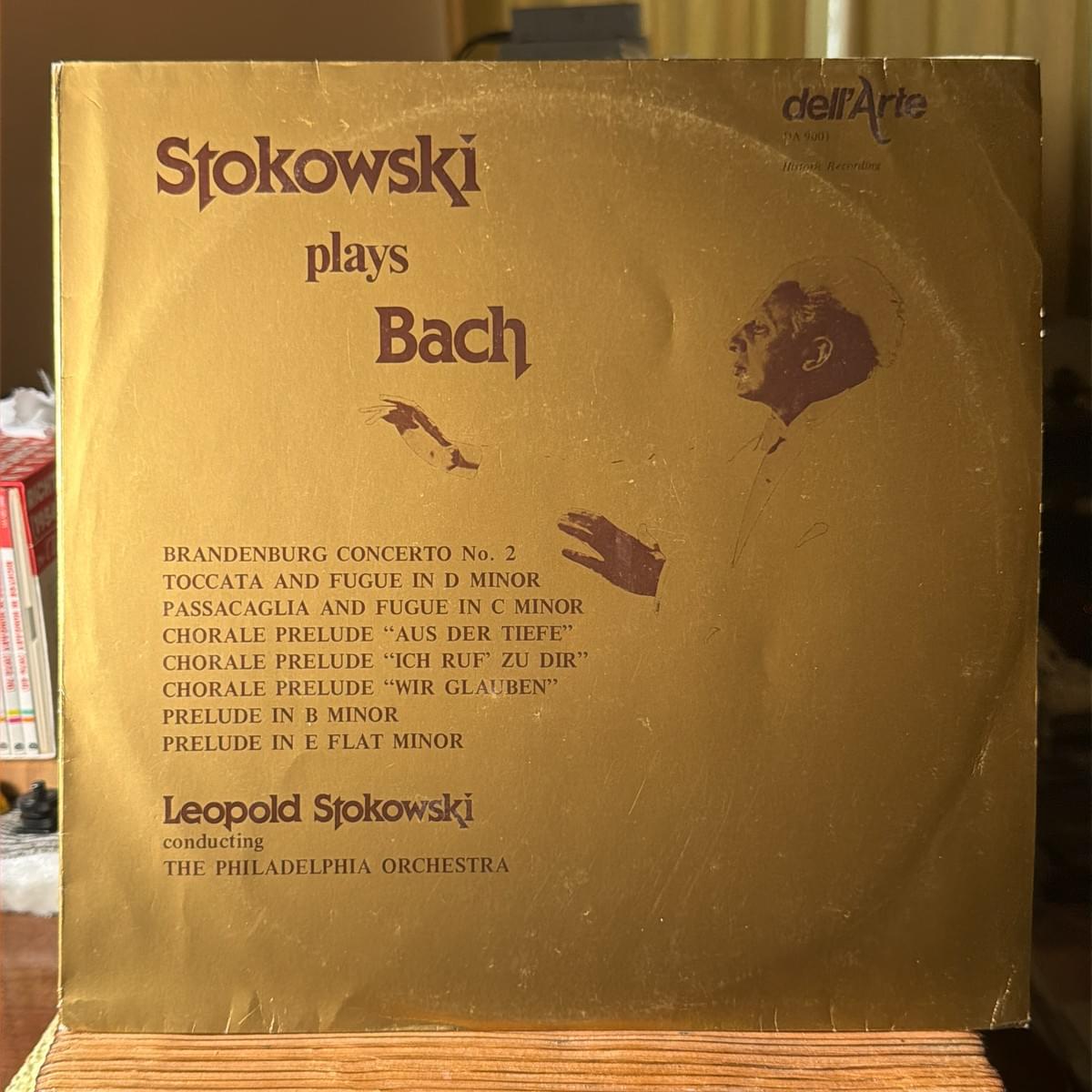
1927到1930年,正是全球錄音工業從老式喇叭全物理聲學錄音,轉型到電氣錄音的關鍵幾年。這項新技術能捕捉的細節、動態範圍,遠遠超過從前。多數美國樂團還在觀望,甚至幾年後全球經濟大蕭條一來,連庫塞維茨基的波士頓交響、托斯卡尼尼自己的紐約愛樂都被迫暫停錄音——但費城管弦樂團和史托科夫斯基沒有停。他們持續進錄音室,不斷擴充曲目,甚至率先投入當時最尖端的實驗:1931年,史托科夫斯基主動找上貝爾實驗室,讓自己與費城管弦樂團的演出,成為貝爾工程師測試新錄音技術的活體對象——地點就在費城音樂學院的地下室,起初連樂團團員都被蒙在鼓裡。1932年3月12日,他們錄下穆索斯基《展覽會之畫》與史克里亞賓《普羅米修斯:火之詩》,這很可能是人類史上第一份真正的立體聲錄音——比本片收錄的巴赫改編曲,還早了將近四年。
史托科夫斯基本人是管風琴出身,倫敦皇家音樂學院、牛津皇后學院受訓,曾在紐約教堂當風琴師。這段背景,直接決定了他改編巴赫的方式:他把管風琴踏板的持續低音交給大提琴與低音提琴,把賦格聲部依序分派給不同管樂器組——本質上,他是在「翻譯」一種他身體裡最熟悉的聲音邏輯。
這批改編曲的評價,本身就是一部活生生的「歷史定論反覆翻盤史」。1928年6月,《留聲機》雜誌對〈D小調觸技與賦格曲〉的樂評,用「壯麗宏偉」來形容,甚至說任何聽了這張唱片還無法體會巴赫手筆的人,心裡根本沒有音樂;1929年12月,同一本雜誌評價布蘭登堡協奏曲第2號時,盛讚費城管弦樂團的合奏水準讓人耳目一新;1933年5月,又有樂評說這是所有真正巴赫愛好者都該珍藏的唱片。換句話說,史托科夫斯基這些改編曲剛問世的那幾年,受到的是幾乎「前所未有」的熱烈推崇。
但到了1950年代,風向整個翻轉——同一批錄音被樂評界毫不留情地嚴厲抨擊。又過了半個世紀,幫 dell'Arte 這張唱片撰寫封底文字的樂評人愛德華·約翰遜(Edward Johnson,生卒年不詳),再次為史托科夫斯基翻案。他引述指揮家艾德里安·鮑爾特爵士(Sir Adrian Boult,1889–1983)的觀察:二十世紀初的巴赫演奏,本來就偏好圓滑綿密、幾乎聽不出樂句呼吸的弦樂風格,這是整個時代的美學,不是史托科夫斯基一個人的毛病。他也正面回應了樂評人羅伯特·菲利普(Robert Philip,1945–)「把巴赫變成布魯克納」的批評:這種指控跟批評托斯卡尼尼把布拉姆斯指揮得像羅西尼一樣沒有意義——因為每一位真正的大師,對每一位作曲家終身都保持著自己獨一無二、卻始終如一的聲音。
同一批錄音,三十年內被捧上天,又被打入谷底,再過五十年又被重新平反。連「這份錄音到底好不好」這件事,都沒有一個史托科夫斯基本人能在1928年預先知道的答案。
史托科夫斯基1928年那三天在費城錄下布蘭登堡協奏曲時,他知道自己在做一件備受爭議的事,但他完全不會知道,十二年後迪士尼會用這套改編當作《幻想曲》的開場,讓全世界一整代觀眾,透過他這雙「翻譯」的耳朵,第一次認識巴赫。
這整條路徑,史托科夫斯基走了超過半個世紀:從聲學錄音時代的尾聲開始投入,到電氣錄音技術剛起步就迎來第一次高峰——也就是本片收錄的這批1927至30年錄音;此後進入黑膠時代,從單聲道一路延伸到立體聲,始終沒有停下來。他不只是站在指揮台上詮釋音樂,也親自參與了貝爾實驗室的錄音技術研發,1933年還和貝爾工程師合作,示範把管弦樂現場演出以立體聲方式用電話線傳送到數百英里外的另一個城市。再過幾年,這整條從指揮、到改編、到錄音科技投入的路徑,又延伸進了迪士尼的動畫世界,促成《幻想曲》這部把古典音樂帶進電影工業與大眾媒體的劃時代作品。某種意義上,史托科夫斯基是卡拉揚之前的典範——早在卡拉揚被封為「錄音室裡的指揮家」之前半個世紀,史托科夫斯基已經示範了:一位真正的音樂家,可以同時是指揮、是改編者,也是錄音科技本身的參與者。
他也是最早非常重視個人影像呈現的指揮家之一,而且這種講究是刻意設計出來的,不是天生的明星氣質。他曾為了一次活動,堅持助理把他的頭髮梳成沒有分線、筆直後梳的樣子,理由是「指揮家就該長這樣」;他在音樂廳裡實驗各種戲劇性燈光,只打亮自己的頭部與雙手,或刻意讓光線在牆上投出誇張的剪影;1929到1930年樂季,他乾脆捨棄指揮棒,改用赤手傳遞戲劇性的手勢。這套視覺語言,後來被他完整帶進了《幻想曲》——片中他以剪影姿態出現在銀幕上的鏡頭角度,正是這套早已在音樂廳裡反覆琢磨過的個人形象設計的延伸,而不是迪士尼團隊臨時起意的安排。
如果歷史不是一條線,而是一片濃霧
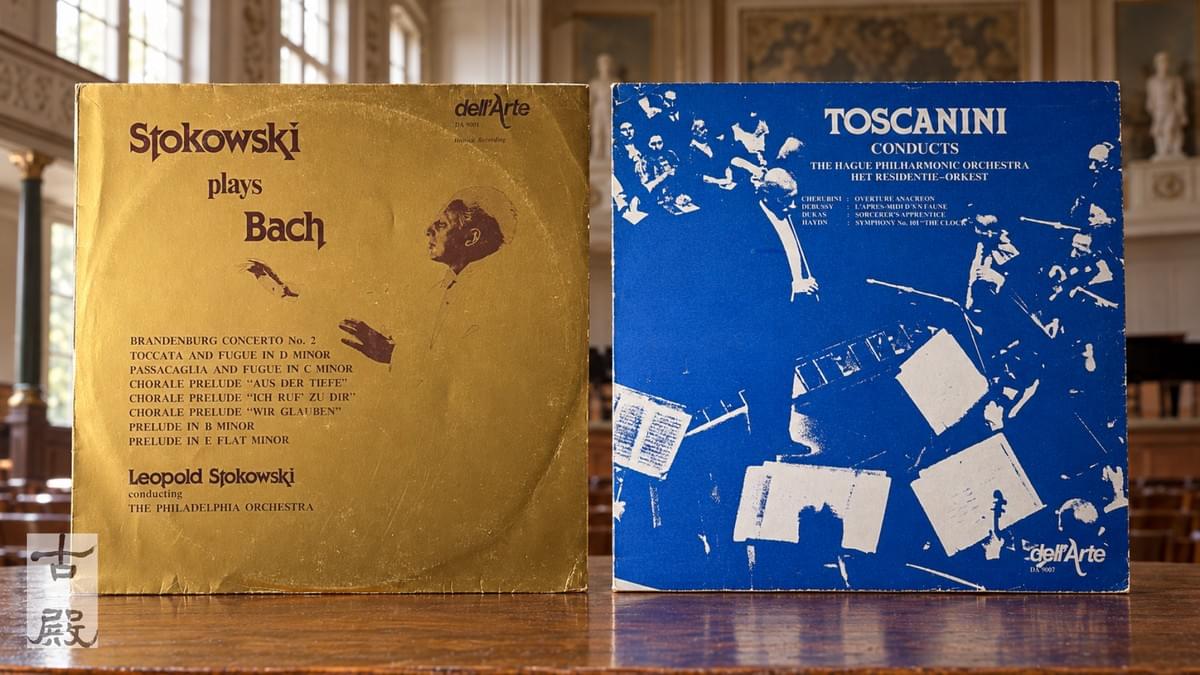
把這兩張唱片放在一起看,你會發現一件很弔詭的事:我們現在講述他們的方式,幾乎全都是倒著講的。
我們說「這是托斯卡尼尼最後一次在海牙演奏華格納」——但這句話只有站在1938年之後、知道接下來六年會發生什麼的人才說得出口。我們說「這奠定了史托科夫斯基巴赫改編的先河」——但這句話也只有站在1940年《幻想曲》上映之後才成立。
那個當下的托斯卡尼尼,面對的不是一段「即將被寫進歷史」的演出,而是一片完全開放、充滿威脅的未知——他不知道歐洲還能撐多久?不知道自己還有幾次機會能回到這座城市?那個當下的史托科夫斯基,面對的也不是「開創傳統」的使命感,而是一項技術上仍然粗糙、藝術上備受質疑的實驗——他甚至可能覺得,這批錄音幾年後就會被更好的技術取代、被人遺忘。
歷史的「普遍定論」,是後來的人為了讓故事好講、好記,把偶然剪裁成必然的結果。而黑膠溝槽裡真正保存下來的,恰恰是那個還不知道自己會通向哪裡的瞬間本身——沒有被後見之明修飾過的,最原始的證言。
這種事,今天已經很難再發生了。不是因為沒有偉大的音樂家,而是因為串流時代的聲音,幾乎不再攜帶這種「物理僥倖」與「刻意投入」並存的重量——一份靠著私人收藏躲過戰火與遺忘才留下來的廣播錄音,一份在經濟崩潰邊緣仍然選擇持續投資的商業實驗,這兩種處境,現在的我們已經很難真正體會了。
最後的問題?
下一次當你聽到「某位大師開創了某個先河」「某場音樂會奠定了某種傳統」的時候,不妨停下來想一想:
那個當下的他,真的知道自己在做這件事嗎?還是這句話,只是我們站在後世的結果裡,替他說的?
******
【Gudian Music Stories】None of Them Knew They Were Making History: What Two dell'Arte Historical Reissue LPs Teach Us
A question to begin: have you ever considered the difference between a "testament" and a "legend"?
On the evening of March 23, 1938, inside an empty concert hall in The Hague, broadcast microphones picked up a performance that was met with no applause. Observers decades later will tell you: this was Arturo Toscanini’s (1867–1957) final appearance in the city, after which Wagner’s music would vanish from this auditorium for forty years.
It sounds like a fated, monumental legend, doesn't it?
Yet the man standing on the podium that evening had no inkling of any of this. Toscanini did not know whether he would ever return to the Netherlands. He did not know whether this city would still stand intact six years later. He could not foresee that he would live for another nineteen years, with the entire mythos of the NBC Symphony Orchestra still waiting ahead. He knew only one stark fact: Austria had been annexed by Nazi Germany just two weeks prior, and he was conducting into a vast, borderless unknown.
A decade earlier, on the other side of the Atlantic, a forty-five-year-old British-born conductor imported the architectural logic of the pipe organ into the modern symphony orchestra, recording a series of Bach transcriptions. He could not foresee that twelve years later Walt Disney would invite him to use one of these transcriptions to open an animated film; he did not know he would re-record the exact same pieces at the age of ninety; nor could he imagine that half a century later, an entire Historically Informed Performance (HIP) movement would arise to challenge the legitimacy of what he had done.
Both episodes are captured in the grooves of LPs issued by the same British historical label: dell'Arte. And both teach us the exact same lesson: history, viewed backward, always resembles a clean, straight line; but for those standing directly inside it, there is never anything ahead but thick, impenetrable fog.
Toscanini: A Testament of Accidental Survival
The dell'Arte release Toscanini Conducts the Hague Philharmonic carries on its sleeve an unexpected backstory.
In 1936, violinist Bronisław Huberman (1882–1947) was assembling an orchestra in Palestine made up of musicians fleeing Nazi persecution, and Toscanini agreed to conduct their inaugural concerts without a fee. During rehearsals, the ensemble’s principal oboe proved unsatisfactory. In a scramble, the management arranged for a Dutch oboist from the Residentie Orkest (The Hague Philharmonic) to fly to Tel Aviv as an emergency replacement: Jaap Stotijn (1891–1970). Toscanini was deeply taken with his playing. When Stotijn humbly told the maestro that "there are even finer players back in The Hague," Toscanini accepted on the spot: "Then I must come to The Hague to see for myself."
He subsequently visited The Hague as guest conductor twice, in 1937 and 1938. The concert of March 23, 1938, happened to be broadcast live by the Dutch network VARA and cut directly onto glass-based lacquer transcription discs.
Here is a detail worth pausing over: this recording survives today by sheer luck. It was never a calculated commercial venture planned by a major record label. It was a stack of fragile glass transcription discs preserved in private hands for nearly half a century—until 1982, when a collector named Hans Kerkhoff loaned them to dell'Arte, allowing these sounds to see the light of day. A few years' delay, a single house fire, or a careless move, and this entire performance would have been lost to oblivion.
The jacket holds yet another fold in time. If you happen upon a copy bearing a circular red sticker, it signifies that this recording was reissued in 1987 by the Residentie Orkest to commemorate the inauguration of their new concert hall, the Dr. Anton Philipszaal. Two moments separated by forty-nine years, wholly unconnected in intent, were brought together by a single phonograph record.
Toscanini, on that evening in March 1938, did not realize he was laying down his "final Wagner" in the city. He likely never imagined that this broadcast before an empty hall would be pressed into commercial vinyl fifty years later.
In the liner notes, critic Thomas Heinitz provided an illuminating chronological reference: when Toscanini led this concert, he had already entered the fifty-second year of his conducting career—yet he still had sixteen years of relentless creative activity ahead of him. The man on the podium that night had already survived half a century of professional life, completely unaware of how much further the road would run. Heinitz noted that while Toscanini’s late NBC Symphony account of Cherubini’s Anacréon Overture was issued posthumously by RCA and quickly went out of print, his reading of Debussy’s Prélude à l'après-midi d'un faune on this disc served as Toscanini’s "world premiere recording" on the Dutch commercial market. The same conductor, the same piece: one account disappeared into the archives, while the other, thanks to this Dutch radio aircheck, became an unexpected regional "first." Which version is remembered and which is forgotten is never something anyone can predict in the moment.
Stokowski: An Experiment in Deliberate Preservation
If Toscanini's disc is an artifact of accidental survival, Leopold Stokowski’s (1882–1977) Stokowski Plays Bach represents the opposite logic: a deliberate, sustained, and lavishly funded commercial enterprise.
The years 1927 through 1930 marked the critical transition across the global recording industry from mechanical acoustic recording to electrical microphone capture. This new technology gathered dynamic range and acoustic detail that were unimaginable a few years earlier. Most American orchestras hesitated. When the Great Depression struck, even Serge Koussevitzky’s Boston Symphony and Toscanini’s own New York Philharmonic were forced to suspend recording operations. But Stokowski and the Philadelphia Orchestra pressed forward. They entered the studio continuously, expanding their recorded repertoire and throwing themselves into cutting-edge experiments. In 1931, Stokowski reached out to Bell Telephone Laboratories, turning the Philadelphia Orchestra into a living testing ground for experimental recording techniques in the basement of the Philadelphia Academy of Music—initially without the musicians' knowledge. On March 12, 1932, they recorded Mussorgsky’s Pictures at an Exhibition and Scriabin’s Prometheus: The Poem of Fire, producing what are widely recognized as the earliest surviving dual-channel stereophonic orchestral recordings—nearly four years prior to many of the Bach transcriptions gathered here.
Stokowski was an organist by training, schooled at the Royal College of Music in London and The Queen's College, Oxford, and having served as an organist at St. Bartholomew's in New York. That foundation governed how he arranged Bach for the modern orchestra: he assigned the pedal point bass to the cellos and double basses, and distributed fugal voices among contrasting choirs of winds and brass. He was translating the acoustic architecture of the organ into an orchestral vocabulary he knew intuitively.
The critical reception of these transcriptions forms a case study in how historical verdicts can reverse themselves over time. In June 1928, The Gramophone reviewed his recording of the Toccata and Fugue in D minor, calling it "magnificent and grandiose," adding that anyone who could hear this disc without being moved by Bach’s genius simply had no music in their soul. In December 1929, reviewing the Brandenburg Concerto No. 2, the same publication marveled at the Philadelphia ensemble's unprecedented precision; in May 1933, another review deemed these discs essential acquisitions for any genuine Bach lover. In their initial years, Stokowski’s transcriptions were received with widespread critical acclaim.
By the 1950s, the tide had turned completely. The very same recordings were dismissed by a new generation of critics as vulgar and bloated. Half a century later, writing the liner notes for this dell'Arte LP, critic Edward Johnson mounted a defense. He cited an observation by Sir Adrian Boult (1889–1983): early twentieth-century Bach performance favored a continuous, seamless legato that left little room for audible phrasing breaths; this was the dominant aesthetic of an entire era, not a personal failing of Stokowski's. Johnson also addressed Robert Philip’s (b. 1945) critique that Stokowski had "turned Bach into Bruckner," noting that such an indictment made no more sense than criticizing Toscanini for conducting Brahms as if it were Rossini—every true master brings their own singular, uncompromised voice to every composer they touch.
The same recordings were celebrated, discarded, and then rehabilitated over a span of decades. Whether these performances were "valid" was a question to which Stokowski himself could not have known the answer in 1928.
When Stokowski spent those three days in Philadelphia cutting the Brandenburg Concerto in 1928, he knew he was doing something bold, but he could not have anticipated that twelve years later Walt Disney would place this arrangement at the opening of Fantasia, introducing an entire generation of filmgoers to Bach through his particular pair of ears.
Stokowski followed this path for more than half a century: beginning at the tail end of the acoustic horn era, reaching an early peak at the dawn of the electrical microphone (represented by these 1927–1930 sessions), and continuing through the LP era from mono into full stereo without pause. He did not simply interpret scores on the podium; he participated directly in recording R&D with Bell Laboratories, collaborating with their engineers in 1933 to demonstrate live orchestral music transmitted stereophonically over telephone lines to another city hundreds of miles away. A few years later, that combination of conducting, arranging, and audio engineering carried him into Disney’s animation studios, resulting in Fantasia—a project that brought classical music into the industrial film sphere. In many respects, Stokowski was the prototype for Herbert von Karajan. Half a century before Karajan was celebrated as the ultimate "studio conductor," Stokowski had already shown that an artist could be a conductor, an arranger, and an active participant in recording technology all at once.
He was also one of the first conductors to deliberately sculpt his visual persona. This was conscious design rather than unvarnished celebrity. For one public engagement, he insisted that his assistant brush his hair straight back without a parting, remarking, "That is how a conductor ought to look." In concert halls, he experimented with theatrical lighting, illuminating only his head and hands, or casting oversized silhouettes against the back wall. In the 1929–1930 season, he abandoned the baton entirely, relying on expressive bare hands to mold the orchestral sound. This visual vocabulary carried over into Fantasia—the iconic shots of him silhouetted against the orchestra were the natural extension of a stage presence he had refined in concert halls for decades, rather than an impromptu idea from Disney's animators.
If History Is Not a Line, but a Fog
Placing these two records side by side reveals a paradox: the way we recount history today is almost always constructed in reverse.
We say, "This was Toscanini’s final performance of Wagner in The Hague"—a sentence that can only be uttered by someone standing after 1938, knowing the devastation the following six years would bring. We say, "This set the precedent for Stokowski’s Bach transcriptions"—a claim that only holds weight in hindsight, after Fantasia arrived in theaters in 1940.
In the moment, Toscanini was not offering a performance destined for the history books; he was facing an open, precarious horizon. He did not know how long Europe had left, nor how many chances he would have to return to that hall. In his own moment, Stokowski was not carrying the mantle of founding a new performance tradition; he was running an experiment using technology that was still crude and an aesthetic that provoked debate. He may well have assumed these discs would be superseded by better technology and forgotten within a decade.
Historical consensus is often the tidy narrative later generations construct, trimming away messy coincidences to make an event feel inevitable. What remains preserved in the grooves of these LPs is the unvarnished moment itself, moving blindly toward a future it could not foresee—the primary testament before hindsight went to work.
That kind of document is increasingly rare today. Not for lack of fine musicians, but because in the streaming era, sound rarely carries the physical weight of accidental survival paired with deliberate investment: an aircheck that survived war and neglect through a private collection, alongside a costly commercial gamble made on the brink of an economic collapse. Those historical circumstances are hard to replicate now.
The next time someone tells you that "a maestro set a precedent" or "a legendary concert inaugurated a tradition," take a moment to ask yourself:
Did the artist standing on that stage in that exact moment actually know what they were creating? Or are those words we simply put in their mouth, looking back from the comfort of the outcome?