
【古殿唱片音樂故事】打造最高音質的藝術品:DAM Super Analogue Disc 45 大衛 歐伊斯特拉夫(David Oistrakh,1908-1974)&賽爾(George Szell,1897-1970): 布拉姆斯小提琴協奏曲
古殿殿主
1987年秋天,兩個相反的選擇
1987年秋天,日本唱片業同時做了兩個決定,主角都是同一位小提琴家、同一首曲子。
10月10日,東芝EMI推出大衛·歐伊斯特拉夫(David Oistrakh,1908-1974)在該公司的第一張CD,曲目是布拉姆斯小提琴協奏曲。他們選的,是1960年他在巴黎與奧圖·克倫培勒(Otto Klemperer,1885-1973)合作的錄音。
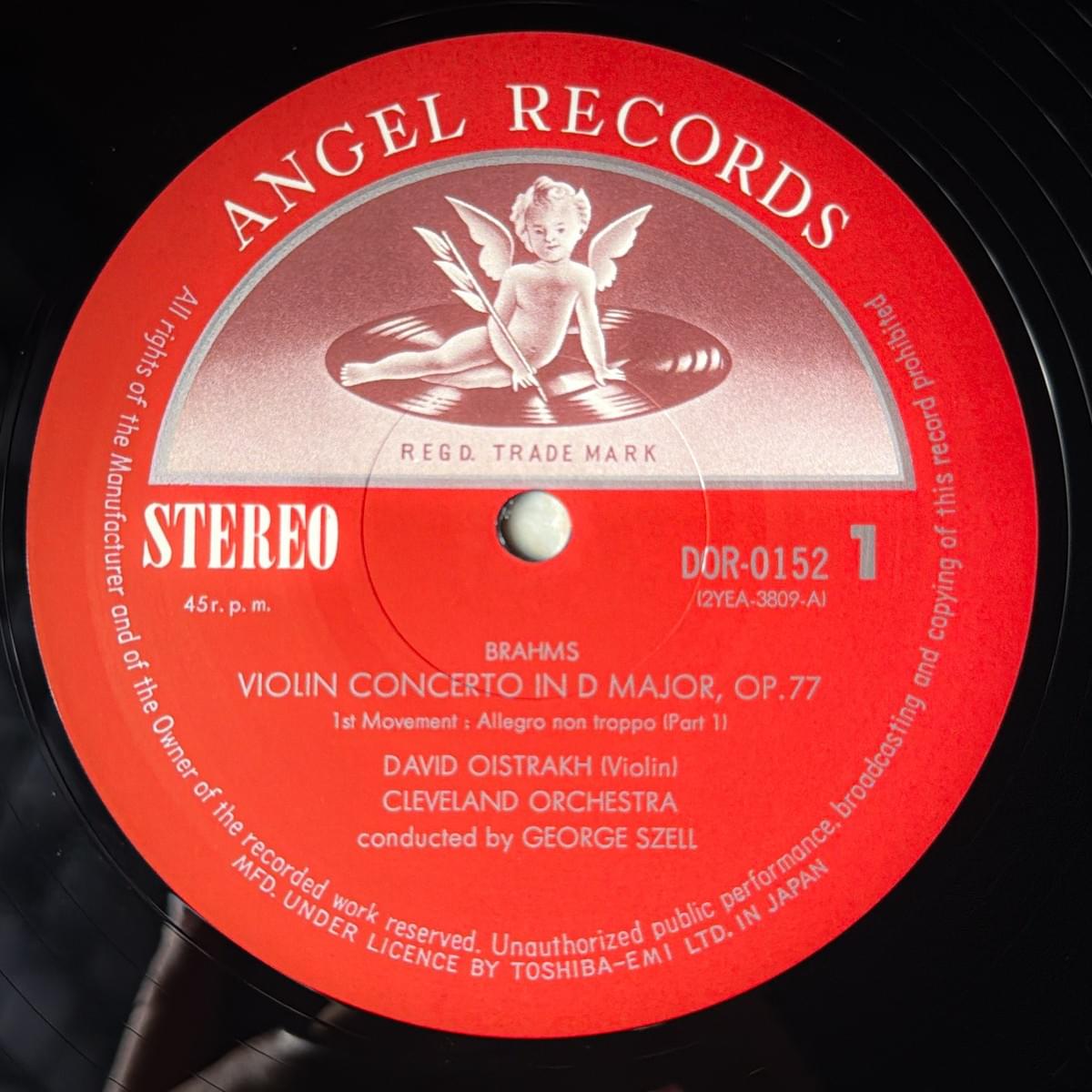
幾乎同一時間,在東京一家家電量販店的會員俱樂部裡,一群人做了完全相反的事。他們把歐伊斯特拉夫晚了九年的另一份布拉姆斯——1969年與喬治·賽爾(George Szell,1897-1970)和克里夫蘭管弦樂團在美國的錄音——從EMI調出原始母帶,不做CD,而是刻成兩張12吋45轉黑膠,整首協奏曲分成四面。
那一年,CD正在把黑膠趕下主流的位置。一邊在擁抱新時代,一邊卻在用最奢侈的方式,替舊時代再刻最後一刀。
為什麼?
答案牽涉到兩位走過戰爭與鐵幕的巨匠、一個由會員預先掏錢撐起來的「狂熱計畫」,以及一個日本有錢、也有耐心做到世界第一的年代。我手上這套唱片,腰帶、外封、內封、解說冊、四面紅色天使標俱全,就是那個決定留下來的實物。
巴黎1960,克里夫蘭1969:同一首曲子的兩種重量
歐伊斯特拉夫一生拉布拉姆斯協奏曲的次數多到數不清。DAM的日文解說寫道,他在蘇聯、捷克、法國、美國都留下過錄音。在EMI的立體聲錄音裡,最重要的就是這兩份。
- 1960年版:克倫培勒指揮法國國家廣播管弦樂團,在法國巴黎錄音,歐伊斯特拉夫52歲。1987年,東芝EMI選它作為歐伊斯特拉夫的首張CD。
- 1969年版:賽爾指揮克里夫蘭管弦樂團,在美國克里夫蘭賽佛倫斯音樂廳錄音,歐伊斯特拉夫60歲。1987年,DAM選它製作45轉超級類比雙碟。
這兩份是歐伊斯特拉夫在西方錄音室留下、製作最完整的布拉姆斯商業錄音。指揮不同、樂團不同、錄音地點與製作團隊也不同,在演奏藝術上卻是無可比擬的雙璧,各有擁護者,很難說誰好誰壞。
克倫培勒版像一座石雕:速度寬緩,結構巨大,每個樂句都站得很穩。賽爾版則是另一種東西——線條緊繃,節奏一直往前推,樂團不是在「伴奏」,而是與獨奏者正面角力。日文解說借用了相撲的說法:小提琴與樂團像兩名力士「四手相扣」,雙手互扣、正面扭在一起。
那麼,東芝EMI為什麼選了較早的1960年版?DAM在製作說明裡給了自己的推測:克倫培勒在英國的人氣根深蒂固,所以EMI英國總部刻意先把年代較早的那份錄音CD化。
DAM的考量則在EMI的市場盤算之外。他們原本把克倫培勒版的布拉姆斯、與安德烈·克路易坦(André Cluytens,1905-1967)合作的貝多芬協奏曲都列入候選,並認為這些都是不分軒輊的頂尖名演。但實際試聽母帶之後,他們發現與賽爾合作的這版布拉姆斯,在錄音品質上遠勝其他版本,因而做出了最終決定。
這個判斷有它的技術基礎。從1960到1969年,唱片產業的錄音技術規格前進了一大步。DAM要做的,是把一份發燒錄音黑膠化,做到前所未有的高度,成為一件藝術品;而一張極致的黑膠,起點永遠是母帶本身。
換句話說,演奏上兩者是雙璧,錄音上1969年勝出。唱片公司考慮的是市場與人氣,DAM考慮的是母帶能不能撐起一張極致的黑膠。這正是這套唱片存在的起點。
歐伊斯特拉夫:一個選擇留在祖國的「幻之小提琴家」
同樣出生在俄國的小提琴大師,以撒·史坦(Isaac Stern,1920-2001)、納森·米爾斯坦(Nathan Milstein,1903-1992)都在西方成名。歐伊斯特拉夫走了另一條路:他留在蘇聯。
這個選擇的代價很具體。1937年他在比利時布魯塞爾首屆易沙意大賽(今伊莉莎白女王大賽)奪冠。名字傳遍歐洲,緊接著二戰與冷戰把他整個關在蘇聯國門內。直到1946年布拉格之春音樂節,他才重新走出去。日文解說記載,連當時日本政府嚴密監控蘇聯情報的年代,「蘇聯出了一個天才」的消息仍零星傳到東京;可是唱片極難取得,他在日本長年只是一個傳說,被稱為「幻之小提琴家」。
1955年春天,他首度訪日,成為第一位從鐵幕後走出來的蘇聯音樂使節。解說寫道,這場邀請的幕後爭奪戰,還被井上靖寫進了小說。親眼聽到他的人,好奇心一夜之間變成崇拜。
解說還留下一句托斯卡尼尼(Arturo Toscanini,1867-1957)的評語:如果歐伊斯特拉夫此刻出現,所有小提琴家都會像太陽前的星星一樣失去光芒。
賽爾:距離布拉姆斯只隔一位老師
賽爾1897年生於布達佩斯,3歲移居維也納。他的作曲老師之一是歐瑟比烏斯·曼迪切夫斯基(Eusebius Mandyczewski,1857-1929)——布拉姆斯晚年的摯友,也是後來整理布拉姆斯全集的人。17歲,他在柏林愛樂指揮自己寫的交響曲,被理查·史特勞斯(Richard Strauss,1864-1949)看中,從此轉向指揮。
1946年,他接下克里夫蘭管弦樂團。日文解說說得很直白:那時它只是一支歷史尚淺的二流樂團。賽爾用近乎苛刻的排練,把它鍛造成美國頂尖的樂團,精準到被稱為「賽爾的樂器」。
兩條血脈,在1969年交會
這首協奏曲是布拉姆斯寫給好友約瑟夫·姚阿幸(Joseph Joachim,1831-1907)的。姚阿幸的學生雷奧波德·奧爾(Leopold Auer,1845-1930)把德奧小提琴傳統帶進聖彼得堡;而在蘇聯,教出歐伊斯特拉夫的彼得·史托里亞斯基(Pyotr Stolyarsky,1871-1944),日後被視為取代奧爾學派的新體系。
一條線從姚阿幸經過俄國走到歐伊斯特拉夫;另一條線從布拉姆斯身邊的曼迪切夫斯基走到賽爾。1969年5月,兩條線在克里夫蘭的賽佛倫斯音樂廳相遇。
1969年5月,賽佛倫斯音樂廳裡
這次相遇本身,也是一場跨越鐵幕的交易。當時克里夫蘭管弦樂團與美國Columbia唱片有合約,但錄音機會越來越少;英國EMI在美國的市佔率則大幅滑落,急著挽救旗下的Angel古典品牌。1968年,樂團總經理巴克斯戴爾(A. Beverly Barksdale)與EMI古典部門主管彼得·安德里(Peter Andry)談成一份三年合約。為了讓條件更有吸引力,EMI動用與蘇聯國營唱片機構Melodiya的關係,取得蘇聯音樂家赴美與樂團錄音的許可。歐伊斯特拉夫與大提琴家姆斯蒂斯拉夫·羅斯托波維奇(Mstislav Rostropovich,1927-2007),就是這樣來到克里夫蘭的。
美國的樂團、蘇聯的獨奏家、英國的唱片公司,在冷戰最緊繃的年代,聚在同一個舞台上。
錄音由安德里親自製作,錄音師是EMI的卡森·泰勒(Carson Taylor)。泰勒在開錄前的備忘錄裡寫下一句承諾:要把克里夫蘭管弦樂團原本的聲音,美好地錄下來。為此他們設計了幾套新的收音方案,把不同類型的麥克風佈滿全廳,甚至懸吊在演奏者頭頂上方。賽爾和EMI還加開了一整場排練,花費約合今天四萬美元,只為了測試樂團座位與麥克風的擺法。同一檔期錄製的布拉姆斯《雙重協奏曲》,前後用了八天,後來獲得1971年葛萊美獎。
排練現場的賽爾,一如傳聞般嚴厲。美國《Stereo Review》的記者想趁空檔採訪歐伊斯特拉夫,賽爾冷冷地說:「我們是來做音樂的,採訪不重要。」午休前,他又補了一句:傍晚他還得和歐伊斯特拉夫討論事情,看不出歐伊斯特拉夫哪來的時間受訪。樂團檔案館留下一張照片:錄音結束後,賽爾、歐伊斯特拉夫與羅斯托波維奇圍在一起,討論還有哪些地方要剪接修正。
那時歐伊斯特拉夫60歲,賽爾71歲。一年後的1970年5月,賽爾率團首度訪日;回國約兩個月,他就在7月30日辭世。1974年10月,歐伊斯特拉夫在阿姆斯特丹巡演途中逝世,享年66歲。
這張唱片錄下的,不是兩位技術最強的音樂家,而是兩段走到最後的生命,最後一次正面相遇。
DAM:一家電器行,如何做出世界上最好的黑膠?
腰帶上那行斜體大字,翻成中文是「超越發燒友!大作戰」。這句口號背後,是一個很少見的商業結構。

誰是DAM?
「第一家庭電器」(第一家電)是1958年創立、總部在東京新宿的家電量販連鎖。它成立了一個音響會員俱樂部,Daiichi-kateidenki Audio Member's Club,取字首就是DAM。1975年,第一張掛上DAM品牌的唱片問世;到1990年,DAM一共發行了約一百五、六十種45轉唱片,古典、爵士、流行、日本傳統音樂到演歌都有,其中不少是自己企劃的原創錄音。
負責企劃製作的,是解說末尾署名的「DAM推進委員會」,標誌就是封面右下角那個方塊字樣DAMPC。
先收錢,再做到最好
一般唱片公司的邏輯是:先花錢做唱片,再祈禱它賣得出去。所以每一個環節都要算成本——母帶用哪一代、盤重多少克、要不要為了塞進一面而壓縮動態。
DAM把順序反過來:
- 會員先入會、繳會費,並預訂即將頒布的唱片。
- 發行採限量制,VIP會員享有優先認購權,數量在製作開始前就已確定,DAM知道要做幾套、錢從哪裡來。
- 唱片不進一般唱片行,只透過「頒布會」分發給會員,沒有通路抽成,也不必迎合大眾的價格線。
- 省下來的空間,全部投進製作,不計成本、不計代價:向唱片公司調原始母帶、換45轉、加重盤材、請名家寫解說。
這套唱片的製作說明開頭就寫著:感謝全國會員對「第27回頒布會」的熱烈支持。也就是說,到1987年,這個會員機制已經穩定運作了二十七期。
狂熱到什麼程度?
舉一個例子。1990年,DAM推出富特萬格勒(Wilhelm Furtwängler,1886-1954)1951年拜魯特貝多芬第九號的45轉版,只限VIP會員預訂,全球1000套,每套編號。他們為此遠赴英國EMI的檔案室翻找當年的母帶,找到一卷保留了開頭指揮上台腳步聲的版本,直接用它來刻片——這就是福迷口中「有皮鞋聲的拜魯特第九」第一次出現在唱片上。
會員預付的錢,買到的不只是一張唱片,而是一整套「不必向市場妥協」的權利。
1987年9月3日,御殿場的那一刀
用CD的技術,做最好的黑膠
1987年9月3日,在靜岡縣的東芝EMI御殿場工廠,刻片工程師原清介與林力,把EMI寄來的1969年母帶接上錄音機,開始刻片。
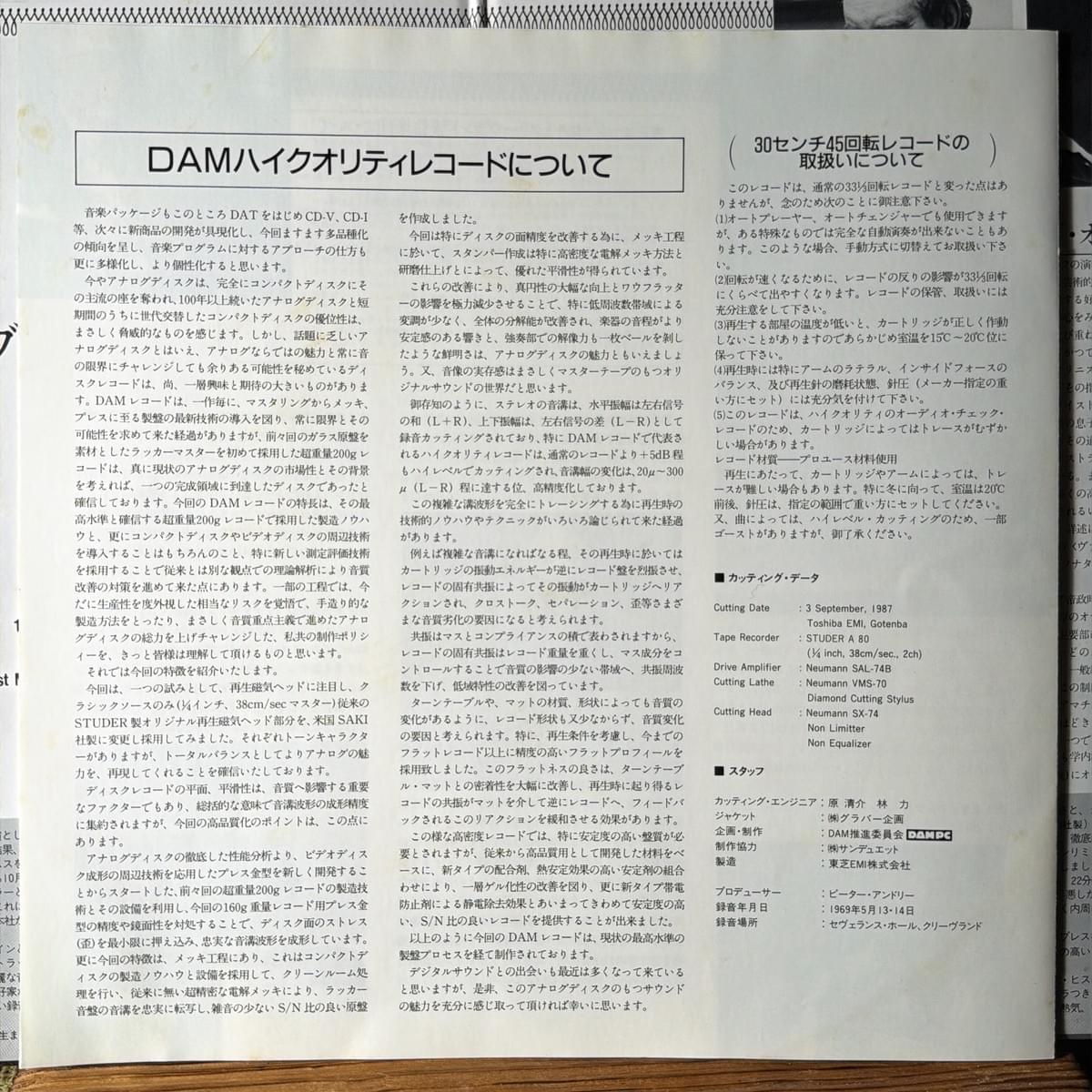
最耐人尋味的是:DAM為了做出最好的黑膠,借用的正是打敗黑膠的那一方的技術。他們把CD生產用的無塵室直接拿來做黑膠的電鍍工序,以超精密電解電鍍把漆盤上的音溝轉印成金屬模板;壓片模具則應用了影音光碟的成型技術。DAM在解說中這樣寫道:「在部分工序中,我們甚至甘冒風險、完全不計生產成本,採取宛如手工精製般的製造方式,以純粹『音質第一主義』全力挑戰類比黑膠的總體工藝極限;我們相信這份製作理念定能獲得各位會員的深刻理解。」
解說開頭甚至寫著,DAT、CD-V、CD-I這些新載體正一個接一個商品化。他們很清楚自己身處什麼時代。
把DAM的每一個決定串起來,會看到一條完整的邏輯:
- 先把聲音刻到最大:45轉的線速度比33⅓轉快,音溝能容納更大的振動幅度。DAM不加限幅器、不加等化器,以高電平直刻,把45轉的物理餘裕用到極限。
- 連放音磁頭都要精心挑選:母帶放音的磁頭,他們沒有直接用原廠的,而是把Studer原廠磁頭與美國SAKI特製磁頭各自實際刻成漆盤,試聽比對後才選定SAKI。刻片頭則用Neumann SX-74,已是當年的最高標準。
- 寧可多一張唱片,也不碰內圈:唱片越往內圈,線速度越慢,物理限制越容易造成失真。做成兩枚組四面,就是為了讓每一面都停在內圈之前。
- 在CD等級的無塵室裡做母模:漆盤刻好後,送進CD實驗室等級的無塵室,以超精密電解電鍍翻製成金屬模板,把音溝一絲不差地轉印下來。
- 用最好的材料壓成厚盤:最後以高密度的頂級配方材料,壓製成成本更高的160克重量盤。
每一步都在回答同一個問題:母帶裡的聲音,怎樣才能一點不少地走到你的唱針底下?
- 母帶放音:Studer A80(¼吋、每秒38公分、雙聲道),原廠磁頭換成美國SAKI特製磁頭。
- 磁頭選擇:兩種磁頭都實際刻成漆盤試聽比對,SAKI在解析度與清晰度上勝出。
- 刻片鏈:Neumann SAL-74B驅動放大器、VMS-70刻片機(鑽石刻針)、SX-74刻頭。
- 訊號處理:不用限幅器、不用等化器,以高電平直刻,比一般唱片高約5dB。
- 轉速與分面:12吋45轉、兩張四面;第一樂章約22分鐘,拆成10'07"與12'39"兩面。
- 內圈:刻意避開內圈,降低內圈失真。
- 盤材:160克重量盤,新型配方與抗靜電劑,高精度全平面盤形。
- 電鍍:引入CD製程的無塵室與高密度電解電鍍。
DAM自己怎麼說?
解說冊裡有一篇〈關於DAM高音質唱片〉,是DAM推進委員會寫給會員的技術自述。它比任何轉述都更能看出這群人的心態,以下摘錄其中的主要段落。
開頭,他們先承認了時代的現實:
如今,類比黑膠唱片的主流地位已被CD徹底取代;面對走過百餘年歷史的類比黑膠,CD在極短時間內完成世代交替所展現的壓倒性優勢,確實令人感到震撼。然而,即便外界對類比黑膠的討論熱度大不如前,但黑膠唱片所獨具的特有魅力,以及其在不斷挑戰聲音極限時所展現的無窮潛力,依然承載著更為深厚的興趣與厚望。
接著是他們對自己過往成績的自信,以及這一次要再往前推的方向:
我們深信,在前前次首度採用玻璃原盤為基底作為漆盤母盤(Lacquer Master)所打造的200公克超重量盤黑膠,立足於當前類比黑膠的市場環境與技術背景來看,已經達到了實質意義上的極致完成領域。本次DAM唱片的特色,不僅繼承了我們深具信心的200公克超重量盤製作技術,更廣泛引進了CD與影音光碟(LD等)的周邊製造科技;特別是藉由導入嶄新的測量與評估技術,從有別於以往的視角進行理論分析,從而推進各項音質改善對策。
關於放音磁頭:
首先作為一項新嘗試,我們將焦點放在母帶播放磁頭上。針對古典音樂訊源(¼吋、每秒38公分母帶),我們將原本STUDER盤式錄音機的原廠播放磁頭,更換為美國SAKI公司的特製磁頭。雖然各品牌磁頭各有其音色個性,但我們確信SAKI磁頭在整體平衡度上,能更為出色地重現類比聲響的獨特魅力。
關於盤面與模具,這是他們認定的核心:
唱片的平面度與表面平滑度是左右音質的關鍵要素,總括而言,它直接決定了音溝波形的成型精確度,而這正是本次提升品質的核心重點。基於對類比黑膠的徹底性能分析,我們應用影音光碟成型的周邊技術,自主開發出全新的壓片金屬模具……將唱片表面內應力(形變歪斜)壓制到最低限度,從而精準壓製出忠實於母帶的音溝波形。
關於無塵室電鍍:
本次在電鍍製程上也迎來重大革新:我們引進了CD製造的專門技術與設備,全程在無塵室(Clean Room)環境下作業,透過前所未見的超精密電解電鍍技術,忠實轉印漆盤的音溝,製作出雜音極低、訊噪比(S/N比)極佳的原盤母模。為了進一步改善唱片盤面的平整精密度,在電鍍壓模(Stamper)製作過程中,特別採用了高密度電解電鍍工藝與精密研磨拋光處理,獲得了極其優異的表面平滑度。
這些改良帶來的聲音,他們這樣形容:
透過上述技術改良,大幅提升了唱片的正圓度,並將抖晃率(Wow and Flutter)的負面影響降至最低;特別是有效抑制了低頻頻段所引發的互調失真,全面改善了整體解析度,使樂器的音準更具安定感與扎實凝聚力。而在強奏樂段的解析力上,那種彷彿揭開一層面紗般的通透鮮活感,正是類比黑膠的無上魅力所在。其音像所呈現出的栩栩如生之實體感,堪稱完美重現了母帶原始聲音的世界。
關於高電平刻片:
特別是以DAM為代表的高品質黑膠,採用了比一般黑膠高出約+5dB的超高電平直刻技術,音溝寬度的動態變化範圍高達20μ至300μ(L-R),達到了極高的精密水準。
關於為什麼要做厚、做平:
由於共振頻率取決於質量(Mass)與順服度(Compliance)的乘積,為了改善低頻響應特性,我們透過增加唱片自重來有效控制質量要素,將共振頻率移至對音質影響較小的頻段……我們採用了精密度超越以往平整黑膠的「高精度全平面盤形設計(Flat Profile)」。這種極致的平整度大幅改善了唱片與唱片墊之間的密合度,進而有效緩解了播放時產生的黑膠振動透過唱片墊再度反饋回唱片本身的惡性循環。
關於盤材:
我們在歷來高品質專用配方材料的基礎上,結合了新型配合劑與高效耐熱穩定劑,大幅改善了膠料的凝膠塑化均勻度(Gelation);並搭配新型抗靜電劑的消除靜電效果,最終成功壓製出物理安定性極高、訊噪比表現優異的頂級唱片。
最後,他們這樣作結:
綜上所述,本次DAM唱片是歷經現今最高規格製盤工藝淬鍊而成的結晶。在數位聲音日益普及的今天,若各位能藉由這張唱片充分領略類比黑膠特有的深邃音質魅力,我們將感到無比欣慰。
在CD全面勝利的1987年,一份唱片附冊用這樣的篇幅與密度,向會員逐項交代電鍍、模具、盤材與共振頻率。這本身就是一份文獻。
DAM在解說裡誠實地向會員道歉:45轉每面理想長度在12分鐘內,所以第一樂章不得不跨兩面。他們也直說,這是老錄音,有磁帶嘶聲、有現場雜音、母帶狀態也有起伏。他們沒有把它「修」乾淨,而是相信18年前那場演奏的熱度,能原樣穿過這些瑕疵傳過來。
一個「世界第一」的企圖
把這些細節放在一起看,DAM在1987年做的事就很清楚了:在黑膠被宣告退場的那一年,把CD實驗室等級的新規格整套搬進黑膠製程,把類比黑膠重新推上「超級」的等級。
這是一個企圖,一個要做到世界第一的企圖。它的目的不一定是賺錢;限量、會員制、不進唱片行,本來就不是為了把生意做大而設計的。它要證明的是另一件事:類比黑膠的極限,還沒有被真正碰到。
一個有錢、也有耐心的年代
1987年是昭和62年,也是昭和時代的倒數第三年。1985年廣場協議之後,日圓大幅升值,股價與地價一路狂飆;東京股市的總市值在這幾年間一度超越紐約。嚴格說,泡沫已經在膨脹,只是還沒有人知道它會破。
正是這樣的經濟底氣,讓一家家電量販店願意養一個「不計成本」的唱片計畫,讓會員願意預先掏錢,也讓東芝EMI的工廠願意配合一個只為少數人開的刻片工序。DAM在解說最後還預告:明年公司創立30週年,有更大規模的紀念錄音正在進行。
1989年1月,昭和結束。1990年代初,泡沫破裂。DAM的45轉計畫,也在1990年前後畫下句點。
這套藝術品,今天再也不可能製作了
不是因為今天沒有好的工程師,也不是因為黑膠沒有復興。今天的黑膠再版多得是,180克、半速刻片、限量編號,應有盡有。
不可能再發生的,是那一整組條件同時成立:一份母帶還在原廠、還沒被一再數位化過;一群刻片工程師還在第一線、手上的Neumann刻片鏈還是當代頂級;一家公司的會員願意先付錢,換取一張不向市場妥協的唱片;而整個國家的經濟,正好撐得起這種奢侈。
更重要的是時間點。DAM不是在黑膠當紅時做這件事,而是在它正被宣告退場的那一刻。解說裡有一段話,幾乎是對整個產業的喊話:他們希望大唱片公司不要只把人類遺產般的類比名盤「濃妝豔抹」後CD化,而是忠於母帶,把它們做成黑膠、以合理的價格賣出去。
這套唱片在收藏上的位置
就目前所知,這套DAM Super Analogue Disc 45兩枚組,是歐伊斯特拉夫與賽爾1969年布拉姆斯在黑膠史上唯一的45轉版本。之後雖然陸續出現各種高音質再版,卻沒有人再把它做成45轉。
它是這份錄音在黑膠上音質最高的版本,至今仍是,而且幾乎無法超越。原因不在某一項規格,而在整個製作過程的用心程度:從母帶、磁頭、刻片、電鍍到盤材,每一個環節都是以藝術品的等級在做。那一組人、那一套設備、那一卷尚未被反覆轉錄的母帶,今天已經湊不齊了。
當年的發行量,推估只有1000套左右。解說書沒有印出確切數字,但以DAM的會員頒布制度來看,這是一個合理的量級。近四十年後,還能找到腰帶、解說冊、內封全部完整的一套,機會只會越來越少。
******
【Gudian Music Stories】Crafting a Work of Art in Supreme Audio Fidelity: DAM Super Analogue Disc 45 — David Oistrakh (1908–1974) & George Szell (1897–1970): Brahms Violin Concerto
Autumn 1987: Two Opposing Paths
In the autumn of 1987, the Japanese record industry made two simultaneous decisions, both centering on the same violinist and the exact same concerto.
On October 10, Toshiba-EMI released David Oistrakh’s (1908–1974) very first compact disc on their label: the Brahms Violin Concerto. For this digital premiere, they selected his 1960 Paris recording with Otto Klemperer (1885–1973).
Virtually at the exact same moment, within a private audiophile club run by a Tokyo consumer electronics chain, a group of dedicated engineers chose the diametrically opposite direction. Calling up the original master tapes of Oistrakh’s other recorded reading made nine years later—his 1969 American collaboration with George Szell (1897–1970) and the Cleveland Orchestra—they bypassed CD entirely. Instead, they cut the concerto across four sides of two 12-inch, 45 RPM analog discs.
That year, the compact disc was systematically driving vinyl from the commercial mainstream. While one contingent rushed to embrace the digital future, another expended immense resources to strike one final, uncompromising cut for the analog era.
Why?
The answer involves two musical titans who survived war and the Iron Curtain, a members-funded venture unburdened by commercial compromises, and an era when Japan possessed both the capital and the patience to pursue absolute craftsmanship. The pristine copy before me—complete with original obi, gatefold outer jacket, dedicated inner sleeves, technical booklet, and four crimson Angel labels—stands as the physical embodiment of that defiant decision.
Paris 1960, Cleveland 1969: Two Manifestations of Weight
Oistrakh performed the Brahms concerto countless times throughout his life. The Japanese booklet for the DAM release notes that he left recordings across the Soviet Union, Czechoslovakia, France, and the United States. Within the EMI stereo catalog, two accounts stand as pillars:
- The 1960 Account: Recorded in Paris with Otto Klemperer conducting the Orchestre National de la Radiodiffusion Française, captured when Oistrakh was fifty-two. In 1987, Toshiba-EMI chose this reading for Oistrakh’s CD debut.
- The 1969 Account: Recorded in Severance Hall with George Szell conducting the Cleveland Orchestra, captured when Oistrakh was sixty. In 1987, DAM chose this performance to engineer their 45 RPM Super Analogue Disc set.
These two traversals represent Oistrakh’s most fully realized commercial studio recordings in the West. Conductors, orchestras, acoustic halls, and production teams differed entirely, yet musically they form an incomparable diptych, each commanding passionate advocacy.
The Klemperer reading resembles a granite sculpture: deliberate in tempo, monumental in architecture, with every phrase rooted firmly to the floor. The Szell collaboration is cut from different cloth—lean, tightly coiled, and driving relentlessly forward. Here, the orchestra does not merely "accompany"; it wrestles with the solo line on equal terms. The Japanese liner notes borrow a metaphor from the sumo ring: the violin and the orchestra lock together like two wrestlers grappling chest-to-chest in a deep, mutual grip (yotsu-gumi).
Why, then, did Toshiba-EMI select the earlier 1960 recording for its inaugural CD issue? The DAM production notes offer an educated deduction: Klemperer’s stature in the United Kingdom remained immense, prompting EMI’s London headquarters to prioritize his earlier performance for digital transfer.
DAM operated outside corporate market calculations. They had originally auditioned both Klemperer’s Brahms and Oistrakh's Beethoven concerto with André Cluytens (1905–1967), considering all of them supreme artistic achievements. But upon evaluating the master tapes directly, they discovered that the 1969 Szell collaboration possessed an acoustic fidelity far surpassing the others.
That judgment was grounded in recording history. Between 1960 and 1969, analog recording technology took substantial strides forward. DAM’s objective was to produce an audiophile vinyl release pushed to an unprecedented physical limit, fashioned as an enduring work of art. And the ceiling of any reference vinyl pressing is governed by the state of its analog master tape.
Musically, both performances remain twin summits; sonically, 1969 proved superior. The major label weighed artist popularity and back-catalog schedules; DAM evaluated whether the master tape could sustain an uncompromising, state-of-the-art LP release. That distinction was the genesis of this set.
Oistrakh: The "Phantom Virtuoso" Who Chose His Homeland
Among Russian-born violin titans of his generation, figures like Isaac Stern (1920–2001) and Nathan Milstein (1903–1992) forged their careers in the West. Oistrakh took the opposite road: he remained in the Soviet Union.
That choice carried tangible consequences. In 1937, he captured first prize at the inaugural Eugène Ysaÿe Competition (later the Queen Elisabeth Competition) in Brussels. His name echoed across Europe, but World War II and the subsequent onset of the Cold War sealed him behind Soviet borders. It was not until the 1946 Prague Spring Festival that he ventured abroad again. The Japanese liner notes recall that even during the era when Tokyo closely tracked Soviet intelligence, fragmented dispatches reporting that "a transcendent genius has arisen in Russia" reached Japan. Yet because his records were virtually unobtainable, he lingered in Japan for years as a mythic figure: the "Phantom Virtuoso."
In the spring of 1955, Oistrakh toured Japan for the first time, serving as the first Soviet cultural ambassador to emerge from behind the Iron Curtain. The liner notes mention that the fierce behind-the-scenes institutional struggle to secure his visit even found its way into a novel by Yasushi Inoue. For those who heard him in person, initial curiosity transformed overnight into reverence.
The text preserves a celebrated remark attributed to Arturo Toscanini (1867–1957): if Oistrakh were to appear on stage, other violinists would pale like stars before the morning sun.
Szell: Separated from Brahms by a Single Generation
George Szell was born in Budapest in 1897 and moved to Vienna at the age of three. Among his composition mentors was Eusebius Mandyczewski (1857–1929)—a close confidant of Johannes Brahms in the composer's final years, and later the lead editor of the critical complete Brahms edition. At seventeen, Szell conducted his own symphony with the Berlin Philharmonic, catching the eye of Richard Strauss (1864–1949), who steered him definitively toward the podium.
In 1946, Szell assumed leadership of the Cleveland Orchestra. The Japanese notes state the unvarnished truth: at the time, it was a modest, second-tier regional ensemble. Through relentless, forensic rehearsals, Szell sculpted it into one of the world's most disciplined ensembles, refined into a collective virtuoso instrument known simply as "Szell's Instrument."
Two Lineages Intersect in 1969
Johannes Brahms composed this concerto for his close friend Joseph Joachim (1831–1907). Joachim’s pupil Leopold Auer (1845–1930) carried the Austro-German violin tradition eastward to the Saint Petersburg Conservatory. In Soviet Ukraine, Pyotr Stolyarsky (1871–1944)—who trained Oistrakh in Odessa—established the foundational pedagogy that would eventually succeed the Auer school.
One line runs from Joachim through Russia to Oistrakh; the other runs from Brahms’s inner circle via Mandyczewski directly to Szell. In May 1969, those two lineages converged inside Severance Hall in Cleveland.
May 1969: Inside Severance Hall
The summit was itself a product of transatlantic Cold War cultural commerce. The Cleveland Orchestra was under contract with American Columbia, but recording sessions were dwindling. Meanwhile, British EMI was losing market share in the United States and sought to revitalize its classical Angel label. In 1968, Cleveland's general manager, A. Beverly Barksdale, negotiated a three-year contract with Peter Andry, head of EMI’s classical division. To sweeten the deal, EMI leveraged its distribution partnership with the Soviet state label Melodiya, securing diplomatic clearance for elite Soviet soloists to travel to Cleveland. That arrangement brought Oistrakh and cellist Mstislav Rostropovich (1927–2007) to Severance Hall.
An American orchestra, a Soviet soloist, and a British label, sharing a single stage at the height of the Cold War.
The sessions were produced by Peter Andry and engineered by EMI’s Carson Taylor. In a pre-session memorandum, Taylor set down a guiding principle: to capture the true, unvarnished acoustic signature of the Cleveland Orchestra in its home hall. The engineering team deployed an array of specialized microphones throughout the auditorium, including dedicated capsules flown above the stage. Szell and EMI added an entire extra testing rehearsal—costing the equivalent of roughly $40,000 today—purely to calibrate orchestral seating and microphone sightlines. The Brahms Double Concerto, captured during the same set of sessions over eight days, went on to win a 1971 Grammy Award.
On the podium, Szell was as exacting as his reputation suggested. When a correspondent from Stereo Review sought an interview with Oistrakh during a break, Szell intervened coolly: "We are here to make music. Interviews are unimportant." Before the luncheon interval, he added dryly that he and Oistrakh had musical details to discuss that evening, making it doubtful the soloist would have time for press. An archival photograph from the orchestra's collection shows Szell, Oistrakh, and Rostropovich clustered tightly together after a take, scrutinizing the score to mark edit points.
Oistrakh was sixty; Szell was seventy-one. One year later, in May 1970, Szell led the orchestra on his first tour of Japan; two months after returning home, he passed away on July 30. In October 1974, Oistrakh died suddenly while on tour in Amsterdam at the age of sixty-six.
This recording documents two masters nearing the end of their creative journeys, meeting face-to-face for a final artistic reckoning.
DAM: How an Appliance Retailer Built One of the World’s Finest Vinyl Pressings
Across the obi strip runs a prominent Japanese slogan, which translates roughly to: "Beyond the Audiophile! Operation Masterpiece." Behind that phrasing lay an unconventional commercial model.
Who Was DAM?
Daiichi Katei Denki (第一家庭電器) was a major consumer electronics retail chain founded in 1958, headquartered in Shinjuku, Tokyo. The company established a dedicated audio enthusiast club: the Daiichi-kateidenki Audio Member’s Club, abbreviated as DAM. In 1975, the first vinyl record bearing the DAM imprint was released. By 1990, DAM had issued roughly 150 to 160 distinct 45 RPM releases spanning classical, jazz, pop, traditional Japanese music, and enka—including an array of original direct-to-disc and proprietary audiophile sessions.
Planning and executive production were guided by the "DAM Promotion Committee" (DAMPC), marked by the square monogram printed on the lower corner of the jacket.
The Subscription Model: Funded First, Engineered Without Compromise
Standard commercial record labels operate on an speculative model: invest production capital upfront, press inventory, and hope retail sales clear a profit. Every production variable is squeezed by unit cost—which generation of tape copy to pull, how many grams of vinyl to press, or whether dynamic peaks must be compressed to squeeze music onto a single 33⅓ RPM side.
DAM inverted that workflow:
- Members enrolled, paid annual dues, and placed binding advance orders for upcoming releases.
- Editions were strictly limited, with VIP members granted first right of refusal. Pressing runs were determined before mastering began; DAM knew exact quantities and production budgets in advance.
- Releases bypassed commercial record stores entirely, distributed exclusively to club members through periodic "distribution events" (hanbaikai). There were no wholesale distributor cuts and no need to target a mass-market price point.
- Every yen saved on distribution was funneled directly into the manufacturing chain: requisitioning original first-generation analog masters, cutting at 45 RPM across multiple discs, utilizing heavy vinyl formulations, and commissioning comprehensive historical monographs.
The opening lines of the technical booklet express gratitude to members nationwide for their overwhelming support of the "27th Distribution Event." By 1987, this subscription mechanism had been running smoothly across twenty-seven production cycles.
The Depth of Their Obsession
Consider an illustrative example: in 1990, DAM issued a 45 RPM edition of Wilhelm Furtwängler’s (1886–1954) legendary 1951 Bayreuth performance of Beethoven’s Ninth Symphony, restricted to VIP advance orders in a numbered edition of 1,000 sets worldwide. DAM representatives traveled directly to EMI’s tape vaults in the UK to examine the original master reels, uncovering a tape that preserved the maestro’s footsteps walking onto the podium before the opening bars. They mastered directly from that reel, giving rise to the famous "Bayreuth Ninth with Footsteps" edition.
Members' advance subscription capital bought an uncommon privilege: the freedom from commercial compromise.
September 3, 1987: The Cut at Gotemba
Deploying Compact Disc Technology to Build the Ultimate Vinyl Record
On September 3, 1987, inside Toshiba-EMI’s Gotemba plant in Shizuoka Prefecture, disc cutting engineers Kiyosuke Hara and Riki Hayashi cabled the 1969 master tapes from EMI into their playback console and engaged the cutting lathe.
The central paradox of the project was that DAM borrowed manufacturing protocols from the compact disc—the very format displacing vinyl—to produce their analog statement. They utilized cleanrooms designed for optical CD production to conduct the electroplating baths, transferring lacquer microgrooves into metal stampers with extreme precision. The stamper molds themselves incorporated structural profiling derived from laserdisc pressing. As DAM wrote in their technical notes: "In certain steps, we disregarded standard production costs entirely and embraced labor-intensive methods to push the total craft of analog vinyl to its absolute limits under an uncompromising 'Sound Quality First' doctrine."
The essay notes that emerging digital media like DAT, CD-V, and CD-I were arriving on the consumer market in rapid succession. The engineers understood the historical crossroads they occupied.
Examining DAM’s technical decisions reveals a coherent engineering chain:
- Maximizing Signal Energy via 45 RPM: Because a 45 RPM disc travels at higher linear velocity past the stylus than a 33⅓ RPM LP, the groove accommodates greater physical excursion. DAM avoided limiters and equalizers, cutting at high modulation levels to maximize the physical dynamic headroom of the format.
- Evaluating Playback Heads: Rather than relying on standard factory heads, the team ran head-to-head lacquer cutting tests comparing a stock Studer playback head against a custom unit made by SAKI in the United States. Following blind listening evaluations, the SAKI head was chosen for superior resolution. The cutting chain was driven by a Neumann SX-74 cutterhead.
- Spreading Across Four Sides to Protect the Inner Diameter: As a stylus approaches the label, linear groove velocity drops, increasing tracking distortion. By spreading the concerto across four sides of two discs, each movement finishes well clear of the inner label area.
- Cleanroom Electroplating: Lacquers were transferred into CD-grade cleanrooms, using high-density electroplating to deposit metal stampers with minimal noise floor.
- 160g Heavyweight Virgin Vinyl: Stampers pressed discs using a high-density compound formulated with antistatic agents, finished in a true flat-profile geometry.
Every decision served a single goal: transferring the signal stored on that 1969 magnetic tape to the playback stylus with minimal loss.
Master Tape Playback: Studer A80 (1/4-inch, 15 ips, 2-track), fitted with custom SAKI playback head
Cutterhead Chain: Neumann SAL-74B drive rack, VMS-70 lathe (diamond stylus), SX-74 head
Signal Processing: Pure straight transfer (no peak limiters, no equalizers), cut ~+5 dB hotter than standard
Format: Two 12-inch discs, 45 RPM, 4 sides; Movement 1 split across Sides 1 & 2 (10'07" / 12'39")
Geometry: Cut stopped well short of inner diameters to eliminate end-of-side distortion
Pressing Compound: 160g heavy vinyl, high-density resin with antistatic formulation, true flat profile
Electroplating: Executed in CD-grade cleanroom using high-density electrolytic baths
In DAM’s Own Words
The release included a technical monograph titled Regarding DAM High-Fidelity Discs, drafted by the DAM Promotion Committee. The following excerpts illustrate the mindset of the production team.
On the industry transition:
"Today, the mainstream position of analog vinyl has been entirely superseded by the compact disc. Witnessing the CD complete a generational succession over the century-long history of analog records in so brief a span of time is undeniably stunning. Yet, even as public discourse around analog vinyl subsides, the distinct acoustic character of the LP and its vast potential when pushed to sonic limits continue to command deep interest and high expectations."
On advancing past their previous achievements:
"We remain convinced that our earlier 200-gram ultra-heavyweight releases—which first introduced glass-base lacquer mastering—reached a practical summit within the existing market and technical framework of analog vinyl. For this project, we not only carried over our 200-gram pressing techniques, but broadly imported manufacturing technologies from optical media like CDs and LaserDiscs. By introducing new measurement and evaluation methods, we analyzed production from fresh theoretical perspectives to implement comprehensive sound quality improvements."
On selecting the playback head:
"As a fresh technical trial, we focused our attention on the master tape playback head. For classical sources (1/4-inch, 15 ips masters), we swapped the stock playback head of the Studer reel-to-reel deck for a custom head engineered by the American firm SAKI. While different playback heads possess distinct tonal characters, we confirmed that the SAKI head delivered superior tonal balance, reproducing the distinct acoustic qualities of analog sound with exceptional fidelity."
On flat profiles and pressing molds:
"Surface flatness and smoothness directly govern audio fidelity; taken together, they dictate the physical precision with which the groove profile is molded. This was our core priority. Based on thorough structural analysis of vinyl performance, we adapted mold-cooling technologies from optical disc manufacturing to design an entirely proprietary metal pressing mold... This minimized internal thermal stress and warp across the disc surface, allowing us to mold groove geometries faithful to the master tape."
On cleanroom electroplating:
"A major technical breakthrough occurred in the plating room: we introduced dedicated CD manufacturing equipment, conducting the entire electroplating process inside an ultra-cleanroom environment. Through high-precision electroplating, we transferred the groove architecture of the lacquer into metal parts with unprecedented accuracy, yielding stampers with remarkably low noise floors and exceptional signal-to-noise ratios. To further enhance structural flatness, stampers underwent high-density plating cycles followed by precision mechanical polishing, achieving superior surface smoothness."
On dynamic resolution:
"Through these technical measures, we improved concentricity and minimized wow and flutter. Intermodulation distortion across the bass registers was effectively controlled, resulting in enhanced transparency, more stable pitch, and tighter instrumental focus. During heavy orchestral tuttis, the veil lifts to reveal an open, vivid acoustic field—the defining virtue of analog vinyl. The presence and dimensionality of the soundstage faithfully mirror the world of the original master tape."
On cutting levels:
"DAM releases feature direct cuts calibrated approximately +5 dB hotter than standard commercial LPs. The groove width shifts dynamically across a wide corridor of 20 to 300 microns (L–R), maintaining exceptional mechanical precision."
On weight and flat profile geometry:
"Because resonance frequency is a product of mass and compliance, we added physical mass to shift resonances into frequency bands that do not compromise musical fidelity... We abandoned traditional raised-lip profiles in favor of a precision Flat Profile. This flat surface ensures complete contact between the record and the turntable platter mat, breaking the feedback loop where mechanical vibrations generated during playback reflect back into the vinyl body."
On the vinyl compound:
"Building upon our proven audiophile vinyl formulations, we incorporated new stabilizing agents and thermal plasticizers to dramatically improve gelation uniformity. Paired with antistatic compounds, we succeeded in pressing discs of high physical stability and superior signal-to-noise metrics."
Their conclusion:
"In summary, this DAM release represents the fruit of modern disc manufacturing pushed to its highest technical limits. In an era where digital sound grows ubiquitous, we would be deeply gratified if this record helps you discover the profound, expressive beauty of analog sound."
Published in 1987 at the height of the CD's commercial ascent, this booklet presented members with detailed discussions of plating baths, mold tooling, resin chemistry, and resonance frequencies. It stands as an extraordinary historical document in its own right.
The text also addresses trade-offs candidly: because 45 RPM limits ideal side length to under twelve minutes, splitting the first movement across two sides was unavoidable. They also noted that because this was a historical session tape from 1969, analog hiss, room rustle, and tape variations remained present. Rather than scrubbing these artifacts, they left them intact, trusting that the energy of the performance would communicate through the medium.
An Ambition to Reach the Summit
Reviewing these decisions makes DAM’s motivation in 1987 clear: at the exact historical juncture when vinyl was marked for obsolescence, they adapted cleanroom optical manufacturing technologies to elevate the analog record to a super-fidelity standard.
The project was driven by a desire to achieve an absolute benchmark. It was not conceived as a mass-market commercial product; limited runs, subscription distribution, and exclusion from retail outlets were designed around artisanal standards. The goal was to prove that the ultimate mechanical limits of the microgroove had not yet been reached.
An Era of Wealth and Patience
The year 1987 was Showa 62, the antepenultimate year of the Showa era. Following the 1985 Plaza Accord, the yen strengthened dramatically, sending asset valuations and equity markets climbing; during this window, the capitalization of the Tokyo Stock Exchange briefly overtook New York. Economic expansion was running at full tilt, long before the subsequent contraction of the early 1990s.
That economic environment allowed a retail electronics chain to sponsor an uncompromising recording program, encouraged subscribers to fund projects in advance, and secured the cooperation of Toshiba-EMI's Gotemba factory for low-volume audiophile production runs. In the closing pages of the booklet, DAM looked ahead to the company's upcoming 30th anniversary, teasing larger commemorative recordings in development.
In January 1989, the Showa era drew to a close. By the early 1990s, the economic climate had shifted decisively. DAM’s 45 RPM series reached its conclusion around 1990.
An Artifact That Defies Duplication
This release cannot be replicated today. That is not because skilled mastering engineers no longer exist, nor because vinyl failed to return. The modern marketplace offers abundant 180-gram reissues, half-speed cuts, and numbered luxury boxes.
What cannot be assembled again is the specific convergence of historical circumstances: an analog master tape resting in fresh condition before repeated digitization passes; veteran disc-cutting engineers operating the Neumann cutting chain at its mechanical peak; an engaged subscription membership willing to finance production costs upfront; and an economic backdrop capable of underwriting such dedication.
Equally decisive was the timing. DAM undertook this project not during vinyl’s commercial zenith, but at the exact moment of its supposed displacement. One passage in the booklet reads like an open appeal to the recording industry: urging major labels not to merely digitize their historical catalogs with superficial processing, but to remain faithful to the analog master tapes, cutting them cleanly into honest vinyl at accessible prices.
Archival Significance
To current knowledge, this two-disc DAM Super Analogue Disc 45 edition remains the only 45 RPM vinyl issue of the 1969 Oistrakh–Szell Brahms Concerto ever produced. While numerous high-end 33⅓ RPM reissues have appeared over the ensuing decades, no other mastering house has returned to cut this historic performance across four sides at 45 RPM.
It remains the sonic benchmark for this performance on vinyl. That status does not rest on a single technical parameter, but on the rigor applied across the entire production chain—from tape transport and playback heads to cutting lathes, cleanroom electroplating, and vinyl resin chemistry. That assembly of engineers, analog hardware, and uncompromised master tapes represents a singular moment in audio history.
The original pressing run is estimated at approximately 1,000 sets. While the booklet omits a formal limitation number, that figure reflects the verified membership scale of DAM’s subscription roster. Nearly four decades on, locating an intact copy—complete with original obi, monograph booklet, and dedicated inner sleeves—is an increasingly rare discovery.