
【古殿唱片音樂故事】用愛演奏——鄭京和《Con Amore》
一張讓全球收藏家搶到 1388 美元的唱片,背後藏著什麼秘密?
古殿殿主
幾乎所有鄭京和的樂迷都知道:
她是第一個征服西方樂壇的韓國小提琴家。1970年,她在倫敦臨時替補帕爾曼上台,演奏柴可夫斯基小提琴協奏曲,全場震驚,第二天各大報紙把她的名字放上頭版。從那一刻起,她的名字就與祖克曼、帕爾曼並列,成為那個時代最炙手可熱的小提琴家之一。
但那位叱吒協奏曲舞台、一年演出120場的鄭京和,在1985年的秋天,悄悄走進英格蘭鄉間一座12世紀的石造修道院,錄下了她生涯裡唯一一張沒有樂團、沒有指揮、只有小提琴與鋼琴的小品集。
她把這張唱片取名為《Con Amore》。
義大利文的意思是:用愛。
一張唱片,記錄了一個女人生命的轉折
1985年,鄭京和37歲。
從外表看,她的事業正在巔峰。Decca 唱片公司與她的合約是當時世界唱片工業裡最受矚目的之一,從柴可夫斯基到艾爾加、從布魯赫到巴爾托克,她的名字保證了一張唱片的價值。
但在這個巔峰的底層,有一件事悄悄地開始改變。
鄭京和後來在訪問中坦承:「我的演奏生涯在三十多歲開始有了家庭之後,實際上停下來了。不再只有我自己,而是孩子、丈夫、家庭,成為一個妻子。我從來沒有作為藝術家妥協過,因為一旦妥協,你就失去了自己的個性。但在婚姻裡不妥協,婚姻就無法運作。這是另一段旅程——學習成為一個母親和妻子。」
1985年的秋天,她把一年120場的演出削減到40場。她開始把時間留給家庭,留給孩子。
就在這個轉折的當口,她走進了福德修道院(Forde Abbey)。
那是英格蘭薩默塞特郡的一座12世紀西多會修道院,石牆、木梁、自然殘響,Decca 的錄音師架起了麥克風。陪她進錄音室的,只有鋼琴家菲利普·莫爾(Phillip Moll),一個她合作多年、默契無需言語的夥伴。
她選的曲目是克萊斯勒的《愛之悲》、《愛之喜》,是艾爾加的《愛的禮讚》,是德布西的《美麗的夜晚》,是蕭邦的夜曲,是布拉姆斯的《匈牙利舞曲》。
全是她最愛的曲子,全是小品,全是不需要向任何人證明任何事的美好音樂。
一個人生命裡,能夠允許自己「只是用愛演奏」的瞬間,並不多。
封面上那件紅色披風
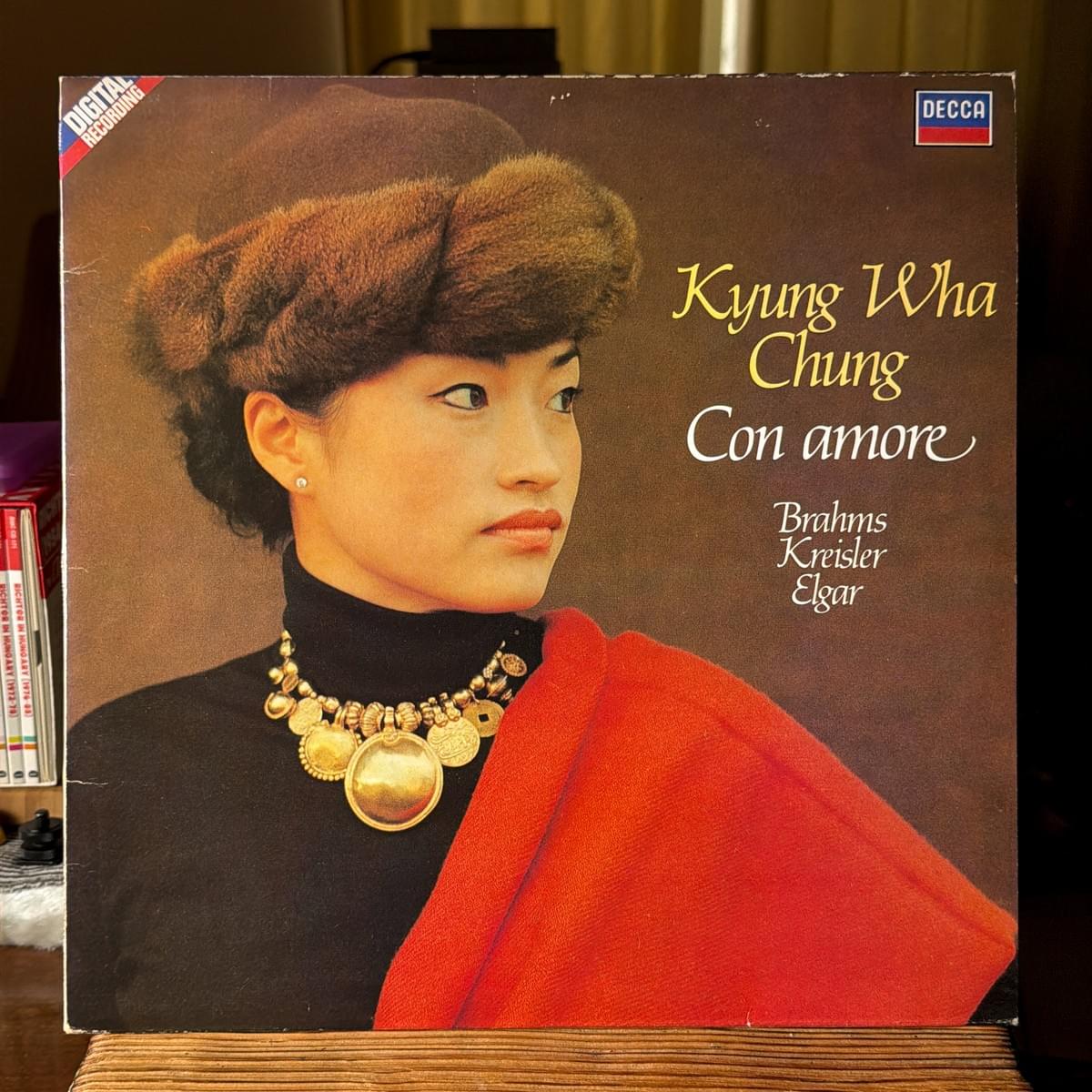
這張唱片的封面,在收藏圈裡有個暱稱:「紅披風」。
照片裡的鄭京和,披著一件鮮豔的磚紅色披風,頭戴毛皮帽,掛著金色大項鍊,側臉凝視著某個畫面以外的地方。攝影師是羅馬的 Vinzenz,那種光影與服裝搭配,有一種1980年代歐洲高端藝術攝影特有的強度。
一位英國樂評人看到這張封面,寫道:「鄭京和那件帶有哥薩克騎兵風情的封面服裝,可能讓人以為這是一張俄羅斯曲目的唱片——但實際上,這是一張獻給克萊斯勒、艾爾加、維尼亞夫斯基的糖果盒。」
糖果盒。這個形容很準確。但說這是「糖果」的人,可能沒有意識到:能把糖果做到這種深度,本身就是一種極罕見的藝術境界。
鄭京和最貴的一張黑膠
《Con Amore》在1987年由 Decca 正式發行。
錄音用的是數位技術(Digital Recording),那是1980年代中期的新科技;但黑膠的壓製,用的是老方法:在荷蘭廠,以 Decca 原廠的金屬母盤,一張一張地壓出來。
這張唱片,後來在鄭京和的整個黑膠目錄裡,成為二手市場價格最高的一張。
根據歷史成交紀錄,DECCA荷蘭壓片首版近年的頂標是 1388 美元。德國 Teldec 製作的 DMM 直刻版(6.43556)也達到 1200 美元(2021年)。
這個市場價格說明了一件事:這張唱片,在收藏圈裡的份量,已經遠遠超過一張「小品集」應有的位置。
原因並不複雜。鄭京和的 Decca 時代橫跨整個1970至80年代,大部分的錄音是協奏曲——有樂團、有指揮、有整個唱片工業體系在背後運作。而《Con Amore》是唯一一張只有她與一架鋼琴、在一個靜謐空間裡、選了她自己想演奏的曲子、用愛錄下來的錄音。
稀有,不只是因為數量少。是因為這種「只為自己演奏」的瞬間,在她的生涯裡,只有這一次。
古殿手上的這一張:荷蘭壓片,韓國身份
古殿目前持有的這張,是韓國星音有限公司(Sung Eum Limited)在 Decca 正式授權下發行的版本,唱片編號 SEL-RD 1024,對應國際版 417 289-1。
很多人看到「韓國版」三個字,直覺上會認為這是原廠國以外的壓片的版本。
但看仔細標籤上的每一行字:
MANUFACTURED / DISTRIBUTED BY SUNG EUM LTD. UNDER LICENSED BY THE DECCA REC.CO., LTD MADE IN HOLLAND
這張唱片,是在荷蘭壓製的。
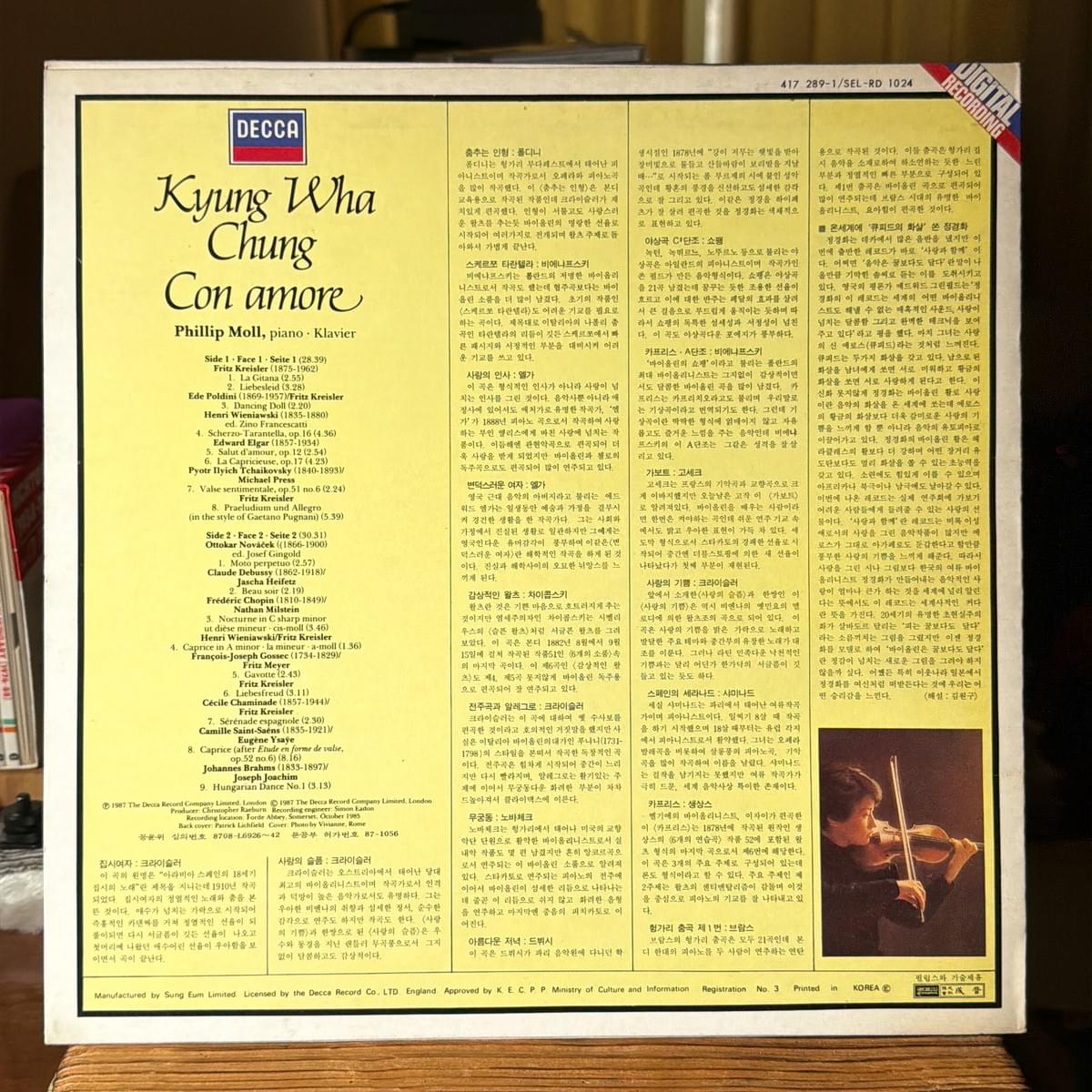
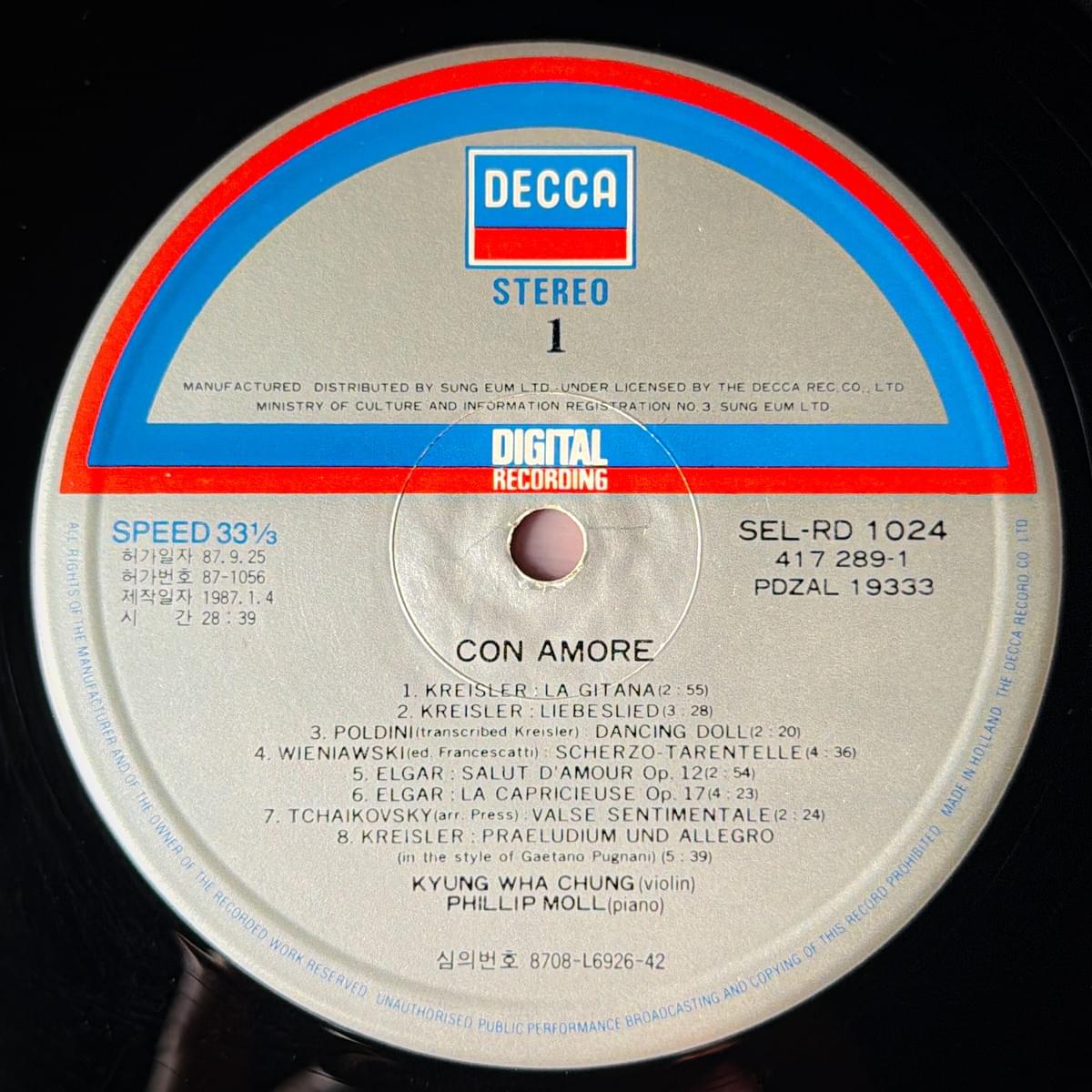
換言之:黑膠本體與歐洲發行版完全相同——同一座壓片廠、同一批金屬母盤、同一條生產線。唯一不同的,是走出工廠後,它裝進了一個印有韓文的封套,貼上了韓國文化公新部的審查戳記,以星音的名義在韓國市場發行。荷蘭版有的,韓國版一樣有,差別只是那件外衣。
這種版本在歐美收藏市場上能見度極低,定價遠低於歐洲版——但聆聽到的是完全相同的聲音。這是一張用韓國版的價格,聽到荷蘭版聲音的唱片。
重刻版也絕版了,但聲音不一樣
幾年前,Decca 為這張唱片出版了180克重刻版(DD41018),由 Emil Berliner Studios 重新母刻,德國 Pallas GmbH 壓製,一出版即告售罄。
但對聽過兩個版本的人來說,答案是清楚的:重刻版的聲音更乾淨,更「現代」,但少了某種只有1987年原版才有的活生感——那種讓音符像是還在呼吸的質地。
原因並不神秘。
1987年的荷蘭壓片,距離那個1985年10月的薩默塞特郡秋天最近。從錄音室到你的唱針,中間走過的環節最少,物理訊息的損耗也最小。而重刻版的母刻工程師,拿到的是數位化處理過的原始母帶,再以現代設備重新刻片——工藝無可挑剔,但這是重新詮釋,不是重新接近。
最後
鄭京和後來說:「我以為我必須一直往前衝。直到手指受傷,直到我不得不停下來,我才真正開始理解,什麼是音樂,什麼是生命。」
2005年,她的左手食指出了問題,幾乎宣告退休。五年後重返舞台,她說那是「第二次機會,也許是最後一次」。
1985年那個秋天,在薩默塞特郡的石牆裡,她也許還不知道這些。但她已經悄悄地、用那把琴,在那個安靜的午後,只為自己,也為所有還沒有機會聽到這段音樂的人,留下了這十七首曲子。
你生命裡,有沒有過一個「只是用愛去做,不需要向任何人證明任何事」的瞬間?
******
[Ancient Palace Music Stories] Playing with Love: Kyung-Wha Chung’s
Con Am
ore
What secret lies behind an album that has global collectors fighting to pay $1,388?
Almost every fan of Kyung-Wha Chung knows this: She was the first South Korean violinist to conquer the Western classical music world. In 1970, she stepped in at the last minute for Itzhak Perlman in London to perform the Tchaikovsky Violin Concerto. The audience was thunderstruck, and the next day, her name was plastered across the front pages of every major newspaper. From that exact moment, her name stood alongside Pinchas Zukerman and Perlman as one of the most sought-after violinists of her era.
Yet, that same fierce artist who dominated the concerto stage and played 120 concerts a year did something unexpected in the autumn of 1985. She quietly walked into a 12th-century stone monastery in the English countryside. There, she recorded the only collection of short pieces in her entire career—no orchestra, no conductor, just a violin and a piano.
She titled the album Con Amore.
In Italian, that means: "With love."
One Album, Recording a Woman’s Turning Point in Life
In 1985, Kyung-Wha Chung was 37 years old.
From the outside, her career was at its absolute zenith. Her contract with Decca Records was one of the most high-profile in the global recording industry. From Tchaikovsky to Elgar, Bruch to Bartók, her name alone guaranteed an album’s value.
But beneath this peak, something had quietly begun to shift.
Chung later confessed in an interview: "My performing career actually came to a halt in my thirties after I started a family. It wasn't just about me anymore; it was about the children, my husband, the home, and being a wife. I have never compromised as an artist, because once you compromise, you lose your individuality. But if you don't compromise in a marriage, the marriage cannot function. It was another journey—learning to be a mother and a wife."
In the autumn of 1985, she cut her schedule from 120 concerts a year down to 40. She began protecting her time for her family, for her children.
It was precisely at this crossroads that she stepped into Forde Abbey.
Forde Abbey is a 12th-century Cistercian monastery in Somerset, England. Surrounded by stone walls, wooden beams, and natural acoustic ambiance, the Decca engineers set up their microphones. Entering the studio with her was only the pianist Phillip Moll—a partner she had collaborated with for years, sharing an understanding that transcended words.
The repertoire she chose included Kreisler’s Liebesleid and Liebesfreud, Elgar’s Salut d’Amour, Debussy’s Beau Soir, a Chopin Nocturne, and Brahms’s Hungarian Dances.
They were all her favorite pieces, all short vignettes, and all beautiful music where she had absolutely nothing to prove to anyone.
In a person's life, the moments where you can allow yourself to "just play with love" are rare.
That Red Cloak on the Cover
In collector circles, this album’s cover has a famous nickname: "The Red Cloak."
In the photograph, Chung is draped in a striking brick-red cloak, wearing a fur hat and a large gold necklace, her profile gazing at something just beyond the frame. Shot by the Roman photographer Vinzenz, the interplay of light, shadow, and attire carries that intense, sophisticated art-photography vibe unique to 1980s Europe.
A British music critic saw this cover and wrote: "Kyung-Wha Chung’s Cossack-style cover attire might lead one to expect a recording of Russian repertoire—but in reality, this is a chocolate box dedicated to Kreisler, Elgar, and Wieniawski."
A chocolate box. The description is precise. But those who dismiss it as mere "candy" might not realize that elevating such miniature pieces to this level of depth is, in itself, a remarkably rare artistic feat.
Kyung-Wha Chung’s Most Expensive Vinyl
Con Am
ore was officially released by Decca in 1987.
The recording utilized digital technology—the cutting-edge tech of the mid-1980s. However, the vinyl pressing followed the old-school ways: pressed one by one at the Philips plant in the Netherlands using Decca's original metal masters.
Subsequently, this particular record became the highest-priced item in the secondhand market across Chung’s entire vinyl discography.
According to historical auction records, the absolute peak price for a first-pressing DECCA Netherlands copy has reached $1,388 in recent years. Even the DMM (Direct Metal Mastering) version produced by Teldec in Germany (6.43556) fetched $1,200 back in 2021.
This market price reveals a truth: the weight this record carries among collectors far exceeds the typical status of a mere "collection of short pieces."
The reason isn't complicated. Chung’s Decca era spanned the entire 1970s and 80s, and the vast majority of her recordings were concertos—backed by an orchestra, a conductor, and the massive machinery of the recording industry. Con Amorestands alone as the only recording where it is just her and a piano, sharing a quiet space, playing the music she wanted to play, recorded purely with love.
Rarity isn’t just about low production numbers. It is because a moment of "playing solely for oneself" occurred only this once in her entire career.
The Copy at Ancient Palace: Pressed in Holland, Born in Korea
The copy we currently hold at Ancient Palace is the version released by South Korea's Sung Eum Limited under official license from Decca, catalog number SEL-RD 1024, corresponding to the international release 417 289-1.
When many people see the words "Korean Pressing," their instinct is to assume it's a local reissue pressed outside the country of origin.
But look closely at every line printed on the label:
MANUFACTURED / DISTRIBUTED BY SUNG EUM LTD. UNDER LICENSED BY THE DECCA REC.CO., LTD
MADE IN HOLLAND
This record was actually pressed in the Netherlands.
In other words, the vinyl itself is entirely identical to the European release—same pressing plant, same batch of metal masters, same production line. The only difference is that after leaving the factory, it was placed into a jacket printed with Korean text, stamped with the verification seal of the Korean Ministry of Culture and Information, and distributed to the Korean market under the Sung Eum name. Everything the Dutch pressing has, the Korean pressing possesses too; the only difference is the outer coat it wears.
This version has incredibly low visibility in Western collector markets and is priced far below the European release—yet the sound you hear is exactly the same. It is a record that lets you experience the genuine sound of a Dutch pressing at a Korean pressing price point.
The Reissue is Sold Out Too, But the Sound is Different
A few years ago, Decca released a 180g reissue of this album (DD41018), remastered by Emil Berliner Studios and pressed by Pallas GmbH in Germany. It sold out immediately upon release.
Yet, for those who have heard both versions, the answer is clear: the reissue sounds cleaner and more "modern," but it lacks a certain vividness, a presence found only in the 1987 original—that specific texture that makes the notes feel like they are still breathing.
The reason isn't mystical.
The 1987 Dutch pressing is closest in time to that October autumn of 1985 in Somerset. From the studio to your stylus, the chain has the fewest links, meaning the loss of physical acoustic information is minimized. On the other hand, the mastering engineer for the reissue received a digitized version of the original master tapes and cut the lacquer using modern equipment. The craftsmanship is flawless, but it is a re-interpretation, not a re-approximation.
Epilogue
Kyung-Wha Chung later reflected: "I thought I had to keep rushing forward. It wasn't until my finger was injured, until I was forced to stop, that I truly began to understand what music is, and what life is."
In 2005, an issue with her left index finger nearly forced her into retirement. When she returned to the stage five years later, she called it her "second chance, and perhaps the last."
Back in the autumn of 1985, within those stone walls in Somerset, she might not have known all this yet. But she had already quietly used her violin on that peaceful afternoon, solely for herself—and for all of us who hadn't yet had the chance to hear it—to leave behind these seventeen tracks.
Have you ever had a moment in your own life where you did something "just with love, with absolutely nothing to prove to anyone"?