
【古殿唱片音樂故事】他的姓氏刻在棒球手套上,但卻是美國第一位國際級小提琴家:艾伯特・斯伯丁(Albert Spalding,1888-1953)與其人生最後錄音
古殿殿主
一個從姓氏開始的誤會
如果你小時候玩過棒球,你很可能已經間接認識過這個家族。A.G. Spalding,美國歷史最悠久的運動用品公司之一,球棒、手套、皮球,幾乎壟斷了二十世紀初美國職業棒球用品市場。創辦這家公司的人,是名人堂投手艾伯特・古德威爾・斯伯丁(Albert Goodwill Spalding,1850-1915)——史上第一個在場上戴手套接球的人,也是替棒球寫下正式規則的人之一。
1888年,芝加哥,這位傳奇投手的姪子出生了。父母以伯父的名字,為這個男孩命名——艾伯特・斯伯丁(Albert Spalding,1888-1953)。
如果故事照著這個姓氏的邏輯發展下去,這孩子的人生應該會走進運動用品的家族事業。
七歲那年的聖誕節,家裡人給了他一份半帶玩笑性質的禮物——一把只值四美元的二分之一小提琴,原本只是逗小孩開心。結果,這個男孩再也不肯把它放下。
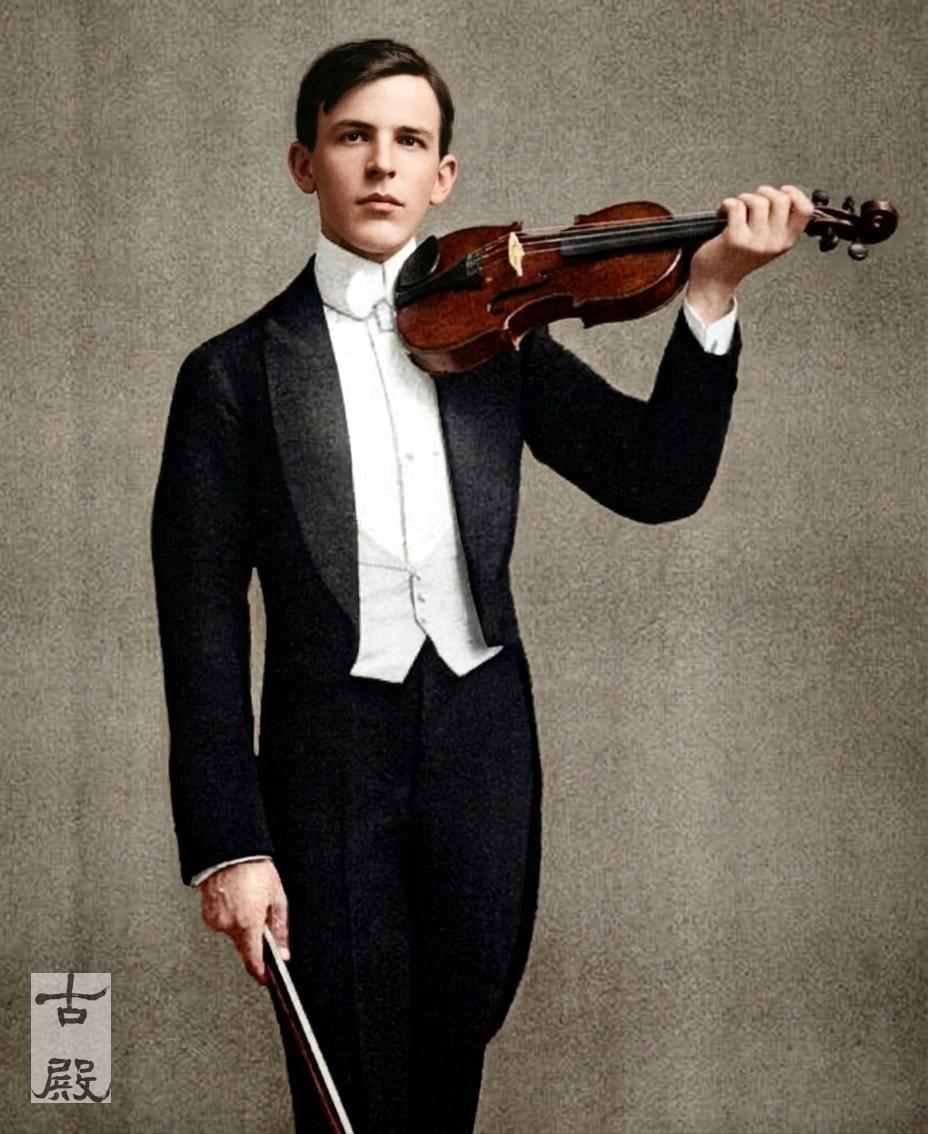
他用四十五年,證明這條路不需要伯父鋪路
斯伯丁沒有留在家族事業裡。他先在紐約與佛羅倫斯私下習琴,再赴巴黎與波隆那深造,十四歲便以優異成績從波隆那音樂院畢業——成為繼133年前的莫札特(Wolfgang Amadeus Mozart,1756-1791)之後,該校最年輕的畢業生。
他去柏林為姚阿幸(Joseph Joachim,1831-1907)——布拉姆斯(Johannes Brahms,1833-1897)協奏曲的受獻者本人——演奏。姚阿幸聽完後告訴他,不需要再接受任何「教導」了;可以獨立走自己的路了。
十六歲,他在巴黎正式登台,隨即成為當時以獨奏家身分受邀,僅有三位與巴黎音樂院管弦樂團合作演出的外國出生音樂家之一。另外兩位,是弗里茨・克萊斯勒(Fritz Kreisler,1875-1962)與歐仁・易沙意(Eugène Ysaÿe,1858-1931)。
後來的唱片解說中這樣形容他:不只是第一位,也是少數幾位真正獲得世界級聲譽的美國小提琴家。往後四十五年的演奏生涯裡,他始終被認為「在歐洲比在美國本土更受完整肯定」——一個帶著頂級運動品牌姓氏的男孩,最終在音樂裡,靠自己的名字站穩了腳跟。
兩場戰爭,兩個不屬於音樂廳的任務
斯伯丁的人生裡,有兩段完全不屬於音樂會海報的插曲。
一戰期間,他加入美國陸軍航空隊,一度擔任時任眾議員費奧雷洛・拉瓜迪亞(Fiorello La Guardia,1882-1947)的副官,戰後獲頒義大利王冠十字勳章。
二戰爆發後,美國國務院助理國務卿柏爾(Adolf A. Berle,1895-1971)親自說服他加入戰略情報局(OSS)的任務。斯伯丁先派駐倫敦六週,之後轉往北非,最終隨盟軍最高統帥部心理作戰處進駐那不勒斯。1944年,他在那不勒斯附近一處防空洞裡,為數千名躲避轟炸、驚恐萬分的難民,舉行了一場沒有海報、沒有售票、也沒有觀眾席的音樂會——在戰火最激烈的時刻,用琴聲安撫了一整個防空洞的人心。
也是在這段動盪的年代裡,1941年,他與波士頓交響樂團、指揮孟許(Charles Munch,1891-1968)合作,首演了塞繆爾 巴伯(Samuel Barber,1910-1981)的小提琴協奏曲——這部作品後來成為極少數躋身古典音樂小提琴文獻的美國本土作品之一。
克萊斯勒後來這樣評價他:「他從不曾讓聽眾的心弦停止震動——他不只是一位美妙的小提琴家,更是一位卓越的公民與愛國者。」
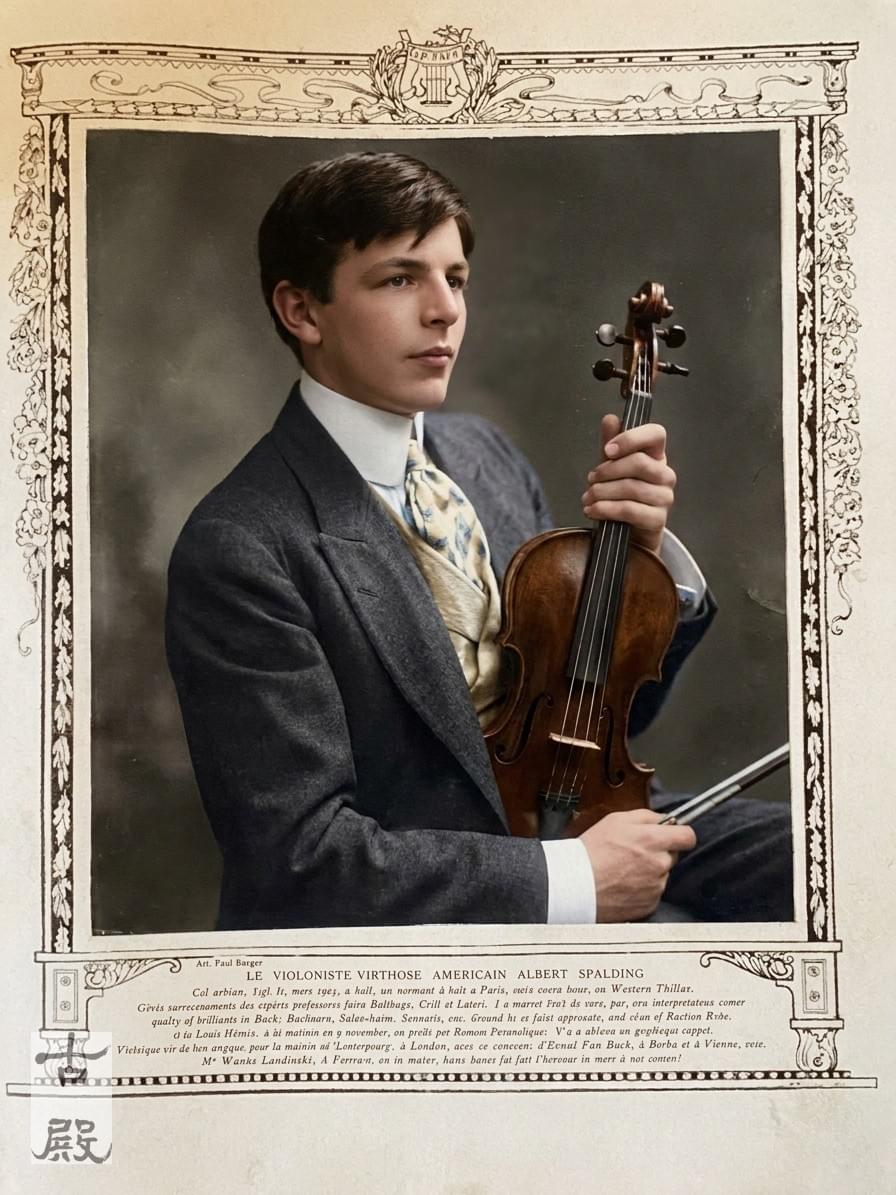
1952年,維也納,他人生最後一次錄音室現場
1952年底,斯伯丁在維也納音樂協會大廳裡的布拉姆斯廳(Brahms-Saal),與威廉・洛伊布納(Wilhelm Loibner,1909-1971)指揮的維也納音響藝術家交響樂團,錄下了布拉姆斯《小提琴協奏曲》——同一次錄音場次,他們也一併錄下了貝多芬(Ludwig van Beethoven,1770-1827)協奏曲。
這兩份錄音,是斯伯丁一生中僅有的兩份「非78轉」協奏曲錄音,也實際上是他生前最後一次的錄音室場次——半年多後,1953年5月26日,斯伯丁猝逝於紐約。
當時採用的是Remington唱片公司稱為「Musirama」的四支麥克風近距離收音技術——這在1952年是相當前衛的做法。但更值得注意的是錄製方式本身:儘管已經進入磁帶時代,每個樂章仍然是從頭到尾一次「一鏡到底」錄製完成,沒有分段、沒有事後剪接——某種程度上,這仍然延續著留聲機時代直接刻片的邏輯。
也正因為如此,這份錄音裡留下了一些「不完美」的痕跡:樂團裡一些額外的雜音,某人(可能是獨奏家本人或指揮)不經意的踏地聲,還有幾處合奏與音準上不算完美的瞬間。這些痕跡,很可能來自演出本身高度緊繃的張力,以及一鏡到底、無法回頭重錄的壓力。
換句話說,你在這張唱片裡聽到的,不只是布拉姆斯的音樂,還有一位小提琴家在生命最後階段,面對麥克風時真實的呼吸與緊張感。
一份被冷凍了二十七年的母帶
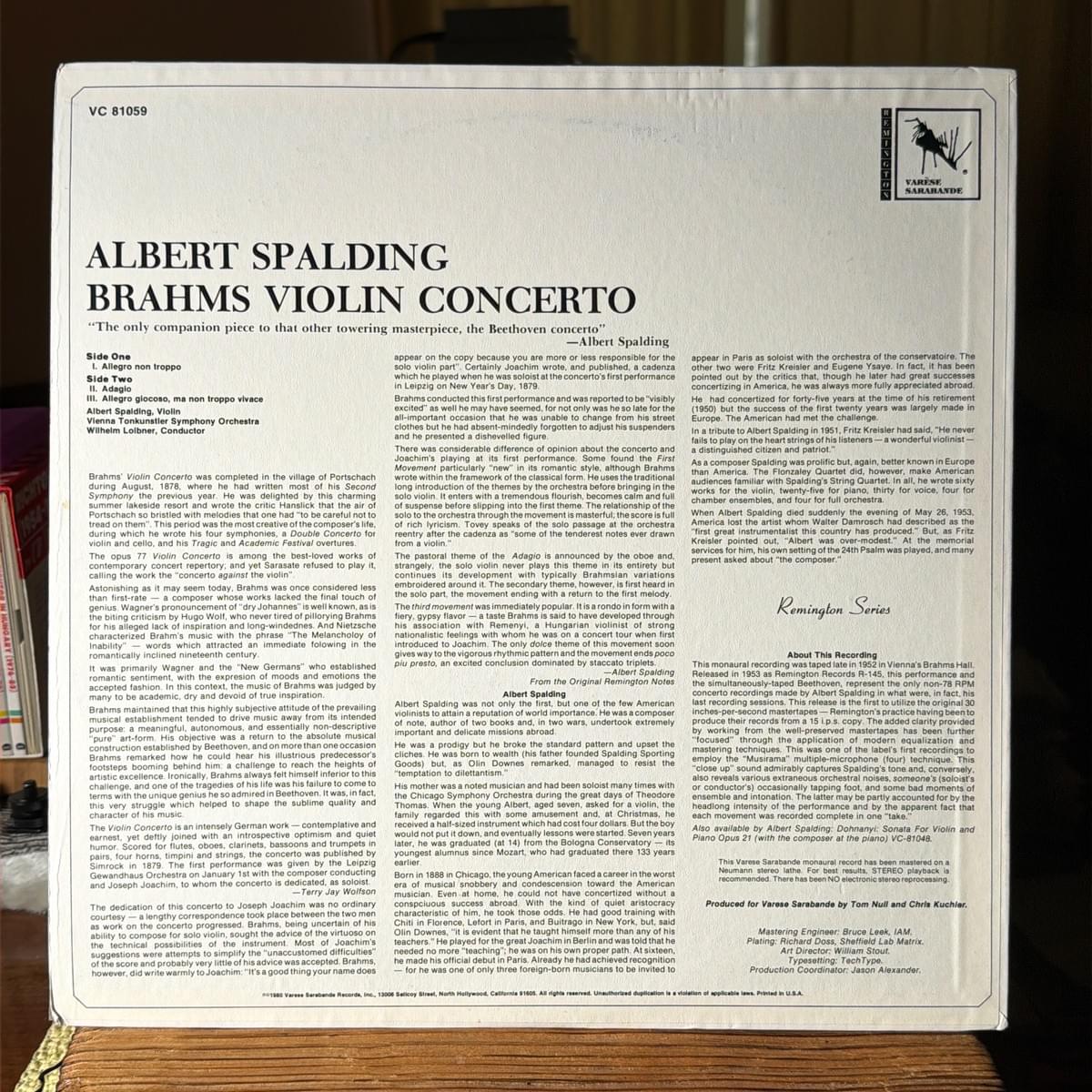
1953年,這份錄音由Remington Records以R-145編號正式發行。但這裡有一個長期不為人知的技術細節:Remington當年的一貫做法,是從15 IPS(每秒15英吋)的拷貝母帶製版,而不是使用最原始的、以30 IPS速度紀錄的母帶——後者是當時磁帶錄音所能達到的最高規格。
原始的30 IPS母帶,其實一直被完好保存著。只是在Remington的年代,沒有人真正用它來製作過唱片。
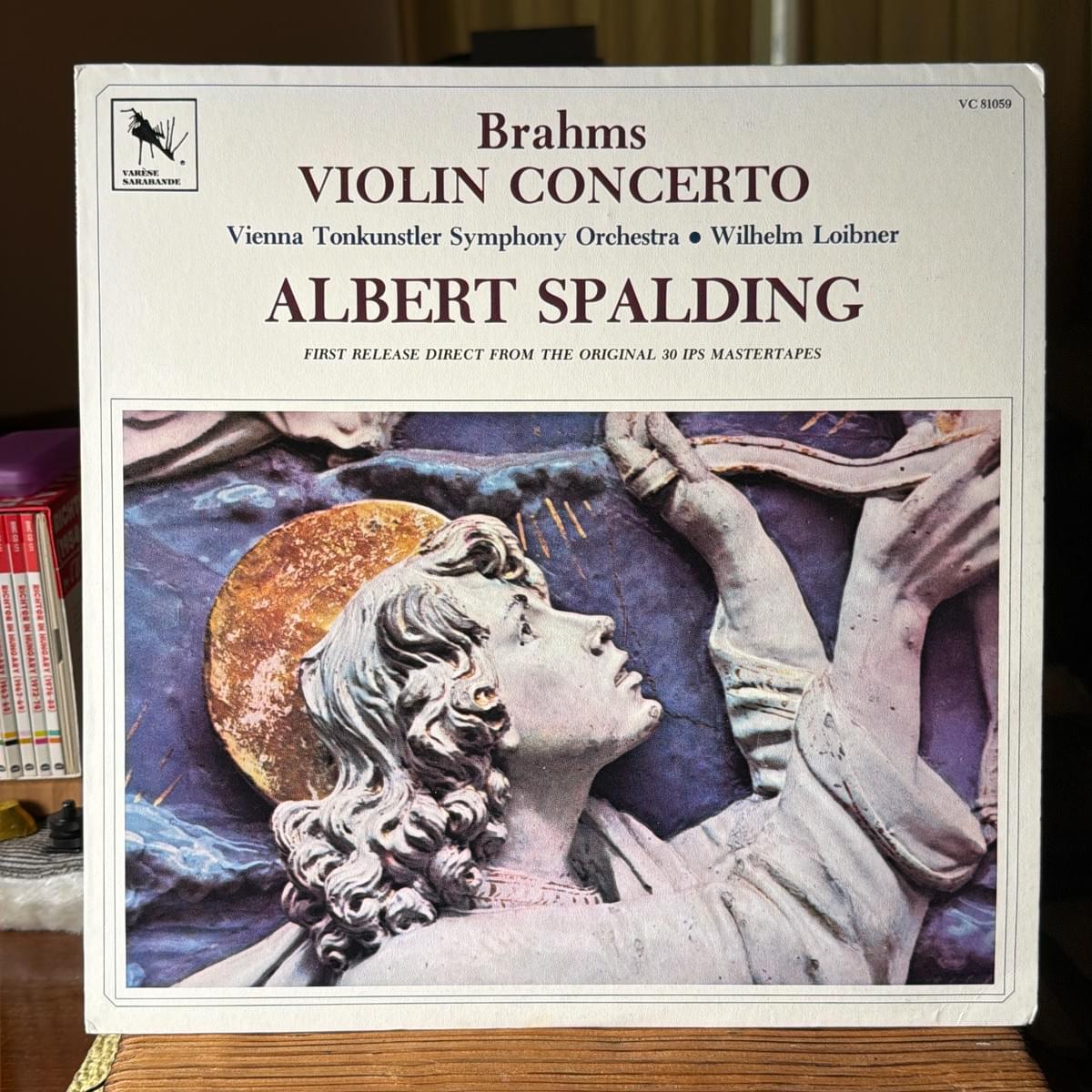
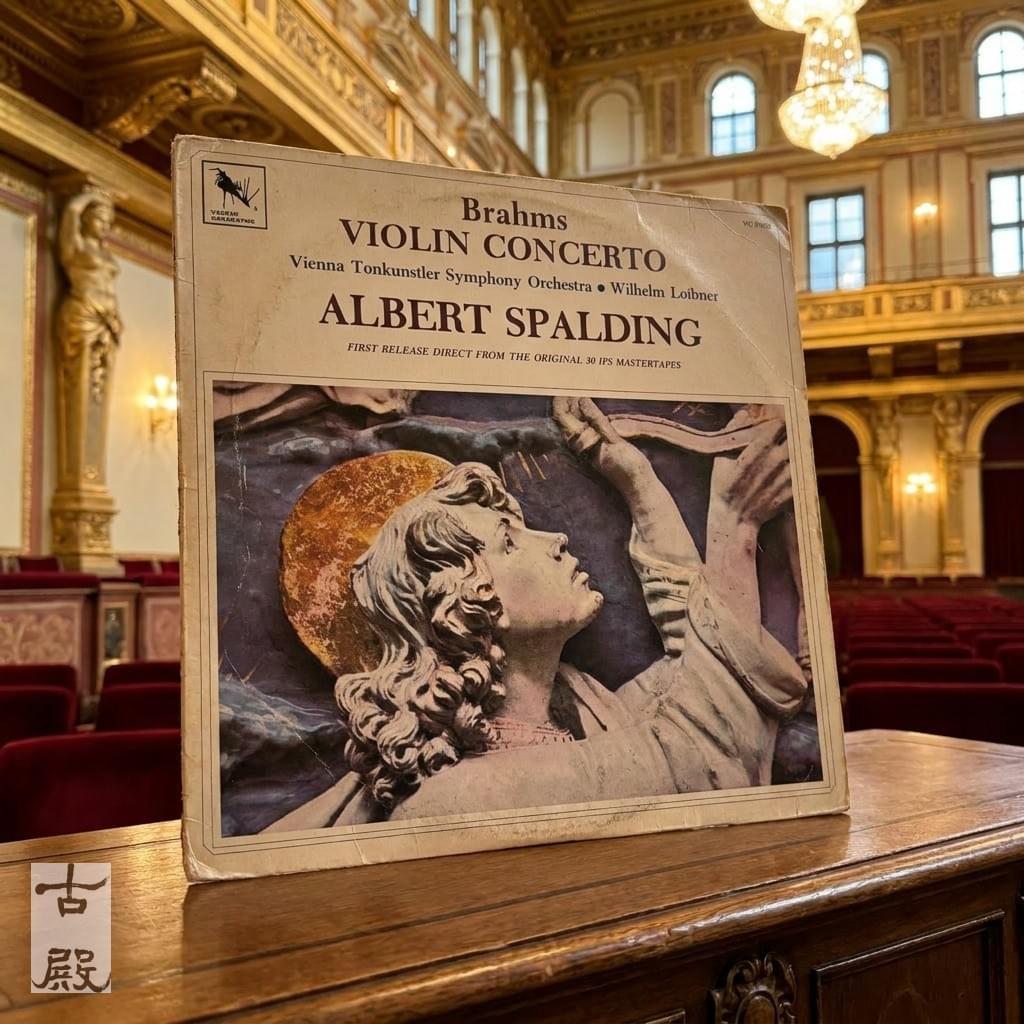
一直到1980年,專門發行發燒錄音的美國廠牌Varèse Sarabande,才第一次直接取用這份原始30 IPS母帶,重新製作發行——也就是眼前這張VC 81059。透過保存完好的母帶所帶來的額外清晰度,再結合現代均衡與母帶處理技術,這份錄音獲得了比1953年Remington原版更進一步「聚焦」的音質。
也就是說,斯伯丁1952年在布拉姆斯廳裡真正拉出來的聲音,一直要等到他去世27年後,才第一次以較接近原始樣貌的方式,回到世人耳中。
手上這張黑膠,特別在哪裡?
這張VC 81059,紅色標籤上印著Varèse Sarabande的鶴鳥商標,隸屬該廠牌旗下專門重新發行歷史錄音的Remington系列。封面選用了一幅巴洛克風格天使雕像的特寫——仰頭望天、伸展的手臂,帶著鎏金般的光暈,藍紫色調的背景,氣氛莊重,呼應著唱片裡那份近乎告別式的錄音。
唱片背面詳細標註了製作團隊:Tom Null與Chris Kuchler監製,母帶工程師Bruce Leek,電鑄製版Richard Doss(Sheffield Lab Matrix,喇叭花製版師),藝術指導William Stout。標籤上也清楚寫著,這是一張單聲道錄音,卻是在Neumann立體聲刻片機上完成母帶刻片——廠方特別註明建議以立體聲唱頭播放以獲得最佳效果,同時強調這張唱片絕無經過任何電子模擬立體聲的重製,聲音是忠實於原始母帶的單聲道紀錄。
一份錄音,要等多久,才會被世界聽見它真正的樣子?
斯伯丁從來不是一位需要靠家族姓氏成名的音樂家。他用四十五年的演奏生涯、兩場戰爭裡的抉擇、還有生命最後一次走進錄音室的緊張與專注,證明了這一點。
但即使是這樣一位音樂家最後的錄音,也差一點就永遠停留在一份當年妥協的拷貝版本所出版的黑膠裡,一直要到有人願意回到倉庫深處,把原始更完整的母帶重新找出來,再花心思重新製作。
一份錄音的「真正樣子」,有時候不是錄下來那一刻就決定的,而是要等到某個人,願意花時間、花技術,把它從時間裡重新打撈出來,才算真正完成。
這份1952年的琴聲,等了27年,終於重現其廬山真面目。
******
【Gudian Music Stories】His Last Name Is Stamped on Baseball Gloves, Yet He Was America’s First International Violinist: Albert Spalding (1888–1953) and His Final Recording
A Misunderstanding That Started with a Last Name
If you played baseball as a child, chances are you’ve already met this family indirectly. A.G. Spalding—one of the oldest sporting goods companies in American history—virtually monopolized the professional baseball market in early 20th-century America with its bats, gloves, and balls. The founder of this empire was Hall of Fame pitcher Albert Goodwill Spalding (1850–1915), the first player in history to catch with a glove on the field and one of the men who wrote baseball's official rulebook.
In 1888, in Chicago, a nephew was born to this legendary pitcher. His parents named the boy after his famous uncle: Albert Spalding (1888–1953).
If the story had followed the logic of his last name, the boy would have spent his life in the family’s sporting goods business.
Then came Christmas when he was seven years old. His family gave him a half-joking gift—a half-size violin worth just four dollars, meant only to entertain a child.
He never put it down again.
Forty-Five Years Proving He Didn't Need His Uncle's Name
Spalding didn’t stay in the family business. He studied privately in New York and Florence before pursuing advanced studies in Paris and Bologna. At age fourteen, he graduated with distinction from the Bologna Conservatory—becoming the school's youngest graduate since Wolfgang Amadeus Mozart (1756–1791) 133 years earlier.
He traveled to Berlin to play for Joseph Joachim (1831–1907), the dedicatee of the Brahms Violin Concerto. After listening, Joachim told him he needed no further "instruction" and was ready to walk his own path independently.
At sixteen, he made his formal debut in Paris. Soon after, he became one of only three foreign-born violinists invited to perform as a soloist with the Orchestre du Conservatoire de Paris. The other two were Fritz Kreisler (1875–1962) and Eugène Ysaÿe (1858–1931).
Later album liner notes described him not just as the first, but as one of the very few American violinists to achieve a true international reputation. Throughout a 45-year performing career, he was consistently regarded as being "even more fully appreciated in Europe than in his home country"—a boy carrying the name of a top sporting goods brand who ultimately forged his own legacy through music.
Two Wars, Two Missions Far Beyond the Concert Hall
Spalding’s life contained two chapters that never belonged on concert posters.
During World War I, he joined the U.S. Army Air Service, serving for a time as an aide-de-camp to Congressman Fiorello La Guardia (1882–1947). After the war, he was awarded the Crown of Italy.
When World War II broke out, Assistant Secretary of State Adolf A. Berle (1895–1971) personally persuaded him to join the Office of Strategic Services (OSS). Spalding was stationed in London for six weeks, then deployed to North Africa, and eventually entered Naples with the Psychological Warfare Branch of Allied Force Headquarters. In 1944, inside an air-raid shelter near Naples, he gave a concert for thousands of terrified refugees hiding from bombs—a concert with no posters, no ticket sales, and no seating charts. At the height of war, his violin brought comfort to a shelter full of frightened souls.
It was also during these turbulent years, in 1941, that he premiered Samuel Barber’s (1910–1981) Violin Concerto with Charles Munch (1891–1968) and the Boston Symphony Orchestra—a piece that would become one of the rare American works to enter the core classical violin repertoire.
Fritz Kreisler later offered this tribute: "He never failed to touch the heartstrings of his audience—he was not only a wonderful violinist, but a distinguished citizen and patriot."
1952, Vienna: His Final Studio Performance
In late 1952, at the Brahms-Saal of the Musikverein in Vienna, Spalding recorded the Brahms Violin Concerto with the Tonkünstler Orchestra under Wilhelm Loibner (1909–1971). During the same sessions, they also recorded the Beethoven (1770–1827) Violin Concerto.
These two recordings were the only non-78 rpm concerto recordings Spalding ever made, and they turned out to be the last studio sessions of his life. Just over six months later, on May 26, 1953, Spalding passed away suddenly in New York.
The session utilized Remington Records' close-miking technique called "Musirama," employing four microphones—a remarkably avant-garde approach in 1952. But even more noteworthy was the method of capture itself: despite entering the tape era, each movement was recorded in a single, unedited take from start to finish. There were no edits or post-production splices—in a way, it preserved the direct-to-disc philosophy of the gramophone era.
Because of this "single-take" pressure, subtle imperfections remain in the recording: stray noises from the orchestra, an incidental foot-tap (perhaps from the soloist himself or the conductor), and a few fleeting moments where ensemble precision or intonation isn't quite perfect. These artifacts speak to the high tension of the live-in-studio atmosphere—a performance captured in one breath, with no second chances.
In other words, what you hear on this record isn't just Brahms's music; it is the raw breath and palpable tension of a master violinist facing the microphone in the final chapter of his life.
A Master Tape Frozen for 27 Years
In 1953, the recording was formally released by Remington Records as catalog number R-145. However, there was a long-overlooked technical detail: Remington’s standard practice at the time was to cut lacquers from a 15 IPS (inches per second) safety master copy, rather than using the original master recorded at 30 IPS—the highest tape fidelity available back then.
The original 30 IPS master tape sat safely in storage, but during Remington's era, no one ever used it to press a record.
It wasn't until 1980 that Varèse Sarabande, an American audiophile label, went back to that original 30 IPS master tape to remaster and reissue the recording as VC 81059. Thanks to the extra clarity of the pristine master, combined with modern equalization and mastering techniques, this reissue achieved a far more focused sound quality than the 1953 Remington original.
The actual sound Spalding produced in the Brahms-Saal in 1952 would take 27 years after his death to finally reach the world in a form closest to its original performance.
What Makes This Vinyl Pressing So Special?
This particular pressing, VC 81059, features Varèse Sarabande’s red label stamped with their signature crane logo, belonging to the label's Remington series dedicated to reissuing historic recordings. The cover art displays a close-up of a Baroque angel sculpture—gazing skyward with outstretched arms beneath a gilded glow against a deep blue-purple backdrop. Its solemn atmosphere mirrors the elegiac quality of this final recording session.
The back jacket credits the production team in detail: produced by Tom Null and Chris Kuchler, mastering engineer Bruce Leek, electroforming by Richard Doss (Sheffield Lab Matrix), and art direction by William Stout. The label clearly states that while it is a monophonic recording, mastering was completed on a Neumann stereo cutterhead—with a note recommending playback using a stereo cartridge for optimal performance, while emphasizing that no artificial electronic stereo processing was applied. The sound remains a faithful, pure mono transfer of the original master tape.
How Long Must a Recording Wait to Be Heard as It Truly Was?
A
lbert Spalding never needed a famous surname to make his mark. He proved it through a 45-year concert career, his courageous choices across two World Wars, and the raw vulnerability he brought to his final studio session.
Yet even the final recording of a master like Spalding nearly remained trapped forever in a compromised copy. It took someone willing to dig into the back of a vault, pull out the pristine master tape, and give it the meticulous care it deserved.
The true essence of a recording isn't always decided at the exact moment it is captured. Sometimes, it is only truly completed when someone in the future decides to take the time, the skill, and the heart to rescue it from time itself.
It took 27 years for this violin performance from 1952 to finally reveal its true voice to the world.