
【古殿唱片音樂故事】世界上最挑剔的指揮家,為什麼對這份現場錄音點了頭?
卡洛斯·克萊伯1982年慕尼黑那個不可思議的夜晚
古殿殿主
告訴你一件很荒唐的事。
有一位指揮家,唱片公司好不容易把錄音做完、裝箱、準備出貨了。他自己跑去唱片行買了一張回來聽。聽到某個地方,覺得不對。
然後他打電話給唱片公司,要求回收,希望重錄。
這是卡洛斯·克萊伯(Carlos Kleiber,1930-2004)曾發生過的事。
他是英國《BBC音樂雜誌》評選史上最偉大的指揮家第一名。他的整個職業生涯,五十年,根據記錄只指揮了九十六場管弦樂音樂會。生前正式授權出版的錄音,兩隻手的手指數得完。他說:「我只有冰箱空了才出門工作。」
就是這樣一個人,在1982年5月3日,做了一件他這輩子幾乎從沒做過的事:
他聽完現場錄音,主動說——這個可以出版。
而且,他甚至史無前例地親自提筆,為這張唱片寫下了封套文字。
這場音樂會,不是普通的音樂會
1982年5月3日,慕尼黑國家劇院。
這是慕尼黑國家劇院當季的第六屆學院音樂會,但這場演出還有另一個標題:「貝姆追悼學院音樂會」。
卡爾·貝姆(Karl Böhm,1894-1981)在前一年八月剛去世。他是那個時代德語歌劇的精神支柱,在慕尼黑任職長達數十年,把巴伐利亞國立歌劇院帶入戰後的輝煌。貝姆走了,慕尼黑樂界要辦一場追悼音樂會。
他們請了克萊伯。
克萊伯帶來了貝多芬第四號交響曲。
這場錄音後來出版,還有另一層意義:這是一張慈善義演盤,收益用於修復慕尼黑另一座歷史場館——普林茨雷根特劇院(Prinzregententheater)。那座劇院在1943年的空襲中受損,1964年起因建物劣化停用,修復工程需要龐大資金。克萊伯自己在封套文字裡也提到:「對吹毛求疵的批評者,我們有一個藉口——這是為普林茨雷根特劇院所做的慈善出版,也是一場現場演出。」
換句話說,這張唱片從一開始,就不是為了「完美」而存在的。它是為了一座受傷的劇院、一位剛逝去的大師、和一個特殊夜晚的生命狀態而存在的。
演出結束後,克萊伯非常興奮——這本身就是一件稀罕的事。他說,這是他一生中最重要的演奏之一。他不只同意出版,還親筆寫下:
「我們既不想、也無法對這個演奏的「聲音快照」使用任何修飾,或做出哪怕最細微的修正……對那些能夠感受到生命力的耳朵,這裡有一些東西,是沒有任何樂團能為你演奏得如此熱切、如此靈動、或如此充滿靈感和愉悅的——正如這個樂團在那一天的演出。衷心感謝!」
這是克萊伯在錄音史上留下的唯一一段親筆聲明。而這段文字裡藏著一句非常重要的話:「沒有任何樂團」。
這不是客套。對於一個一生只指揮九十六場管弦樂音樂會、對每一個細節都有近乎病態要求的人來說,「沒有任何樂團」的意思只有一個——在他有生之年指揮過的所有樂團裡,沒有任何一個,在任何一個夜晚,達到過這個高度。
但還有一件事,比這句話本身更值得停下來想一想。
克萊伯是一個連「同意出版」都要克服巨大恐懼的人。他不欠任何人一個字,沒有任何慣例要求他為這張唱片寫什麼。但他主動提筆,寫下了這段文字。他寫的不是樂曲解說,不是錄音說明——他寫的是一聲感謝。
「衷心感謝!」
從克萊伯這個人說出這四個字,份量完全不一樣。這不是禮貌,不是客套,不是職業性的致謝。這是一個內心極度嚴苛、對自己和他人都近乎苛刻的人,在被真正打動之後,從內心深處說出來的感恩。
1982年5月3日的慕尼黑,是這位世界上最挑剔的指揮家,心中有史以來最好的一場現場。而那個夜晚讓他感動到必須提筆致謝——這件事本身,就已經說明了一切。
福特萬格勒讓位了——四十年無人能撼動
這張唱片1984年出版之後,發生了一件事。
在日本《唱片藝術》的貝多芬第四號名曲決定盤排行中,長年穩坐第一的版本,是福特萬格勒(Wilhelm Furtwängler,1886-1954)。
福特萬格勒是德國指揮的神話,他的貝多芬詮釋被整個古典音樂世界視為這個傳統最不可動搖的頂峰。沒有人覺得他的王座會動搖。
克萊伯這張一出,福特萬格勒退到第二位。
從那天起,四十年過去了,沒有任何人能撼動這個位子。
那個只指揮九十六場管弦樂音樂會、「冰箱空了才出門」的人,用一場追悼音樂會的現場錄音,定義了貝多芬第四號的最高標準。
至今無人超越。
他的指揮,是一場舞蹈
克萊伯最讓人著迷的,不只是聲音的結果,而是他指揮的樣子。
很多指揮家揮得很投入、很過癮,但台上的激情與台下的樂音之間,隱隱有一條縫。克萊伯不一樣。他的每一個手勢、每一個身體的律動,都是完全長在音樂裡的——不是他在表達音樂,而是音樂透過他的身體流出來。翩翩如舞,每個動作都是音樂本身的延伸。
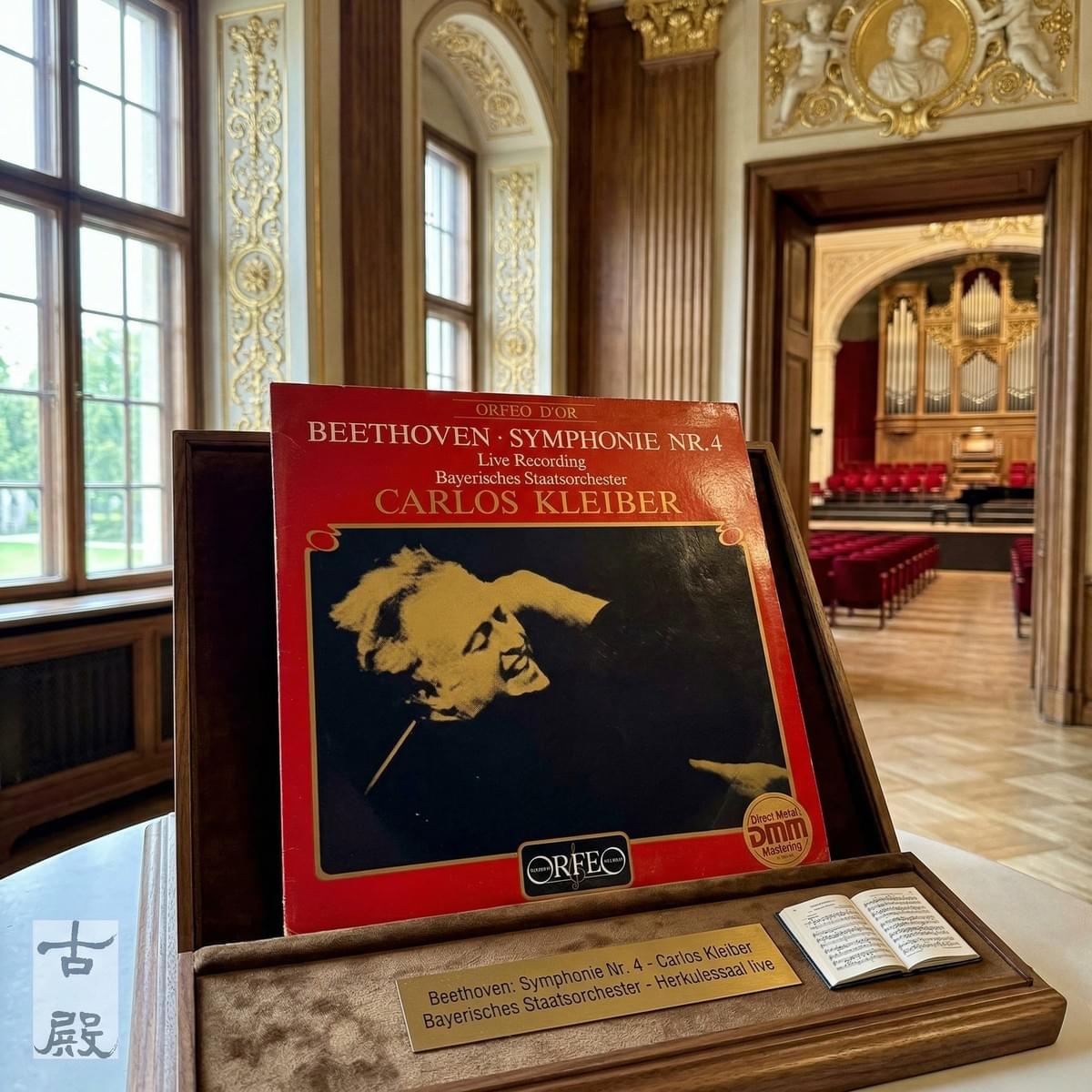
你看看這張唱片的封面。
深藍底色,一個金色的人影,指揮棒指向空中,整個身體傾斜著,彷彿正被音樂帶著飛起來。這不是一張設計出來的宣傳照——這是他真實指揮時的樣子,被捕捉下來的一個瞬間。
當你按下播放鍵,閉上眼睛,你會發現這個錄音裡的聲音,跟這張封面是同一個世界的東西。那不是沈重的哲學,那是一場狂歡。音樂本身就在舞蹈,樂團跟著他在舞蹈,而你,也會不由自主地被帶進那個舞蹈裡。
封面的那個金色人影,就是那個聲音的來源。聲音與圖像,在這裡真正地合而為一。
「圓的方程式」——連數學都解不出的東西
在這張唱片的封底,《南德意志報》樂評人凱薩(Joachim Kaiser)試圖解釋克萊伯為什麼如此不同。
他用了一個意象:化圓為方(Quadratur des Kreises)——幾何學上那個永遠無法完成的任務。
在貝多芬的演奏裡,有一個古老的矛盾:你可以嚴格精準,但會失去呼吸;你可以情感流動,但會失去結構。通常,你只能選一邊。把兩件事同時做到,幾乎是不可能的。
克萊伯那一晚,把兩件事都做到了。
第一樂章的慢板,謎一般的黑暗靜默慢慢積蓄——然後,Allegro vivace突然爆發,不是漸進的,是突然的,像黑暗中一個巨大而確定的肯定。速度快,但你感受到的不是「快」,而是每一個樂句都以最自然的方式呼吸、展開、消散。
技術已經被遺忘,剩下的只有音樂本身。
第四樂章,巴松管在克萊伯近乎瘋狂的速度下走到了人體極限的邊緣。那幾個顫抖的音符,沒有剪掉,全都留在唱片裡。克萊伯說:我們不想修正任何東西。那不是失誤——那是在極限之下,依然給出一切的證明。
世界上最挑剔的人,為什麼對「有瑕疵」的錄音點了頭?
克萊伯的父親埃里希·克萊伯(Erich Kleiber,1890-1956)是兩次大戰之間德語音樂界的頂尖人物。納粹上台後毅然辭職離國,不屈服任何政治壓力。
這個父親,勸兒子不要學音樂,把他送去念化學。
克萊伯念了一陣子化學,還是回來了,從最小的德國地方歌劇院開始,一個人摸索。他幾乎總是用父親親筆標記的總譜來準備詮釋——不是在模仿父親,而是在一場永遠沒有終點的對話裡,透過父親的痕跡找自己的聲音。
「批准一個錄音,通常是一種恐懼。」這句話有多重,只有理解了這整個背景的人,才能感受到。
那他為什麼這次點頭了?
我自己的想法是:那一晚,他遇到了比「完美」還要真實的東西。一個擁有五百年歷史的樂團,在一個紀念逝去大師的特殊夜晚,給出了任何錄音室都複製不了的狀態——那種全身投入、傾盡所有、甚至走到極限邊緣還是繼續的合奏狀態。
他說的很清楚:「對那些能感受到生命力的耳朵……」
他沒有說「懂古典音樂的人」。
他說的是能感受到生命力的耳朵。
這個門檻,不需要任何預備知識。只需要你願意,用全身去聽。
*******
【Music Stories from Ancient Hall】
Why Did the World’s Most Picky Conductor Finally Give the Nod to This Live Recording?
The Incredible Night of Carlos Kleiber: Munich, 1982
Let me tell you something absolutely absurd.
There was once a conductor who, after the record company had finally finished the recording, boxed the CDs, and was ready to ship them out, went to a record store and bought a copy to listen to himself. Upon hearing a certain passage that didn’t feel right, he immediately called the company and demanded they recall the entire shipment to re-record.
This was Carlos Kleiber (1930–2004).
Ranked as the greatest conductor in history by the BBC Music Magazine, his entire career spanned fifty years, yet records show he conducted only ninety-six orchestral concerts. The number of officially authorized recordings published during his lifetime can be counted on your fingers. He famously said, "I only go out to work when my fridge is empty."
But on May 3, 1982, this man did something he almost never did in his life:
After listening to the live recording of a performance, he took the initiative to say—"This can be published."
Moreover, he did something unprecedented: he personally sat down and wrote the liner notes for this record.
This Was No Ordinary Concert
May 3, 1982, at the Munich National Theatre.
It was the sixth Academy Concert of the season for the Munich National Theatre, but the performance carried another title: "The Karl Böhm Memorial Academy Concert."
Karl Böhm (1894–1981) had passed away the previous August. He was the spiritual pillar of German opera in that era and had served in Munich for decades, leading the Bavarian State Opera into its post-war glory. With Böhm gone, the Munich music world wanted to hold a memorial concert.
They invited Kleiber.
Kleiber brought with him Beethoven’s Symphony No. 4.
The release of this recording later held another layer of meaning: it was a charity disc, with proceeds dedicated to the restoration of another historic venue in Munich—the Prinzregententheater. That theater had been damaged in the 1943 air raids and had been out of use since 1964 due to structural decay; the restoration required massive funding. Kleiber himself mentioned in the liner notes: "For the nitpicking critics, we have an excuse—this is a charity publication for the Prinzregententheater, and it was a live performance."
In other words, from the very beginning, this record did not exist for "perfection." It existed for a wounded theater, for a recently departed master, and for the "state of life" of one special night.
After the performance, Kleiber was incredibly excited—a rarity in itself. He said it was one of the most important performances of his life. Not only did he agree to the publication, but he also personally wrote:
"We neither wanted nor were able to use any retouching or make even the slightest correction to this 'sound snapshot'... For ears that can feel vitality, there is something here that no orchestra could play for you with such fervor, such nimbleness, or such inspiration and joy—as this orchestra did on that day. My heartfelt thanks!"
This is the only handwritten statement Kleiber ever left in the history of recording. And within these words lies a crucial phrase: "No orchestra."
This wasn't mere politeness. For a man who conducted only ninety-six orchestral concerts in his life and held almost pathological standards for every detail, "no orchestra" meant only one thing—of all the orchestras he had ever conducted, on any given night, none had ever reached this height.
But there is one thing even more worth pausing to consider than the sentence itself.
Kleiber was a man who had to overcome immense fear just to "agree to a publication." He didn't owe anyone a single word; no convention required him to write anything for this record. Yet, he chose to pick up the pen. What he wrote wasn't a musical analysis or a recording log—he wrote a thank you.
"My heartfelt thanks!"
Coming from Carlos Kleiber, those four words carry a completely different weight. This wasn't etiquette, nor was it a professional courtesy. This was a man, intensely rigorous and nearly harsh on himself and others, speaking from the depths of his soul after being truly moved.
Munich on May 3, 1982, was, in the heart of the world’s most fastidious conductor, the best live performance of all time. The fact that the night moved him so deeply that he felt compelled to write a letter of thanks—that says everything.
Furtwängler Steps Aside—Unshaken for Forty Years
After this record was published in 1984, something happened.
In the rankings for the "Definitive Version" of Beethoven’s Fourth Symphony in the Japanese magazine Record Geijutsu, the version that had sat firmly at number one for years was that of Wilhelm Furtwängler.
Furtwängler was the myth of German conducting; his interpretation of Beethoven was seen by the entire classical music world as the most immovable peak of the tradition. No one thought his throne would ever be shaken.
But once Kleiber’s version was released, Furtwängler moved to second place.
Forty years have passed since that day, and no one has been able to shake this version from its position.
The man who conducted only ninety-six concerts and "only went out when the fridge was empty" used a live recording of a memorial concert to define the highest standard of Beethoven’s Fourth.
To this day, he remains unsurpassed.
His Conducting Was a Dance
What fascinates people most about Kleiber isn't just the resulting sound, but the way he looked while conducting.
Many conductors are very involved and passionate, but there is often a slight gap between the passion on stage and the music coming from the pit. Kleiber was different. Every gesture, every rhythm of his body, was completely "grown" within the music—it wasn't that he was expressing the music, but rather that the music was flowing through his body. He was as graceful as a dancer; every movement was an extension of the music itself.
Look at the cover of this record.
A deep blue background with a golden silhouette, a baton pointing into the air, the entire body leaning as if being carried away by the music. This wasn't a staged promotional photo—it was a snapshot of him in actual performance.
When you press play and close your eyes, you’ll find that the sound in this recording belongs to the same world as this cover. It isn't heavy philosophy; it’s a celebration. The music itself is dancing, the orchestra is dancing with him, and you, too, will be involuntarily drawn into that dance.
That golden figure on the cover is the source of that sound. Here, sound and image truly become one.
"Squaring the Circle"—Something Even Math Cannot Solve
On the back cover of this record, the music critic for the Süddeutsche Zeitung, Joachim Kaiser, attempted to explain why Kleiber was so different.
He used an image: Squaring the Circle (Quadratur des Kreises)—the task in geometry that can never be completed.
In the performance of Beethoven, there is an ancient contradiction: you can be strictly precise, but you will lose the "breath"; you can have emotional flow, but you will lose the "structure." Usually, you can only choose one side. To achieve both at the same time is nearly impossible.
On that night, Kleiber achieved both.
In the Adagio of the first movement, a mysterious darkness and silence slowly accumulate—and then, the Allegro vivacesuddenly explodes. It isn't gradual; it is sudden, like a massive and certain affirmation in the dark. The tempo is fast, but what you feel isn't "speed," but rather every phrase breathing, unfolding, and dissipating in the most natural way.
Technique has been forgotten; all that remains is the music itself.
In the fourth movement, the bassoon reaches the very edge of human limits under Kleiber’s nearly frantic speed. Those few trembling notes were not edited out; they remain entirely on the record. Kleiber said: We don't want to correct anything. Those weren't mistakes—they were the proof of giving everything, even under extreme pressure.
Why Did the Most Fastidious Man Give the Nod to a "Flawed" Recording?
Kleiber’s father, Erich Kleiber, was a titan of the German music world between the two World Wars. He resolutely resigned and left the country when the Nazis took power, refusing to bow to any political pressure.
This father advised his son not to study music and sent him to study chemistry.
Kleiber studied chemistry for a while but eventually came back, starting from the smallest local German opera houses and finding his own way. He almost always prepared his interpretations using his father’s hand-marked scores—not to imitate his father, but to find his own voice through an endless dialogue, following his father’s traces.
"Approving a recording is usually a form of terror." Only those who understand this entire background can feel the weight of those words.
So why did he nod this time?
My own thought is this: That night, he encountered something more real than "perfection." A five-hundred-year-old orchestra, on a special night commemorating a departed master, gave a "state" that no recording studio could ever replicate—a state of total immersion, of giving everything, and of continuing to play as one, even at the very edge of possibility.
He said it very clearly: "For those with ears that can feel vitality..."
He didn't say "for those who understand classical music."
He said "ears that can feel vitality."
This threshold requires no prior knowledge. It only requires you to be willing to listen with your entire being.