
【古殿唱片音樂故事】他被鐵幕另一端錄了音,卻等了58年才知道——拜倫・堅尼斯(Byron Janis,1928-2024)與兩張改寫冷戰的黑膠
古殿殿主
一份陌生人寄來的包裹
2018年,已經高齡90歲的美國鋼琴家拜倫・堅尼斯(Byron Janis, 1928–2024),收到了一份意外的禮物——確切地說,禮物不是寄給他的,是寄給他的錄音師 Seth Winner。一位不具名的人士,將一份罕見黑膠轉錄寄了過去。裡面是一場音樂會的現場錄音。Seth Winner於是再將錄音轉給他。
打開一聽,堅尼斯愣住了——那是他自己彈奏的聲音,他自己彈的蕭邦(Frédéric Chopin, 1810–1849)、柯普蘭(Aaron Copland, 1900–1990)、德・法雅(Manuel de Falla, 1876–1946)。地點是蘇聯時代的列寧格勒愛樂大廳。日期是1960年10月9日。
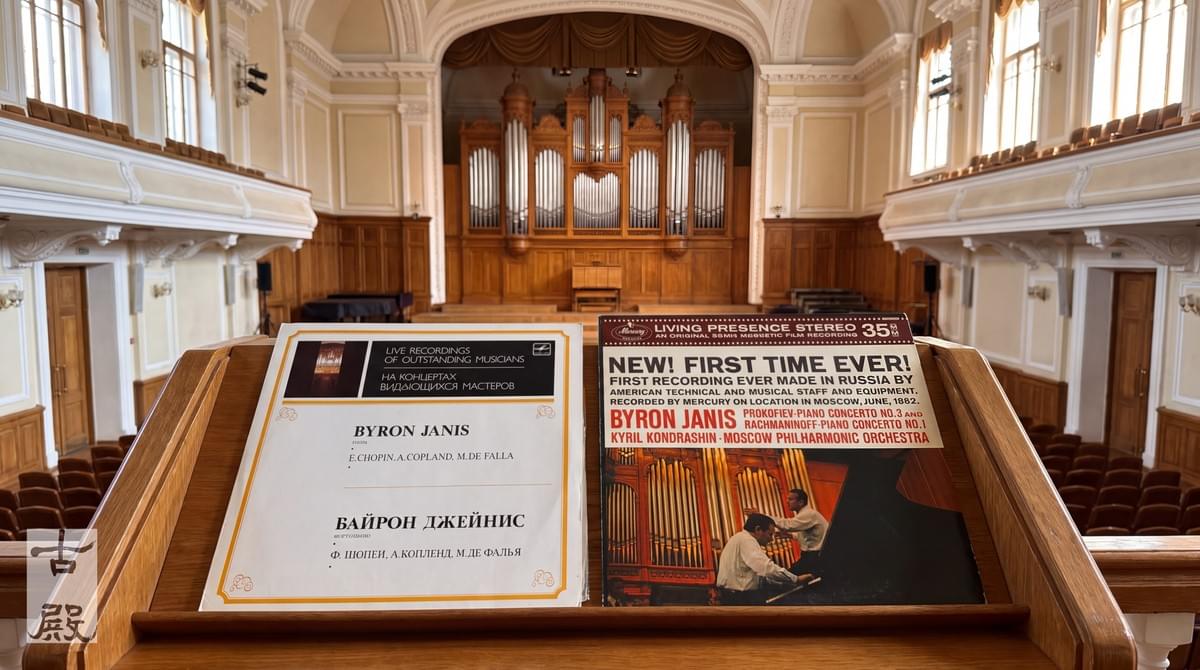
問題是:他完全不記得這場音樂會被錄了音。
驚人的是這份錄音,早在1986年,就已經被蘇聯國營廠牌「旋律唱片」(Мelodiya)以黑膠唱片的形式,曾在蘇聯境內公開發行。編號 M10 47031 005,附有俄英雙語的封套介紹,寫著他的生平、師承、蘇聯樂評對他的讚譽。但這張唱片的發行數量其實不多,因此並未引起太多世界樂壇的注意。
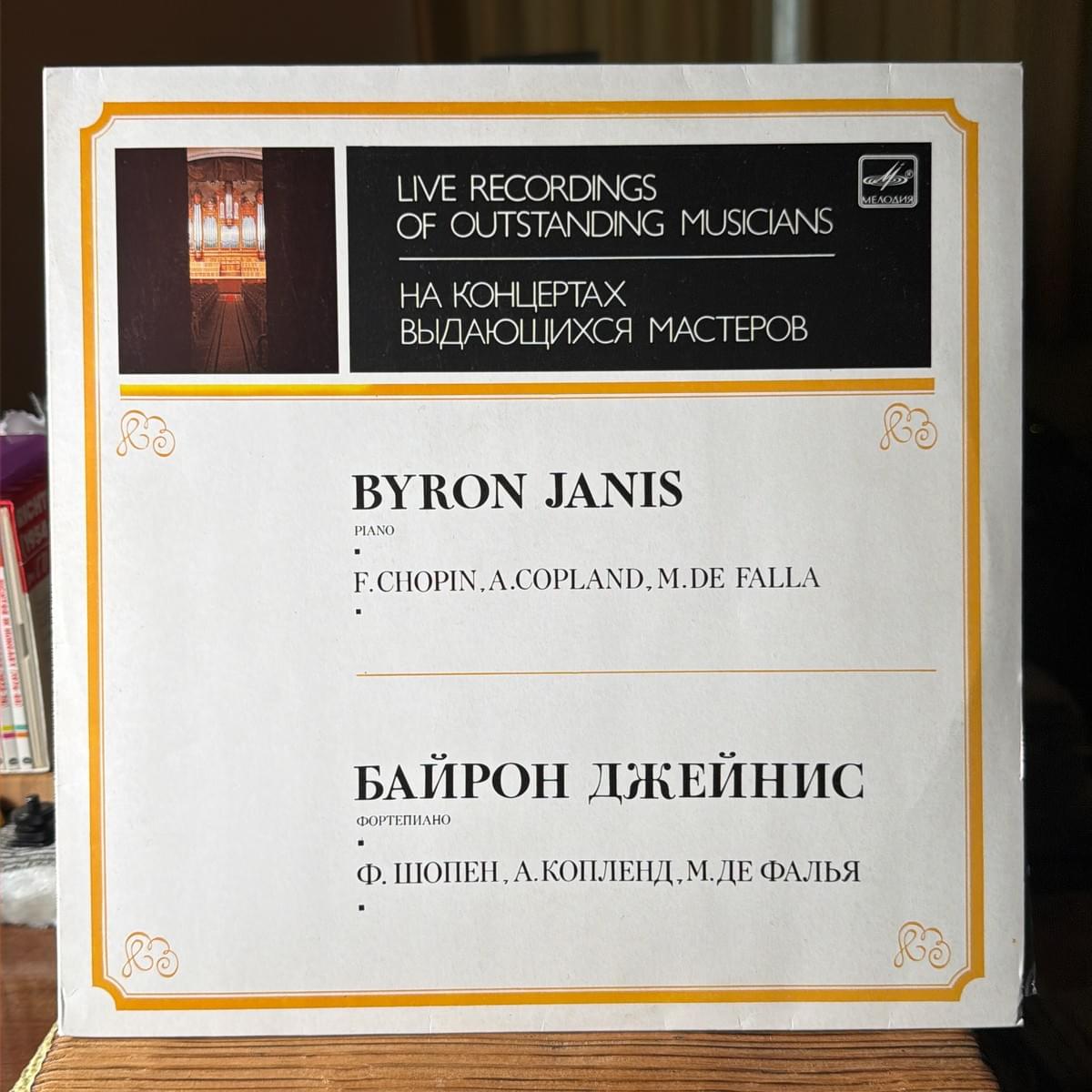
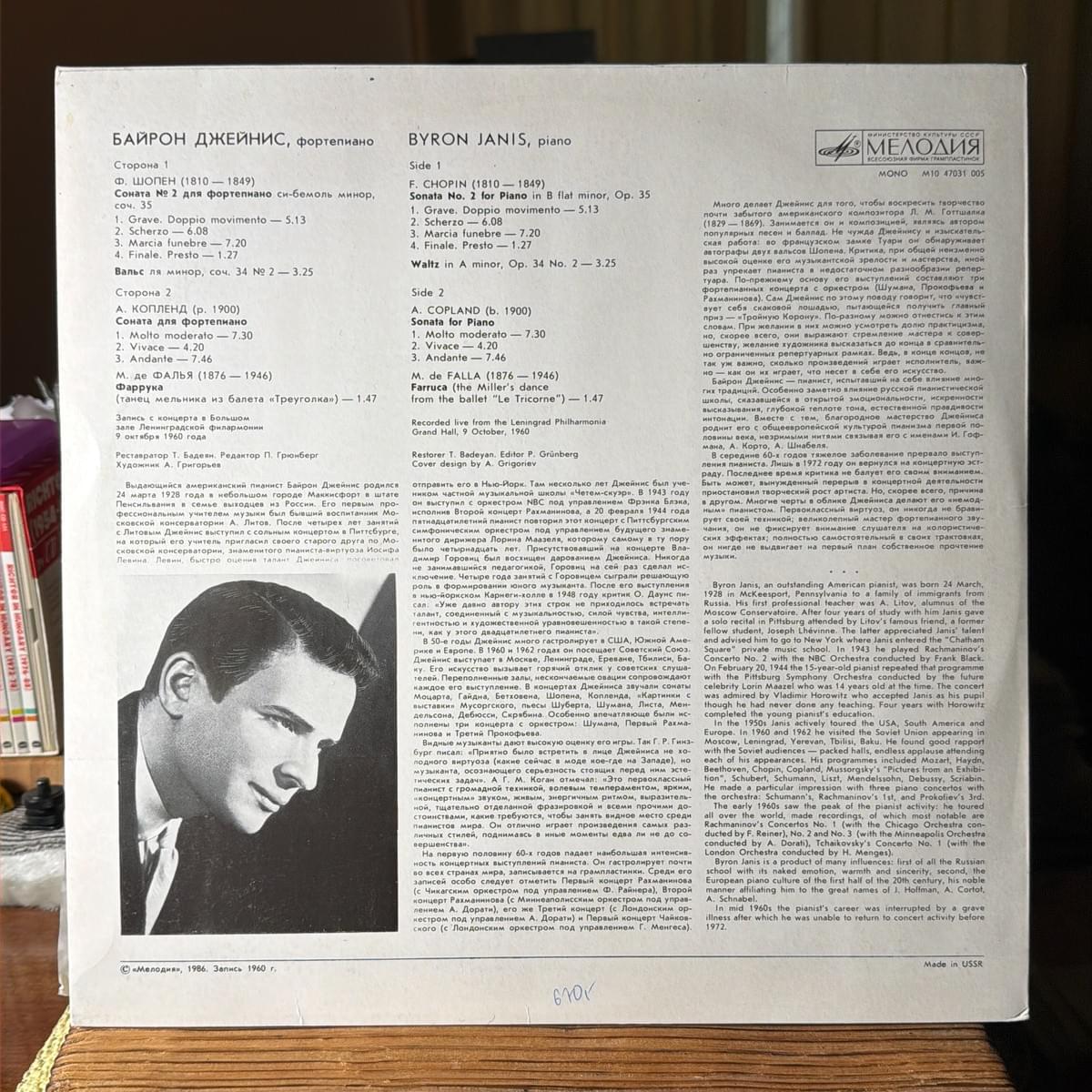
一張真實存在、正式發行、印著他的名字與照片的唱片,在蘇聯的唱片行架上,賣了超過三十年。而唱片裡的彈奏的主角,卻對這一切一無所知。
他後來說:「我起初對這件事感到錯愕——這場音樂會竟然在我不知情的情況下被錄下、還在蘇聯境內出版了幾十年。但現在,我很感激,一個獨特的音樂史時刻,被這樣保存了下來。」
這是一位90歲的鋼琴家,面對自己人生中一段被別人偷偷記錄、卻遲了58年才親手拿到證據的往事。
但這裡有一個容易被忽略的背景,值得先說清楚:這其實不是蘇聯特別針對堅尼斯做的一次「秘密行動」。在蘇聯的體制下,「旋律唱片」(Мelodiya)是國營唱片公司,幾乎每一場公開音樂會,理論上都會留下現場錄音,母帶的保存與使用權,預設就歸屬國家檔案庫——不論台上站的是蘇聯音樂家,還是像堅尼斯這樣的外國訪客,也不論演奏者本人是否被告知、是否同意。也就是說,就算堅尼斯當年在台上被明確告知「這場音樂會會被錄音」,這份錄音一樣會被做、一樣會歸入國家檔案、一樣有可能在多年後以任何形式發行——「知情與否」,在這個體制裡,從來就不是一個會被考慮的變數。
而這件事之所以會發生,得先回到1960年——冷戰最緊張的年代,一個27歲的美國鋼琴家,第一次踏上蘇聯的土地。
一個「不合邏輯」的人生選擇
要理解堅尼斯為什麼會被選中,得先理解他這個人。
他生於1928年,賓夕法尼亞州一個俄裔移民家庭。四歲學琴,啟蒙老師是莫斯科音樂院校友。少年時期一場公開演出,台下坐著一位聽眾——鋼琴巨匠霍洛維茲(Vladimir Horowitz, 1903–1989)。霍洛維茲當場被這個少年的才華震住,破例收他為徒——這是霍洛維茲生平第一次正式收學生,往後也只再收過兩位(蓋瑞·葛拉夫曼(Gary Graffman,1928-2025)與羅納德·圖里尼(Ronald Turini,1934-))。
按照這樣的起點,堅尼斯理應成為一位純粹活在音樂廳與錄音室裡的技巧型鋼琴家。
但1960年,美國政府找上了他。
當時美蘇兩國簽署了一項「文化交流」協議,雙方同意互派藝術家、學者、運動員赴對方國家演出交流,試圖在核武對峙的僵局之外,找出一條不那麼容易擦槍走火的溝通管道。堅尼斯不是第一位赴蘇的美國音樂家——小提琴家艾薩克・史坦(Isaac Stern, 1920–2001)早在1956年就已經在莫斯科音樂院登台,波士頓交響樂團同年也成為第一支訪蘇的美國樂團,之後費城管絃樂團、指揮史托科夫斯基(Leopold Stokowski, 1882–1977)、紐約愛樂與伯恩斯坦(Leonard Bernstein, 1918–1990),也都陸續去過。堅尼斯真正特別的地方,在於他「先後去了兩次」——1960年10月與1962年——而正是這兩次造訪,讓他後來成為整段冷戰音樂外交史裡,一個獨一無二的角色:第一位讓美國錄音技術與人員,親自踏進蘇聯國境、留下史上第一份錄音成果的人。這件事,發生在他第二次造訪的1962年,稍後會細說。
他去了。莫斯科、列寧格勒、葉里溫、提比里斯、巴庫——五個城市,場場爆滿,場場起立鼓掌到工作人員必須把已經熄掉的廳燈重新打開。《紐約時報》稱他是「在打破冷戰藩籬上的一位大使」。
一位美國鋼琴家,選擇在核戰陰影最濃的年代,飛進鐵幕另一端,用蕭邦和柯普蘭去做外交官做不到的事。這不是一個「合理」的職業選擇——這是一個賭上自己藝術生涯,去賭一件更大的事情是否可能的選擇。
而列寧格勒那場被秘密錄音的音樂會,正是這趟旅程裡的一站。
四公噸半的錄音設備,四年談不成的事
如果說1960年的秘密錄音,是蘇聯單方面留下的紀錄,那麼1962年的故事,則是完全相反的方向——蘇聯官方,主動邀請一整支美國錄音團隊,帶著全套美製設備,進入莫斯科境內錄音。
這是史上第一次。
美國廠牌 Mercury Records 的談判,早在1958年就已經展開,一路談了整整四年,中間至少五次瀕臨破局。蘇聯方面涉入的政府機構超過五個,權責交疊,光是把將近四點五公噸的錄音器材從紐約運進莫斯科,每一件設備的每一次移動,都要重新申請許可——若許可延誤,整套器材甚至可能來不及送達。Mercury 的行動錄音車,必須在最終許可核發之前就先出發,賭錄音真的能夠成行。
真正讓這件事鬆動的,是堅尼斯1960年那趟旅程留下的迴響。唱片封套上寫得很直白:正是他第一次訪蘇激起的熱烈迴響,讓蘇聯音樂圈迫切希望能與他再度合作、正式錄音——這才給了整場談判最後一把推力。
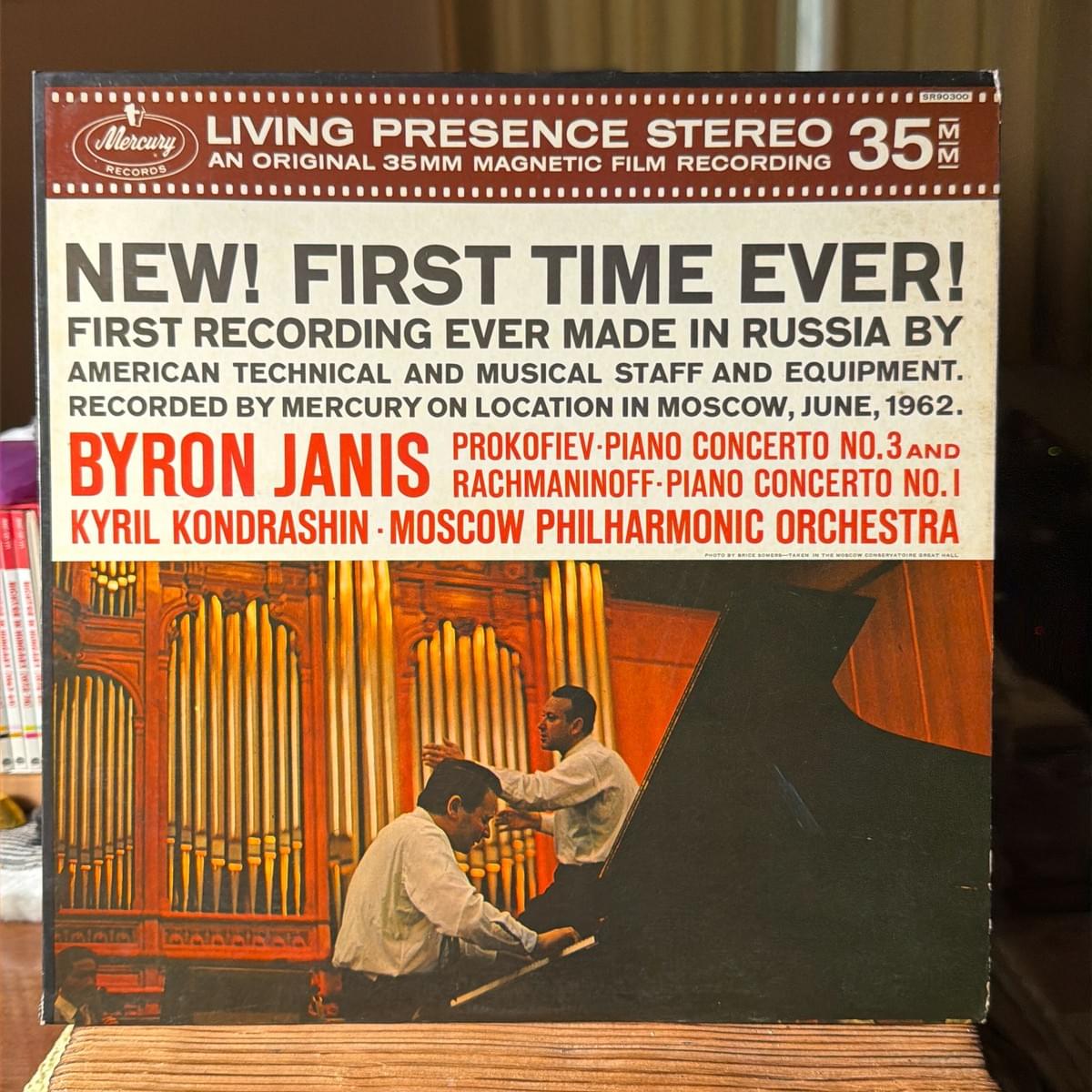
1962年5月13日,莫斯科音樂院大廳。蘇聯方面提出一個近乎苛刻的要求:同一個晚上,連續演奏三首風格迥異的協奏曲——拉赫曼尼諾夫(Sergei Rachmaninoff, 1873–1943)第一號、舒曼(Robert Schumann, 1810–1856)協奏曲、壓軸普羅高菲夫(Sergei Prokofiev, 1891–1953)第三號。
中場休息,堅尼斯靠幾口巧克力和一瓶蘇打水撐過去,回到台上彈完普羅高菲夫,聽眾已經湧向舞台邊緣,鼓掌足足二十分鐘不停。他望向指揮孔德拉辛(Kyril Kondrashin, 1914–1981),用口型說了一個詞——「柴可夫斯基」——樂團當場、毫無排練,加演了柴可夫斯基(Pyotr Ilyich Tchaikovsky, 1840–1893)第一號協奏曲的第三樂章。
觀眾席裡,坐著普羅高菲夫的遺孀莉娜(Lina Prokofiev, 1897–1989)。音樂會後,她親筆寫下一段感言,稱堅尼斯的演奏「令人屏息」「以驚人的靈感」演繹她已故丈夫的作品,還附上親筆簽名——「Lina Prokofieff, Moscow, May 1962」——後來這段手稿,被原樣製版,印在了這張唱片的封套背面。
一位鋼琴家把自己逼到近乎虛脫,換來的不只是掌聲,是一位作曲家遺孀真跡淚水般的文字,永久留在一張黑膠的封套上。
這就是史上第一張「錄音現場在蘇聯、卻由美國人親手完成」的商業唱片誕生的過程——嚴格來說,這張唱片本身仍是不折不扣的美國製品:錄音地點雖然在莫斯科音樂院大廳,但實際的壓片、封套印刷,都是在美國本土完成(封套上明白印著「Printed in U.S.A.」)。真正史無前例的,「美國的技術與人員,第一次被允許進入蘇聯境內,把聲音錄下來、再帶回美國做成唱片」。
一支麥克風,一對夫妻——「Living Presence」是怎麼來的
要理解這張唱片封套上「Living Presence」幾個字有多重的份量,得把時間倒回1951年4月,比莫斯科這場錄音早了整整十一年。
那一年,兩個年輕人扛著一支麥克風,從紐約搭火車到芝加哥——29歲的錄音師 C. Robert Fine(人稱 Bob Fine, 1922–1982),與31歲的 George Piros(生卒年不詳)。他們要錄的,是芝加哥交響樂團新任音樂總監庫貝利克(Rafael Kubelík, 1914–1996,當時還不到37歲)指揮的穆索斯基《展覽會之畫》。
Fine 把一支 Neumann U-47 麥克風,用繩子吊在指揮頭頂上方大約15英尺、稍微偏後的位置——全場只用這一支麥克風。訊號透過貝爾電話公司提供的專線,傳到位於別處的錄音室,錄進磁帶。這種「用最少的麥克風,換取最真實的空間感」的哲學,正是 Fine 從 John Hammond(1910–1987)那裡承繼下來、並終其一生奉行的錄音信仰——與其用多支麥克風分軌拾音、再靠後製把聲音「拼」回去,不如信任一個位置精準的單點,讓聲音自然地在空間裡呼吸。
這張唱片發行後,《紐約時報》樂評人 Howard Taubman(1907–1996)寫下一句評語,形容這張唱片的音質,讓人感覺自己「活在樂團真實的臨場之中」(in the living presence of the orchestra)。Mercury 索性把這句話,變成了自己古典系列的名字——Living Presence,就此誕生。
而當時在幕後主導這一切的,是 Mercury 唱片公司年僅24歲的古典部門主管——Wilma Cozart(1927–2009)。
Bob Fine 與 Wilma Cozart,後來成為夫妻。往後將近二十年,這對搭檔——先生負責用最精準的耳朵與最少的器材,捕捉音樂廳裡最真實的聲音;太太負責談判、製作、把整個系列的美學標準扛在肩上——聯手打造出兩百多張至今仍被發燒圈奉為圭臬的古典錄音。1959年起,他們把單支麥克風的做法,升級為三支麥克風(一支主中置、兩支側邊)的立體聲技術;1961年,也就是堅尼斯這張莫斯科錄音的前一年,他們再度升級——放棄原本使用的½吋三軌磁帶,改用「35mm 電影膠卷」來錄音。
35mm 電影底片般的介質,乳劑層更厚、音軌更寬、走帶速度更快,能大幅降低磁帶錄音常見的「層間印痕」雜訊,換來更寬廣的動態範圍與更低的噪訊底——這是當時類比錄音技術幾乎已達到的極限。
而這套設備的來歷,本身就是一段唱片業的興衰故事。35mm 磁性電影膠卷錄音技術,最早並不是 Mercury 發明的,而是由另一家廠牌 Everest Records 率先引進。Everest 由電子工業出身的 Harry Belock(1908–1999)創辦,工程師 Bert Whyte(1920–1994)主導錄音哲學——同樣信奉「極簡拾音」,用三軌 35mm 影片捕捉最真實的音樂廳空間感。他們委託 Westrex 公司依照自己的規格打造這套系統,一台錄音機造價高達兩萬美元(在1959年,是一筆驚人的數字),並搭配 Neumann U-47 麥克風使用。
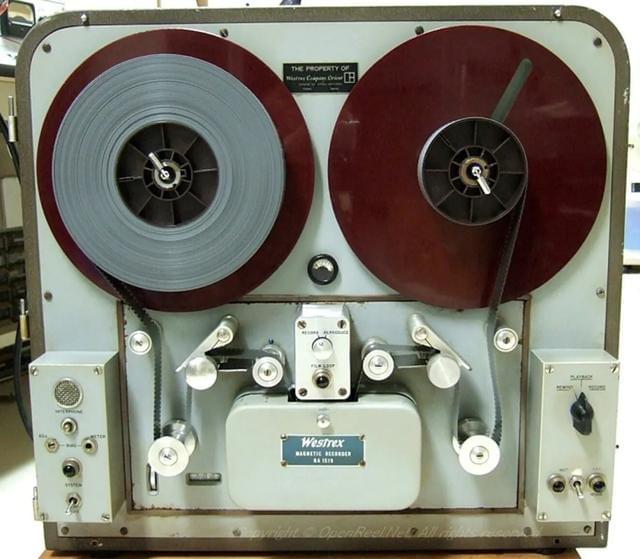
但 Everest 的錄音雖然口碑極佳,銷售卻始終起不來,公司財務很快陷入困境。1961年3月,Everest 位於紐約 Bayside 的錄音室與整套 35mm 設備——包括一批連拆封都還沒拆封的全新膠卷——被整批出售,買家正是 C. Robert Fine。Fine 把這套原本屬於競爭對手的頂級設備接手過來,用在自己的 Mercury Living Presence 系列上——1962年這張堅尼斯的莫斯科錄音,用的正是這套原本是 Everest 家當的機器。
1962年,Mercury 並不是把這套系統拆散裝箱運過去的——他們把整套 35mm 錄音設備、連同兩台 Ampex 錄音機,一併塞進了 Bob Fine 自己那台專屬的錄音車裡。這台錄音車從1951年就跟著 Fine 東奔西走,去過英國、奧地利、法國、義大利做歌劇錄音,1958年還整車翻修過一次——這回,它被裝上貨輪,跨越大西洋,運到蘇聯境內一處鐵路貨運場,讓 Fine 親自去把車開出來,再一路開往莫斯科音樂院。
車隊開往音樂院的路上,經過紅場——車上所有人都想在紅場前拍張照留念,Fine 索性把車停了下來。結果,一位莫斯科警察立刻上前,把他狠狠訓斥了一頓:紅場,不是隨便什麼車都可以停的地方。這個小插曲被當時隨行的 Mercury 音樂總監 Harold Lawrence(生卒年不詳)拍了下來,後來還被 CBS 電視台的新聞團隊全程跟拍,剪成一則專題,在 CBS Evening News 上播出——一台裝滿美製錄音設備的卡車,開在蘇聯的紅場上,被蘇聯警察攔下來,這個畫面本身,就是整個冷戰文化交流最生動的縮影:兩個超級強權之間,那道看似無法穿越的高牆,最後被一台違規停車的錄音貨車,撞出了一道縫。

而這台車、這套設備、這趟耗費四年才談成的許可,換來的也不只是堅尼斯這一張唱片。Mercury 團隊把這趟莫斯科遠征的產能榨到了極限——同一趟行程裡,一口氣錄下了五張專輯:除了堅尼斯的普羅高菲夫第三號與拉赫瑪尼諾夫第一號協奏曲(SR90300),還有賈尼斯的另一張《Encore》鋼琴獨奏選曲集(SR90305)、蕭士塔高維契(Dmitri Shostakovich, 1906–1975)的第四號與第八號弦樂四重奏(SR90309)、一張俄羅斯民謠精選《Balalaika Favorites》(SR90310),以及李斯特(Franz Liszt, 1811–1886)第一號與第二號鋼琴協奏曲(SR90329)。四年談判、四點五公噸設備、一台被蘇聯警察攔下的錄音車——賭的不是一張唱片能不能錄成,而是一整批唱片。
這就是封套上特別標注的「An Original 35mm Magnetic Film Recording」背後,真正的旅程。
負責這場莫斯科錄音的技術總監,正是 C. R. Fine 本人;擔任錄音現場總指揮的,則是已經改冠夫姓的 Wilma Cozart——多年後,她又在1989年親自主持整個 Living Presence 目錄轉製 CD 的工程,堅持一切都要拿原始的35mm母源與三軌磁帶反覆比對、「相信自己的耳朵」,不肯讓任何一絲數位化的便利,稀釋掉當年那份對真實聲音的執著。願不願意為了「聽起來像真的」這件事,不計一切成本與代價。
一個秘密,藏了十二年——關於他不敢說的另一件事
堅尼斯的人生裡,其實藏著不只一個「被隱瞞的秘密」。
1973年,45歲的他,在倫敦錄音期間,發現手指上出現一塊紅斑。醫生診斷:乾癬性關節炎(psoriatic arthritis)——一種會逐漸侵蝕手指與手腕關節的疾病。醫生告訴他:「不會好轉」,而且「每一次演出,都有可能造成嚴重傷害」。
他選擇隱瞞病情,長達十二年。
從1973到1985,他一邊忍受著手部關節的劇痛,一邊繼續巡演、繼續錄音,甚至改寫自己的指法——用大拇指代替其他手指按下某些音符,省略某些和絃裡難以按到的音——只為了不讓外界看出他手上正在發生的事。直到1985年,他在雷根總統(Ronald Reagan, 1911–2004)的白宮演出後才公開病情,並成為美國關節炎基金會的代言人。他說:「我有關節炎,但它沒有擁有我。」
這句話,和他58年後才知道自己被秘密錄音時說的那句「我很感激它被保存了下來」,其實是同一種性格的兩面:面對自己無法控制的事情——身體的、歷史的——他選擇的從來不是憤怒或否認,而是把它接下來,變成自己故事的一部分。
一張封套,兩個版本——真相被抹去了一次,卻沒有真的消失
這張1962年 Mercury 版唱片,還有一個鮮少人知道的細節。
它的原始第一版的唱片封套背面,原本印著三張照片:堅尼斯與莉娜・普羅高菲夫的合照、他與指揮孔德拉辛在錄音結束後的合影、以及吉利爾斯(Emil Gilels, 1916–1985)與阿胥肯納吉(Vladimir Ashkenazy, 1937-)向他道賀的畫面——而且不只是照片,這一版連莉娜親筆寫下的那句感言與簽名「Lina Prokofieff, Moscow, May 1962」,也一併原樣製版印在封套上。
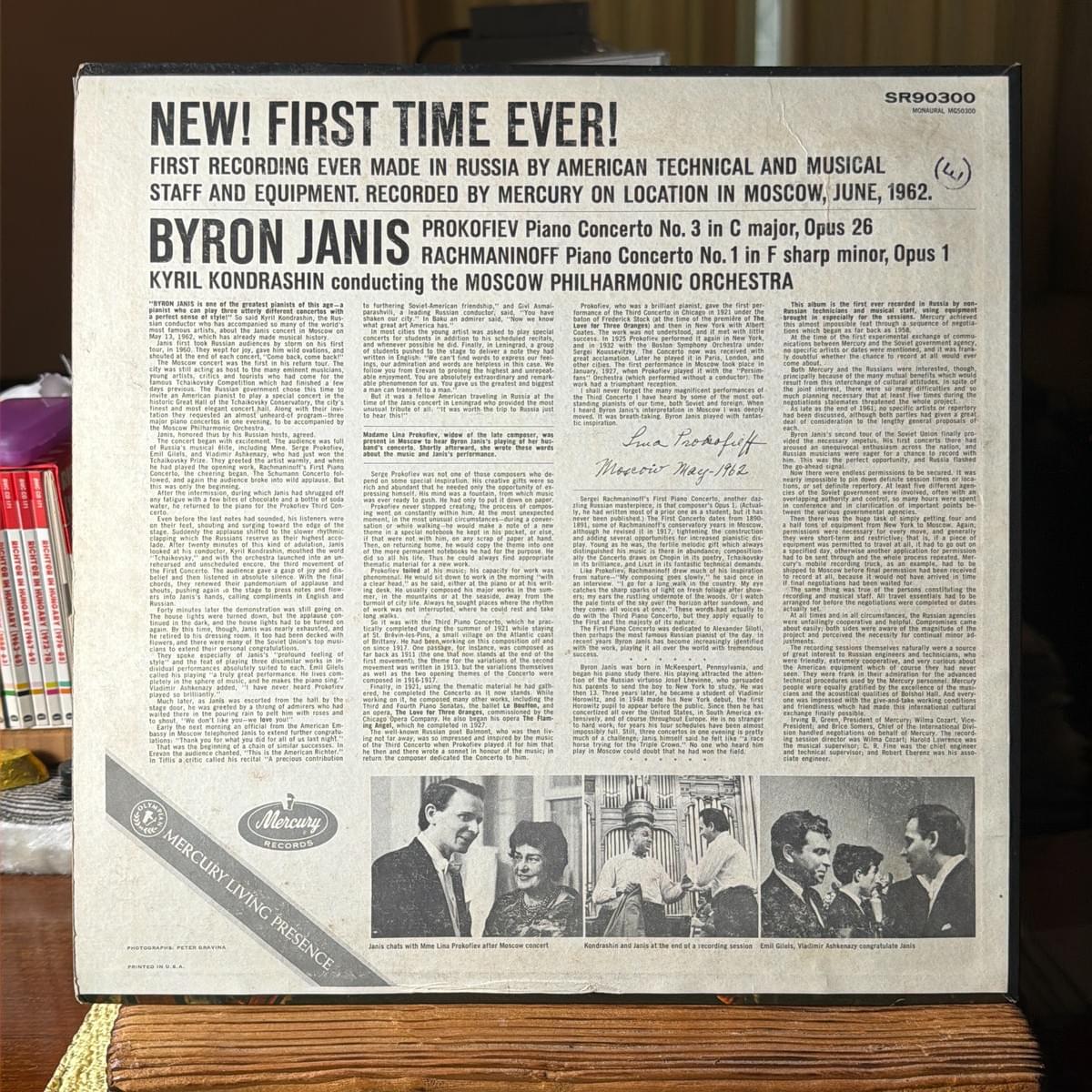
但這個「三照片版」的封套,存世數量極少——不久之後,首版原始第一版封套就被迅速換成了第二個版本:莉娜與堅尼斯的合照,連同她那份手寫簽名,一起被拿掉了。也就是說,抽換的不只是一張照片,而是莉娜・普羅高菲夫在這張唱片上留下的所有痕跡——影像與筆跡,同時消失。
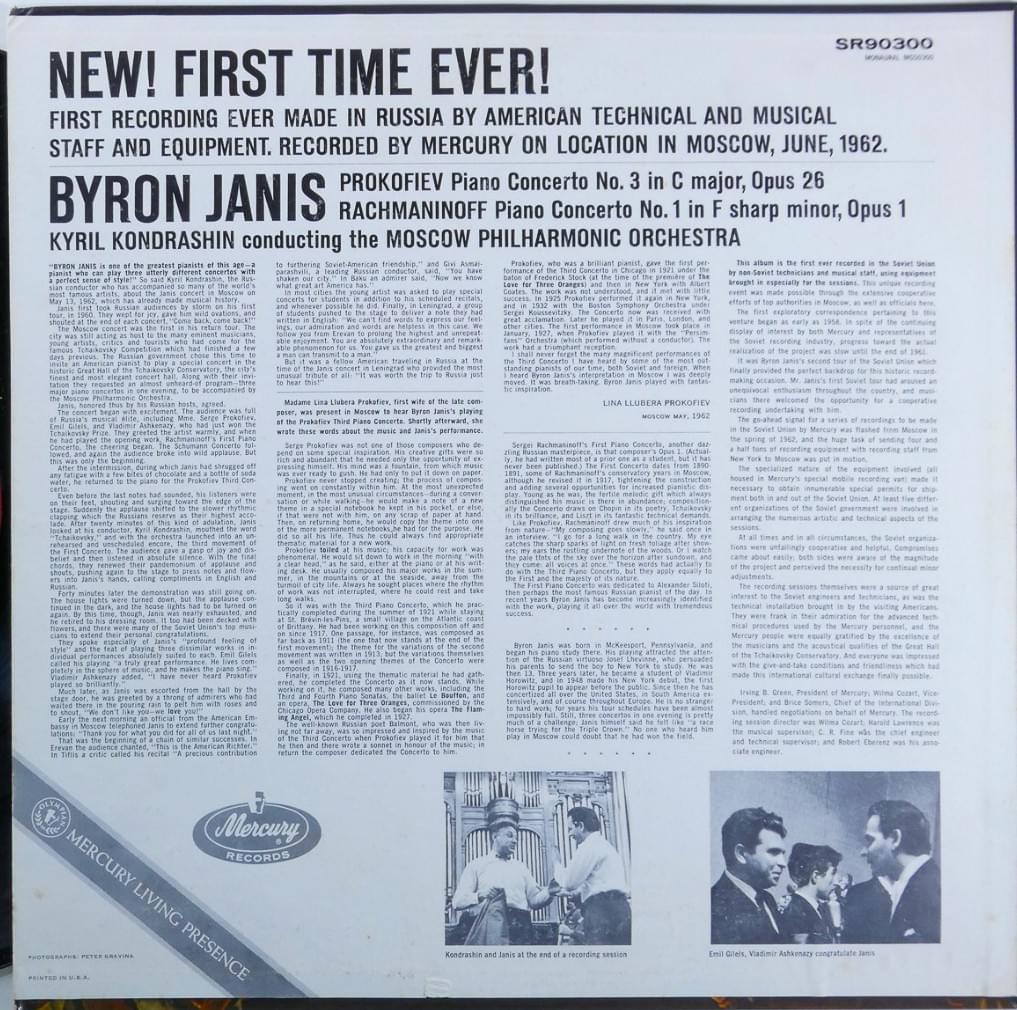
至今沒有任何公開資料能確認,這次抽換究竟是為什麼?也許——考慮到莉娜・普羅高菲夫本人在蘇聯的政治處境並不單純(普羅高菲夫在世時,蘇聯當局曾迫使他與莉娜辦理法律上的離婚、另娶蘇聯籍妻子;莉娜本人後來還一度因間諜罪嫌被關押於古拉格)——這張合照的存在,某種程度上觸及了一段當局並不希望被留下痕跡的往事。
但無論原因是什麼,有一件事是確定的:那個「三照片版」,作為一份實物,依然存在。總是有躲過了抽換的,落到了今天某位收藏者的手中。
某種真相,一旦以實體的形式被印刷、被壓製、被裝訂成冊,它就很難被真正抹去。你可以改版、可以停產、可以讓後續所有流通的複本都不再提起——但只要有一份原始的複本留了下來,那個「曾經發生過」的事實,就不會消失。
這正是這兩張唱片,作為「物件」而不只是「音樂」,最動人的地方。
最後
想像一下,如果堅尼斯1960年的那場列寧格勒音樂會,發生在今天。
可以全程錄影,全程直播,錄音檔案幾小時內就會傳遍全世界。不會有「秘密錄音」,——一切都是可以立即公開的。
但也正因為如此,1960到2018年之間,那58年的空白,才顯得如此不可思議。一份錄音,可以真實存在於世界上超過半個世紀,經過蘇聯的解體、冷戰的結束、數位時代的來臨,卻完全不在它主人的認知範圍之內——直到某個素未謀面的陌生人,決定把一份黑膠轉錄寄出去。
這種橫跨半世紀、靠著實體物件本身的存在而非任何數位紀錄流傳下來的偶然,黑膠的實體價值是:它是一個物件,只要沒有被摧毀,它就會在世界的某個角落,安靜地等待被重新發現。
******
【Gudian Music Stories】Recorded Behind the Iron Curtain, but Kept in the Dark for 58 Years: Byron Janis (1928–2024) and Two Vinyl Records That Rewrote the Cold War
A Package from a Stranger
In 2018, the celebrated American pianist Byron Janis (1928–2024), then 90 years old, received an unexpected gift. Strictly speaking, it wasn’t addressed to him directly; it arrived in the mailbox of his sound engineer, Seth Winner. An anonymous contact had mailed over a transfer of an exceedingly rare vinyl record—a live concert performance. Winner promptly forwarded the audio to Janis.
When Janis pressed play, he froze. The fingers on the keys were unmistakably his own. It was his Chopin, his Copland, his de Falla. The venue: the Leningrad Philharmonic Hall under Soviet rule. The date: October 9, 1960.
There was just one catch: he had no recollection whatsoever of that concert ever being recorded.
Even more startling was the fact that this performance had been officially pressed and released within the USSR as early as 1986 by the Soviet state-owned label Melodiya (catalog number M10 47031 005). The jacket featured bilingual sleeve notes in Russian and English detailing his biography, his lineage under legendary teachers, and glowing praise from Soviet critics. Because the pressing run was modest, it slipped past the radar of the wider international music world.
A physical, officially issued record—emblazoned with his name and portrait—had sat in Soviet record bins for more than three decades. Yet the artist at the center of it had remained entirely oblivious.
Janis reflected later: "At first, I was stunned that this concert had been recorded without my knowledge and distributed within the Soviet Union for decades. But today, I am profoundly grateful that such a singular moment in musical history was preserved."
Here stood a 90-year-old pianist, suddenly presented with physical proof of a chapter from his youth secretly committed to tape 58 years prior.
It helps to understand the context here: this was not an act of covert espionage targeted at Janis. Under the Soviet system, Melodiya was a state monopoly. By default, virtually every major public concert was recorded, and master tapes belonged automatically to the state archives—whether the artist on stage was a domestic Soviet master or a visiting foreigner, and regardless of whether the musician had consented or had even been told. Had Janis been explicitly informed back in 1960 that the tape machines were rolling, the outcome would have been identical: it would still have entered the state archives, and it still might have surfaced decades later on vinyl. In that regime, "knowing" was simply never a factor.
To understand why Janis found himself on that stage in the first place, one must journey back to 1960—the height of Cold War tensions—when a 27-year-old American pianist set foot on Soviet soil for the first time.
An "Illogical" Life Choice
To understand why Janis was chosen, you have to look at the man himself.
Born in 1928 in Pennsylvania to Russian-Jewish immigrant parents, he began piano lessons at four; his early mentor was an alumnus of the Moscow Conservatory. During an early public appearance as a young prodigy, a solitary figure sat in the hall: Vladimir Horowitz (1903–1989). Electrified by the boy's sheer artistic instinct, Horowitz took the unprecedented step of taking him on as his very first official pupil—a privilege granted to only two other pianists in his entire lifetime (Gary Graffman and Ronald Turini).
By every conventional metric, Janis seemed destined for a sheltered, prestigious life: a keyboard virtuoso moving between pristine concert halls and high-end recording studios.
Then, in 1960, the U.S. government came knocking.
Washington and Moscow had inked a bilateral Cultural Exchange Agreement, agreeing to swap performers, academics, and athletes in an effort to open channels of human communication beneath the shadow of nuclear standoff. Janis was not the first American artist sent across: Isaac Stern had performed at the Moscow Conservatory in 1956; the Boston Symphony visited that same year; Leopold Stokowski, the Philadelphia Orchestra, and Leonard Bernstein with the New York Philharmonic followed soon after.
What made Janis unique was that he traveled there twice—first in October 1960, and again in 1962. Those two journeys positioned him as an unmatched figure in Cold War cultural diplomacy: he became the first musician to bring an American audio engineering team and their gear inside Soviet borders, yielding the first such joint recording in history during his 1962 return.
During that first tour in 1960, Janis traveled to Moscow, Leningrad, Yerevan, Tbilisi, and Baku. Five cities, every hall packed to the rafters, audiences demanding encore after encore until venue staff were forced to turn the house lights back on. The New York Times hailed him as an "ambassador who tore through the barriers of the Cold War."
For an American concert pianist, stepping across the Iron Curtain to let Chopin and Copland do the work of deadlocked diplomats was hardly a "safe" career path. It meant putting his artistic trajectory on the line for the sake of something far larger.
That secretly recorded concert in Leningrad was one stop along that extraordinary journey.
4.5 Tons of Gear, Four Years of Stalemate
If the 1960 tape was a unilateral Soviet souvenir, 1962 ran entirely in reverse: Soviet authorities officially invited an American recording crew, fully outfitted with American gear, onto Moscow soil.
It was unprecedented.
Negotiations led by Mercury Records had begun in 1958, dragging out across four years and nearly collapsing on at least five separate occasions. Over five Soviet government agencies had to sign off, their overlapping jurisdictions causing endless friction. Transporting nearly 4.5 tons of delicate audio equipment from New York to Moscow required separate transit permits for every component at every border; any delay could derail the entire session. Mercury’s mobile recording truck had to set sail before final approvals were even stamped, gambling on faith alone.
What broke the deadlock was the lingering impact of Janis’s 1960 tour. The original record sleeve puts it plainly: the thunderous reception from his first visit left Soviet musical circles desperate to collaborate with him on an official recording project. That gave the negotiations the decisive final push.
On May 13, 1962, at the Great Hall of the Moscow Conservatory, Soviet organizers laid out an unforgiving program: three major, stylistically contrasting concertos performed in a single evening—Rachmaninoff’s First, Schumann’s Concerto, and Prokofiev’s formidable Third as the finale.
During intermission, Janis kept himself going with bites of chocolate and a bottle of soda. When he finished the Prokofiev, listeners rushed the stage, applauding continuously for twenty minutes. Turning toward conductor Kyril Kondrashin (1914–1981), Janis mouthed a single word: "Tchaikovsky." Without a single rehearsal, the orchestra launched into the third movement of Tchaikovsky’s First Concerto as an encore.
Sitting in that hall was Lina Prokofiev (1897–1989), the composer’s widow. After the concert, she penned a tribute commending Janis's "breathtaking" and "profoundly inspired" reading of her late husband's music, signing off personally: "Lina Prokofieff, Moscow, May 1962." That handwritten note was later photographically reproduced directly onto the back of the album jacket.
A pianist pushing himself to utter physical exhaustion had yielded more than applause: it secured a composer’s widow’s heartfelt gratitude, preserved forever in print on a vinyl sleeve.
This was how the very first commercial record captured on Soviet soil by an American engineering team came into being. Technically, the final product remained thoroughly American: while recorded in Moscow, the disc pressing and jacket printing were handled in the United States (bearing the legend "Printed in U.S.A."). The historic breakthrough was that American equipment and personnel had been permitted to capture sound inside the USSR and transport the physical masters home.
One Microphone, One Couple: The Birth of "Living Presence"
To understand what the words "Living Presence" on that album cover mean, one has to rewind eleven years before Moscow, to April 1951.
That spring, two young technicians boarded a train from New York to Chicago hauling a single microphone: 29-year-old engineer C. Robert Fine ("Bob Fine," 1922–1982) and 31-year-old George Piros. Their assignment was to record Mussorgsky’s Pictures at an Exhibition, played by the Chicago Symphony Orchestra under its newly appointed, 36-year-old music director, Rafael Kubelík (1914–1996).
Fine suspended a single Neumann U-47 microphone roughly 15 feet above and slightly behind the conductor's podium. Just that one mic for the entire orchestra. The signal traveled via dedicated Bell Telephone lines to an offsite studio to be captured on tape. This philosophy—using the minimum number of microphones to preserve an authentic sense of physical space—was an article of faith Fine inherited from John Hammond (1910–1987). Instead of multi-miking sections and piecing the ensemble together in post-production, they trusted one meticulously placed acoustic point, allowing sound to breathe naturally within the hall.
Reviewing the release, Howard Taubman (1907–1996) of The New York Times wrote that the sound placed the listener "in the living presence of the orchestra." Mercury adopted the phrase as the banner for its classical catalog: Living Presencewas born.
The driving force behind this venture was Mercury’s 24-year-old head of the classical division: Wilma Cozart (1927–2009).
Bob Fine and Wilma Cozart later married. For nearly two decades, the pair—he with an uncompromising ear and minimal gear, she handling negotiations, production, and aesthetic direction—built a catalog of more than two hundred recordings that audiophiles revere to this day. In 1959, they expanded their single-mic technique to a three-microphone stereo array (one center, two flanking). By 1961, the year before Janis’s Moscow sessions, they upgraded again, swapping standard ½-inch three-track tape for 35mm magnetic film.
Magnetic 35mm film stock featured a thicker base, wider tracks, and faster tape speed, virtually eliminating print-through bleed-through while unlocking expansive dynamic range and a remarkably low noise floor—pushing analog sound to its operational ceiling.
The provenance of this gear carried its own historical weight. Recording onto 35mm magnetic film had been pioneered not by Mercury, but by Everest Records, founded by electronics industrialist Harry Belock (1908–1999) with engineer Bert Whyte (1920–1994). Everest likewise championed minimalist miking onto three-track 35mm film. They commissioned Westrex to build the recorders to their own exacting specifications—costing $20,000 per unit in 1959, an astronomical sum at the time—paired with Neumann U-47s.
Yet while Everest earned critical acclaim, sales stalled and financial strain mounted. In March 1961, Everest’s Bayside studio and its full suite of 35mm machines—including virgin spools of film—went on the block. The buyer was Bob Fine. Fine folded his rival’s premier equipment into Mercury’s mobile operation; it was this very Westrex-Everest rig that captured Janis in Moscow in 1962.
Mercury did not crate and ship the equipment piece by piece. Instead, they mounted the 35mm film machines and two Ampex reel-to-reel tape decks inside Bob Fine’s custom recording truck. That van had traversed Britain, Austria, France, and Italy for location sessions since 1951, undergoing a complete rebuild in 1958. Now it was hoisted onto a freighter across the Atlantic, transferred onto Soviet rail tracks, and driven off the flatcar by Fine himself straight toward the Moscow Conservatory.
En route, passing Red Square, the crew wanted a souvenir photo, so Fine pulled the truck over. A Moscow policeman promptly marched up and delivered a blistering reprimand: Red Square was no place for casual parking. Mercury musical director Harold Lawrence captured the moment on film; a CBS Evening News crew documenting the expedition later aired the footage back home. An American truck loaded with audio gear, parked illegally on Red Square and getting ticketed by a Soviet cop: the image captured the Cold War cultural thaw in a single snapshot. A concrete barrier between two superpowers had been breached by a recording van.
That single trip produced far more than just Janis’s concerto LP. The Mercury team pushed their location setup to its absolute limit, tracking five full albums during the stay: Janis’s Prokofiev Third and Rachmaninoff First (SR90300); a Janis solo recital titled Encore (SR90305); Shostakovich’s String Quartets Nos. 4 and 8 (SR90309); the landmark Russian folk album Balalaika Favorites (SR90310); and Liszt’s Piano Concertos Nos. 1 and 2 (SR90329). Four years of diplomacy and 4.5 tons of gear had yielded an entire historic catalog.
This was the voyage behind the line on the jacket: "An Original 35mm Magnetic Film Recording."
Technical direction rested in the hands of C. R. Fine; session supervision was handled by Wilma Cozart Fine. Decades later, in 1989, she oversaw the CD remastering of the Living Presence catalog, insisting on working straight from original 35mm films and three-track session tapes, trusting her own ears rather than modern digital short-cuts. It was a lifelong commitment to sound as a tangible, living presence.
A Secret Kept for Twelve Years
The 1960 Soviet tape was not the only hidden reality in Byron Janis’s life.
In 1973, at age 45 during a recording engagement in London, Janis noticed a red patch on his fingers. Doctors delivered a devastating diagnosis: psoriatic arthritis, a progressive disease that erodes finger and wrist joints. The prognosis was blunt: it would not improve, and every concert risked irreversible damage.
He decided to keep the diagnosis entirely to himself for twelve years.
Between 1973 and 1985, living with severe pain, Janis toured, performed, and recorded without pause. He quietly reinvented his fingerings, using his thumbs to cover for disabled digits and omitting unplayable notes within chords—all to conceal what was happening to his hands. It was not until 1985, after performing at the White House for President Ronald Reagan, that he spoke publicly about his condition and became a spokesperson for the Arthritis Foundation. "I have arthritis," he said, "but it does not have me."
That quiet resolve mirrors how he responded upon discovering the secret 1960 recording 58 years later: "I am grateful that it was preserved." Faced with circumstances beyond his control—whether physical limitation or Cold War politics—he refused resentment, absorbing both into his story.
One Jacket, Two Pressings: Erased, Yet Never Gone
There is a rare collector's detail tucked into the 1962 Mercury release.
The earliest copies of the first-edition back sleeve featured three photographs: Janis with Lina Prokofiev; Janis with conductor Kyril Kondrashin after the session; and Soviet masters Emil Gilels and Vladimir Ashkenazy congratulating him. Alongside the photos, the jacket reproduced Lina’s handwritten praise and signature: "Lina Prokofieff, Moscow, May 1962."
Very few copies of this "three-photo" cover survived. Shortly into production, the artwork was abruptly modified. The photo of Janis with Lina Prokofiev, along with her handwritten endorsement, was removed entirely. Every trace of her connection to the release was wiped from subsequent print runs.
No official documentation has surfaced to explain why. Given Lina Prokofiev’s fraught political standing—the Soviet state had previously coerced Sergei Prokofiev into a legal separation from her, after which she spent years imprisoned in the Gulag on espionage charges—it is likely that her prominent presence touched a political nerve authorities preferred to leave buried.
Yet one fundamental truth remains: copies of that original three-photo jacket survived. A handful slipped past the censors and rest safely in private collections today.
Once truth takes physical form—ink pressed on paper, sound cut into vinyl—it becomes almost impossible to erase. You can alter a second edition, discontinue a run, or scrub references from future prints. But so long as a single physical copy endures, the reality of what took place remains unbroken.
That physical persistence is what makes these two vinyl records so moving as artifacts, far beyond their musical brilliance.
A Parting Reflection
Imagine if Janis’s 1960 Leningrad concert took place today.
It would be recorded in high definition, live-streamed worldwide, and archived across servers within hours. There would be no mystery, no hidden master tapes—everything instantly accessible.
Yet that contrast is precisely why that 58-year silence feels so poignant. A live recording lay quietly in the world across nearly six decades, surviving the collapse of the Soviet Union, the close of the Cold War, and the rise of the internet, entirely unknown to the man who made the music—until a stranger decided to send an audio transfer across an ocean.
That kind of survival relies on the tactile reality of physical objects rather than digital clouds. A record is an enduring artifact: so long as it is not broken, it sits quietly in some corner of the earth, waiting to be found again.