
【古殿唱片音樂故事】被誤解的「浪漫」,為何李希特不敢碰的「拉三」,卻藏在莫吉列夫斯基的指尖下?
古殿殿主
前言:當傳奇選擇沉默
如果我告訴你,這世界上有一首鋼琴協奏曲,連被譽為「蘇聯鋼琴巨匠」、一雙手能撐起整個俄羅斯鋼琴學派的巨人——斯維亞托斯拉夫·李希特(Sviatoslav Richter,1915-1997),都不碰,或者更精確地說,「直接不彈」,你會不會覺得我在開玩笑?
李希特是誰?他的觸鍵可以像雷神之鎚一樣敲碎你的心防,也能像羽毛一樣輕撫你的傷口。他一輩子挑戰過無數艱澀的曲目,但在他的演奏生涯清單裡,有一首超級名曲始終缺席——拉赫曼尼諾夫《第三號鋼琴協奏曲》(以下簡稱「拉三」)。
這首曲子被稱為「大象之作」,是無數鋼琴家證明自己技術的終極戰場。但當被問到為什麼不彈這首曲子時,這位個性十足的大師給了一個讓人跌破眼鏡、卻又無比深邃的答案:
「若我對別人彈奏的這首曲子感到相當滿意,我就可以不彈。但如果我不滿意,那我早就親自出馬,把它列在自己的演出曲目上了。」
這句話聽起來很傲嬌,充滿了李希特式的霸氣。但如果你仔細咀嚼,這背後其實藏著一個驚人的秘密:到底是誰?是誰彈得好到讓李希特願意「封刀」?是誰讓他覺得這首曲子的真理已經被說盡了?
李希特點名了三個人:范.克萊本(Van Cliburn,1934-2013)、弗利爾(Yakov Flier,1912-1977),還有一個名字,可能連很多資深樂迷都覺得陌生,甚至在唱片行架上都不容易找到的
——莫吉列夫斯基(Evgeni Mogilevsky,1945-2023)
第一章:被誤解的「浪漫」——是催眠曲還是興奮劑?
讓我們把時間倒回 1964 年。
那一年的5月,一位年僅 18 歲的蘇聯少年——莫吉列夫斯基(Evgeni Mogilevsky),在布魯塞爾的伊麗莎白大賽決賽舞台上,彈奏了拉赫曼尼諾夫《第三號鋼琴協奏曲》。那一晚的演出震撼了評審團,他不僅為蘇聯奪下了金牌,更創下紀錄,成為該大賽史上最年輕的獲獎者。
榮耀加身,載譽歸國後,這位天才少年在同年12月,蘇聯官方為了紀念這份偉大的貢獻,給予了他最高規格的待遇——特別請到了當時蘇聯最好的指揮(基里爾·孔德拉辛,Kirill Kondrashin,1914-1981)與莫斯科愛樂樂團,專門為他錄製了一張「拉三」的紀念專輯。
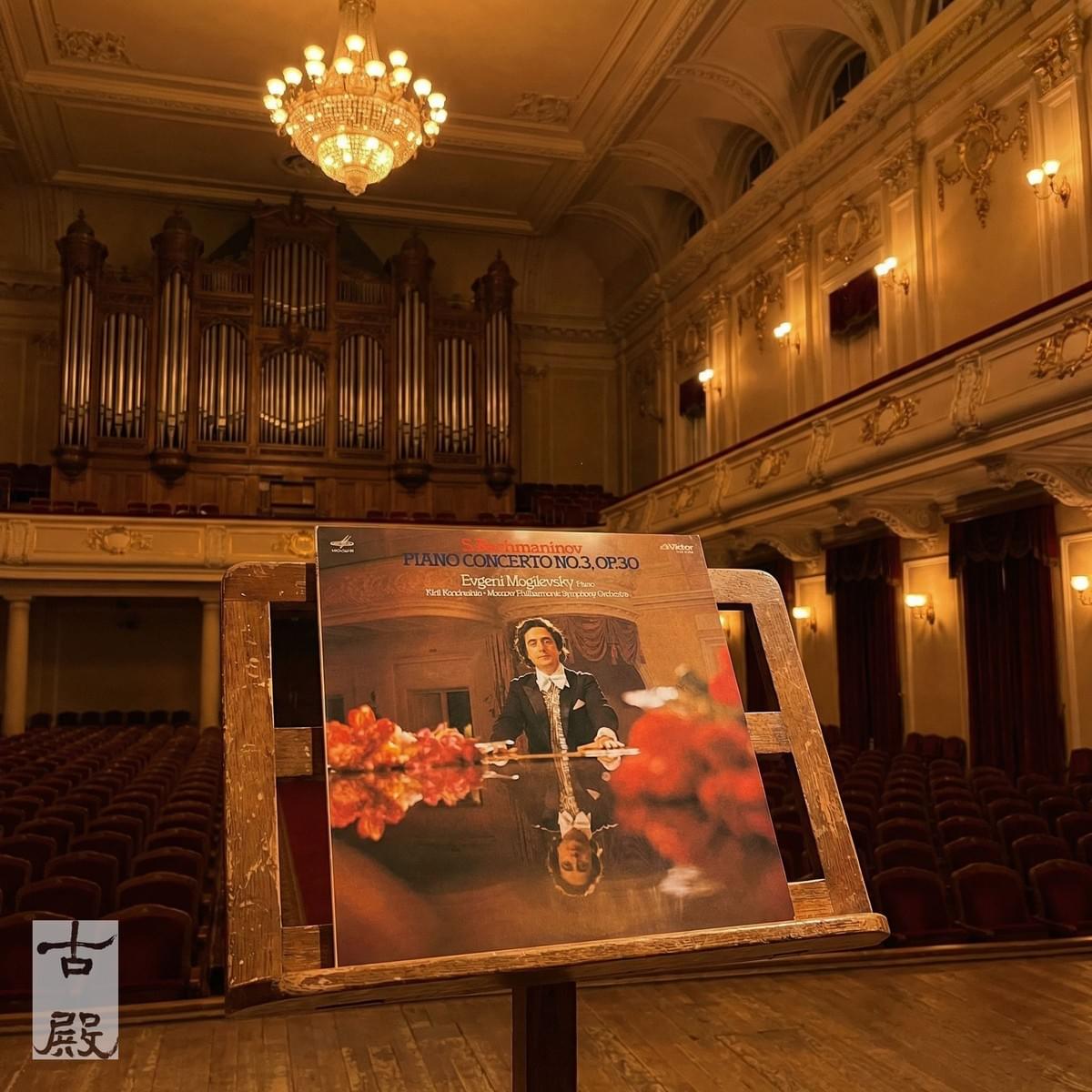
請想像一下那個畫面:年輕的莫吉列夫斯基坐在鋼琴前,面對著這首號稱「世界最難」、像大山一樣的協奏曲。當時才18歲的他,心裡或許根本沒想著要「超越」誰,也沒有要在鍵盤上證明自己有多強壯。他只是單純地、誠實地,把手指放在琴鍵上,彈出他認為心中應該有的聲音。
然而,當這份承載著金牌光環的錄音問世時,卻在世界樂評界引起了一場讓人摸不著頭腦的「爭議」。
許多樂評人第一次聽完,表情是困惑的。他們甚至不知道該怎麼下筆。因為他們聽到的,跟他們預期的「俄羅斯戰鬥民族風格」完全不一樣。
爭議的點非常有趣,甚至充滿了矛盾:
它太快了,卻又太「軟」了。
從數據與技巧上來看,這幾乎是史上速度最快的版本之一。他的手指在鍵盤上的跑動速度簡直像是在飛,流暢得不可思議,沒有任何技術障礙能阻擋他。
但是,許多當時的樂評人聽完後卻皺著眉頭,甚至有人毫不客氣地批評:「這太溫柔了吧?缺乏火氣,有些段落甚至令人昏昏欲睡。」
「令人昏昏欲睡的拉三?」這在當時簡直是個天大的笑話。
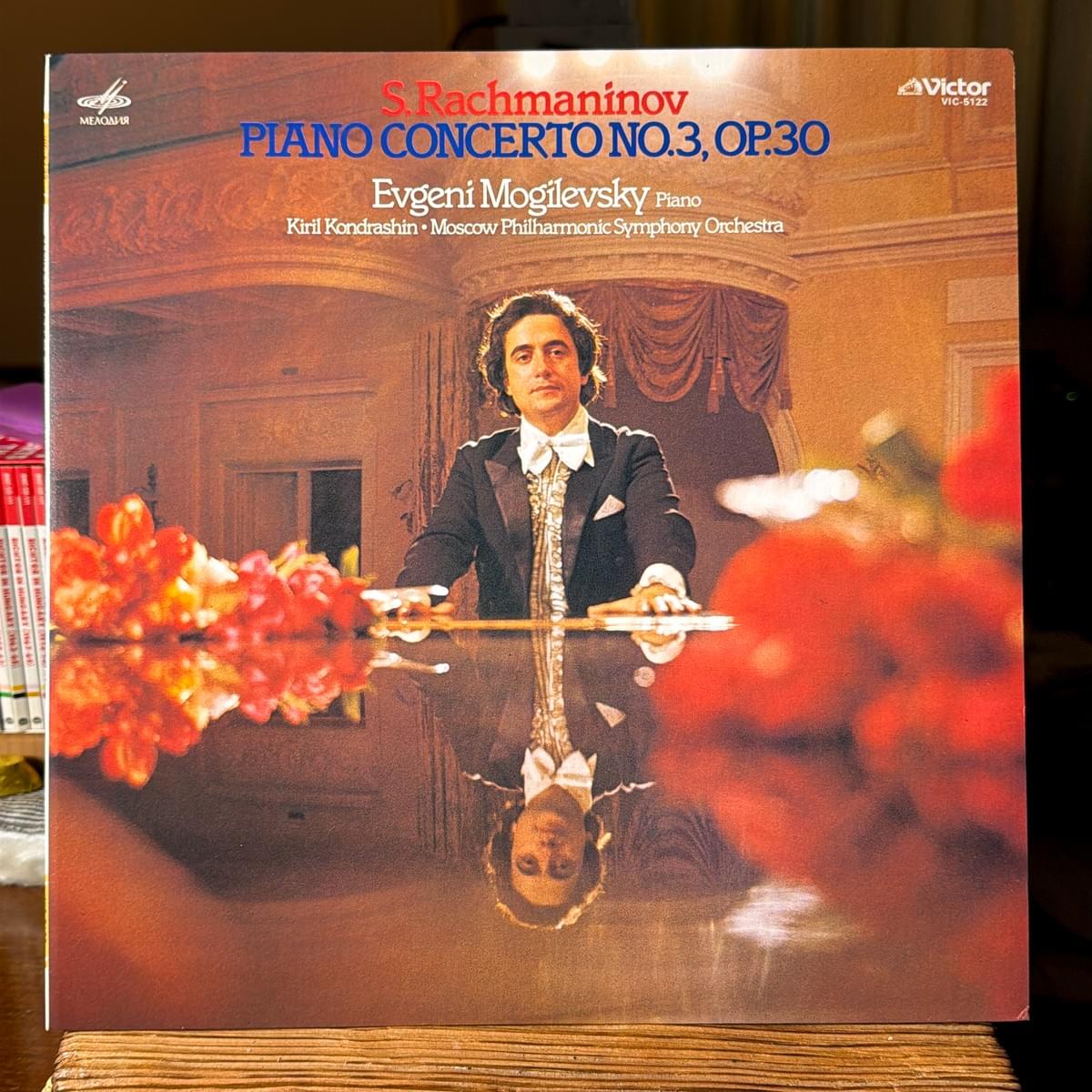
要知道,這首曲子在大家的概念裡,可是「鋼琴協奏曲之王」,是用來炫技、用來流汗、用來讓鋼琴家砸琴、讓觀眾血脈賁張的!你怎麼可以把它彈得像是在哄嬰兒睡覺?這簡直是對「拉三」的褻瀆!
但這正是我在古殿一直想跟你們分享的觀念,也是我們現代人聽覺上最大的盲點:我們的耳朵,其實早就被「重口味」給養壞了。
回想一下,我們習慣了什麼?我們習慣了霍洛維茲(Vladimir Horowitz,1903-1989)那種神經質的、電光石火般的詮釋。
霍洛維茲是天才,他把這首曲子拆解成無數個精彩的碎片。在他的指下,每一個重音都像是在你的神經末梢上點火,每一個快速音群都像是在向世界宣戰,充滿了張力與稜角。那種刺激感真的很爽,就像在你疲累的下午,喝了一杯濃縮咖啡加上三倍的糖,讓你瞬間嗨起來,心跳加速。
所以,當莫吉列夫斯基用一種極度流暢、不刻意敲擊、不炫耀顆粒感的方式演奏時,那些習慣了「吃重鹹」的樂評人,第一反應當然是覺得「沒味道」。
他們豎起耳朵等待那些預期中的每一個「爆點」,等待那些像炸彈一樣的重音,結果莫吉列夫斯基卻像一陣風一樣滑過去了。於是,他們失望了,他們覺得這是一種軟弱,覺得這個年輕人「沒力氣」。
但為什麼像李希特這樣挑剔的大師會說這就是他心目中的標準?
因為李希特聽懂了。
他聽懂了莫吉列夫斯基在做音樂,而不是在表演「彈鋼琴」,也不是在討好觀眾的腎上腺素。他是在還原一個被歷史掩埋的真相——拉赫曼尼諾夫創作時,原本設想的樣子。
第二章:被誤解的作曲家——拉赫曼尼諾夫不想讓你哭
我們對拉赫曼尼諾夫(Sergei Rachmaninoff,1873-1943)有一個巨大的誤解,這個誤解甚至扭曲了我們對「浪漫」的認知。
提到拉赫曼尼諾夫的「浪漫」,你腦海中浮現的是什麼? 是不是那些好萊塢電影裡煽情的配樂?是不是那種濃得化不開的憂鬱?是不是那種像瓊瑤劇一樣,哭天搶地、濫情到不行的「浪漫」?
如果是,那我要很殘酷地告訴你:那是我們後人強加給他的,那不是他。
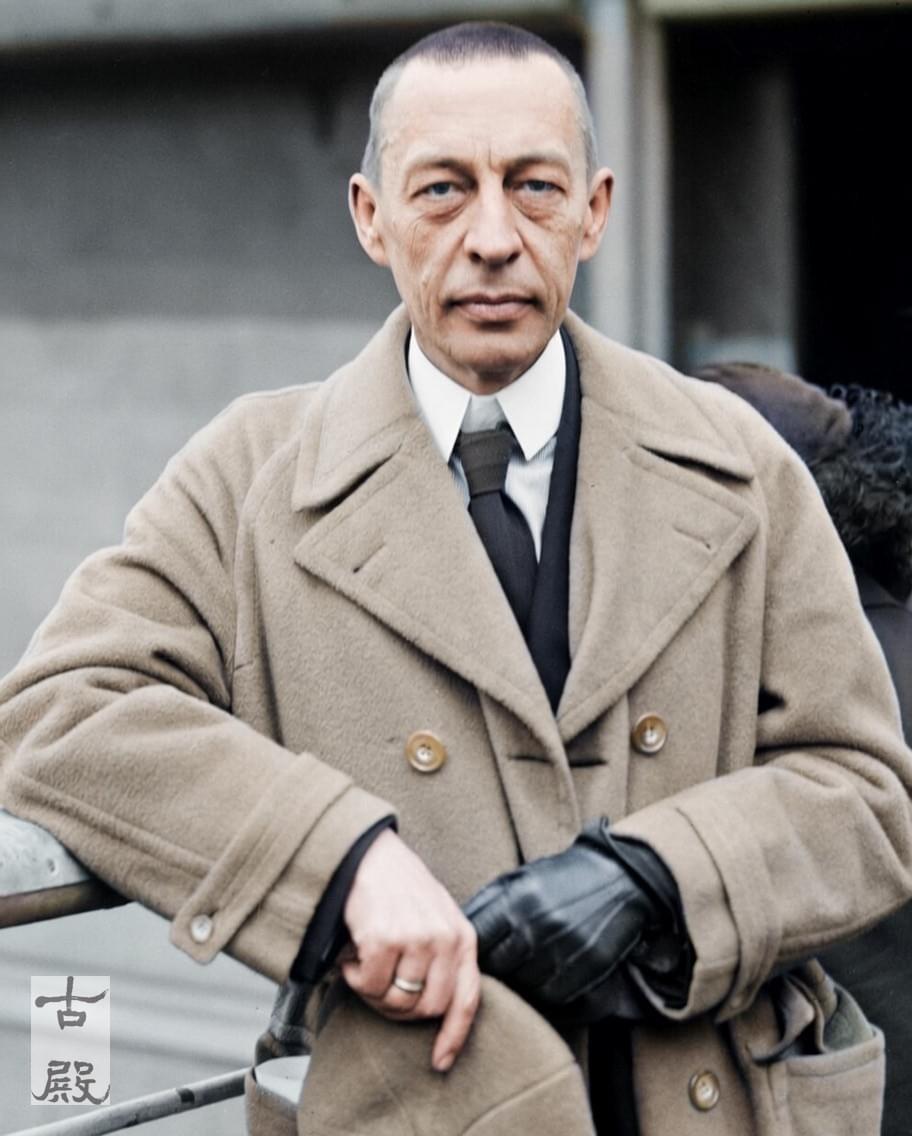
在古殿樂藏,我們花了很多時間修復、聆聽 1920 到 1930 年代,拉赫曼尼諾夫親自演奏的蟲膠唱片(Shellac)。當你透過那些原始載體的錄音時,我們聽見作曲家本人的聲音時,你會震驚。
拉赫曼尼諾夫的演奏,一點都不「濫情」。 相反的,他是「冷靜、冷酷」的。
真正的拉赫曼尼諾夫,是一個身高一米九十幾的俄國大漢,總是板著一張撲克臉(作曲家史特拉汶斯基曾戲稱他是「六呎半的悲愁」)。他坐在鋼琴前,背脊挺得筆直,手指像鋼鐵一樣精準。他討厭那種故意放慢速度、搔首弄姿的彈奏。對他來說,情感不是靠刻意來表現的,而是藏在嚴謹的結構背後。
為了讓你更具體地感受到這一點,我們來聽聽幾個他在 1920 年代的關鍵錄音,這些錄音就像是法醫的解剖刀,精準地切開了後世的誤解:
1. 柴可夫斯基《四季:馬車》(Troika)——你是坐車還是暈車?
這首曲子大家都很熟,很多鋼琴家把它彈得非常「浪漫」,左右手搖搖晃晃,好像馬車夫喝醉了一樣。但在拉赫曼尼諾夫1920年的錄音裡,你會聽到一個截然不同的景象。
拉赫曼尼諾夫的左手節奏(Rhythm)極度清晰、穩定,就像是一個精密的時鐘,又像是馬蹄敲擊在凍土上的聲音。那個節奏是**「有骨頭」**的,它不會因為右手的旋律而在那邊扭捏作態。
這給了我們什麼感覺?一種強烈的**「空間感」與「速度感」**。你真的感覺到馬車在奔馳,風在耳邊呼嘯。這就是他要的——清晰、明確、立體。
2. 舒曼《狂歡節》(Carnaval)——不是乒乓球,是立體的油畫
小提琴大師米爾斯坦(Nathan Milstein,1904-1992)曾說過一個非常精準的比喻。他說,當你看其他鋼琴家彈舒曼的《狂歡節》時,你會覺得他們像是在打乒乓球——球速很快,你一來我一往,只求不漏接,只求快與炫技,聽完只覺得一陣眼花撩亂。
但是,當你聽拉赫曼尼諾夫彈奏時,那是一幅**「宏偉的油畫」**。
在1929年的錄音中,拉赫曼尼諾夫賦予每一個變奏段落完全不同的音色性格。他不趕拍子,他不急著展示手指的靈活度。相反的,他像個說書人,把每一個角色的性格都「雕刻」出來。你會發現,他的技術是用來服務「敘事」的。他不是在告訴你「我彈得有多快」,而是在告訴你「這個故事有多深」。
米爾斯坦在回憶錄中總結得最好:拉赫曼尼諾夫的演奏,就像是「從大理石中雕刻出立體的圖像」。
這意味著什麼?這意味著他的音樂是建築,是結構,是堅硬且清晰的線條。這絕對不是那種黏答答、模糊不清的情感宣洩。這對鋼琴技巧的要求極高,甚至對於演奏者的藝術要求也極高——你必須先是一個整體結構的建築師,每一個聲音都有意義,然後才是一個詩人。
第三章:河流與水坑——霍洛維茲、霍夫曼與那些沒說出口的話
既然拉赫曼尼諾夫這麼重視整體結構與清晰度,那為什麼我們現在對「拉三」的印象全是狂亂的炫技?
這就要引入一個很有趣的歷史公案:霍洛維茲與拉赫曼尼諾夫的關係。
大家都知道,霍洛維茲是「拉三」的推廣功臣。他在1930年錄下了世界首錄,拉赫曼尼諾夫聽完後,公開說:「他彈得比我好。」這句話成了霍洛維茲一輩子的引以為傲的金字招牌,而且一輩子他都只彈「拉三」,彷彿這是他個人的專屬名片。
但身為一個歷史研究者,我要提醒大家,有時候大師說的話,是一種「防衛性的外交辭令」(Diplomatic compliment)。(米爾斯坦說,拉赫不希望這句「他彈得比我好」,是由別人口中先說出來,所以他先說先堵住別人的嘴。)
根據米爾斯坦在《俄國到西方》的回憶紀錄,拉赫曼尼諾夫這句話背後有著複雜的情感。他當然欣賞霍洛維茲的才華與世俗魅力,但他心裡很清楚,霍洛維茲走的是一條跟他完全不同的路。
霍洛維茲是**「拆解炫技派」**。他擅長把曲子變成無數個發光的碎片,這裡一個高音如閃電,那裡一個低音如炸雷。聽霍洛維茲,你是在看煙火秀,很精彩,但也很累,因為你的神經一直處於緊繃狀態。
但你知道拉赫曼尼諾夫真正心儀的鋼琴家是誰嗎?
是:約瑟夫·霍夫曼(Josef Hofmann,1876-1957)。
拉赫曼尼諾夫將這首《第三號鋼琴協奏曲》題獻給了霍夫曼(雖然霍夫曼一輩子完全沒有公開演奏過這首曲子)。他甚至公開承認:「霍夫曼的鋼琴技巧高於我。」這句話可不是客套(拉赫曼尼諾夫可是有名的自負,尤其是對自己的鋼琴演奏),因為霍夫曼的風格是什麼?
是:絕對的清晰。
霍夫曼他能彈出如水晶般透徹的音色,並且清楚呈現樂曲中的複雜結構。他的演奏就像是一個精密的萬花筒,雖然色彩斑斕,但所有的變化都在一個嚴謹的幾何框架內。他從不濫情,從不模糊。
拉赫曼尼諾夫把作品獻給霍夫曼,因為霍夫曼才是那個真正能夠體現他那整體「建築美學」的人。
拉赫曼尼諾夫的哲學到底是什麼?
他在受訪時曾說過一段非常重要的話,這也是解開莫吉列夫斯基錄音之謎的鑰匙:
「一部作品就像一條河流,它應該只有一個真正的『頂點(高潮)』(Culminating Point)。如果不顧一切地在每個段落都炫技、都製造高潮,那你就會把這條河流切斷,變成一灘一灘死水坑。」
這就是關鍵!為什麼現代很多人的演奏聽起來很累?因為他們把河流切斷了。他們為了討好觀眾,每三分鐘就給你一個高潮,結果整首曲子支離破碎,變成了「精彩片段集錦」。
這也完美解釋了為什麼李希特會這麼推崇莫吉列夫斯基——因為李希特最討厭的就是「碎片化的炫技」,他最在乎的就是「整體結構的長線條」。
第四章:莫吉列夫斯基的「造山運動」——把時間縫合起來
現在,帶著這些歷史背景,我們再回頭聽聽莫吉列夫斯基的1964年錄音。
當那些樂評人嫌他「溫柔」、「想睡」時,他們沒聽出來的是,莫吉列夫斯基正在進行一場偉大的**「造山運動」**。
他不像霍洛維茲那樣,急著在第一樂章就向你展示他的肌肉,急著把每一個音符都彈得像鑽石一樣刺眼。不,莫吉列夫斯基選擇了:「醞釀」。
這版錄音的速度極快,但那種快不是為了炫技,而是為了**「流動」**。他把所有的技巧、所有的能量都壓抑住,把它們轉化為一種連綿不斷的流動感。他的觸鍵極快且輕盈,不刻意強調顆粒感,是為了讓音樂像水流一樣前進,而不是為了讓你看清楚每一顆水珠。
聽這張唱片,你需要一點耐心。
他在鋪陳,他在帶著我們,沿著山坡一路往上爬,不讓你半路停下來看風景。他在累積那股巨大的勢能,他在編織那條長長的河流。
然後,神奇的事情發生了。
當那個真正的**「頂點(高潮)」(Culminating Point)**——也就是拉赫曼尼諾夫所說的那個唯一的「高潮」時刻——終於到來時,莫吉列夫斯基才把積蓄已久的能量一次釋放出來。
那一刻,不是煙火,而是火山爆發。 那一刻,不是感官的刺激,而是靈魂的震撼。
因為前面的鋪陳夠長、夠穩、夠壓抑,所以這個爆發才顯得如此巨大。那種震撼,是把你整個人「吸進去」的。
這就是為什麼李希特說他滿意了。因為這才是拉赫曼尼諾夫要的:不是水坑,是河流;不是土丘,是高山。
最後:找回那個「浪漫」的真義
在這份莫吉列夫斯基的「拉三」中,試著不去尋找那些「刺激點」,而是跟隨莫吉列夫斯基那種流動與醞釀,你會發現你的呼吸開始變慢了,你的肩膀開始放鬆了,被吸入那個音樂的世界中。
你不再期待下一個音符要給你什麼重擊,你開始學會在整體中「跟隨」。
你會聽見,原來在那些快速的音群背後,藏著這麼綿長的旋律線。就像拉赫曼尼諾夫說的,那是從大理石中雕刻出來的線條,雖然冷靜,但無比堅定。那是一種**「撐得住」**的力量。
這就是拉赫曼尼諾夫真正的「浪漫」。他的浪漫不是哭哭啼啼的情緒發洩,而是在巨大的壓力與痛苦面前,依然保持著優雅與結構的完整。
莫吉列夫斯基把這份力量找回來了。他拒絕討好觀眾的耳朵,他拒絕用廉價的刺激來換取掌聲。他選擇了一條更難的路:用極致的控制力,還原作品的整體性。
在1964年的錄音裡,莫吉列夫斯基或許沒想那麼多。他只是忠實地,展現了他作為俄羅斯鋼琴學派繼承人所理解的真理。
(莫吉列夫斯基在莫斯科音樂學院的兩大巨頭老師(伊貢諾夫 (Konstantin Igumnov, 1873-1948)與戈登懷瑟 (Alexander Goldenweiser, 1875-1961)),他們是拉赫曼尼諾夫在莫斯科音樂學院的同學)
別急著要高潮, 讓音樂流動一會兒。 讓莫吉列夫斯基帶著你,走過那段長長的、溫柔的鋪陳。
當最後的高潮來臨時,你會發現,那份感動不是來自於外在的刺激,而是來自於你內心深處,而這就是拉赫曼尼諾夫當年所謂的「浪漫」的真義。
*******
[Gu Dian Music Stories] The Misunderstood "Romance": Why the "Rach 3" That Richter Dared Not Touch Lies Hidden beneath Mogilevsky's Fingertips
Preface: When a Legend Chooses Silence
If I told you that there is a piano concerto so dauntless that even the man hailed as the "Soviet Piano Titan"—the giant whose two hands held up the entire Russian Piano School, Svia
toslav Richter (1915-1997)—would not touch it, or more precisely, "refused to play it," would you think I was joking?
Who was Richter? He was a man whose touch could shatter your defenses like Thor's hammer, yet also caress your wounds like a feather. Throughout his life, he conquered countless arduous works, yet one super-masterpiece remained conspicuously absent from his repertoire list: Rachmaninoff’s Piano Concerto No. 3 (hereinafter referred to as "Rach 3").
This piece is known as the "Elephants" of the repertoire, the ultimate battleground where countless pianists prove their technique. But when asked why he didn't play it, this maestro, full of character, gave an answer that was both shocking and profoundly deep:
"If I am quite satisfied with how others play this piece, I can refrain from playing it. But if I were dissatisfied, I would have long since taken the field myself and added it to my own repertoire."
This statement sounds arrogant, full of Richter-esque dominance. But if you chew on it carefully, a startling secret lies hidden behind it: Who was it? Who played it so well that Richter was willing to "sheathe his sword"? Who made him feel that the truth of this piece had already been fully spoken?
Richter named three people: Van Cliburn (1934-2013), Yakov Flier (1912-1977), and one name that might be unfamiliar even to seasoned audiophiles, a name not easily found on record store shelves—Evgeni Mogilevsky (1945-2023).
Chapter 1: The Misunderstood "Romance" — Soporific or Stimulant?
Let us rewind time to 1964.
In May of that year, an 18-year-old Soviet boy, Evgeni Mogilevsky, sat on the stage of the Queen Elisabeth Competition finals in Brussels and played Rachmaninoff’s Piano Concerto No. 3. That night’s performance shook the jury. He not only won the gold medal for the Soviet Union but also set a record as the youngest winner in the competition's history.
adorned with glory, he returned home. In December of that same year, to commemorate this great contribution, the Soviet authorities granted him the highest honors—they specially engaged the best Soviet conductor of the time (Kirill Kondrashin, 1914-1981) and the Moscow Philharmonic to record a commemorative album of "Rach 3" specifically for him.
Imagine the scene: Young Mogilevsky sitting at the piano, facing this concerto known as the "hardest in the world," looming like a mountain. At only 18, perhaps he wasn't thinking about "surpassing" anyone, nor was he trying to prove how strong his muscles were on the keyboard. He simply, honestly, placed his fingers on the keys and played the sound he believed should exist in his heart.
However, when this recording—bearing the halo of a gold medal—was released, it sparked a "controversy" in the world of music criticism that left many scratching their heads.
Many critics were confused upon first listen. They didn't even know how to write about it. Because what they heard was completely different from the "Russian Battle Style" they expected.
The point of controversy was interesting, even contradictory: It was too fast, yet it was too "soft."
In terms of data and technique, this is almost one of the fastest versions in history. His fingers fly across the keyboard, incredibly fluid, with no technical obstacles stopping him.
But, listening to it, many critics frowned. Some unceremoniously criticized: " Isn't this too gentle? It lacks fire. Some passages are even soporific (sleep-inducing)."
"A soporific Rach 3?" That was practically a joke at the time. You have to understand, in everyone's concept, this piece is the "King of Piano Concertos." It is used to show off, to sweat, to make pianists smash the piano, and to make the audience's blood boil! How could you play it as if you were lulling a baby to sleep? This was practically blasphemy against "Rach 3"!
But this is exactly the concept I want to share with you at Gu Dian, and it is also the biggest blind spot in our modern hearing: Our ears have long been spoiled by "heavy seasoning."
Think back: What are we used to? We are used to Vladimir Horowitz (1903-1989) and his neurotic, lightning-bolt interpretations.
Horowitz was a genius. He dismantled this piece into countless brilliant fragments. Under his fingers, every accent was like lighting a fire on your nerve endings; every rapid scale was like a declaration of war against the world. That kind of stimulation feels great, like drinking a double espresso with triple sugar on a tired afternoon—it gets you high instantly, heart racing.
So, when Mogilevsky played in a manner that was extremely fluid, without deliberate hammering, without showing off granularity, the first reaction of those critics used to "heavy salt and spice" was, naturally, that it was "bland."
They pricked up their ears waiting for every expected "explosion," waiting for those bomb-like accents, but Mogilevsky glided past like a gust of wind. So, they were disappointed. They felt this was a weakness, that this young man had "no strength."
But why did a master as picky as Richter say this was his standard?
Because Richter understood. He heard that Mogilevsky was making music, not "performing piano," nor was he catering to the audience's adrenaline. He was restoring a truth buried by history—the way Rachmaninoff originally envisioned it when he composed it.
Chapter 2: The Misunderstood Composer — Rachmaninoff Doesn't Want You to Cry
We have a huge misunderstanding about Sergei
Rachmaninoff (1873-1943), a misunderstanding that has even twisted our perception of "Romanticism."
When mentioning Rachmaninoff's "Romance," what comes to mind? Is it those sentimental soundtracks in Hollywood movies? Is it that thick, insoluble melancholy? Is it the kind of weeping, wailing, excessively sentimental "romance" found in soap operas?
If so, I must brutally tell you: That is what we, the later generations, forced upon him. That is not him.
At Gu Dian, we have spent a lot of time restoring and listening to the shellac records played by Rachmaninoff himself between 1920 and 1930. When you hear the composer's own voice through those original mediums, you will be shocked.
Rachmaninoff's playing is not "sentimental" at all. On the contrary, he is "calm, even cold."
The real Rachmaninoff was a towering Russian man of over 1.90 meters, always wearing a poker face (the composer Stravinsky once jokingly called him "six and a half feet of scowl"). He sat at the piano, back perfectly straight, fingers precise as steel. He hated that kind of deliberate slowing down, the posturing rubato. For him, emotion was not expressed through deliberate manipulation, but was hidden behind a rigorous structure.
To let you feel this more concretely, let's listen to a few of his key recordings from the 1920s. These recordings are like a forensic scalpel, precisely cutting away the misunderstandings of later generations:
1. Tchaikovsky's The Seasons: Troika — Are you riding the carriage or getting carsick? Everyone knows this piece. Many pianists play it very "romantically," swaying left and right as if the carriage driver is drunk. But in Rachmaninoff's 1920 recording, you hear a completely different scene. Rachmaninoff's left-hand rhythm is extremely clear and stable, like a precision clock, or the sound of horse hooves striking frozen earth. That rhythm has "bones"; it doesn't twist and turn just because of the melody in the right hand. What feeling does this give us? A strong sense of "Space" and "Speed." You truly feel the carriage galloping, the wind whistling in your ears. This is what he wanted—clear, definite, three-dimensional.
2. Schumann's Carnaval — Not Ping-Pong, but a 3D Oil Painting Violin master Nathan Milstein (1904-1992) once used a very precise metaphor. He said that when you watch other pianists play Schumann's Carnaval, you feel like they are playing Ping-Pong—the ball moves fast, back and forth, just trying not to drop it, aiming for speed and virtuosity, leaving you dazzled but dizzy. However, when you listen to Rachmaninoff play, it is a "Magnificent Oil Painting." In his 1929 recording, Rachmaninoff gives each variation a completely different tonal character. He doesn't rush the beat; he isn't in a hurry to show off his finger dexterity. Instead, he is like a storyteller, "sculpting" the character of each role. You discover that his technique is used to serve the "narrative." He isn't telling you "how fast I play," but telling you "how deep this story is."
Milstein summarized it best in his memoirs: Rachmaninoff's playing was like "carving stereoscopic images out of marble."
What does this mean? It means his music is architecture, it is structure, it is hard and clear lines. It is absolutely not that sticky, blurry emotional venting. This requires extremely high piano technique, and even higher artistic demands on the performer—you must first be an architect of the overall structure, where every sound has meaning, and only then can you be a poet.
Chapter 3: Rivers and Puddles — Horowitz, Hofmann, and Things Left Unsaid
Since Rachmaninoff valued overall structure and clarity so much, why is our current impression of "Rach 3" all about frantic virtuosity?
This brings us to an interesting historical case: the relationship between Horowitz and Rachmaninoff.
Everyone knows Horowitz was the champion of "Rach 3." He recorded the world premiere in 1930. After hearing it, Rachmaninoff publicly said: "He plays it better than I do." This sentence became the gold standard Horowitz prided himself on for life, and he played "Rach 3" his entire life, as if it were his personal calling card.
But as a historical researcher, I must remind everyone: sometimes what masters say is a form of "defensive diplomatic compliment." (Milstein noted that Rachmaninoff didn't want the phrase "he plays better than me" to be said by someone else first, so he said it himself to silence others.)
According to Milstein's records in From Russia to the West, there were complex emotions behind this statement. Rachmaninoff certainly admired Horowitz's talent and worldly charm, but he knew in his heart that Horowitz was walking a completely different path.
Horowitz was of the "Deconstructionist Virtuoso School." He excelled at turning a piece into countless glowing fragments—here a high note like lightning, there a low note like thunder. Listening to Horowitz is watching a fireworks show; it's exciting, but also exhausting, because your nerves are constantly taut.
But do you know who Rachmaninoff's truly favored pianist was? It was Josef Hofmann (1876-1957).
Rachmaninoff dedicated his Piano Concerto No. 3 to Hofmann (even though Hofmann never publicly performed the piece in his life). He even publicly admitted: "Hofmann's piano technique is superior to mine." This was not politeness (Rachmaninoff was famously proud, especially of his own piano playing). Why? Because what was Hofmann's style? It was: Absolute Clarity.
Hofmann could produce a tone as transparent as crystal and clearly present the complex structures within the music. His playing was like a precision kaleidoscope; though colorful, all changes occurred within a rigorous geometric framework. He was never sentimental, never blurry.
Rachmaninoff dedicated the work to Hofmann because Hofmann was the one who could truly embody his "Architectural Aesthetic."
What, exactly, was Rachmaninoff's philosophy? He once said something very important in an interview, which is also the key to unlocking the mystery of Mogilevsky's recording:
"A musical work is like a river; it should have only one true 'Culminating Point.' If you recklessly show off and create climaxes in every section, you will cut the river off and turn it into stagnant puddles."
This is the key! Why do many modern performances sound exhausting? Because they cut the river. To please the audience, they give you a climax every three minutes. The result is the piece becomes fragmented, turning into a "Compilation of Highlights."
This also perfectly explains why Richter admired Mogilevsky so much—because Richter hated "fragmented virtuosity" the most; what he cared about was the "Long Line of the Overall Structure."
Chapter 4: Mogilevsky's "Mountain-Building" — Stitching Time Together
Now, armed with this historical background, let us listen again to Mogilevsky's 1964 recording.
When those critics complained he was "gentle" or "sleep-inducing," what they failed to hear was that Mogilevsky was conducting a magnificent "Mountain-Building Movement" (Orogeny).
Unlike Horowitz, he didn't rush to show you his muscles in the first movement, didn't rush to make every note dazzle like a diamond. No, Mogilevsky chose: "Incubation."
The speed of this recording is extremely fast, but that speed is not for showing off; it is for "Flow." He suppressed all the technique, all the energy, transforming them into a continuous sense of motion. His touch was incredibly fast and light, not emphasizing granularity, in order to let the music move forward like water, rather than making you see every single water droplet.
Listening to this record requires a little patience.
He is laying the groundwork. He is leading us, climbing up the hillside, not letting you stop halfway to look at the scenery. He is accumulating that massive potential energy; he is weaving that long river.
Then, the miracle happens.
When that true "Culminating Point"—the single "climax" moment Rachmaninoff spoke of—finally arrives (especially at the end of the third movement), Mogilevsky releases all the accumulated energy at once.
At that moment, it is not fireworks, but a volcanic eruption. At that moment, it is not sensory stimulation, but a shock to the soul.
Because the foreshadowing was long enough, stable enough, and suppressed enough, this explosion appears so colossal. That shock is one that "sucks you in."
This is why Richter said he was satisfied. Because this is what Rachmaninoff wanted: Not a puddle, but a river; not a mound, but a mountain.
Conclusion: Rediscovering the True Meaning of "Romance"
In this Mogilevsky version of "Rach 3," try not to look for those "stimulation points." Instead, follow Mogilevsky's flow and incubation. You will find your breathing slowing down, your shoulders relaxing, as you are drawn into that musical world.
You no longer expect the next note to deal you a heavy blow; you begin to learn to "follow" within the whole.
You will hear that behind those rapid groups of notes, there lies such a long, continuous melodic line. Just as Rachmaninoff said, it is a line carved out of marble—cool, but incredibly firm. That is a strength that "holds up."
This is Rachmaninoff's true "Romance." His romance is not a tearful emotional venting, but maintaining elegance and structural integrity in the face of immense pressure and pain.
Mogilevsky retrieved this strength. He refused to cater to the audience's ears; he refused to exchange cheap thrills for applause. He chose a harder path: using extreme control to restore the integrity of the work.
In that recording from 1964, Mogilevsky perhaps didn't think that much. He simply, faithfully, demonstrated the truth as he understood it as an heir to the Russian Piano School. (Mogilevsky’s two giant teachers at the Moscow Conservatory—Konstantin Igumnov (1873-1948) and Alexander Goldenweiser (1875-1961)—were Rachmaninoff's classmates at the Moscow Conservatory.)
Don't rush for the climax. Let the music flow for a while. Let Mogilevsky take you through that long, gentle foreshadowing.
When the final climax arrives, you will discover that the emotion comes not from external stimulation, but from deep within your own heart. And that is the true meaning of the "Romance" Rachmaninoff spoke of back then.