
【古殿唱片音樂故事】法國小提琴藝術之聲~~令人心碎的小提琴家,生命充滿裂痕,卻成了光照進來的地方:費拉斯的故事
古殿殿主
在二十世紀法國小提琴學派的群星譜系中,克里斯提安·費拉斯(Christian Ferras, 1933–1982)是一個讓人難以輕描淡寫的名字。他的故事,既是天才的燦爛,也是人性脆弱的寫照——而他所留下的錄音,恰好在這兩極之間,留存了某種永恆的東西。
1982年9月14日,巴黎。一位49歲的小提琴家從窗口縱身躍下,為長年折磨著他的重度憂鬱症畫上了最後的句點。
這個名字——克里斯提安·費拉斯——在他離世之後數十年間,仍持續出現在古典音樂愛好者的案頭與討論中。不是因為他的死亡方式,而是因為他留下的錄音:那些唱片裡有一種聲音,溫潤、纖細、帶著說不清楚的憂鬱光澤,讓聽過的人難以忘懷。
費拉斯生於法國北部靠近比利時邊境的小鎮勒圖凱,童年隨家遷往南法尼斯。學琴的契機相當偶然——一次生病臥床,父親買來一把小提琴打發時間,從此一發不可收拾。他進步飛快,兩年內便拿到尼斯音樂院的一等獎,11歲前往巴黎音樂學院,1946年以13歲之齡在小提琴與室內樂兩個科目同時獲得最高獎項。後來他跟隨羅馬尼亞小提琴大師喬治·安奈斯可(George Enescu, 1881–1955)學習,那位兼具詩人氣質與哲學深度的老師,對費拉斯的音樂性格影響深遠。

法蘭西的驕傲
1949年,法國最傑出的女小提琴家吉娜特·努娃(Ginette Neveu,1919-1949)在亞速爾群島的空難中驟然離世,年僅三十歲,整個法國樂壇為之震慟。費拉斯此時正好在隆-提博大賽嶄露頭角,他自然而然地被寄予了接棒的期望——成為法國小提琴學派新一代的旗手。 1950年起,費拉斯開始在歐洲與世界各地巡迴演奏。
費拉斯的演奏有一種令人著迷的特質,不僅技巧驚人,他的指法與弓法更是獨樹一幟,幾乎像是專為他個人量身打造,旁人難以模仿。他的演奏姿勢優美自然,毫不做作,與音樂渾然一體,讓聽者在聽覺與視覺上同時被帶入音樂之中。他的巔峰時期在1960年代,那個年代他的聲音在世界琴壇中獨樹一幟——兼具感性與知性,技術與音樂融合無間,是當時「法比小提琴學派」最驕傲的代表之一。
1960年代是費拉斯的全盛時期。他是卡拉揚欽點的獨奏合作者,與柏林愛樂留下了多張令後人珍視的錄音。他詮釋的曲目極為廣泛——從巴赫到貝多芬,從舒曼、勃拉姆斯到法國比利時學派的全部曲目,皆能令人信服。作為最後幾位情感性滑音大師之一,他能讓小提琴嘆息、哭泣,而他的音色又帶有法國美學傳統中最好的那種明亮光澤。
然而,1960年代末的一次手傷成為他人生的轉折點。傷勢對心理造成的打擊,加上外界對他一貫的高標準期待,讓他備受挫折,逐漸沉迷酒精,此後幾乎絕跡於公開舞台。經過漫長的十年沉寂,1982年他終於重新站上演奏台,與巴比澤在巴黎完成了最後一場主要音樂會——但短短幾個月後,他選擇以自己的方式結束一切,年僅49歲,令人不勝唏噓。
長達二十年的默契
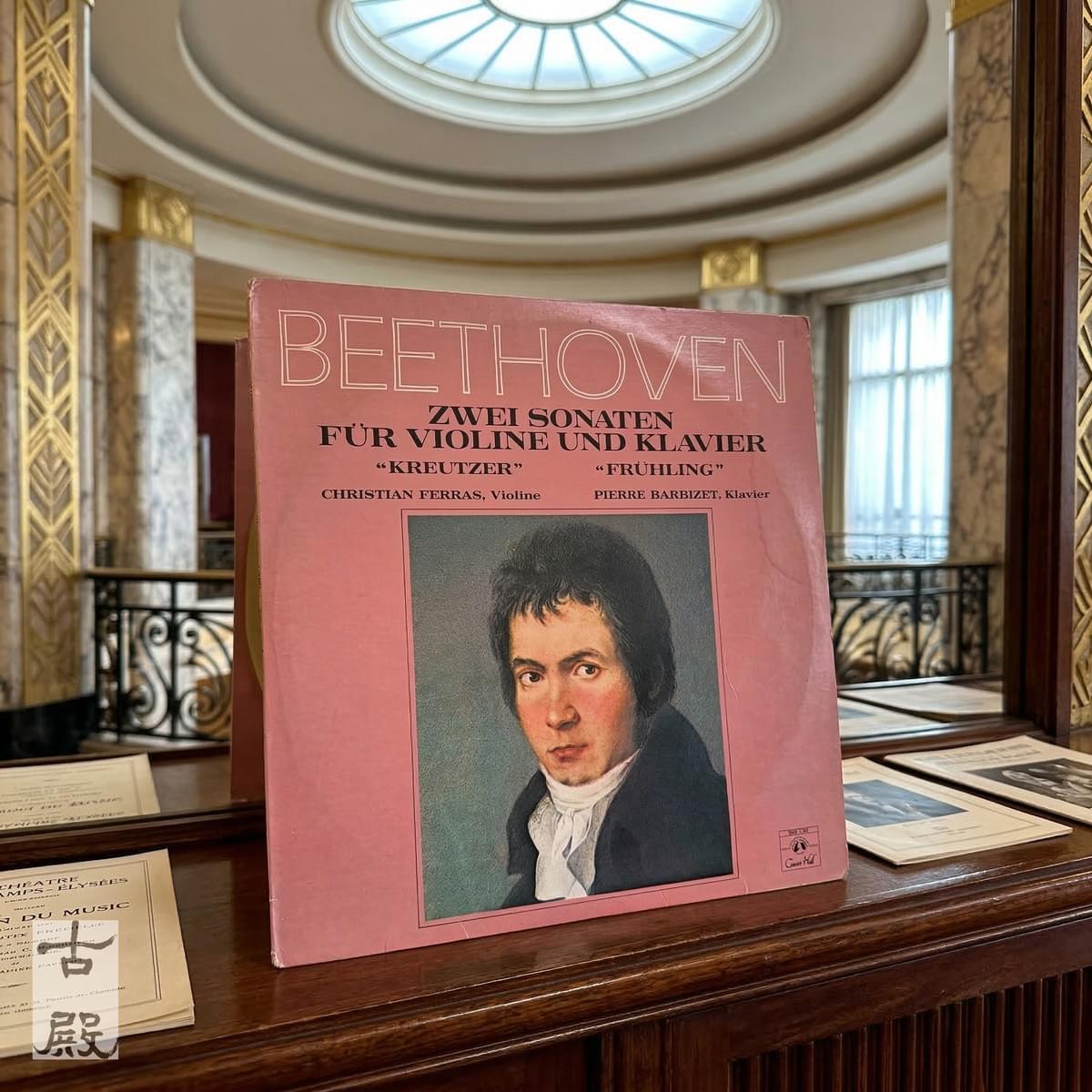
這張Concert Hall / Guilde Internationale du Disque出版的SMS 2702,錄製了費拉斯與巴比澤在1970年合作演奏的兩首貝多芬小提琴奏鳴曲:第九號《克羅采》(A大調,op. 47)與第五號《春天》(F大調,op. 24)。
值得一提的是,這並非費拉斯與巴比澤第一次錄製這組曲目。早在1958年11月,兩人已為EMI錄製了完整的貝多芬小提琴奏鳴曲全集,《克羅采》的錄音日期可考為1958年11月23日,在英國EMI錄音室完成。長期以來,唱片學家尚-米歇爾·莫爾科(Jean-Michel Molkhou)在2012年的考訂中曾誤將這套Guilde版本視為1958年EMI錄音的同一版本,後來到2014年才加以更正,確認SMS 2702屬於1970年的全新錄音。佐證之一,是法國INA廣播檔案中留有一份1971年的採訪影像,記錄了巴比澤剛收到這套Guilde全集後接受媒體訪問的畫面。

換言之,眼前這張唱片,是費拉斯與巴比澤歷經二十年合作積累之後,對這兩首曲目的成熟再詮釋。1958年是費拉斯事業上升期的青壯之聲;1970年,則是兩位老搭檔在深厚默契中的沉澱與回望。
費拉斯演奏這張唱片使用的,是一把1721年製造的史特拉迪瓦里名琴,別名「總統(Le Président)」。這把琴是他透過制琴師艾蒂安·瓦特洛(Etienne Vatelot)的介紹,於1954年取得,此後成為他最重要的演奏樂器之一,陪伴他度過了職業生涯最輝煌的歲月。
最後的歲月
然而,費拉斯自己的「春天」並不長久。1960年代末,一次手傷重創了他的信心。多年巔峰所積累的高標準期待,反而在此刻化為巨大的心理重壓,他開始借助酒精來面對舞台焦慮。此後他幾乎淡出公開演奏,在長達十年的休養與掙扎中,那把「總統」史特拉迪瓦里漸漸沉默。
1982年5月6日,費拉斯與巴比澤在巴黎完成了最後一場主要音樂會——兩位相識三十三年的老搭檔,最後一次共同站在觀眾面前。同年9月14日,費拉斯從巴黎的窗口縱身躍下,結束了自己的生命,享年四十九歲。
因起初對其死因諱莫如深,費拉斯的聲譽曾有一段時間趨於沉寂。但隨著錄音與廣播現場的陸續重新發掘,他作為一位擁有獨特音聲的頂尖小提琴家的歷史地位,最終得到了應有的確認。
一張唱片的重量
SMS 2702,這張粉紅封套的唱片,正面是貝多芬的畫像,背面是三種語言並列的唱片注釋。唱片標籤上印著「Gravure Universelle Synchro-Stereo」——Guilde du Disque自有的立體聲錄音工藝商標,在1960至70年代的法國音響圈中代表著一種對音質的承諾。
這張唱片是費拉斯與巴比澤二十年合作的結晶。它錄製於費拉斯生命中最後的活躍黃金期,用那把1721年的「總統」琴,以法國最高水準的錄音技術留存下來。《克羅采》的搏鬥與《春天》的清澈,在此並置,或許恰好映照了費拉斯自身的兩面:那個在舞台上如日中天、音色令人屏息的費拉斯,與那個在內心深處始終脆弱、終究無法與自己和解的費拉斯。
音樂是他留給我們的答案,也是他留給自己的未竟之語。
實體音樂:
*******
【Gu-Dian Record Stories】 The Voice of French Violin Art
Christian Ferras: A Heartbreaking Soul Where the Cracks Let the Light In
In the constellation of 20th-century French violinists, Christian Ferras (1933–1982) is a name I find impossible to mention lightly. His story is a vivid portrait of both brilliant genius and human fragility—and the recordings he left behind sit right between those two poles, capturing something eternal.
September 14, 1982, Paris. A 49-year-old violinist leaped from a window, putting a final, tragic period to the severe depression that had tormented him for years.
Even decades after his passing, Ferras’s name continues to live on the desks and in the hearts of music lovers. It isn’t because of the way he died, but because of the sound he lived: a tone that is warm, slender, and possessed of an indefinable melancholic glow. Once you hear it, it is impossible to forget.
The Accidental Prodigy
Ferras was born in Le Touquet, a small town in northern France, and later moved to Nice. His journey with the violin started by pure chance—while stuck in bed during an illness, his father bought him a violin just to pass the time. From that moment, there was no turning back.
He progressed at a lightning pace, winning first prize at the Nice Conservatory within two years. By age 13, he swept the top awards for both violin and chamber music at the Paris Conservatoire. He eventually studied under the Romanian master George Enescu, a teacher who was as much a poet and philosopher as a musician. This depth of character profoundly shaped Ferras’s musical soul.
The Pride of France
In 1949, France lost its greatest female violinist, Ginette Neveu, in a tragic plane crash. She was only thirty. The French musical world was devastated. At that exact moment, a young Ferras was emerging at the Jacques Thibaud Competition. Naturally, the nation looked to him to carry the torch—to become the new standard-bearer of the French violin school.
Throughout the 1950s and 60s, Ferras’s playing captivated the world. While his technique was breathtaking, it was his unique timbre that truly haunted listeners. It was a voice both sensual and intellectual—fine as silk one moment, explosive as a flood the next. His bowing and fingerings were so personal they seemed tailor-made for his soul; others found them nearly impossible to imitate. On stage, his movements were elegant and natural, completely integrated with the music. To watch him was to be visually and aurally seized by the performance.
The 1960s were his golden era. He was Herbert von Karajan’s hand-picked soloist, leaving behind legendary recordings with the Berlin Philharmonic. He could play anything—from the structural rigor of Bach and Beethoven to the romantic sighs of the French-Belgian school. As one of the last masters of the "emotional portamento," he could make a violin sigh and weep, all while maintaining that bright, luminous polish of the French aesthetic.
The Spring That Faded Too Soon
However, the "Spring" in Ferras’s own life was short-lived. In the late 1960s, a hand injury dealt a crushing blow to his confidence. The high expectations built up during his years at the peak became a psychological weight he couldn't carry. He began to turn to alcohol to cope with stage anxiety, eventually vanishing from the public eye.
After a decade of silence and struggle, he finally returned to the stage in 1982 for a final major concert in Paris with his longtime partner Pierre Barbizet. But just a few months later, he chose to end it all at the age of 49.
A 20-Year Bond: The Weight of a Record
I want to talk about this specific record—C
oncert Hall / Guilde Internationale du Disque, SMS 2702. It features Ferras and Barbizet performing two of Beethoven’s masterpieces: the “Kreutzer” (No. 9) and the “Spring” (No. 5) sonatas.
This wasn’t their first time recording these works. They had recorded a complete set for EMI back in 1958. For a long time, discographers thought this Guilde version was just a reissue of the 1958 recording. It wasn't until 2014 that experts confirmed this was a completely new recording from 1970.
In other words, what you hear on this record is the "mature" Ferras. The 1958 version was the sound of a young man on the rise; this 1970 version is the sound of two old friends looking back through the lens of a twenty-year brotherhood.
On this recording, Ferras plays the 1721 "Le Président" Stradivarius. It was his constant companion through his most glorious years. But by 1970, the "President" was singing with a different kind of depth—one born from silence and struggle.
Why This Matters
When you look at this pink-covered record, you see Beethoven on the front and notes in three languages on the back. But the real value is in the "
Gravure Universelle"—a French recording process from that era that promised a specific kind of "3D" presence and warmth.
This record is the fruit of a 20-year labor of love. It captures Ferras during his final active "golden period." The struggle in the Kreutzer and the clarity in the Spring are placed side-by-side here, perhaps mirroring the two sides of Ferras himself: the man who shone brilliantly on stage, and the man who, deep down, remained fragile and unable to find peace with himself.
Music was the answer he left for us—and perhaps the words he never got to say to himself.