
【古殿唱片音樂故事】燃燒的琴弓——麥可·拉賓與他的帕格尼尼、維尼奧夫斯基
古殿殿主
有些人天生就是為了某件事而來的。
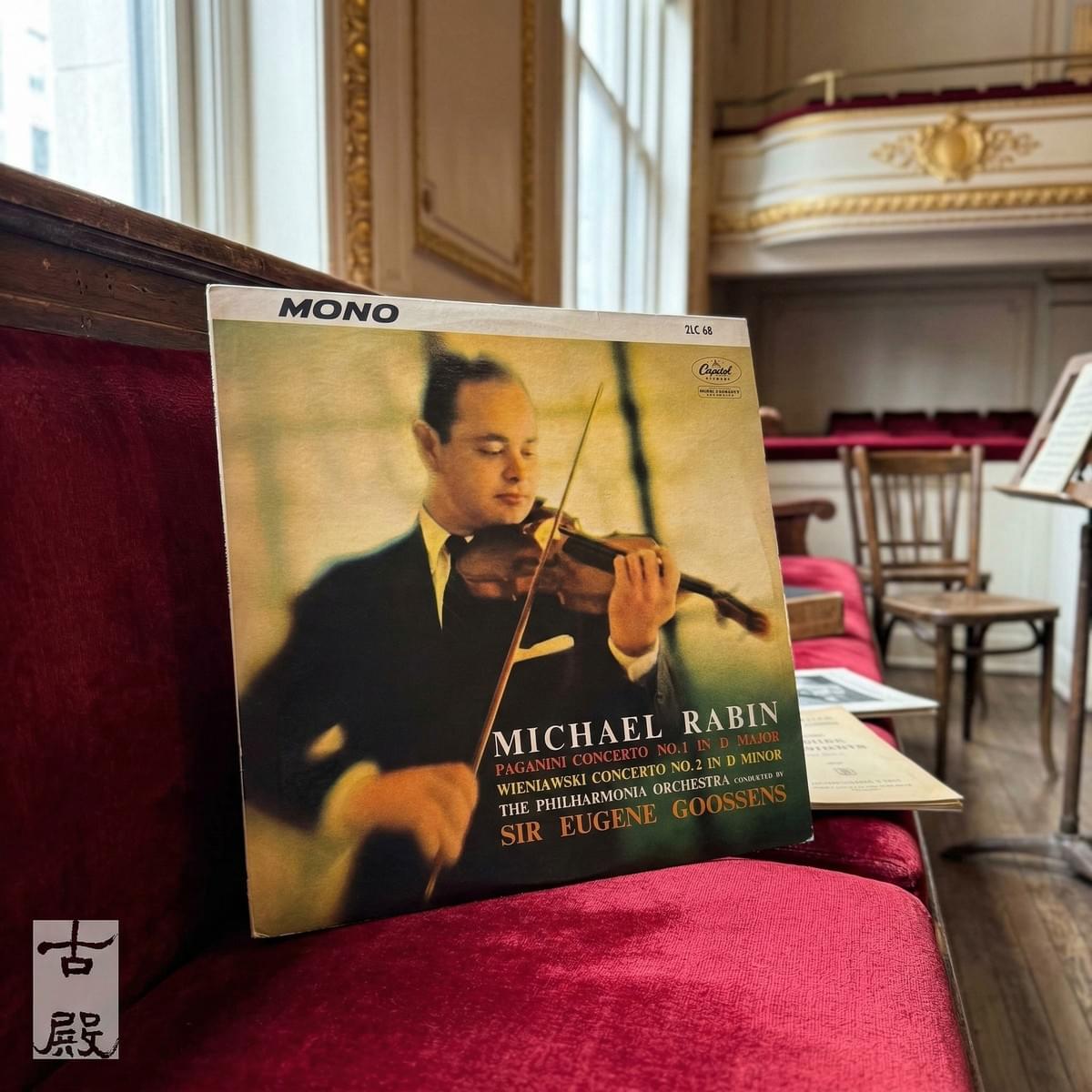
麥可·拉賓(Michael Rabin, 1936-1972)大概就是為了小提琴而來的。他七歲開始學琴,十三歲登上卡內基廳,二十二歲錄下了這張日後被譽為「無人超越」的錄音。然後,在三十五歲那年,他突然就不在了。
他留給世界的錄音少得令人心疼,但每一張幾乎都成了後世難以跨越的標竿。
一個不可思議的孩子
拉賓出生在紐約一個音樂家庭,父親是紐約愛樂的小提琴手,母親是茱莉亞音樂學院的鋼琴家。據說他一歲就能用木棍打出完美的節奏,三歲已具備絕對音感。七歲跟著父親學琴,進步之快令父親自嘆不如,很快便安排他拜師求教。
當時把他介紹出去的,是海菲茲——這位20世紀最偉大的小提琴家之一,在聽過這個孩子演奏之後,直接建議他的父母把他送到名師伊凡·加拉米安(Ivan Galamian, 1903-1981)門下。加拉米安一生培育過無數頂尖小提琴家,包括後來赫赫有名的帕爾曼與祖克曼,但他在晚年留下了一句話:拉賓是他這一生教過最棒的學生,「毫無弱點,從來都不。」
1950年,13歲的拉賓第一次走上卡內基廳的舞台,全場震動。1951年,15歲的他再度登台演奏帕格尼尼協奏曲,由米特羅普洛斯指揮紐約愛樂協奏,指揮事後說:「他已經具備了成為偉大藝術家的一切條件。」
所有人都在等待這個孩子長大成為一代宗師。但事情沒有朝那個方向走。
短暫,卻無法被取代
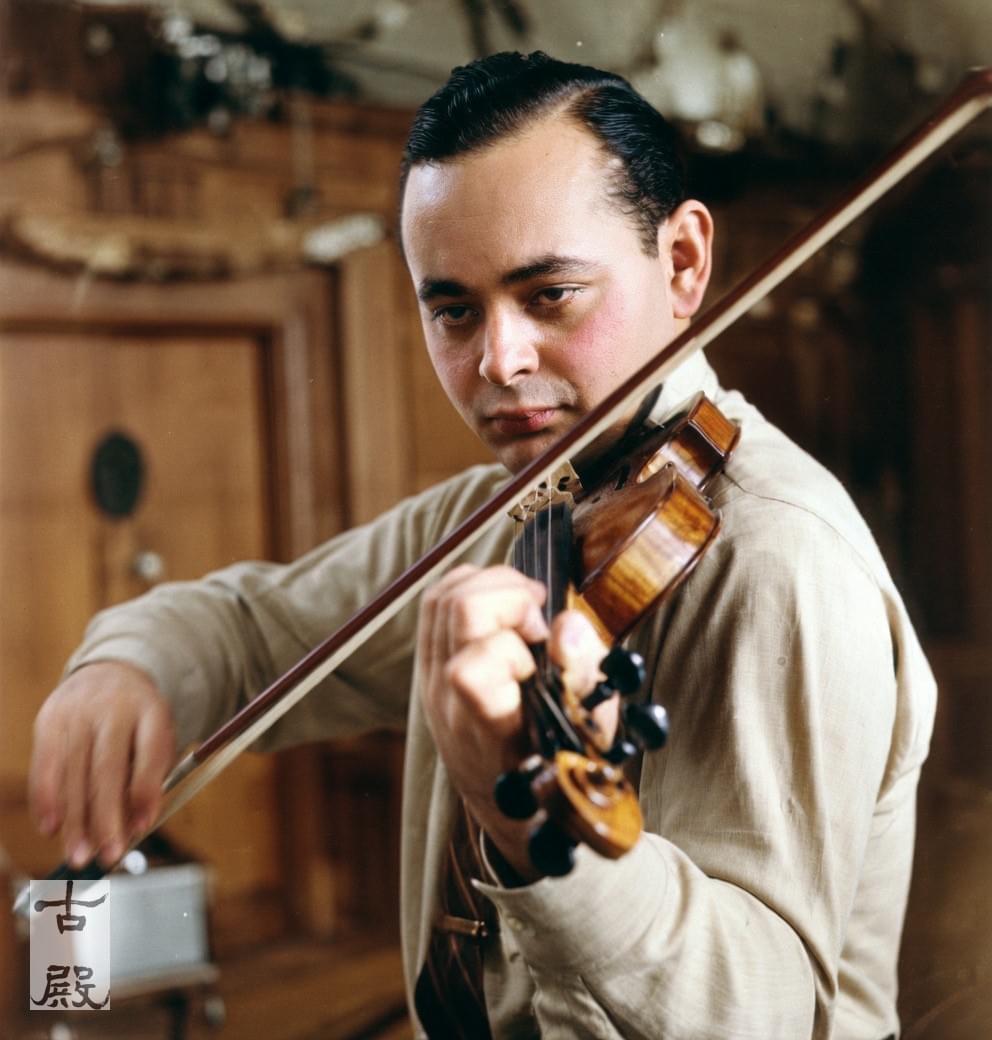
拉賓的演奏生涯其實非常短暫。他在1959年之後便再也沒有進過錄音室,個人生活也陷入困境,逐漸淡出舞台。1972年1月,他在自己的公寓裡意外滑倒,頭部撞傷,就這樣走了,只有三十五歲。
但在那幾年裡,他留下的錄音,張張都是傳世之作。
眼前這張唱片,錄製於1958年9月,倫敦。當時的拉賓二十二歲,正值一生技藝最全盛的時期。他與英國愛樂管弦樂團合作,由古森斯爵士(Sir Eugene Goossens, 1893-1962)指揮,錄下了帕格尼尼第一號與維尼奧夫斯基第二號兩首小提琴協奏曲。這兩首曲子,恰好是19世紀小提琴炫技傳統的兩座高峰,也是最考驗演奏家技巧與音樂性的作品之一。
六十多年過去,這個錄音至今仍被許多人認為是這兩首曲子最難被超越的版本之一。
帕格尼尼與維尼奧夫斯基:兩個時代的炫技大師
說到這兩位作曲家,其實他們有個共同點:都是小提琴家出身,都是為了自己演奏而作曲,也都在當時的音樂界掀起了巨大的轟動。
帕格尼尼(Niccolo Paganini, 1782-1840)是更早的一位,他的技巧之驚人,當時甚至有傳言說他與魔鬼立了契約。舒伯特為了買票聽他的音樂會不惜傾盡家產,李斯特聽了他的演奏之後立志要成為「鋼琴界的帕格尼尼」。他的第一號小提琴協奏曲(D大調,Op.6),旋律優美、技巧炫目,第一樂章氣宇軒昂,第二樂章如歌如泣,第三樂章的跳弓節奏據說當年令全歐洲為之傾倒。
維尼奧夫斯基(Henryk Wieniawski, 1835-1880)則是半個世紀後的波蘭人,人稱「小提琴界的蕭邦」。他的第二號小提琴協奏曲(D小調,Op.22)帶有濃厚的斯拉夫浪漫氣質,抒情與技巧並重,第三樂章標注「吉普賽風格」,在熱烈的節奏中奏出令人目眩的跳弓,華麗而充滿生命力。
在拉賓手中,這兩首曲子既有炫技的輝煌,又不失音樂的溫度。那種年輕人特有的熱情與衝勁,和他精準無比的技巧結合在一起,產生了一種讓人屏息的效果——你不只是在聽一個人拉琴,你是在感受一個人燃燒。
這張唱片特別在哪裡:日本赤盤的故事
說完音樂,來說說這張唱片本身。
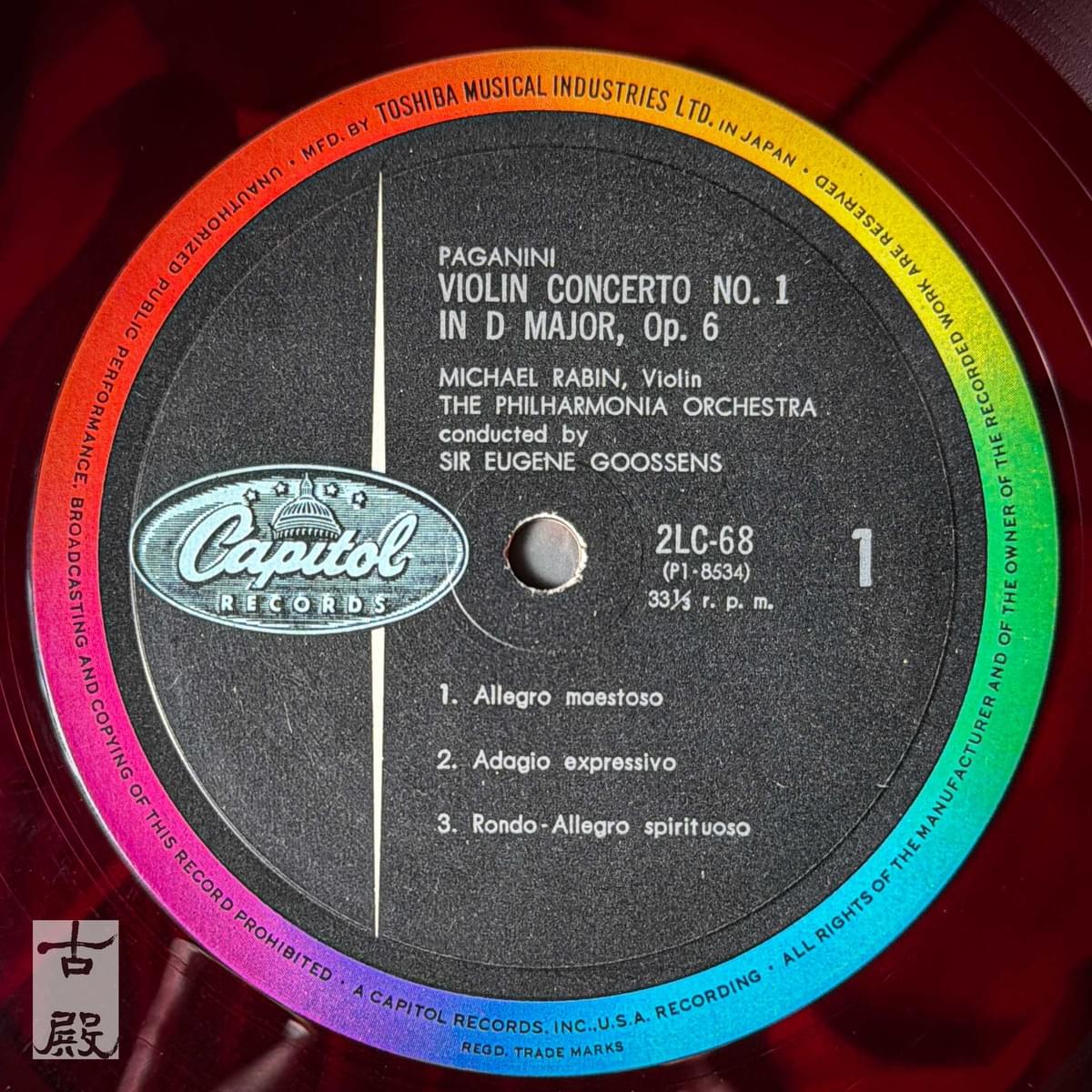
這是1960年代初期由日本東芝音樂工業壓製的Capitol日本初版,編號2LC 68,MONO版本。但讓它格外珍稀的,是它的材質——這是一張「赤盤」,也就是日文俗稱的「赤盤(aka-ban)」,紅色的黑膠唱片。
很多人第一次看到它會以為只是顏色好看,但這張紅色完全不是噱頭。請千萬不要把它跟現在市面上那些五顏六色的「現代彩膠」混為一談——現在的彩膠基本上是重看不重用,添加色料往往讓聲音更差。當年的日本赤盤,是為了耳朵做的,不是為了眼睛。
東芝從1958年開始研發一種名為「EverClean」的獨家配方膠片,思路其實很清楚:把傳統黑膠裡面用來增加硬度的「碳黑」去掉。碳黑讓唱片變黑變硬,但它也會產生微小的摩擦噪音,是底噪的來源之一。去掉碳黑之後,膠料自然呈現出這種通透的酒紅色——紅色不是刻意染的,而是去掉雜質之後,材料本來的樣子。這是一種「減法的工藝」:去掉了噪音的來源,留下最純淨的聲音底色。
國外藏家的覺醒:最接近母帶的聲音
這幾年,在國外資深收藏圈與音響論壇(如 Steve Hoffman Forums、Lenco Heaven)裡,日本赤盤正在成為愈來愈多行家眼中的「隱藏聖物」。英國著名黑膠專家 Andrew(Parlogram Auctions)——這位專門處理 Beatles 天價唱片的權威人士,曾在分析影片中直接點名:東芝的 EverClean 紅膠品質可能是「世界之最」。
為什麼連挑剔的英國人都這樣說?原因有三:
第一,它最安靜。 因為沒有碳黑微粒的摩擦,赤盤的背景安靜得像深淵。音樂停下來的瞬間,是一片真正的死寂。這讓你能聽見演奏者最細微的呼吸,聽見錄音空間裡最輕的殘響——那些在一般版本裡被底噪蓋掉的細節,在赤盤上重新浮現出來。
第二,它最耐磨。 很多人以為紅膠軟、容易壞,其實恰恰相反。赤盤使用的是100%原生料(Virgin Vinyl),物理韌性極佳。Andrew 特別指出,1970年代石油危機之後,歐美許多唱片廠為了節省成本,開始混入回收料壓片,音質因此大幅下滑。但1960年的日本赤盤,用的是當時最頂級的原生材料,六十年後唱針磨過去,高頻細節依然保存完好。更殘酷的現實是:這種等級的原生料,因為現在的環保法規限制,現代工業已經基本做不出來了。這是一種真正意義上已經失傳的聲音工藝。
第三,它最忠實。 一般製作黑膠時,工程師為了遷就碳黑等材料產生的物理誤差,在刻片時往往需要調整等化器(EQ)來補償。但EverClean紅膠因為配方純淨,不需要這種人工修飾,能夠更直接地把錄音室母帶上的聲音,原原本本地「印」進膠片裡。換句話說,你聽到的,是離當年那條母帶最近的聲音。
東芝的赤盤從1958年生產到1974年便停止了,此後從未復刻。眼前這張封底右上角印有「EverClean Records」字樣的2LC 68,正是這個年代的見證。
為什麼值得聽?
MONO版本有它自己的聽感哲學。比起立體聲版的聲音分布在左右兩側,MONO的琴音更集中、更綿密,像是拉賓就站在你面前幾步之遙,對著你一個人拉琴。許多老藏家認為,對於這個年代的錄音而言,MONO往往比立體聲更能傳遞演奏者的氣息與存在感。
如果你對小提琴協奏曲有興趣,這張唱片是一個非常好的起點——不是因為它稀有,而是因為它真的好聽。
拉賓的演奏有一種只有年輕天才才有的特質:技巧無懈可擊,卻又帶著一股不計後果的衝勁與熱情,讓音樂聽起來既精準又自由。帕格尼尼的華麗,維尼奧夫斯基的浪漫,在他手中像是兩條火焰,各有溫度,卻同樣燃燒得炙熱。
加上這張日本赤盤MONO初版的音質,你在聆聽時,有機會聽見1958年那個倫敦錄音室裡,一個22歲青年最真實的聲音——經由最純淨的材質,跨越六十年,直接傳進你的耳朵。
那個聲音,已經燃燒了六十多年,還沒有熄滅。
實體音樂:
******
[Goodien Records Music Story] The Burning Bow — Michael Rabin and his Paganini & Wieniawski
Some people are just born to do one specific thing.
Michael Rabin (1936-1972) was probably born for the violin. He started learning at seven, debuted at Carnegie Hall at thirteen, and recorded this "unsurpassable" album at twenty-two. And then, at thirty-five, he was suddenly gone.
He left us with heartbreakingly few recordings, but almost every single one became a benchmark that later generations struggle to cross.
An Incredible Child
Rabin was born into a musical family in New York. His dad was a violinist in the New York Philharmonic, and his mom was a pianist at Juilliard. They say he could tap out perfect rhythms with a wooden stick when he was just one, and had perfect pitch by three. He started learning from his dad at seven, and progressed so fast that his dad, feeling outpaced, quickly found him a master teacher.
The person who recommended him was Jascha Heifetz—one of the greatest violinists of the 20th century. After hearing this kid play, Heifetz told his parents to send him straight to the legendary Ivan Galamian (1903-1981). Galamian taught countless top-tier violinists in his life, including the famous Perlman and Zukerman, but in his later years, he said this about Rabin: he was the greatest student he ever taught, "with no weaknesses, never."
In 1950, 13-year-old Rabin walked onto the Carnegie Hall stage for the first time, and the whole place was shaken. In 1951, at 15, he played Paganini's concerto there again, with the New York Philharmonic. The conductor said afterward, "He already has everything it takes to be a great artist."
Everyone was waiting for this kid to grow into a grandmaster. But things didn't go that way.
Brief, Yet Irreplaceable
Rabin's performing career was actually incredibly short. After 1959, he never stepped into a recording studio again. His personal life hit some rough patches, and he slowly faded from the stage. In January 1972, he accidentally slipped in his apartment, hit his head, and passed away. He was only thirty-five.
But the recordings he made in those few years are absolute masterpieces.
The record I'm looking at right now was recorded in September 1958, in London. Rabin was twenty-two, right at the peak of his skills. He teamed up with the Philharmonia Orchestra to record Paganini's Violin Concerto No. 1 and Wieniawski's Violin Concerto No. 2. These two pieces happen to be two massive peaks of 19th-century violin showmanship, and they are some of the toughest tests of a player's skill and musical soul.
Over sixty years later, this recording is still considered by many to be one of the hardest versions to beat.
Paganini and Wieniawski: Virtuosos of Two Eras
Speaking of these two composers, they actually have something in common: both were violinists, both wrote music for themselves to play, and both caused a massive stir in the music world of their time.
Paganini (1782-1840) came first. His skills were so mind-blowing that rumors flew around saying he had made a deal with the devil. Schubert spent his life savings just to buy a ticket to his concert, and Liszt decided to become the "Paganini of the piano" after hearing him play. His Concerto No. 1 has gorgeous melodies and dazzling techniques. The first movement is majestic, the second weeps like a song, and the bouncing bow rhythm in the third movement reportedly enchanted all of Europe.
Wieniawski (1835-1880) was a Polish composer from half a century later, often called the "Chopin of the violin." His Concerto No. 2 has a deep, romantic Slavic vibe. The third movement is marked "Gypsy style," bursting with blindingly fast bouncing bows in a fiery rhythm—gorgeous and full of life.
In Rabin's hands, these two pieces have that brilliant showmanship, but they never lose their emotional warmth. That unique, fiery passion of youth, combined with his flawless technique, creates a breathtaking effect. You aren't just hearing someone play the violin; you're feeling someone burn.
What Makes This Record Special: The Story of the Japanese "Aka-ban"
Now that we've talked about the music, let's talk about the physical record itself.
This is a Capitol first Japanese pressing from the early 1960s, made by Toshiba Musical Industries (MONO version). But what makes it super rare is its material. It's an "Aka-ban"—a red vinyl record.
When people first see it, they might just think the color looks pretty, but this red isn't a gimmick. Please don't confuse it with the colorful "modern color vinyl" you see today. Today's colored vinyl is mostly for looking, not for listening, and adding dye often makes the sound worse. But back then, the Japanese Aka-ban was made for the ears, not the eyes.
Starting in 1958, Toshiba developed an exclusive formula called "EverClean." The idea was simple: take out the "carbon black" used in traditional vinyl to make it hard. Carbon black makes the record black and tough, but it also creates tiny friction noises—a big source of background fuzz. Once you remove it, the vinyl naturally shows this translucent, wine-red color. It wasn't dyed red on purpose; it's just what the material looks like when you strip away the impurities. This is an art of "subtraction": removing the source of noise to leave behind the purest sonic canvas.
The Awakening of Global Collectors: The Sound Closest to the Master Tape
Lately, in hardcore collecting circles and audio forums abroad, the Japanese Aka-ban is becoming a "hidden holy grail." Even famous British vinyl experts have pointed out that Toshiba's EverClean red vinyl might be the best in the world.
Why? For three simple reasons:
- It’s the quietest. Without the friction of carbon black particles, the background of an Aka-ban is as quiet as the deep ocean. When the music pauses, it's true silence. This lets you hear the player's softest breaths and the faintest echoes in the recording room—details normally swallowed by background noise on standard records suddenly reappear.
- It’s the most durable. Many think red vinyl is soft and easily broken, but it's the exact opposite. Aka-ban uses 100% Virgin Vinyl, which is incredibly physically tough. After the 1970s oil crisis, many factories started mixing in recycled materials to save money, which ruined sound quality. But this 1960 Aka-ban uses top-tier original materials. Sixty years later, the high-frequency details are still perfectly preserved. Because of modern environmental laws, we basically can't make this grade of vinyl anymore. It's a truly lost craft.
- It’s the most faithful. Normally, engineers have to tweak the sound settings to compensate for the physical errors caused by materials like carbon black. But because the EverClean formula is so pure, it doesn't need that artificial touch-up. It acts like a direct mirror. You're hearing the sound closest to the original master tape.
Why It’s Worth Listening To
MONO records have their own listening philosophy. Instead of sound spreading out to the left and right like in stereo, MONO's violin sound is focused and dense. It feels like Rabin is standing just a few steps away from you, playing right to you. Many old collectors believe that for recordings of this era, MONO captures the artist's breath and presence much better than stereo.
If you're curious about classical music, or if you just want to sink into your couch after a long, exhausting day of work and completely turn off your brain, this record is a wonderful place to start. Not because it's rare, but because it simply sounds beautiful and real.
Rabin's playing has a quality only young geniuses have: flawless technique driven by a reckless, passionate energy that makes the music feel both perfectly precise and wildly free. In his hands, Paganini's brilliance and Wieniawski's romance are like two flames—different in temperature, but burning equally bright.
Coupled with the sheer purity of this Japanese Aka-ban MONO pressing, you get a chance to hear the truest sound of a 22-year-old young man in a London studio in 1958. Through this ultra-pure material, crossing over sixty years, it reaches your ears directly.
That sound has been burning for over sixty years, and it still hasn't gone out.