
【古殿唱片音樂故事】季雪金(Walter Gieseking,1895-1956)唯一的一張《安可曲集》:收錄他最後錄音的 Columbia 33CX 1761
古殿殿主
1956 年 10 月 18 日,倫敦。季雪金在 EMI 的錄音室裡彈了一首搖籃曲。
那是蕭邦(Frédéric Chopin,1810-1849)的《搖籃曲》Op.57。同一天,他還錄了兩首史克里亞賓(Alexander Scriabin,1872-1915)的小品;前一天,他錄了舒曼(Robert Schumann,1810-1856)的《預言鳥》。
八天後,10 月 26 日,他在倫敦過世。
這幾首曲子,後來被收進了一張名叫《安可曲集》(Encores)的唱片,1961 年由英國 Columbia 發行,編號 33CX 1761。
「安可曲」,是音樂會結束後,聽眾不肯離席高呼「安可」、演奏者回應給觀眾加碼的小品。季雪金一生只有這一張「安可曲集」,而它實際上收進了他人生最後的錄音。
封套上沒有寫的事
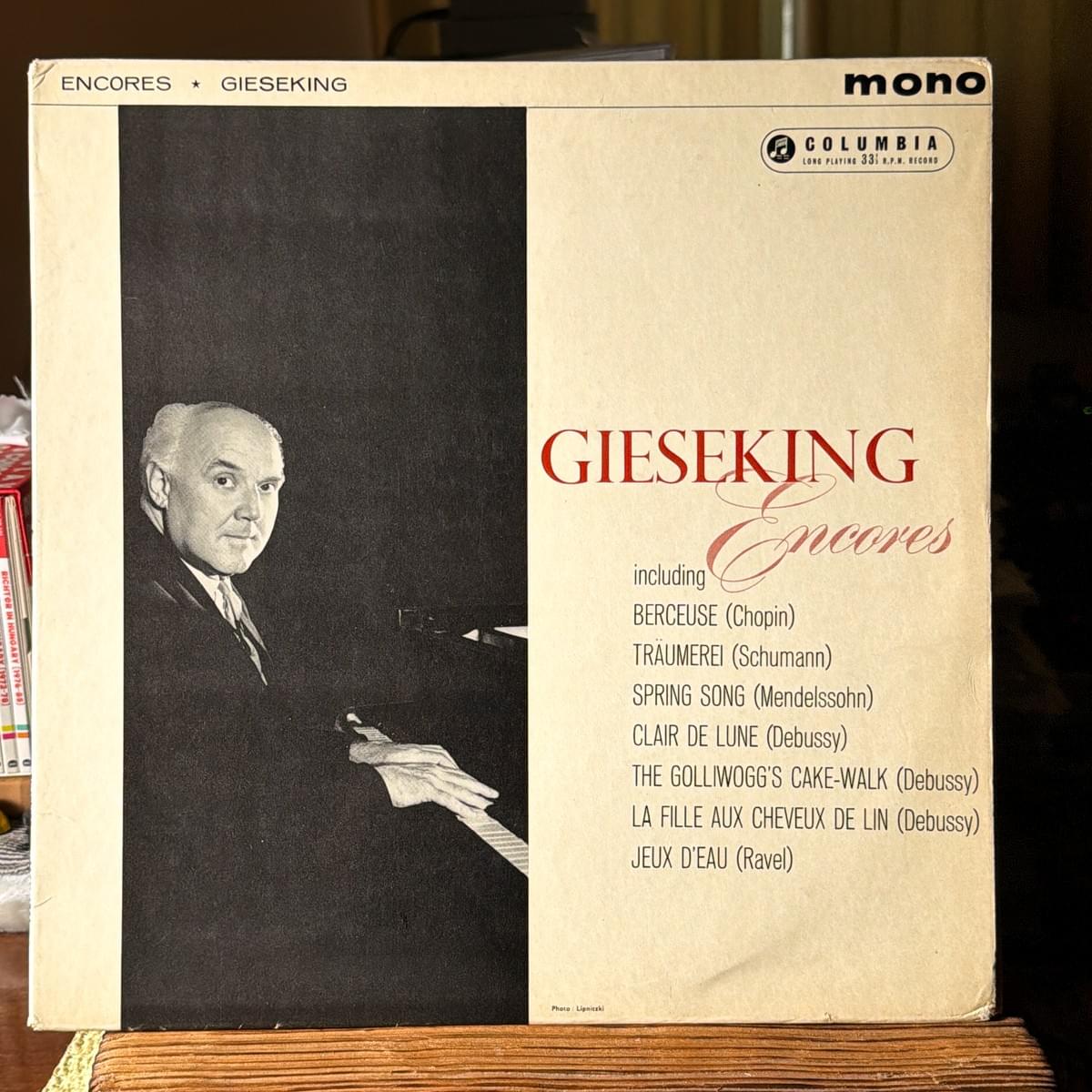
封面是一張黑白照片:白髮的季雪金坐在鋼琴前,轉頭看著鏡頭,右手放在琴鍵上。旁邊是紅色的 GIESEKING、手寫體的 Encores,下面列了七首最知名的曲目:蕭邦《搖籃曲》、舒曼《夢幻曲》、孟德爾頌(Felix Mendelssohn,1809-1847)《春之歌》、德布西(Claude Debussy,1862-1918)《月光》……
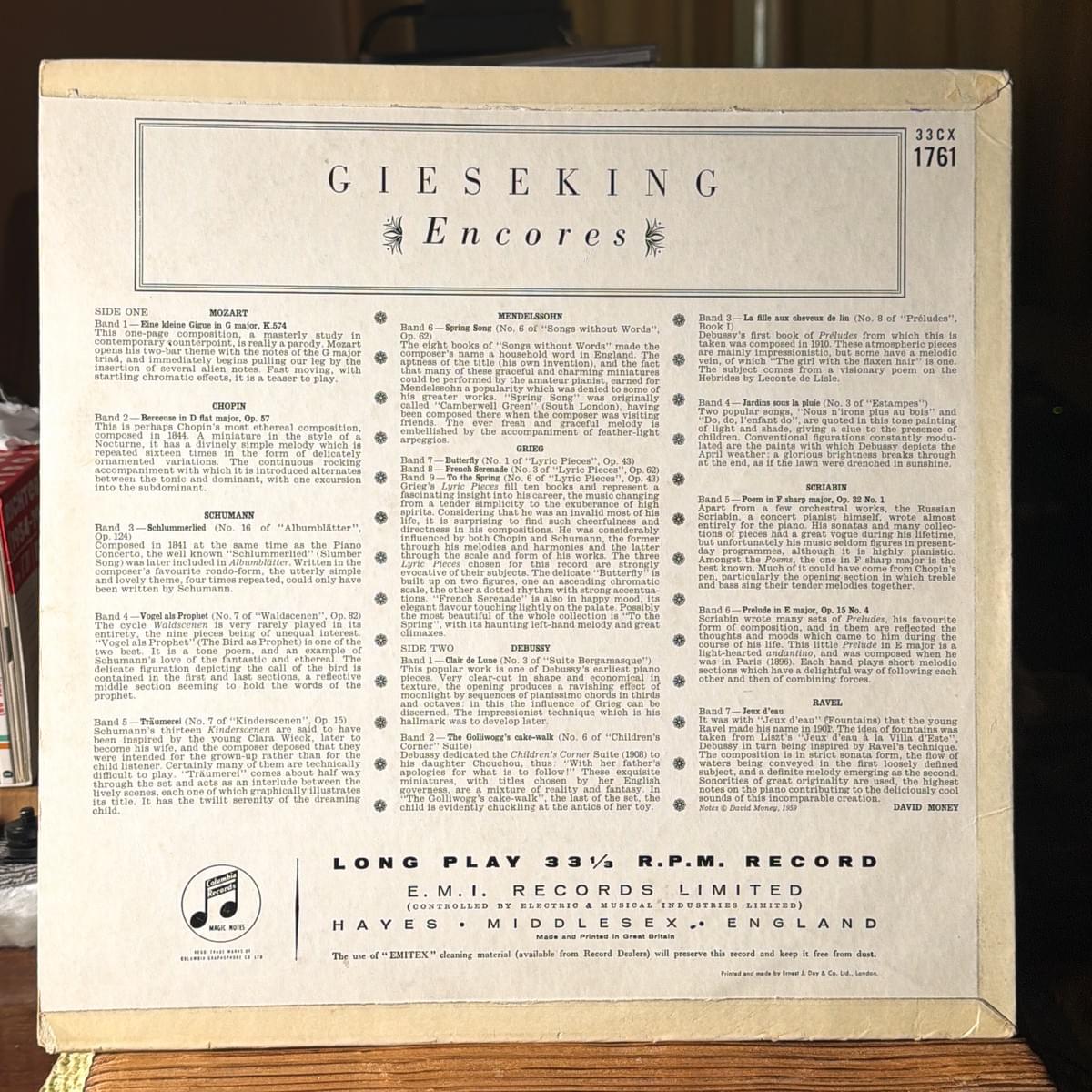
封底是英國樂評人大衛·莫尼(David Money)的解說,他逐首介紹曲目:莫札特(Wolfgang Amadeus Mozart,1756-1791)這首小吉格如何捉弄對位法、蕭邦《搖籃曲》的旋律重複了十六次、孟德爾頌《春之歌》原本叫「坎伯韋爾綠地」。寫得親切、實用,是一份很好的音樂入門導讀。
但唱片沒有一個字提到季雪金已經過世,也沒有交代任何一首曲子是什麼時候錄的。唱片行裡的聽眾拿起它,只會以為這是一張輕鬆的小品集。
一年之內的兩次生命崩塌
要理解這張唱片背後的故事,得先回到 1955 年。
那年的季雪金,正處在戰後錄音生涯的高峰。1950 年起,他與 EMI 的傳奇製作人華爾特·李格(Walter Legge,1906-1979)合作,在倫敦錄下德布西、拉威爾(Maurice Ravel,1875-1937)、莫札特的獨奏曲全集,這些都是載入史冊的全本計畫,然後他們又開始挑戰貝多芬(Ludwig van Beethoven,1770-1827)鋼琴奏鳴曲全集。同年 9 月,他錄了舒曼《兒時情景》全曲與《紀念冊》裡的《睡眠曲》,這兩首後來都出現在《安可曲集》裡。
1955 年 12 月,他在斯圖加特附近遭遇巴士車禍,頭部受傷,跟他同車的妻子當場喪命。
不到一年,他又回到倫敦錄音室。1956 年 10 月 17、18 日這兩天,他錄了舒曼《預言鳥》、舒伯特(Franz Schubert,1797-1828)的三首鋼琴小品、蕭邦《搖籃曲》與《船歌》,以及兩首史克里亞賓。接下來,他還要繼續錄貝多芬。
他在錄《田園》奏鳴曲時突然病倒。前三個樂章已經錄好,終樂章原定第二天錄。幾天後,他因胰臟炎手術的併發症過世,後來安葬在威斯巴登。EMI 把未完成的《田園》照樣發行了。
所以《安可曲集》裡那幾首 10 月的小品,不是「晚年錄音」而已。它們是一個剛失去妻子、頭部受過重傷的人,在自己生命最後幾天裡彈的音樂。他當然不知道這是最後幾天。對他來說,這只是一次尋常的錄音,第二天還要繼續。
他願意用全部蕭邦換的曲子
10 月 18 日的曲目裡有兩首史克里亞賓,這件事很值得停下來想一想。
據說季雪金曾表示,願意用蕭邦的全部音樂,換一首史克里亞賓。後來《留聲機》雜誌的樂評也感嘆,很難理解當年的 EMI,尤其是李格,為什麼沒有讓他多錄幾首史克里亞賓。結果,他在 EMI 錄音室裡留下的史克里亞賓,就是這兩首短小的小品。
同一天,他還錄了蕭邦。在他的錄音目錄裡,蕭邦並不多;但《搖籃曲》與《船歌》都是他在音樂會上常彈的曲目。他願意拿來交換的蕭邦,和他理想中的史克里亞賓,在他過世前八天,放進了同一天的錄音裡。
十六首小品,一張一生的曲目地圖
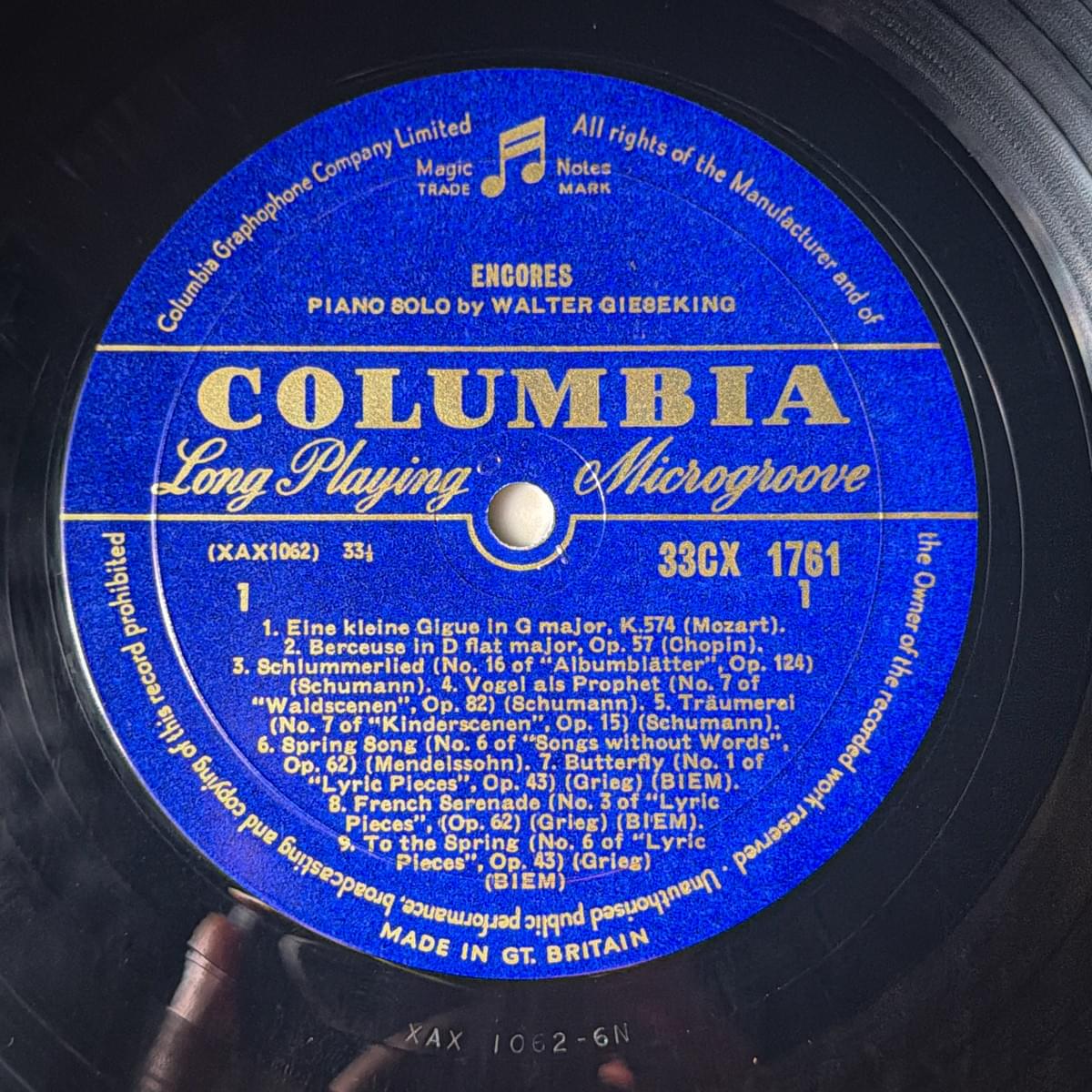
《安可曲集》並不全是最後的錄音。對照後來 CD 複刻標示的錄音日期,它其實是一張橫跨五年的合輯:
- 1951–1954 年德布西全集:《月光》、《黑娃娃的步態舞》、《棕髮少女》、《雨中花園》
- 1953–1954 年莫札特獨奏全集:《小吉格》K.574
- 1954 年拉威爾全集:《水之嬉戲》
- 1955 年 9 月:舒曼《安眠曲》、《夢幻曲》
- 多為 1956 年:孟德爾頌《春之歌》、葛利格三首《抒情小品》
- 1956 年 10 月 17 日:舒曼《預言鳥》
- 1956 年 10 月 18 日:蕭邦《搖籃曲》、史克里亞賓《詩曲》Op.32-1 與《前奏曲》Op.15-4
放在一起看,這就是季雪金一生曲目的縮影:莫札特的古典、舒曼與孟德爾頌的德國浪漫、葛利格(Edvard Grieg,1843-1907)的北歐抒情、德布西與拉威爾的法國印象派,再加上他偏愛的史克里亞賓。十六首曲子,每一首都只有一兩分鐘到幾分鐘。
小品最難。大曲子可以靠結構、靠氣勢撐起來;一兩分鐘的曲子,沒有任何地方可以藏。一個音色、一個踏板、一個呼吸,就是整首曲的成敗。這正是季雪金最拿手的地方:他是公認的踏板大師,是《留聲機》雜誌稱為鋼琴上至高的「色彩家」之一的人。
怎麼聽?
先聽第一面第 2 首,蕭邦《搖籃曲》。 解說寫得很清楚:一個簡單的旋律重複了十六次,每次加上更精緻的裝飾,左手的伴奏則一直在同樣的兩個和弦之間搖擺。MusicWeb 的樂評認為,季雪金這份演奏溫和、如歌、速度得宜,儘管左手律動規律得像搖籃,却一點也不單調。試著只聽右手:十六次重複,音色有沒有每一次都不一樣?
再聽第一面第 4 首,舒曼《預言鳥》。 解說說這是一首音詩,頭尾描寫鳥鳴,中段一段反思,彷彿在轉達先知的話。同一位 MusicWeb 樂評認為,季雪金這份的輕透音色,和哈絲姬兒(Clara Haskil,1895-1960)的版本一樣迷人。一首叫「預言鳥》的曲子,在他過世前九天錄下。
最後把第一面的《安眠曲》和《搖籃曲》接著聽。 一首錄於車禍之前的 1955 年 9 月,一首錄於車禍後、生命最後的 1956 年 10 月。同樣是哄孩子入睡的曲子,中間隔著一場讓他失去妻子的車禍。你聽得出兩者之間的不同嗎?也許聽得出,也許聽不出。這個問題沒有標準答案,只有你自己的耳朵。
去世五年後才發行的安可曲集
這張唱片直到 1961 年 9 月 8 日才在英國發行,《留聲機》雜誌同月刊登了 EMI 的新片廣告。那時距季雪金過世,已經快五年。封底解說標明寫於 1959 年,美國 Angel 則以《紀念曲集》(Souvenirs)為名,澳洲 Columbia 也有自己的版本。
美國叫「紀念」,英國叫「安可」。同一組錄音,兩個名字,恰好是這張唱片的兩面:一面是音樂會後的加彈,輕鬆、親切,全是聽眾喜歡的曲子;另一面是一位已經不在的鋼琴家留下的紀念。
在季雪金的正式發行實體黑膠唱片裡,這是唯一一張以「安可曲」為名的專輯;美國、澳洲的《紀念曲集》是同一張的外國版。2023 年 Warner Classics 雖然推出了同名的數位專輯,但那是後世又新編選的合輯,不是當年這一張。
英國 Columbia 當年為什麼選用「安可」這個名字,又為什麼封套上對他的過世隻字未提,今天已經無從得知。但這個名字恰巧說中了一件封套沒寫的事:季雪金人生的音樂會結束得太突然,這張唱片,就是他留下的最後加彈。
結語
一位一生錄下德布西、拉威爾、莫札特全集的鋼琴家,留給世界的最後聲音,不是一部巨作,而是一首搖籃曲、一首預言鳥,和兩首他一直想多彈却沒有機會錄的史克里亞賓。
******
[Gudian Record Stories]Walter Gieseking’s (1895–1956) Only Encores Album: Columbia 33CX 1761, Preserving His Final Recordings
October 18, 1956, London. Inside EMI’s Abbey Road Studios, Walter Gieseking sat down to play a lullaby.
It was Frédéric Chopin’s (1810–1849) Berceuse, Op. 57. That same day, he also set down two short pieces by Alexander Scriabin (1872–1915); the day before, he had recorded Robert Schumann’s (1810–1856) Vogel als Prophet (The Prophet Bird).
Eight days later, on October 26, he died in London.
Those twilight tracks were later gathered into an LP titled Encores, issued in the United Kingdom by Columbia in 1961 under catalog number 33CX 1761.
An encore is a brief gift offered by a performer when an audience refuses to leave the hall after the formal program concludes, calling for one more piece. Across his entire career, Gieseking released only one album titled Encores—and tucked quietly inside its grooves were the very last recordings of his life.
What the Sleeve Left Unsaid
The front cover features a monochrome portrait: a silver-haired Gieseking seated at the keyboard, turning his head toward the camera with his right hand resting lightly on the keys. Beside him, crimson block letters spell GIESEKING above Encores in cursive script, followed by seven familiar titles: Chopin’s Berceuse, Schumann’s Träumerei, Felix Mendelssohn’s (1809–1847) Spring Song, Claude Debussy’s (1862–1918) Clair de lune.
On the back cover, British critic David Money offers a friendly track-by-track guide: how Wolfgang Amadeus Mozart’s (1756–1791) Eine kleine Gigue plays mischievous games with counterpoint, how the melodic motif of Chopin’s Berceuse repeats sixteen times over an unchanging bass, and how Mendelssohn’s Spring Song was originally titled Camberwell Green. Written with warmth and accessibility, it serves as an inviting primer for the casual listener.
Yet not a single word on the jacket mentions that Gieseking had passed away, nor does it disclose when any of the tracks were recorded. A browser picking up the LP in a record shop would assume it was simply an unassuming collection of charming miniatures.
Two Life-Shattering Blows Within a Single Year
To understand the gravity behind this record, one must step back to 1955.
In that year, Gieseking stood at the summit of his postwar recording career. Beginning in 1950, working alongside legendary EMI producer Walter Legge (1906–1979) in London, he had committed monumental complete solo cycles of Debussy, Maurice Ravel (1875–1937), and Mozart to tape before embarking on an ambitious complete cycle of Ludwig van Beethoven’s (1770–1827) piano sonatas. In September 1955, he recorded Schumann’s complete Kinderszenen alongside Schlummerlied (Slumber Song) from Albumblätter—two pieces that would later appear on Encores.
Then, in December 1955, a bus crash near Stuttgart left him with severe head injuries and claimed the life of his wife, who was traveling beside him.
Less than a year later, he returned to the London studio. Over two days—October 17 and 18, 1956—he recorded Schumann’s Vogel als Prophet, three Franz Schubert (1797–1828) Klavierstücke, Chopin’s Berceuse and Barcarolle, and two Scriabin miniatures. Next on his schedule was the continuation of his Beethoven sonata cycle.
While taping Beethoven’s Pastoral Sonata, Op. 28, he fell acutely ill. Three movements were already in the can, with the finale scheduled for the following morning. Days later, he died from complications following emergency surgery for pancreatitis, and was laid to rest in Wiesbaden. EMI ultimately issued the unfinished Pastoral Sonata just as he left it.
Those October miniatures on Encores are therefore far more than routine late recordings. They are the final musical utterances of a man who had recently lost his wife and survived severe head trauma, playing in the closing days of his life. Naturally, he had no inkling the end was near; to him, it was simply another working session, with the next movement waiting on the music rack for tomorrow.
The Composer He Would Have Traded All of Chopin For
The presence of two Scriabin pieces on October 18 invites quiet reflection.
Gieseking reportedly remarked that he would gladly trade the entirety of Chopin’s output for a single work by Scriabin. Reviewers in Gramophone later lamented how inexplicable it was that EMI—and Walter Legge in particular—had never invited Gieseking to record more Scriabin. As it turned out, these two brief miniatures represent the entirety of the Scriabin he ever committed to tape inside EMI’s studios.
On that very same day, he also recorded Chopin. Chopin occupies a relatively modest corner of Gieseking’s discography, though the Berceuse and Barcarolle were staples of his recital programs. Eight days before his death, the Chopin he claimed he would gladly trade away and the Scriabin he revered were set down together during a single session.
Sixteen Miniatures: A Cartography of a Lifetime’s Repertoire
Encores does not consist solely of his final sessions. Cross-referencing recording dates documented in subsequent CD transfers reveals an anthology spanning five years:
- 1951–1954 (Complete Debussy Cycle): Clair de lune, Golliwogg’s Cakewalk, La fille aux cheveux de lin, Jardins sous la pluie
- 1953–1954 (Complete Mozart Solo Cycle): Eine kleine Gigue, K. 574
- 1954 (Complete Ravel Cycle): Jeux d’eau
- September 1955: Schumann’s Schlummerlied and Träumerei
- Mostly 1956: Mendelssohn’s Spring Song and three Lyric Pieces by Edvard Grieg (1843–1907)
- October 17, 1956: Schumann’s Vogel als Prophet
- October 18, 1956: Chopin’s Berceuse; Scriabin’s Poème, Op. 32, No. 1 and Prelude, Op. 15, No. 4
Viewed together, the program forms a miniature atlas of Gieseking’s artistic universe: the Classical poise of Mozart, the German Romanticism of Schumann and Mendelssohn, the Nordic lyricism of Grieg, the French Impressionism of Debussy and Ravel, crowned by his cherished Scriabin. Across sixteen pieces, each lasts barely one to a few minutes.
Miniatures are the ultimate test of a pianist. Large-scale sonatas and concertos can lean on architectural sweep and cumulative momentum; a two-minute piece offers nowhere to hide. A single shift in timbre, a fraction of pedal depth, or a measured breath determines the success or failure of the entire canvas. Here Gieseking stood on home ground: universally acknowledged as a master of the damper pedal and hailed by Gramophone as one of the supreme colorists of the keyboard.
How to Listen
Begin with Side One, Band 2: Chopin’s Berceuse. As the liner notes observe, a simple four-bar melody repeats sixteen times, draped in ever more intricate filigree while the left hand rocks gently over an unchanging ostinato bass. Writing in MusicWeb International, a reviewer noted that Gieseking’s reading is tender, singing, and impeccably paced—never lapsing into mechanical monotony despite the cradle-like regularity of the left hand. Try focusing strictly on his right hand: across those sixteen variations, does the tonal shading ever repeat itself twice?
Next, turn to Side One, Band 4: Schumann’s Vogel als Prophet. Framed by fleeting, elusive birdsong at both ends, its central chorale unfolds like an intimate prophecy. The same MusicWeb critic praised the luminous transparency of Gieseking’s tone here as every bit as captivating as Clara Haskil’s (1895–1960) celebrated account. A piece titled The Prophet Bird, recorded nine days before his death.
Finally, listen to Schumann’s Schlummerlied and Chopin’s Berceuse back to back on Side One. One was taped in September 1955 before the accident; the other in October 1956 after the crash, in the final days of his life. Both are lullabies written to soothe a child to sleep, separated by a tragedy that took his wife’s life. Can you hear a difference between the two? Perhaps you will, or perhaps you will not. There is no textbook answer—only what your own ears discover.
An Encore Issued Five Years After the Curtain Fell
The LP was not released in Britain until September 8, 1961—announced in that month’s Gramophone EMI advertisements—nearly five years after Gieseking’s passing. The rear sleeve notes are dated 1959; in the United States, Angel issued the exact same program under the title Souvenirs, alongside a domestic pressing from Australian Columbia.
America called it Souvenirs; Britain called it Encores. Two titles for the exact same master tapes, capturing the dual nature of the record: on one hand, a relaxed, affectionate post-concert offering of beloved favorites; on the other, a lasting keepsake left behind by an artist already gone.
Among Gieseking’s official analog vinyl releases, this remains his sole album issued under the title Encores(with the American and Australian Souvenirs serving as its international counterparts; while Warner Classics released a digital compilation sharing the name in 2023, that is a newly curated modern anthology rather than this original 1961 program).
Why British Columbia chose the title Encores—and why the sleeve remained completely silent about his death—can no longer be known. Yet that title unwittingly spoke the deepest truth omitted from the jacket: the concert of Walter Gieseking’s life ended far too abruptly, and this record was his final encore.
Coda
A pianist who bequeathed monumental complete cycles of Debussy, Ravel, and Mozart to posterity left as his final recorded voice not a towering sonata, but a lullaby, a prophet bird, and two brief pages of the Scriabin he had always longed to record more of, yet never had the chance to finish.