
【古殿唱片音樂故事】一場像是一場宗教儀式精神淨化的偉大音樂會:魯道夫 塞爾金(Rudolf Serkin,1903-1991) 75大壽紀念音樂會實況
古殿殿主
一個不合理的例外
魯道夫 塞爾金(Rudolf Serkin,1903-1991)這個人,一輩子做了一件事,做到近乎信仰的程度:他拒絕相信錄音。
不是拒絕錄音技術,是拒絕錄音這件事背後的哲學。他曾對訪問他的《Piano Quarterly》編輯羅伯特.西爾弗曼(Robert J. Silverman)說:
「一個人對作品的詮釋,只在那一次演出中才有效。唱片只是一個快照,是演奏者在那一刻觀點的圖像。藝術成就不能也不應該被重複。」他甚至提到一個更極端的例子——鋼琴家達爾伯特(D'Albert,1864-1932)曾被要求錄音,答應的條件是:允許他錄三次,而且三個版本都要發行。因為,「難道演出永遠不會相同,不是一種奇蹟嗎?」
他也幾乎沒上過電視。一輩子只在六〇年代末《Casals at Marlboro》裡短暫露臉過一次。
所以,1977年12月,當小提琴家也擔任也擔任卡耐基音樂廳總裁的艾薩克 史坦(Isaac Stern,1920-2001),邀請他,在新開播的「Tonight at Carnegie Hall」系列節目裡,於卡內基音樂廳現場錄影演出——這件事,照塞爾金自己的邏輯,根本不應該發生。一個不相信任何演出可以被「凍結」下來反覆播放的人,為什麼會答應在攝影機前,留下一個永遠會被反覆播放的版本?
答案,藏在那個晚上的日期裡:1977年12月14日至15日,塞爾金七十五大壽紀念音樂會實況裡。
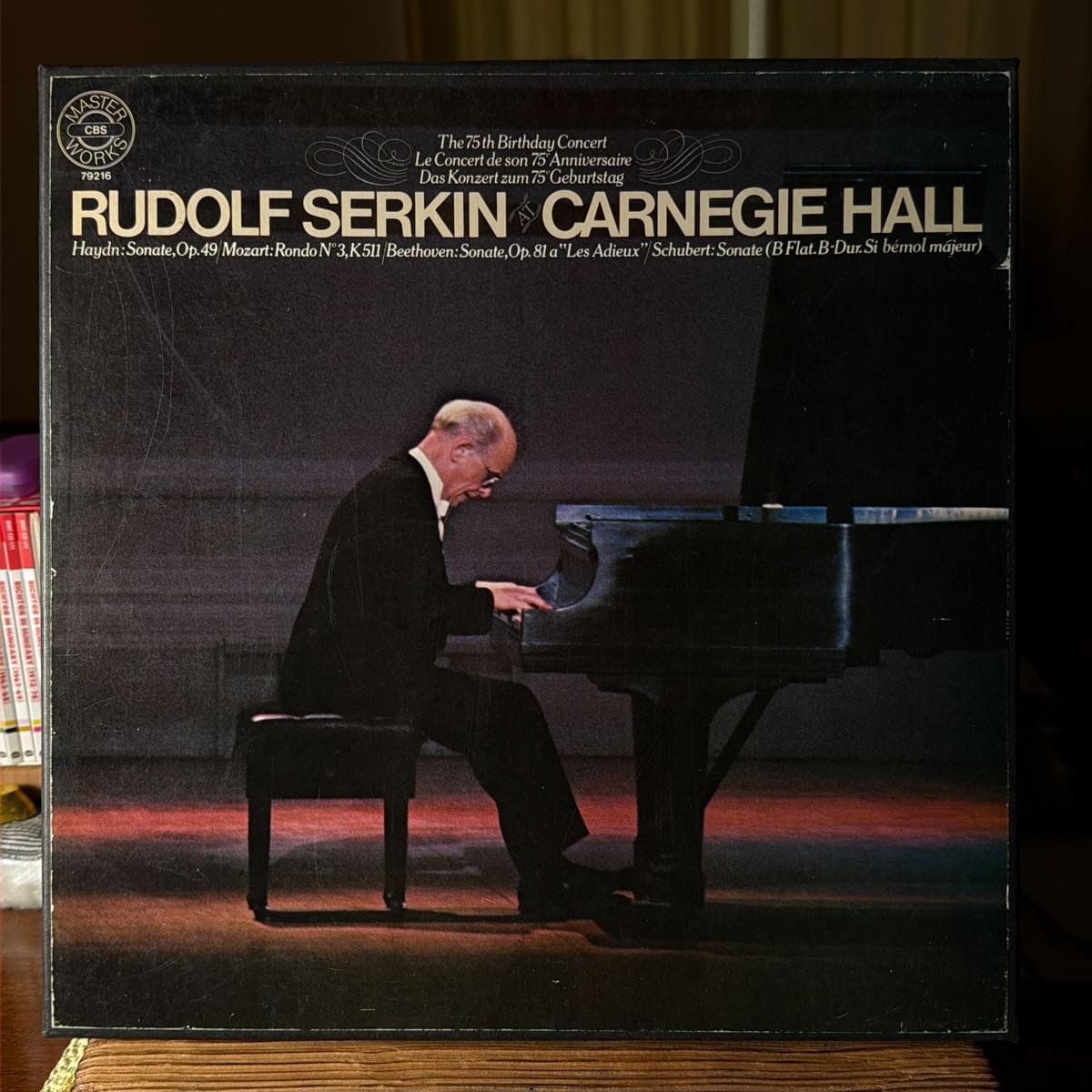
一輩子的紀律,在那一晚被要求做一件相反的事
CBS製作人湯瑪斯.佛羅斯特(Thomas Frost, 1925-2026)在唱片內頁寫下一個細節:那一晚,塞爾金必須「改變一輩子的習慣」——刻意壓抑他招牌的踏板聲響與演奏時的呼吸聲,只為了讓錄音/錄影能乾淨。評論家歐文 科爾丁(Irving Kolodin,1908-1988)在同一本冊子裡下了註腳:「紀律有很多種形式,其中最偉大的一種,是沉默。」
這不是塞爾金第一次在壓力下展現這種近乎冷酷的自制。1964年12月8日,他與費城管絃樂團合作演出貝多芬 C 大調鋼琴協奏曲,第一樂章演奏到一半,一根琴弦斷了。停下來,還是忍受斷弦持續發出的嗡嗡雜音?塞爾金選擇了第三條路——他用暫時空出來的左手,直接把那根斷掉的琴弦,彎折到不再干擾演奏的位置,然後繼續彈下去,若無其事。
這種紀律感的源頭,可以一路往回追溯到他十七歲那年。1920 年,柏林,十七歲的塞爾金開始與小提琴家阿道夫 布許(Adolf Busch,1891-1952)合作——布許當時二十九歲,日後也是塞爾金的岳父。這段合作關係持續了三十二年,直到1952年布許在美國佛蒙特過世才結束。而他們長期的合作,兩人默契幾乎不需要眼神交流——「他們的思想共同專注於一件事:貝多芬。」1951年塞爾金與岳父小提琴家布許共同創辦了佛蒙特的萬寶路音樂節(Marlboro Music Festival),創辦初衷是為了讓音樂家們遠離商業喧囂,享受「純粹製作音樂的快樂」。
這種訓練塑造出來的,是一種現在很難再找到的東西:不是炫技的浪漫主義者,而是像塞爾金自己形容的那種音樂家——「一個會終其一生、只要還健康,就持續進步的人。」
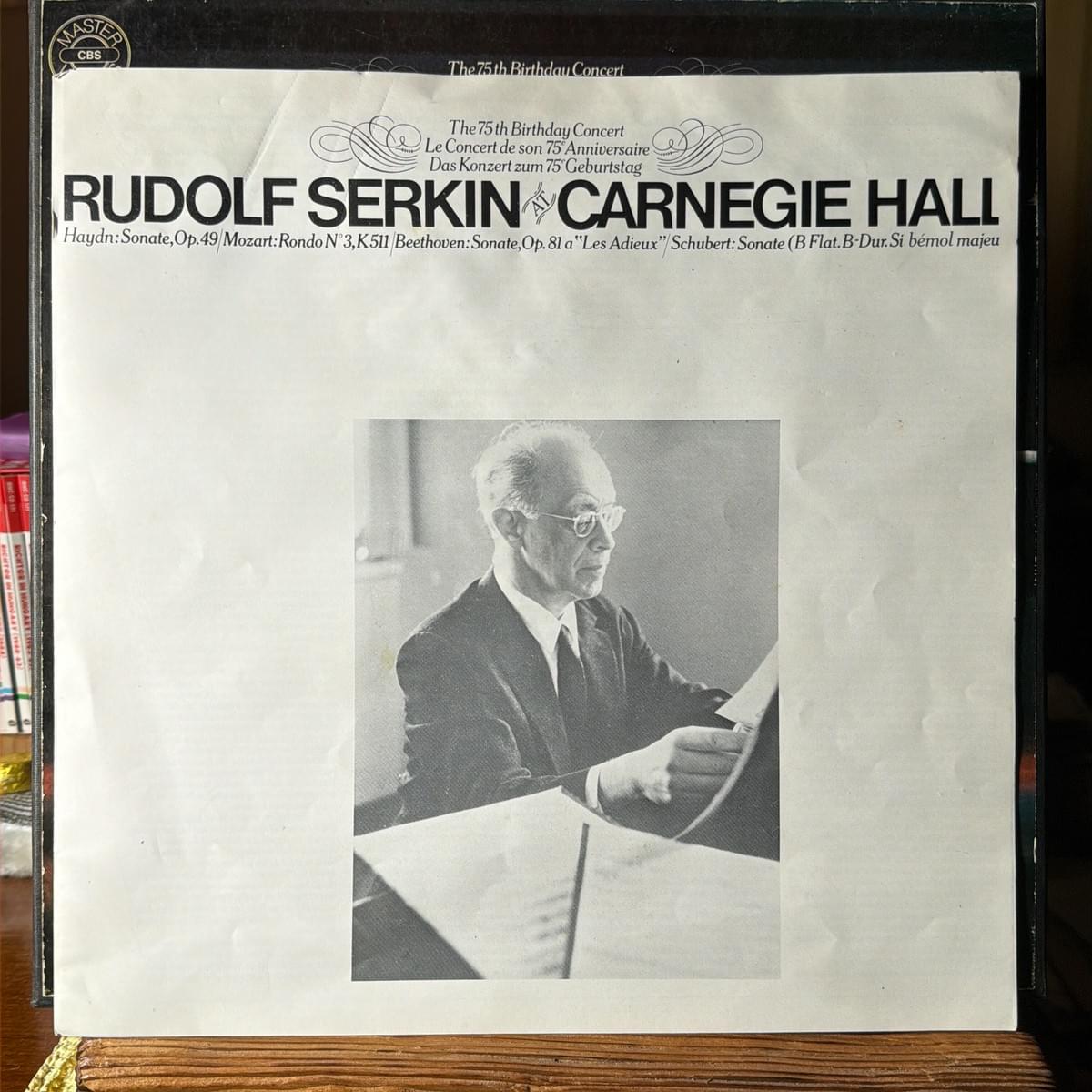
1903 年,一個奇蹟的年份
這套75大壽紀念音樂會,之所以特別值得放在「黃金年代消逝」的脈絡下重讀,是因為塞爾金並不是一個人的故事。
美國鋼琴評論家大衛.杜巴爾(David Dubal),在他 1993 年主持製作的紀錄片《鋼琴的黃金年代》(The Golden Age of the Piano)裡,把整部片子的敘事支點,放在一個巧合上:克勞迪奧 阿勞(Claudio Arrau)、魯道夫 塞爾金、弗拉基米爾 霍洛維茲(Vladimir Horowitz),三人同一年出生——1903 年。
三人,三個國家,三種傳承:
阿勞,出生於智利,自視為貝多芬的傳人——師承譜系一路回溯:貝多芬→徹爾尼→李斯特→馬丁.克勞澤→阿勞。
- 塞爾金,出生於奧地利,杜巴爾形容他體現了「高度德意志嚴肅性的最後輝煌」——那個源自克拉拉.舒曼、漢斯.馮.畢羅、布拉姆斯的傳統。
- 霍洛維茲,出生於俄羅斯,浸潤在柴可夫斯基與拉赫曼尼諾夫式的熾熱浪漫裡,師承安東.魯賓斯坦一脈的俄羅斯鋼琴學派。
- 三人,幾乎在同一個窗口裡相繼離世:霍洛維茲 1989 年,塞爾金與阿勞都在 1991 年——不到十年間,三條各自獨立、卻共同構成整個二十世紀鋼琴黃金年代的血脈,全部斷了。
這是整部紀錄片的骨架。
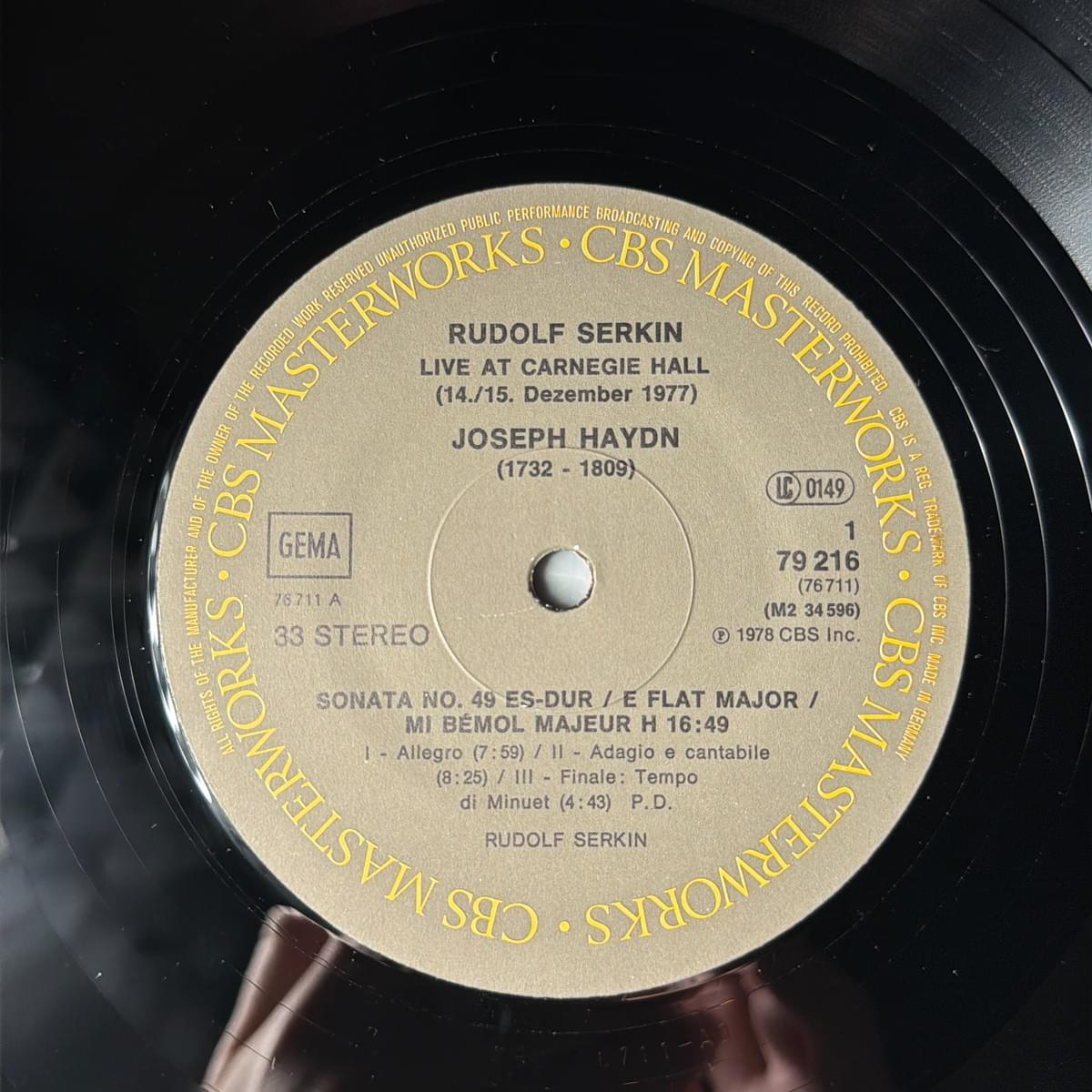
那一晚,卡內基音樂廳
傅聰與台灣樂評人崔光宙曾在一場唱片座談會上說過一句話:「現場演奏的感覺是錄音室中無法做出來的」,「好的現場演奏就是歷史的偶然,真正要刻意去做,反而做不出來」。
這句話用來描述1964年吉利爾斯在莫斯科音樂學院大廳演奏蕭邦第一號鋼琴協奏曲的那個現場,很貼切——第一個音落下的瞬間,全場彷彿都明白了:蕭邦,此刻降臨了。
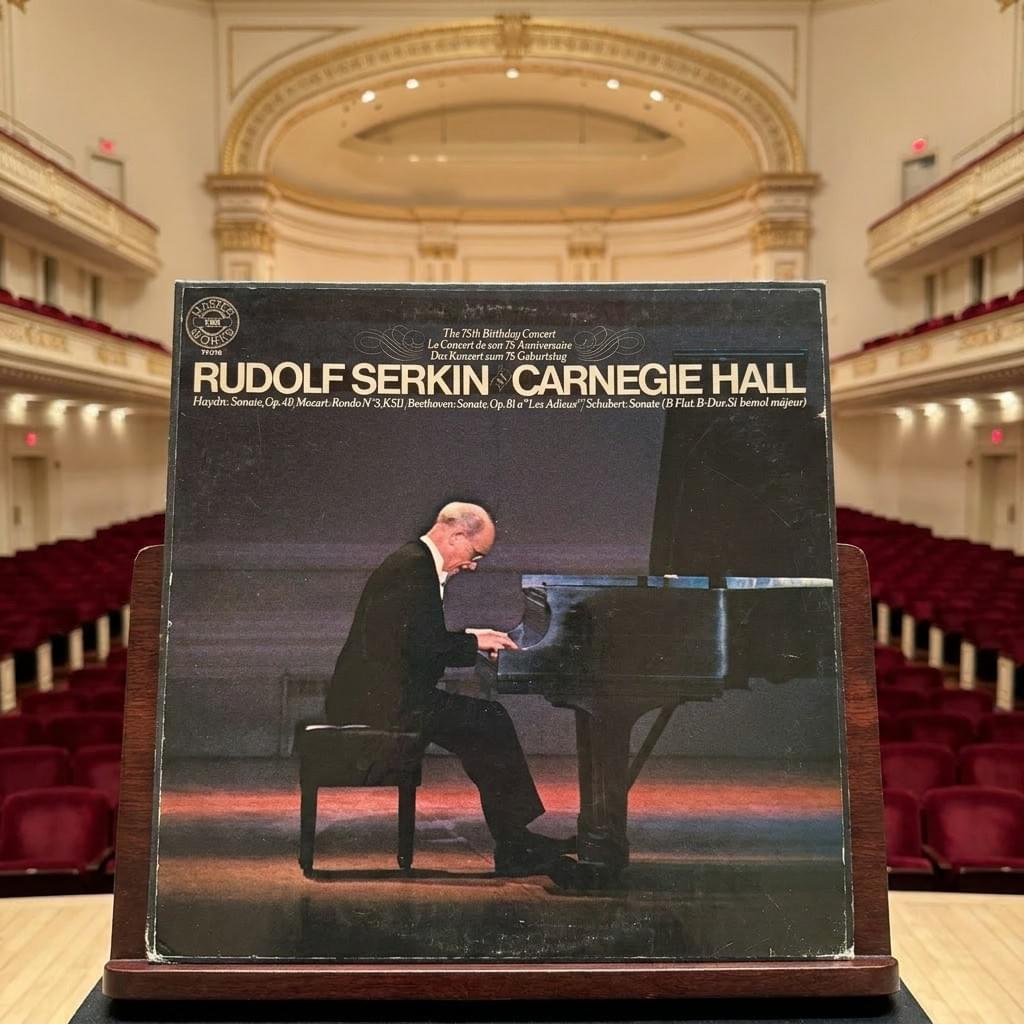
1977年12月15日,卡內基音樂廳裡,同樣的事情發生了一次。
七十五歲大壽那晚的塞爾金腎上腺素絕對是大爆發的——他心情激動,而這股激動,把音樂帶出了原本的時空刻度。音樂廳,在那一夜,不再只是一個表演場地,變成了一座真正的祭壇。
大衛杜巴爾當晚就坐在觀眾席裡。多年後,他在《鋼琴的黃金年代》紀錄片裡,用這樣一句話,去配上那個晚上的畫面:
「在塞爾金的演奏中,我記得一種如光芒燃燒的興奮。某次獨奏會幾乎像是一場宗教儀式——透過莫札特、貝多芬、舒伯特達成淨化。」
這不是一句寫在樂評裡的形容詞。這是一個親眼在場的人,事隔多年,仍然無法用更冷靜的語言去描述那一晚的證詞。杜巴爾自己也留下另一句幾乎同樣具體的話:「在場中演奏的老塞爾金,今晚是貝多芬、舒伯特浪漫音樂祭壇的祭司。」
海頓、莫札特、貝多芬「告別」、舒伯特 D.960——這套唱片裡收錄的四首作品,就是那天晚上被拿來獻祭、也被拿來淨化的曲目。杜巴爾聽見的那種「光芒燃燒的興奮」,此刻,仍然完整地刻在這兩張黑膠的聲音溝槽裡。
藝術是一種生活方式,不是治療也不是娛樂
杜巴爾在同一部紀錄片裡談阿勞的段落,講了一句話,我認為是整部片子真正的核心命題:
「當阿勞演奏時,我們被帶回一個逝去的時代——藝術不只是治療或娛樂,而是一種生活方式。」
這句話放到塞爾金身上,其實也是非常貼切。
想想他75大壽那晚選的曲目:海頓第四十九號奏鳴曲、莫札特輪旋曲 K.511、貝多芬「告別」奏鳴曲、舒伯特 D.960——沒有一首是用來炫技、用來討好觀眾的作品。「告別」奏鳴曲本身寫的就是離別、缺席與歸來;舒伯特 D.960 是舒伯特生命最後幾週寫下的、近乎預知死亡的告別之作。一個七十五歲的老人,在自己的生日慶典上,選擇彈奏的,是關於告別的音樂。
這不是巧合,是塞爾金一貫的邏輯延伸。他從不把演奏當成一種取悅——他把它當成一種必須用一生去償還的生活紀律。他這樣談自己一生反覆彈奏、又反覆感到不安的貝多芬《迪亞貝利變奏曲》:1958年他把這部作品錄成唱片,樂評家歐文.科爾丁稱之為一個「分水嶺」——「之前和之後的一切,都可以據此衡量」。而1974年,71歲的塞爾金仍然願意把貝多芬三十二首奏鳴曲的第一首與最後的《迪亞貝利變奏曲》,並排在同一場音樂會裡——像是要在一個晚上,走完貝多芬一生鋼琴語言的全部路程。
這正是「藝術是一種生活方式」的具體樣貌:不是表演一段音樂,而是用一生的紀律,去侍奉一段音樂背後的完整世界觀。
逝去的思想
塞爾金曾經批評他那個年代已經開始出現的東西——比賽制度催生出來的「早熟成功」。他說:「贏得比賽似乎是開啟職業生涯的一種方式,但競爭精神對音樂創作是有害的。」他甚至在75歲那年,還在佛蒙特租下兩棟房子,開辦「年輕表演音樂家學院」,讓年輕音樂家在真正的觀眾面前——哪怕只是私人住宅裡的小型演出——學習他們的技藝,而不是在比賽的評分表格裡被量化。
杜巴爾的紀錄片裡也留下了另一句很殘忍的話,描述霍洛維茨晚年——公眾「彷彿緊抓著最後一位浪漫主義者不放」,「彷彿大家都知道,霍洛維茨之後,輝煌的時代將終結」。
這正是「體制對照」最尖銳的地方:在塞爾金、阿勞、霍洛維茨的年代,一場音樂會可以是一整晚不間斷的、要求觀眾用全部注意力去跟隨的宗教儀式;今天,串流服務把整個鋼琴文獻切成三分鐘一首的播放清單,演奏家的職業生涯建立在比賽名次與社群媒體聲量之上。塞爾金那句「一次演出永遠不會重複」,在一個任何演出都可以被無限重播、被演算法推播的年代裡,聽起來幾乎像是一種已經失傳的方言。
留在唱片裡的,不是快照,是一整個時代的呼吸
有意思的悖論在這裡:塞爾金一輩子不信任錄音能承載真實的演出,但正是因為1977年12月那兩個晚上被錄了下來——我們今天才有機會,隔著四十八年,重新聽見那個他自己都認為「不可能被凍結」的瞬間,重新聽見杜巴爾當晚聽見的那種「光芒燃燒的興奮」。
如果塞爾金是對的,一次演出真的無法被完整保存,那麼這張唱片留給我們的,或許不是那個晚上的「複製品」,而是那個晚上曾經真實存在過的、無法否認的證據——就像杜巴爾說的,藝術是一種生活方式;而這張唱片,記錄的正是一個人用生活方式演奏音樂的最後幾年之一。
塞爾金說,唱片只是快照。但如果快照裡拍下的,是一整個即將消失的時代最後一次完整的呼吸呢?
******
【Gudian Music Stories】A Concert Like a Spiritual Purification Ritual: Rudolf Serkin’s (1903–1991) 75th Birthday Concert Live
An Unreasonable Exception
Rudolf Serkin did one thing his entire life, and he did it with the devotion of a religious believer: he refused to believe in recordings.
It wasn’t that he rejected the technology itself; he rejected the philosophy behind it. He once told Robert J. Silverman, the editor of The Piano Quarterly:
"An artist's interpretation of a work is valid only for that single performance. A record is merely a snapshot, a picture of the performer's view at that exact moment. Artistic achievement cannot and should not be duplicated."
He even cited a radical example—the pianist Eugen d'Albert (1864–1932), who agreed to record only on one condition: he must be allowed to record the piece three times, and all three versions had to be released. Why? Because "Isn't it a miracle that a performance is never exactly the same twice?"
Serkin also almost never appeared on television, making only a brief appearance in the late 1960s documentary Casals at Marlboro.
So, in December 1977, when violinist Isaac Stern (1920–2001), acting as the president of Carnegie Hall, invited Serkin to perform for a live television recording for the premiere of the Tonight at Carnegie Hall series, it should never have happened according to Serkin's own logic. Why would a man who believed no performance should be "frozen" and replayed agree to step in front of the cameras?
The answer is hidden in the date of that very night: December 14–15, 1977—Rudolf Serkin’s 75th Birthday Concert.
A Lifetime of Discipline, Asked to Do the Opposite
In the album's liner notes, CBS producer Thomas Frost (1925–2006) captured a striking detail: that night, Serkin had to "change the habits of a lifetime." He had to deliberately suppress his trademark heavy pedaling and vocal groans just so the audio and video tracking could be clean. In the same booklet, critic Irving Kolodin (1908–1988) remarked:
"Discipline takes many forms, and one of the greatest is silence."
This wasn’t the first time Serkin displayed such cold, absolute self-control under pressure. On December 8, 1964, while performing Beethoven’s Piano Concerto No. 1 in C major with the Philadelphia Orchestra, a piano string snapped midway through the first movement. Stop the performance, or endure the loud, buzzing vibration of the broken string?
Serkin chose a third path: using his momentarily free left hand, he reached into the piano, bent the broken string out of the way so it wouldn't interfere, and kept playing as if nothing had happened.
This profound sense of discipline can be traced back to 1920 in Berlin. At age 17, Serkin began collaborating with the 29-year-old violinist Adolf Busch (1891–1952), who would later become his father-in-law. This partnership lasted 32 years until Busch passed away in Vermont. Their unspoken chemistry required no eye contact; their minds were jointly focused on one single thing: Beethoven. In 1951, they co-founded the Marlboro Music Festival in Vermont, born from a desire to escape commercial noise and return to "the pure joy of making music."
What this training produced is something incredibly rare today: not a showboating romantic virtuoso, but a musician who, as Serkin described himself, is "someone who will keep improving for his whole life, as long as he remains healthy."
1903: A Year of Miracles
This 75th Birthday Concert album is particularly worth revisiting within the context of the "fading Golden Age," because Serkin’s story is not an isolated one.
In his 1993 documentary The Golden Age of the Piano, American piano critic David Dubal built his narrative around an extraordinary coincidence: Claudio Arrau, Rudolf Serkin, and Vladimir Horowitz were all born in the exact same year—1903.
Three individuals, three nations, three legendary lineages:
Arrau (Chile): Viewed himself as a direct descendant of Beethoven. His lineage traced straight back: Beethoven →Czerny → Liszt → Martin Krause → Arrau.
Serkin (Austria): Described by Dubal as embodying the "last brilliance of supreme German seriousness"—the tradition descending from Clara Schumann, Hans von Bülow, and Brahms.
Horowitz (Russia): Steeped in the fiery, passionate romanticism of Tchaikovsky and Rachmaninoff, coming out of the Russian school of Anton Rubinstein.
Astonishingly, all three passed away within the same historical window: Horowitz in 1989, and both Serkin and Arrau in 1991. Within a span of less than ten years, the three distinct bloodlines that collectively formed the Golden Age of 20th-century piano music were gone.
That Night at Carnegie Hall
The legendary pianist Fou Ts'ong once noted in a seminar that a live performance is a historical accident; the magic of a great live concert is born of the moment and cannot be manufactured in a studio.
This was true when Emil Gilels played Chopin’s First Piano Concerto in Moscow in 1964—the moment the first note dropped, everyone knew Chopin had arrived. And on December 15, 1977, at Carnegie Hall, that same lightning struck twice.
At 75 years old, Serkin’s adrenaline was in full surge. He was visibly moved, and that emotional intensity pushed the music far beyond standard boundaries. For one evening, the concert hall ceased to be just a venue; it became a sanctuary.
David Dubal was sitting in the audience that night. Years later, pairing his words with the archival footage, he recalled:
"In Serkin's playing, I remember an excitement that burned like a light. One recital was almost like a religious ceremony—a purification through Mozart, Beethoven, Schubert."
This wasn’t just a line written for a review. It was the testimony of a man who was there, who decades later still couldn't find a calmer way to describe the experience. As Dubal beautifully put it elsewhere: "The old Serkin playing tonight was a priest at the altar of the romantic music of Beethoven and Schubert."
The program consisted of four works: a Haydn Sonata, Mozart's Rondo K.511, Beethoven’s "Les Adieux" Sonata, and Schubert’s Sonata in B-flat major, D.960. They were the offerings brought to the altar that night, and that "burning excitement" remains perfectly etched into the grooves of these vinyl records.
Art is a Way of Life, Not Therapy or Entertainment
When discussing Arrau in the same documentary, Dubal made a statement that serves as the ultimate thesis for that entire era:
"When Arrau plays, we are brought back to a vanished era—where art was not just therapy or entertainment, but a way of life."
This applies seamlessly to Serkin. Look at what he chose to play for his 75th birthday celebration: Haydn’s Sonata No. 49, Mozart's K.511, Beethoven’s "Les Adieux," and Schubert’s D.960. Not a single piece was chosen to show off or pander to the audience.
"Les Adieux" is entirely about departure, absence, and return. Schubert's D.960 was written in the final weeks of the composer's life—a haunting, beautiful farewell. For his own milestone birthday, a 75-year-old man chose a program completely centered on saying goodbye.
This wasn't a coincidence; it was the ultimate extension of Serkin's philosophy. He never treated performance as a tool to please; he treated it as a lifelong discipline.
Consider how he approached Beethoven's Diabelli Variations, a piece he played his whole life yet always approached with humility and nervousness. When he recorded it in 1958, Irving Kolodin called it a "watershed" moment against which everything else could be measured. Yet in 1974, at age 71, Serkin still insisted on pairing Beethoven’s very first piano sonata with the monumental Diabelli Variations in a single recital—as if trying to traverse the entirety of Beethoven’s life journey in a single evening.
This is what it means when art is a way of life. It’s not about performing a piece of music; it’s about using a lifetime of discipline to serve the profound world hidden behind the notes.
A Vanished Mindset
Serkin was highly critical of a trend that was gaining traction late in his life: the rise of music competitions and the "precocious success" they manufactured. He famously warned:
"Winning a competition seems to be a way to start a career, but the competitive spirit is harmful to music-making."
Even at 75, he rented two houses in Vermont to establish the Institute for Young Performing Musicians. He wanted young artists to hone their craft in front of real, intimate audiences—even just in private living rooms—rather than being reduced to a quantified score on a judge's rubric.
In Dubal's documentary, there is a poignant line describing Vladimir Horowitz's final years: it felt as though the public was "clinging to the last Romantic," knowing deep down that when Horowitz was gone, an entire glorious epoch would end.
This highlights the sharp contrast with our modern world. In the days of Serkin, Arrau, and Horowitz, a concert was an uninterrupted, evening-long ritual that demanded the audience's complete presence. Today, streaming services chop the vast history of classical music into three-minute playlist tracks, and a performer's career is often dictated by competition rankings and social media algorithms.
Serkin’s belief that "a single performance can never be repeated" sounds almost like a forgotten dialect in an age where everything is endlessly replayed and pushed by algorithms.
What Remains in the Grooves
Yet, a
beautiful paradox remains. Serkin spent his whole life distrusting recordings, arguing they couldn't capture the true essence of a live performance. But precisely because those two nights in December 1977 were captured, we are able to reach across 48 years and listen to that very moment he thought could never be frozen. We get to hear the "burning excitement" that David Dubal witnessed firsthand.
If Serkin was right, and a live performance can never truly be preserved, then perhaps this record isn't just a "copy" of that night. Instead, it serves as undeniable evidence that such a magical night actually existed.
Art was a way of life, and this record captures one of the final chapters of a man who lived his life entirely through his music. Serkin called records mere snapshots. But what if the snapshot captures the final, collective breath of a magnificent, vanishing era?