
【古殿唱片音樂故事】教父與教子:安奈斯可(George Enescu,1881-1955)&李帕第(Dinu Lipatti,1917-1950)《Inédits(未發表作品)》
古殿殿主
「我無法期望一位更好的詮釋者」
1943 年 3 月,布加勒斯特,羅馬尼亞廣播公司的錄音室。
六十一歲的喬治・安奈斯可(George Enescu,1881-1955)剛剛拉完自己寫的兩首小提琴奏鳴曲,坐在鋼琴前的是二十五歲的迪努・李帕第(Dinu Lipatti,1917-1950)。漫長的錄音結束後,安奈斯可握住李帕第的雙手,擁抱他,對他說:
「我無法期望一位比你更好的詮釋者、一位比你更好的音樂家了。謝謝你,親愛的迪努。」
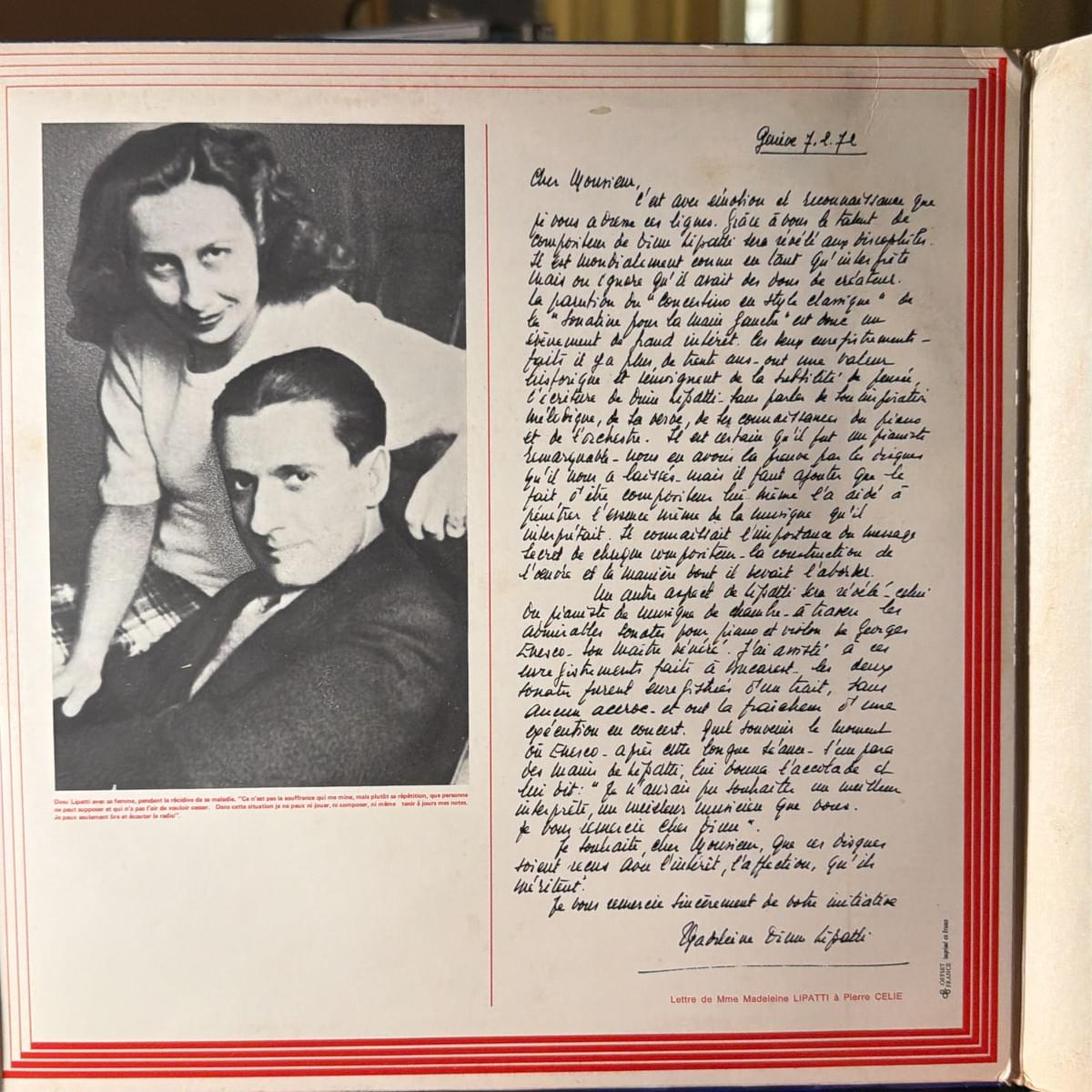
這一幕沒有被錄進唱片裡。它被一個當時也在現場的人記住了,二十九年後親筆寫在一封信裡——李帕第的妻子瑪德蓮・李帕第(Madeleine Lipatti,1908-1983)。那封信的手稿,就印在法國 Disques Déesse 1972 年發行的雙 LP 套裝《Inédits》的內頁上。
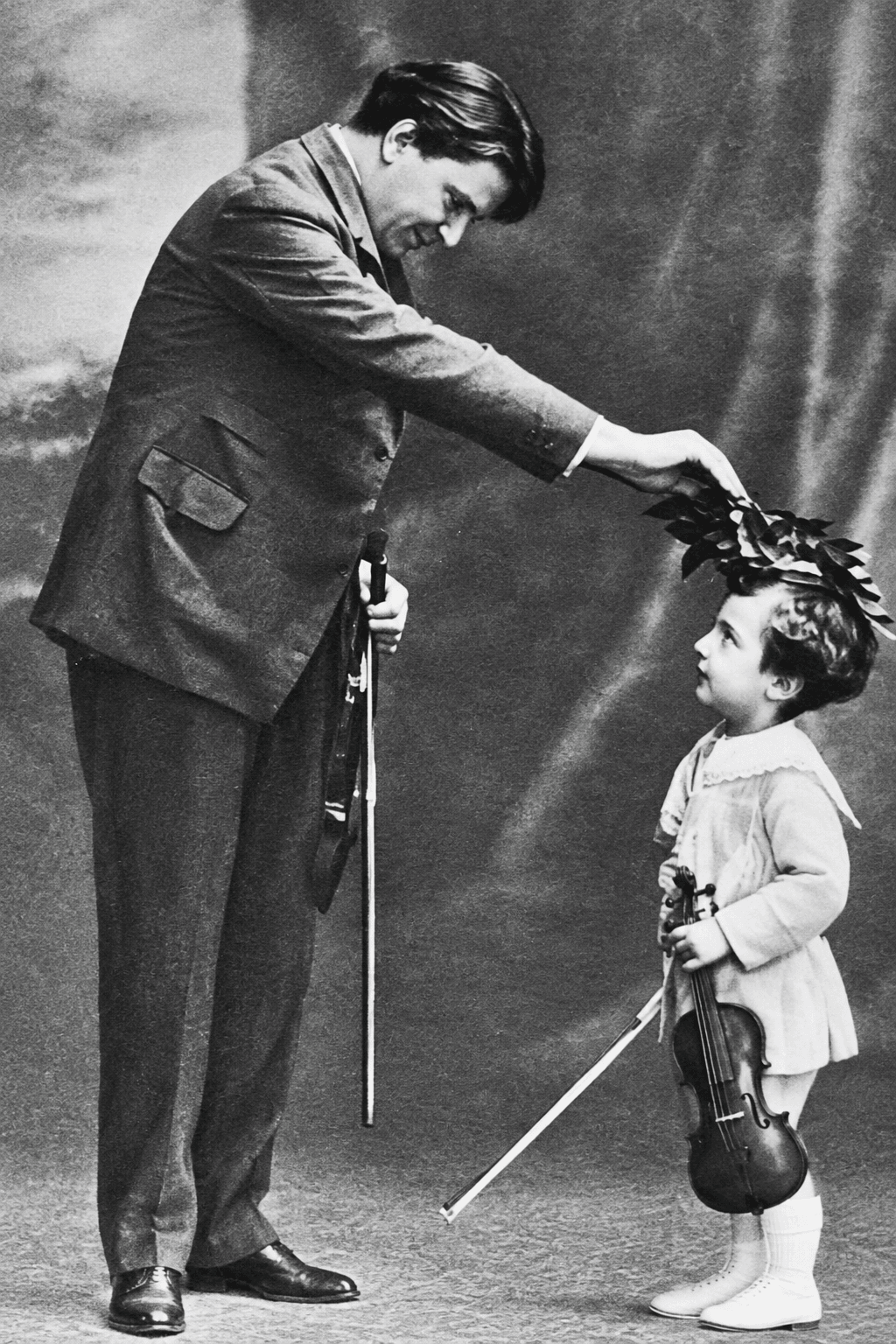
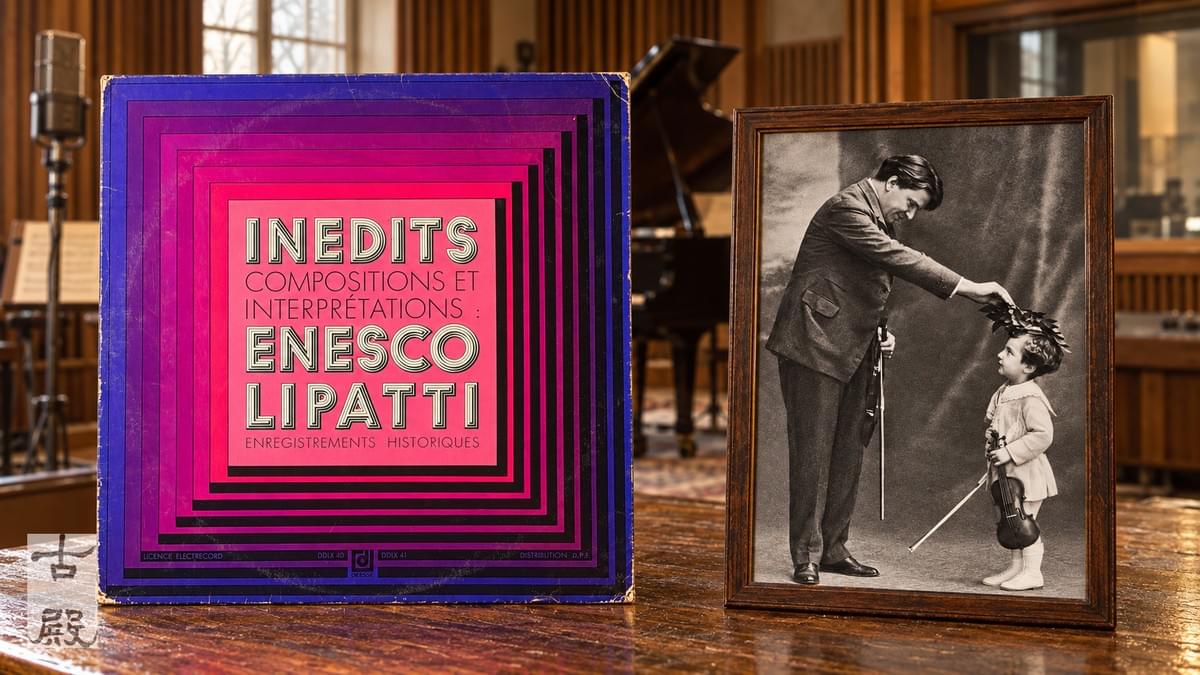
二十二年前,安奈斯可曾經為一個手持小提琴、穿著水手服的四歲男孩戴上桂冠。那張照片,也印在同一份內頁上。那個男孩就是李帕第,安奈斯可是他的教父。
這套唱片保存的,就是這兩個人之間一條完整的線:一位作曲家兼演奏家,和他的教子——另一位作曲家兼演奏家。
一封寫於日內瓦的信
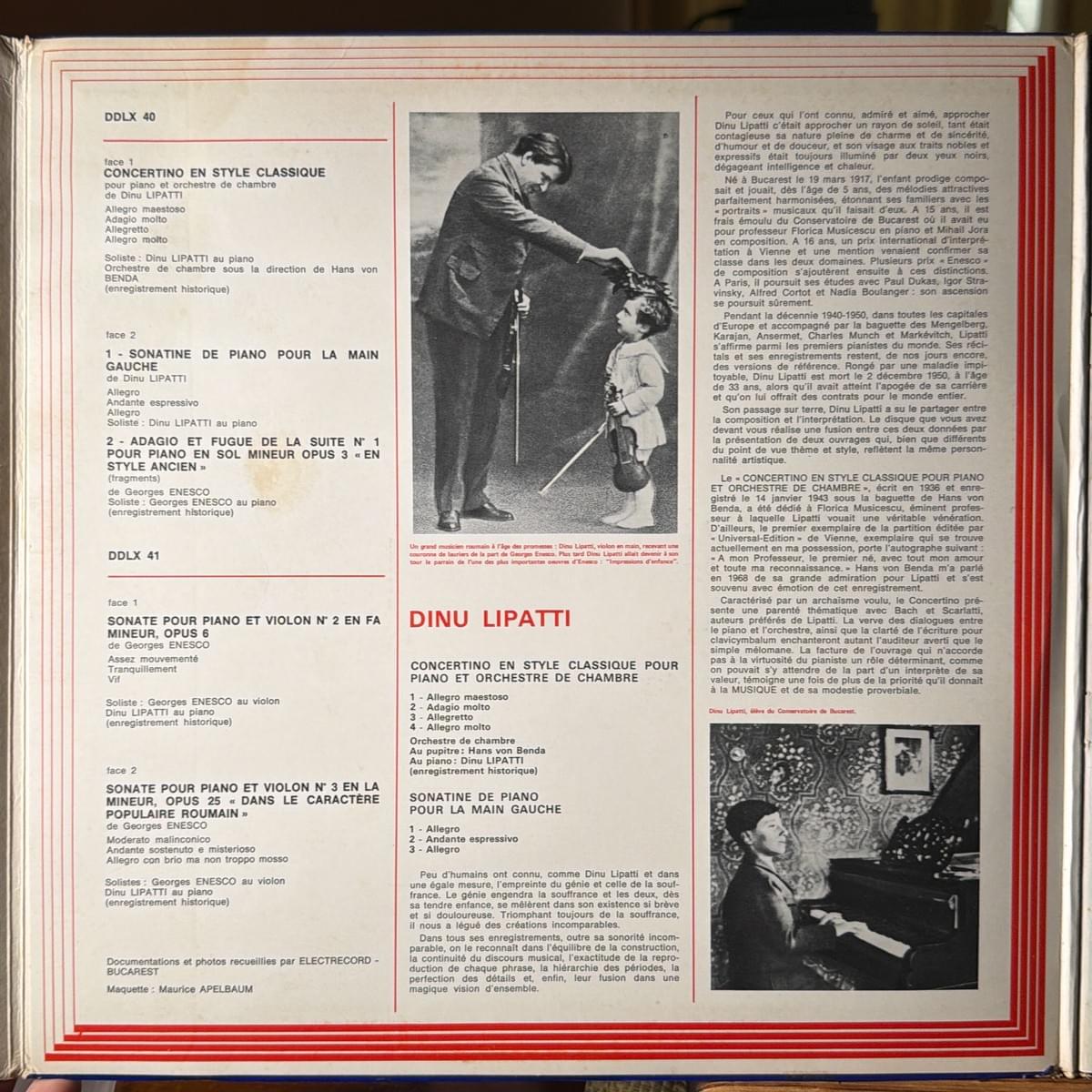
《Inédits》的法文意思是「未發表作品」。完整的標題是《未發表作品——創作與詮釋:安奈斯可、李帕第》,副標「歷史錄音」。兩張唱片編號 DDLX 40 與 DDLX 41,封面是紫色與桃紅色層層內縮的同心方框,由 Maurice Apelbaum 設計;錄音授權自羅馬尼亞國營唱片公司 Electrecord,內頁的文獻與照片也由 Electrecord 從布加勒斯特提供。
在 1972 年的冷戰歐洲,這是一件不容易的事:一家法國小廠牌,把鐵幕另一側保存了三十年的錄音帶進了西歐。
瑪德蓮的信
內頁最後一頁,是瑪德蓮親筆寫給皮耶・塞利(Pierre Célie)的信,日期「日內瓦,1972 年 2 月 7 日」,以手稿原樣影印。塞利是出身法國北部的歌手兼詞曲作者,與弟弟米歇爾・塞利(Michel Célie)共同創辦了 Disques Déesse 這個廠牌。信末那句「衷心感謝您的倡議」,說明這套唱片是由他主動促成的。一位流行歌手出身的唱片人,在 1972 年去說服一位遺孀,把鐵幕後的古典錄音帶到巴黎——這本身就是一個不尋常的選擇。信的要點如下(意譯):
- 全世界都知道李帕第是一位演奏家,卻不知道他有創作的天分。《古典風格小協奏曲》與《左手小奏鳴曲》的出版,因此是一件意義重大的事。
- 這兩份錄音做於三十多年前,具有歷史價值,見證了李帕第思想與寫作的細膩——更不必說他的旋律靈感、他的活力,以及他對鋼琴與管弦樂的認識。
- 他無疑是一位出色的鋼琴家,他留下的唱片就是證據;但必須說,正是「自己也是作曲家」這件事,幫助他穿透了所演奏的音樂的本質。他懂得每一位作曲家「秘密訊息」的重要,懂得作品的構造,以及應該如何接近它。
- 李帕第的另一面也將被揭示:室內樂鋼琴家——透過他「尊敬的老師」安奈斯可的小提琴奏鳴曲。
- 她親自在布加勒斯特觀看了這些錄音:兩首奏鳴曲都是一氣呵成錄下的,沒有任何差錯,帶著音樂會演出的新鮮感。
「未發表」?
嚴格說來,這個標題並不完全屬實。兩首奏鳴曲早在 1950 年代就已由 Electrecord 在羅馬尼亞出版,美國也有 Monitor 廠牌的版本。
但這兩個早期版本,各有各的限制。Electrecord 是共產國家的國營唱片公司,當時的壓片與製作品質有限;Monitor 則是美國的小廠牌,基本上沒有正式授權,很可能是拿羅馬尼亞的唱片翻製而來。
Déesse 的法國版則不同:它有 Electrecord 的正式授權、法國的壓片與印製品質、六面完整的解說與照片,更有李帕第遺孀的親筆信——一份來自最接近李帕第的人的感謝與認可。就這些錄音而言,這套法國版應是歷來最好的出版版本。對法國與西歐的唱片市場而言,它也是首度發行;而李帕第的兩部自作,在此之前幾乎無人知曉。
那個「未發表」,與其說是指錄音,不如說是指一個人——一個世界還不認識的李帕第。
作曲家李帕第(一):《古典風格小協奏曲》
內頁引了恩斯特・安塞美(Ernest Ansermet,1883-1969)的一句話:
「作曲對李帕第來說,就和彈鋼琴一樣容易。他擁有天生作曲家那種不會出錯的特質:當他提筆寫作時,不是為了『尋找』,而是為了『找到』。」
獻給老師的「第一個孩子」
《古典風格小協奏曲》為鋼琴與室內管弦樂團而作,寫於 1936 年,那時李帕第十九歲,正在巴黎學習。他把它獻給了布加勒斯特的鋼琴恩師佛洛麗卡・穆西切斯庫(Florica Musicescu,1887-1969)——一位他打從心底敬重的老師。
內頁的作者透露,維也納環球出版社(Universal Edition)出版的這部樂譜的第一冊,就在他手上。樂譜上有李帕第的親筆題字:
「獻給我的老師——這是頭生的孩子,帶著我全部的愛與全部的感激。」
「頭生的孩子」(le premier né)——一位十九歲的作曲家,把自己第一部正式出版的大型作品當作孩子,交到教他彈琴的人手上。
在戰時的柏林錄音
1943 年 1 月 14 日,李帕第與漢斯・馮・本達(Hans von Benda,1888-1972)指揮的室內管弦樂團錄下了這首作品。封套只寫「室內管弦樂團」,其他目錄著錄為本達創辦的柏林室內管弦樂團。一位羅馬尼亞鋼琴家在戰時的柏林錄音,此後不到一年,他就離開羅馬尼亞、流亡瑞士了。
內頁作者說,本達在 1968 年曾對他談起對李帕第的欽佩,提到這次錄音時仍然動了情。二十五年過去了,那位年輕的羅馬尼亞人已經去世十八年,指揮家還記得。
一首不炫技的協奏曲
內頁對這首作品的解說,重點可以整理為:
- 刻意的擬古: 主題與李帕第最愛的巴赫、史卡拉第(Domenico Scarlatti,1685-1757)有親緣關係。製作人華爾特・李格(Walter Legge,1906-1979)則覺得它令人聯想起普羅高菲夫(Sergei Prokofiev,1891-1953)的《古典交響曲》。
- 編制: 兩支雙簧管、兩支低音管、定音鼓與弦樂。樂團織出透明而充滿機智的對位,時而出現不和諧音與切分節奏。
- 聽覺重點: 第三樂章優雅的小步舞曲中段,可以聽到鋼琴「珠圓」(perlé)的觸鍵。
- 鋼琴的位置: 鋼琴的寫法清晰得如同大鍵琴,而且不讓炫技佔據主導地位。內頁說,以李帕第這樣的演奏家,本來大可以為自己寫一首展現技巧的曲子;他沒有這樣做,又一次證明他把「音樂」放在第一位,以及他出了名的謙遜。
- 流傳: 華爾特・季雪金(Walter Gieseking,1895-1956)與克拉拉・哈絲姬兒(Clara Haskil,1895-1960)都演奏過這首作品。
作曲家李帕第(二):一首因為「缺五線譜紙」而生的左手小奏鳴曲
《左手小奏鳴曲》寫於 1941 年,地點是羅馬尼亞阿爾傑什(Argeș)縣的鄉間別墅。
為什麼只用左手?世界上有名的左手鋼琴作品,大多有一個悲壯的理由——例如為一戰中失去右臂的鋼琴家而寫。李帕第的理由,却實際得令人莞爾。他在首演的節目單上自述:在鄉下的房子裡,他手邊沒有足夠的五線譜紙,只好只寫一行譜表——於是就只用一隻手。
獻給老師的五十歲生日
這首作品是為李帕第的作曲老師米哈伊爾・約拉(Mihail Jora,1891-1971)的五十歲生日而寫。約拉的同屆學生各獻一曲,包括保羅・康斯坦丁內斯庫(Paul Constantinescu,1909-1963)、李帕第、康斯坦丁・西爾維斯特里(Constantin Silvestri,1913-1969)、杜米特雷斯庫兄弟(Ion 與 Gheorghe Dumitrescu)以及康斯坦丁・布傑亞努(Constantin Bugeanu)。一位老師的生日,讓一整代羅馬尼亞作曲家各寫了一首曲子。
1943 年 3 月 4 日,李帕第在羅馬尼亞廣播公司的錄音室錄下了它。
「道地的羅馬尼亞作品」
1941 年 8 月 28 日,李帕第寫信給穆西切斯庫,對這首作品的自評只有一句:
「這是一部道地的羅馬尼亞作品,建立在相當燦爛的羅馬尼亞主題上。」
全曲三個樂章:快板、富表情的行板、快板。內頁說,聽行板那懷舊的主題,與終曲和聲迷人的民間舞曲畫面,就能體會一種屬於李帕第自己的風格如何結晶——它深深連著羅馬尼亞民間的「歌調」(mélos),李帕第稱之為「羅馬尼亞的金子」。
「每一個音都必須自己活著」
內頁有一張李帕第側身在鋼琴前、傾聽自己琴聲的照片。圖說引用了他筆記中的一句話:
「每一個音都必須自己活著,並以此幫助闡明作品的意義。」
這句話放在一首左手作品的解說旁邊,特別有意思。只用一隻手,音就少了一半;每一個音,都得擔起更多的意義。
坐在鋼琴前的安奈斯可
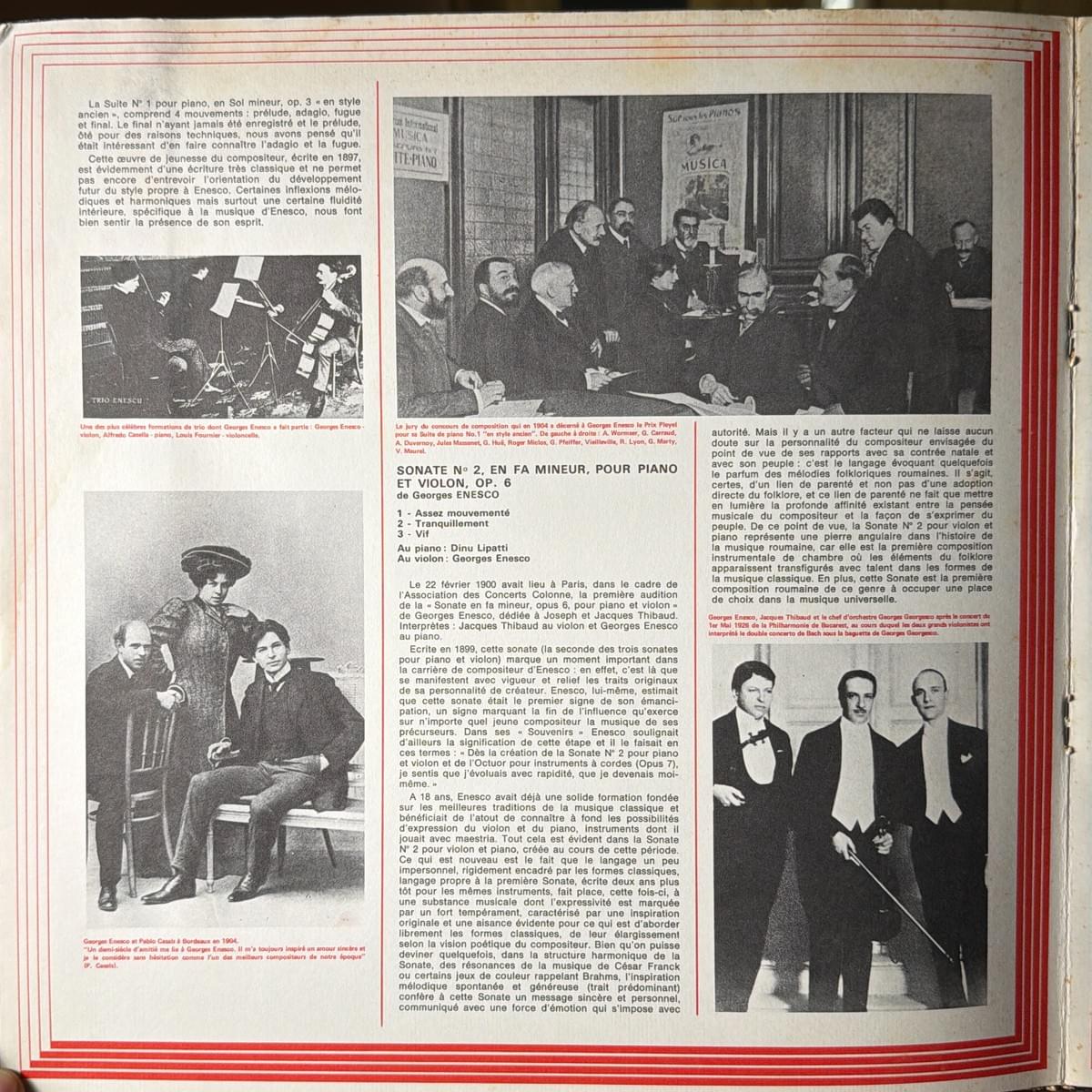
DDLX 40 第二面的後半,彈琴的人換成了安奈斯可自己。曲目是他十六歲寫的《G 小調第一號鋼琴組曲》,作品 3,「古風」。
這是一份很少見的文獻。安奈斯可以小提琴家聞名世界,其實也是一位出色的鋼琴家,但他很少公開彈鋼琴獨奏——除了自己的作品。他以鋼琴家身分登台時,多半是室內樂(四重奏、五重奏)或為人伴奏。
只剩兩個樂章的組曲
這部組曲寫於 1897 年,原有四個樂章:前奏曲、柔板、賦格與終曲。內頁說明,終曲從來沒有被錄過音,前奏曲則因為技術原因被拿掉了,所以只收了柔板與賦格。內頁印了一張 1904 年普萊耶爾獎(Prix Pleyel)評審團的合影,圖說說這部組曲就是那一年的得獎作品,評審之一是馬斯奈(Jules Massenet,1842-1912)。
內頁寫道,這是一部寫法非常古典的少作,還看不出他日後獨特風格的發展方向;但某些旋律與和聲的轉折,尤其是一種屬於安奈斯可的「內在流動感」,已經讓人感覺到他的精神。
「做音樂有兩種方式」
這段組曲的解說裡,約安・D・蓋雷亞(Ioan D. Gherea)引用了安奈斯可自己的一段話,是整套唱片最有分量的文字之一(意譯):
「做音樂、開音樂會有兩種方式,各有利弊。第一種,是專心於數量有限的作品,經過深思熟慮,把每一個細節一勞永逸地定下來——在這種情況下,臨時、尤其是在音樂會中改動任何細節,都是一種瘋狂。 第二種,是我與許多人一樣採取的方式。我在技術的完美上做了讓步;換來的是一份廣大到『曲目』一詞已不再適用的曲目。我曾在布加勒斯特的一個冬天裡,在一系列音樂會中演出了大約六十首奏鳴曲。但曲目的廣度只是這個方式的次要優點。重要的是,詮釋變成『演化的』;它不是永遠被定下來的,因此得以免於機械化。」
蓋雷亞接著描述了這種「演化的詮釋」給聽眾的感受:聽安奈斯可拉琴或彈琴,你會以為是他正在邊演奏邊作曲。一個漸慢、一個延長記號,都讓人覺得他還沒有決定接下來怎麼走。在家裡,他會為朋友應要求,憑記憶在鋼琴上彈出華格納歌劇的片段,「就像一位熟知某個語言中的角色的演員,當場把它譯成另一種較貧乏的語言,而且譯得令人讚嘆」。
「對情感的恐懼,是完全多餘的」
蓋雷亞還引了安奈斯可另一段話,幾乎是對二十世紀演奏風氣的預言:
「演奏者之間,尤其是鋼琴家之間,有一種流行:彈得冷冰冰的,好像用的是別人的手,心裡想的是別的事。他們害怕感傷。這種恐懼完全是多餘的:如果一個人沒有品味,就算彈得漠不關心,聲音也一樣庸俗。……演奏者的原則是變化與對比,必須避免均一與單調。」
讀這段話,也就更能理解李帕第為什麼既「不炫技」也「不冷漠」。在安奈斯可看來,真正的危險不在感情本身,而在品味。
作曲家親拉、教子伴奏:兩首小提琴奏鳴曲
第二張唱片 DDLX 41,兩面各一首安奈斯可的小提琴奏鳴曲。安奈斯可拉小提琴,李帕第彈鋼琴。作品的「原始意圖」與演奏在這裡重合,這是世上無法被取代的一種錄音。
第二號,F 小調,作品 6(1899):「我感到自己成為了自己」
這首奏鳴曲寫於 1899 年,安奈斯可十八歲。1900 年 2 月 22 日,它在巴黎科隆音樂會協會首演,獻給約瑟夫與賈克・提博(Jacques Thibaud,1880-1953)兄弟;首演時由提博拉小提琴,安奈斯可自己彈鋼琴。
安奈斯可自己認為,這首曲子是他擺脫前輩影響的第一個記號。他在回憶錄《Souvenirs》中寫道:
「從寫出第二號小提琴奏鳴曲與弦樂八重奏(作品 7)開始,我感到自己正在迅速地演變,我正在成為我自己。」
內頁還給了它一個更大的定位:這是第一部把羅馬尼亞民間元素「轉化」進古典形式的器樂室內樂,是羅馬尼亞音樂史的一塊基石;也是第一部在世界音樂中佔有一席之地的羅馬尼亞室內樂。和聲中偶然聽得到法朗克(César Franck,1822-1890)與布拉姆斯(Johannes Brahms,1833-1897)的回聲,但它與「民間」的關係是一種「親緣」,而不是直接拿來用。
三個樂章的聽覺地圖:
- 相當激動(Assez mouvementé): 年輕人衝動的熱情,內頁形容像山澗——時而湍急沸騰,時而平靜蜕蜒。
- 安靜地(Tranquillement): 詩意的夢想緩緩抽絲,帶著「來自民間心底的懷鄉歌」的溫柔語氣,並聽得到第一樂章的回聲。
- 活潑(Vif): 把前兩個樂章的主題融為一體,給全曲的生命力一個完整的意義。
內頁的結語說,作曲家拉小提琴、李帕第彈鋼琴的這份詮釋,是「智性與想像力完美而幸福的結合」,是兩人藝術與精神親緣的動人見證。
安奈斯可一生錄過這首曲子兩次,另一次是與法國鋼琴家塞琳妮・夏耶-里謝(Céliny Chailley-Richez)合作。英國 MusicWeb 的評論者認為後者音質較好,但在第三樂章,李帕第注入了更強的節奏能量。
第三號,A 小調,作品 25「羅馬尼亞民間風格」(1926)
如果第二號是「親緣」,第三號就是「變成」。二十七年後,安奈斯可把羅馬尼亞民間樂手(lăutari)那種「如說話般的自由節奏」(parlando-rubato),全面寫進了藝術音樂。內頁對這首作品的解說極為詳盡,重點如下:
- 與巴爾托克並論: 內頁說,安奈斯可在節奏上的貢獻與巴爾托克(Béla Bartók,1881-1945)互為補充,都來自民間來源,讓音樂從小節線的枷鎖中解放出來。
- 微分音: 小提琴使用四分之一音,內頁特別指出,這早於梅湘(Olivier Messiaen,1908-1992)與哈巴(Alois Hába,1893-1973)的研究。
- 音色的旋律: 泛音、flautando、撥弦、滑音,讓音樂如同一道「音色旋律」流過;鋼琴則模仿揚琴(țambal)與民間彈撥樂器 cobza 的音型。
- 第一樂章「憂鬱的中板」: 仍是古典的奏鳴曲式,但第一主題再現時,化為一首緩慢的 hora 舞曲。
- 第二樂章「持續而神秘的行板」: 作曲家蒂多爾・奇奧爾泰亞(Tudor Ciortea,1903-1982)形容它是一幅建立在單一影像上的壁畫:從牧人的視角看到的羅馬尼亞山野——牧人的呼喊、鳥鳴、羊鈴,再加上夜幕落下時的沉重寂靜,「這是詩人埃米內斯庫(Mihai Eminescu,1850-1889)的森林」。
- 第三樂章「有活力但不太快的快板」: 迴旋奏鳴曲式,疊句令人想起摩爾達維亞舞曲,第二插段回到 doina 的自由吟唱。
內頁的最後一句,是整套唱片的結論:
「喬治・安奈斯可把這種典範性的詮釋風格,烙印在他的搭檔迪努・李帕第身上;它成為後人詮釋他作品的範本。」
第三號奏鳴曲的記譜極精細,連滑音與微分音都寫在譜上;但那種「民間的說話感」,只有作曲家本人能示範。這張唱片,就是一份活的樂譜註解。
1943 年春天,布加勒斯特
把這套唱片裡李帕第的錄音日期排在一起,會發現它們全部擠在 1943 年的頭三個月:
- 1 月 14 日,柏林: 《古典風格小協奏曲》,馮・本達指揮。
- 3 月 4 日,布加勒斯特羅馬尼亞廣播公司: 《左手小奏鳴曲》。
- 3 月 11 日,同一錄音室: 安奈斯可第三號小提琴奏鳴曲。
- 3 月 13 日,同一錄音室: 安奈斯可第二號小提琴奏鳴曲。
前兩個日期印在內頁的解說裡;後兩個來自李帕第的錄音目錄。同一年稍後,李帕第就與當時還是未婚妻的瑪德蓮離開了羅馬尼亞,此後再也沒有回去。這些錄音,是他在祖國留下的最後聲音之一。
一氣呵成
瑪德蓮在信裡寫道,她親自在錄音現場:兩首奏鳴曲都是一氣呵成地錄下的,沒有任何差錯,帶著音樂會演出的新鮮感。然後,就是文章開頭那一幕:安奈斯可握住李帕第的手,擁抱他,說自己無法期望更好的詮釋者。
這讓人想起安奈斯可自己的話:詮釋不該被「一勞永逸地定下來」,而要保持「演化」。唱片恰恰是把某一天的演奏「定下來」的東西——但它定下的,是一次沒有中斷、沒有重來的演奏。它保存的,正是那一天的「未定」。
內頁裡的一生
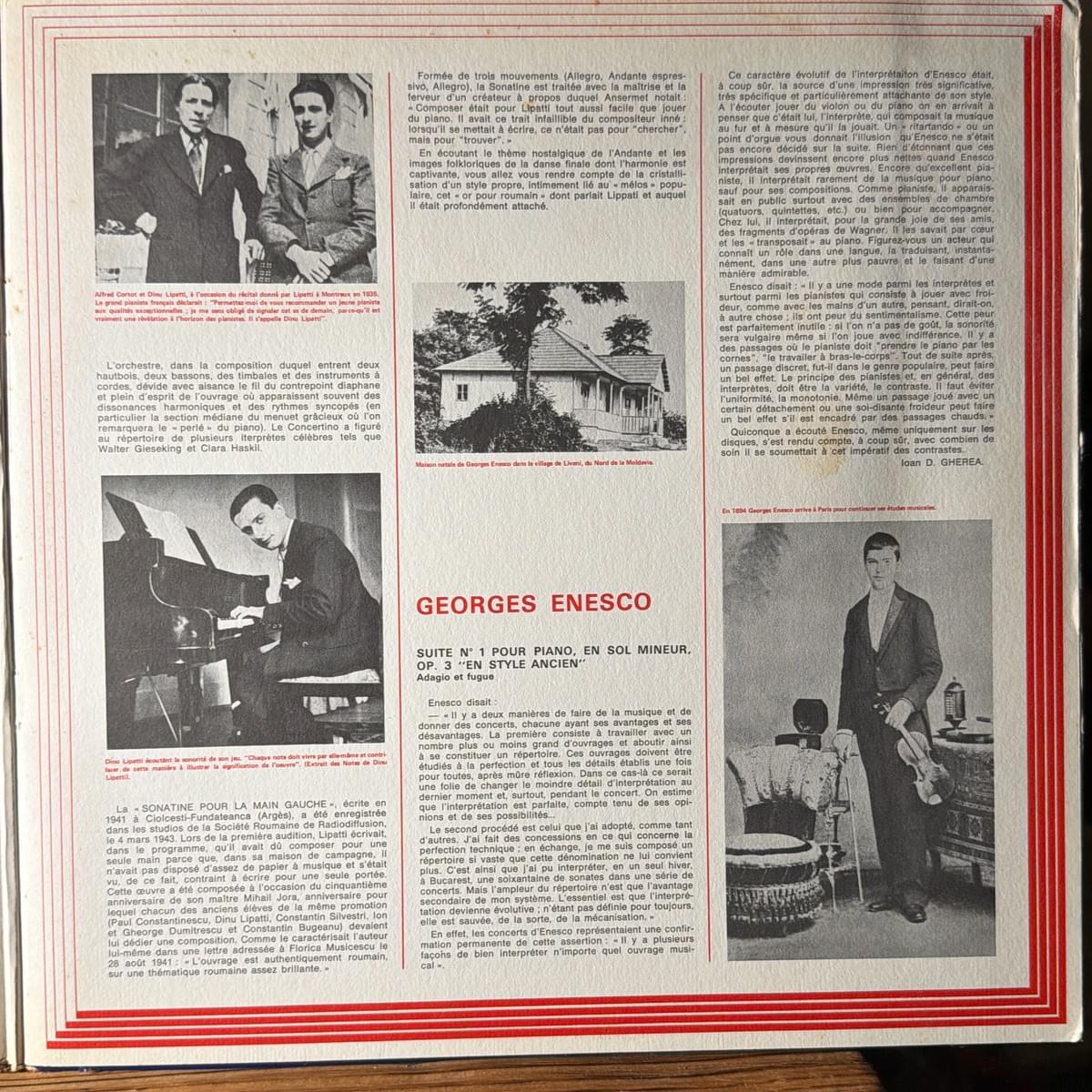
這套唱片的內頁共六面,照片由 Electrecord 從布加勒斯特提供。幾張照片與圖說,合起來就是兩個人的一生:
- 桂冠: 安奈斯可為手持小提琴的幼年李帕第戴上桂冠。圖說寫道:「後來,迪努・李帕第也反過來,成了安奈斯可最重要的作品之一《童年印象》的教父。」教父與教子,在音樂裡互換了位置。
- 蒙特勒,1935: 李帕第與阿爾弗雷德・柯爾托(Alfred Cortot,1877-1962)的合影。圖說引柯爾托的話:「請容我向各位推薦一位具有非凡特質的年輕鋼琴家……他是鋼琴界地平線上真正的啟示。他叫迪努・李帕第。」
- 安奈斯可的世界: 摩爾達維亞利韋尼村的故居;1894 年初到巴黎的少年;1904 年與卡薩爾斯(Pablo Casals,1876-1973)在波爾多的合影,圖說引卡薩爾斯的話:「半個世紀的友誼將我與安奈斯可繫在一起……我毫不猶豫地認為他是我們這個時代最好的作曲家之一。」以及提博、安奈斯可、克萊斯勒(Fritz Kreisler,1875-1962)「當代三大小提琴家」的合影。
- 病中: 李帕第與妻子在病情復發期間的合影。圖說引用他的話:
「折磨我的不是痛苦本身,而是它的反覆——沒有人能想像,而且它看起來沒有要停止的意思。在這種狀態下,我既不能彈琴,也不能作曲,甚至無法整理我的筆記。我只能讀書,聽收音機。」
「既不能彈琴,也不能作曲」——在李帕第自己的句子裡,這兩件事是並列的。這套唱片,就是為了把他的這個並列還給他。
一條從桂冠開始的線
把這套唱片從頭聽到尾,聽到的是一條完整的線。
安奈斯可十六歲寫的組曲,由他自己彈;他十八歲「成為自己」的奏鳴曲,和四十五歲寫下的民間風格奏鳴曲,由他拉、由他的教子彈;那位教子十九歲獻給老師的「頭生的孩子」,以及二十四歲在鄉下因為沒有五線譜紙而寫成的左手小奏鳴曲,由他自己彈。兩位作曲家、兩位演奏家,互為對方的詮釋者。
今天的演奏家很少作曲,作曲家也很少親自登台;「作曲家的意圖」變成了研究的對象,而不再是站在你身邊、拉完琴握住你的手的那個人。瑪德蓮在信裡說,正是「自己也是作曲家」,讓李帕第懂得每一位作曲家的「秘密訊息」。這套唱片,就是這句話的證據。
最後:
安奈斯可說,詮釋要保持演化,不要被定下來;李帕第說,每一個音都必須自己活著。兩個人說的都是同一件事:音樂不是一件完成品,而是一個活著的狀態。
你的生命裡,有沒有一位「為你戴上桂冠」的人?你後來有沒有機會,用你自己的方式,把他們的東西完整地彈給他聽?
******
【Gudian Music Stories】Godfather and Godson: George Enescu (1881–1955) & Dinu Lipatti (1917–1950) — Inédits
"I Could Never Wish for a Finer Interpreter"
March 1943. Bucharest, inside the broadcast studios of the Romanian Radio Broadcasting Company.
Sixty-one-year-old George Enescu (1881–1955) had just drawn the final stroke on two of his own violin sonatas; seated at the piano was twenty-five-year-old Dinu Lipatti (1917–1950). As the long recording session drew to a close, Enescu took Lipatti’s hands in his own, embraced him warmly, and said:
"I could never wish for a finer interpreter, nor a greater musician than you. Thank you, my dear Dinu."
That moment was never captured on tape. It was preserved in the memory of an eyewitness in the room, committed to paper in a handwritten letter twenty-nine years later by Lipatti’s widow, Madeleine Lipatti (1908–1983). A facsimile of that letter is reproduced across the gatefold insert of the two-LP set Inédits, released in 1972 by the French imprint Disques Déesse.
Twenty-two years before that session, Enescu had placed a celebratory laurel wreath on the brow of a four-year-old boy dressed in a sailor suit, holding a miniature violin. That historic photograph appears inside the very same gatefold. That child was Lipatti; Enescu was his godfather.
This release preserves an unbroken lineage: a composer-virtuoso partnered with his godson—himself a composer-virtuoso.
A Letter Penned in Geneva
In French, inédits translates to "unreleased works." The full title of the album reads: Inédits — Création et Interprétation: Enesco, Lipatti, subtitled Enregistrements Historiques. Across two discs—catalog numbers DDLX 40 and DDLX 41—the cover artwork by Maurice Apelbaum presents nesting concentric rectangles in shades of violet and magenta. The audio was licensed directly from Electrecord, Romania's state-owned recording enterprise, which also supplied the archival documentation and photographs from Bucharest.
In the divided Europe of 1972, this was no ordinary feat: a boutique French imprint reaching across the Iron Curtain to retrieve performance tapes preserved for three decades and issue them in Western Europe.
Madeleine's Letter
The final page of the gatefold reproduces Madeleine Lipatti's handwritten letter to Pierre Célie, dated "Geneva, February 7, 1972." Célie, a singer-songwriter from northern France, co-founded Disques Déesse alongside his brother Michel Célie. Her concluding words—"Heartfelt thanks for your fine initiative"—confirm that this project was his personal undertaking. A record producer with roots in popular music traveling to Switzerland in 1972 to persuade a classical widow to bring Cold War tapes to Paris remains an extraordinary historical chapter.
Her letter highlights several key insights:
- The world celebrated Lipatti as a virtuoso pianist, yet remained largely blind to his gifts as a composer. Releasing his Concertino in Classic Style and the Sonatina for the Left Hand was therefore an act of profound historical significance.
- Cut over three decades earlier, these historical recordings document the sensitivity of Lipatti’s musical thought and compositional craft—to say nothing of his melodic gift, rhythmic vitality, and mastery of both keyboard and orchestra.
- He was an exceptional pianist, as his recordings attest; yet being a composer himself allowed him to penetrate the inner essence of the scores he performed. He grasped the "secret message" of every master, understood the architecture of a work, and knew intuitively how to approach it.
- The album reveals another dimension of his artistry: Lipatti as a chamber musician, partnering with his "venerated master" Enescu in the violin sonatas.
- Having witnessed the sessions in Bucharest firsthand, she recalled that both sonatas were committed to disc in uninterrupted single takes without a single slip, breathing with the spontaneity of a live concert.
"Unreleased"?
Strictly speaking, the title was an overstatement. Both sonatas had been issued in Romania by Electrecord in the 1950s, and a budget edition had appeared in the United States on the Monitor label.
Yet those early issues had clear limitations. Electrecord was a state-run Eastern Bloc enterprise with modest vinyl pressing standards, while Monitor was a small American label operating without primary master tapes, likely dubbing commercial Romanian LPs.
The French Déesse set was an entirely different artifact: formally authorized by Electrecord, manufactured with French plating and pressing standards, accompanied by six pages of detailed essays and archival photographs, and authenticated by the pianist’s widow. It represents the finest historical edition of these recordings ever issued. For the French and Western European markets, it was an authentic premiere; as for Lipatti’s two original compositions, they were virtually unknown outside specialist circles.
The designation inédits applied less to the physical tape than to the artist himself: an unfamiliar Lipatti stepping before the world.
Lipatti the Composer (I):
Concertino in Classic Style
The liner notes quote an observation by conductor Ernest Ansermet (1883–1969):
"Composing was as natural for Lipatti as playing the piano. He possessed that infallible instinct of the born creator: when he took up the pen, he did not write to 'search,' but to 'find.'"
The "Firstborn" Dedicated to His Teacher
Scored for piano and chamber orchestra, the Concertino in Classic Style, Op. 3, was composed in 1936, when Lipatti was nineteen years old and studying in Paris. He dedicated the score to his revered piano pedagogue in Bucharest, Florica Musicescu (1887–1969).
The author of the liner notes notes that he held the first printed copy of the score, published in Vienna by Universal Edition. Across the title page ran Lipatti's handwritten inscription:
"To my Teacher—this firstborn child, with all my love and all my gratitude."
"The firstborn child" (le premier né)—a nineteen-year-old composer dedicating his maiden published orchestral work as an offering to the mentor who had guided his hands.
Recorded in Wartime Berlin
On January 14, 1943, Lipatti recorded the work alongside a chamber orchestra conducted by Hans von Benda (1888–1972). While the sleeve credits simply a "Chamber Orchestra," standard discographies identify the ensemble as the Berlin Chamber Orchestra, which Benda had founded. A Romanian pianist recording in wartime Berlin: within a year of these sessions, Lipatti would leave Romania behind to begin his Swiss exile.
The annotator recalls that when discussing Lipatti in 1968, Benda grew visibly moved. A quarter of a century had passed, and the young Romanian had been in his grave for eighteen years, yet the conductor remembered the session vividly.
A Concerto Free of Virtuoso Ostentation
The liner notes outline the key hallmarks of the work:
- Deliberate Classicism: The thematic material shares a stylistic affinity with Bach and Domenico Scarlatti (1685–1757), composers Lipatti revered. Producer Walter Legge felt it recalled the neoclassicism of Sergei Prokofiev’s (1891–1953) Classical Symphony.
- Orchestration: Two oboes, two bassoons, timpani, and strings. The ensemble weaves a transparent, contrapuntal texture marked by witty syncopations and mild dissonances.
- Aural Highlight: In the central section of the third movement’s elegant Minuet, the listener encounters Lipatti’s crystalline, pearlescent touch (jeu perlé).
- The Role of the Keyboard: The piano writing is articulate, resembling a modern realization of a harpsichord concerto, never allowing technical display to eclipse musical substance. The notes observe that an instrumentalist of Lipatti’s virtuosity could easily have composed a showpiece to dazzle audiences; that he chose not to confirms his humility and his commitment to musical integrity.
- Reception: Walter Gieseking (1895–1956) and Clara Haskil (1895–1960) both championed the work in concert.
Lipatti the Composer (II): A Sonatina for the Left Hand Born from a "Shortage of Manuscript Paper"
The Sonatina for the Left Hand was composed in 1941 at the family’s country retreat in Argeș County, Romania.
Why compose exclusively for the left hand? Most renowned left-hand works share a tragic origin—such as commissions for pianists who lost their right arm during the First World War. Lipatti’s rationale was practical: secluded in the countryside, he discovered he had run out of multi-stave music paper. Restricted to a single staff per system, he decided to write for a single hand.
A Fiftieth Birthday Tribute
The piece was composed to mark the fiftieth birthday of his composition instructor, Mihail Jora (1891–1971). Jora’s students each contributed an original work, including Paul Constantinescu (1909–1963), Lipatti, Constantin Silvestri (1913–1969), the brothers Ion and Gheorghe Dumitrescu, and Constantin Bugeanu. A mentor's milestone prompted an entire generation of Romanian composers to put pen to paper.
On March 4, 1943, Lipatti committed the piece to tape in the studios of Romanian Radio.
"An Authentic Romanian Work"
In an August 28, 1941 letter to Musicescu, Lipatti summarized the score in a single sentence:
"It is an authentically Romanian work, built upon quite brilliant Romanian themes."
The piece unfolds across three movements: Allegro, Andante espressivo, and Allegro. The notes observe that the nostalgic cantabile of the Andante, paired with the rustic folk rhythms of the finale, captures Lipatti's mature voice: an idiom rooted in the Romanian folk mélos, which Lipatti termed "the gold of Romania."
"Every Note Must Possess Its Own Life"
The booklet includes a portrait of Lipatti leaning over the keyboard, listening intently to his own tone. The caption quotes an entry from his personal notebooks:
"Every note must possess its own life, and in doing so, help illuminate the meaning of the work."
Set beside a left-hand composition, that reflection carries added resonance. Working with one hand cuts the available notes in half; each remaining voice must carry greater expressive weight.
Enescu at the Keyboard
On the second half of Side Two (DDLX 40), Enescu takes over at the piano. The repertoire is his own Piano Suite No. 1 in G minor, Op. 3, "Dans le style ancien," composed when he was sixteen.
This is a rare acoustic document. Celebrated internationally as a titan of the violin, Enescu was also an accomplished pianist, yet he seldom performed solo piano literature in public, reserving appearances at the keyboard for his own scores, chamber collaborations, or vocal accompaniments.
A Suite Preserved in Fragments
Composed in 1897, the suite originally comprised four movements: Prélude, Adagio, Fugue, and Finale. The notes explain that the Finale was never recorded, while the Prélude was omitted due to technical tape flaws, leaving only the Adagio and Fugue. The gatefold reproduces a 1904 photograph of the Prix Pleyel jury, noting that this suite won the prize that year, with Jules Massenet (1842–1912) among the jurors.
The commentary characterizes it as an early, classically proportioned score that predates his mature folk synthesis; yet its melodic contours and inner rhythmic flow already reveal his distinctive voice.
"Two Ways of Making Music"
In his analysis of the suite, Ioan D. Gherea quotes Enescu on performance practice:
"There are two ways of making music and presenting concerts, each with its advantages and perils. The first is to concentrate on a limited repertoire, setting every detail in place once and for all after deep reflection—in which case, altering any detail on the spur of the moment, especially during a concert, is a form of madness.
The second is the path I have chosen, along with many others. I have made concessions regarding technical perfection; in return, I have acquired a repertoire so vast that the very word 'repertoire' ceases to apply. In a single winter in Bucharest, I performed some sixty sonatas across a series of recitals. But breadth of repertoire is merely a secondary virtue. What matters is that interpretation becomes 'evolutionary'; it is never frozen permanently, and is thus spared from mechanization."
Gherea describes the effect of this "evolutionary interpretation" on an audience: hearing Enescu play violin or piano, one felt as though he were composing the work in real time. A ritardando or a fermata felt like a musician deciding where to step next. In private gatherings, he would perform Wagnerian orchestral passages from memory at the piano upon request, "like an actor who, knowing a character intimately in one tongue, translates it extemporaneously into a leaner language, doing so with astonishing eloquence."
"The Fear of Emotion Is Entirely Superfluous"
Gherea records another observation by Enescu that anticipates twentieth-century performance aesthetics:
"There is a fashion among performers today, particularly among pianists, to play coldly, as if with borrowed hands, their minds occupied elsewhere. They are terrified of sentimentality. This fear is entirely superfluous: if an artist lacks taste, playing with clinical detachment will sound just as vulgar... The performer's true principle is contrast and variety; uniformity and monotony must be avoided at all costs."
This perspective explains why Lipatti's playing is neither showy nor detached. In Enescu’s view, the danger in performance lay not in feeling, but in a lack of taste.
The Composer on Violin, His Godson at the Piano: The Two Sonatas
The second LP (DDLX 41) devotes an entire disc to Enescu’s violin sonatas: Enescu on violin, Lipatti at the piano. Creator and interpreter meet on equal terms, yielding an irreplaceable performance document.
Violin Sonata No. 2 in F minor, Op. 6 (1899): "I Felt Myself Becoming Myself"
Composed in 1899 when Enescu was eighteen, the sonata premiered in Paris on February 22, 1900, at the Concerts Colonne, dedicated to Joseph and Jacques Thibaud (1880–1953). At the premiere, Jacques Thibaud played the violin, accompanied by Enescu at the piano.
Enescu regarded this score as his first decisive step away from his academic models. In his memoirs, Souvenirs, he wrote:
"Beginning with the Second Violin Sonata and the Octet for Strings, Op. 7, I felt myself evolving rapidly; I was becoming myself."
The liner notes frame its place in Romanian music history: it represents the first chamber score to integrate Romanian folk idioms into classical sonata architecture, establishing an indigenous chamber tradition. While echoes of César Franck (1822–1890) and Johannes Brahms (1833–1897) surface in the harmony, its relationship to folk material is one of organic affinity rather than direct quotation.
A roadmap of its three movements:
- Assez mouvementé: Impulsive youthful energy, described in the notes as a mountain brook—alternating between turbulent rapids and reflective pools.
- Tranquillement: Poetic lyricism unfolding with the tenderness of a folk lament (doina), carrying thematic echoes of the opening movement.
- Vif: Synthesizing the themes of the preceding movements into an energetic, unified conclusion.
The notes characterize this reading as a meeting of intellect and imagination, documenting the spiritual kinship shared by the two men.
Enescu recorded this sonata twice, the other version partnering with French pianist Céliny Chailley-Richez. A reviewer for MusicWeb International noted that while the Chailley-Richez account offers quieter surfaces, Lipatti injects the finale with heightened rhythmic vitality.
Violin Sonata No. 3 in A minor, Op. 25, "dans le caractère populaire roumain" (1926)
Where the Second Sonata represents stylistic affinity, the Third Sonata represents complete transformation. Twenty-seven years later, Enescu integrated the speech-like, improvisatory rhythm (parlando-rubato) of traditional Romanian folk fiddlers (lăutari) directly into concert music. The sleeve analysis details several technical dimensions:
- Parallels with Bartók: Enescu’s rhythmic innovations complement Béla Bartók’s (1881–1945) research, drawing upon folk roots to liberate classical phrasing from the rigidity of the bar line.
- Microtonality: The violin employs quarter-tones, anticipating the later experiments of Olivier Messiaen (1908–1992) and Alois Hába (1893–1973).
- Timbral Melodies (Klangfarbenmelodie): Harmonics, flautando bowing, left-hand pizzicato, and glissandos create a flowing stream of acoustic colors, while the piano mimics the hammered attacks of the cimbalom (țambal) and the strummed accents of the folk cobza.
- First Movement (Moderato malinconico): Retains classical sonata architecture, though the recapitulation of the principal theme transforms into a slow, circular hora dance.
- Second Movement (Andante sostenuto e misterioso): Composer Tudor Ciortea (1903–1982) described this movement as a pastoral fresco: mountain vistas, shepherds' calls, bird song, and distant sheep bells beneath nightfall—"the primeval forest of the poet Mihai Eminescu (1850–1889)."
- Third Movement (Allegro con brio, ma non troppo mosso): A sonata-rondo whose refrain evokes a Moldavian dance, while the second episode returns to the free vocalise of the doina.
The booklet concludes with a summary statement:
"George Enescu imparted this definitive interpretive tradition directly to his partner Dinu Lipatti, establishing an authoritative benchmark for all future readings of his work."
The score of the Third Sonata is meticulously annotated, with microtonal inflections and expressive slides written into the notation; yet its vernacular speech-rhythms required the composer's own performance to bring them fully to life. This recording serves as an acoustic companion to the printed page.
Spring 1943, Bucharest
Reviewing Lipatti’s recording dates in this collection reveals that they clustered within the opening months of 1943:
- January 14, Berlin: Concertino in Classic Style, conducted by Hans von Benda.
- March 4, Bucharest (Romanian Radio): Sonatina for the Left Hand.
- March 11, Bucharest (Romanian Radio): Enescu Violin Sonata No. 3.
- March 13, Bucharest (Romanian Radio): Enescu Violin Sonata No. 2.
The first two dates are printed in the gatefold text; the latter two derive from standard discographical records. Later that year, Lipatti and Madeleine departed Romania, never to return. These sessions represent his final recordings made in his native land.
In a Single Breath
Madeleine noted that both sonatas were committed to disc in continuous single takes, free of retakes, preserving the freshness of a live concert. Then followed the moment described at the start of this essay: Enescu taking Lipatti’s hands, embracing him, and confessing that he could imagine no finer interpreter.
This echoes Enescu’s conviction: interpretation should evolve rather than freeze into routine. A phonograph record captures a specific reading on a specific day; yet what it preserved here was an uninterrupted performance, capturing the spontaneous vitality of that single afternoon.
A Shared Life Across the Gatefold
The six-panel gatefold features archival photographs provided by Electrecord in Bucharest, sketching the arc of two intertwined careers:
- The Wreath: Enescu crowning the young Lipatti with a laurel wreath. The caption notes: "Later, Dinu Lipatti would in turn become the godfather to one of Enescu’s masterworks, 'Impressions d’enfance.'" The roles of godfather and godson reversed through sound.
- Montreux, 1935: Lipatti alongside Alfred Cortot (1877–1962). The caption cites Cortot's endorsement: "Allow me to present a young pianist of extraordinary gifts... a true revelation on the horizon of the keyboard: his name is Dinu Lipatti."
- Enescu's World: His childhood home in Liveni, Moldavia; the young student arriving in Paris in 1894; with Pablo Casals (1876–1973) in Bordeaux in 1904 (quoting Casals: "Half a century of friendship bound me to Enescu... I consider him without hesitation one of the greatest composers of our era"); and a portrait uniting Jacques Thibaud, Enescu, and Fritz Kreisler (1875–1962) as the preeminent violin triumvirate of their day.
- During Illness: Lipatti and Madeleine during a period of medical convalescence. The caption quotes the pianist's reflections:
"What torments me is not the pain itself, but its ceaseless recurrence—beyond anything one can imagine, showing no sign of relenting. In this state, I can neither play nor compose, nor even organize my notes. I can only read, and listen to the radio."
"I can neither play nor compose"—in Lipatti’s mind, performance and composition were twin expressions of the same artistic calling. This album was curated to restore that balance.
An Unbroken Lineage
Heard from beginning to end, the album traces a coherent trajectory:
Enescu performs the suite he wrote at sixteen; the sonatas he composed at eighteen and forty-five are played by the composer on violin, partnered by his godson at the piano; the godson performs the Concertino he dedicated to his teacher at nineteen, alongside the left-hand sonatina born of necessity at twenty-four. Two composers, two instrumentalists, each serving as the other's interpreter.
Today, concert soloists rarely compose, and composers seldom maintain touring careers. The "composer’s intent" has become a scholarly puzzle rather than a conversation with the colleague standing beside you at the piano. Madeleine observed that being a composer himself allowed Lipatti to unlock the "secret message" within every score. This collection stands as physical proof of that insight.
Enescu insisted that interpretation must evolve and breathe; Lipatti maintained that every single note must possess a life of its own. Both were describing the same artistic truth: music is not an inert product, but a living reality.
Has there been a mentor in your own life who placed a symbolic laurel on your brow? And have you ever had the chance to take what they gave you, and play it back to them in your own voice?