
克萊斯勒拒絕「競爭」的「放棄」哲學~~尋找自己的賽道,最終成為永恆藝術之美
古殿殿主
最近幾乎殿主每天都在整理克萊斯勒(Fritz Kreisler,1875-1962)的老錄音,心裡突然有個聲音告訴我:
「未來,我們不能再談『競爭』這個概念了,因為它是一切焦慮與罪惡的根源。」
這聽起來很反直覺,對吧?從小到大,學校教我們要競爭,職場要我們去廝殺,彷彿不贏過別人,我們就沒有價值。但今天,我想請大家把手機放下,給自己倒杯茶,聽殿主講一個關於「放棄競爭」的故事。這不是什麼心靈雞湯,而是一段真實發生在一百多年前的音樂歷史。
在這個故事裡,主角不是透過「贏」來成為大師,而是透過「輸」、透過「被拒絕」、透過「離開」,最後確認了心中摯愛,找到了屬於他自己的永恆。
一、 真正的國王,懂得「懶」的藝術
在講這段歷史故事之前,我想先跟各位聊聊心態。
在這個科技焦慮的年代,很多人問我:「殿主,AI 來了,歷史研究怎麼辦?音樂怎麼辦?」我的回答總是:
關鍵在於「體驗」!
目前AI只是資料上的駕馭,它能運算幾億條文獻,但它無法感受到風吹過臉龐的涼意,無法感受到失戀心痛後的那個音符有多重。這就是生理與物理體驗的不可取代性。
所以,我們要回歸到「人」的本質。
你要成爲自己,千萬不要強迫自己去做不喜歡的事。我們追求的應該是更穩定的生命狀態、更健康的身體、更好的生活品質。這些東西才是首要目標,而不是把生命耗費在跟別人「競爭」上。投入努力去競爭,只會讓你更焦慮,而焦慮,是健康最大的殺手。
說真的,人都是「懶」的,其實「懶」並沒有什麼不好!在那個強調節奏與效率的工業賽道上,「懶」或許是別人的絆腳石;但對我們自己的生命來說,「懶」與「放空」是至高的價值。
如果要我選一句話來代表這種精神,我會這樣說:
「朋友們,試著學會『懶』一點吧!這裡的懶,不是讓你混吃等死,而是把那些不屬於你的焦慮、那些別人的期待統統丟掉。把你的時間、你的專注、你的生命力,只留給你真心喜歡的人與事。當你敢於對世界『偷懶』,你才能勤奮地『做自己』。這,就是真正的國王。」
而小提琴大師克萊斯勒,就是這條「懶人國王」之路的先行者。
二、 13歲的震撼教育:當「暖男」遇見「哲學博士」
讓我們把時光倒流回1888年。那一年,有一列火車在美國廣闊的大地上奔馳,車上坐著兩個來自歐洲的音樂家。
一個是26歲的鋼琴大師羅森塔爾(Moriz Rosenthal,1862-1942)。這位大師有個堅持,喜歡人家尊稱他為**「博士」**。這可不是為了擺架子,而是因為他真的是一位鑽研哲學的博士!他是李斯特的高徒,蕭邦的親嫡傳,精通拉丁文與希臘哲學,還是一個練柔道的健身達人。他的琴聲就像他的哲學辯論一樣,邏輯嚴密、而且聲音力拔山河無堅不摧。
另一個是縮在角落、年僅13歲的小胖子,剛從巴黎音樂院畢業的小提琴神童——克萊斯勒。
這是一場「大哥帶小弟」的巡迴演出。羅森塔爾是主角,克萊斯勒只是負責當跟班的「助理藝術家」。這趟旅程對小克萊斯勒來說,簡直是地獄般的震撼教育。
在台上,羅森塔爾博士用那種「哲學家的霸氣」征服了美國觀眾,樂評家形容他是「鍵盤上的巨人」。而輪到克萊斯勒上場時,雖然他的音色甜美,但站在羅森塔爾這個巨人的陰影下,美國紐約的樂評毫不留情地寫道:「這個少年的聲音太小了」、「缺乏成熟男性的力量」、「不夠宏亮」。
如果你是那個13歲的小男孩,你會怎麼想?是不是覺得自己太弱了?是不是覺得自己不是這塊料?
三、 感謝那場失敗的面試:被「教皇」拒絕的幸運
從美國回來後,克萊斯勒做了一個決定,這個決定充分展現了他「不強求」的性格。
他心想:「既然我當不了像羅森塔爾那樣的獨奏大師,那我低下頭,去考個樂團,當個穩定的公務員樂手總行了吧?」
大約1890年,他去參加了維也納歌劇院樂團(也就是現在維也納愛樂)的面試。這是多麼謙卑的一步啊!一個剛拿過巴黎音樂院金獎的天才,願意隱身在樂團裡。
但命運跟他開了個大玩笑——他居然被刷掉了。
當時的面試官是樂團首席阿諾德·羅瑟(Arnold Rosé,1863-1946)。這位大師的來頭可大得嚇人,他不僅是作曲家馬勒(Gustav Mahler,1860-1911)的妹婿,更是當時維也納音樂界公認的「小提琴教皇」。
這位「教皇」拒絕克萊斯勒的理由有兩個:第一,視奏能力太差(因為他是靠直覺拉琴的天才,討厭死盯著譜);第二,也是最關鍵的一點——「他的抖音太多了」。
在羅瑟這種講究傳統紀律的權威眼裡,這個年輕人拉琴一直抖個不停,聲音太甜、太個人化,根本是邪魔歪道,無法跟樂團融合。
這次失敗,如果是別人可能早就崩潰了。獨奏這條路走不通(拚不過大力士與哲學博士),退而求其次想當個樂團團員也被嫌棄(被教皇說不入流)。
但克萊斯勒展現了一種我很佩服的**「生命彈性」**。他並沒有覺得「我的人生如果不能拉琴就完了」,也沒有在那裡死磕、抱怨懷才不遇。他只是聳聳肩,轉身去嘗試更多其他的東西。
四、 離開,是為了確認真愛:1899 年的重生
既然音樂這條路暫時堵死了,那就聽聽爸爸的話吧。
克萊斯勒的父親薩洛蒙醫生,是佛洛伊德(Sigmund Freud,1856-1939)的好朋友,他一直堅信:
「音樂應該是生命中最美好的嗜好,但不一定是一個穩定的職業。」
從1890年到1899年,這近十年,克萊斯勒真的脫下了燕尾服。他去讀了兩年醫學院,在大體解剖室裡拿手術刀;他去巴黎學畫畫,拿起了畫筆;他甚至去當兵拿起了槍,體驗過生死存亡。
這段「空白期」,看似是他放棄了音樂,放棄了小提琴,其實是他走進了真實的生活。
而就在他嘗試了這世間各種可能性——做醫生救人、做畫家繪畫、做軍人戰鬥——之後,他在某個深夜裡突然明白了一件事:
「我可以做別的事,但我不能沒有音樂。」
那一刻,他終於發現,音樂不是父親口中那個「不穩定的職業」,也不是羅瑟眼裡那個「不合群的技術」,而是他:一生的摯愛。
於是,在 1899 年,他選擇了回歸。這一次,他不是為了謀生,而是為了愛。
他沒有選擇在那個拒絕他的維也納復出,而是去了德國柏林。站在他身邊的,是當時歐洲指揮界的「神」——尼基許 (Arthur Nikisch,1855-1922),以及赫赫有名的柏林愛樂。
尼基許是一位極度重視「音色魔力」的指揮家,他聽懂了克萊斯勒。那晚,克萊斯勒拉奏了:孟德爾頌的小提琴協奏曲。曲畢觀眾響起掌聲,掌聲中有一位當時小提琴界巨人:意沙易(Eugène Ysaÿe,1858-1931),更站起來鼓掌賀彩,象徵比法小提琴學派的下一代繼承人出現了。
請注意這個選擇。他沒有選那些需要展現肌肉與力量的曲目來證明自己,他選了孟德爾頌——那首最需要優雅、甜美與歌唱性的曲子。
那晚的演出獲得了巨大的成功。經過近十年生活的洗禮,克萊斯勒的琴聲不再只是「神童的炫技」,而是充滿了對生命深刻體悟後的深情告白。
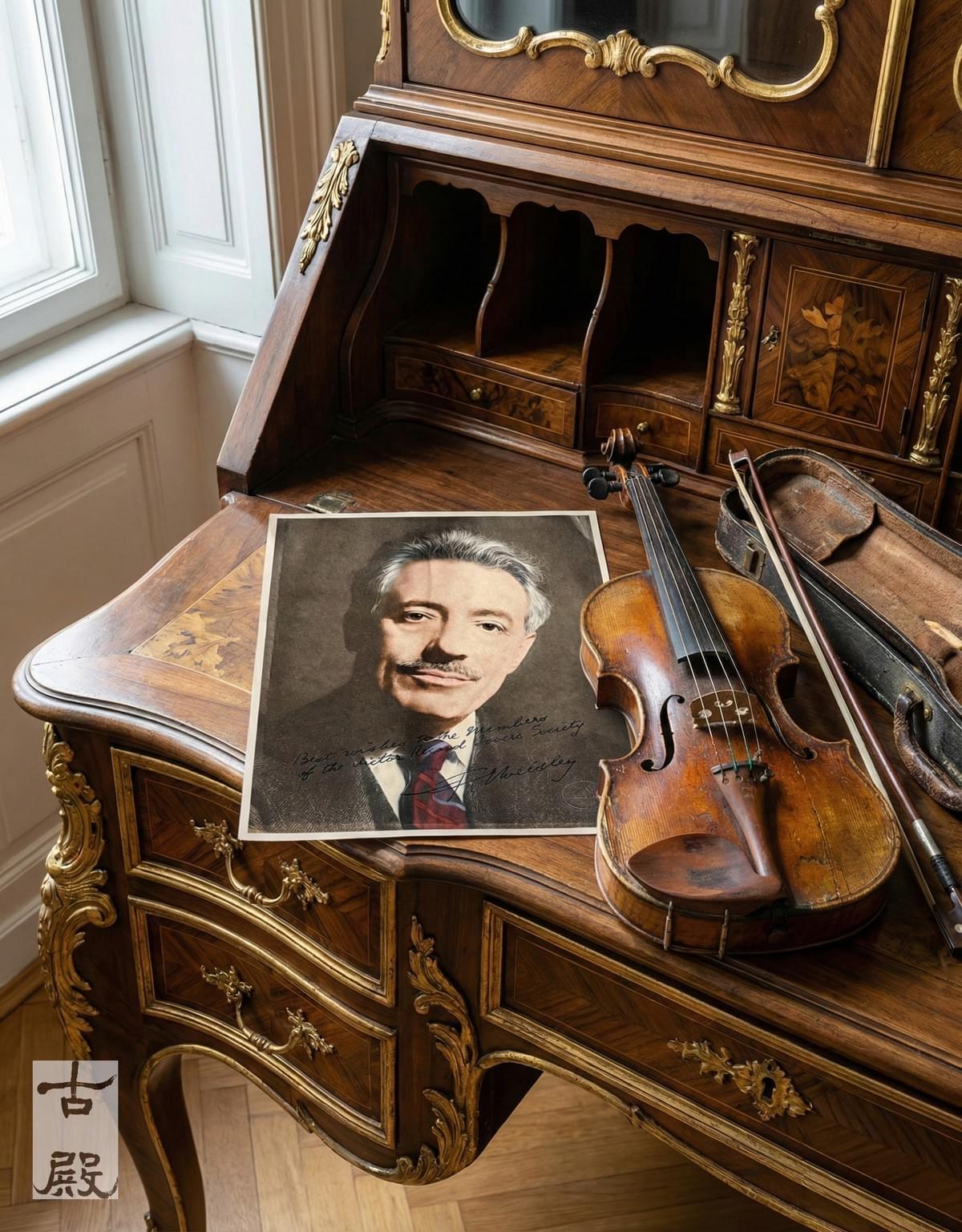
五、 外來的神祇與被遺忘的鄰居
但故事到這裡還沒結束。最諷刺的是,即便他在柏林跟尼基許合作獲得了巨大成功,但當他回到故鄉維也納時,他依然是一個「局外人」。
身為歷史研究者,我們必須誠實地面對這段「燈下黑」的歷史:
在 1900 年代到 1920 年代的維也納,舞台上根本沒有克萊斯勒的空間。
當時的維也納人有一種很奇妙的心態,他們對「自己人」不感興趣,反而瘋狂追捧外來的神祇。當時稱霸維也納的兩位巨人,一個是來自捷克的庫貝利克(Jan Kubelík,1880-1940),另一個是來自波蘭的胡伯曼(Bronisław Huberman,1882-1947)。
- 庫貝利克是「技巧的極致」。他的演奏像希臘雕塑一樣完美、純淨,精準得像一台精密儀器。當時的維也納少女對他的瘋狂程度,就跟現在追星一樣。
- 胡伯曼是「精神的極致」。他的音樂像燃燒的火焰,充滿了道德力量與掙扎。他不追求好聽,他追求的是真理。
這兩位當然都是絕非等閒之輩的大師。但在這兩座大山面前,克萊斯勒就像個沒沒無聞的鄰居大叔。即便他在柏林已經紅了,維也納人還是覺得他太溫和、太普通、太沒有那種「異國情調」的刺激感。
如果克萊斯勒當時選擇去跟他們「競爭」,去比拼庫貝利克的精準,或者去模仿胡伯曼的張力,他絕對會輸得很慘,然後消失在歷史的塵埃中。
但他沒有。他選擇了:做自己。
在被主流忽視的歲月裡,他用那把溫暖的Guarneri名琴,拉著那些充滿人情味的曲子。他不跟神競爭,他選擇擁抱人。
而時間,是最公平的裁判。
一百年過去了,當炫技的驚嘆冷卻後,當精神的燃燒平息後,人們驚訝地發現,留下來最能感動我們的,竟然是當年那個「沒空間」的克萊斯勒。
他的**「人性光輝」**超越了技巧,超越了時髦,成為了更有價值的永恆藝術。
六、 最後:為自己的生命定錨
回到我們一開頭說的,未來不要再談「競爭」了。
看看克萊斯勒,他的一生都在「被比較」中度過,但他始終在「放棄競爭」。他放棄了跟羅森塔爾博士比哲學與力量,嘗試低身去考樂團被「教皇」拒絕後也沒糾結。他甚至離開了音樂圈十年,去學醫、去畫畫、去當兵,只為了確認自己對音樂的愛。
他從來沒有覺得自己的人生:「一定要怎麼樣才行」
最終找到自己一生的摯愛。
他讀書,幾萬本的古籍收藏(據説沒有ㄧ本是英文寫的),通曉十幾國語言(每一種都達精通程度)。這些知識不是拿來炫耀的武器,而是滋養他音樂摯愛的土壤。
當我們聽克萊斯勒拉琴時,我們聽到的不只是小提琴,而是那幾萬本古書化成的——人類文明的厚度與溫暖。
在這個時代,「古殿」希望這裡能成為大家心靈的避風港。當你走進「古殿」,請把大腦裡那個負責運算、負責比較、負責焦慮的開關關掉。
打開你的耳朵,打開你的身體,去體驗那些歷史留下來的聲音。去聽聽克萊斯勒是如何在被世界一次次拒絕、忽視後,依然溫柔地擁抱這個世界。
把生活過好,把身體顧好,找到自己的興趣與價值。當你的心自由了,不再被「競爭」綁架了,我相信,真正的藝術之美,以及那個更真實的你自己,就會在某個不經意的瞬間,悄悄降臨。
期待我們古殿見。
*******
Fritz Kreisler’s Philosophy of "Giving Up" on Competition: Finding Your Own Path to Eternal Art
Recently, I’ve been sorting through the old recordings of Fritz Kreisler (1875-1962) almost every day. While listening, a voice suddenly whispered to me:
"In the future, we can no longer talk about the concept of 'competition,' because it is the root of all anxiety and evil."
Sounds counter-intuitive, doesn't it? Since we were kids, schools taught us to compete, and workplaces pushed us to fight, as if we have no value unless we defeat someone else. But today, I’d like to ask you to put down your phone, pour yourself a cup of tea, and let me tell you a story about "giving up competition." This isn't some cheesy motivational fluff; it’s a piece of real music history from over a hundred years ago.
In this story, the protagonist didn't become a master by "winning." He found his own eternity through "losing," through "being rejected," and through "leaving," which finally allowed him to confirm his true love for music.
1. The Real King Knows the Art of Being "Lazy"
Before we dive into history, let’s chat about mindset. In this age of tech-anxiety, many people ask me: "Master, AI is here! What will happen to historical research? What about music?" My answer is always:
The key lies in 'Experience'!
Right now, AI only masters data. It can crunch billions of documents, but it cannot feel the cool breeze on your face, nor can it feel how heavy a single musical note weighs after a heartbreak. This is the irreplaceable nature of physical and physiological experience.
So, we must return to the essence of being "Human."
You have to become yourself. Never force yourself to do things you dislike. We should pursue a more stable state of being, a healthier body, and a better quality of life. These are the primary goals—not wasting life "competing" with others. Throwing effort into competition only makes you more anxious, and anxiety is the biggest killer of health.
Honestly, humans are naturally "lazy," and there is actually nothing wrong with being "lazy"! On that industrial track that emphasizes speed and efficiency, "laziness" might be a stumbling block for others; but for our own lives, "laziness" and "spacing out" are values of the highest order.
If I had to pick one sentence to represent this spirit, I’d say:
"Friends, try to learn to be a little 'lazy'! This doesn't mean just messing around and wasting away. It means throwing away the anxiety that doesn't belong to you and the expectations of others. Save your time, your focus, and your vitality only for the people and things you truly love. Only when you dare to be 'lazy' toward the world can you be diligent in 'being yourself.' This is what a true King does."
And the violin master Kreisler was the pioneer of this "Lazy King" path.
2. A Shock at Age 13: When a "Gentle Soul" Met a "Doctor of Philosophy"
Let’s rewind time to 1888. That year, a train was speeding across the vast American landscape. Two musicians from Europe were sitting inside.
One was the 26-year-old piano master, Moriz Rosenthal (1862-1942). This master had a quirk: he insisted people address him as "Doctor." He wasn't putting on airs; he really was a scholar of philosophy! He was a top student of Liszt, a direct musical descendant of Chopin, fluent in Latin and Greek philosophy, and even a fitness expert trained in Judo. His piano playing was just like his philosophical debates—logically rigorous, with a sound as powerful as a mountain.
The other one was a chubby 13-year-old kid curled up in the corner, a violin prodigy fresh out of the Paris Conservatory—Fritz Kreisler.
This was a "Big Brother brings Little Brother" concert tour. Rosenthal was the star; Kreisler was just the "assisting artist" tagging along. For little Kreisler, this trip was a hellish education.
On stage, Dr. Rosenthal conquered American audiences with that "philosophical dominance." Critics called him a "giant of the keyboard." But when it was Kreisler's turn, even though his tone was sweet, standing in the shadow of this giant, New York critics showed no mercy: "The boy's sound is too small," "Lacks the power of a mature man," "Not resonant enough."
If you were that 13-year-old boy, what would you think? Would you feel you were too weak? Would you feel you weren't cut out for this?
3. Thank You for That Failed Interview: The Luck of Being Rejected by the "Pope"
After returning from America, Kreisler made a decision that perfectly showcased his "don't force it" personality.
He thought: "Since I can't be a solo master like Rosenthal, I'll humble myself, join an orchestra, and be a stable civil servant musician. That should work, right?"
Around 1890, he auditioned for the Vienna Court Opera Orchestra (now the Vienna Philharmonic). What a humble step! A genius who had just won the Gold Medal at the Paris Conservatory was willing to hide himself in an orchestra.
But fate played a huge joke on him—he was rejected.
The auditioner was the concertmaster Arnold Rosé (1863-1946). This man was a formidable figure. Not only was he the brother-in-law of composer Gustav Mahler, but he was also recognized as the "Pope of the Violin" in Vienna.
The "Pope" rejected Kreisler for two reasons: First, his sight-reading was poor (because he was a genius who played by intuition and hated staring at sheet music). Second, and most critically—"His vibrato is too much."
In the eyes of an authority like Rosé who valued traditional discipline, this young man who kept shaking his hand while playing, producing a sound that was too sweet and too personalized, was basically a heretic who couldn't blend in with the orchestra.
For anyone else, this failure might have been a mental collapse. The solo path was blocked (couldn't beat the strongmen and philosophers), and the backup plan of being an orchestra member was also rejected (called "unrefined" by the Pope).
But Kreisler showed a "Life Elasticity" that I deeply admire. He didn't feel like "my life is over if I can't play violin," nor did he bang his head against the wall complaining about unrecognized talent. He simply shrugged and turned to try other things.
4. Leaving to Confirm True Love: The Rebirth of 1899
Since the music road was temporarily blocked, he decided to listen to his dad.
Kreisler's father, Dr. Salomon, was a good friend of Sigmund Freud. He always believed: "Music should be the most beautiful hobby in life, but not necessarily a stable profession."
From 1890 to 1899, for nearly ten years, Kreisler really took off his tuxedo. He went to medical school for two years, holding a scalpel in the anatomy lab; he went to Paris to study art, picking up a paintbrush; he even joined the army and picked up a gun, experiencing life and death.
This "gap decade" looked like he had given up on music and the violin. But actually, he was walking into real life.
After trying all these possibilities—saving lives as a doctor, creating as a painter, fighting as a soldier—he suddenly understood something late one night:
"I can do other things, but I cannot live without music."
In that moment, he finally discovered that music wasn't the "unstable job" his father spoke of, nor the "non-conforming technique" Rosé saw. It was: The Love of His Life.
So, in 1899, he chose to return. This time, not to make a living, but for love.
He didn't choose to make his comeback in Vienna, where he was rejected. He went to Berlin, Germany. Standing beside him was the "God" of European conducting at the time—Arthur Nikisch (1855-1922), and the famous Berlin Philharmonic.
Nikisch was a conductor who deeply valued "the magic of tone color," and he understood Kreisler. That night, Kreisler played the Mendelssohn Violin Concerto. When it ended, the applause was thunderous. In the audience, a giant of the violin world, Eugène Ysaÿe, stood up to cheer, symbolizing that the next heir to the Franco-Belgian violin school had arrived.
Please notice his choice. He didn't pick a piece that required muscle and power to prove himself. He picked Mendelssohn—the piece that most requires elegance, sweetness, and singing quality.
That night was a huge success. After ten years of life’s baptism, Kreisler’s sound was no longer just "a prodigy showing off skills"; it was a deeply affectionate confession filled with profound realization of life.
5. Foreign Gods and the Forgotten Neighbor
But the story doesn't end there. Ironically, even after his massive success in Berlin with Nikisch, when he returned to his hometown of Vienna, he was still an "outsider."
As historical researchers, we must honestly face this "darkness under the lamp": From the 1900s to the 1920s, there was basically no space for Kreisler on the stages of Vienna.
The Viennese at the time had a strange mindset. They weren't interested in "one of their own"; instead, they crazily worshipped foreign gods. The two giants dominating Vienna then were Jan Kubelík from the Czech lands, and Bronisław Huberman from Poland.
Kubelík was the "Ultimate Technique." His playing was perfect and pure like a Greek sculpture, precise as a machine. The teenage girls of Vienna went crazy for him, just like fans chasing pop stars today.
Huberman was the "Ultimate Spirit." His music was like a burning flame, full of moral force and struggle. He didn't aim for "pleasant to hear"; he aimed for "Truth."
Both were undeniably masters. But in front of these two mountains, Kreisler was like an obscure uncle living next door. Even though he was famous in Berlin, the Viennese felt he was too gentle, too ordinary, and lacked that "exotic" thrill.
If Kreisler had chosen to "compete" with them back then—trying to match Kubelík’s precision or mimic Huberman’s tension—he would have lost miserably and vanished into the dust of history.
But he didn't. He chose to: Be Himself.
During those years of being ignored by the mainstream, he used his warm Guarneri violin to play pieces full of human touch. He didn't compete with gods; he chose to embrace humans.
And time is the fairest judge.
A hundred years have passed. Now that the gasps at technical wizardry have cooled, and the flames of spiritual struggle have settled, people are surprised to find that what remains, what moves us the most, is actually Kreisler—the man who had "no space" back then.
His "Human Radiance" transcended technique, transcended trends, and became an eternal art of greater value.
6. Finally: Anchor Your Own Life
Let’s go back to what we said at the start: In the future, let’s not talk about "competition" anymore.
Look at Kreisler. He spent his whole life being "compared," yet he always "gave up competition." He gave up comparing philosophy and power with Dr. Rosenthal; he didn't dwell on it when the "Pope" rejected his humble attempt to join an orchestra. He even left the music circle for ten years to study medicine, painting, and soldiering, just to confirm his love for music.
He never felt that his life "had to be a certain way." Ultimately, he found the love of his life.
He read voraciously, collecting tens of thousands of rare books (it is said none were in English), and was fluent in over a dozen languages. This knowledge wasn't a weapon to show off; it was the soil that nourished his beloved music.
When we listen to Kreisler play, we aren't just hearing a violin. We are hearing the thickness and warmth of human civilization, transformed from those thousands of ancient books.
In this era, I hope "Gu Dian" (The Ancient Palace) can be a safe haven for your soul. When you walk into "Gu Dian," please turn off the switches in your brain responsible for calculation, comparison, and anxiety.
Open your ears, open your body, and experience the sounds left by history. Listen to how Kreisler, after being rejected and ignored by the world time and time again, still embraced that same world with tenderness.
Live your life well, take care of your body, and find your own interests and value. When your heart is free and no longer kidnapped by "competition," I believe that true artistic beauty—and the truer version of yourself—will quietly descend in an unexpected moment.
I look forward to seeing you at Gu Dian.