
【古殿唱片音樂故事】李帕第(Dinu Lipatti,1917-1950)最後的音樂會:1950 年 9 月 16 日貝桑松全紀錄:從 INA 磁帶、一枝紅筆與一個被剪掉的錯音,來重建那一天
古殿殿主
一場「最後的安可」,其實不是那一天
1951 年 9 月 6 日晚上八點四十五分,法國東部小城貝桑松的市立劇院。第四屆貝桑松國際音樂節的開幕音樂會,是一場「向迪努・李帕第致敬」的音樂會。台上是法國廣播國家管弦樂團,指揮是李帕第的教父——喬治・安奈斯可(George Enescu,1881-1955);獨奏者是李帕第的遺孀瑪德蓮・李帕第(Madeleine Lipatti,1908-1983),以及他的學生貝拉・席基(Béla Siki,1923-2020)。
音樂會開始之前,主辦單位宣布,全場將先聽到「1950 年 9 月 16 日獨奏會最後的音符……李帕第最後一場音樂會中的最後一首安可曲」。揚聲器裡傳出巴赫的聖詠〈耶穌,世人仰望的喜悅〉。最初幾秒,觀眾與正在暖身的樂手還有些嘈雜,很快,全場就安靜下來了。一年前在這個音樂節裡,李帕第拖著垂死的身體彈完他生命中最後一場獨奏會;兩個半月後,他去世了,年僅三十三歲。在場的人都相信,他們正在聽的,就是那一天的告別。
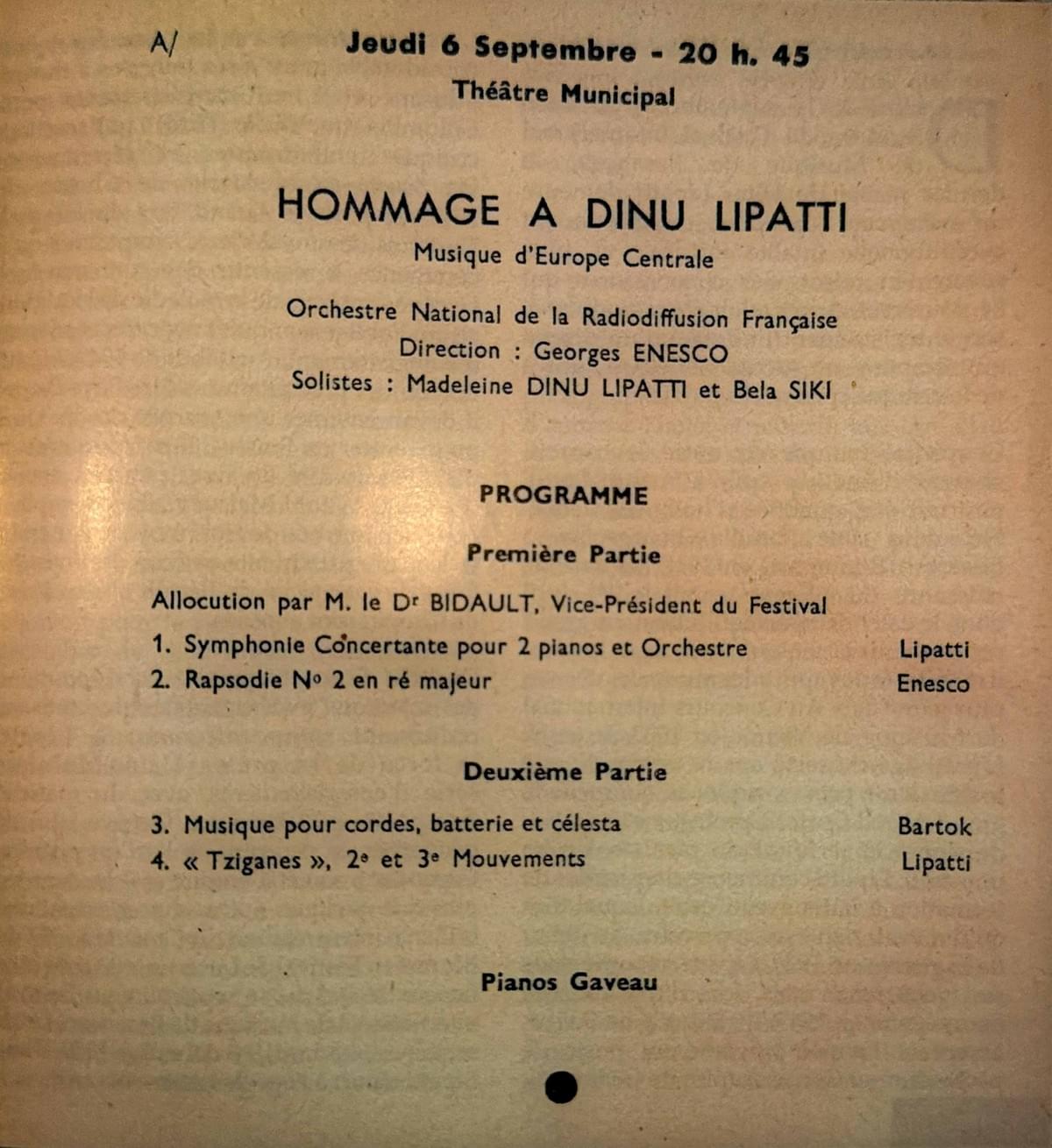
一直到將近七十年後,才有人用電腦拆穿了這件事。兩位技術人員對這份 1951 年的廣播錄音做了頻譜分析,結果顯示:那天劇院裡播放的,其實是李帕第 1947 年 9 月 24 日在倫敦錄音室錄下的版本,唱片編號 Columbia LC 30 78轉蟲膠唱片。貝桑松那天午後的巴赫聖詠,從來沒有被錄下來。
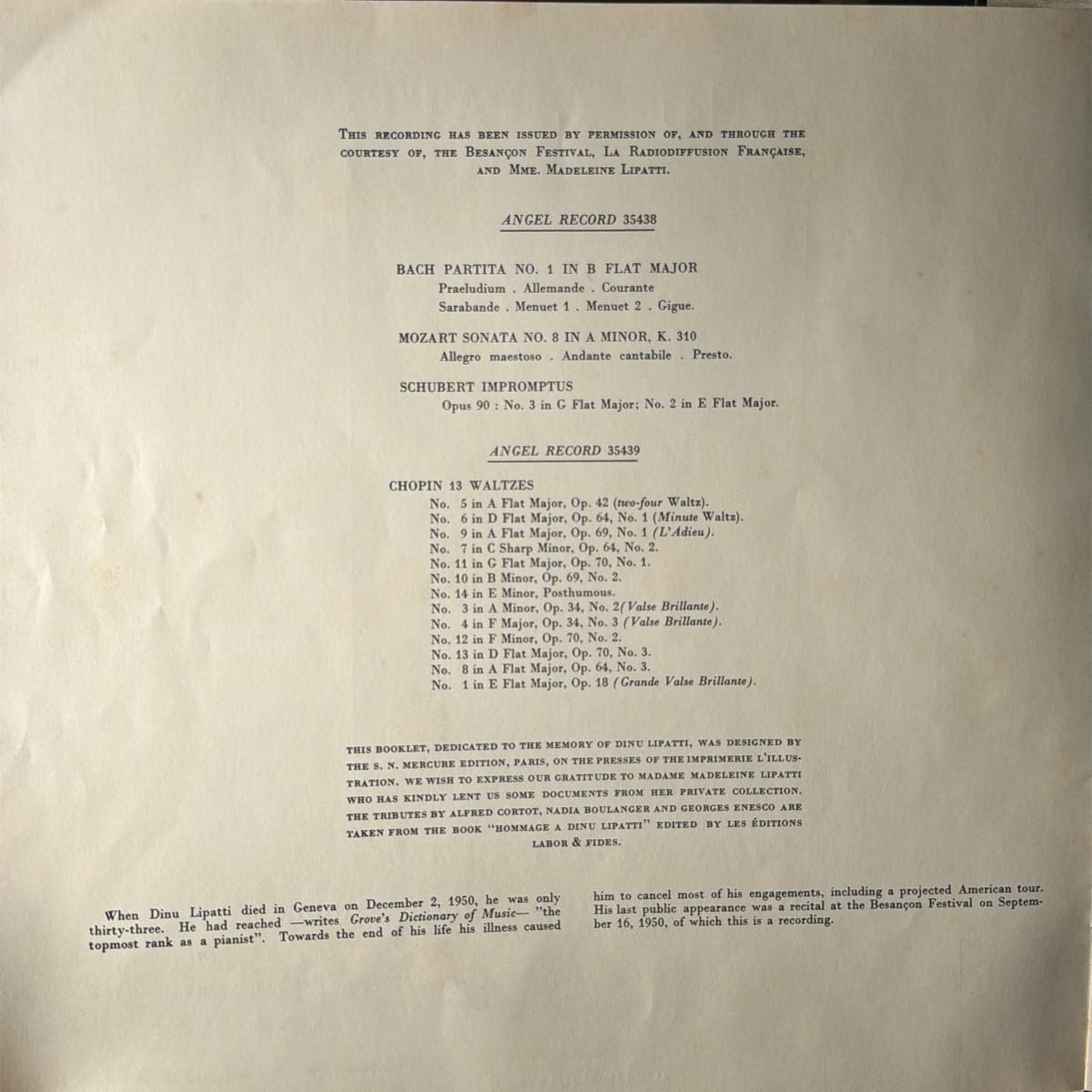
這個小小的「誤會」,正好說明了李帕第最後這場音樂會的處境:它太有名、太常被談論,以至於傳說與事實早就糾纏在一起。這篇文章,要依據兩份最新的資料重新講一次這個故事:一是 2018 年法國 Solstice 與法國國家視聽研究院(INA)合作、首次以原始廣播母帶完整發行的 CD(SOCD 358),其解說冊收錄了 INA 的調查報告、李帕第研究者馬克・安利(Mark Ainley)的長文與當年的行政文件;二是美國出版的 Angel 盒裝解說冊,其中有瑪德蓮親筆的回憶、三份當年的報紙報導與那張寫著「14 首」的節目單。
把它們放在一起,我們第一次可以幾乎逐小時地,重建 1950 年 9 月 16 日這一天。
一套「較不耗費體力的節目」
李帕第從來不是一位怯於挑戰的鋼琴家。病情緩解的時候,他的節目可以英勇得驚人。1948 年在巴黎普萊爾音樂廳的獨奏會,他彈了五十分鐘的巴赫、蕭邦兩首練習曲與《船歌》,最後還以舒曼(Robert Schumann,1810-1856)的《交響練習曲》收尾。
但從抵達日內瓦開始,一種不明的症狀就如影隨形——那是何杰金氏病。1949 年初,他在荷蘭的十天巡演不得不匯匆中斷,接下來整整十個月無法演奏;原定三個月的澳洲巡演由維托德・馬爾庫金斯基(Witold Małcużyński,1914-1977)代替,計畫中的巴爾托克第三號鋼琴協奏曲與蕭邦圓舞曲錄音也全部取消。
罹病之後為了保存體力、降低臨時取消的風險,李帕第為自己設計了一套「較不耗費體力的節目」:
- 巴赫:降 B 大調第一號帕蒂塔,BWV 825
- 莫札特:A 小調第八號鋼琴奏鳴曲,K. 310
- 舒伯特:即興曲兩首(作品 90/D. 899 第三、第二首)
- 蕭邦:十四首圓舞曲全集
他從 1949 年開始磨這套節目,同年 12 月在伯恩首演。有位聽眾記得,那天晚上他還加彈了一首不在那十四首之內的蕭邦遺作圓舞曲。
接受貝桑松音樂節的邀請之後,李帕第與主辦單位來回通信。他特地更正了節目上的一個錯誤:他要彈的是莫札特的 A 小調奏鳴曲,不是那首帶有變奏曲與《土耳其進行曲》的 A 大調。這個差別不小。K. 310 是莫札特僅有的兩首小調鋼琴奏鳴曲之一,寫於母親去世的那一年;一位自知時日無多的鋼琴家,選的是這一首。
主辦單位在貝桑松的 Hôtel des Bains 訂了房間,名單上有李帕第、瑪德蓮、友人喬治・史瓦卜(Georges Schwob),以及他的醫師亨利・杜布瓦-費里耶爾(Henri Dubois-Ferrière)與醫師夫人。一位鋼琴家的巡演隊伍裡,帶著自己的醫師同行。
9 月 16 日:「哪怕只是三個音」
李帕第一行人在獨奏會前一天抵達貝桑松。
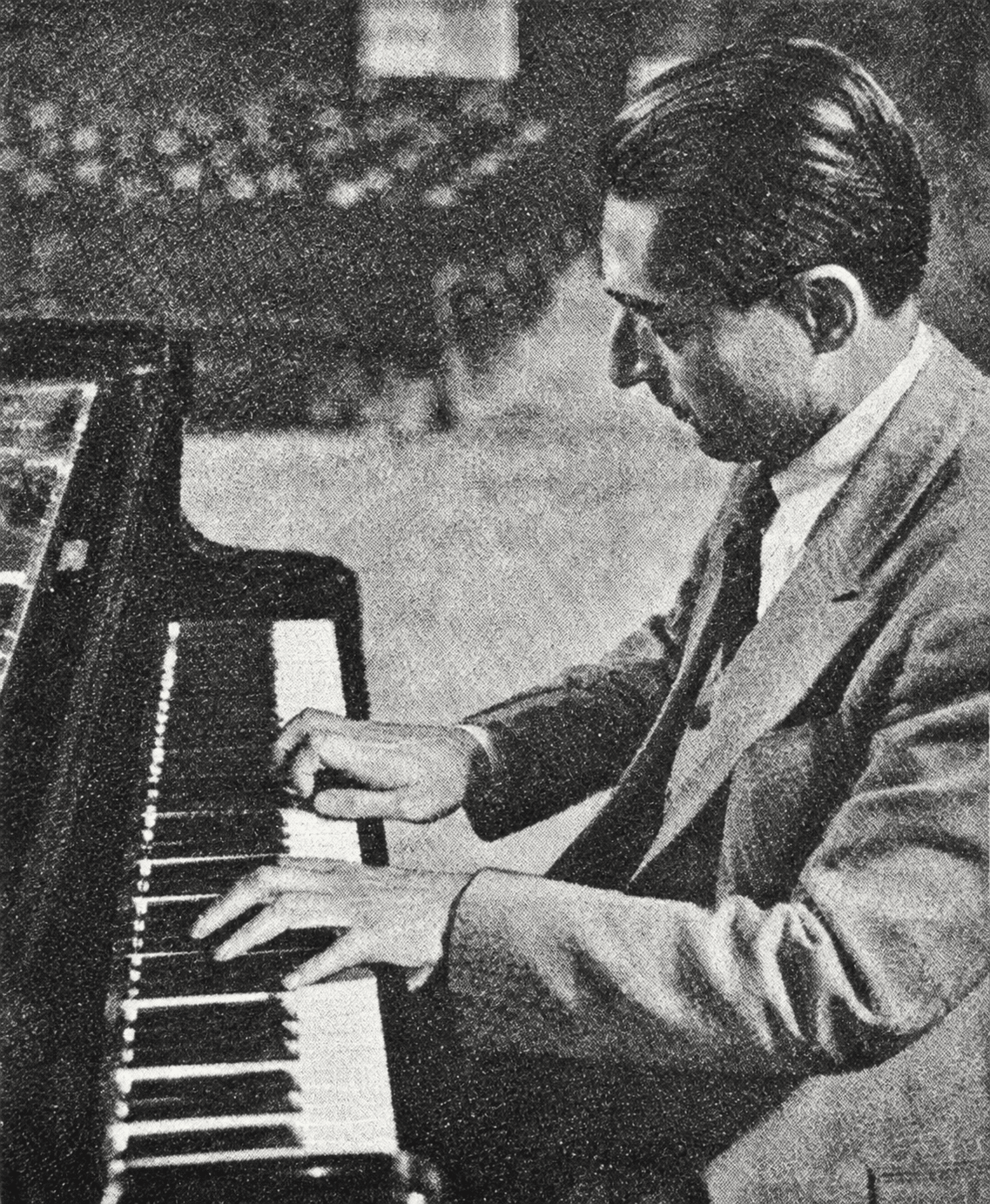
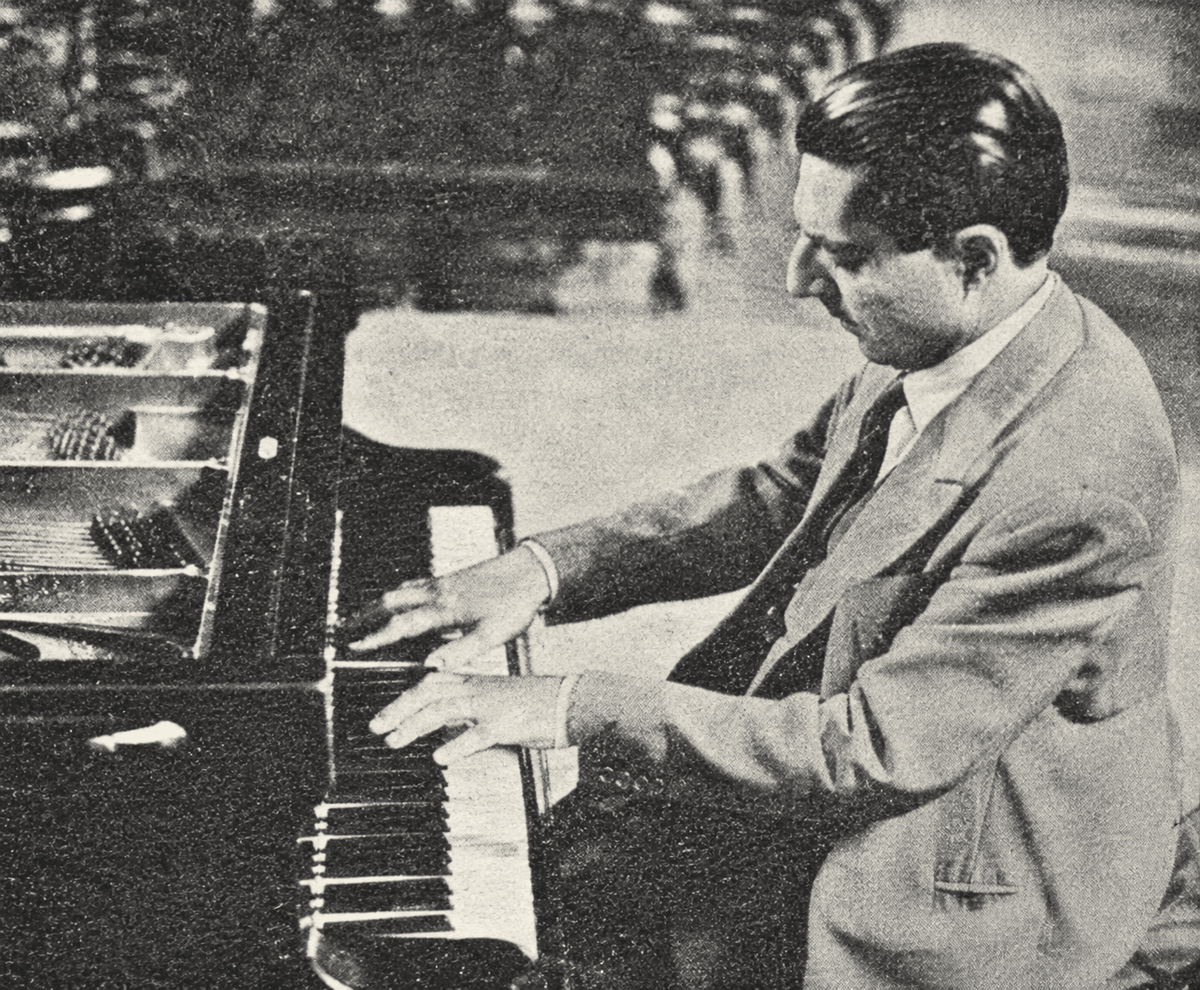
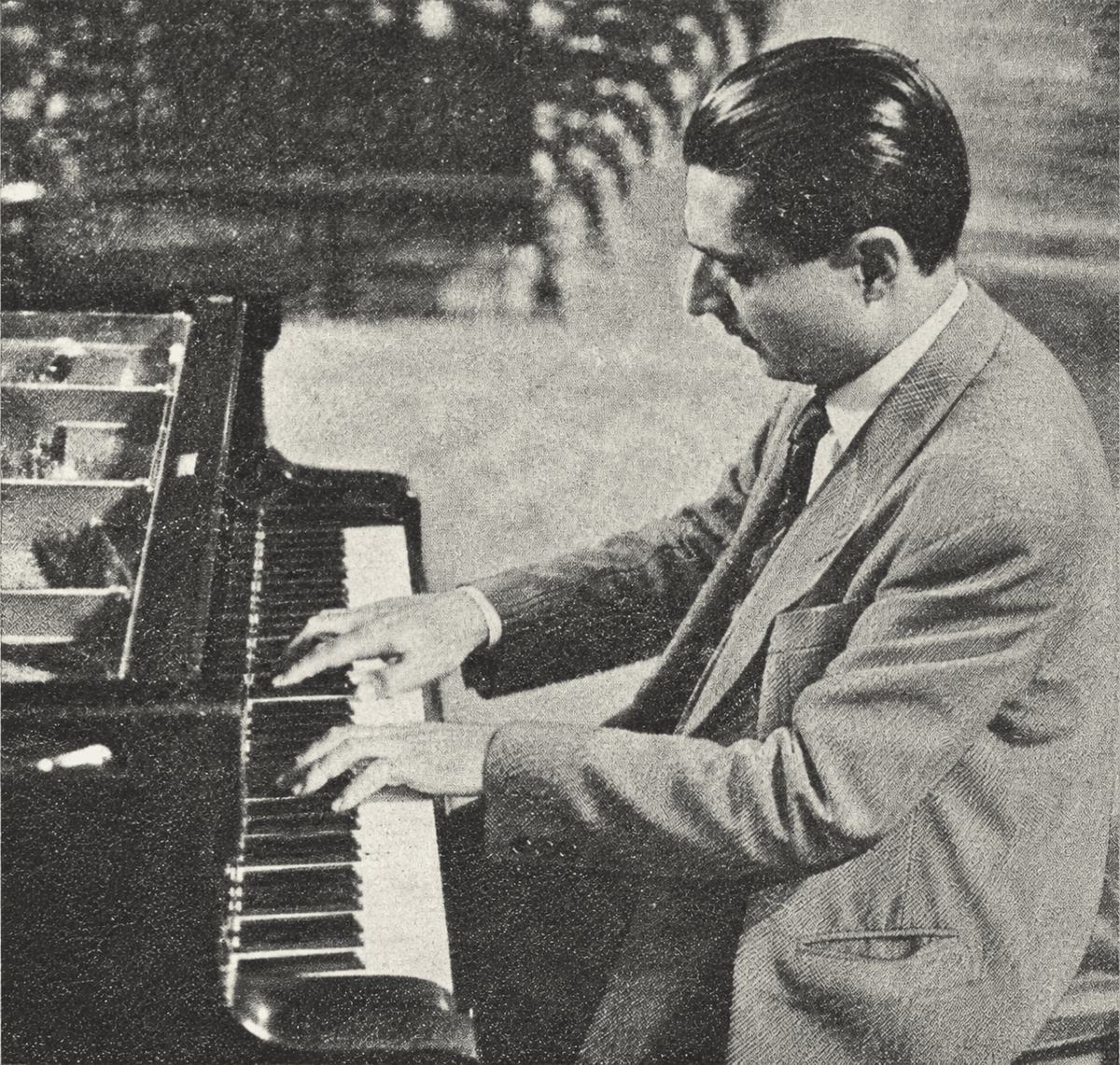
早晨。 9 月 16 日早上,杜布瓦-費里耶爾醫師在旅館門口、在準備載他們去排練的計程車旁,替李帕第夫婦拍了幾張照片。照片裡的李帕第看起來狀態不錯。同一卷底片上還有大約十二張他在議會廳練琴的照片,由醫師與音樂節主任羅傑・奧爾(Roger Hauert)拍攝。這些照片留下了一個細節:他彈不同作曲家時,手的位置會跟著改變。 Angel 盒裝解說冊,就印了其中三張——彈莫札特、彈蕭邦、彈巴赫。
午後。 隨著一天過去,狀況急轉直下:可怕的高燒,加上痛苦的病情發作。到了下午稍早,所有人都認為獨奏會只能取消。下午三點,醫師打電話給音樂節,告訴他們演出必須取消。
主辦單位在電話裡懇求:無論如何,請他彈一點什麼,「哪怕只是三個音!」。
李帕第聽說,距離開演還有兩個小時,音樂廳就已經坐滿了。他告訴自己,不能退縮。當天早上,沒有人知道他能不能上台——《基督徒見證報》(Témoignage chrétien)後來這樣寫。聽眾太多,主辦單位只好打開通往前廳的門,臨時搬來庭園椅;有人坐在舞台周圍的台階上,一路擠到入口大廳。
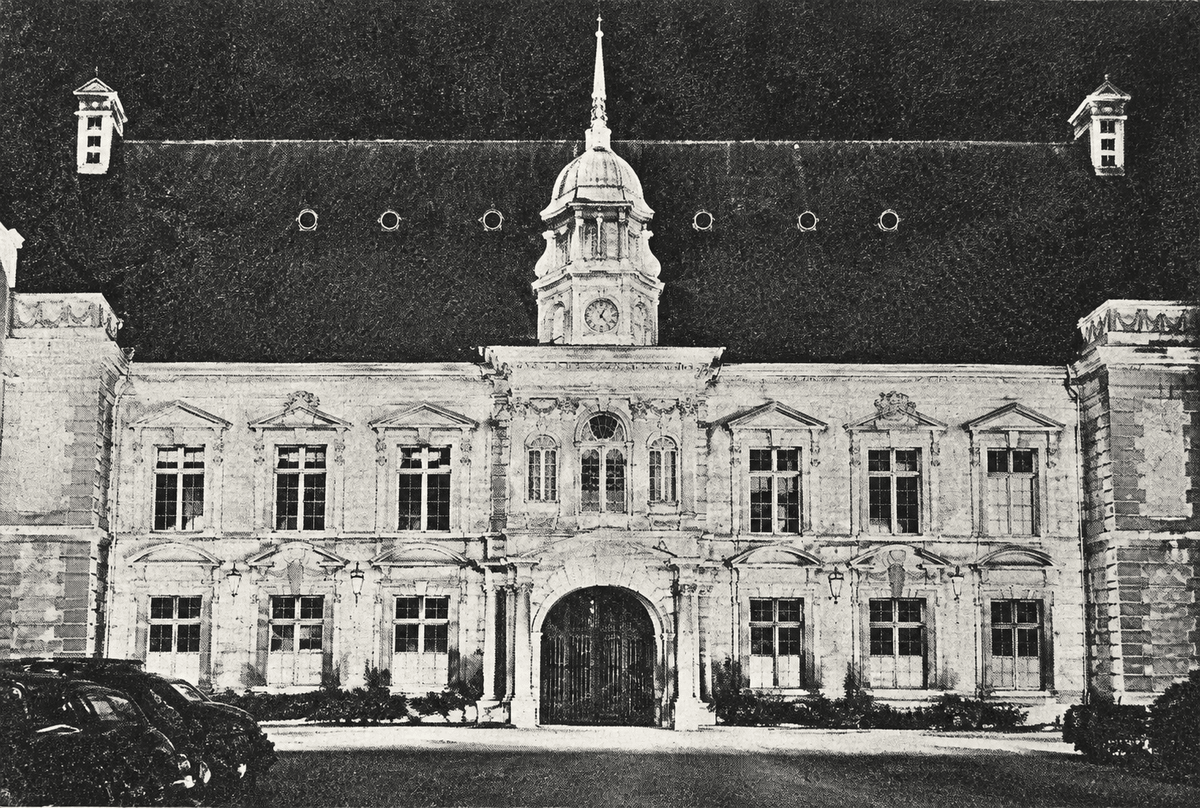
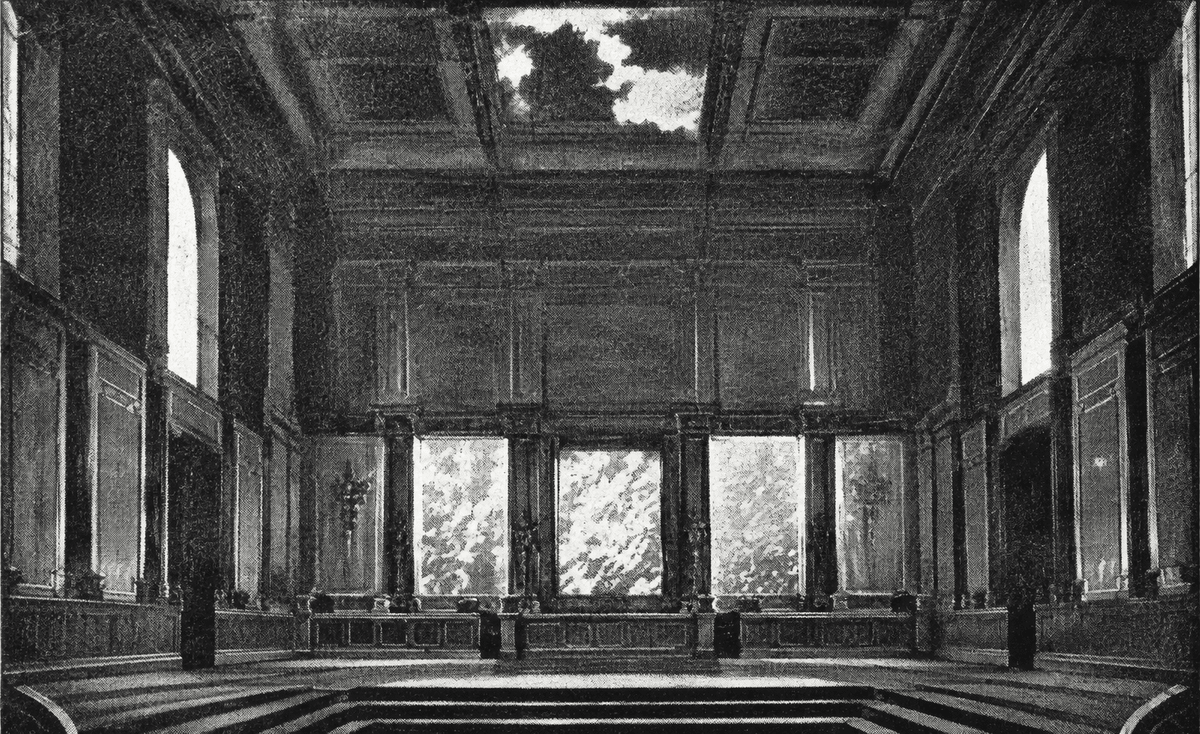
四點左右,他甚至覺得好一點了,至少可以試著彈完上半場。瑪德蓮與醫師一左一右扶著他,走上議會廳的樓梯。瑪德蓮後來在 Angel 解說冊裡寫道,那段樓梯對他而言是一條「受難之路」。
後台那張扶手椅
Solstice 解說冊裡最珍貴的一份證詞,來自一位當天在場的廣播人員諾埃爾・布瓦耶(Noël Boyer)。一年後,他在 1951 年紀念音樂會的廣播中回憶了那一天:
「就在觀眾即將來到議會廳的半小時之前,我們得知李帕第仍在旅館裡,被一次病情發作擊倒。……就在音樂會播報開始前整整五分鐘,我們看見迪努・李帕第抵達,由他那位令人敬佩的妻子摶扶著。我特別強調『摶扶』,因為他幾乎已經無法行走。半小時前,醫生們還守在他的床邊,一針接著一針地替他注射。」
那天天氣很好,非常炎熱。但在那間兼作廣播室與藝術家休息室的小房間裡,他們為李帕第準備了一張扶手椅,椅子前面架著三台電暖器,還有一條羊毛毯。李帕第臉色蒼白、冒著冷汗、渾身發抖,整個人癱在椅子裡。廣播人員還在猶豫,要不要接通線路、宣布音樂會開始。
「可是,時間已經到了,無法挽回。就在那一刻,音樂的奇蹟發生了:李帕第掀開毯子,站起身來,移開電暖器,以堅定、敏捷而自信的步伐,走向鋼琴。」
每一組曲目之間,他就回到那張扶手椅裡。人們替他打針,給他喝一點提神的補酒,然後他又回去彈。布瓦耶說:「那一刻的音樂,對迪努・李帕第而言,是一股真正賦予生命的氣息。」
三份記憶的出入
把幾位見證者的說法放在一起,細節並不完全一致:
- 開演時間: 節目單寫「下午五點」,布瓦耶的回憶是「四點左右」。
- 試琴: 瑪德蓮 1957 年寫道,他前一晚到達後勉強去議會廳試琴,回到旅館病情就加劇;安利根據醫師的底片指出,練琴是在當天早上,狀況還好,下午才發高燒。
- 「我答應了」: 瑪德蓮記得,前一晚醫師再次勸他取消,他只是固執地重複:「I promised; I MUST play!(我答應了;我必須演奏!)」
這些出入並不減損整個故事。瑪德蓮寫於六年之後,很可能把前一晚與當天早上合在一起記了;底片的證據更硬。但所有的記述都指向同一件事:下午三點,醫師已經宣布取消;五點,他坐在了鋼琴前。
上半場:琶音、播報與三位作曲家
李帕第走向那台法國製的嘉禾(Gaveau) 鋼琴,琴的左側放著一杯水。在正式彈巴赫之前,他先隨手彈了幾串琶音。
這是一個在 1950 年已經快要消失的傳統——在作品之前「即興前奏」,十九世紀與二十世紀初的鋼琴家很常這樣做,後來只剩下少數人保留,例如威廉・巴克豪斯(Wilhelm Backhaus,1884-1969),一直到他 1969 年的最後一場音樂會都還這樣彈。對李帕第而言,這些琶音既是暖手,也是調性的橋梁:從降 B 大調轉到 A 小調,從一位作曲家走到下一位。
巴赫之前的第一串琶音,彈到第四個音就塌了。這是整場最具臨場感的幾秒鐘:一個剛從扶手椅上站起來的人,手指還沒有找到自己。然後,他以精準、從容的觸鍵,完整彈完了巴赫的第一號帕蒂塔。
尚・托斯卡納的聲音
每組曲目之間,李帕第回到後台那張扶手椅;而錄音裡,填滿這些空檔的是法國廣播名主持人尚・托斯卡納(Jean Toscane)的播報。這些播報過去從來沒有發行過,2018 年的 Solstice 版CD中才第一次完整收錄。
莫札特彈完之後,托斯卡納對收音機前的聽眾講了一個關於舒伯特即興曲的小故事:舒伯特三十歲時,美因茲的出版商 Schott 本來只願意以六十弗羅林接下他的鋼琴《即興曲》,幾個月後又反悔,理由是「法國的顧客不喜歡這一類作品」。托斯卡納說,法國人已經用行動駁斥了這種說法——舒伯特的即興曲,在法國始終極受歡迎。
這段廣播稿一個字也沒有提到李帕第的病。廣播另一頭的聽眾,聽到的是一場尋常的音樂節獨奏會;只有現場演奏廳裡的人,知道每一段播報的背後,是又一針注射。
舒伯特:唯一的文獻
上半場的最後,是舒伯特作品 90 中間的兩首即興曲。先是歌唱線條綿長的降 G 大調,再是三連音急速流動的降 E 大調。安利寫道,後者那股向前推進的勁勢,完全不像出自一位身體如此不佳的演奏者。
這兩首舒伯特有它特別的地位:整場獨奏會裡,只有它們不在李帕第兩個月前的日內瓦錄音室曲目之中。如果沒有這場音樂會,我們就完全聽不到李帕第的舒伯特。而降 G 大調那一首裡,藏六十多年的秘密——我們留到後面再講。
十三首圓舞曲,與沒有彈完的第十四首
中場休息之後,托斯卡納對廣播聽眾宣布:這場獨奏會「將以完整演奏蕭邦的十四首圓舞曲作為結尾」。
李帕第沒有照作品號的順序彈。他說過,這些圓舞曲不是同一時間寫成的,本來就不是要作為一部曲集依序演奏;依音樂的需要重新安排銘接,反而更合理。關於這個曲序的來龍去脈,殿主已另文詳述;這裡只記一件事:貝桑松的曲序,跟兩個月前在日內瓦為 Columbia 錄下的版本略有不同。安利的解釋是,錄音室版必須配合 78 轉唱片每面四到五分鐘的容量來安排。也就是說,貝桑松這一晚,很可能才是李帕第心中「不受唱片限制」的曲序。
疲倦的痕跡
前幾首,李帕第用細膩的樂句與音色,彈出每一首圓舞曲各自的性格。但隨著演出進行,體力的極限一點一點露了出來。安利在 Solstice 解說裡逐首指出:
- 他省略了部分反覆,稍微縮短了當晚的第八首(作品 34 之 2),以及第十、十一首(作品 70 之 2、70 之 3)。
- 第十二首,降 A 大調作品 64 之 3,在最後幾個小節出現了一個明顯的錯誤。
- 然後是第十三首,降 E 大調作品 18《華麗大圓舞曲》。他以充沛的活力與英雄般的氣概彈完,最後一個大和弦落下,全場爆出熱烈的掌聲。
錄音就停在這陣掌聲裡。唱片上聽得到的最後一個聲音。
第十四首
安利寫道,接下來發生的,無疑是李帕第一生中最悲劇性的一刻。
他開始彈節目的最後一首——降 A 大調圓舞曲,作品 34 之 1——但不久就停了下來。他太虛弱了,無法繼續。他站起身,默默走回休息室。
觀眾安靜地坐著等待,那段時間彷彿永無止境。
瑪德蓮在 Angel 解說冊裡寫道,全場只有一刻軟弱:他沒有力氣彈完十四首圓舞曲的最後一首。她接著加了一句:「連蕭邦也不會因此怪他。」
這個空白,後來被一枝紅筆正式記錄了下來——不過那是後話。
最後的安可:一首,還是三首?
漫長的沉默之後,李帕第回到了舞台。他彈起巴赫,像最後一次祈禱——米拉・海絲(Myra Hess,1890-1965)改編的〈耶穌,世人仰望的喜悅〉。
這首曲子像一條主導動機,貫穿了李帕第的整個演奏生涯。1935 年他在巴黎的第一場獨奏會,彈的第一首就是它,用來追悼剛去世的作曲老師保羅・杜卡(Paul Dukas,1865-1935)。十五年後,他用同一首曲子,與自己的舞台告別。瑪德蓮寫道,他疲憊不堪、幾乎無法呼吸,却仍有勇氣彈那首「對他而言是祈禱」的巴赫聖詠。
這是流傳最廣的版本:一首安可,一首聖詠,一個完美的結尾。但 Solstice 解說冊裡的新資料,讓這幅畫面變得更複雜。
報紙上的「一首接著一首」
安利指出,當地的兩份報紙《共和報》(La République)與《康堤人報》(Le Comtois),都記載李帕第彈了不只一首安可曲。Solstice 解說冊重印了《共和報》的樂評,其中寫道:
「他回應聽眾的要求,一首接著一首演奏安可曲;其中一首,還是出自他自己才華的改編作品。」
哪一首是他自己的改編?安利的推測有兩條線索:
- 巴赫《田園曲》BWV 590。 李帕第當時剛完成這部管風琴作品的鋼琴改編。那年 11 月 20 日,他最後一次坐到鋼琴前,為瑪德蓮彈的最後一首曲子,就是《田園曲》的第三樂章。
- 巴赫-肯普夫《西西里舞曲》。 其中一份報紙記載他彈了「一首西西里舞曲」;獨奏會兩週後的一次廣播訪談中,他也彈了威廉・肯普夫(Wilhelm Kempff,1895-1991)改編的這首巴赫,但那次的錄音至今下落不明。
如果安利是對的,李帕第在貝桑松的「天鵝之歌」是三首巴赫,而不是一首。這件事至今仍未正式確認;但有一件事是確定的:這些安可,沒有一首被錄下來。
為什麼沒有錄音?
關於錄音為何中斷,有兩種說法:
- 一位廣播錄音工程師曾說,他停止錄音,是因為最後那些時刻太過私人,他不忍再錄下去。Solstice 的發行人也採信這個說法:出於對藝術家的尊重,錄音工作已經停止。
- 也可能是李帕第離開舞台、在後台停留太久,設備先關了;等他最後一次登台時,沒有人再重新啟動。
INA 的檔案裡,找不到這些段落的任何痕跡。而文章開頭那場 1951 年的「最後的安可」,正是在這個空白裡產生的:貝桑松的人們太想再聽一次那一天的祈禱,於是拿出了一張 1947 年的唱片——也許是無心,也許是不得不然。那天晚上的廣播裡,致詞者還預先向聽眾道歉:「無論錄音品質如何,如果某些技術上的缺陷未能忠實呈現鋼琴家的才華,敬請將它歸因於科學技術進步尚有不足。」
一份錄音的命運
這場音樂會能夠留下來,靠的是一個謹慎的決定。
法國廣播機構原本計畫現場直播。考慮到李帕第的身體,他們改成只錄不播,以防他在台上倒下。Angel 解說冊裡印出了《基督徒見證報》的報導,編者特地在這一句底下畫了線——他們想告訴讀者:你手上這張唱片能夠存在,是因為那天下午有人做了這個決定。
先是唱片,然後才是磁帶
錄音工程師在現場將演出直接刻錄在 78 轉唱片上,之後再轉錄到磁帶。INA 廣播聲音修復部門負責人 Vincent Fromont 解釋了當時的狀況:1950 年,磁帶才剛進入法國國家廣播機構,音質好得多,却仍然稀少;它常常先被複製到唱片上,然後拿去錄別的東西,或用幾次就丟掉。唱片是主流,要到 1958 年,廣播機構才全面改用磁帶。
這場獨奏會的原始錄音,最初由七卷磁帶組成。數十年間它歷經許多波折,衍生出完整程度不一的複製拷貝版本。INA 的團隊為了 2018 年的發行,來回通了超過八十封訊息,花了六十多個小時數位化、修復這些古老媒介,才把「盡可能完整」的那一天重新拼回來。
一枝紅筆
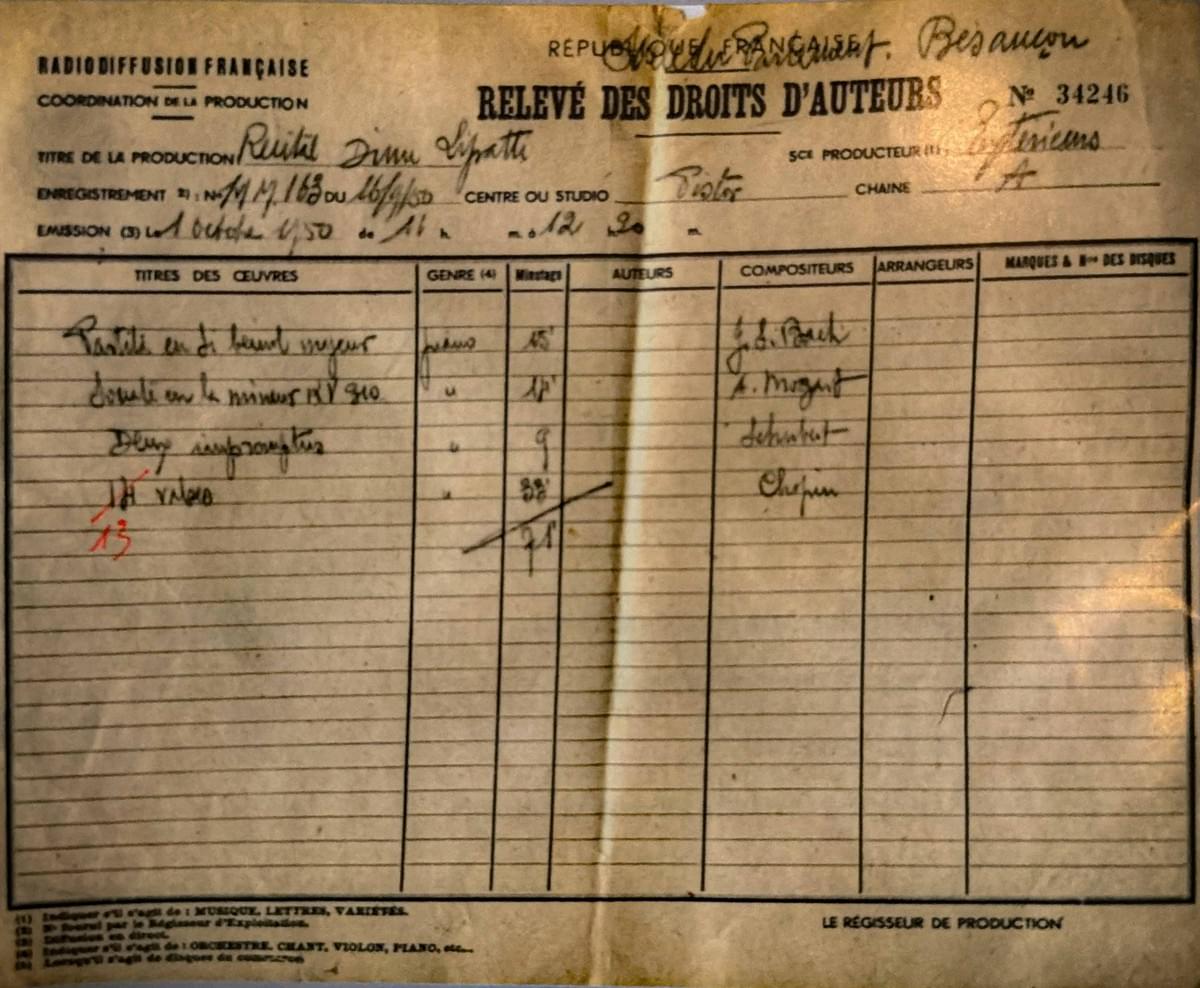
INA 找到的文件裡,有一張法國廣播機構的著作權申報表,編號 34246。表上寫著:節目名稱「迪努・李帕第獨奏會」,播出日期 1950 年 10 月 1 日,上午十一點至十二點二十分。曲目欄逐行列出巴赫、莫札特、舒伯特,最後一行是「蕭邦,十四首圓舞曲」。
那個「14」,被人用紅筆改成了「13」。
節目單上印著「14 首」,唱片上只有 13 首;而在兩者之間,一位不知名的廣播公務員,用一筆紅色的更正,為那首沒有彈完的圓舞曲做了最安靜的記錄。
這份申報表也解決了一個老問題:這場音樂會的首播是哪一天?部分英文資料則寫它一直留在電台檔案裡,直到李帕第死訊公佈才播出。現在可以確定:首播是 1950 年 10 月 1 日星期日上午十一點,在 RTF 國家頻道;12 月 3 日,也就是李帕第去世的翌日,又重播了一次。兩種說法都對。
從檔案卡到唱片
接下來的發展,依時序如下:
- 1955 年: 法國 Columbia 為紀念李帕第逝世五週年,出版五張 LP 的紀念套裝(FCX 491–495),貝桑松的兩首舒伯特即興曲收在其中的 FCX 495。這是這場音樂會第一次以唱片形式問世。
- 同一時期: 在 EMI 法國分公司 Pathé Marconi 工作的賈克・萊瑟(Jacques Leiser),在法國廣播檔案裡尋找可以發行的富特萬格勒(Wilhelm Furtwängler,1886-1954)廣播錄音時,偶然看到了貝桑松獨奏會的檔案卡。他建議出版,被上級拒絕了:曲目都已經有錄音室版,錄音品質也達不到商業標準。
- 1957 年: 在萊瑟的堅持下,法國 Columbia 以豪華盒裝發行全場(FCX 698–699),美國則由 Angel 發行(ANG 35438–39,英國壓片)。美國《Saturday Review》4 月 27 日以李帕第做封面,評論家艾文・柯洛丁(Irving Kolodin,1908-1988)讚不絕口。
- 1958 年: 英國 Columbia 以法國提供的金屬母盤,發行 33CX 1499/1500 兩張單行版。
為什麼是 Angel?安利提供了一個很少人知道的理由:當時美國 Columbia 握有歐洲 Columbia 錄音在美國的發行權,EMI 無法在美國發行李帕第的英國 Columbia 錄音室唱片。但貝桑松不是錄音室錄音,李帕第又與 EMI 簽有合約——於是 EMI 剛在美國成立的 Angel,就此拿到了一份「獨家的李帕第」。
此後,它在全世界發行,成為唱片史上最著名的音樂會錄音之一。
一個錯音,與瑪德蓮的那張唱片
現在可以回到前面那個秘密了。
法國廣播的原始磁帶裡,舒伯特降 G 大調即興曲有一個很突兀的剪接:從第十六小節後半到第二十四小節結束,整整八個半小節不見了。可是自 1957 年以來發行的唱片,這首曲子卻是完整的,一個音都不少。幾十年來,大家的推測是:錄音工程師從樂曲後面重複的樂段取了相同的音樂,把缺口補了起來。
但這個推測有個漏洞:第十七到二十三小節確實跟第六十三到六十九小節相似,可是第十六與第二十四小節並不對應——那麼唱片上對的音符是從哪裡來的?
2015 年的發現
2015 年,答案出現在收藏家維爾納・翁格(Werner Unger)的手上:他擁有一張法國廣播機構製作的舒伯特即興曲原始轉錄唱片。封套上打字寫著「舒伯特:G 大調即興曲,演奏:迪努・李帕第,本唱片由法國廣播機構提供」。這張唱片本來屬於瑪德蓮;經由李帕第的崇拜者、繼承了瑪德蓮部分遺物的 Marc Gertsch,轉到了翁格手中。
安利在場親眼看著它被轉錄。答案就在第二十小節的開頭:李帕第的手指滑了一下,在低音彈出一個錯音。這個位置,正好就在廣播磁帶所刪掉的段落中央。
有人不希望聽眾聽到這個錯音。是鋼琴家自己、他的妻子,還是廣播製作人?沒有人知道。但 1957 年發行唱片時,錄音工程師同時使用了廣播磁帶與瑪德蓮提供的這張轉錄唱片,巧妙地拼出了一個「複合版」:第十七到二十小節取自樂曲後面的第六十三到六十六小節(電腦分析顯示兩者百分之百相同,可以完全同步播放),其餘缺口則由瑪德蓮的唱片補足。錯音消失了,音樂卻完整地留了下來。
「把不好的東西去掉」
安利認為,瑪德蓮這樣做,無疑是想維護丈夫作為完美主義者的聲譽。而李帕第自己也曾在訪談中說過,他喜歡錄音,因為可以「把不好的東西去掉」。從這個角度看,那一刀剪接,也許正是在遵從他的意願。
但安利也寫了另一句話:第二十小節的那個輕微失誤,其實是一個十分感人、極具人性的時刻。它似乎促使鋼琴家在緊接著的幾個小節裡,加入了更多的莊重感,把樂句塑造得更有戲劇性。
這是這場音樂會最複雜的一個問題:我們應該聽到哪一個李帕第?是他自己、他的妻子希望世界記住的那一個,還是 1950 年 9 月 16 日午後真實彈出來的那一個?兩者都是他。前者是他的理想,後者是他為了這個理想所付出的代價。
要聽哪一個版本?
這份錄音七十年來的版本史,其實就是「保留什麼、拿掉什麼」的拉鋸。以下依時序列出主要版本,以及各自留下了什麼:
- 1957 年法國 Columbia 首版(FCX 698–699,豪華盒裝): 保留了巴赫與莫札特之前的上台掌聲與試音琶音;舒伯特與蕭邦之前的琶音雖然錄在磁帶上,却沒有收入,原因不明。舒伯特降 G 大調是剪接後的複合版。古殿 2020 年的歷史轉錄,使用的就是這套法國首版黑膠。
- 1957–1960 年美國 Angel 首版盒裝 ANG 35438–39(英國壓片)與 1958 年英國 Columbia 33CX 1499/1500: 延續法國首版的形制,掌聲與試音仍在。Angel 盒裝附有巴黎 Mercure 出版社設計的解說冊,收入瑪德蓮的回憶、華爾特・李格(Walter Legge,1906-1979)的紀念文、三位老師的題詞、三份報紙剪報與當天的節目單。
- 1970 年代起的美國 Angel 再版(Album 3556 B,美國壓片): 盒子與解說冊製作漸趨粗糙,音質也因再版製作而變差。
- 1982 年起的 EMI CD: 降噪過度,把掌聲與試音琶音全部刪除,連現場的空間感也一併拿掉了。
- 約 2010 年日本 Opus Kura OPK70560 CD: 以美國 Angel LP 轉錄,把掌聲與試音帶回 CD,當時被譽為最佳轉錄,CD出版中第一次出現了原始的掌聲與試音;但這版不僅仍有降噪,還聽得出頻率混音加工的痕跡,已不是唱片原本的聲音。
- 2018 年法國 Solstice SOCD 358 CD: 由 INA 以原始廣播磁帶重新製作母帶,是 1957 年以來第一次回到源頭。每一曲之前的琶音、全部掌聲、尚・托斯卡納的三段播報第一次完整收錄;舒伯特降 G 大調採用瑪德蓮那張轉錄唱片的小節,第一次讓世人聽到李帕第當天實際彈的樣子,包括那個錯音。全長 1 小時 21 分 24 秒。就內容而言,這是至今最完整的版本;但就聲音而言,轉錄出來的聲音仍帶著很重的後世數位設備的感覺。頻率很寬、很乾淨,但對聽過歷史錄音原本聲音密度與質感的耳朵來說,那仍是後來的數位感,而不是 1950 年代的聲音。
這些版本不是一個「越新越好」的序列,而是對同一個下午的不同記憶。Solstice 最完整、最接近事實;1957 年的首版黑膠,則是當年世界各地的聽眾第一次聽到的李帕第——那個經過瑪德蓮輕輕修整過、沒有錯音的李帕第。
「讓它們被寂靜包圍」
回頭看,這場音樂會差一點就什麼也沒有留下。下午三點,醫師已經打電話取消;廣播電台如果堅持直播、不做錄音,今天我們手上就什麼都沒有。它之所以還在,靠的是一連串的人:懇求「哪怕只是三個音」的主辦者;決定只錄不播的廣播人員;用紅筆把 14 改成 13 的公務員;在檔案卡前停下來的萊瑟;把一張廣播唱片保存了一生的瑪德蓮;六十多年後來回通了八十封信的 INA 團隊。
1951 年那場紀念音樂會上,音樂節副主席比多(Bidault) 醫師說,由於李帕第,音樂節那種每到九月才突然出現、中間被長久沉默隔開的「斷裂」將就此終止;第四屆音樂節的第一場音樂會,將「毫無間斷地」承接上一屆的演出。一個人在舞台上倒下的地方,成了下一個人接上去的地方。
李帕第的作曲老師、他自己稱為「精神之母」的娜迪亞・布蘭潔(Nadia Boulanger,1887-1979),曾經這樣勸告樂迷:
「請聽迪努・李帕第的唱片。請反覆聆聽。讓它們被寂靜包圍;沒有寂靜,就不會有真正的專注。如此,您便會理解,它們向我們傳達的是什麼訊息。」
貝桑松這張唱片的最後,是一陣掌聲;接下來是一首只彈了開頭的圓舞曲、一段漫長的等待、三首沒有被錄下的巴赫。唱片停下來的地方,正是布蘭潔所說的那片寂靜。
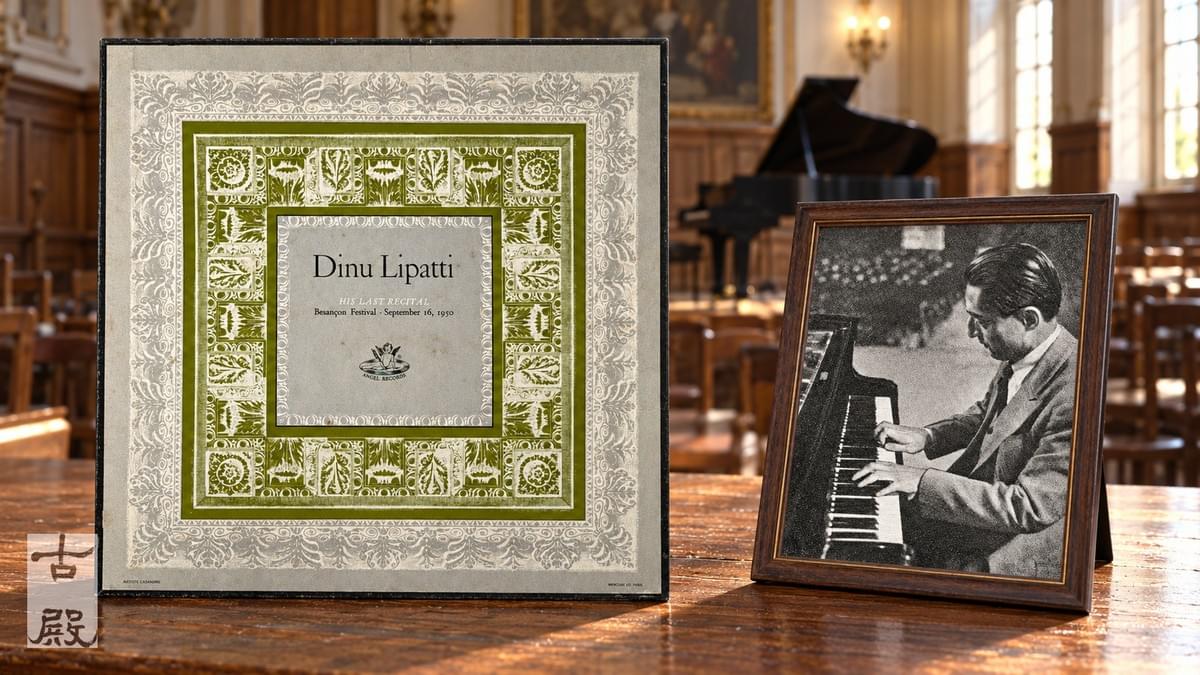
*****
本文主要資料來源:法國 Disques Fy & du Solstice SOCD 358(2018)解說冊,包括 Yvette Carbou 序言、INA 研究員 Brigitte Decroix 的調查報告、Mark Ainley〈李帕第最後的獨奏會〉(2018 年 10 月)及所附文件;美國 Angel Album 3556 B 解說冊(瑪德蓮・李帕第文、《Témoignage chrétien》等剪報複本)與店主歷來收藏過的各式這樣李帕第最後獨奏會出版版本。中文由古殿殿主編譯。
******
【Gudian Music Stories】Dinu Lipatti’s (1917–1950) Final Concert: The Complete Besançon Chronicle of September 16, 1950—Reconstructing the Day Through INA Tapes, a Red Pen, and a Spliced Wrong Note
A "Final Encore" That Never Happened That Day
At 8:45 PM on September 6, 1951, inside the Théâtre Municipal of Besançon in eastern France, the opening concert of the 4th Besançon International Music Festival took the form of an official Hommage à Dinu Lipatti. On stage sat the Orchestre National de la Radiodiffusion Française under the baton of Lipatti’s godfather, George Enescu (1881–1955), joined by Lipatti’s widow, Madeleine Lipatti (1908–1983), and his pupil Béla Siki (1923–2020) as soloists.
Before the first downbeat, the presenter announced that the hall would first hear the "very last notes of the recital of September 16, 1950... the final encore from Lipatti's final concert." Through the theatre loudspeakers drifted J. S. Bach’s chorale Jesu, Joy of Man's Desiring. A murmur of conversation and instrumental warming-up gave way to hush. One year earlier, on that same festival stage, Lipatti had summoned his remaining physical strength to perform his farewell recital; two and a half months later, he was dead at thirty-three. Everyone gathered in the hall believed they were reliving that parting moment.
Nearly seventy years passed before forensic audio analysis unraveled the scene. Spectrographic examination of that 1951 broadcast transcript revealed that what played over the house loudspeakers was Lipatti’s studio master cut in London on September 24, 1947, issued on Columbia LC 30 (78 RPM). The Bach chorale offered on that September afternoon in Besançon was never recorded.
That historical slip illustrates the legend surrounding Lipatti’s final concert: an event so celebrated that memory and myth have become intertwined. This essay reconstructs that day using two primary source collections: the 2018 French Solstice release in collaboration with the Institut National de l’Audiovisuel (INA, catalog number SOCD 358)—featuring INA’s forensic documentation, extensive commentary by Lipatti scholar Mark Ainley, and contemporary administrative records—and the deluxe US Angel boxed set, which preserves Madeleine's memoir, contemporary French press reviews, and the printed program listing "14 Waltzes."
Examining these artifacts together makes it possible to reconstruct the hours of September 16, 1950.
A Program Designed to Preserve Strength
Lipatti was an artist of formidable technical command. During periods of remission, his programs were expansive. At the Salle Pleyel in Paris in 1948, he performed fifty minutes of Bach, two Chopin Études, the Barcarolle, and concluded with Schumann’s Symphonic Études.
Yet from the moment he arrived in Geneva, an insidious illness shadowed his steps: Hodgkin's disease. In early 1949, a ten-day tour of the Netherlands collapsed midway, sidelining him from the platform for ten months. A planned three-month Australian tour was transferred to Witold Małcużyński (1914–1977), while scheduled studio sessions for Bartók’s Piano Concerto No. 3 and the Chopin Waltzes were abandoned.
To conserve his physical reserves and mitigate last-minute cancellations, Lipatti developed an economical program:
- J. S. Bach: Partita No. 1 in B-flat major, BWV 825
- W. A. Mozart: Piano Sonata No. 8 in A minor, K. 310
- Franz Schubert: Two Impromptus (Op. 90 / D. 899, Nos. 3 and 2)
- Frédéric Chopin: The Fourteen Waltzes
He refined this program throughout 1949, unveiling it in Bern that December. A concertgoer noted that as an encore that evening, he added a posthumous Chopin waltz outside the core fourteen.
Upon accepting the invitation to the Besançon Festival, Lipatti corresponded with the organizers, asking them to correct an error on the draft program: he was to perform Mozart’s Sonata in A minor, not the A major sonata with the Rondo alla Turca. The distinction was telling. K. 310 is one of only two minor-key piano sonatas in Mozart’s oeuvre, composed in Paris in the shadow of his mother's death. An artist aware of his own mortality chose this score.
The festival reserved accommodations at the Hôtel des Bains in Besançon for Lipatti, Madeleine, their friend Georges Schwob, and his physician, Dr. Henri Dubois-Ferrière, accompanied by his wife. A touring virtuoso accompanied on the road by his personal doctor.
September 16: "Even Just Three Notes"
The Lipatti party arrived in Besançon on the eve of the recital.
Morning. On the morning of September 16, outside the hotel by the taxi waiting to take them to rehearsal, Dr. Dubois-Ferrière snapped photographs of Lipatti and Madeleine. Lipatti appeared in relatively good spirits. On the same roll of 35mm film are roughly a dozen frames of him rehearsing inside the Salle du Parlement, taken by the doctor and festival director Roger Hauert. The images capture his hand mechanics adapting to each composer. Three of these frames were reproduced in the Angel booklet: one playing Mozart, one playing Chopin, and one playing Bach.
Afternoon. As the day wore on, his condition deteriorated: high fever and severe physical pain set in. By early afternoon, those around him assumed the recital was impossible. At 3:00 PM, Dr. Dubois-Ferrière telephoned festival management to cancel the performance.
The organizers pleaded on the line: could he play anything at all—"even just three notes!"
Word reached Lipatti that the hall was already packed two hours before curtain. He resolved not to turn back. As Témoignage chrétien reported, no one in the city that morning knew whether he would manage to walk onto the stage. The crowd overflowed the auditorium; management opened the doors to the foyer, setting out garden chairs, with listeners seated on the steps around the stage apron and lining the entry hall.
Around 4:00 PM, his fever eased slightly, enough for him to attempt the first half. Supported on either side by Madeleine and Dr. Dubois-Ferrière, he mounted the stairs to the Salle du Parlement. Madeleine later wrote in the Angel booklet that those stairs felt to him like a via dolorosa.
The Armchair Backstage
A primary witness statement in the Solstice documentation comes from French radio producer Noël Boyer, who recalled the day during the 1951 memorial broadcast:
"Half an hour before the public was admitted to the Salle du Parlement, we were informed that Lipatti was still at his hotel, prostrated by an attack... Exactly five minutes before the broadcast announcement was scheduled to begin, we saw Dinu Lipatti arrive, supported by his admirable wife. I say 'supported' deliberately, for he could scarcely walk. Thirty minutes prior, doctors had been at his bedside, administering injection after injection."
The September weather was hot. In the small room serving as both broadcast control booth and artist's green room, staff had arranged an armchair flanked by three electric space heaters and a woolen blanket. Pale, trembling, and sweating, Lipatti rested in the chair. The radio staff hesitated, unsure whether to patch through the audio line and open the broadcast.
"Yet the hour had struck, irreversible. At that exact instant, the musical miracle occurred: Lipatti cast off the blanket, stood up, moved the electric heaters aside, and with a firm, agile, and confident stride, walked toward the piano."
Between sets, he returned to that armchair. Medical staff administered injections and offered cordials before he returned to the stage. Boyer reflected: "At that moment, the music was for Dinu Lipatti an authentic life-giving breath."
Divergent Memories
Comparing the witness accounts reveals minor discrepancies in the timeline:
- Curtain Time: The printed program listed 5:00 PM; Boyer recalled it as around 4:00 PM.
- The Rehearsal: In 1957, Madeleine wrote that upon arriving the previous evening, he attempted to test the piano in the hall and relapsed upon returning to the hotel; Ainley’s analysis of the doctor's negative strips confirms the rehearsal took place on the morning of the concert, when his condition was stable, before the fever spiked that afternoon.
- "I Promised": Madeleine remembered that when his physician urged him to cancel, he repeated: "I promised; I MUST play!"
These variations reflect recollections set down years later. Madeleine wrote six years after the event, conflating aspects of the previous evening with the morning of the recital. The physical film negatives establish the sequence. Every account confirms the central fact: at 3:00 PM, the physician had called to cancel; at 5:00 PM, Lipatti was seated at the keyboard.
Part One: Arpeggios, Continuity, and Three Composers
Lipatti walked to the French Gaveau concert grand piano, a glass of water resting to the left of the music desk. Before sounding Bach, he cast off a few rolling arpeggios.
This was an older performance custom—improvising a preludial flourish to test keybed resistance and acoustic response, common among nineteenth- and early twentieth-century masters like Wilhelm Backhaus (1884–1969), who retained it through his final recital in 1969. For Lipatti, these arpeggios served both to warm his hands and establish harmonic bridges: moving from B-flat major to A minor, transitioning between composers.
Before the Bach partita, his first arpeggio faltered on the fourth note—a fleeting reminder of an artist who had just risen from a sickbed regaining his footing. He then launched into the Partita No. 1, playing with rhythmic poise and balanced voicing.
The Spoken Voice of Jean Toscane
Between works, as Lipatti retreated to the backstage armchair, French radio announcer Jean Toscane filled the broadcast intervals. These spoken announcements remained unissued until their release on Solstice in 2018.
Following the Mozart sonata, Toscane offered listeners an anecdote regarding Schubert’s Impromptus: when Schubert was thirty, publisher Schott in Mainz offered sixty florins for the pieces, before balking on the grounds that French audiences had little taste for such works. Toscane remarked that the French public had proved Schott wrong, noting that Schubert’s Impromptus enjoyed enduring affection in France.
The continuity script made no mention of Lipatti’s illness. Listeners over the airwaves heard what sounded like a standard festival broadcast; only those in the hall were aware of the medical treatment underway backstage between takes.
Schubert: The Sole Acoustic Document
The first half closed with two Impromptus from Schubert's Op. 90: the cantabile in G-flat major, followed by the flowing triplets of the E-flat major. Ainley noted that the forward momentum of the E-flat Impromptu gave no hint of an artist in physical distress.
These two Schubert performances carry singular historical importance: they were the only works on the program not recorded during the Geneva studio sessions two months prior. Without this concert tape, Lipatti's Schubert would be lost to the discographical record. The G-flat Impromptu also concealed a tape edit that remained hidden for over six decades.
Thirteen Waltzes, and the Fourteenth Left Unfinished
Following the intermission, Toscane announced over the airwaves that the recital would conclude with a performance of Chopin’s fourteen waltzes.
Lipatti did not follow the standard opus numbering. He maintained that the waltzes were composed at disparate times and were never conceived as a chronological cycle; arranging them by harmonic and expressive affinity offered greater musical coherence. The sequence at Besançon departed slightly from the studio account cut for Columbia in Geneva two months earlier. Ainley suggests the studio order was planned around the physical limits of four-to-five-minute 78 RPM shellac sides. Besançon, therefore, presents the cyclic architecture Lipatti envisioned when freed from mechanical groove constraints.
Traces of Exhaustion
Through the opening numbers, Lipatti delineated each waltz with nuanced phrasing. As the set progressed, physical fatigue began to leave its mark. Ainley’s notes identify several moments:
- He omitted select repeats, trimming the eighth waltz on the bill (Op. 34, No. 2), as well as the tenth and eleventh (Op. 70, Nos. 2 and 3).
- In the twelfth waltz (A-flat major, Op. 64, No. 3), an audible slip occurs in the closing measures.
- He rallied for the thirteenth selection: the Grande Valse brillante in E-flat major, Op. 18, played with rhythmic drive. As the final chord sounded, the hall erupted in applause.
The recording tape ends on that applause—the final sound preserved on the disc.
The Fourteenth Waltz
Ainley observed that what followed was one of the tragic moments of Lipatti’s life.
He sounded the opening measures of the final piece on the bill—the Waltz in A-flat major, Op. 34, No. 1—before his hands dropped. He was too exhausted to continue. He stood and walked back to the dressing room.
The hall waited in silence.
Madeleine wrote in the Angel booklet that the performance knew only one moment of weakness: when his strength failed before he could finish the fourteenth waltz. She added: "Even Chopin would not have blamed him."
That empty bar was subsequently noted on an administrative broadcast sheet in red ink.
The Final Encores: One, or Three?
After a long silence, Lipatti returned to the stage. He played Bach as a parting prayer: Dame Myra Hess’s (1890–1965) transcription of Jesu, Joy of Man's Desiring.
This chorale was a leitmotif across his career. At his Paris debut in 1935, it was the first piece he played, honoring his recently departed composition teacher, Paul Dukas (1865–1935). Fifteen years later, he chose the same piece to conclude his public life. Madeleine recalled that he was breathless and exhausted, yet found the strength to offer that chorale, which for him was a prayer.
This is the established narrative: one encore, one chorale, a quiet resolution. Yet source materials in the Solstice release complicate the picture.
"One After Another" in the Regional Press
Ainley points out that two local newspapers, La République and Le Comtois, reported that Lipatti played more than one encore. Solstice reprinted the review from La République:
"He yielded to the entreaties of his public, performing encore after encore; among them was a transcription that was the product of his own genius."
Which transcription was his own? Ainley identified two possibilities:
- Bach’s Pastorale in F major, BWV 590: Lipatti had recently completed a piano transcription of this organ work. On November 20 of that year, when he sat at the keyboard for the final time, the last movement he played for Madeleine was the Adagio from this Pastorale.
- Bach-Kempff Siciliano: Another report mentioned a "Sicilienne"; two weeks after the recital, in a radio interview, he played Wilhelm Kempff’s (1895–1991) arrangement of this Bach movement, though that broadcast tape remains unlocated.
If Ainley's reading is correct, Lipatti’s farewell at Besançon encompassed three Bach selections rather than one. That detail remains unconfirmed; what is certain is that none of those encores were captured on tape.
Why Was There No Recording?
Accounts differ as to why the recording machine stopped:
- One broadcast engineer stated that he halted the machine because those moments felt too intimate to document. Solstice’s publisher credits this account: the recording was suspended out of respect for the artist.
- Alternatively, Lipatti remained backstage for an extended period, prompting the crew to power down the equipment, which was left unengaged when he re-emerged.
The INA archives contain no audio trace of those final minutes. That absence explains the 1951 playback mentioned at the start of this essay: the festival public desired to hear that final prayer again, leading organizers to spin a commercial 78 RPM disc from 1947. During that 1951 broadcast, the speaker offered an apology: "Whatever the technical quality of the recording, if mechanical imperfections fail to render the full measure of the pianist's genius, we ask that you attribute this to the limits of technical progress."
The Archival Legacy
The survival of this performance turned on an administrative decision.
French Radio had intended to broadcast the concert live. Given Lipatti’s precarious health, they opted to record the event to disc rather than transmit it live, in case he collapsed mid-recital. In the Angel booklet, the excerpt from Témoignage chrétien underlines this sentence, reminding listeners that the physical recording exists because of that operational change.
Discs First, Tape Second
On-site engineers recorded the concert directly onto lacquer transcription discs, later dubbing the audio to magnetic tape. Vincent Fromont, head of sound restoration at INA, explains the context: in 1950, magnetic tape was a new medium in French broadcasting—it offered superior fidelity, but was scarce; tapes were routinely copied onto transcription discs and then erased for reuse. Discs remained the primary storage medium until French broadcasting transitioned fully to tape around 1958.
The raw broadcast was originally distributed across seven tape reels. Over the decades, those reels yielded copies of varying completeness. INA’s engineering team exchanged more than eighty technical memorandums and spent over sixty hours digitizing and restoring these vintage media to assemble the 2018 edition.
A Stroke of Red Ink
Among the paperwork retrieved by INA was the RTF copyright declaration, Sheet No. 34246. The ledger reads: Programme: Récital Dinu Lipatti, broadcast on October 1, 1950, from 11:00 AM to 12:20 PM. The repertoire rows list Bach, Mozart, Schubert, and a final entry: "Chopin, 14 Valses."
That number "14" was crossed out and amended in red ink to read: 13.
The printed concert bill read "14 Waltzes," the sound recording held 13; between them, an anonymous radio clerk used red ink to record the waltz left unplayed.
This sheet also clarifies the broadcast history. Certain accounts suggested the tape languished in the archives until after Lipatti's death. The paper trail confirms the initial broadcast took place on Sunday, October 1, 1950, at 11:00 AM over the RTF National Network, followed by a rebroadcast on December 3, the day after Lipatti died.
From Archival Card to Vinyl Box
The commercial release unfolded in stages:
- 1955: To mark the fifth anniversary of Lipatti's passing, French Columbia issued a five-LP commemorative set (FCX 491–495), with the two Schubert Impromptus from Besançon included on FCX 495—the public's first encounter with the recital on disc.
- Around the same time: Jacques Leiser, working for EMI’s French affiliate Pathé Marconi, was searching the RTF archives for unreleased Furtwängler broadcasts when he came across the index card for the Besançon recital. His proposal to release the concert was initially rebuffed: studio versions of the repertoire already existed, and the audio was deemed sub-commercial.
- 1957: Following Leiser’s persistence, French Columbia issued the full concert in a deluxe two-LP boxed set (FCX 698–699), while Angel issued it in the United States (ANG 35438–39, pressed in the UK). In the April 27 issue of the Saturday Review, Lipatti was featured on the cover, accompanied by praise from Irving Kolodin (1908–1988).
- 1958: British Columbia issued single LP editions (33CX 1499 and 1500) using metal parts supplied from France.
Why did it appear on Angel? Ainley notes an operational reason: American Columbia held US distribution rights for European Columbia recordings, preventing EMI from issuing Lipatti's UK Columbia studio sides under its own auspices in the States. Because Besançon was a live broadcast recording and Lipatti was an exclusive EMI artist, EMI’s newly formed American label, Angel Records, secured an exclusive release for the US market.
The album became one of the celebrated live concert recordings in the catalog.
A Wrong Note and Madeleine’s Reference Disc
This brings us to the tape edit in the Schubert Impromptu in G-flat major.
On the original broadcast tape, an edit occurs: between the second half of measure 16 and the end of measure 24, eight and a half measures are missing. Yet on commercial records issued since 1957, the piece plays through without a missing bar. For decades, listeners assumed engineers had patched the gap using the parallel recapitulation later in the piece.
That explanation had a structural flaw: measures 17 through 23 resemble measures 63 through 69, but measures 16 and 24 do not correspond. Where did the missing notes come from?
The 2015 Discovery
The answer surfaced in 2015 through collector Werner Unger, who possessed an original transcription disc cut by French Radio. The label was typed: "Schubert: Impromptu en Sol Majeur, par Dinu Lipatti, Disque fourni par la R.D.F." This personal copy had belonged to Madeleine, passing to Unger via Lipatti admirer Marc Gertsch.
Ainley observed the transfer: at measure 20, Lipatti’s left hand slips, striking an errant bass note. That slip sits in the middle of the passage excised from the broadcast tape.
Someone had preferred that listeners not hear that slip. Whether the decision came from the pianist, his wife, or the radio producer remains unrecorded. When preparing the 1957 commercial release, engineers combined the broadcast tape with Madeleine’s reference disc to assemble a composite master: measures 17 through 20 were borrowed from the later recapitulation at measures 63 through 66 (digital analysis confirms the waveforms are identical), while the remaining gaps were restored from Madeleine’s disc. The wrong note was concealed, leaving the musical architecture intact.
"Removing What Was Flawed"
Ainley observed that Madeleine’s intervention was intended to protect her husband's reputation for technical perfection. Lipatti had remarked in interviews that he valued recording because it offered the means to "remove what was flawed." In that respect, the splice honored his aesthetic priorities.
Yet Ainley added a counter-observation: the slip at measure 20 is a moving, human moment. It appears to have prompted the pianist to invest the subsequent bars with greater gravitas, lending the phrase heightened dramatic weight.
This raises an interpretive question: which Lipatti should we hear? The idealized artist his widow wished to preserve, or the human being who performed on the afternoon of September 16, 1950? Both are authentic: the former embodies his artistic aspiration; the latter reveals the physical cost of pursuing it.
Navigating the Editions
The seventy-year history of this recording reflects changing priorities regarding restoration and fidelity:
- 1957 French Columbia Original (FCX 698–699, Deluxe Box): Retains the entrance applause and preludial arpeggios before the Bach and Mozart; the arpeggios preceding the Schubert and Chopin were omitted from the master, for reasons unrecorded. The Schubert G-flat Impromptu appears in its composite form. The Ancient Palace’s 2020 transfer utilized this French first edition.
- 1957–1960 US Angel First Edition Box (ANG 35438–39, UK Pressing) and 1958 UK Columbia (33CX 1499/1500): Follows the French mastering, preserving applause and arpeggios. The Angel box contains the Paris-printed booklet with Madeleine’s reflections, Walter Legge’s tribute, facsimiles of press reviews, and the printed program.
- 1970s US Angel Reissues (Album 3556 B, US Pressing): Packaging and audio fidelity show signs of wear from later stamper generations.
- 1982 onward EMI CDs: Heavy de-noising removed the applause and preludial arpeggios, drying out the natural acoustic decay of the hall.
- ca. 2010 Opus Kura CD (OPK70560, Japan): Transferred from US Angel LPs, restoring the entrance applause and flourishes to digital disc, though retaining EQ adjustments.
- 2018 French Solstice CD (SOCD 358): Remastered by INA directly from the raw broadcast master reels, returning to the source for the first time since 1957. It gathers every preludial flourish, all audience applause, and Jean Toscane’s three spoken continuity scripts; the Schubert G-flat Impromptu uses Madeleine’s reference transcription disc, presenting Lipatti’s performance unedited, complete with the slip at measure 20. Total runtime: 1 hour, 21 minutes, 24 seconds. Textually, it is the most complete edition available. Sonically, the digital mastering reflects contemporary transfer techniques—wide in frequency response and clean, though different in analog weight and density compared to early vinyl cuts.
These releases trace how different eras have remembered that September afternoon. Solstice offers the unvarnished documentary record; the 1957 vinyl preserves the performance as listeners first encountered it—with Madeleine’s edits in place, free of errors.
"Let Them Be Surrounded by Silence"
Looking back, the recital came close to leaving no recorded trace. At 3:00 PM, his physician had called to cancel; had the network stuck to a live broadcast without running transcription lathes, the sound would have vanished into the air. Its preservation was the work of several hands: organizers who pleaded for "even just three notes"; engineers who chose to cut lacquers rather than broadcast live; the clerk who changed "14" to "13" in red ink; Jacques Leiser, who stopped before an index card; Madeleine, who kept a reference disc for a lifetime; and the INA team, who unraveled the reels six decades later.
At the 1951 memorial concert, festival vice-president Dr. Bidault remarked that Lipatti’s presence had bridged the annual silence between festival seasons; the opening concert of the Fourth Festival would continue from the third without interruption. Where one artist fell on the platform, the community stepped forward to carry the thread.
Nadia Boulanger (1887–1979), Lipatti’s composition mentor whom he revered as his spiritual mother, offered this counsel to listeners:
"Listen to Dinu Lipatti’s records. Listen to them repeatedly. Let them be surrounded by silence; for without silence, there can be no true concentration. Only then will you understand the message they convey to us."
The Besançon recording concludes with applause, followed by an unfinished waltz, a long silence, and three unrecorded Bach encores. Where the disc falls silent is where Boulanger’s stillness begins.
Primary Sources:
- Disques Fy & du Solstice SOCD 358 (2018) monograph, including preface by Yvette Carbou, archival research by INA’s Brigitte Decroix, and Mark Ainley’s Lipatti’s Last Recital (October 2018).
- Angel Records Album 3556 B booklet (memoir by Madeleine Lipatti, clippings from Témoignage chrétien, and primary press archives).
- Comparative analysis based on historical vinyl pressings preserved in the Ancient Palace archives.