
【古殿唱片音樂故事】上帝揀選的樂器:一個垂死的鋼琴家,最後的錄音室錄音
古殿殿主
製作人寫到一半,停下來道歉
1951 年 2 月,英國《留聲機》(The Gramophone)雜誌刊出一篇長文。作者是英國 Columbia 的唱片製作人,主角是兩個月前在日內瓦去世、年僅三十三歲的羅馬尼亞鋼琴家。
文章寫到一半,作者忽然停下來,向讀者道歉。
他說,外面流傳一個說法:這位鋼琴家在一天之內,就錄完了蕭邦(Frédéric Chopin,1810-1849)的十四首圓舞曲、巴赫(Johann Sebastian Bach,1685-1750)的組曲和莫札特(Wolfgang Amadeus Mozart,1756-1791)的奏鳴曲。這個誤會,很可能是他自己過去說得含糊不清造成的。真實的情況是:光是那十四首圓舞曲,就錄了大約九天,每天三到七個小時。
一位製作人,在悼念文章裡特地更正一個「聽起來更傳奇」的說法,把它改回比較不傳奇、卻更真實的版本。
這位製作人是華爾特·李格(Walter Legge,1906-1979)。鋼琴家是迪努·李帕第(Dinu Lipatti,1917-1950)。
為什麼李格寧可讓故事少一點傳奇,也要把那九天說清楚?因為對他來說,那九天本身就是重點。那是一個身患絕症的人,在藥效只能撑兩個月的窗口裡,和一群願意為他改變一切的人,一起完成的最後工作。每一個小時,都是從病痛那裡借來的。
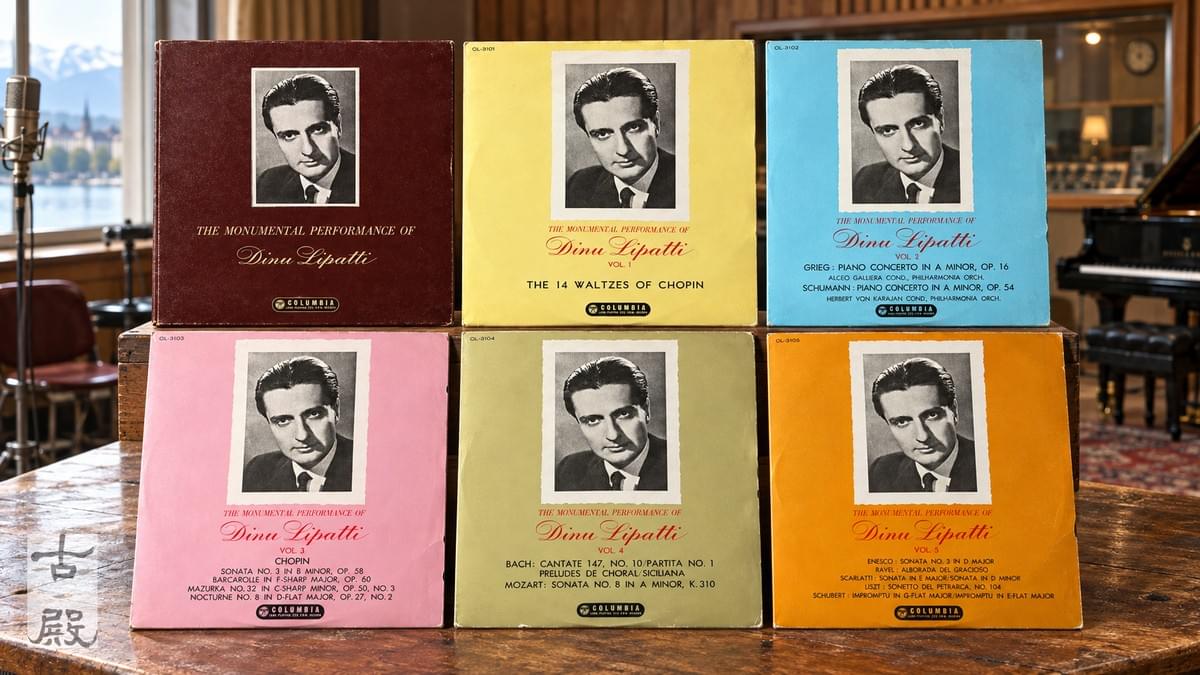
這篇文章的完整日譯,就收在古殿收藏的一套唱片裡。接下來,就跟著李格的筆,回到 1950 年日內瓦的那個夏天。
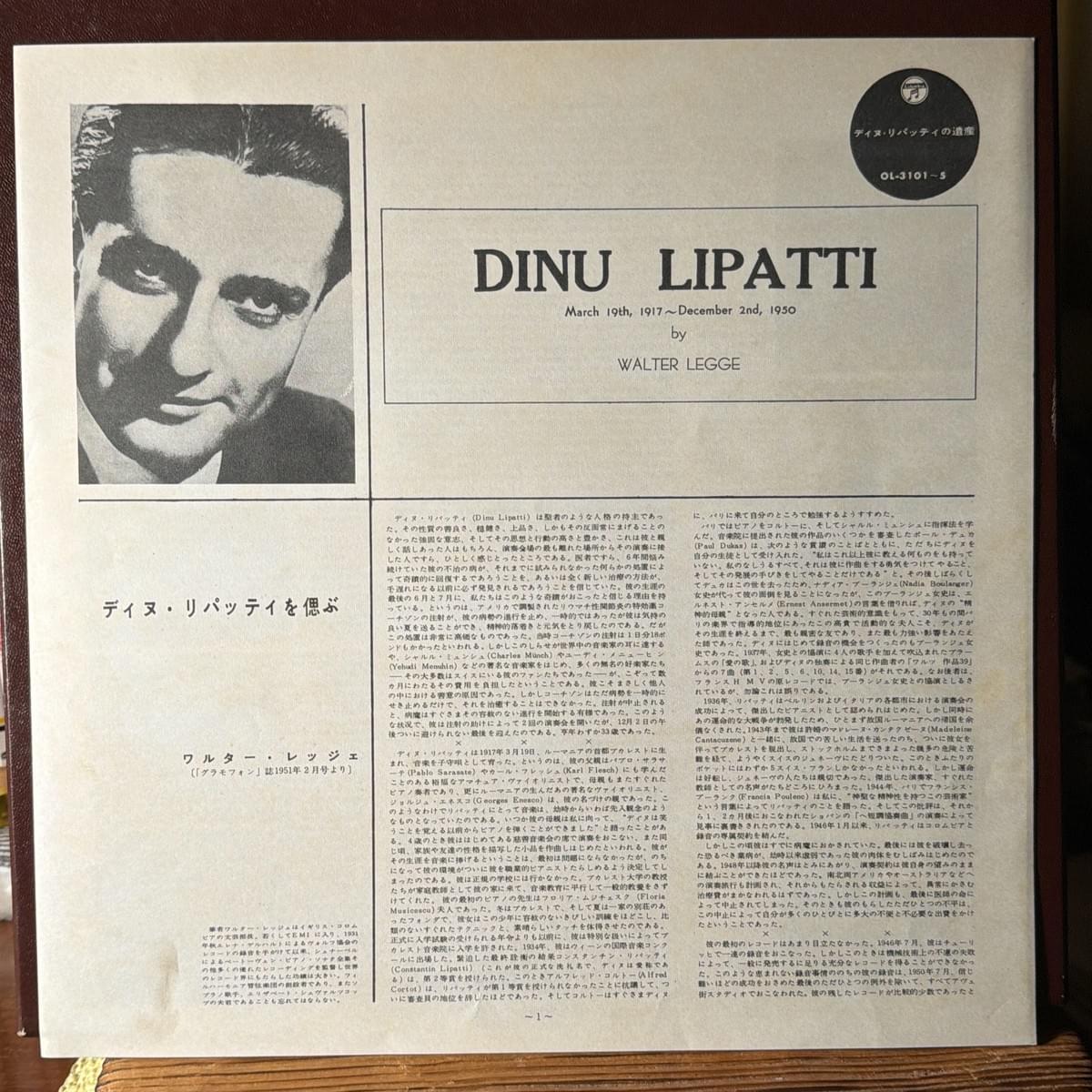
寫下這篇文章的人
李格是英國 Columbia 的文藝部總監。1931 年秋天,他為歌唱家愛蓮娜・格哈特(Elena Gerhardt,1883-1961)錄製「沃爾夫協會」唱片,從此開始了他的製作人生涯;後來又監製了亞圖爾·許納貝爾(Artur Schnabel,1882-1951)的貝多芬鋼琴奏鳴曲全集等無數經典錄音。他創辦了愛樂管弦樂團(Philharmonia Orchestra),妻子是女高音伊莉莎白・舒瓦茲柯芙(Elisabeth Schwarzkopf,1915-2006)。福特萬格勒(Wilhelm Furtwängler,1886-1954)、卡拉揚(Herbert von Karajan,1908-1989)、曼紐因(Yehudi Menuhin,1916-1999)都在他手上錄過唱片。
自 1946 年李帕第與英國 Columbia 簽約起,李帕第為 Columbia 錄下的每一張唱片,都經過李格的手。他後來說李帕第的唱片「產量雖小,卻是最純淨的黃金」。這篇〈緬懷迪努·李帕第〉,就是那個陪他在錄音室裡度過每一個小時的人,在他死後兩個月寫下的第一手記錄。
1957 年貝桑松最後獨奏會的 Angel 首版盒裝,解說書裡曾節錄這篇文章。而 1962 年 9 月,日本 Columbia 發行五枚組《迪努·李帕第全集》(OL-3101~3105)時,在解說冊裡收入了掛下榮一郎的日譯,連同 1952 年日內瓦紀念文集《獻給迪努·李帕第》的節譯、李帕第從四歲到去世的照片。
至於李帕第為十四首圓舞曲重新設計的曲序,我在〈他沒能彈完最後一首圓舞曲〉一文已經詳談,這裡不再重複。這一篇要說的,是那份錄音本身:它是怎麼被做出來的。
錄音為什麼這麼少?
李帕第留給唱片公司的正式錄音,只有三個半小時多一點。李格說,對「錄音太少」的指責,完全應該歸哎於他的病。
開頭就不順。1946 年 7 月,李帕第在蘇黎世錄了一系列母盤,卻因為設備突然故障,沒有一面能拿來發行。此後,除了 1950 年 7 月日內瓦那一次,他所有的錄音都在倫敦 Abbey Road 完成。李格一一列出他的四次英國之行:
- 1946 年 10–11 月: 李斯特(Franz Liszt,1811-1886)《佩脫拉克十四行詩》、《輕盈》、蕭邦圓舞曲;英國首演是與卡爾・蘭克爾(Karl Rankl,1898-1968)指揮的愛樂管弦樂團合作莫札特協奏曲。
- 1947 年 2–3 月: 史卡拉第(Domenico Scarlatti,1685-1757)兩首奏鳴曲、蕭邦夜曲與第三號奏鳴曲;開始漫長地尋找〈耶穌,世人仰望的喜悅〉的理想詮釋。
- 1947 年 9 月: 葛利格(Edvard Grieg,1843-1907)協奏曲(加利耶拉指揮);重錄蕭邦圓舞曲、李斯特與史卡拉第,第二次錄音成為公認的權威版本。
- 1948 年 4 月: 舒曼(Robert Schumann,1810-1856)協奏曲(卡拉揚指揮)、拉威爾(Maurice Ravel,1875-1937)《丑角的晨歌》、蕭邦《船歌》。
這份清單裡藏著李帕第的脾氣。〈耶穌,世人仰望的喜悅〉反覆錄了很多次,他始終不滿意,最後是在瑞士與法國樂迷的恳求下,才勉強同意只在這兩個國家發行最好的一個版本。《船歌》他也始終覺得不夠好。而《丑角的晨歌》裡那些彷彿夢境般湧出的滑奏,李格說,簡直難以相信是人類的雙手彈出來的。
李格還記下了兩張「沒有錄成」的唱片。卡拉揚後來錄的巴爾托克(Béla Bartók,1881-1945)《為弦樂、打擊樂與鐘片琴寫的音樂》,原本的計畫是李帕第的布梭尼(Ferruccio Busoni,1866-1924)《印度幻想曲》與巴爾托克第三號鋼琴協奏曲,由印度邁索爾土邦大公的音樂基金贊助。指揮家阿爾切奧·加利耶拉(Alceo Galliera,1910-1996)提早整整一年錄了雷史畢基(Ottorino Respighi,1879-1936)的《巴西印象》,也是因為李帕第預定的蕭邦 F 小調第二號協奏曲因病告吹。
從這個角度看,卡拉揚的巴爾托克、加利耶拉的雷史畢基,都是李帕第的「空位」——每一張沒有錄成的唱片,都留下了一張別人的唱片作為它的形狀。
1948 年以後,他的名聲如日中天,經紀公司已經排好北美、南美與澳洲的巡演,收入本可以負擔他驚人的醫療費。醫師下了禁令,計畫全部取消。李格說,李帕第對此唯一的抱怨,是自責給主辦單位和樂迷帶來了麻煩。
看起來,不會再有下一次錄音了。
一封醫師的信
1950 年復活節,李格到日內瓦探望李帕第,給了他一個承諾:只要身體好轉,就在他喜歡的地點、他覺得舒服的任何時間,安排錄音。
轉機來自美國。一種剛研發出來、原本用來治療類風濕性關節炎的藥物——可的松(Cortisone)——暫時止住了李帕第的病情。這種針劑極其昂貴,據說一天就要十八英鎊。消息傳開之後,指揮家查爾斯·孟許(Charles Munch,1891-1968)、曼紐因,以及許多不留名的樂迷——大多是李帕第在瑞士的聽眾——主動出錢,負擔了他好幾個月的藥費。李格寫道:「他本身就是激發他人內心良善的源泉。」
5 月底,李格收到一封私信。寫信的人是李帕第的主治醫師之一、也是他的摘友——亨利·杜布瓦-費里耶(Henri Dubois-Ferrière)醫師。信裡只有一個要求:請你立刻趕來日內瓦錄音。
醫師把話說得很明白。可的松的療效不可思議,但這種療法決不可能持續超過兩個月;這是第一次對李帕第的病嘗試這種藥,沒有人能保證狀態會維持多久。所以他以朋友的身分懇求李格:一旦藥效結束,必須立刻停止所有錄音。
李格用了一個比喻:可的松只是一道暫時擋住洪水的堤防,不是解藥。一旦停止注射,病魔就會立刻回來。
這就是那個夏天的前提。所有人都知道時間有限,只是沒有人知道還剩多少。
一群人為一個病人改了行程
李帕第的身體去不了倫敦。那就把錄音室搬到日內瓦。李格在文章裡寫:為了促成這場最後錄音而傾力相助的人,在未來數十年、甚至數個世代裡,都應該得到全世界愛樂者的感謝。然後他一個一個點名:
- EMI 錄音室總監 W. S. 巴瑞爾(W. S. Barrell),犧牲自己的假期,在日內瓦四處尋找合適的錄音場地。
- 日內瓦電台,重新調整台內的節目播出表,讓選定的錄音室日夜都能使用。
- 瑞士 Columbia 總代理保羅・傑克林(Paul Jecklin),從漢堡史坦威工廠買來一台戰後製造最精良的演奏平台鋼琴,那是引進瑞士的第一台。
- 法國 Columbia,把原本在普拉德(Prades)卡薩爾斯(Pablo Casals,1876-1973)音樂節使用、裝滿最先進錄音設備的錄音工程車,整輛開到日內瓦。
這裡面還有一個小插曲。杜布瓦-費里耶醫師早就替多年渴望一台好琴的李帕第募了款,從漢堡訂來一台全新的史坦威。可惜那不是全尺寸的演奏平台鋼琴,李格對小型鋼琴錄音時低音單薄的問題一直很不滿意。於是錄音室裡最後擺了兩台史坦威:傑克林訂的大演奏琴,和朋友們集資買的、「純潔如處子般尚未有人碰觸過」的小史坦威。
第一天完全沒有錄音。他們從早到晚做聲學測試:用哪一台琴、琴擺在哪個位置殘響最好、麥克風用哪幾支、架在哪裡。錄音車停在電台錄音室旁,周圍是草坪和細心照料的玫瑰花圃。
李帕第夫婦住在日內瓦郊外,離法國邊界只有幾分鐘路程的一個小公園裡,是朋友們為他安排的一棟小屋。李格們戲稱它「小特里布申之家」(Haus Triebschenli),因為它看起來就像華格納(Richard Wagner,1813-1883)在琉森湖畔特里布申別墅的縮小模型。李帕第很喜歡那裡的陽光和樹木。兩個星期裡天天晴空萬里,溫度計停在華氏 90 度上下(約攝氏 32 度),「連天氣都對我們笑」。
李格說,這時的李帕第,無論精神或身體,都是他見過狀態最好的時候。可的松給了他好胃口,也喚醒了他天性裡的爽朗。他常常開懷大笑。
九天:錄音室裡的作息與規則
錄音的作息極其規律:早上九點錄到午餐,傍晚六點半或七點再開始,一直到晚上十點,有時更晚。
最初的七個錄音時段,全部只錄蕭邦的圓舞曲。李格記下了李帕第對這套曲子的想法:圓舞曲不像《練習曲》或二十四首《前奏曲》那樣是成套寫成的作品,它們彼此之間唯一的實質連結,只有「圓舞曲」這個標題與三拍子。所以他始終堅持兩件事:不對所有圓舞曲套用同一種音色,也不讓彈性速度變成千篇一律的套路。每一首,都要找到它自己那個時期的樣子。
也就是在這些日子裡,錄音室裡多了一句口頭禪。李帕第剛聽到一則軼事:一位以起拍手勢神經質、看似猶豫不決而聞名的大指揮家,在義大利某大樂團第一次排練剛開始時,低音提琴首席大聲喚他:「Coraggio! Maestro, coraggio!」(振作點!大師!)
於是每當圓舞曲的琶音達不到他要的澄澈、精準與優雅,李帕第就立刻停下來,帶著歉意又近乎自嘲地大喊:「Arpeggio! Maestro! Arpeggio!」(琶音!大師!琶音!)李格說,這句話一直到臨終前,都是他最喜愛的口頭禪。如果圓滑奏不夠光滑、和弦不夠光彩,他就笑罵:「這副通心粉般軟趴趴的手指頭!」這是他罵自己、也罵學生的話。
錄了七個時段的圓舞曲之後,為了換一換心境,他們轉向巴赫。當晚李帕第錄了威廉・肯普夫(Wilhelm Kempff,1895-1991)改編的《西西里舞曲》,接著又繼續他多年來的課題——〈耶穌,世人仰望的喜悅〉。那一次也還不是定稿。
錄音開始後的第六天,十四首圓舞曲裡終於有六首,得到了「始終坐在評審席上的三位最嚴厉的批評者」一致點頭:李帕第自己、他的妻子瑪德蓮(Madeleine Lipatti),和李格。六天,六首。
當晚宵夜的桌上,他們決定:明天是星期天,把一整天獻給巴赫。
7 月 9 日,最長的一天
李格說,在整個充滿難以置信的幸福感的錄音過程裡,1950 年 7 月 9 日星期天,是最炎熱、也最值得永遠記住的一天。
上午九點,巴赫。 他們從降 B 大調第一號帕蒂塔開始,午餐前錄完。六個樂章裡,幾乎每一個都錄了四、五次。李格看他在這份錄音裡傾注的精神實在太多,強烈勸他取消當天傍晚的工作。
李帕第根本不聽。李格寫道:「他心中的太陽正耀眼普照,靈魂正昂首邁向偉大的精神圓滿。」
晚上七點,莫札特。 A 小調鋼琴奏鳴曲 K. 310 開錄。這是李帕第生平第一次為莫札特錄唱片。莫札特和巴赫,是與他心靈最貼近的兩位作曲家。李帕第相信,即使是器樂作品,莫札特在本質上仍是一位歌劇作曲家;在他手下,這首奏鳴曲就像一齣沒有寫下唱詞的歌劇,穿上了人的形體與性格。李格的評語只有一句:「如果世間真有被超自然力量附身的演奏家,當晚的李帕第無疑正是其化身。」
晚上十點,圓舞曲。 莫札特錄完了。李格說,這時已經沒有任何力量能夠攔住他。他一鼓作氣又錄了五首圓舞曲。午夜前夕,精疲力竭的錄音師拖著沉重的雙腳出去覓食時,李帕第是所有人裡精力最充沛的一個,整個人沉醉在李格所說的「暴風雨般的極樂」之中。
一個病人,從早上九點彈到午夜。而那天早上錄的帕蒂塔,要到他去世那天早上,才剛剛壓製出爐、送到他手上——這是後話。
接下來三天,他反覆補錄圓舞曲尚未完美的地方,另外錄了幾首布梭尼改編的巴赫聖詩前奏曲、〈耶穌,世人仰望的喜悅〉的最後定稿,還有一首升 C 小調馬祖卡。錄完馬祖卡,他對李格說:
明年就由您來向我提出錄製全套《馬祖卡》的邀約吧,我們就這麼約定了。我想試試看,能不能勾起一般樂迷對這套曲目的渴望。
7 月 11 日,圓舞曲的定盤得到全體同意。7 月 12 日,他錄下僅剩的一首——第 14 號圓舞曲。李格稱這套圓舞曲是李帕第留給世人的「藝術聖經」:就篇幅而言或許小巧,在精神本質上卻是「至高至純的純金」。
那個「明年」並沒有來。
「我已經不想再開音樂會了」
李格說,李帕第熱愛錄音。在反覆試錄的過程裡,他曾對李格說:
我已經不想再舉辦公開演奏會了。當然,為了錄音而舉行的排練性質演奏另當別論;今後為了攜手錄製唱片,讓我們把生命奉獻給它吧。
這句話聽起來像是在迴避舞台,其實不是。對一個完美主義者來說,錄音室是唯一可以把每一個瑕疵都洗乾淨的地方。李格寫道,李帕第在確認一次演奏已臻極境、所有被他稱作「蠢事」(bêtises)和「齷齪瑕疵」(cochonneries)的小毛病全都洗淨之前,甚至對無止境地反覆試錄樂在其中。而實際上,這類瑕疵在他身上極為罕見。李格的評價很直接:在他共事過的所有鋼琴家裡,李帕第擁有最純粹、最透徹的技術。
兩個月後的 9 月 16 日,他還是從病床上起來,走上了貝桑松的舞台。一個說自己不想再開音樂會的人,最後用一場音樂會作結。不是因為他改變了想法,而是因為他答應過人家。
另一位評審
在這些無數次的試錄裡,李格特別提到一個人:李帕第的妻子瑪德蓮。
1943 年,李帕第和當時還是未婚妻的她,在羅馬尼亞熬過一段艱苦的時日,冒著危險逃離布加勒斯特,轉道斯德哥爾摩,到達日內瓦時,兩人身上合計只剩五瑞士法郎。
李格說,瑪德蓮和李帕第師出同門,本身就是一位卓越的鋼琴家與教育家——尤其作為教師,他「甚至懷疑世上是否有人能出其右」。她有一雙和丈夫一樣敏銳的耳朵,聽得出泛音結構與音色最細微的層次。李格寫道:除了她的深情與無私,她的藝術智慧也同樣銘刻在李帕第的唱片裡。
我們聽到的那十四首圓舞曲,是三個人一起點頭的結果。
李格眼中的李帕第
文章的後半,李格不再講錄音日程,而是試著描述「李帕第是什麼樣的人」。這是全文最珍貴的部分,因為這些細節,只有天天坐在錄音室裡的人才看得到。
他不是「炫技名家」。 李格說,從觸鍵、響音到踏板,李帕第都不是今天帶著貶義的那種 virtuoso。如果借用十七世紀的詞彙,他是一位「鑑賞行家」(connoisseur)。他從不吝於讚美有超凡技巧的同行,自己卻絕不把炫技當作目的。他是把鋼琴當作心靈交流與情感表達之途徑的音樂家。
他連故意彈得俗氣都做不到。 李格說,李帕第從本性上就拒絕一切庸俗。他向學生示範「絕對不應該這樣彈」時,甚至連模仿那種拙劣的彈法都做不到。為了讓朋友開心、或打破客人的拘謹,他有時會彈爵士樂,但就算是微不足道的小曲,他也會用自己的音色賦予它光彩。
他對作品懷著敬畏。 李格說,他初識李帕第時,李帕第從未在公開場合彈過貝多芬(Ludwig van Beethoven,1770-1827),因為他自認還沒有資格;是在許納貝爾的鼓勵下,他才在去世前兩年公開彈了《華德斯坦》。李格還說,李帕第準備《皇帝》協奏曲需要四年、柴可夫斯基(Pyotr Ilyich Tchaikovsky,1840-1893)的協奏曲也要三年,曲目計畫排到五年之後。
這裡要說一句公道話:後來的李帕第研究者根據 EMI 檔案與音樂會節目單指出,李帕第其實一生都在彈《華德斯坦》,「準備四年」的數字也未必屬實。但李格寫的不是年表,是他親眼看到的態度:「在他的演奏中,絕不存在任何未經縝密準備、或委諸於當下傶倖的成分。」數字可以被修正,這份態度卻有太多人可以作證。
十條象鼻。 李格對李帕第雙手的描寫,是全文最生動的一段。跟他瘦弱的身材極不相稱,李帕第有一雙巨大而有力的手——小指和無名指一樣長——肩膀寬得像摔角選手。他彈琴時,每一根手指都獨立於其他手指、手腕與手臂,各有自己的生命。彈複調音樂時,十根手指就像十位馴象師手中的十條象鼻,交織成一場奇幻的芭蕾。「他那溫潤柔和的音色,始終由雄渾強韌的力量所支撐。」他對學生、也對自己說:每一個樂句、樂句裡的每一個音,都必須有鮮明的「個性」。
如果巴赫有一台現代鋼琴。 李帕第彈不同時代的作品,心願是把作曲家與他同時代人眼中的作品生命,鮮活地呈獻給今天的我們。彈巴赫時,他不去模仿大鍵琴,而是設想「如果巴赫有一台今天的演奏平台鋼琴,他會怎麼彈」,所以會在深思熟慮後,謹慎地加上八度,或把低音移低一個八度;彈李斯特時,則用李斯特時代樂器做不到、卻合乎樂曲性格的現代踏板。李格說,這是李帕第唯一允許自己、也允許學生享有的藝術自由。
一位未完成的作曲家。 李格坦承自己沒有深入研究過李帕第的作品,但他記下了幾件事。李帕第留下了親自演奏的自作《古典風格小協奏曲》錄音,由漢斯・馮・本達(Hans von Benda,1888-1972)指揮,李格覺得它令人聯想起普羅高菲夫(Sergei Prokofiev,1891-1953)的《古典交響曲》。生命最後的幾個月,李帕第還在改編巴赫:四樂章的《田園曲》已經完稿;清唱劇詠嘆調《羊群安然吃草》和《我滿懷信心的心靈》的改編,李格不確定是否寫成了樂譜,但李帕第親自彈給他聽過。至於《羅馬尼亞舞曲》,李格說聽起來簡直像是巴爾托克親手寫的——那是李帕第彈西歐古典音樂時很少露出、卻時而主宰著他的巴爾幹血統。
最後半小時
李格把文章的最後一段,留給了李帕第生命的最後半小時。
據他記述,那天李帕第請人放了一張唱片:施奈德漢四重奏(Schneiderhan Quartet)演奏的貝多芬弦樂四重奏作品95。聽完之後,他轉過頭對身邊的妻子瑪德蓮說:
「妳明白嗎?單單成為一位偉大的作曲家是不夠的。要寫出這樣的音樂,你必須被神揀選為器皿才行。」
李格接著寫道,這句話換成鋼琴家,也一樣成立。單單成為一位偉大的鋼琴家是不夠的;要彈出李帕第那樣的音樂,你也必須是被揀選的器皿。然後是全文的最後一句:
「神將祂所揀選的器皿借給了這個世界……那段借給我們的歲月,終究是太過短暫了。」
瑪德蓮記得的那幾天
日本 Columbia 的解說冊裡,緊接在李格之後的,是瑪德蓮自己的回憶。她記下的,是一個比較長、也比較安靜的結尾。
11 月 20 日,李帕第還坐到鋼琴前,彈了蕭邦的第一號前奏曲,以及他自己改編的巴赫《田園曲》慢板樂章——那是他最後一次碰鋼琴。12 月 2 日,他接受輸血;這一天,好友杜布瓦-費里耶爾(Dubois-Ferrière)帶來了剛壓好的唱片:巴赫第一號組曲(Partita BWV 825)。李帕第終於親手拿到了自己的唱片。
最後那天,收音機裡播著一首貝多芬的四重奏。他最後留下的話,是關於痛苦:痛苦是為了準備一個更好的生命。
一個小小的出入
兩份記述放在一起看,有一處不一樣:李格說那首貝多芬是一張「唱片」,瑪德蓮說是「收音機」。瑪德蓮從頭到尾守在床邊,李格的記述則很可能是轉轉聽來的。若要論事實層次,瑪德蓮的版本應該更可靠。
但這正好是前面說過的那兩個層次。李格也許記錯了媒介,卻沒有記錯那句話——那句關於「器皿」的話,後來在中文世界被轉述成「上帝派遣到人間的樂器」,古殿過去的文章也這樣引用過。它的源頭,就在這裡:一位垂死的鋼琴家,在聽貝多芬的時候,說的其實不是他自己,而是貝多芬。只是聽到這句話的人,都不約而同地把它還給了他。
為一個病人停下來的世界
回頭看 1950 年的這個夏天,最令人動容的其實不只是李帕第本人,而是圍繞在他身邊的那一群人。一家唱片公司把整套錄音器材運到日內瓦;一位醫師寫信說明患者的狀況;一位製作人為了配合病人一天只能工作幾個小時,把自己的行程整個打亂。沒有人問這樣做划不划算,也沒有人問這些錄音能賣多少?他們只知道,這個人時間不多了,而他手上的東西不能就這樣消失。
十二年後,在地球的另一頭,又有一群人做了類似的事。1962 年日本 Columbia 發行《迪努・李帕第全集》五枚組時,不只是把唱片裝進盒子,而是請掛下榮一郎把李格這篇長文完整譯出,再由西條卓夫、石川登志夫從紀念文集《Hommage à Dinu Lipatti》中挑出安奈斯可、布蘭潔、柯爾托、卡拉揚、馬可維奇與瑪德蓮的文字,編成一本厚厚的解說冊。他們相信,聽李帕第之前,讀者應該先知道這些錄音是怎麼來的。
這件事放在當時的發行史裡看,更顯得特別。李帕第的母國唱片市場——法國版的五枚組,以及英國版的五枚單行版——都沒有完整收入這些文章與資料。反而是遠在東京的日本 Columbia,把它們一篇一篇譯出、編在一起。就解說書與文獻資料而言,這套紀念專輯是當時世界上最完整的李帕第全集。
再過五十五年,2017 年李帕第百歲誕辰,華納古典(Warner Classics)《永遠的李帕第:逝世百周年紀念》(Immortal Dinu Lipatti)3CD。德國 Profil Edition Günter Hänssler 《李帕第:百年誕辰紀念版》(Dinu Lipatti – 100th Anniversary Edition)12CD。但這兩套的解說冊裡卻幾乎沒有關於上述的這些資料。而在串流平台上,這些錄音更只是一排曲目——沒有醫師的信,沒有九天的作息表,沒有李格寫到一半停下來的那句道歉。
*******
【Gudian Music Stories】An Instrument Chosen by God: The Final Studio Sessions of a Dying Pianist
A Producer Halts Mid-Sentence to Apologize
In February 1951, The Gramophone published an extensive tribute. The author was a senior producer at British Columbia; the subject was a Romanian pianist who had died in Geneva two months prior, just thirty-three years old.
Midway through the essay, the author suddenly stopped to address his readers with an apology.
A persistent rumor was circulating, he noted: that this pianist had dashed off all fourteen Chopin waltzes, a Bach partita, and a Mozart sonata in a single heroic day. That misunderstanding, he conceded, had likely been spawned by his own ambiguous phrasing in earlier conversations. The unvarnished truth was far different: recording those fourteen waltzes alone required roughly nine days, in gruelling sessions lasting between three and seven hours each day.
Here was a veteran impresario pausing inside an elegy to debunk a romantic myth—revising a tale of effortless genius back into a version that sounded less glamorous, yet was infinitely truer.
The producer was Walter Legge (1906–1979). The pianist was Dinu Lipatti (1917–1950).
Why did Legge strip away the mythology to document those nine days with forensic precision? Because to him, those nine days were the heart of the matter. They chronicled a terminally ill artist operating inside a narrow two-month therapeutic window, supported by an ensemble of colleagues willing to upend their entire workflow on his behalf. Every hour captured on tape had been borrowed from physical suffering.
A complete Japanese translation of Legge’s text is preserved within a boxed set in the Ancient Palace archives. Guided by his recollections, we return to Geneva in the summer of 1950.
The Author of the Chronicle
Walter Legge served as head of Artists and Repertoire for British Columbia. In the autumn of 1931, his recording of Hugo Wolf lieder with soprano Elena Gerhardt (1883–1961) launched his producing career; he went on to oversee historic benchmarks, including Artur Schnabel’s (1882–1951) complete Beethoven piano sonatas. He founded the Philharmonia Orchestra and was married to soprano Elisabeth Schwarzkopf (1915–2006). Wilhelm Furtwängler (1886–1954), Herbert von Karajan (1908–1989), and Yehudi Menuhin (1916–1999) all made landmark recordings under his guidance.
From the moment Lipatti signed with British Columbia in 1946, every side he cut passed through Legge’s hands. Legge later characterized Lipatti’s discography as "small in output, but the purest gold." His memoir, In Memory of Dinu Lipatti, was penned just two months after the pianist’s passing by the man who had shared every hour inside those control rooms.
Excerpts from the text appeared in the booklet for the 1957 American Angel release of Lipatti’s farewell recital at Besançon. When Nippon Columbia issued its five-LP anthology The Art of Dinu Lipatti (OL-3101–3105) in September 1962, the companion book included a complete Japanese translation by Eiichirō Kakeshita, paired with excerpts from the 1952 memorial volume Hommage à Dinu Lipatti and photographs spanning Lipatti's childhood to his final days.
Having explored Lipatti’s cyclic sequence for the fourteen waltzes in The Final Waltz Left Unfinished, this essay focuses on the physical reality of the recordings themselves: how they were brought into being.
Why So Few Recordings?
Lipatti left barely three and a half hours of commercial studio recordings. Legge insisted that any grievance over this small output must be laid entirely at the door of his illness.
The venture faced obstacles from the outset. In July 1946, Lipatti cut a sequence of test lacquers in Zurich, but technical equipment failures ruined every side, rendering them unpublishable. Aside from the July 1950 Geneva sessions, his commercial output was captured at EMI's Abbey Road studios in London across four working visits:
- October–November 1946: Liszt’s Petrarch Sonnet No. 104 and La Leggierezza; Chopin’s Waltz in A-flat major, Op. 34, No. 1; and a London concert debut in Mozart’s Piano Concerto No. 21, K. 467, with the Philharmonia Orchestra under Karl Rankl (1898–1968).
- February–March 1947: Two Scarlatti sonatas; Chopin’s Nocturne in D-flat major and the Sonata No. 3 in B minor; and the start of an exhaustive search for a satisfactory account of Bach’s Jesu, Joy of Man’s Desiring.
- September 1947: Grieg’s Piano Concerto with Alceo Galliera (1910–1996); remakes of the Chopin waltz, Liszt, and Scarlatti, yielding what became the definitive published takes.
- April 1948: Schumann’s Piano Concerto under Herbert von Karajan; Ravel’s Alborada del gracioso; and Chopin’s Barcarolle, Op. 60.
This ledger illustrates Lipatti’s exacting standards. He recorded Jesu, Joy of Man’s Desiring repeatedly without finding satisfaction; only after appeals from Swiss and French admirers did he permit the finest take to be issued, restricted exclusively to those two territories. He remained dissatisfied with his reading of the Barcarolle. As for the glissandos in Alborada del gracioso, Legge wondered whether human hands could execute them with such clarity.
Legge also documented the albums that were never made. Karajan’s recording of Bartók’s Music for Strings, Percussion and Celesta was originally scheduled as Lipatti performing Busoni’s Indian Fantasy and Bartók’s Piano Concerto No. 3, underwritten by the Maharajah of Mysore’s Musical Foundation. Conductor Alceo Galliera recorded Respighi’s Brazilian Impressions a year ahead of schedule because Lipatti’s planned sessions for Chopin’s Piano Concerto No. 2 fell through due to sudden illness.
Karajan’s Bartók and Galliera’s Respighi stand as the silhouettes of Lipatti’s cancellations—unmade albums traced out by the recordings made in their place.
By 1948, his international reputation was surging. Concert agencies organized major tours across North America, South America, and Australia, projecting fees that could have absorbed his mounting medical expenses. His physicians intervened with an absolute travel ban. Legge recalled that Lipatti’s sole complaint was self-reproach for inconveniencing his presenters and public.
It appeared there would be no further studio recordings.
A Physician's Letter
At Easter in 1950, Legge visited Lipatti in Geneva, offering an open pledge: whenever his health allowed, Columbia would record him at any venue he selected, on whatever schedule he found comfortable.
An unexpected reprieve arrived from the United States. An experimental compound introduced for rheumatoid arthritis—cortisone—arrested the progress of his Hodgkin's disease. The injections were costly, running roughly eighteen pounds sterling per day. Word circulated, and conductor Charles Munch, Yehudi Menuhin, and anonymous music lovers—primarily Swiss concertgoers—covered months of treatments. Legge wrote: "He was himself a fountainhead that drew out goodness in others."
In late May, Legge received an urgent letter from Dr. Henri Dubois-Ferrière, Lipatti’s physician and close friend. The request was direct: Come to Geneva to record at once.
The physician laid out the clinical realities. The therapeutic response to cortisone was striking, but the regimen could not be maintained safely for more than two months; this was an early application for this pathology, and no one could forecast how long the remission would hold. As a friend, Dubois-Ferrière asked Legge to call an immediate halt to the sessions the moment the drug's efficacy waned.
Legge used a telling analogy: cortisone was an earthen levee holding back floodwaters, not a cure. The moment the injections ceased, the illness would return.
That was the context of that summer: everyone recognized that time was running out, though no one could say how much remained.
A Circle Upends Its Plans for One Man
Lipatti could not travel to London, so the studio had to come to Geneva. Legge noted that those who mobilized to make these sessions possible deserved the gratitude of music lovers for generations to come:
- W. S. Barrell, Director of EMI Studios, gave up his summer holiday to scout acoustic venues across Geneva.
- Radio Genève rearranged its broadcast schedules, freeing Studio 2 for day and night use.
- Paul Jecklin, general agent for Columbia in Switzerland, purchased a concert grand from the Steinway factory in Hamburg—the finest instrument produced there since the war, and the first imported into Switzerland.
- French Columbia dispatched its mobile recording van—outfitted with state-of-the-art lacquer cutting equipment, then deployed at Pablo Casals’s Prades Festival—driving it directly to Geneva.
The arrangements hit an unexpected complication. Dr. Dubois-Ferrière had previously raised funds to purchase a brand-new Hamburg Steinway for Lipatti, who had long wished for an instrument of his own. It was a parlor grand rather than a full concert model, and Legge remained concerned by the lighter bass resonance of smaller instruments. As a result, two Steinways were wheeled into the studio: Jecklin’s full concert grand, and the parlor instrument purchased by friends—"untouched and pristine as a maiden."
The first day passed without recording a single bar. The team conducted acoustic evaluations from dawn to dusk: comparing the two instruments, testing piano placement for natural reverberation, and adjusting microphone selections and arrays. The recording truck parked alongside the studio, bordered by lawns and tended rose gardens.
Lipatti and his wife stayed in a cottage secured by friends inside a park outside Geneva, minutes from the French border. Legge and his colleagues dubbed it Haus Triebschenli ("Little Triebschen"), noting its resemblance to Wagner’s villa on Lake Lucerne. Lipatti found peace among the trees and sunlight. Cloudless skies held for a fortnight, with temperatures hovering near 90 degrees Fahrenheit (roughly 32 degrees Celsius)—"even the weather smiled upon us."
Legge recalled that Lipatti appeared in the finest spirits and physical condition he had ever witnessed. Cortisone revived his appetite and brought back his good humor, punctuated by frequent laughter.
Nine Days: Discipline and Daily Life in the Studio
The sessions followed an unyielding timetable: from 9:00 AM until lunch, resuming at 6:30 or 7:00 PM, and running until 10:00 PM or later.
The first seven sessions were devoted exclusively to the Chopin waltzes. Legge noted Lipatti’s conception of the cycle: unlike the Études or the twenty-four Preludes, the waltzes were not composed as an integrated set; their only common thread was the title "Waltz" and triple meter. He held fast to two principles: avoiding a single uniform timbre across the collection, and refusing to let rubato degenerate into predictable mannerisms. Each dance had to inhabit its own expressive world.
During those sessions, a running studio joke was born. Lipatti had recently heard an anecdote concerning a celebrated maestro known for nervous, hesitant downbeats; during a first reading with an Italian orchestra, the principal double bass shouted from the back desk: "Coraggio! Maestro, coraggio!" ("Courage! Maestro, courage!")
Whenever an arpeggio in the waltzes fell short of the crystalline clarity and elegance he sought, Lipatti would stop, calling out with self-deprecating irony: "Arpeggio! Maestro! Arpeggio!" Legge noted that this remained his favorite catchphrase until his final days. If a legato felt uneven or a chord lacked bloom, he would laugh and chide himself: "These fingers like limp macaroni!"—a rebuke he used with himself as well as his students.
After seven sessions on the waltzes, they turned to Bach to reset their ears. That evening, Lipatti recorded Wilhelm Kempff’s (1895–1991) transcription of the Siciliano, before returning to Jesu, Joy of Man’s Desiring. Even then, a definitive take proved elusive.
By the sixth day, only six of the fourteen waltzes had earned the unanimous approval of the three judges: Lipatti, his wife Madeleine, and Legge. Six days of labor for six short dances.
Over supper that evening, they set their plans: tomorrow was Sunday, and the entire day would be given over to Bach.
July 9: The Longest Day
Legge remembered Sunday, July 9, 1950, as the hottest and most memorable day of the sessions.
- 9:00 AM: Bach. They began with the Partita No. 1 in B-flat major, BWV 825, finishing before lunch. Across its six movements, nearly every section was recorded four or five times. Seeing the concentration Lipatti poured into the music, Legge urged him to cancel the evening session. Lipatti refused. Legge wrote: "The sun was blazing within his heart, and his soul was marching toward a serene spiritual fulfillment."
- 7:00 PM: Mozart. They started the Piano Sonata in A minor, K. 310—Lipatti’s first commercial Mozart recording. Mozart and Bach were the composers closest to his inner life. Lipatti regarded Mozart as fundamentally an operatic dramatist, even in instrumental scores; beneath his fingers, the sonata unfolded like an unwritten opera, animated by human characters. Legge noted: "If there ever was an artist possessed by supernatural powers, that night Lipatti was his incarnation."
- 10:00 PM: The Waltzes. With the Mozart complete, Legge observed that nothing could hold him back. In a single sustained effort, he cut five more Chopin waltzes. Near midnight, as the recording crew stepped out for food, Lipatti remained the most energetic person in the hall, caught in what Legge described as a state of "tempestuous ecstasy."
A dying man, playing continuously from nine in the morning until midnight. The Bach Partita cut that morning would arrive back from the pressing plant on the morning of his death.
Over the next three days, he retouched passages in the waltzes, recorded Bach chorale preludes arranged by Busoni, set down the definitive take of Jesu, Joy of Man’s Desiring, and added the Mazurka in C-sharp minor, Op. 50, No. 3. Finishing the Mazurka, he told Legge:
"Next year, you must invite me to record the complete Mazurkas; let that be our agreement. I want to see if we can awaken a true appetite for these pieces among everyday music lovers."
On July 11, the masters for the waltzes received unanimous approval. On July 12, he cut the remaining piece: Waltz No. 14 in E minor. Legge called this cycle Lipatti’s enduring testament: modest in physical duration, yet in spiritual essence "the highest, purest gold."
That "next year" never arrived.
"I No Longer Wish to Play in Public"
Legge recalled that Lipatti felt at home in the recording studio. During the sessions, he remarked to Legge:
"I no longer wish to give public recitals. Rehearsal concerts for recording purposes are another matter, but from now on, let us dedicate our lives to making records together."
This was not stage fright. For a perfectionist, the studio was the only space where every blemish could be addressed. Legge noted that Lipatti found genuine satisfaction in repeating takes until every flaw—what he called bêtises(stupidities) and cochonneries (filthy slips)—was eliminated. In practice, such slips were exceedingly rare; Legge observed that among all the keyboard virtuosos he had worked with, Lipatti possessed the cleanest, most transparent technique.
Two months later, on September 16, he rose from his sickbed to take the stage in Besançon. An artist who had spoken of leaving the concert platform chose to conclude his public career with a live recital—not from a change of heart, but because he had given his word.
The Third Ear in the Booth
Among the session accounts, Legge singled out Madeleine Lipatti.
In 1943, Lipatti and Madeleine, then his fiancée, had escaped wartime Bucharest, traveling through Stockholm to reach Geneva with barely five Swiss francs between them.
Legge noted that Madeleine, trained in the same pedagogical tradition, was an accomplished pianist and teacher in her own right—"I doubt whether anyone in the world could surpass her as an instructor." Her ear matched her husband's in detecting fine balances of timbre and harmonic overtones. Legge wrote that her artistic discernment was etched into Lipatti’s discs alongside her devotion.
Those fourteen waltzes represent the shared judgment of three listeners in the booth.
Lipatti Through Legge's Eyes
In the latter half of his essay, Legge reflected on Lipatti’s artistic character. These observations carry weight because they were formed through daily work in the studio:
- He was no mere virtuoso. From touch and tone to pedaling, Lipatti avoided the showmanship associated with modern virtuosity. In seventeenth-century terms, he was a true connoisseur. Generous in praising technically gifted colleagues, he never treated speed or power as an end in itself; the piano served as a vehicle for musical expression.
- He could not play vulgarity. Lipatti’s musical instincts rejected commonness. When demonstrating an unmusical approach to his students, he found himself unable to mimic a vulgar phrase convincingly. To entertain friends, he occasionally played jazz, investing the lightest tunes with the same tonal balance he brought to the classics.
- A reverence for the score. Legge recalled that when they first met, Lipatti had never performed Beethoven in public, believing he was not yet ready. Encouraged by Artur Schnabel, he finally presented the Waldstein Sonata two years before his death. Legge noted that Lipatti spent four years preparing the Emperor Concerto and three years on Tchaikovsky’s First, mapping his performance calendar years ahead.(Later researchers working through EMI session files and concert programs noted that Lipatti had played the Waldstein earlier in his youth, suggesting that Legge's "four years of preparation" reflected the producer's impression rather than a strict diary. Yet Legge was describing an underlying attitude: nothing in his performances was left to chance.)
- Ten elephant trunks. Legge’s description of Lipatti’s hands remains one of the vivid passages in the essay. Contrasting with his frail frame, Lipatti possessed broad, powerful hands—his fourth finger matching his pinky in length—and shoulders built like a wrestler's. At the keyboard, each finger moved with independence from the wrist and arm. In contrapuntal textures, his ten fingers moved like ten trunks guided by mahouts in an intricate dance: "His warm, singing tone was anchored by robust physical power." He reminded his students and himself that every phrase, and every note within a phrase, required its own distinct character.
- Bach on a modern piano. When approaching early music, Lipatti aimed to convey the vitality a work held for its contemporaries to modern listeners. In Bach, rather than imitating a harpsichord, he asked how Bach might have used the resources of a modern concert grand, adding octaves or transposing bass lines down after careful deliberation; in Liszt, he deployed modern sustaining pedaling unavailable on nineteenth-century instruments to clarify the musical character. Legge observed that this was the only expressive liberty Lipatti permitted himself or his students.
- An unfulfilled composer. While Legge did not claim deep expertise in Lipatti’s compositions, he noted several achievements. Lipatti recorded his own Concertino in Classic Style, Op. 3, with the Berlin Chamber Orchestra under Hans von Benda (1888–1972), a work Legge compared to Prokofiev’s Classical Symphony. In his final months, Lipatti continued transcribing Bach: a four-movement Pastorale was completed, and while Legge was uncertain whether transcriptions of Sheep May Safely Graze and Mein gläubiges Herze were fully committed to paper, Lipatti had played them for him. His Romanian Dances reminded Legge of Bartók—a glimpse of the Balkan musical heritage that lay beneath his classical training.
The Final Half Hour
Legge reserved the closing lines of his essay for Lipatti’s final moments.
According to his account, Lipatti asked to hear a recording of Beethoven’s String Quartet in F minor, Op. 95, performed by the Schneiderhan Quartet. When the music ended, he turned to Madeleine and whispered:
"You see, it is not enough to be merely a great composer. To write music such as this, one must be chosen by God as an instrument."
Legge reflected that the same held true for performers: it was not enough to be a great pianist; to play as Lipatti played, one had to be an instrument chosen for that purpose. He closed with these words:
"God lent His chosen instrument to this world... and the time granted to us was, in the end, far too brief."
Madeleine’s Recollection
In Nippon Columbia’s 1962 anthology, Madeleine Lipatti’s personal memoir follows Legge’s text, offering a quiet, intimate perspective on those final days:
On November 20, Lipatti sat at the keyboard one last time, playing Chopin’s Prelude in C major, Op. 28, No. 1, and the slow movement of his transcription of Bach’s Pastorale. On December 2, following a blood transfusion, his friend Dr. Dubois-Ferrière arrived carrying the test pressing of the Bach Partita in B-flat major, BWV 825, fresh from the plant. Lipatti held the finished disc in his hands.
Later that day, as a Beethoven quartet played over the radio, he offered his final thoughts on suffering: that pain served to prepare the spirit for a fuller life.
A minor discrepancy emerges between the two accounts: Legge described the Beethoven quartet as a phonograph record, while Madeleine recalled it as a radio broadcast. As Madeleine remained at his bedside, her account carries greater documentary authority.
Yet while Legge may have misremembered the playback format, the sentiment remained intact. That phrase concerning the "instrument" was passed down in translation: a dying pianist, listening to Beethoven, spoke not of himself, but of the composer. Those who heard the words turned them back in tribute to the man who spoke them.
The Circle That Stepped Forward
Looking back at the summer of 1950, what moves the reader is not only Lipatti's artistry, but the community that gathered around him. A record label moved its mobile engineering unit across the continent; a physician sent clinical updates; a producer adjusted his professional calendar to accommodate sessions limited to a few hours a day. No one calculated whether the venture would turn a profit. They knew only that this artist was running out of time, and that what he carried had to be preserved.
Twelve years later, another group of people took up that work. When Nippon Columbia prepared its five-LP set The Art of Dinu Lipatti in 1962, they went beyond simply boxing the discs: they commissioned Eiichirō Kakeshita to translate Legge’s essay in full, while Takao Saijō and Toshio Ishikawa gathered reflections by Enescu, Boulanger, Cortot, Karajan, Markevitch, and Madeleine Lipatti from the Swiss volume Hommage à Dinu Lipatti to build a substantial monograph. They believed listeners should understand how these performances came into being before placing the needle on the record.
That effort stands out in the discography of the era. Neither the French five-LP edition nor the British single-LP releases assembled this documentary archive in full. It was an independent team in Tokyo that translated and published these accounts together. In editorial scope, that 1962 Japanese edition was the most comprehensive Lipatti compilation of its day.
Decades later, centenary sets from major European labels—Warner Classics’ three-CD Immortal Dinu Lipatti and Profil’s twelve-CD edition—contained little of this historical documentation. On digital streaming platforms, the performances sit as a bare list of tracks: without the physician's letter, without the nine-day session timetable, and without the moment where a producer paused mid-sentence to offer an apology.