
【古殿唱片音樂故事】被音樂耽擱的文學家:1966年柴可夫斯基大賽大提琴銅牌得主安田謙一郎(Ken-ichiro Yasuda,1944- )
古殿殿主
翻到背面的那一刻
一張唱片的背面,通常寫著什麼?
十六年來,經過我手上的唱片有數萬張。答案幾乎永遠一樣:評論家的解說、樂曲分析、演奏家簡歷、錄音資料。寫得好的,是一篇知識密度很高的導讀;寫得平庸的,是一份說明書。無論好壞,那些文字都在做同一件事——告訴你應該怎麼聽這張唱片。
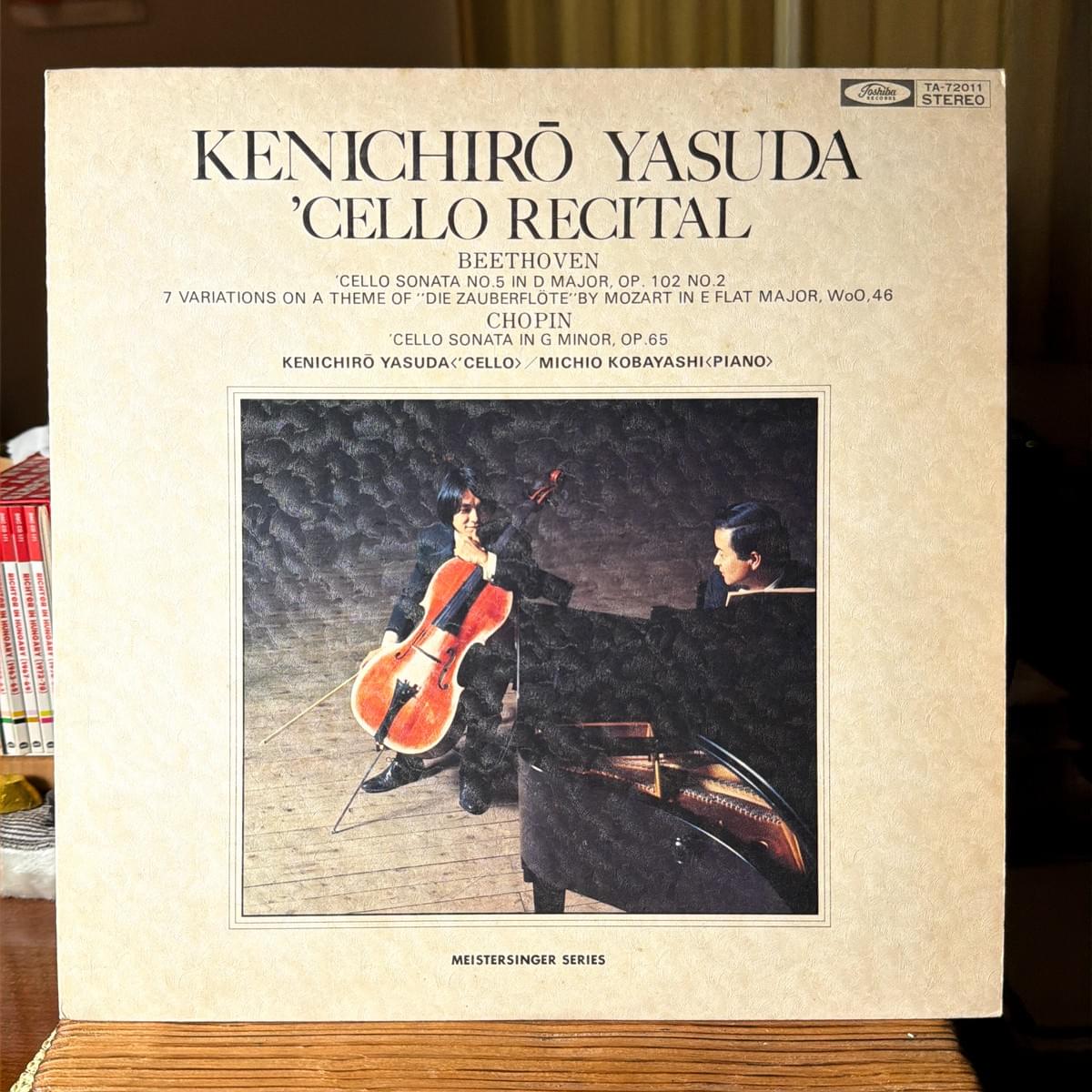
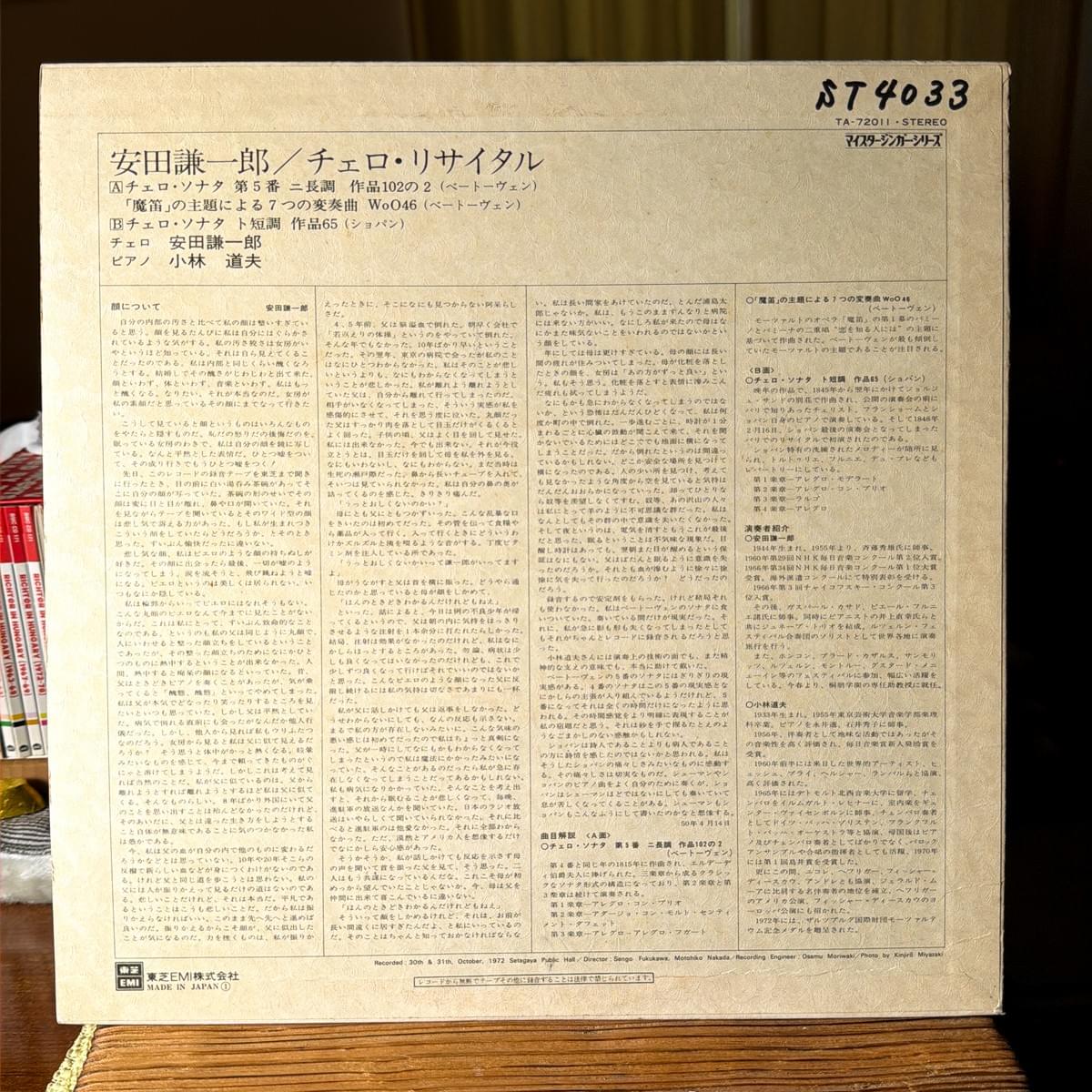
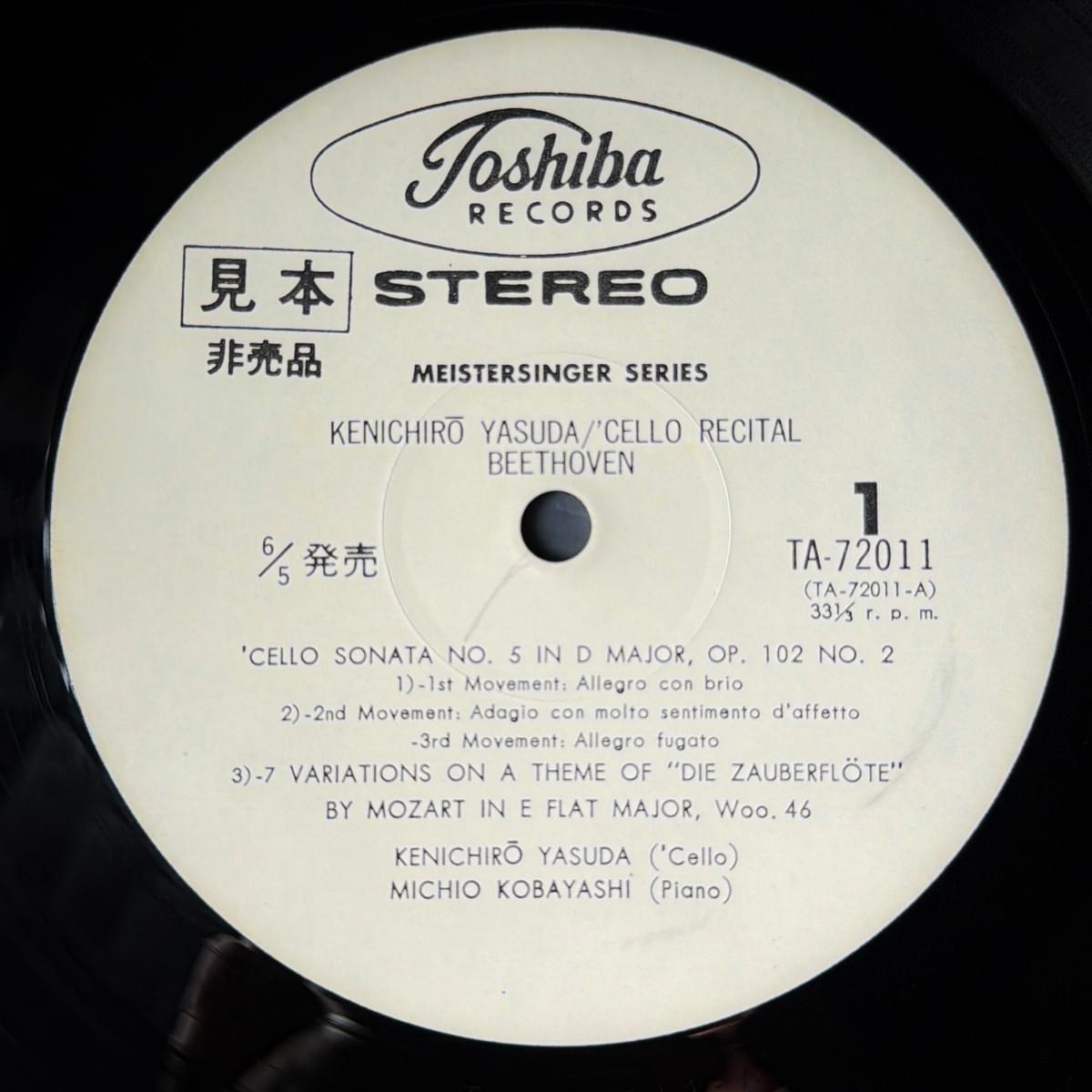
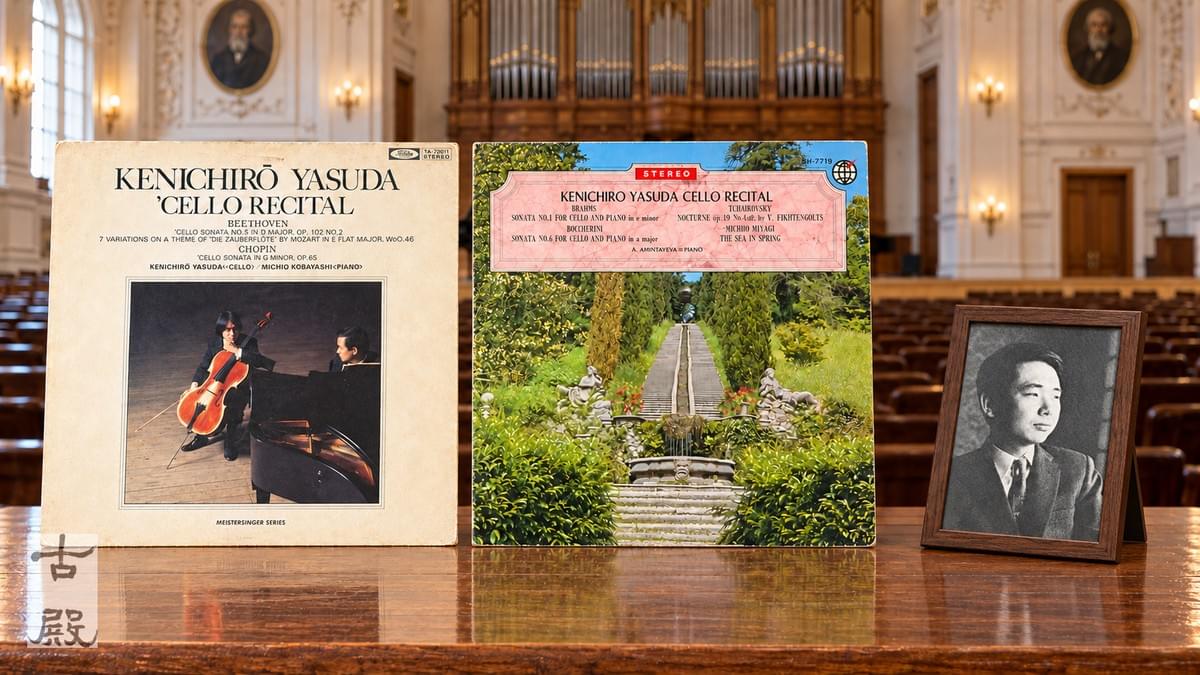
所以當我把這張 1975 年的東芝白標見本(SAMPLE)盤翻過來,原本只是想確認錄音日期。米色壓紋的封底上,左上角印著一個標題:〈顔について(關於臉)〉。署名:安田謙一郎(Ken-ichiro Yasuda,1944- )。
不是評論家,是演奏家本人。而且這篇文章的第一句,跟大提琴毫無關係。他說:比起自己內心的骯髒,他的臉長得太端正了。
我站在唱片架前把它讀完,讀到最後幾段,才終於出現貝多芬和蕭邦。那一刻我很清楚:這不是唱片解說,這是一篇文學作品。一位大提琴家,把一篇關於自己的臉、自己的父親、自己的恐懼的自述,印在了自己唱片的背面。
這種情況,在我十六年來見過的數萬張音樂唱片中,屈指可數。
一張臉的告白
〈關於臉〉的篇幅佔去了封底大半,卻有一個極其完整的文學結構。它從一張臉開始,經過三面「鏡子」,最後抵達音樂。
第一面鏡子,是鏡子本身。 熟睡的妻子身旁,他對著鏡子看自己的臉,驚訝於那張臉竟能如此平靜——明明剛剛才撒了謊。臉,在他筆下不是自我的表達,而是自我的遮蔽。羞恥、憤怒、後悔,全被一張端正的臉收納得乾乾淨淨。他甚至說,他想讓外表變得和內心一樣醜,想變成妻子眼中那個真正的自己。
第二面鏡子,是一只白色茶碗。 這是全文最精彩的一筆。他到東芝去聽這張唱片的錄音帶,眼前擺著一只茶碗,碗面映出他的臉:因為弧面的關係,兩眼分得很開,口鼻張大,寬扁變形。他一邊聽著自己的大提琴,一邊看著那張變形的臉,竟覺得那張臉帶著一種悲傷的說服力。他想:如果我天生就長這樣,該有多愉快。
從這裡,他寫到小丑。他喜歡小丑那種悲傷的臉,因為在那張臉面前,眼淚和跳躍都成了謊言;小丑永遠在隱藏什麼。可是他說,自己的輪廓太平凡,連小丑都當不成。
第三面鏡子,是父親。 這才是文章真正的核心。他發現自己越來越像父親——一張同樣端正、同樣平凡的臉。父親曾說,人一旦熱衷於某件事,臉就會變得癡呆;父親偶爾彈鋼琴,一旦彈得入神,就會自嘲一聲「醜態」然後停手。他說他一直想看父親真正怒吼或大笑一次,卻從未見過。
請停在這裡想一想:一個把「入神是醜態」當作信條的父親,生了一個必須在舞台上全然入神的大提琴家兒子。 安田在歐洲待了將近八年,以為自己在過一種與父親不同的生活,回頭才發現那種努力本身就是徒勞——越想逃離父親,就越像他。
然後,父親倒下了。腦溢血,在公司做晨間體操的時候。第二年他回東京探望,父親已認不得他,消瘦的臉上只剩一雙眼珠在轉。安田寫下一個讓人心碎的細節:小時候父親常表演轉眼珠逗他,他一直學不會;如今,那竟成了父親唯一還能做的動作。
那個一輩子不肯讓臉失態的父親,最後變成了一張小丑般的臉。而兒子在這張臉前面,終於哭了。
這不是一篇唱片解說能有的筆法。茶碗、小丑、轉動的眼珠——意象一層扣一層,每一個都回到同一個問題:我們的臉,到底在替我們隱藏什麼?
「只有演奏的時候才是現實」
讀到這裡,你才會明白最後那幾段關於音樂的文字,分量有多重。
父親倒下之後,安田寫到一種逐漸蔓延的恐懼:害怕一切會在某一刻突然變得無法理解,害怕關燈之後就是最後,連入睡都成了一件陰森的事。他不知道父親是「啪」一聲失去意識的,還是像血滲開那樣,一點一點地失去。
就在這樣的狀態下,1972 年 10 月 30、31 日,他走進東京的世田谷區民會館,坐在鋼琴家小林道夫(Michio Kobayashi,1933- )身旁,錄下這張唱片。
他說,為了錄音,他拿了鎮定劑,最後沒有吃。他死命咬住貝多芬(Ludwig van Beethoven,1770-1827)的奏鳴曲。只有在演奏的時候,才是現實。 而且他想,就算自己突然形體消散了,那段演奏也會好好地留在唱片裡。
這句話,請你在放下唱針之前再讀一次。
他選的是貝多芬最後一首大提琴奏鳴曲,D 大調 Op.102-2。安田對這首曲子的理解,是我讀過最不像「樂曲解說」的樂曲解說:他說第 5 號有一種「ぎりぎりの現実感(逼到極限邊緣的現實感)」;第 4 號還交織著某種表裡兩面,到了第 5 號,只剩下純粹的時間。他說,要把這種時間感表現得更明確,是他的功課;那或許就像用手抓沙子一樣,是一種毫無虛假的觸感。
用手抓沙。沙子從指縫流走,你抓得越緊,流得越快;但掌心那一瞬間的觸感,是真的。這是一個詩人才會找到的比喻,而他用它來形容貝多芬。
談蕭邦(Frédéric Chopin,1810-1849)的那一段同樣驚人。他認為蕭邦比起身為詩人,更是以「病人」的身分感受到詩情;他被蕭邦那種近乎痛楚的東西打動。他說自己常為了自己彈舒曼和蕭邦的鋼琴曲,彈著彈著會呼吸困難,於是想像:他們是不是也在這種狀態下寫作的?
蕭邦的 g 小調奏鳴曲 Op.65,寫於他生命最後幾年、在喬治·桑(George Sand,1804-1876)的諾昂別墅病中完成,1848 年 2 月在巴黎首演,那是他生前最後一場巴黎公開演奏會。一個病中的作曲家,一個守著病中父親的大提琴家——安田不是在「詮釋」這首曲子,他是在認出它。
在談貝多芬與蕭邦之前,他特別插進一句,說小林先生無論在演奏技術上,還是作為精神上的支柱,都真的幫了他大忙。這一句很短,但放在這樣一篇文字裡,你會知道那兩天在世田谷,鋼琴前坐著的是什麼樣的一個人。
回到 1966:那個熱愛韓波的青年
讀完〈關於臉〉,我從架上抽出另一張唱片。
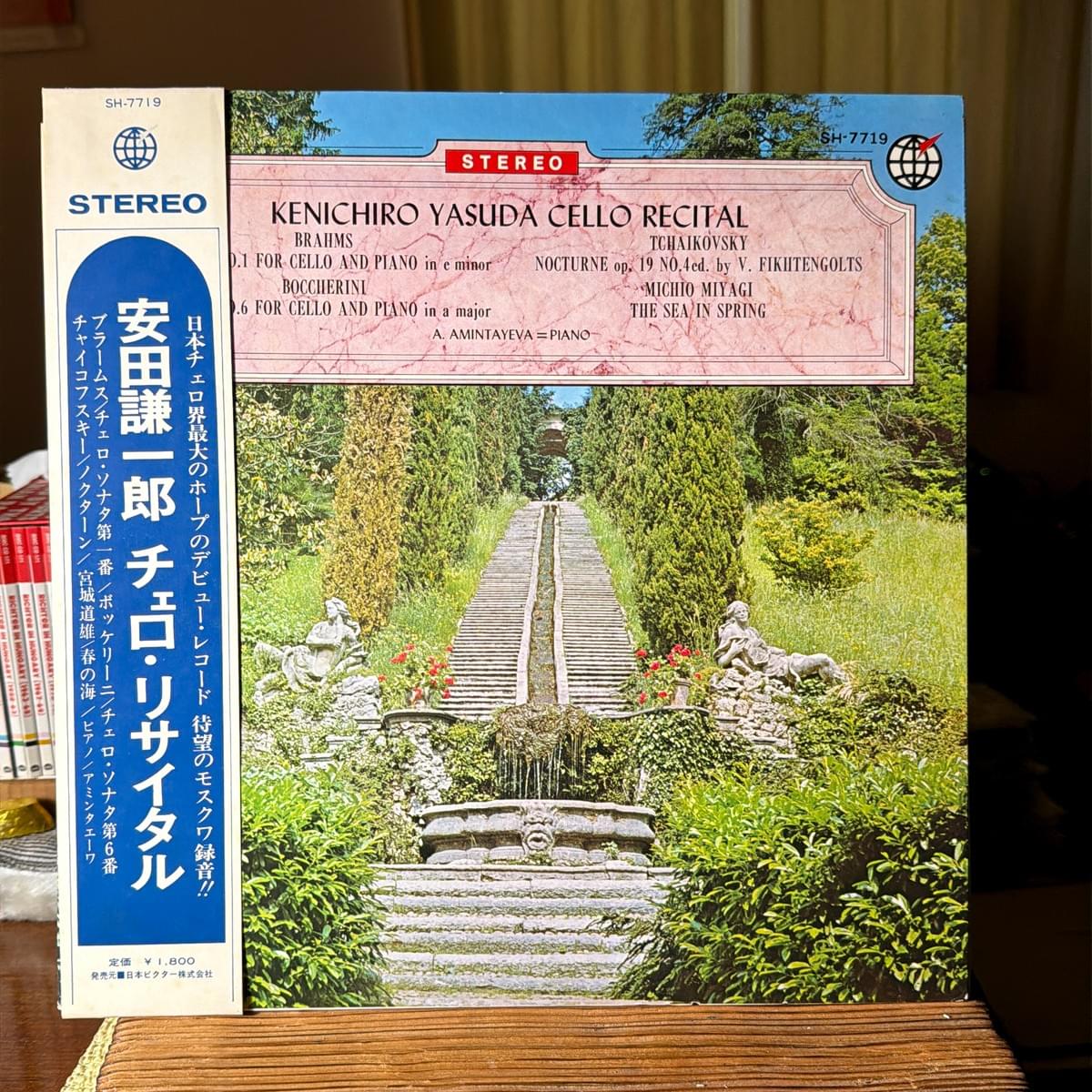
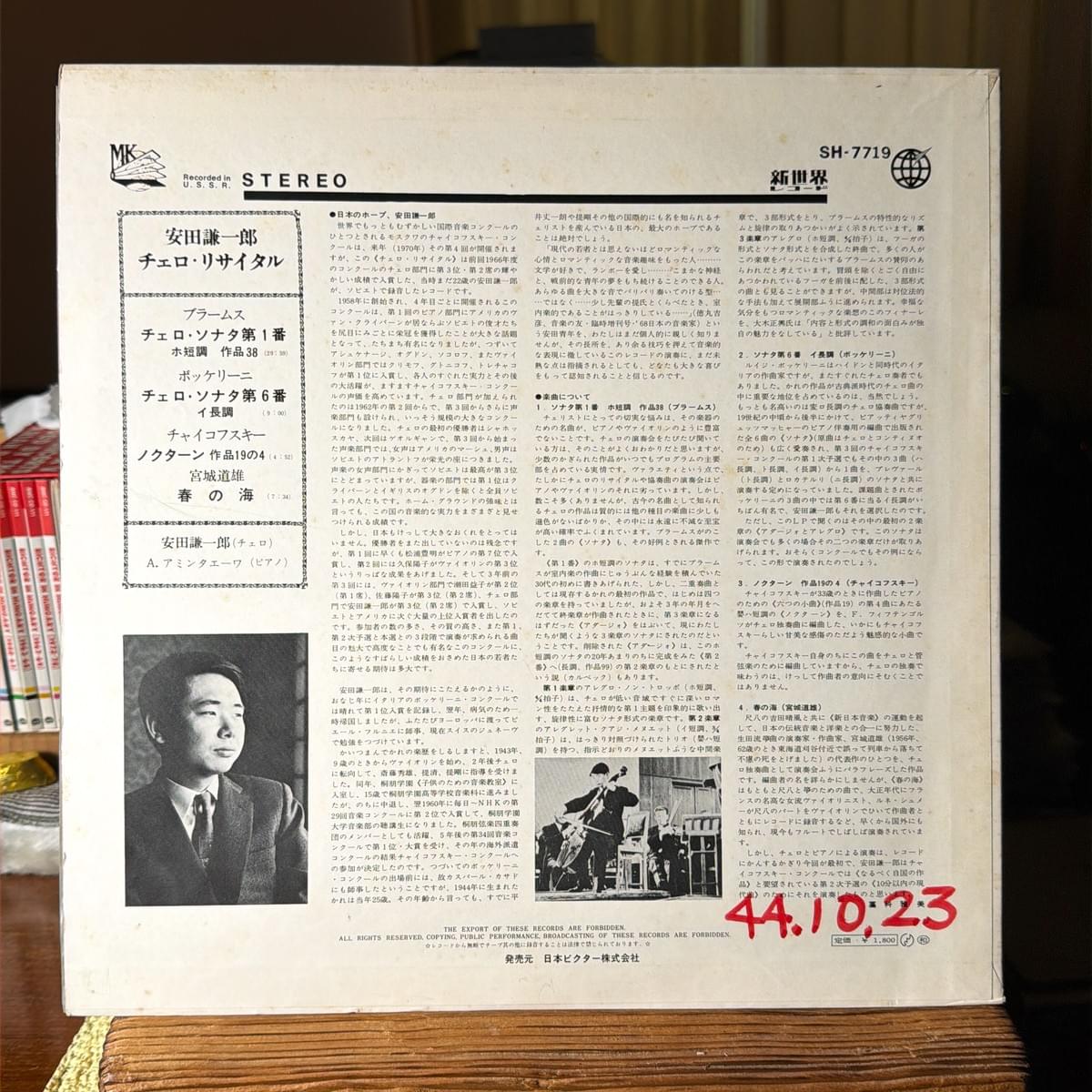
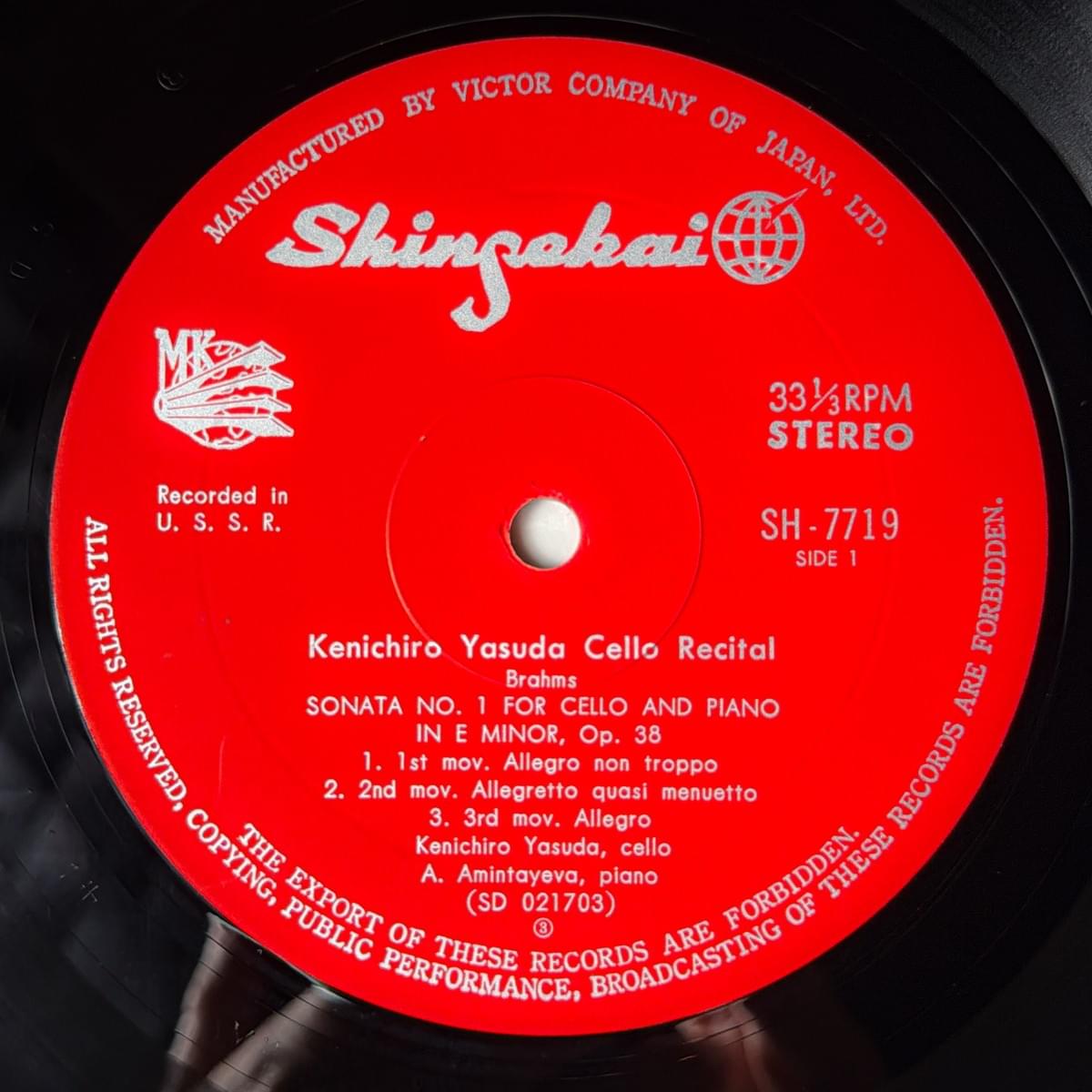
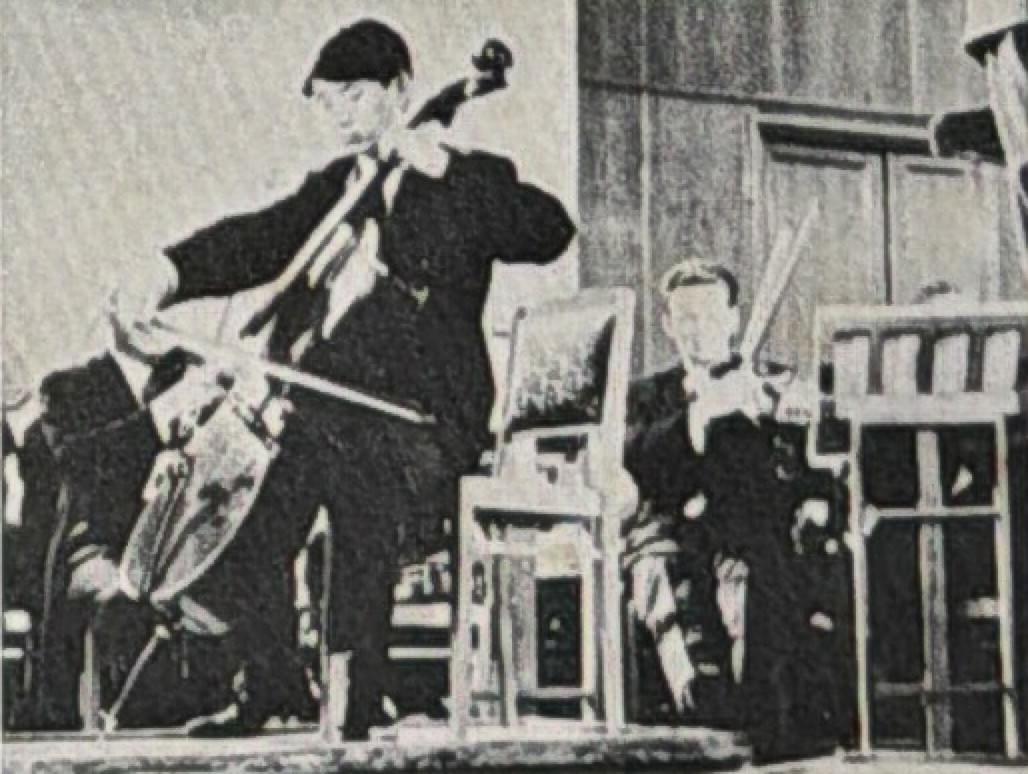
新世界唱片 SH-7719,紅底銀字的標籤,左上角印著蘇聯國際圖書公司的 MK 標誌,「Recorded in U.S.S.R.」。這是安田的唱片首作,側封寫著「日本大提琴界最大希望的出道唱片,期待已久的莫斯科錄音」。1966 年,22 歲的他在第三屆柴可夫斯基大賽拿下大提琴第三名,隨後在莫斯科錄下布拉姆斯(Johannes Brahms,1833-1897)第 1 號奏鳴曲、鮑凱利尼(Luigi Boccherini,1743-1805)、柴可夫斯基(Pyotr Ilyich Tchaikovsky,1840-1893),以及宮城道雄(Michio Miyagi,1894-1956)的《春之海》。柴可夫斯基大賽的大提琴組在 1962 年第二屆才設立,1966 年是第二次舉辦大提琴比賽;安田代表日本出賽、名列第三,成為當時日本國內年輕一輩大提琴家的代表人物。這張唱片被歸入第三屆柴可夫斯基大賽的得獎者紀念錄音系列,可說是一份來自莫斯科的大賽紀念。為他協奏的,是羅斯托波維契(Mstislav Rostropovich,1927-2007)的長年搭檔阿薩·阿明塔耶娃(Aza Amintayeva,1920-1997)。蘇聯 Melodiya 於 1968 年以 Д 021703-4 發行,日本版則由當時與 Melodiya 合作、專門在日本發行蘇聯錄音的新世界唱片在 1969 年推出。
這張唱片背面,是評論家藁科雅美寫的標準解說:大賽歷史、演奏家經歷、樂曲分析,一切都在它該在的位置。但其中有一段引文,在讀過〈關於臉〉之後,我再也無法用同樣的眼光看待。
藁科引用了德丸吉彥(Yoshihiko Tokumaru,1936- )在《音樂之友》臨時增刊〈'68 日本的音樂家〉中對安田的描述:一個擁有難以想像是現代年輕人的浪漫情懷的人,喜歡文學,熱愛韓波,神經細膩,能持續懷抱戰前青年般的夢想。
喜歡文學,熱愛韓波。
1968 年,一位評論家在介紹一位大提琴新秀時,第一個注意到的不是他的弓法、音色或技巧,而是他讀什麼書。七年後,這位大提琴家在自己唱片的背面,寫出了一篇真正的文學作品。
韓波(Arthur Rimbaud,1854-1891)留下過一句名言:「我是另一個人。」(Je est un autre)——那個寫詩的「我」,不是鏡子裡那個「我」。再回頭讀〈關於臉〉:一個人對著鏡子、對著茶碗、對著父親,不斷發現鏡中那張臉不是自己。這不只是巧合,這是一個熱愛韓波的青年,在七年後交出的答卷。
更耐人尋味的是:韓波在二十歲左右就放棄了詩,轉身走進生活。而安田,是一個本來可能走向文學的人,被音樂留住了。
他為什麼能寫出這樣的文字?
一個從 9 歲起就把一切交給樂器的人,為什麼能在 31 歲寫出這樣的文字?這個問題比答案更有意思。我沒有定論,只能把幾條線索並排放著。
第一條線索,是時代。 安田成長的 1950、60 年代,是日本戰後文學最旺盛的年代。對那一代有教養的青年而言,讀文學、讀法國詩,幾乎是一種共同的精神語言。德丸吉彥說他懷抱「戰前青年般的夢想」,指的正是這種把藝術當作人生問題來追問的氣質,而不是把音樂當作一門職業技能。
第二條線索,是搖籃。 安田學琴的桐朋「兒童音樂教室」,1948 年 10 月由齋藤秀雄(Hideo Saito,1902-1974)、井口基成(Motonari Iguchi,1908-1983)、伊藤武雄、柴田南雄(Minao Shibata,1916-1996)與吉田秀和(Hidekazu Yoshida,1913-2012)共同創辦,首任室長正是吉田秀和;第一期學生中有小澤征爾(Seiji Ozawa,1935-2024)、中村紘子(Hiroko Nakamura,1944-2016)、堤剛(Tsuyoshi Tsutsumi,1942- )。這間教室後來成為整個桐朋學園音樂教育的母體。吉田秀和是東京帝大法文科出身、日後以文學性音樂評論聞名的作家;他在成城高校就學時,曾跟詩人中原中也(Chūya Nakahara,1907-1937)學法文,而中原中也後來出版了日譯的《韓波詩集》。
我不知道安田小時候是否直接受教於吉田秀和,這點需要更多史料。但這個事實本身就足以說明:安田學琴的地方,從創立那天起,音樂與文學就不是兩件事。熱愛韓波的大提琴少年,出現在這樣一個搖籃裡,並不奇怪。
第三條線索,是他自己。 八年旅歐,他師事的卡薩多(Gaspar Cassadó,1897-1966)與傅立葉(Pierre Fournier,1906-1986)都是以人文教養著稱的大提琴家,他也參加過卡薩爾斯(Pablo Casals,1876-1973)在普拉德的音樂節,卡薩爾斯一生把音樂與良知視為一體。而最後把他推向這篇文章的,是父親倒下這件事:當一個人被迫面對至親失去意識、自己連入睡都害怕的時候,他要不就把臉藏得更好,要不就把它卸下來。安田選了後者。
今天的音樂家養成,起步更早、比賽更密集、競爭更專業化;唱片背面印的,多半是經紀公司統一撰寫的簡歷,演奏家的形象由社群媒體精心管理。我們培養出越來越多技巧完美的演奏者,卻越來越少讀到一位演奏家,用自己的文字誠實地談自己。
安田的例子提醒我們:技巧可以訓練,但那種願意直視自己的能量,來自一個人整體的生命——他讀過的書、他走過的路、他失去過的人。音樂只是這股能量最後找到的出口。
為什麼這樣的文字,幾乎不會出現在唱片背面
要理解這篇隨筆有多罕見,得先知道一張日本古典唱片的背面是怎麼誕生的。
在日本唱片業的製作流程裡,唱片公司會事先指定一位音樂評論家或專業撰稿人負責解說。撰稿人在發行前一段時間交稿,唱片公司再把稿子排進封底或內頁,之後才進入壓片、包裝、上市。整個流程的預設是:演奏家負責聲音,評論家負責文字。 一張唱片的「話語權」,從一開始就被分配好了。
這套制度造就了日本唱片解說的高水準。SH-7719 背面藁科雅美的解說就是典型:嚴謹、詳盡,連大賽各屆的日本得獎者都列得清清楚楚。但它也意味著,演奏家在自己的唱片上幾乎是沉默的。我們聽得到他們的琴聲,卻很少讀得到他們的心聲。即使偶爾出現演奏家的文字,通常也是談曲目、談詮釋、談對作曲家的敬意。
東芝 TA-72011 打破了這個慣例,而且打破得非常徹底。封底上,沒有評論家的導聆,只有一份簡短的曲目說明、兩位演奏家的簡介,以及佔去大半版面的〈關於臉〉。安田沒有告訴你這張唱片該怎麼聽,他告訴你的是——錄下這張唱片的那個人,當時活在什麼樣的處境裡。
我常想,當年東芝的製作人為什麼會同意把這樣一篇文字印上去?它不推銷唱片,不分析樂曲,甚至寫到了一位演奏家不太會公開示人的脆弱。這種決定,在今天以行銷為導向的唱片產業裡,大概不可能再發生了。
被音樂耽擱的文學家
把兩張唱片並排放在桌上,一條線就清楚了。
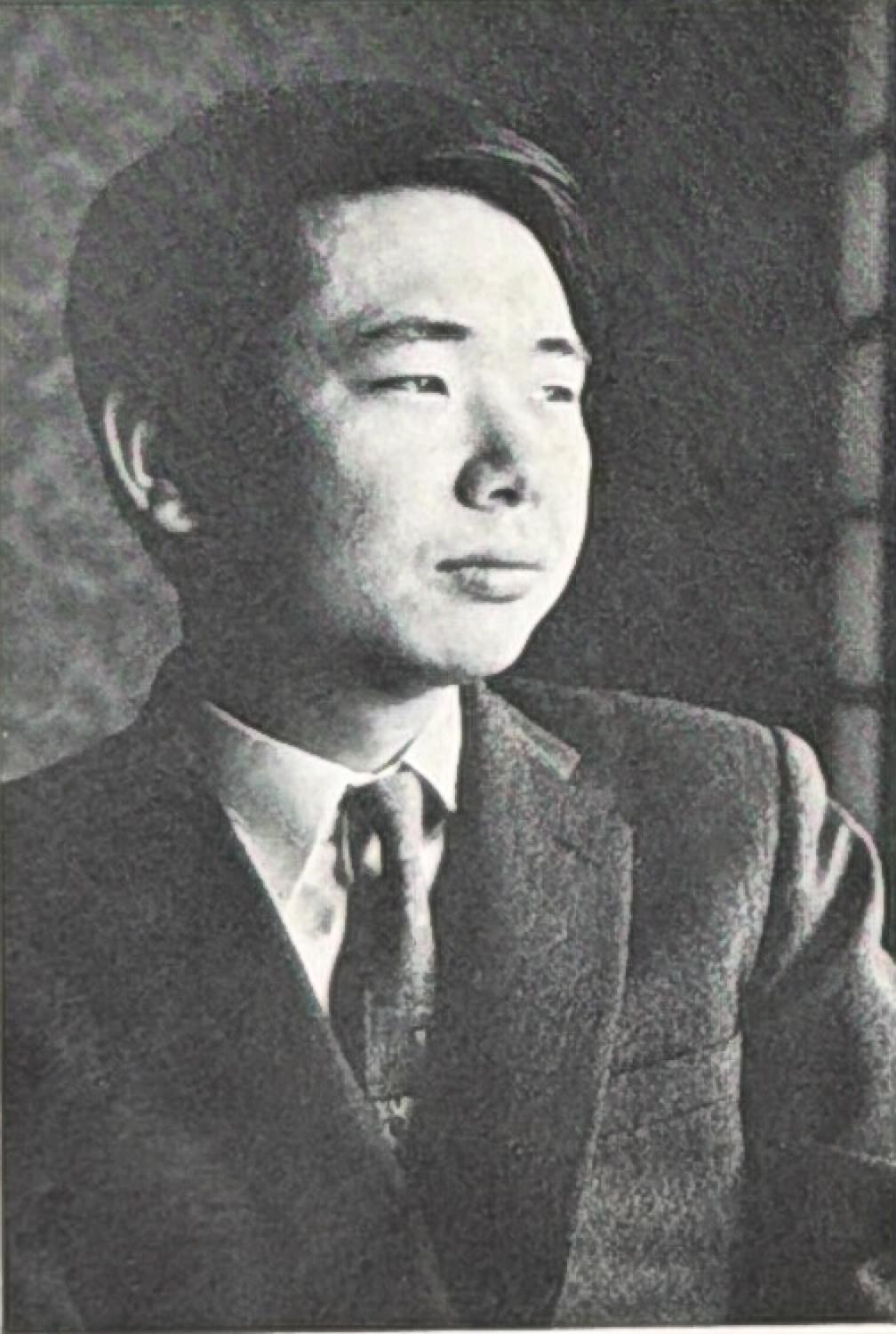
1953 年,9 歲的安田開始學琴,不久轉學大提琴,進入齋藤秀雄(Hideo Saito,1902-1974)門下。那是一條極其嚴苛的路:桐朋兒童音樂教室、日本音樂比賽、柴可夫斯基大賽、旅歐求學,師事卡薩多與傅立葉。一個孩子的時間,幾乎全部交給了弓與弦。
可是在這條路的縫隙裡,有另一個人一直活著。1968 年的評論家看見了他——那個讀韓波的青年;1975 年,他在唱片背面現身了一次,用茶碗、小丑和轉動的眼珠,寫出了一篇讓人讀完久久無法平靜的文字。
而這個文學家,一生沒有正式出版過任何文學作品。沒有詩集,沒有小說,沒有散文集。我們今天能讀到的,只有這一篇〈關於臉〉——而它之所以能留下來,純粹是因為 1975 年某位東芝的製作人,同意把它印在一張大提琴唱片的背面。如果當年那張封底照例交給評論家,這篇文字就不會存在;如果這張唱片沒有被人保存下來,它也早已消失。
一位文學家的全部文學作品,只有一篇;而這一篇的載體,是他自己的琴聲。
所以我說他是:被音樂耽擱的文學家。
真正的藝術家,是勇敢地、真實地面對自我的一切。 不只面對光彩的那一面,也面對骯髒、狡猾、恐懼與無力。安田在文中說,他想讓外表變得和內心一樣,那才是真實的。這句話,正是他寫作的態度,也是他演奏的態度:他要在貝多芬裡找的,是那種「毫無虛假的觸感」。一個敢在文字裡卸下臉孔的人,在琴聲裡也不會戴著面具。
這個文學家後來仍不時探出頭來。安田日後不只演奏,也作曲,為無伴奏大提琴寫下自己的《三首聖詠》;他在 2015 年受訪時,把巴赫的音樂形容為「虔敬而日常的祈禱」。回到桐朋任教後,他接下了齋藤秀雄留下的位置,教出一代又一代大提琴家。2026 年 6 月,82 歲的他仍在埼玉開獨奏會,拉的是布拉姆斯第 2 號奏鳴曲——五十多年前在莫斯科,他錄下的是第 1 號。
他在〈關於臉〉裡說,自己的功課是把貝多芬那種「時間感」表現得更明確。寫下這句話時他 31 歲。這項功課,他做了五十年,現在還在做。
我想,這就是一張唱片之所以值得被保存的原因。安田 2015 年受訪時曾提到,自己早年在日本哥倫比亞錄的 LP 早已絕版,連他本人手上都沒有。數位時代裡,我們以為什麼都找得到;可是就我查得到的資料,這篇〈關於臉〉從來沒有被數位化,這張唱片也未見 CD 再版或串流上架。它只存在於一張 1975 年的米色封套背面。
一位文學家此生唯一的一篇作品,就這樣靜靜地躺在一張唱片的背面,等人翻過來。
給新時代音樂家的一面鏡子
把安田放回今天,他像一面鏡子。
現代的音樂家,幾乎都是從小在練習室、考試與比賽之間被訓練出來的。他們的技術水準是歷史上最高的:音準、速度、乾淨度,每一項都經得起放大檢視。可是比賽的評分表能量化這些,卻量化不了一個人活過什麼、感受過什麼。於是我們常常聽到一種演奏——無可挑剔,聽完卻什麼也記不住。缺的不是技巧,而是「這個人是誰?」。
這不是說今天的年輕音樂家沒有內在,而是整個養成體系很少為那一部分留下空間。從早到晚的練習、一場接一場的比賽,讓人沒有時間讀一本與音樂無關的書,沒有餘裕去看一幅畫、走一段遠路、經歷一次真正的失去並好好面對它。
安田並沒有逃過嚴格的訓練。他在齋藤秀雄門下吃過的苦,絕不比今天任何一位比賽選手少。不同的是,在練習之外,他讀韓波,在歐洲生活了八年,跟著有人文教養的老師學琴,也在父親倒下的時候,誠實地面對了自己的恐懼。技術是地基,生命才是建築本身。 他的演奏之所以有厚度,是因為琴聲背後站著一個完整的人。
這一點,在新的時代只會更重要。錄音可以修音,剪接可以拼出完美的每一小節。當完美變得容易複製,真正無法被取代的,就只剩下一個人的生命感受:他讀過的書、愛過的人、害怕過的夜晚,以及他願不願意誠實地把這些交給音樂。
如果要給今天學音樂的孩子一個建議,我會請他們去讀讀〈關於臉〉。不是學它的文筆,而是學那份勇氣——敢在自己最重要的作品背面,把那張端正的臉卸下來。
******
【Gudian Music Stories】A Writer Derailed by Music: Ken-ichiro Yasuda (b. 1944), 1966 Tchaikovsky Competition Cello Bronze Medalist
The Moment You Turn It Over
What do you usually find on the back of a record jacket?
Over the past sixteen years, tens of thousands of vinyl records have passed through my hands. The answer is almost invariably the same: critical essays, formal analyses of the scores, a curriculum vitae of the artist, and recording session data. Written well, it reads like an erudite monograph; written poorly, it resembles an instruction manual. Good or bad, those texts all serve a single master: telling you how to listen to the disc.
So when I turned over this 1975 Toshiba white-label promo (SAMPLE) disc, I was merely looking to verify the recording date. Yet on the beige textured rear sleeve, tucked in the upper-left corner, sat an essay title: Kao ni tsuite (〈顔について〉—On Faces). Signed: Ken-ichiro Yasuda (b. 1944).
Not a critic, but the cellist himself. And the very first sentence had nothing whatsoever to do with the cello. He confessed: compared to the squalor within his own heart, his face was far too upright, far too proper.
I stood before the record shelves reading it to the end. Only in the final paragraphs did the names Beethoven and Chopin finally surface. In that instant, I knew: this was not a liner note; this was a piece of literature. A cellist had chosen to print a deeply personal confession—concerning his own face, his father, and his terror—on the back of his own record.
In sixteen years, among tens of thousands of classical recordings, such an occurrence can be counted on the fingers of one hand.
The Confession of a Face
Occupying the lion's share of the rear cover, On Faces is built upon an intricate literary structure. It begins with a countenance, moves across three distinct "mirrors," and only then reaches the music.
The first mirror is the literal glass. Lying beside his sleeping wife, he looks at his own face in the mirror, astonished that it can appear so tranquil—knowing he had just uttered a lie moments before. In his eyes, a face is not a vehicle for self-expression, but an apparatus of concealment. Shame, fury, and remorse are smoothed over by an upright, disciplined exterior. He even admits a wish for his physical exterior to turn as hideous as his inner state, yearning to appear as the unvarnished self his wife might truly see.
The second mirror is a white teacup. This is the most striking image in the essay. Visiting Toshiba’s offices to audition master tapes for this album, he sat before a white ceramic teacup whose curved surface mirrored his face: distorted by the bowl's convex curvature, his eyes spread wide apart, his mouth and nose gaping open, flat and warped. Listening to his own cello playback while staring into that deformed reflection, he found himself struck by a somber conviction. He thought: If I had been born looking like this, how liberating it would be.
From there, his prose wanders to clowns. He had long loved the mournful visage of the clown, because before that painted mask, tears and acrobatic leaps alike were recognized as fiction; a clown is perpetually hiding something. Yet he lamented that his own features were far too ordinary even to play the clown.
The third mirror is his father. This is the core of the piece. He realized he was growing increasingly like his father—possessing the same upright, ordinary countenance. His father once remarked that whenever a person becomes completely absorbed in something, their face grows vacant and foolish. When the father occasionally played the piano, the moment he fell into genuine reverie, he would catch himself, scoff with self-mockery—"What an unsightly display"—and halt his hands. The son wrote that he had spent his life waiting to see his father truly roar in fury or burst into unrestrained laughter, yet he never saw it happen once.
Pause here and consider this dynamic: a father whose unbending creed was that losing oneself in emotion is an "unsightly display," raising a son who was destined to lose himself entirely on the concert platform. Yasuda spent nearly eight years in Europe, believing he was forging a life divorced from his father's mold, only to realize the effort was futile: the harder he fought to escape his father, the more like him he became.
Then, his father collapsed. A cerebral hemorrhage, struck down while doing morning calisthenics at his office. The following year, when Yasuda returned to Tokyo, his father no longer recognized him; all that remained of the gaunt face was a pair of rolling eyes. Yasuda set down a heartbreaking vignette: when he was a boy, his father used to roll his eyes to make him laugh, a trick the son could never master; now, it had become the only physical gesture his father was capable of making.
The father who had spent an entire lifetime refusing to let his face falter had ended up wearing the tragic face of a clown. And standing before that face, the son wept.
This is not the language of commercial liner notes. The teacup, the clown, the rolling eyes—image folds upon image, each returning to the same inquiry: What is our face hiding on our behalf?
"Reality Exists Only While Playing"
Only after reading those opening reflections do the final paragraphs on Beethoven and Chopin reveal their true weight.
Following his father’s collapse, Yasuda was seized by an encroaching terror: the dread that at any moment everything might suddenly slip into the incomprehensible; that switching off the light might be the final threshold; that sleep itself was an ominous descent. He did not know whether his father lost consciousness with a sudden snap, or whether his mind had drained away slowly like blood seeping into fabric.
It was in this psychological state that, on October 30 and 31, 1972, he walked into the Setagaya Public Hall in Tokyo, sat beside pianist Michio Kobayashi (b. 1933), and recorded this album.
He confessed that he brought tranquilizers for the session, but ultimately chose not to take them. He threw himself into Beethoven's (1770–1827) sonata. Reality exists only while playing. And he thought: even if his physical form were to dissolve into thin air, that performance would remain preserved within the grooves of the disc.
Read that line once more before lowering the stylus into the run-in groove.
He chose Beethoven’s final Cello Sonata in D major, Op. 102, No. 2. Yasuda’s appraisal of this score is unlike any standard program note: he noted that the Fifth Sonata possesses an "uncompromising, razor-edge sense of reality (giri-giri no genjitsukan)"; where the Fourth Sonata still juxtaposes surface and interior, the Fifth strips away ornament to leave pure, unadorned time. He wrote that rendering this sense of time with absolute clarity was his ongoing artistic duty—an experience akin to grasping handfuls of dry sand, an entirely unvarnished physical tactile reality.
Grasping sand. It slips through your fingers; the tighter you squeeze, the faster it drains away; yet the friction against your palm in that brief instant is real. That is a poet's metaphor, deployed to describe late Beethoven.
His reflections on Frédéric Chopin (1810–1849) are equally arresting. He argued that rather than being merely a poet, Chopin understood poetry primarily as an invalid; he was moved by the underlying physical suffering in Chopin’s music. Yasuda noted that he often sat at the piano playing Schumann and Chopin for himself, finding himself breathless as he played, wondering: Did they compose under this exact physical strain?
Chopin’s Cello Sonata in G minor, Op. 65, was written during his final years of illness at George Sand’s (1804–1876) estate in Nohant, premiered in Paris in February 1848 at his final public concert. An invalid composer met by a cellist keeping vigil over a paralyzed father—Yasuda was not merely "interpreting" the score; he was recognizing his own life within it.
Before addressing the Beethoven and Chopin, he inserted a brief, affectionate line thanking Michio Kobayashi, observing that both technically and as a pillar of emotional stability, the pianist had carried him through. It is an unassuming sentence, but placed within this text, you realize who was seated at the keyboard during those two autumn days in Setagaya.
1966: The Youth Who Loved Rimbaud
Having read On Faces, I pulled another record from the shelf: Shinsekai Records SH-7719, bearing a red label with silver lettering, the Soviet Mezhdunarodnaya Kniga (MK) logo in the upper corner, reading "Recorded in U.S.S.R."
This was Yasuda’s debut LP. The obi proclaimed: "The debut recording of the greatest hope in the Japanese cello world; the long-awaited Moscow sessions." In 1966, at age twenty-two, he captured third prize at the 3rd International Tchaikovsky Competition, subsequently recording in Moscow Brahms's (1833–1897) Cello Sonata No. 1, along with Boccherini, Tchaikovsky, and Michio Miyagi's (1894–1956) Haru no Umi (The Sea in Spring). The cello division of the Tchaikovsky Competition had only been established in 1962; 1966 was its second iteration. Representing Japan and taking bronze, Yasuda became the foremost figure among his generation of Japanese cellists. The disc was issued as part of the competition's laureate series, partnering him with Mstislav Rostropovich’s (1927–2007) longtime accompanist, Aza Amintayeva (1920–1997). Melodiya issued the recording in 1968 (Д 021703-4), with Japan’s Shinsekai Records releasing its domestic edition in 1969.
On the back of that debut LP sits standard liner notes by critic Masami Warashina: competition milestones, the artist's resume, and musical analyses. Yet there is a quotation embedded within it that I could no longer read the same way after encountering On Faces.
Warashina quoted a description of Yasuda by Yoshihiko Tokumaru (b. 1936) from a 1968 special issue of Ongaku no Tomo:
A musician possessing a romanticism that feels almost unimaginable in a young modern man; someone who loves literature, adores Rimbaud, possesses exquisite sensitivity, and carries the idealistic dreams of pre-war youth.
He loved literature, and adored Rimbaud.
In 1968, when introducing a rising cello prodigy, what the critic noticed first was not his bow technique or tonal projection, but the books he read. Seven years later, that cellist penned a literary work on the reverse of his own album jacket.
Arthur Rimbaud (1854–1891) left behind his famous dictum: "Je est un autre" (I is another)—the "I" who writes is not the "I" reflected in the mirror. Revisit On Faces: a man peering into a bedroom mirror, into a ceramic teacup, into the failing eyes of his father, continually discovering that the face before him is not himself. That is no accident; it is the philosophical reflection of an artist steeped in Rimbaud, answering himself seven years later.
Rimbaud abandoned poetry around age twenty, turning his back on art to enter the physical world of commerce. Yasuda was the converse: a writer by temperament who was held captive by music.
Why Did He Write Like This?
How does an artist who devoted himself entirely to an instrument from age nine manage to produce prose of this caliber at thirty-one? The question is far more engaging than any tidy conclusion. Three biographical threads suggest an answer:
First, the cultural climate. Yasuda came of age during the 1950s and 60s, the golden era of postwar Japanese literary culture. For educated youths of that generation, reading world literature and French verse was a shared lingua franca. When Tokumaru observed that he held "the dreams of pre-war youth," he was referring to an artistic mindset that treated music not as a trade, but as an existential inquiry into life itself.
Second, his formative training. Yasuda studied at the Toho Music School for Children, co-founded in October 1948 by Hideo Saito (1902–1974), Motonari Iguchi (1908–1983), Takeo Ito, Minao Shibata (1916–1996), and critic Hidekazu Yoshida (1913–2012), who served as its first director. Its inaugural cohort included Seiji Ozawa (1935–2024), Hiroko Nakamura (1944–2016), and Tsuyoshi Tsutsumi (b. 1942). The school became the incubator of the Toho Gakuen School of Music. Hidekazu Yoshida held a degree in French literature from Tokyo Imperial University and was famed for his literary approach to music criticism; during his youth at Seijo High School, he had studied French under poet Chūya Nakahara (1907–1937), who subsequently published the definitive Japanese translations of Rimbaud's poetry.
Whether Yasuda received direct instruction from Yoshida as a child requires further archival verification, but the broader environment is clear: where Yasuda learned his instrument, music and literature were never viewed as separate pursuits. An adolescent cellist reading Rimbaud was a natural inhabitant of that world.
Third, the artist himself. During his eight years in Europe, he studied under Gaspar Cassadó (1897–1966) and Pierre Fournier (1906–1986)—artists celebrated for their humanistic culture. He attended Pablo Casals’s (1876–1973) festival in Prades, an environment where music and moral conscience were inextricably linked. What catalyzed this text was his father's sudden collapse: forced to watch an intimate lose consciousness while fearing sleep himself, an individual must either conceal his face behind a mask, or tear it away entirely. Yasuda chose to strip it away.
Modern conservatory training begins earlier, is driven by competitions, and emphasizes technical specialization. Album jackets are populated by agency biographies, with public personas curated across digital media. We produce instrumentalists of immaculate mechanical polish, but rarely encounter an artist who speaks of their own vulnerabilities with such unvarnished honesty.
Yasuda’s example is instructive: mechanical discipline can be drilled, but the courage to look into one's own shadow stems from the whole life of the individual—the literature he has absorbed, the terrain he has walked, and the grief he has shouldered. Music is simply the vessel that gathers and releases that energy.
An Anomaly on an Album Jacket
To appreciate the rarity of this essay, one must understand how Japanese classical LP jackets were produced.
In the Japanese record industry, labels typically commissioned established critics or specialized writers to draft program notes. Texts were submitted in advance and integrated into the layout before plating and printing. The system operated on a clear division of labor: the performer provided the sound; the critic provided the words. The voice of the recording was partitioned from the outset.
That system produced remarkably high standards in Japanese liner notes. Masami Warashina’s essay on SH-7719 is exemplary: thorough, rigorous, cataloging every historical Japanese laureate in the competition's history. But it also meant that performers remained silent on their own releases. We hear their tone, but rarely read their thoughts. When artists did contribute notes, they generally confined themselves to historical context, interpretive choices, or tributes to the composer.
Toshiba TA-72011 discarded that protocol completely. On its rear sleeve, there is no critical commentary—only brief movement titles, bios of the two musicians, and Yasuda’s On Faces taking up the page. Yasuda does not tell you how to listen to the performance; he reveals the psychic landscape of the human being who sat before the microphones.
One wonders why the producer at Toshiba approved this text in 1975. It does not sell the album, it does not analyze the themes, and it exposes vulnerabilities few classical musicians would dream of making public. Such a decision would be virtually unthinkable in today's marketing-driven industry.
A Writer Derailed by Music
Placing both records side by side on the table makes the trajectory clear.
In 1953, nine-year-old Yasuda began musical studies, soon switching to the cello and entering Hideo Saito’s rigorous studio. It was an unsparing path: the Toho Music School for Children, the Music Competition of Japan, the Tchaikovsky Competition, and years of European study with Cassadó and Fournier. A child's hours were handed over to bow and string.
Yet in the margins of that routine lived another soul. The critic in 1968 saw him—the young man reading Rimbaud; in 1975, he stepped forward on the back of his record, using a teacup, a clown, and rolling eyes to compose an essay that leaves the reader unsettled long after finishing.
And that writer never formally published a work of literature. No poetry volumes, no short stories, no essay collections. All we have today is this solitary text, On Faces—preserved solely because an open-minded Toshiba producer in 1975 agreed to print it on the back of an album jacket. Had that sleeve been assigned to a conventional critic, the essay would never have existed; had this vinyl not been preserved, it would have been lost entirely.
An author whose literary output consists of a single piece of prose, borne upon the back of his own musical recordings.
That is why I call him: a writer derailed by music.
A genuine artist confronts his inner life with courage: facing not only the polished exterior, but the vanity, the cowardice, and the helplessness beneath. Yasuda wrote that he wished his outer appearance could match his inner turmoil, for that alone would be honest. That ethos informs his playing as much as his prose: what he sought in Beethoven was an "unvarnished reality." An artist who dares to strip away his mask in prose will not hide behind one when he takes up the bow.
That literary voice resurfaced periodically in later years. Yasuda composed works of his own, including Three Choralesfor solo cello; in a 2015 interview, he described the music of Bach as a "quiet, daily prayer." Returning to teach at Toho Gakuen, he assumed the pedagogical mantle left by Hideo Saito, mentoring successive generations of cellists. In June 2026, at eighty-two years of age, he mounted the stage in Saitama for a recital, performing Brahms's Cello Sonata No. 2—more than fifty years after he recorded No. 1 in Moscow.
In On Faces, he wrote that his lifelong duty was to articulate Beethoven’s sense of unyielding time. He was thirty-one when he wrote those words. That artistic duty has occupied him for over half a century, and continues today.
This is why physical phonograph records remain worth preserving. In that same 2015 interview, Yasuda mentioned that his early LP releases on Nippon Columbia had been out of print for decades, noting that he did not even possess copies himself. In the digital age, we operate under the illusion that everything is accessible; yet On Faces was never digitized, nor has this Beethoven/Chopin disc been reissued on CD or streaming platforms. It survives solely on the reverse of a beige jacket from 1975.
A writer's single surviving literary work, resting quietly on the back of an LP, waiting for someone to turn it over.
A Mirror for Contemporary Musicians
Placed in the context of the present day, Yasuda functions as a mirror.
Modern classical musicians are trained from early childhood through practice rooms, exams, and competitions. Their mechanical facility is higher than at any point in history: intonation, speed, and accuracy survive microscopic scrutiny. Yet competition jury sheets can quantify technical parameters, but cannot weigh what a human being has lived through or felt. We are left with performances that are mechanically flawless, yet leave no lasting impression. What is missing is not technique, but a clear answer to the question: Who is this person?
This is not to suggest that young musicians lack depth, but rather that contemporary training systems rarely leave room to cultivate it. Relentless practice routines and consecutive competitions leave little time to read a book unrelated to music, to contemplate a canvas, to walk a distant road, or to confront grief directly.
Yasuda did not escape rigorous training. The discipline he endured under Hideo Saito was as severe as anything faced by competition laureates today. The difference was that alongside that discipline, he read Rimbaud, lived in Europe for eight years, studied with artists of broad humanistic culture, and confronted his own terror when his father fell ill. Technique is the foundation; lived experience is the architecture. His playing possessed weight because behind the cello stood a complete human being.
That distinction matters even more in our current era. Software can correct pitch, and editing suites can assemble a pristine take measure by measure. When perfection becomes effortless to manufacture, what remains irreplaceable is an artist's lived experience: the literature they have absorbed, the people they have loved, the nights they have feared, and their willingness to offer that truth honestly to the music.
If I were to offer a single piece of counsel to students of music today, I would encourage them to read On Faces. Not to emulate its literary style, but to learn its underlying courage: the willingness to set aside the upright mask on the back of their most important work.