
【古殿唱片音樂故事】他已經對全世界宣布退隱,卻在評審席上臨時推翻了自己:1955年米開蘭傑里(Arturo Benedetti Michelangeli,1920-1995)在波蘭華沙的復出演奏會
古殿殿主
1953 年,消息傳遍世界:阿圖羅·貝內德蒂·米開蘭傑里(Arturo Benedetti Michelangeli,1920-1995),因肺疾與深度的心理低潮,正式宣布退出舞台。
這對當時推崇他藝術的樂迷感到無比震驚,但也只能接受——世界照常運轉,鋼琴世界少了一位天才,大家漸漸習慣了這件事。
兩年後,1955 年 3 月,他去了華沙。但他是以「評審」的身分去的,不是演奏家。雖然他不當演奏家了,但主辦方仍是想到了他,邀他去當「評審」。當年他35歲,是當屆最年輕的「評審」。
一場全歐洲矚目的盛會
第五屆蕭邦國際鋼琴大賽,在剛剛重建完成的華沙國家愛樂廳舉行。這不是一場普通的比賽。比利時伊莉莎白皇后親自到場,坐在包廂裡聆聽年輕蕭邦演奏者的演出;評審席上集結了法國學派的瑪格麗特 隆(Marguerite Long,1874-1966) 與拉札爾 列維(Lazare Lévy,1882-1964)、蘇聯學派的列文 歐柏林(Lev Oborin,1907-1974,歐柏林也是第一屆蕭邦大賽的金牌)、義大利學派的卡羅 賽奇(Carlo Zecchi,1903-1984)——冷戰正酣的年代,東西方陣營的音樂權威同台評分。整場賽事期間,華沙與其他城市總共舉辦了七十場音樂會、八十場獨奏會,是一場貨真價實的音樂嘉年華。
米開蘭傑里,就坐在這群人之中。
他是評審席上「最年輕的一位」,也將是「最具爭議的一位」——賽事結果揭曉後,他會為了心目中真正的天才而憤然辭去評審職務,讓整個華沙樂壇議論紛紛。但在這一切發生之前,還有一件更不尋常的事:
在座所有評審裡,只有他一個人,同時也披掛上陣、親自登台演奏。
沒有人邀請他,是他自己決定的
身兼鋼琴家與音樂製作人哥德·加本 (Cord Garben,1943-)在研究裡明確寫道:
「當米開蘭傑里「自發性地」決定在評審們輪班之間的休息日登台表演時,所有人無不感到非常驚訝。」
他去華沙的身分,原本純粹就是評審而已。演出,是他開始擔任評審工作之後,才自己臨時決定的。不是行前規劃好的復出計畫,而是一個完全體制外、未經任何人安排的舉動。
幾個細節可以佐證這件事有多「臨時」:原定 3 月 7 日的獨奏會,後來改到了 3 月 13 日;演出結束後兩天,波蘭當地報紙還在寫「米開蘭傑里可能會再演一場,但曲目尚未確定」;甚至在克拉科夫,還有一場完全非官方的「快閃演出」——大批群眾衝破警方封鎖線,擠進一間電影院,只為了再聽他彈一次布拉姆斯。連主辦單位與媒體,都跟不上他的節奏。
這裡有一個矛盾,值得停下來想一想:正式的音樂會演出,尤其是協奏曲與高難度獨奏曲目,通常需要數週甚至數月的準備——不只是手指狀態,還有記憶力、舞台耐力、心理狀態,都需要循序漸進地建立。而他選的曲目——巴哈—布索尼《夏康舞曲》要求極長時間的結構掌控力,布拉姆斯《帕格尼尼主題變奏曲》是鋼琴技巧文獻裡數一數二的高難度作品——沒有一首是能夠「臨時抱佛腳」應付過去的。
比較合理的解釋是:他「決定要不要演出」這件事是臨時的,但這些曲目,很可能早已存在他退隱之前的身體記憶裡,這些都是他一生演奏生涯的經典曲目。
那股拉扯,藏在他的身體裡
沒有人能夠真正知道,米開蘭傑里在評審席上那幾天,內心經歷過怎樣的猶豫?他從未對此留下任何一句解釋——這位素以在訪談中言詞閃爍著稱的鋼琴家,從未解釋過這段掙扎。
但他的身體說了一些話。
當時在場的波蘭記者形容他上台時:
「步伐緩慢,彷彿疲憊,不斷用手帕拭去額上的汗。」
這不是舞台魅力的表演,是一具剛剛熬過兩年病痛與心理低潮的身體,在面對重新登台的巨大心理壓力的痕跡。而這段記載也提到,他「每一場演出都耗費極大的心力」——耗費心力的,恐怕不只是彈奏本身,更是不斷與自己拉扯的證明。
若長期觀察米開蘭傑里一生,他絕對不會讓這樣的情況出現在演奏會的當下,他要上台要不就是以準備好的狀態出現,要不就取消音樂會。但1955年的這次臨時決定復出,是他一生中非常罕見的狀態。他非常想去做這件事,但由於太過臨時讓他內心產生巨大壓力與掙扎。
但他終究還是走到了琴椅前,坐下,彈下第一個音。這代表,在那個當下,有某種力量,蓋過了那份不安。我們無法確知那股力量究竟是什麼?——是評審席上聽了太多場「還不夠好」的演奏所積累的煩躁?是這場罕見的、東西方名家雲集的盛會氛圍,重新點燃了什麼?還是單純地,一位鋼琴家已經有兩年沒有真正活過,而活著這件事,最終比恐懼更有力量?
我們不知道答案是什麼?。但我們知道:那股拉著他坐下的力量,贏了!
勝利的回歸
那麼,他撐住了嗎?
答案,留在了唱片的紀錄裡。
2 月 27 日,他與波蘭指揮家維托爾德·羅維茨基(Witold Rowicki,1914-1989)、與剛創立不久的華沙國家愛樂管弦樂團合作,演出舒曼《a小調鋼琴協奏曲》。3 月 13 日,他再開一場獨奏會,曲目橫跨巴哈—布索尼、貝多芬、舒曼、史卡拉第、蒙波、布拉姆斯。
當時在場的波蘭鋼琴家也是評審團主席的茲比格涅夫·維耶茨基(Zbigniew Drzewiecki,1890-1971),後來回憶那段演出:「給了我難以忘懷、震撼心靈的印象」,對他歌唱性旋律的處理讚嘆不已,連協奏曲裡的表現也同樣令人讚嘆。這段證言出自一位同樣與與米開蘭傑里坐在評審席上的鋼琴家之口,格外有分量——而且是唯一一句留存至今、直接評論那場協奏曲演出的第一手見證。(有意思的是,當時他辭去評審身份槓上的人也是評審團主席維耶茨基)
一個兩年沒有公開演出、每一場都耗費極大心力的人,站上一座有皇后蒞臨、法蘇義三國學派大師同席評審的舞台,交出了一場讓在場的鋼琴家感動落淚的演出——而且不只一場,是協奏曲與獨奏會,一連兩場。
這才是「勝利」這兩個字真正的重量。它不是比賽名次上的勝利,而是一個人在最脆弱的狀態下,重新奪回了對自己身體與藝術的掌控權。
曲目裡,藏著他真正的態度
「他臨時決定復出」這件事已經夠戲劇性,但這只呈現了一半的故事。真正值得玩味的,是他選了什麼曲目?
整整兩場音樂會、橫跨八位作曲家,蕭邦只出現一次——《降E大調圓舞曲》Op.posth.17,而且是安可曲,不是正式節目單上的曲目。在一個以蕭邦之名舉辦、全城慶祝蕭邦的盛會裡,這是一個相當顯眼的「不配合」。
歷屆蕭邦大賽得主回來當評審、主辦方順道邀請他們開一場以蕭邦為主的音樂會,也是大賽嘉年華的慣例——他們是被這個比賽塑造出來的人,用蕭邦回饋這個場合。但米開蘭傑利跟蕭邦大賽無關——他 1938 年伊莉莎白大賽第七名、1939 年日內瓦大賽首獎,跟蕭邦大賽這個體系毫無淵源。他被邀請,單純是因為他是當時樂壇公認的重量級鋼琴家(雖然當時他已經宣布引退)。
也就是說,如果他選擇彈一整場蕭邦去配合大賽嘉年華,似乎也是正常的,但他選擇幾乎不彈蕭邦,反而才是符合他個性與自由,加上米開蘭傑里卻是在完全沒有被事先邀請與安排的情況下,自己臨時決定要開,自己決定要演奏什麼?
兩場音樂會曲目:
第一場:協奏曲音樂會(1955年2月27日)
Robert Schumann — 舒曼:a小調鋼琴協奏曲 Op.54
演出:Arturo Benedetti Michelangeli(鋼琴)/Orkiestra Symfoniczna Filharmonii Narodowej(華沙國家愛樂管弦樂團)/Witold Rowicki(指揮)
→ 收錄於 SX 1897
第二場:獨奏會(1955年3月13日)
1. Ludwig van Beethoven — 貝多芬:C大調奏鳴曲第三號 Op.2 No.3
2. Claude Debussy — 德布西:向拉摩致敬(《意象》第一集)
Hommage à Rameau(7:05)
- → 以上收錄於 SX 1898
3. Robert Schumann — 舒曼:維也納狂歡節 Op.26("Karnawał wiedeński")
4. Domenico Scarlatti — 史卡拉第:四首奏鳴曲
Sonata c小調 L. 352
- Sonata d小調 L. 413
- Sonata h小調 L. 442
- Sonata A大調 L. 483
- 5. Federico Mompou — 蒙波:歌與舞
Cancione y Danza
- 6. Fryderyk Chopin — 蕭邦:降E大調圓舞曲 Op.posth.17(1827,安可曲)(2:20)
→ 以上收錄於 SX 1899
7. J. S. Bach – F. Busoni — 巴哈-布索尼:夏康舞曲(選自 d小調第二號組曲 BWV 1004)
8. Johannes Brahms — 布拉姆斯:帕格尼尼主題變奏曲 Op.35
→ 以上收錄於 SX 1900
最挑剔的人,連自己的合作對象都不放過
那場舒曼協奏曲,演出當晚座無虛席,觀眾反應熱烈。照理說,這應該是一次雙贏的合作。
但演出結束後不久,米開蘭傑里也以「評審」的身份,正式向波蘭文化藝術部長遞交投訴信,抗議樂團在賽事決賽伴奏時的演出水準——即使投訴的對象,是幾天前才與他同台、共同完成一場受到熱烈掌聲的演出的指揮與樂團。
這正是米開蘭傑里這個人最核心的性格:他對自己的殘忍,和他對外界的殘忍,是同一把尺量出來的。他不會因為自己身體虛弱就放寬對音樂的要求,也不會因為對方是幾天前的合作夥伴就客氣以待。
這也是曾當過他學生的波里尼(Maurizio Pollini,1942-2024)評價他代表了:「鋼琴演奏的絕對頂峰」,因為他的這種犧牲、自律與敬畏的態度。
為了一個他認定值得的人,賭上自己的評審身分
真正讓這段故事有重量的,是賽事終了時他做的最後一個決定。
在評審過程裡,米開蘭傑里給出的分數令人心驚——三分、六分,幾乎等同「不及格」。而他心目中真正的天才,是年僅十七歲的阿胥肯納吉(Vladimir Ashkenazy,1937-)。當比賽結果揭曉,冠軍由波蘭鋼琴家哈拉謝維奇(Adam Harasiewicz,1932-)奪得,阿胥肯納吉只拿到第二名時,米開蘭傑里選擇的不是私下抱怨,而是:當場辭去評審職務,以示抗議。
這個決定,對他自己沒有任何好處。他失去了評審身分,也讓自己在波蘭音樂圈裡留下「難搞」的名聲,之後應該就再也不會邀請他了,但他還是做了。
對他而言,他不是不在乎別人的想法,而是他只服從一種評判標準——藝術本身的標準(當然這藝術標準,也是從他自己的思想展開的)。其他所有規範——評審該有的角色分際、合作者的顏面、大賽主辦方的立場——在這個標準面前,都可以讓路。
唱片裡的紀錄
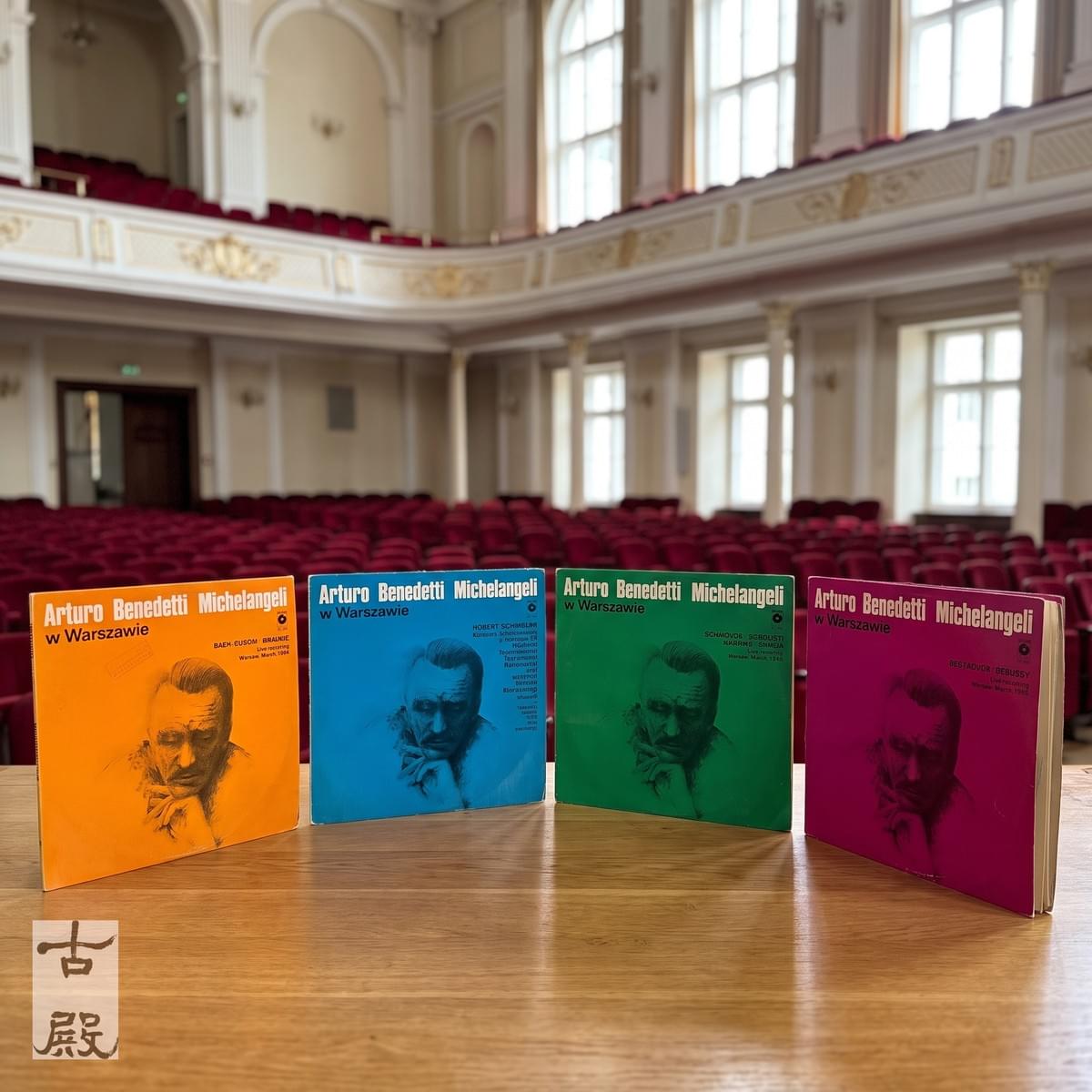
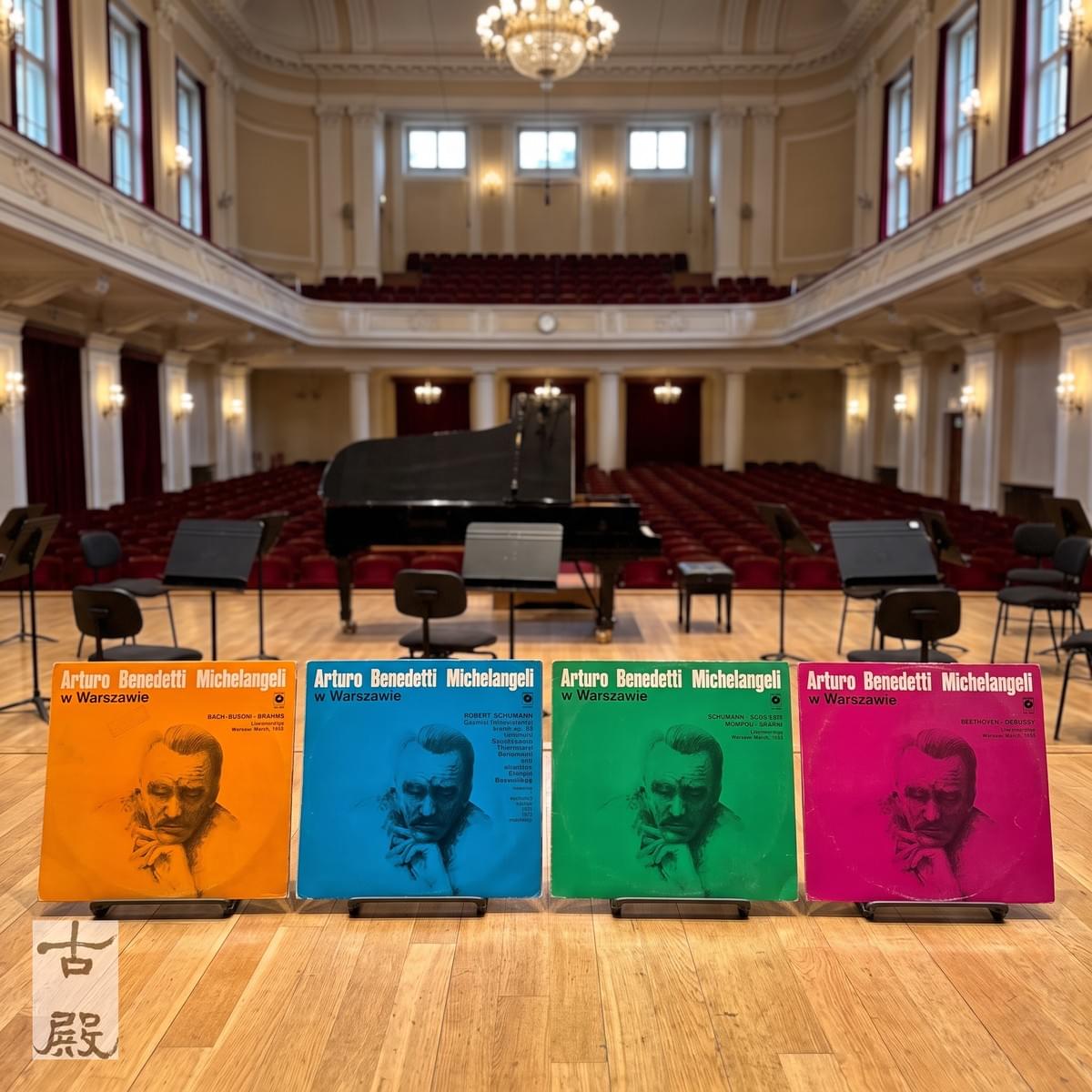
這一套四張單行版,正是把這段故事保存下來的四張唱片——波蘭 Polskie Nagrania Muza 廠牌於1980年發行的《米開蘭傑利在華沙》系列,橘、藍、綠、桃紅四色封面,同一幅米開蘭傑里垂首沉思的鉛筆素描肖像,只是套色不同。
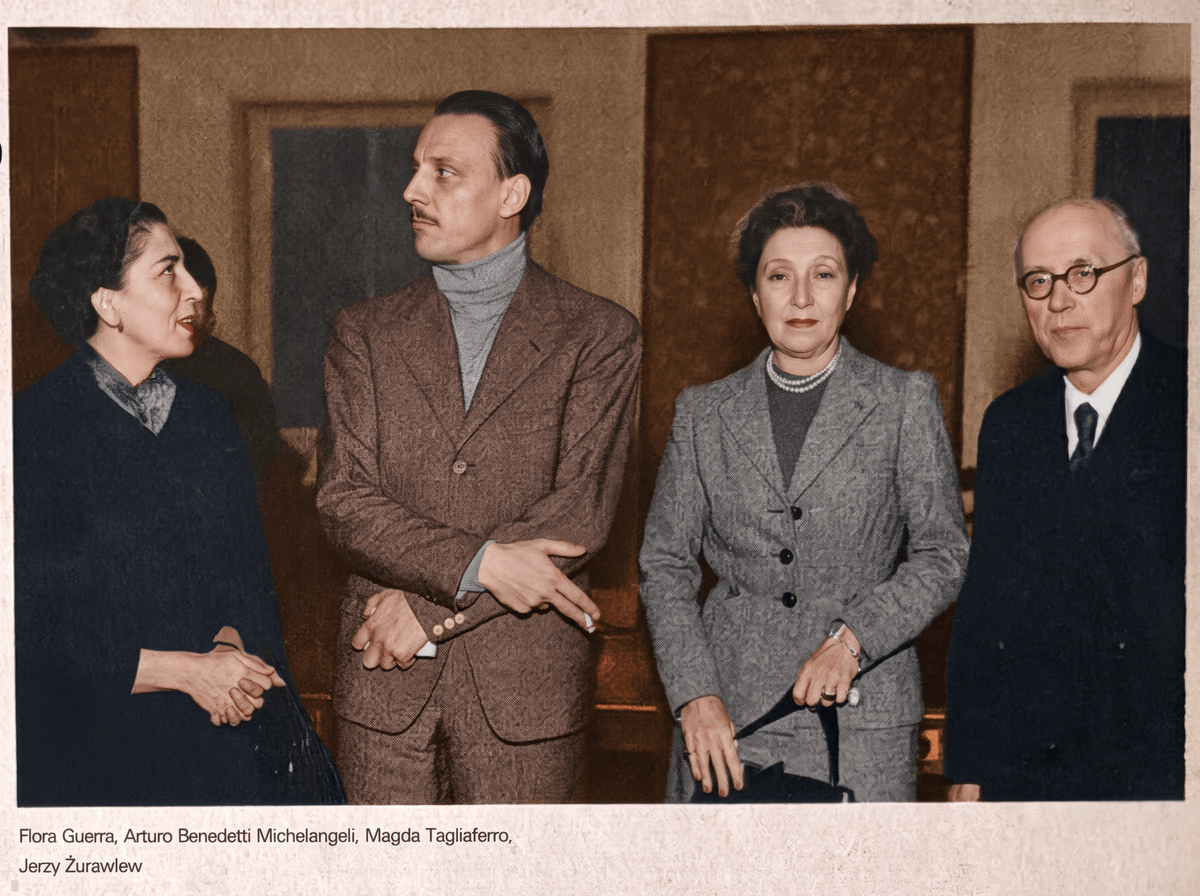
翻開封底,是同一張黑白照片——米開蘭傑利與另外幾位評審並肩而立。
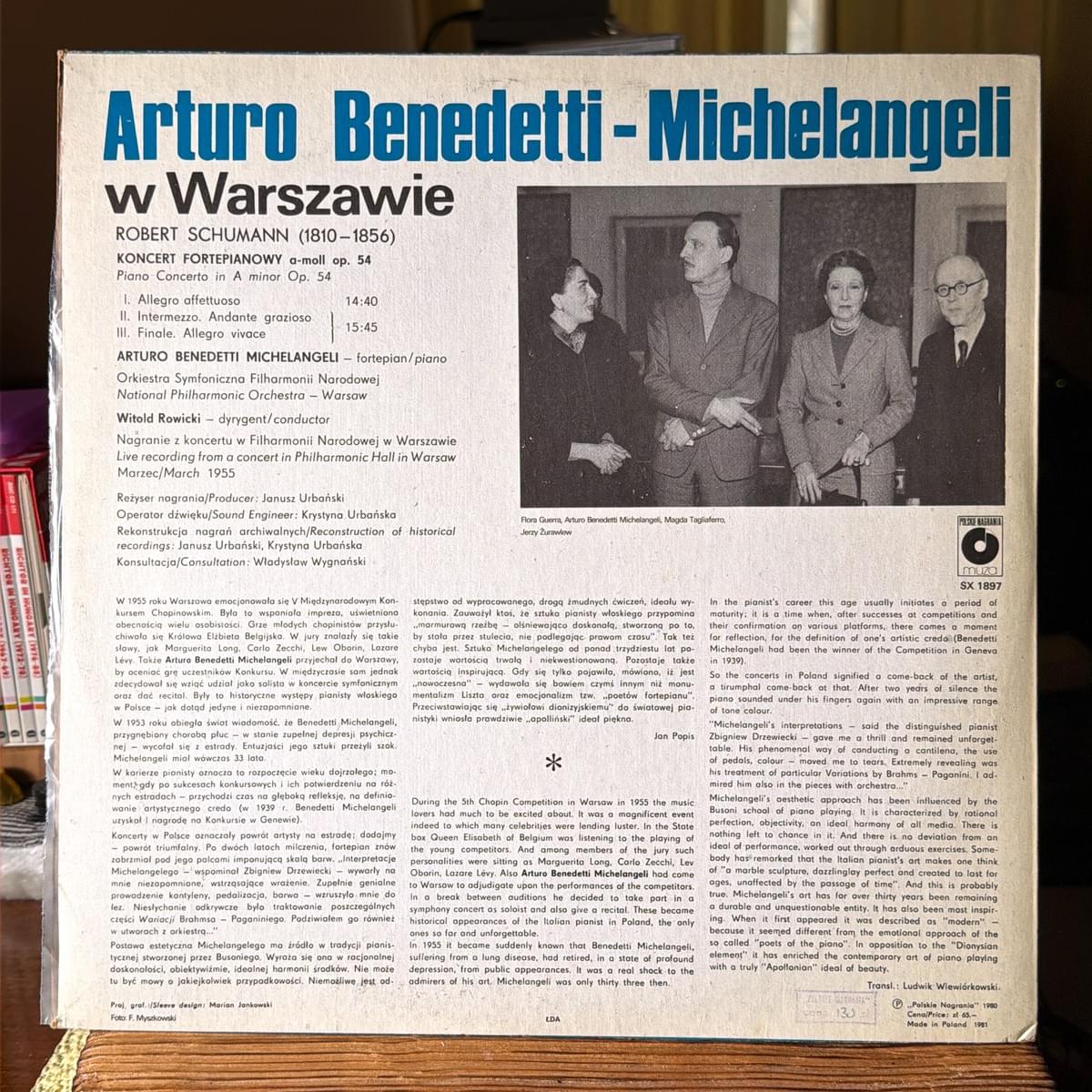
2 月 27 日那場協奏曲,與 3 月 13 日那場獨奏會,被完整收錄進這四張唱片——SX 1897 是協奏曲,SX 1898、1899、1900 是獨奏會的三個部分。
一張唱片能保存的,從來不只是聲音。它保存的,是一個人在特定時刻,用盡全力做出的每一個選擇——包括他推翻自己退隱宣告的選擇,也包括他辭去評審職務的選擇。
最後:
當時一個已經對全世界宣布「我不會再回來」的人,卻偏偏在毫無準備、身心都還在復原的狀態下,當下臨時決定要重新復出;明明可以安穩地坐在評審席上直到賽事結束,卻偏偏要為了一個素不相識的年輕人,賭上自己的名聲。
如果是你,你會為了自己認定「對」的事情,推翻自己已經說出口的話,付出這樣的代價嗎?
******
【Gudian Music Stories】He announced his retirement to the world, only to overturn his own decision from the jury box: Arturo Benedetti Michelangeli’s (1920-1995) 1955 Comeback Concert in Warsaw, Poland
In 1953, a piece of news sent shockwaves around the world: Arturo Benedetti Michelangeli (1920-1995), suffering from lung disease and deep psychological depression, officially announced his retirement from the stage.
Music lovers who revered his art were absolutely devastated, but they had no choice but to accept it. The world kept turning, the piano realm had lost a genius, and everyone slowly grew accustomed to this new reality.
Two years later, in March 1955, he traveled to Warsaw. But he went as a jury member, not as a performer. Even though he had laid down his performing career, the event organizers still thought of him and invited him to judge. At 35 years old, he was the youngest person on the panel.
A Grand Event That Captivated All of Europe
The 5th International Chopin Piano Competition was taking place in the newly rebuilt Warsaw National Philharmonic. This wasn't your average competition. Queen Elisabeth of Belgium attended in person, sitting in a box seat to listen to young pianists play Chopin. The jury gathered absolute titans: Marguerite Long (1874-1966) and Lazare Lévy (1882-1964) from the French school; Lev Oborin (1907-1974, also the gold medalist of the very first Chopin competition) from the Soviet school; and Carlo Zecchi (1903-1984) from the Italian school. At the height of the Cold War, musical authorities from both the East and the West sat together to score the event. Throughout the competition, 70 concerts and 80 recitals were held across Warsaw and neighboring cities. It was a true musical carnival.
Michelangeli sat right there among them.
He was the "youngest" on the panel. He would also become the "most controversial." After the competition results were announced, he would furiously resign from his post to defend the true genius he believed in, leaving the entire Warsaw music scene buzzing. But before all of that unfolded, something even more extraordinary happened: among all the esteemed judges present, he was the only one who stepped out and took the stage to perform himself.
Nobody Invited Him; It Was His Own Decision
Pianist and music producer Cord Garben (1943-) clearly wrote in his research: "When Michelangeli 'spontaneously' decided to perform on his rest days between his jury shifts, everyone was absolutely astonished."
In other words—his sole purpose for going to Warsaw was to be a judge. The performance was a spur-of-the-moment decision he made after arriving and starting his jury duties. This wasn't a carefully plotted comeback; it was a completely unorthodox move, arranged by no one.
A few details prove just how "spontaneous" this really was. His solo recital, originally scheduled for March 7th, had to be bumped to March 13th. Two days after his performance, local Polish newspapers were still reporting, "Michelangeli might play another concert, but the program is yet to be determined." There was even a completely unofficial "flash mob" performance down in Krakow, where massive crowds broke through police lines and squeezed into a movie theater just to hear him play Brahms one more time. Even the organizers and the media couldn't keep up with him.
There’s a contradiction here worth pausing to think about: a formal concert, especially one featuring a concerto and highly demanding solo pieces, usually requires weeks or even months of physical and mental preparation. It's not just about finger dexterity; memory, stage stamina, and mental readiness all need to be built up gradually. Yet, look at the pieces he chose. The Bach-Busoni Chaconne requires incredibly sustained structural control, and Brahms's Paganini Variations is easily one of the most technically punishing works in the entire piano repertoire. Neither of these can be pulled off by last-minute cramming.
The most reasonable explanation is this: his decision to perform was spontaneous, but these pieces were already woven deeply into his muscle memory from before his retirement. These were the monumental works of his entire performing life.
The Struggle Hidden Within His Body
No one will ever truly know what kind of hesitation Michelangeli wrestled with during those days on the jury. He never left behind a single word of explanation. The pianist, famously elusive in interviews, never spoke of this inner struggle.
But his body did the talking.
A Polish journalist present at the time described him walking onto the stage: "His pace was slow, as if exhausted, constantly wiping the sweat from his forehead with a handkerchief."
This wasn't some theatrical display of stage charisma. This was the physical trace of a body that had barely survived two years of sickness and psychological despair, now bearing the immense, crushing pressure of returning to the stage. That same record notes that "every performance consumed an enormous amount of his energy." What drained him, I suspect, wasn't just striking the keys, but the relentless, agonizing tug-of-war happening inside his own mind.
If you look at Michelangeli’s life as a whole, he would never allow himself to be in such a state during a concert. He was a perfectionist—he would either appear fully prepared, or he would simply cancel the show. This sudden decision to return in 1955 was a phenomenally rare exception in his life. He wanted to do it so badly, yet the abruptness of it all created a massive storm of pressure and conflict within him.
Yet, ultimately, he walked over to the piano bench, sat down, and played the very first note. That means, in that specific moment, some invisible force eclipsed his anxiety. We can't know for sure what that force was. Was it the frustration of sitting in the jury box hearing too many "not quite good enough" performances? Did the electric atmosphere of this rare gathering of Eastern and Western masters reignite an old fire in his soul? Or was it simply that a pianist hadn't truly felt alive for two years, and the primal urge to live again was, in the end, stronger than fear?
We don't have the definitive answer. But we do know that the force pulling him down onto that piano bench won!
A Triumphant Return
So, did he hold up? The answer is etched forever in the vinyl records.
On February 27th, he performed Schumann's Piano Concerto in A minor with Polish conductor Witold Rowicki and the newly founded Warsaw National Philharmonic Orchestra. On March 13th, he held a solo recital with a program spanning Bach-Busoni, Beethoven, Schumann, Scarlatti, Mompou, and Brahms.
The Polish pianist Zbigniew Drzewiecki (1890-1971), who was sitting in the audience, later recalled the performance: "It gave me an unforgettable, soul-shaking impression." He marveled at Michelangeli's handling of the singing melodies, and found his concerto performance just as breathtaking. This testimony comes from a fellow pianist who sat right next to him on the jury, giving it extraordinary weight—and it remains the only surviving first-hand account directly commenting on that concerto performance.
A man who hadn't performed publicly in two years, whose every show drained him immensely, stepped onto a stage graced by a Queen and judged by masters from the French, Soviet, and Italian schools—and delivered a performance that moved the pianists in the room to tears. And it wasn't just one performance; it was a concerto and a solo recital, back-to-back.
This is the true weight of the word "victory." It wasn't a victory of competition rankings or scores. It was a victory of a human being, in his most vulnerable state, fighting tooth and nail to reclaim control over his own body and his art.
His True Attitude, Hidden in the Repertoire
The fact that he "spontaneously decided to return" is dramatic enough, but that's only half the story. What's truly fascinating is what he chose to play.
Across two full concerts and eight different composers, Chopin appeared exactly once—the Waltz in E-flat major, Op. posth. 17—and that was an encore, not even on the official program. At a grand festival literally held in Chopin's name, in a city entirely devoted to celebrating Chopin, this was a rather glaring act of "non-cooperation."
It was customary for past Chopin Competition winners returning as judges to play a Chopin-centric concert for the festival. They were, after all, shaped by this competition; paying tribute with Chopin made perfect sense. But Michelangeli was never a product of the Chopin system. He won 7th place at the Elisabeth Competition in 1938 and 1st prize at the Geneva Competition in 1939—he had no ties to this competition's lineage. He was invited purely because he was universally recognized as an absolute heavyweight in the piano world.
Meaning, if he had chosen to play an all-Chopin program to play along with the festival, no one would have blinked. But choosing to play almost zero Chopin was perfectly in line with his stubbornly free spirit. Combine that with the fact that he was completely uninvited and unscripted to perform in the first place—so, what exactly did he play?
The Two Concert Programs:
First Concert: Concerto Performance (February 27, 1955) Robert Schumann — Piano Concerto in A minor, Op. 54 Performers: Arturo Benedetti Michelangeli (Piano) / Orkiestra Symfoniczna Filharmonii Narodowej (Warsaw National Philharmonic Orchestra) / Witold Rowicki (Conductor) → Featured on album SX 1897
Second Concert: Solo Recital (March 13, 1955)
Ludwig van Beethoven — Piano Sonata No. 3 in C major, Op. 2 No. 3
- Claude Debussy — Hommage à Rameau (Images, Book I) (7:05) → The above are featured on album SX 1898
Robert Schumann — Faschingsschwank aus Wien, Op. 26 ("Karnawał wiedeński")
- Domenico Scarlatti — Four Sonatas: Sonata in C minor, L. 352 Sonata in D minor, L. 413 Sonata in B minor, L. 442 Sonata in A major, L. 483
- Federico Mompou — Canción y Danza
- Fryderyk Chopin — Waltz in E-flat major, Op. posth. 17 (1827, Encore) (2:20) → The above are featured on album SX 1899
J. S. Bach – F. Busoni — Chaconne (from Partita No. 2 in D minor, BWV 1004)
- Johannes Brahms — Variations on a Theme of Paganini, Op. 35 → The above are featured on album SX 1900
The Most Fastidious Man Spared No One, Not Even His Collaborators
That Schumann concerto had a packed house, and the audience response was wildly enthusiastic. Logically, this should have been a beautiful, win-win collaboration.
But shortly after the performance, Michelangeli—acting in his capacity as a "judge"—formally submitted a letter of complaint to the Polish Minister of Culture and Art. He was protesting the orchestra's subpar accompaniment during the competition finals. Yes, he was filing a formal complaint against the very same conductor and orchestra he had just shared the stage with days prior, bathing in thunderous applause together.
This captures the very core of who Michelangeli was. The cruelty he aimed at himself was measured by the exact same ruler as the cruelty he aimed at the outside world. He wouldn't lower his musical standards just because he felt physically weak, and he certainly wouldn't sugarcoat his artistic judgments just because the orchestra had been his collaborators a few days ago.
This is exactly why Maurizio Pollini (1942-2024), who was once his student, said that Michelangeli represented "the absolute pinnacle of piano playing." It was precisely because of this uncompromising attitude of sacrifice, brutal self-discipline, and deep reverence for the art.
Gambling His Jury Seat for Someone He Believed Was Worth It
What gives this entire story its true, lasting gravity is the final decision he made when the competition came to a close.
Throughout the judging process, Michelangeli handed out shocking scores—threes, sixes—practically failing grades. The person he considered the one true genius of the bunch was a 17-year-old boy named Vladimir Ashkenazy (1937-). When the results were finally announced, Polish pianist Adam Harasiewicz (1932-) took first place, while Ashkenazy only got second. Michelangeli didn't just grumble in private. He protested by resigning from his jury duties right then and there.
This decision brought him absolutely zero benefit. He lost his prestigious jury status and successfully cemented a reputation for being "difficult" in the Polish music circle, practically ensuring they would never invite him back. But he did it anyway.
For him, it wasn't about not caring what people thought. It was that he only bowed to one standard of judgment: the standard of the art itself (which, naturally, stemmed from his own deeply held philosophy). Every other social norm—the expected etiquette of a judge, the pride of his collaborators, the political stance of the organizers—had to step aside when placed in front of this standard.
The Record in the Vinyl & Final Thoughts
This exa
ct story is preserved beautifully in a set of four single records. Released in 1980 by the Polish label Polskie Nagrania Muza, the Michelangeli in Warsaw series featured covers in orange, blue, green, and hot pink. All four bore the exact same pencil sketch of Michelangeli, his head bowed in deep thought, just in different colors.
Flip over to the back cover, and you see the same black-and-white photo: Michelangeli standing shoulder-to-shoulder with his fellow jury members.
That concerto on February 27th and the solo recital on March 13th were captured in their entirety across these four vinyls. SX 1897 holds the concerto, while SX 1898, 1899, and 1900 contain the three parts of his solo recital.
A vinyl record preserves so much more than just sound. It preserves every agonizing choice a human being made with all their might at a specific, fleeting moment in time—including his choice to tear up his own retirement declaration, and his choice to resign in fiery protest.
Think about it: Here was a man who had already told the world, "I will never return." Yet, in a state of total unpreparedness, while his body and mind were still healing, he made a split-second decision to come back. He could have comfortably sat in that jury box, collected his honorarium, and gone home. Instead, he chose to gamble his position and reputation for a young, unfamiliar pianist.
If it were you, would you be willing to pay such a heavy price, and overturn your own words, just to stand up for what you believed was truly "right"?